Sunday, January 6, 2019

Saudi woman who 'fled abusive family' fears she will be killed if she returns as she is held at Bangkok airport

A Saudi woman held at Bangkok airport said she would be killed if she was repatriated by Thai immigration officials, who confirmed the 18-year-old was denied entry to the country on Sunday.
The incident comes against the backdrop of intense scrutiny on Saudi Arabia over its investigation and handling of the shocking murder of journalist Jamal Khashoggi last year, which has renewed criticism of the kingdom's rights record.
Rahaf Mohammed M Alqunun told AFP she was stopped by Saudi and Kuwaiti officials when she arrived in Suvarnabhumi airport and her travel document was forcibly taken from her, a claim backed by Human Rights Watch.
"They took my passport," she told AFP, adding that her male guardian had reported her for traveling "without his permission".
Rahaf said she was trying to flee her family, who subjected her to physical and psychological abuse.
"My family is strict and locked me in a room for six months just for cutting my hair," she said, adding that she is certain she will be imprisoned if she is sent back.
"I'm sure 100 percent they will kill me as soon as I get out of the Saudi jail," she said, adding that she was "scared" and "losing hope".
Rahaf was stopped from entering Thailand when she flew in from Kuwait on Sunday, Thailand's immigration chief Surachate Hakparn told AFP.
"She had no further documents such as return ticket or money," he said, adding that Rahaf was currently in an airport hotel.
"She ran away from her family to avoid marriage and she is concerned she may be in trouble returning to Saudi Arabia. We sent officials to take care of her now," he said.
He added that Thai authorities had contacted the "Saudi Arabia embassy to coordinate".
But Rahaf disputed his account, saying that she was only in transit to seek asylum in Australia, where she claimed to have a visa, and was accosted by Saudi and Kuwaiti embassy representatives when she deplaned in Suvarnabhumi airport.
She took to Twitter to plead her case, livestreaming a video where she spoke about how her father had told Saudi embassy officials she was a "psychiatric patient" who had to be returned.
Human Rights Watch Asia deputy director Phil Robertson slammed the Thai authorities and urged the UN refugee agency to help the teenager.
"What country allows diplomats to wander around the closed section of the airport and seize the passports of the passengers?" he said, adding that there is "impunity" within the family unit in Saudi Arabia to abuse women.
Immigration head Surachate said Rahaf would be sent back to Saudi Arabia by Monday morning.
"It's a family problem," he said of the case.
The ultra-conservative kingdom has long been criticised for imposing some of the world's toughest restrictions on women.
That includes a guardianship system that allows men to exercise arbitrary authority to make decisions on behalf of their female relatives.
If punished for "moral" crimes, they could become victims of further violence in "honour killings" at the hands of their families, activists say.
https://www.telegraph.co.uk/news/2019/01/06/saudi-woman-says-fled-abusive-family-fears-will-killed-returns/

Saudi Woman Who Tried to Flee Family Says, ‘They Will Kill Me’


    A young Saudi woman who wanted to assert her independence slipped away from her family during a holiday in Kuwait last week and boarded a plane for Thailand.
    Rahaf Mohammed Alqunun, 18, said that her family was abusive and that she hoped to seek asylum in Australia.
    But when she got off the plane in Bangkok, she said, a man was waiting, her name written on a placard. He said he would help her get a Thai visa, and disappeared with her passport.
    Instead, Ms. Alqunun said, the man came back with other men she believes were Thai security officers and a representative of Kuwait Airlines. They said that her family had filed a missing persons report about her — and that she had to return to Kuwait on a flight late Monday morning.
    Ms. Alqunun said she feared for her life if she is forced to go back to her family.
    “They will kill me,” she said by telephone Sunday evening from a hotel at Bangkok’s Suvarnabhumi Airport, where she was being kept overnight. “I am detained,” Ms. Alqunun said. “I can’t even go out of the hotel.”
    Human rights advocates urged the Thai government to allow Ms. Alqunun to continue on her journey to Australia or to seek asylum in Thailand. They called on the United Nations Refugee Agency to help her.
    “Saudi women fleeing their families can face severe violence from relatives, deprivation of liberty, and other serious harm if returned against their will,” said Michael Page, the deputy Middle East director at Human Rights Watch. “Thai authorities should immediately halt any deportation.”
    Thailand has a history of sending refugees back to autocratic countries, including China, Pakistan and Turkey, said the deputy Asia director for Human Rights Watch, Phil Robertson.
    In November, the Thai authorities arrested a former Bahrain soccer player, Hakeem al-Araibi, who had been granted refugee status in Australia after speaking out against a powerful Bahraini soccer official.
    Mr. Araibi had come to Thailand for his honeymoon but was stopped at the same Bangkok airport as Ms. Alqunun after Bahrain sought his arrest through Interpol. He remains in custody, awaiting a decision on Bahrain’s extradition request. “Basically, Thailand is open for business sending refugees and asylum seekers back to their authoritarian governments,” Mr. Robertson said. In the interview, Ms. Alqunun described a life of unrelenting abuse at the hands of her family, who live in the city of Hail, in northern Saudi Arabia. She said she was once locked in a room for six months because she had cut her hair in a way that her family did not approve of. And she said her family used to beat her, mostly her brother. Saudi Arabia, Ms. Alqunun said, is “like a prison.”
    “I can’t make my own decisions,” she said. “Even about my own hair I can’t make decisions.”
    Ms. Alqunun said that when she was 16, she tried to kill herself. When her family did not seek help for her, she said, she started planning her escape.
    Even at age 18, though, Ms. Alqunun could not simply leave Saudi Arabia on her own. Women in the kingdom need the approval of a “male guardian” to travel, usually a father, husband or even a son.
    Her chance for freedom came on Wednesday, when her family took a trip to Kuwait, which does not have the same restrictions on women. On Saturday, she caught the plane to Thailand, where she had reserved a hotel and an outbound flight.
    Her plan was to stay there until she could leave for Australia, where she was supposed to meet a woman she described as “a Saudi refugee” who would help her.
    Maj. Gen. Surachate Hakparn, the head of Thailand’s immigration agency, said Ms. Alqunun had been denied a visa to enter Thailand because she did not have sufficient money. She also lacked the necessary documents to gain entry to the country or continue on to Australia, he said.
    “She left her original country due to a family issue and came to Thailand,” General Hakparn said in an interview. “She’s safe. Her passport wasn’t confiscated.”
    He said Ms. Alqunun would be put on the flight back to Kuwait accompanied by Thai immigration officers.
    Saudi Arabia’s ambassador to Bangkok, Abdul-Ilah al-Shuaibi, issued a statement asserting that Ms. Alqunun had been arrested at the airport for violating Thai laws, which was not the case. He said the embassy did not have the authority to stop her at the airport. In a similar case in 2017, a Saudi woman, Dina Ali Lasloom, was forced to return to her family in Saudi Arabia while in transit in the Philippines on her way to Australia.
    Ms. Alqunun said it appeared that the Saudis and Thai officials were working together. At one point, she said, she was required to sign documents written in Thai that she did not understand. She said her passport had been returned to her but was later taken again and handed over to Kuwait Airways to help ensure that she boarded her return flight.
    If she is returned to Saudi Arabia, Ms. Alqunun could face criminal charges of parental disobedience or harming the reputation of the kingdom, Human Rights Watch said.
    Saudi Arabian men consider themselves guardians of their families’ honor and often punish family members, especially girls and women, who are said to have brought dishonor on the family. In extreme cases, the family members are killed. Ms. Alqunun said she was particularly concerned about what her family might do to her because in describing her plight on Twitter, she renounced religion. “They will kill me because I fled and because I announced my atheism,” she said. “They wanted me to pray and to wear a veil, and I didn’t want to.”
    Ms. Alqunun posted reports and videos on Twitter in a bid to build support. “I’m the girl who run away from Kuwait to Thailand,” she wrote in one post in English. “I’m in real danger because the Saudi embassy trying to forcing me to go back to Saudi Arabia, while I’m at the airport waiting for my second flight.” On Sunday, she was still hoping to make it to Australia.
    “I want to be protected in a country that will give me my rights,” she said, “and allow me to live a normal life.”

    Music Video - Lokan do do yaar banaye - Afshan Zebi

    Music Video - Benjamin Sisters .:. Gari ko chalana babu zara halke halke

    Music Video - Mera Laung Gawacha by Musarrat Nazir

    Music Video - O Lal Meri Pat Rakheyo - Runa Laila

    VIDEO - #PPP Chairman Bilawal Bhutto's Media Talk in #Lahore - 06 Jan 2019

    #Pakistan - #PPP - Incarcerate my entire family but I won’t compromise on Constitution: Bilawal

    Pakistan Peoples Party (PPP) Chairman Bilawal Bhutto on Sunday said that the party will not compromise on the Constitution and the 18th Amendment, even if his whole family is put in jail.


    Speaking with media, Bilawal said the “grand plan” behind the joint investigation team in the fake accounts case is to eventually force PPP to withdraw support for the historic amendment.
    Bilawal said that the aim behind this is political engineering.
    “They want to use courts for political engineering. If I expose them, their politics of vendetta, and their grand plan against 18th amendment, our opponents start complaining…,” he said.
    Responding to a question as to why PPP fails to answer fake accounts accusations against party co-chairman Zardari, Bilawal said that since it is a legal matter PPP is continuing to respond in courts. “We are responding to [only] political attacks in media.”
    He further said Zardari, who was a former president, has submitted his reply before the JIT too but that its report failed to include it, adding that efforts are being made to not only misguide masses but also courts.
    Slamming the government, Bilawal said that the Pakistan Tehreek-e-Insaf is aware that it can’t win election without rigging so it is trying to get rid of opponents through backdoor.
    Commenting on efforts to unite opposition, he said that PPP aims at doing issue-based politics and intends to unite opposition on such issues.
    "I don't think efforts are being made at this time for a grand alliance," he added.
    https://www.geo.tv/latest/224294-incarcerate-my-whole-family-but-i-wont-compromise-on-constitution-bilawal

    #Pakistan - Who controls the exit list


    By Shahzada Irfan Ahmed / Shehryar Warraich

    The inclusion of 172 names has exposed the many anomalies in the ECL law and procedure which is considered biased, discriminatory and violation of the constitutional and human rights of Pakistani citizens.
    The recent inclusion of 172 names in the Exit Control List (ECL) on the insistence of a Joint Investigation Team (JIT) looking into some fake accounts cases has generated intense heat and led to criticism from different quarters. This was done in one go and reportedly without stating sufficient reason for every individual in the list.
    The Chief Justice of Pakistan (CJP) took notice and asked the federal government to review this decision, terming it akin to overstepping the legal ambit. He questioned the federal government as to how the name of the Sindh Chief Minister Murad Ali Shah, who was heading the second biggest province of the country, could be put on the same list. Besides, the inclusion of these names just on the basis of a report was also questioned.
    The said action by the court has, in fact, given a stimulus to an already initiated debate on how to check the discretionary powers of the federal government or the interior ministry to put people’s name on the ECL. The law still followed in this respect is The Exit From Pakistan (Control) Ordinance 1981, promulgated by General Ziaul Haq around 38 years ago.
    The law is termed oppressive, that is why the sitting Senate Committee on Interior has suggested some amendments in it so that it cannot be used to target political and other opponents.
    Though the 1981 Ordinance has remained intact so far, some procedural changes in rules were made in the past. For example, during the term of former interior minister Chaudhry Nisar Ali Khan, the interior minister was allowed to put names of terrorists, members of proscribed organisations and those requested by security organisations, on the ECL. Later on, the minister changed the policy and established a committee under the interior ministry to decide whether a person’s name should be placed on ECL or not.
    However, during the term of his successor Ahsan Iqbal, a new procedure was adopted according to which the federal cabinet undertook up the task of putting names on the ECL. It is assumed it was also in the light of an SCP order in 2016 that the outgoing PML-N government had abolished the committee of the interior ministry and withdrawn its powers.
    Despite such attempts, it is still believed by many that the procedure followed to put people’s names on the ECL is biased, discriminatory, without any judicial oversight and is violative of the constitutional and human rights of citizens.
    Former Interior Minister Faisal Saleh Hayat calls these steps cosmetic and says the democratic forces should have brought foundational changes in the ECL structure. “Primarily, the 1981 ordinance was promulgated with a declared purpose to counter criminals and anti-state elements. However, General Ziaul Haq used it to smear politicians.”
    “If, while making an order under sub-section (1) it appears to the Federal Government that it will not be in the public interest to specify the ground on which the order is proposed to be made, it shall not be necessary for the Federal Government to specify such grounds.”
    “Unfortunately, the same method was adopted by successive governments, though they introduced some changes in the procedures,” he adds.
    Hayat sees inclusion of 172 names in ECL on somebody’s whims. “The government has violated the fundamental rights of the citizens by curtailing their right of mobility just on the basis of suspicion.”
    Under the 1981 Ordinance, under Article 2, sub-section 3 of this law, it is not necessary for the federal government to share the reason(s) why it is putting a person’s name on the ECL. The said clause states: “If, while making an order under sub-section (1) it appears to the Federal Government that it will not be in the public interest to specify the ground on which the order is proposed to be made, it shall not be necessary for the Federal Government to specify such grounds.”
    The Senate Committee on Interior has recommended doing away with this clause and making it compulsory to give reason why a name has been put on the ECL. Its other recommendations include informing the affected individuals within 24 hours about their names being put on the ECL, giving them the right to file a review of the decision within 15 days, and if there is no decision on the review in this time, the names should be removed immediately from the list.
    Former Secretary Supreme Court Bar Aftab Bajwa, however, is in favour of the 1981 Ordinance, but wants to make an addition. He thinks that apart from Interior Ministry, security agencies, district heads of civil administration and law enforcing agencies, “judges [of high courts] should have this authority to put anybody’s name on the ECL if they have solid reasons to do so”.
    He is of the view that putting 172 people on the ECL by the federal cabinet is as per the law of the land. That is why, he says, “even the honourable CJP does not have the right to revoke such a decision unless a bench of at least three judges hears the case and asks to remove the names from the ECL”. For this very reason, Bajwa says, the CJP referred the case to the federal cabinet for review.
    Bajwa shares that “different countries have laws on not permitting any person to go abroad for reasons like involvement in corruption, misuse of power, causing loss to government’s funds or property; economic crimes, acts of terrorism or involvement in conspiracies in these areas, heinous crimes, a threat to national security and so on”. Besides, probationers and parolees are prohibited from leaving without the permission of concerned officers
    In India, there have been incidents where courts have asked the accused to submit passports at the time of bail. In the UK, the passport office takes such a step if there is a court order to do so.
    Advocate Sardar Asif Ali Sial says no doubt states have such laws and there is nothing wrong with these if they follow certain principles like those mentioned in the International Covenant on Civil and Political Rights (ICCPR). “The ICCPR,” he says, “permits states to place restrictions on people’s right to leave provided these are lawful, imposed with the objective to maintain public order and meant to protect public health or morals or the rights and freedoms of others.
    “It has also been made clear that such restrictions must be imposed according to a precise criteria and those charged with their execution must not have any discretionary powers. This is what’s exactly needed in our country.”

    PERSPECTIVES - Why I defended Asia Bibi in #Pakistan

    Asia Bibi spent Christmas in a safe house in Islamabad, Pakistan. I hope that’s the last time my client, a Catholic, must spend the holiday unable to live and worship in freedom.
    Two months ago, a three- justice panel of the Pakistani Supreme Court overturned her 2010 conviction and death sentence for blaspheming.
    Protests by religious hardliners over the possibility that she would be allowed to leave Pakistan prompted the government to bar her, at least temporarily, from departing.
    Prime Minister Imran Khan’s government appears determined to ensure the safety of Asia and her husband, Ashiq Masih, and the couple’s two daughters, until another country agrees to take them in. Canada is their most likely destination. Asia was still in prison, not in the courtroom, when the decision was handed down on October 31. Enraged protesters poured into the streets in several Pakistani cities.
    Police escorted me from the courthouse, and I spent three days in hiding, aided by friends in the diplomatic community, before I boarded a flight for the Netherlands still wearing my Pakistani lawyer’s uniform of a black suit and white shirt.
    I had insisted I wouldn’t leave without Asia, but my friends swore they would take good care of her. It was my life they feared for at that moment.
    My last meeting with Asia had taken place on October 10 at the women’s prison in Multan, about 400 kilometres from my home in the eastern city of Lahore, where she had been incarcerated for the past five years.
    Protests by religious hardliners over the possibility that she would be allowed to leave Pakistan prompted the government to bar her, at least temporarily, from departing.
    Death row
    Contrary to reports of her terrible treatment in prison, Asia seemed to have found a quiet life of sisterhood with her guards, who allowed her a television set and more time outside her cell than usually granted to death-row inmates.
    The relatively benign treatment might have resulted from pressure by Western governments, but I sensed it was because the guards recognised Asia’s bravery and human spirit.
    Asia is not a sophisticated person. She was born 47 years ago to a poor family in a dusty farming village in the Punjab province and never sat in a classroom for a single day of her life.
    But she was helped by her strong religious faith when she ran afoul of blasphemy laws often exploited by religious extremists and ordinary Pakistanis to settle personal scores.
    She was working on a berry farm in June 2009 with several Muslim women when a dispute broke out because Asia had filled a jug of water for her co- workers.
    The women refused to drink water from a utensil touched by a choorhi, a derogatory word for a Christian. Apparently incensed that a lowly Christian woman had argued with them, two of the women who later appeared as witnesses in the case said Asia had insulted the Prophet Mohammad (PBUH) and the Quran.
    Local clerics began denouncing her. An enraged mob beat her and dragged her to a police station, saying she had confessed to blasphemy.
    Asia was sentenced to death by a district court in 2010. She had legal representation in name only, because competent lawyers often fear to take on blasphemy cases.
    At least 70 people, including defendants, lawyers and judges, have been killed by vigilantes or lynch mobs since blasphemy laws were strengthened in the 1980s under the military dictator Gen. Mohammed Zia ul-Haq.
    Judges bullied
    A lawyers group that offers free legal advice to complainants is known to pack courtrooms with clerics and raucous supporters who try to bully judges into handing out convictions.
    In 2011, Salman Taseer, the prominent governor of Punjab and a critic of the blasphemy laws who had visited Asia in prison and promised to lobby for her pardon, was assassinated by one of his own bodyguards.
    A few months later, Shahbaz Bhatti, a Christian and a Cabinet minister for minorities who had also spoken up for Asia, was murdered. I took on Asia’s case in 2014.
    I’m a lawyer, and I do not want to see anyone falsely convicted of a crime, much less hanged for it.
    The Supreme Court granted a petition to appeal her case, and in 2015 the death sentence was suspended. In October, I was notified that the final appeal would be heard. The justices’ ruling for Asia, citing insufficient evidence, took great courage.
    I think I will have to stay away from Pakistan for at least two years before it will be safe to return. Until then, I will live with friends in the Netherlands or with my daughter in Britain. But I yearn to return home to continue defending victims of the blasphemy laws.
    Asia had rarely ventured far from her village before being imprisoned, so beginning a new life in another country would be a challenge for her.
    But she has shown remarkable strength throughout this ordeal, and I am confident that she will succeed.

    #Pakistan - Benazir entrusted me with the nation's responsibility: Zardari

    Pakistan Peoples Party (PPP) Co-chairman Asif Ali Zardari claimed on Sunday that Benazir Bhutto entrusted him with the responsibility of the nation and that former prime minister’s government was ‘taken away’ from her.
    Addressing the media in Badin, he said that PPP supporters voted them into the power because they trusted them. He further reassured the workers that PPP’s war against the government shall continue. Zardari further commented that PPP always accounts for low socio-economic groups first. “We aren’t scared no matter how many cases are hashed against us,” the PPP stalwart said.
    Addressing the rally, Sindh Chief Minister Murad Ali Shah promised the nation to continue serving. “The conspiracies hatched by the government against the PPP shall fail,” he said.
    On January 5, party co-chairman Bilawal Bhutto-Zardari reiterated that the July 25 general elections were rigged. He said that “who will hold accountable the manipulators who have stolen the votes of people”.

    https://tribune.com.pk/story/1882648/1-benazir-entrusted-nations-responsibility-zardari/

    #Pakistan - 'Fake accounts JIT being used as a tool for political victimisation': Zardari replies to probe report in SC

     Haseeb Bhatti

    Former president Asif Ali Zardari on Sunday denied all the claims made about the Zardari Group in a joint investigation team (JIT) report submitted to the Supreme Court in an ongoing case pertaining to alleged money laundering of billions of rupees through fake bank accounts.

    The apex court last year took suo motu notice of a delay into a 2015 Federal Investigation Agency (FIA) probe into the fake bank accounts. Several bigwigs, including Zardari, his sister Faryal Talpur, former president of Summit Bank Hussain Lawai and Omni Group's Anwar Majeed, have been nominated in the case. Property tycoon Malik Riaz, his son-in-law Zain, Sindh Chief Minister Murad Ali Shah and PPP Chairman Bilawal Bhutto-Zardari have also been included in the probe.
    The fresh JIT probing the matter told the SC earlier that a close nexus had been found between a troika of the Zardari Group, Omni Group and Bahria Town. The JIT report revealed that at least 29 bank accounts identified as fake had been used for money laundering of Rs42 billion.
    The two groups, the JIT alleged in its fresh report, had amassed assets through misappropriation of loans, government funds, kickbacks and proceeds of crime.
    The top court subsequently ordered the Zardari Group, Omni Group, Bahria Town, Faryal Talpur and others, including contractors/builders, to file their comments on the JIT report.
    In a 17-page-long written reply submitted in the SC today, former president Zardari said that he had not done anything wrong.
    "The statements recorded by witnesses and the documents [accompanying them] were not provided to us," the reply stated.
    "The JIT is being used as a means for political victimisation," it said, adding that to accuse someone without showing them the evidence is against Article 10A of the Constitution (Right to a fair trial).In his reply, the PPP co-chairman requested the court to dismiss the JIT's reports, contending that the leaking of the second JIT report prior to its submission in court is against the sanctity of the court.The reply also argued that the JIT is being used as an instrument by the Pakistan Tehreek-i-Insaf (PTI) government to humiliate Zardari and Talpur.According to the reply, the JIT does not have the right to suggest that the matter should be sent to the National Accountability Bureau, and if the court orders the move upon the JIT's suggestion, it will also be against Article 10A.
    The JIT report
    In the fresh report, the JIT contended that prima facie evidence brought to the record during investigations clearly indicated that the Zardari and Omni groups, which started with a paid-up capital of Rs600 in 1981 and Rs6,000 in 2001, respectively, had amassed assets through misappropriation of loans, government funds, kickbacks and proceeds of crime.The evidence suggested, it said, that the groups had a history of laundering their illegal proceeds abroad through illegal channels of Hundi and Hawala.The report highlighted that the International Business and Shopping Centre (IBSC) project identified by the JIT to be a “Benami” of Asif Zardari held in the name of his then front man Iqbal Memon (International Builders) was frozen in 1998. Later when Iqbal Memon got exposed and left the country for Canada, the property changed hands in 2000 through AR Developers of Nasir Jamal and ultimately came back in 2008 to be held by Zardari, this time through Park Lane Pvt Ltd.The report requested the apex court to order freezing of the assets of both groups held through different subsidiary and front companies and those held in the name of their directors, pending the final adjudication by the accountability courts, lest the "money laundering cartel" shift its assets abroad.
    In its first report, the JIT had mentioned a transfer of Rs357 million from 12 fake accounts into the accounts of Ms Parthenon. It transpired that Ms Parthenon was a front company of M/s Park Lane since it had no independent business of its own when it entered into a joint venture with Park Lane.
    Similarly, Plots C5 and 6, Clifton, Karachi, where Bahria Icon Towers has been constructed, were identified and frozen in 1998 as "Benami" of Asif Zardari held in the name of Galaxy Construction owned by his then front man Saleem Akhter. This property again come back to be held by Zardari through Galaxy Construction owned by his present frontman Dr Dinshaw Hoshang Ankleseria.
    The JIT had recommended that the apex court should also order the Securities and Exchange Commission of Pakistan not to change the ownership through the change of directors of any of the companies holding the assets in question.
    The report also mentioned different assets owned by the Zardari Group like Opal 225 Saddar, Karachi, IBSC Saddar of Park Lane, different farm houses in Tando Allahyar and Nawabshah, a set of some houses in Clifton called Bilawal House, agricultural land, different properties owned by Faryal Talpur, different vehicles of Asif Zardari that belonged to Tosha Khana, including bullet proof vehicles BMW 760, Lexus 570 and Mitsubishi SUV, and assets in foreign countries known to be held by Asif Zardari and Faryal Talpur.
    Likewise the assets owned by the Omni Group and its directors included 16 sugar mills in different districts of Sindh, 19 power generation companies, agriculture farms, real estate and agriculture land, vehicles and bank accounts, the report said.

    Saturday, January 5, 2019

    #PPP Music - kitne maqbool hain Bhutto - #HappyBirthdaySZAB 🎂🎂💖🌷

    Documentary - Zulfiqar Ali Bhutto - #HappyBirthdaySZAB #BhuttosAwaitJustice #SZAB #HappyBirthdaySZAB 🎂🎂💖🌷

    Video Documentary - Z A Bhutto - Video - #HappyBirthdaySZAB #BhuttosAwaitJustice #SZAB #HappyBirthdaySZAB 🎂🎂💖🌷

    Video - #HappyBirthdaySZAB #BhuttosAwaitJustice #SZAB #HappyBirthdaySZAB 🎂🎂💖🌷 Zulfiqar Ali Bhutto

    Video - #SZAB #HappyBirthdaySZAB - Speeches of Zulfikar Ali Bhutto

    #HappyBirthdaySZAB #BhuttosAwaitJustice #SZAB #HappyBirthdaySZAB 🎂🎂💖🌷 A tribute to “Quaid-e-Awam” Z.A Bhutto


    By: Nazia Memon

    It’s been 38 years but every year 4th of April tells a different story as Garhi Khuda Bux and Larkana wear a dark chaddar of sorrow to mourn and remember once again their most distinguished leader “Qaid-e-Awam” Zulfikar Ali Bhutto, Widely venerated by the mass of ordinary people.
    Zulfikar Ali Bhutto was born at Larkana in the province of Sindh on January 5, 1928. On his 51st -birthday he was in the death cell of Rawalpindi gaol, Z.A Bhutto have refused to compromise on his principles even when face to face with the gallows. More than three decades on, millions of Pakistanis still mourn the fate of Shaheed Zulfikar Ali Bhutto.
    Z.A Bhutto, 51, who had been Pakistan’s leader since 1973, was deposed in an army coup in 1977.
    In 1977 during his services as a prime minister, General Zia-ul-Haq his political opponent accused him of rigging an election and staged a coup. Later Zia imprisoned Zulfiqar Ali Bhutto on charges of murdering another political rival.
    He was sentenced to death for the murder of a political opponent following a trial which was widely condemned as unfair.
    The appeal process was also tainted by allegations of bias on the part of some judges.
    Despite international calls for clemency, the Pakistani authority carried out a barbaric act, no advance warning of the execution had been given.
    If I look back in the window of political history of Pakistan and so particularly about the first democratically elected Prime-minister, I have got these following facts about him.
    Zulfikar Ali Bhutto lacked far nothing as a child. His family was rich and influential. His education was rounded off in the United States and Britain: he graduated in political science from the University of California at Berkeley in 1950, and later studied at Christ Church, Oxford. There he was awarded MA honors with distinction in jurisprudence in 1952, and became a barrister at law in Lincoln’s Inn, London. Later Bhutto went to lecture in international law at the University of Southampton – the first Asian to teach there. When he returned to Pakistan, Z.A Bhutto kept his legal work briefly but soon became entangled in politics.
    He was a politician who broke away from the gentlemanly cabals of wealthy landowners and bureaucrats who had previously ruled Pakistan between military dictatorships.
    Bhutto resigned from the cabinet in June 1966. He was highly critical of the Tashkent agreement between Pakistan President Ayub Khan and Indian Prime Minister Lal Bahadur Shastri in the aftermath of 1965 Indo-Pak war.
    In 1967, he established Pakistan People’s Party, along with Dr. Mubashir Hassan, J.A. Rahim and Basit Jehangir Sheikh. The party became a part of the pro-democratic movement and denounced Ayub Khan’s regime as a dictatorship, demanding his resignation.
    Bhutto brought power to the people, campaigning in a western style. He exchanged his Savile Row suits and silk handkerchiefs for baggy trousers and long shirts.
    It was his strong personality clubbed with his aggressive nature and immense determination that made him the country’s greatest civilian leader, with him dominating almost the entire decade of the 70s.
    In 1970’s general elections Awami league won a majority of seats in East Pakistan and PPP won a majority of seats in West Pakistan, the two parties were unable to agree on a new constitution in particular on the issue of “Six point movement” which many in West Pakistan saw as a way to break up the country.
    Bhutto was handed over the presidency in December 1971 and emergency rule was imposed.
    People continue to position SZAB till today as the real villain in a drama where the entire responsibility of the separation of East Pakistan and the creation of Bangladesh is laid at his door.
    Recognition of Bangladesh was a thorny issue as Pakistan was caught between pressure to recognize against domestic public opinion, which was virulently opposed on the one hand; and the looming threat by Mujeeb ur Rehman to carry out war crimes against the POW’s on the other. Added to this was India’s insistence on making the release of the POWs and Pakistan’s captured territory contingent upon recognizing Bangladesh, and satisfying all her mounting and unreasonable demands. It was a diplomatic tight rope, which called for unprecedented political dexterity. Muhtarma Benazir Bhutto stated in “Bhutto’s vision of Pakistan” that there were those who, forgetting that a Military dictator was at the helm of affairs of the State, unkindly accused Prime Minister Zulfikar Ali Bhutto Shaheed of thwarting the rule of the majority and creating the conditions for the breakup of Pakistan.
    When Bhutto set about rebuilding Pakistan, he stated his intention was to ‘rebuild confidence and rebuild hope for the future” by July 1972, Bhutto had recovered 93,000 prisoners of war 5,000 square miles of Indian-held territory after signing the Simla Agreement.
    Bhutto significantly transformed Pakistan’s hitherto pro-West foreign policy once he has got the power.
    Benazir Bhutto has written in “Bhutto’s vision of Pakistan” that Prime Minister Zulfikar Ali Bhutto Shaheed moved with amazing alacrity in all directions.
    In line with the PPP manifesto, agricultural reforms were brought in and lands distributed amongst the landless peasants. Labor unions were allowed and minimum wage for labor was fixed. Owing to a near economic collapse faced by the country, currency devaluation became necessary. It was a very difficult decision but decision was taken and the currency devalued.
    Prime Minister Zulfikar Ali Bhutto Shaheed’s politics and diplomacy was based on what he termed as “the total sweep of history”.
    He was the architect of bilateralism, which he propounded as the only effective mode of conduct among nations in a bipolar world where the competing interest of the super powers could easily influence and cloud relations between nations. Prime Minister Zulfikar Ali Bhutto Shaheed perused a fiercely independent foreign policy, always keeping Pakistan’s national interest foremost in consideration.
    He was the protagonist of flexibility in politics and was not tied to any fixed prejudices. “The dogmas, the theories and the script stand outside the gates of history”, Z.A Bhutto once wrote I am guiding you to seek truth from the facts of the historical conditions of our society and to identify the problems. The correct solutions will come with the correct identification of the problems.
    “A dreaded society is not a civilized society. The most progressive and powerful society in the civilized sense, is a society which has recognized its ethos, and come to terms with the past and the present, with religion and science. With modernism and mysticism, with materialism and spirituality; a society free of tension, a society rich in culture. Such a society cannot come with hocus-pocus formulas and with fraud. It has to flow from the depth of a divine search.
    During his term as the President, he uplifted the state of emergency, thus allowing opposition governments to be formed. His main aim was to eliminate poverty and revitalise the economy, industry and agriculture.
    On 14th August 1973 Zulfikar Ali Bhutto took up the position of the Prime Minister. In his five years of term, he made extensive reforms changing the capitalistic and western policy to socialistic reforms.
    Pakistan is one of nine states to possess nuclear weapons and the only Muslim majority country to do so. Zulfiqar Ali Bhutto was the main architect of this programme, Bhutto led Pakistan’s nuclear weapon programme, despite several shortcomings in the form of limited financial resources and strong western oppositions, Bhutto reportedly said, “Pakistan will fight, fight for a thousand years. If… India builds the (atom) bomb…. (Pakistan) will eat grass or (leaves) even go hungry, but we (Pakistan) will get one of our own (atom bomb)…. We (Pakistan) have no other Choice!” In his 1969 book The Myth of Independence Bhutto argued that it was the necessity for Pakistan to acquire the fission weapon, and start a deterrence programme to be able to stand up to the industrialised states, and against a nuclear armed India.
    Perhaps, Prime Minister Zulfikar Ali Bhutto Shaheed’s greatest contribution to Pakistan was the 1973 Constitution. It was the only unanimously adopted Constitution in the history of this nation and for that reason, even today, in spite of its many mutilations by Military dictators, remains the index and the reference point of Pakistan’s legal and constitutional system.
    The people of Pakistan, especially the poor will always remember him with affection because it was Shaheed Zulfikar Ali Bhutto who gave the down trodden people of this country a reason to hope for a better future, he gave them a voice, he gave them a sense of dignity. He gave them consciousness that no tank, no dictator can take away; Bhutto brought power to the people. It’s his image lives on, its bhuttoism and his ideology couldn’t be killed
    I haven’t witnessed his reign, nor I have any kind of far flash memory but years after his death the grief of loss loomed in the hearts of millions and I have found it in my family members as well, with time I came to know that it’s hard for them to vanish that grief or may be that grief is the only way to keep them close to their leader   Who they aspire, who they don’t want to forget..!! Perhaps never.
    It’s a reciprocal love between Bhutto and Awam” and his death couldn’t take it away.

    #HappyBirthdaySZAB #BhuttosAwaitJustice #SZAB - Zulfiqar Ali Bhutto: A leader alive in people’s hearts


    BY 

    On March 18, 1978, Lahore High Court (LHC) Chief Justice Molvi Mushtaq Hussain gave Zulfiqar Ali Bhutto a death sentence in a false murder case. The decision was not surprising as it was according to the wishes of dictator Zia-ul-Haq who was working towards removing Bhutto from Pakistan’s political landscape.
    In October 1977, some Pakistan National Alliance (PNA) workers in London were already claiming that Bhutto would be hanged, indicating that the decision was made even before the trial was conducted.
    During that period, Begum Nusrat Bhutto gave an interview to The Guardian where she shared her fears that the military had made its decision to get rid of Bhutto and that General Zia had ignoble intentions for her entire family. Her lawyer, Yahya Bakhtiar also stated in the Supreme Court of Pakistan (SC) that he suspected a false trail to be conducted against Zulfiqar Ali Bhutto.
    The news of Bhutto’s death sentence spread like wildfire. Pakistanis and Kashmiris felt devastated by the news. In a London newspaper, the then-British prime minister Edward Heath commented on the decision saying that it would have long-lasting and dire consequences for Pakistan. Other British leaders, as well as leaders from around the world, condemned the decision to hang Bhutto.
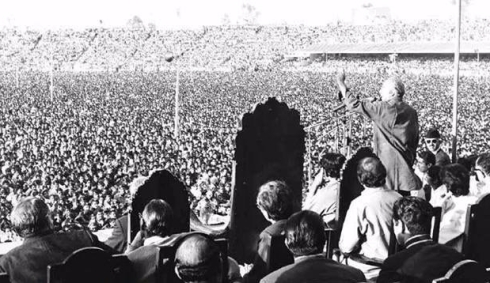
    Pakistanis registered a strong protest against the decision. The streets echoed with slogans of “long live Quaid-e-Awam” and “death to dictatorship”. Pakistanis demanded an immediate release of their beloved leader.
    An eminent British lawyer Sir John Matthew visited Pakistan to witness the trial. Upon his return from Pakistan, I happened to meet him and he shared that if such a case was presented in the British courts, it would have been immediately dismissed. He further observed that the biased attitude of the chief justice gave away the fact that the decision would be given against Bhutto.
    Mir Murtaza Bhutto organised a protest in Birmingham against his father’s death sentence. He led thousands of protestors in the streets of Birmingham chanting slogans for the release of their beloved leader.
    In his address to the people, Mir Murtaza Bhutto said that Zia was conspiring to murder Zulfiqar Ali Bhutto and that only a global campaign by the people could save him.
    The protest received prominent coverage in the local papers of Birmingham. This protest was the beginning of worldwide outrage against Bhutto’s sentence. British Pakistanis and Kashmiri joined hands and held demonstrations in front of Pakistani High Commissions. Hyde Park in London became a symbol for the restoration of democracy.
    After Zulfikar Ali Bhutto was hanged, all the major newspapers of the world commented on the decision and called it a political murder and injustice against Bhutto. A lot of papers even named the chief justice and stated that his partial decision could not have stayed hidden from the world.
    It has been 39 years since Zulfiqar Ali Bhutto left us.
    Shaheed Benazir Bhutto in a television interview once said that she does not believe in the politics of revenge. Later, the world saw that her faith was vindicated by history.
    The ashes of those who devised the plan of Zulfiqar Ali Bhutto’s murder have become lost in the pages of history. On the other hand, Bhutto, whose name was attempted to be erased from history, is alive even today.

    #HappyBirthdaySZAB #BhuttosAwaitJustice #SZAB #HappyBirthdaySZAB 🎂🎂💖🌷 Bilawal rejuvenates resolve to take forward ZA Bhutto’s mission

     Pakistan People’s Party (PPP) Chairman Bilawal Bhutto Zardari Friday paid tribute to former prime minister and PPP founder Zulfikar Ali Bhutto on his 91st birth anniversary, to be observed on Saturday (Jan 5), throughout the country.
    In his message, the PPP Chairman said that the PPP leadership and party workers would continue their struggle to take the philosophy, vision and mission of Zulfikar Ali Bhutto and Benazir Bhutto forward.
    He lauded Zulfikar Bhutto and said that it was his aim to not only make people firmly adhere to his ideology rather also apprise the people about commitment to his mission, political vision, wisdom and bravery.
    Bilawal said Zulfikar Ali Bhutto had a rich mind, an unprecedented democracy in his blood, unmatched political vision with which he created a unanimous Constitution. He retrieved the 90,000 prisoners of war and thousands of miles of occupied Pakistani territory from India and signed the Simla accord.
    He pointed out that from laying foundation of the country’s nuclear programme he established mega projects like Pakistan Steel Mills, Port Qasim, universities and health facilities.

    https://www.brecorder.com/2019/01/04/463376/bilawal-rejuvenates-resolve-to-take-forward-za-bhuttos-mission/