Sunday, December 16, 2018

'We're All Handcuffed in This Country.' Why Afghanistan Is Still the Worst Place in the World to Be a Woman


By LAUREN BOHN
It was a sunny morning in early December last year when 23-year-old Khadija set herself on fire. She kissed her three-month old son Mohammed goodbye and said a short prayer.“Please God, stop this suffering,” she pleaded in the sun-soaked courtyard of her home in Herat, Afghanistan as she poured kerosene from a copper lamp over her small frame. She then struck a match. The last thing she heard were birds chirping.The next morning, she realized her prayer had gone unanswered. Khadija, who asked TIME not to publish her last name or her family’s, woke up at Herat Hospital in Afghanistan’s only burn unit, her body blanketed in third-degree burns and bandages.
“I am not alive, but I am not dead,” Khadija told me later that week, crying and gripping the hands of her sister, Aisha. “I tried running away and I failed.” Like the majority of Afghan women, Khadija was a victim of domestic abuse. For four years, she said, her husband beat her and told her that she’s ugly and dumb – “a nobody.”
“Women never have any choices,” Khadija said last December in the hospital, as tears streamed down her face, a barely recognizable charred patchwork of fresh scars. “If I did, I wouldn’t have married him. We’re all handcuffed in this country.”Khadija’s decision to set herself on fire prompted her husband to be arrested on charges of domestic violence, an unusual situation in a country where abuse against women is rarely criminalized. But even while he was serving his prison sentence, Khadija felt more trapped than when she tried to take her own life. Her husband’s parents, who were looking after her son, issued Khadija an ultimatum: If she would tell the police that she lied—that her husband didn’t actually abuse her—and if she returned home, then she could see her son. If she refused, she would never see him again.
In a country racked by decades of war and a dearth of resources, Khadija’s story shows how women in Afghanistan are struggling to live with dignity. It also highlights how, in the face of little governmental support and dwindling international aid, women are stepping in to help one another.
It wasn’t supposed to be like this for Afghanistan, the country of 35 million people where America has waged its longest war. The war was billed, in part, as “a fight for the rights and dignity of women.” The Taliban ruled in Afghanistan from 1996 until 2001, a period in which women were essentially invisible in public life, barred from going to school or working. In a 2001 radio address to the nation, First Lady Laura Bush urged Americans to “join our family in working to ensure that dignity and opportunity will be secured for all the women and children of Afghanistan.” In 2004, President George W. Bush declared victory in the country.
But seventeen years and almost $2 trillion later, the country is still in turmoil as the Taliban maintains its grip on almost 60 percent of the country, the most territory it has controlled since 2001. In October, the U.N. said Afghan civilian deaths were the highest since 2014: from January to September 2018, at least 2,798 civilians were killed and more than 5,000 others injured. Gallup’s most recent survey of Afghans, conducted in July, revealed strikingly low levels of optimism: Afghans’ ratings of their own lives are lower than in any country in any previous year.
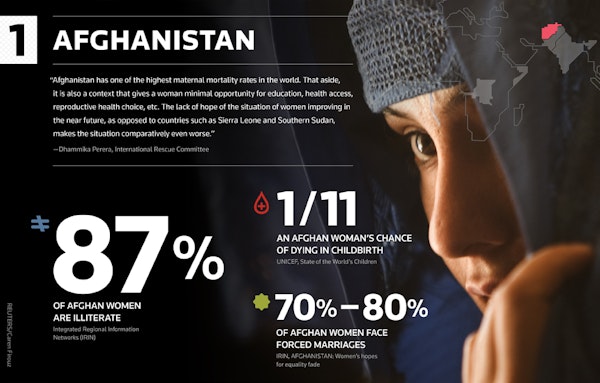
As in all war-torn societies, women suffer disproportionately. Afghanistan is still ranked the worst place in the world to be a woman. Despite Afghan government and international donor efforts since 2001 to educate girls, an estimated two-thirds of Afghan girls do not attend school. Eighty-seven percent of Afghan women are illiterate, while 70-80 percent face forced marriage, many before the age of 16. A September watchdog report called the USAID’s $280 million Promote program – billed the largest single investment that the U.S. government has ever made to advance women’s rights globally – a flop and a waste of taxpayer’s money.Government statistics from 2014 show that 80 percent of all suicides are committed by women, making Afghanistan one of the few places in the world where rates are higher among women. Psychologists attribute this anomaly to an endless cycle of domestic violence and poverty. The 2008 Global Rights survey found that nearly 90 percent of Afghan women have experienced domestic abuse.“It hurts me to say this, but the situation is only getting worse,” said Jameela Naseri, a 31-year-old lawyer at Medica Afghanistan, an NGO established by German-based Medica Mondiale, defending women and girls in war and crisis zones throughout the world. Naseri oversees Khadija’s case, as well as the cases of dozens of other women who are seeking refuge or divorce from allegedly abusive husbands. In the face of what she calls “a war against women,” she is leading an informal but determined coalition of female psychologists, doctors and activists in Herat who take on cases like Khadija’s.
“I meet a new Khadija almost every day,” she said, while fielding a call from an activist. Earlier that week, a man claimed his wife had died from a longstanding illness but activists suspect he murdered her. “We do the best to help these women, but sometimes we can’t. That’s hard to accept.” Herat, a province in western Afghanistan near the border of Iran, has some of the highest rates of violence against women in the country and some of the highest rates of suicide among women. Psychologist Naema Nikaed, who was working with Khadija, said she handles several cases of attempted suicide every week. Most go unreported due to fear of tarnishing a family’s honor. “The government wants to say they’re prioritizing women,” a female Afghan diplomat told me, speaking on condition of anonymity during the NATO Summit in Brussels in July. “But they’re really not. Supporting women in Afghanistan is something people all over the world pay lip service to, but money and aid never get to them. It’s eaten by corruption, the monster of war.” Transparency International ranked Afghanistan the fourth most corrupt country in the world, noting that corruption hampers humanitarian aid from getting where it needs to go. At the NATO summit, I asked President Ashraf Ghani why two-thirds of girls are still out of school. He largely blamed the numbers on ill-conceived, misguided Western aid efforts that fail to acknowledge the realities on the ground.
“To get to the very nitty gritty, how many girls schools at the age of puberty have a toilet? That’s fundamental,” he said. “How many girl schools are three kilometers away? The issue here is that international experts were male-centric. They talked about gender but their pamphlets were glossy and totally lacking content.”
But activists say his administration has failed to take responsibility for clear backslides in women’s rights. In 2015, 27-year-old Farkhunda Malikzada was beaten to death by a mob in Kabul after being falsely accused of burning the Quran. The government did little to mete out justice and ignored demands for more action to combat violence against women. What’s more, in February 2018, Afghanistan passed into law a new criminal code that the UN Assistance Mission in Afghanistan (UNAMA) hailed as a milestone in the country’s criminal justice reform. However, one chapter of the code was removed before it was passed: the chapter penalizing violence against women. In June, a United Nations report took the Afghan criminal justice system to task for ignoring violence against women.
“Women’s rights were supposed to be the success story of the 2001 invasion,” Naseri said. “But the legacy of war is still killing our women.”
Naseri knows this legacy all too well. Her own mother was forced to marry her father when she was only 12 years old and says she was then abused for years. In order to go to school, Naseri and her mother crafted lies so that her father would let her leave the house. They told him she was going to the mosque or to Quran studies. School wasn’t a place for girls, he contended. Eventually, they convinced him to let her attend university; she became the first and only woman in her family with a degree.
In the face of so much oppression, Naseri vowed to become a lawyer and help women like her own mother and sister, who was forced into marriage at the age of 14.
“Afghan women need to take matters into our own hands. We can’t wait for the government and international charities to save or liberate us,” she said in her office at Medica. Across the hall, a 16-year-old girl named Sahar sat waiting to speak to Naseri. Her mother brought her to Medica after she tried to jump off the sixth-floor balcony of their building. She was to be married off to her cousin in days, and said her uncle had been raping her since she was just 10.
“In doing this work alone, the risks are high. At any moment, we could be killed,” Naseri said. Not a week goes by, she said, that she doesn’t receive death threats. Just last year, an angry mob of men came to the center threatening to burn it to the ground, claiming Naseri was promoting divorce and damaging the fabric of Afghan society.“I know what it’s like to be the victim,” Naseri said. While at university, she fell in love with a classmate. She says she is the first woman in her family whose marriage wasn’t arranged.In March, on International Women’s Day, she gave birth to a boy. “I refuse to bring my son into a world where he thinks women are second-class citizens.”
Last December, the halls of Herat Hospital were lined with patients sitting on the floor, waiting for assistance. Everything is off-white: the chairs, the walls, the floors. Moans of pain echo through the hospital’s burn unit.
Khadija’s doctor, 29-year-old Hasina Ersad, visited her a few times a day for months. “I saw women like Khadija all my life,” said Ersad. “She’s the reason I wanted to become a doctor.”Khadija said her abuse began as soon as she got married. Her father, Mohammed, was poor and sold her off. Her husband promised her that she could go to school and pursue her goal of becoming an esthetician, but by the first week of marriage she learned that would likely never happen. Her mother-in-law told her that her purpose was to raise children. After several miscarriages, she finally gave birth to her son, Mohammed. She thought the abuse would stop once he arrived, but it only got worse.Khadija’s sister Aisha said domestic abuse is pervasive. “My husband has hit me for years,” she shrugged.
Aisha’s husband is 71 years old; she is 26. Over the years, she said she has thought about getting a divorce, but she knows the reality: she’d lose custody of her three children and likely never marry again. In cases of divorce, women have custody of their children up until the age of 7, then children are given to their fathers.
“We weren’t lucky girls,” Aisha said as Khadija struggles to nod in agreement. “Actually, no girl in Afghanistan is lucky.”
Khadija’s psychologist Naema Nikaed, one of the few in Afghanistan who counsel suicide survivors, said she and her colleagues have witnessed an uptick in suicides among women over the past few years.“If the government doesn’t start prioritizing the lives of women, then we will be in a forever war here in Afghanistan,” she said. Earlier that day, Nikaed had visited a 15-year-old patient who overdosed that morning on unidentified tablets from a pharmacy.“It’s really only up to us – the women like Jameela, myself and others – to fight this discrimination and to save lives. No one can save us but ourselves.”When Khadija was three, her mother died from childbirth complications, leaving their father Mohammed to raise Khadija and her four siblings. (Afghanistan has one of the highest maternal mortality rates in the world.)
“I always wanted to give my daughters a better life, but how could I?” Mohammed asks as he waits on a bustling street corner to find daily labor. It’s a cold December morning and he and other men warm their hands over a makeshift fire. He’s only 50 years old, but his face prematurely droops from years of depression and destitution.
Both of Mohammed’s parents died when he was one; he said he grew up with an abusive uncle who stole his land. “War has affected this whole country,” he said. “It’s all we know and it has made us broken and blind.”
When Khadija was 15, he began shopping around for dowries. The highest bid came from a working-class family in Herat with a “good enough” reputation. Mohammed received $3,400 for Khadija. Mohammed said he understands that his daughter is unhappy, but that she has no choice. Even if her husband is abusive, he is resolute about what his daughter should do: she must stay with him. “I can’t take care of her. I wish I could, but she’s better off with them,” he said. “Trust me, she’s better off.”
To get to Khadija’s and her parents-in-law’s home, you pass through a maze of trash-strewn streets and small corner shops selling nothing more than soda and chips. On the corner, there’s a tiny pre-school filled with little boys in blue shirts next to a beauty store where sometimes Khadija would work – her only reprieve from home life. In the family’s small living room, Khadija’s in-laws told me their son “never touched” Khadija and that because of her, they had lost their reputation. When their son called them from prison, where he was granted one call a day, he told me he was an innocent man.
Naseri’s close friend, Hassina Nikzad, the director of Afghan Women’s Network, visited Khadija weekly and reminded her that she could file for a divorce. “But where will I go? Mom is dead and dad is old,” she cried to her sister, Aisha.
Nikzad suggested that she could move to a shelter and learn a trade like tailoring. Khadija shook her head and looked down.
Last December, Nikzad told me she wasn’t sure Khadija would go through with the divorce. “It’s often easier to stay with the pain. Starting a new life in Afghanistan seems impossible,” she said. “We’re not given any chances, let alone a second chance.”
Last June when Khadija left the hospital, she wearily told Naseri that she had made up her mind. Although Naseri suggested she move to a shelter, Khadija decided to return to her husband’s parents. The pain of not seeing her son was too much to bear and raising a child in a shelter seemed too daunting.But after a month of living with her parents-in-law, Khadija called Naseri in the middle of the night, crying. Her parents-in-law had refused to let her touch her son, Khadija said. And her husband kept saying that he planned to “punish” her when he was released from prison.
Because there was no adequate shelter space in Herat, Khadija decided to stay in her father’s one-room apartment. But her step-mother made it clear that Khadija wasn’t welcome there.
“I don’t regret doing what I did, but I’m still in chains,” Khadija told me in November over Skype. She hadn’t seen her son in months. “One day, I will try to explain to my son why I did this. I hope he understands.” Naseri held her as she sobbed.
In late November, Khadija’s husband was released from prison. Soon after, Naseri tried to contact Khadija but couldn’t reach her. Her phone has been turned off since. Naseri suspects Khadija fled across the border to Iran. It’s unlikely she will see her son again—at least not for a while.
To Naseri, Khadija is one of far too many invisible victims in the country’s war against women. “I could have been Khadija,” Naseri said. “Who knows what separates us? Nothing does.”

India, Pakistan, and the Kartarpur Corridor


It is no great claim to state that India and Pakistan have always struggled with the complexities that were established by the 1947 border. Instead of facilitating a separation, the partition persistently highlights the realities of a shared past, and continues to present new ways both countries seek to negotiate this dilemma. While an issue like the disputed territory of Kashmir can seem almost intractable, there are areas of shared interest between the two countries where they are capable (albeit stubbornly) of forming agreements, building trust, and making progress toward greater stability.
One of many problematic outcomes of the 1947 partition of India — and its creation of Pakistan — was that a number of sites of religious significance to the region’s three main religions became located on either side of the division. This created a significant tension between the religious aspirations of the two countries’ citizens and the new hard border now placed in front of them.
This became especially troublesome for followers of Sikhism. For Sikhs, the partition of India posed a deep existential headache. Sikhs overwhelmingly chose India over the newly formed Pakistan as the state that would best protect their interests (there remain around 20,000 Sikhs living in Pakistan today, compared to around 21 million in India). However, in making this choice Sikhs became isolated from a number of their holiest sites, as well as their cultural, and former political, capital of Lahore. This has generated a westward yearning for the community that the border only intensifies.
While the Sri Harmandir Sahib (or Golden Temple) in the Indian city of Amritsar remains Sikhism’s most important religious site, three sites (gurdwaras) deeply connected to the life of the religion’s founder, Guru Nanak, are now in Pakistan. The Gurdwara Janam Asthan, west of Lahore, is situated on the location where Guru Nanak was born, and the Gurdwara Panja Sahib in the town of Hasan Abdal is believed to have the handprint of Guru Nanak imprinted on a boulder within its grounds. And lying just 4 kilometers across border is the Gurdwara Darbar Kartarpur Sahib, the location of Guru Nanak’s death, and where he spent the last 18 years of his life. Such is the emotional pull of this site that on the Indian side of the border a viewing platformhas been constructed where people can use binoculars to gain a look at the temple.
India and Pakistani do have an agreement that provides a framework to approach this dilemma. The Protocol on Visits to Religious Shrines (1974) allows their respective citizens the opportunity to visit religious shrines in each country under certain conditions. Alongside Sikhism’s holy sites in Pakistan, India contains a number of sites of great importance to followers of the Sufi Islam, while Pakistani Hindus and Indian Muslims also rely on the protocol for their cross-border pilgrimages. The protocol recognizes the deep shared history that permeates the region, and understands that the cultural and religious requirements of their respective citizens need to be honored outside the strategic animosity between the two states.
However, the agreement is often held hostage to this animosity. When tensions arise both states become reluctant to issue visas to pilgrims, creating further resentment and suspicion between the countries. Yet a recent initiative, instigated by the new Pakistani government of Imran Khan, to establish more consistent access for Sikh pilgrims has the potential to build some greater trust between the two countries. With the Gurdwara Darbar Kartarpur Sahib being so close to the border, its location presented an opportunity to create a more efficient structure around visitation rights, and provide some surety for Sikh pilgrimages.
In late November inauguration ceremonies were held for a new road linking the Indian town of Dera Baba Nanak to the Gurdwara Darbar Kartarpur Sahib in Pakistan. Known as the “Kartarpur Corridor,” the road would allow for visa-free travel for Sikh pilgrims to the gurdwara. It is planned to be opened next year, in time for the anniversary celebrations commemorating 550 years since Guru Nanak’s birth. Although the plans for the corridor include a fenced roadway, creating something of a inhospitable environment for the short journey, the development will nonetheless be appreciated by Indian Sikhs, and the display of cooperation between Islamabad and New Delhi should be taken as a positive step.
Khan’s initiative, combined with an announcement that Pakistan would issue 3,800 visas for Sikh pilgrims to visit other sites in Pakistan for Guru Nanak’s birth anniversary, seems to indicate a greater willingness to reach out to India. These actions can be seen in light of what has come to be known at the “Bajwa Doctrine.” Earlier in the year, Pakistan’s army chief General Qamar Javed Bajwa, made a series of speeches signalling that Pakistan was willing to take a more cooperative approach to its neighborhood relations. The analytical consensus was that a stalling Pakistani economy has the potential to become an internal security threat, and Bajwa sees that increasing trade with India may provide a solution to this problem.
While New Delhi may welcome this more conciliatory tone from the Pakistani military commander (the driving force of Pakistani foreign policy), it will also be wary that the Bajwa Doctrine itself faces a highly institutionalized combative attitude toward Pakistan’s neighbors that may be difficult to shift so easily, even with the Pakistani military’s considerable influence on public policy.
This reflex attitude was on full display when Pakistani Foreign Minister Shah Mahmood Qureshi boasted that Khan had “bowled a googly” to India in order to secure Indian representation at the Kartarpur Corridor groundbreaking ceremony in Pakistan. In cricket a “googly” is a ball that seems like it is going to spin in one direction but actually spins the opposite way. The use of the term indicated that India had fallen for a “trap” laid by Khan. The predictable combative response from India’s Minister of External Affairs Sushma Swaraj then threatened to derail the goodwill that had initially been established. Khan has since distanced himself from his foreign minister’s remarks, stating that the plan for the Kartarpur Corridor was a “sincere effort.”
Although Bajwa and Khan may be attempting to find a more cooperative relationship with New Delhi, Pakistan’s national psychology remains focused on proving that the idea of India, as a plural and secular society, cannot work. Pakistan was indeed born out of this notion, making it a deep existential component of the state. Due to this Islamabad has a tendency to find ways to try and intensify sensitive internal issues to annoy the Indian government.
In April, a group of Indian Sikh pilgrims were granted visas to visit the Gurdwara Panja Sahib in Hasan Abdal for Vaisakhi, Sikhism’s most important festival. However, along the route to the town Sikh separatist propaganda had been strategically placed. The posters proclaimed “Sikh Referendum: 2020 Khalistan” — a reference to a proposed referendum by the New York-based Sikhs for Justice for a separate Sikh state to be known as Khalistan. The advocated poll has no support from either the Indian government or the Punjab state government, and it seems to lack any credible way of gauging actual separatist sentiment with its focus on diaspora communities. But for Pakistan the noise presented an opportunity to try sow discontent among the Sikh pilgrims visiting their religious site.
India has long accused Pakistan of attempting to ferment separatist sentiment in Indian Punjab, and the leadership of Babbar Khalsa International (BKI) — the Sikh terrorist organization responsible for the bombing of an Air India flight from Toronto to Delhi in 1985 — is currently located in Pakistan. According to the South Asia Terrorism Portal, the organization is aided by Pakistan’s Inter-Services Intelligence (ISI), as well as by Sikh diaspora groups.
Coming so soon after a tense visit by Canadian Prime Minister Justin Trudeau, where issues of Khalistani sentiment in Canada dominated the agenda, New Delhi had little patience for this attempt to influence Sikh pilgrims and directly warned Islamabad that such tactics would not be tolerated. The Ministry of External Affairs issued a statement regarding the incident that explained “Pakistan was called upon to immediately stop all such activities that were aimed at undermining India’s sovereignty, territorial integrity and incitement of disharmony in India.”
Making note of the threat this posed to the Protocol on Visits to Religious Shrines agreement, the statement further added, “It was conveyed that such repeated attempts by authorities and entities in Pakistan to extend support to secessionist movements in India amount to interference in the internal affairs of India. Moreover, such incidents during the visit of the Indian pilgrims went against the spirit of the bilateral Protocol of 1974 governing the exchange of visits of pilgrims between the two countries.”
Were Pakistan to utilize such tactics again in relation to the Kartarpur Corridor the initiative would quickly be derailed.  But as a new prime minister, Khan should be given time to demonstrate he is indeed sincere in wishing to make progress on the relationship with India (he wasn’t yet PM in April). However, Bajwa must understand that antagonistic actions like displaying Khalistani propaganda will only undermine his new strategic doctrine. That Bajwa was seen shaking hands with a pro-Khalistan leader at the groundbreaking ceremony for the corridor did not bode well in this regard. If Pakistan is genuine about its current outreachtoward New Delhi then its leaders will require greater vigilance and restraint in order to establish the requisite trust.
Currently that trust is lacking. Swaraj has indicated that she sees the positive developments regarding the Kartarpur Corridor as separate from the wider bilateral talks between the two countries — the latter being something that New Delhi is currently refusing to re-engage with due to continued Pakistani efforts to further destabilize India’s Kashmir region. With an election approaching in India, Prime Minister Narendra Modi would also be cautious about engaging in any complex and protracted negotiations. Modi will also not attend the South Asian Association for Regional Cooperation (SAARC) summit to be held in Islamabad this month.
As is the case with such a diverse and complex region, a potential solution to one problem usually has the knock-on effect of generating another problem. The smoother access to the Gurdwara Darbar Kartarpur Sahib for Indian Sikhs has already created demand from other religious groups for similar arrangements. Hindu Kashmiri Pandits are now hoping to gain easier access to the Sharada Peeth temple, which lies across the Line of Control (LoC) in Pakistan-administered Kashmir. Given the sensitivity of the region, this seems highly unlikely.
In this light, what the development of the Kartarpur Corridor has clearly demonstrated is that the deep shared cultural and religious histories of the region cannot be erased, only complicated by the border. It remains true that at the time of partition it was not fully understood exactly what the new border would produce. After all, Muhammad Ali Jinnah — the driving force of partition and founder of Pakistan — thought he’d be able to retire in Bombay (now Mumbai), a prospect that may have seemed plausible to him at the time, but is clearly absurd today.
The Kartarpur Corridor may be a small initiative to create some goodwill and ease one pressure on both states, and with success this may create the momentum to identify and sooth another problem in the future. Although religious tensions in the region continue to be fraught, the opportunity for more consistent and efficient access to pilgrimage sites is an area of cooperation between the two states that could prove fruitful. With increased trust and serious commitment this incremental approach may achieve some tangible results, but the overall task of rapprochement remains considerable.

Iran, Pakistan Sign Deal To Boost Security Of Common Border

High-ranking officials from Iran and Pakistan signed an agreement to promote cooperation in preserving the security of common borders nearly two months after terrorists abducted a number of Iranian border guards at a military post.
According to Tasnim dispatches, following a three-day negotiation between a number of Iranian and Pakistani security and political officials in Iran’s southeastern city of Zahedan, a memorandum of understanding (MoU) on border security was signed.
The two sides agreed to boost cooperation in order to preserve the security of common borders and prevent fuel smuggling as well as human trafficking.   
Preventing terrorists from crossing the common borders was another issue agreed between the two countries.
The Iranian side also called for the return of the remaining border guards, who were abducted by terrorist in October.
On November 22, five of the 14 Iranian border guards who had been abducted by terrorists returned home following consultations with Pakistani diplomatic and military officials.
The so-called Jaish-ul-Adl terrorist group infiltrated the country from the Pakistani side of the border on October 15 and took hostage 14 border guards, local Basij forces, and the Islamic Revolution Guards Corps (IRGC) members.
The IRGC Ground Force’s Quds Base announced in October that the local Basij forces and the border regiment forces stationed at the border post in Mirjaveh region in Iran’s southeastern province of Sistan and Balouchestan had been abducted after “acts of treason and collusion” involving an element or elements of the anti-Revolution groups who had infiltrated the country.
Iranian military forces along the southeastern border areas are frequently attacked by terrorist groups coming from Afghanistan and Pakistan.
Tehran has frequently asked the two neighbors to step up security at the common border to prevent terrorist attacks on Iranian forces.

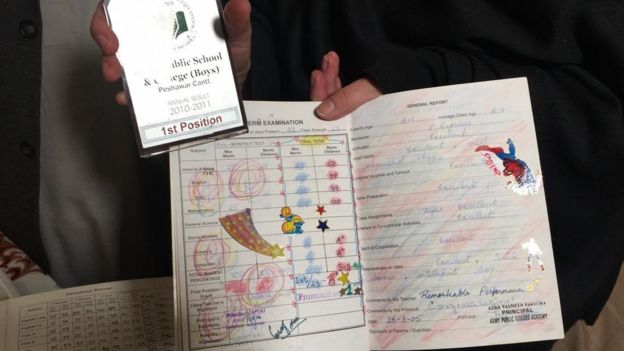
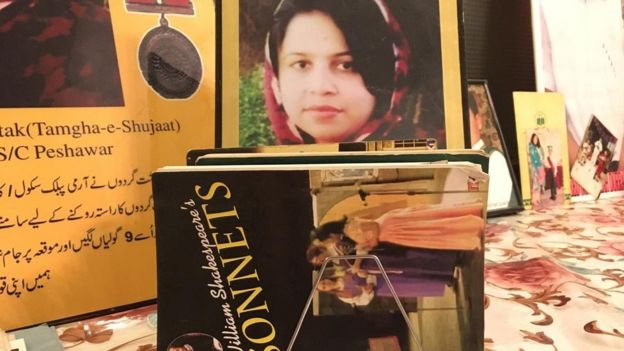
- #APSPeshawar #16December #APSMartyrs - #APS - Army Public School Peshawar SAD Poetry | ( APS ) A DARK DAY 16 DECEMBER 2018

آرمی پبلک سکول حملہ: ’مائیں آج بھی یہ سوچتی ہیں کہ اس تشدد سے بچوں پر کیا گزری ہوگی‘ - #APSPeshawar #16December #APSMartyrs - #APS

عزیز اللہ خان
یہ کیسے آنسو ہیں کہ تھمنے کا نام ہی نہیں لیتے، میں نے اپنے بچے کی لاش جس طرح دیکھی میں ہی جانتی ہوں، وہ بچہ جو چند روز پہلے ایک انجیکشن کی تکلیف برداشت نہیں کر سکتا تھا جانے کیسے اتنی گولیاں اس کے جسم کو چھلنی کر گئیں، میرے بچے کے دونوں بازو فریکچر تھے اور جرسی گولیوں سے ادھڑ گئی تھی۔'
یہ باتیں ایسی اشکبار ماں کے ہیں جو آج چار سال بعد بھی اپنے بیٹے کا غم بھلا نہیں پائیں۔ صرف یہ ایک ماں نہیں بلکہ ایسے 147 والدین ہیں جو ہر روز مرتے ہیں اور ہر روز جیتے ہیں۔
پشاور کے ایک مکان میں آرمی پبلک سکول پر حملے میں ہلاک اور زخمی ہونے والے بچوں اور اساتذہ کے والدین اور رشتہ دار مہینے میں ایک یا دو بار ضرور اکٹھے ہوتے ہیں۔ اس ملاقات میں یہ والدین اپنے بچوں کو یاد کرتے ہیں، ان کی باتیں اور ان کی یادیں لیے یہ لوگ چار سے پانچ گھنٹے اکٹھے بیٹھے رہتے ہیں اور ان باتوں سے اپنے دل کا غم کم کرنے کی کوشش کرتے ہیں۔
نوراللہ آرمی پبلک سکول کا طالبعلم تھا۔ نوراللہ کی والدہ کا کہنا تھا کہ نور اللہ ہنس مکھ تھا لیکن ذرا سی تکلیف بھی برداشت نہیں کر سکتا تھا۔ 'حملے سے کچھ روز پہلے ڈاکٹر کے پاس گئے تو ایک انجیکشن کا درد سہہ نہیں سکا اور اس نے ہسپتال میں خوب شور مچایا تھا۔'
حملے کے بعد جب انھوں نے اپنے بیٹے نور اللہ کی لاش دیکھی تو برداشت نہیں کر پائیں۔ اشک بار آنکھوں سے ماں کا کہنا تھا کہ ان کے بیٹے کو بہت بے دردی سے مارا گیا تھا۔ یہ کہتے ہوئے ان کا چہرہ آنسووں سے بھیگ چکا تھا۔ وہ بتا رہی تھیں کہ ان کے بیٹے کا سینہ گولیوں سے چھلنی تھا یہاں تک کہ جرسی بھی ادھڑ گئی تھی، دونوں بازو کندھوں سے ٹوٹ چکے تھے جسم خون خون تھا اور وہ یہ سوچ رہی تھیں کہ نہ جانے ان کے بچے پر کیا گزری ہوگی، جب اتنی گولیاں لگی ہوں گی تو اس وقت ان کے بیٹے کا کیا حال ہوا ہو گا۔
اسی طرح دیگر والدین بھی اپنے بچوں کی باتیں کرتے رہے۔ ان والدین کا کہنا تھا کہ عجیب دہشت گرد تھے جو ٹیچرز کے کانوں کی بالیاں بھی نوچ کر چلے گئے، لاکٹ بھی چھین لیا اور ان کے پرس بھی غائب تھے، یہ کیسے عجیب دہشت گرد تھے۔
شدت پسندی کے ایک واقعے کے شکار 100 سے زیادہ خاندان ایک بڑے خاندان کی شکل اختیار کر گئے ہیں جہاں ان کے دکھ اور سکھ اب مشترکہ ہیں۔ خوشی کے مواقع ہوں، شادی بیاہ کی تقریبات ہوں، ان میں کوئی مشکل کا شکار ہو یا کوئی غم یا فاتحہ ہو یہ خاندان اس میں ضرور شرکت کرتے ہیں۔
خیال رہے کہ آرمی پبلک سکول پر 16 دسمبر سنہ 2014 کو ہونے والے حملے میں 130 بچوں سمیت 147 افراد شدت پسندوں کا نشانہ بنے تھے۔

اے پی ایس

ان دنوں پشاور کے ورسک روڈ پر ایک مکان میں آرمی پبلک سکول پر حملے میں ہلاک ہونے والے بچوں اور اساتذہ کی تصویریں، یونیفارم، بستے، کتابیں، جوتے اور ان کی ڈھیر ساری یادیں سجا کر رکھی گئی ہیں۔ اس سے قبل گلبرگ اور پشاور صدر کے علاقے کے ایک مکان میں بھی ایسی یادیں رکھی گئی تھیں۔
گل شہزاد خٹک کی بیٹی سعدیہ گل آرمی پبلک سکول میں انگریزی کی استانی تھیں۔ وہ اس حملے میں شدت پسندوں کی گولیوں کا نشانہ بن گئی تھیں۔ اس مہینے ان کے مکان میں یہ خاندان دوسری مرتبہ اکٹھے ہوئے تھے۔ اس مرتبہ کوئی ایک درجن گھرانوں کے افراد ایک خاندان کی شکل میں یکجا ہوئے، کھانا کھایا، چائے پی اور اپنے اپنے دلوں کی باتیں ایک دوسرے سے کیں۔
وہ کہہ رہے تھے کہ عجیب دہشت گرد تھے جو چوریاں بھی کرتے رہے، کسی ٹیچر کے کانوں سے سونے کی بالیاں نوچ لی گئی تھیں، کسی کے گلے سے لاکٹ اچک لیا گیا تھا اور پرس تو سب کے غائب تھے۔ ایک والد نے کہا کہ لاشوں کی بے حرمتی کی گئی، خاص طور پر جب لاشیں شہ زور ٹرکوں میں ہسپتالوں کو منتقل کی جا رہی تھیں۔
مائیں یہ سوچ سوچ کر ہلکان ہوئے جا رہی تھیں کہ ان کے بچوں پر کیا کچھ گزری ہو گی اور جو وسوسے ان کے ذہنوں میں پیدا ہو رہے تھے ان چار سالوں میں وہ وسوسے جوں کے توں ہیں کہ آخر بچوں نے اتنا تشدد کیسے برداشت کیا ہو گا۔

اے پی ایس

شاہانہ اجون اپنے بیٹے اسفندیار کو یاد کرتے ہوئے کہتی ہیں کہ وہ اپنے بیٹے کا بستر دیکھتی ہیں تو کلیجہ منہ کو آتا ہے اور ہر وقت ان کی آنکھیں دروازے پر لگی ہوتی ہیں کہ ابھی اسفند گھر میں داخل ہو گا۔ ان کا کہنا تھا کہ یہ وہی جانتی ہیں کہ ان کے دل پر کیا گزر رہی ہے۔
شاہانہ اجون کہتی ہیں کہ وہ مجرمان کو سزا دینے کا حق کسی اور کو نہیں دیں گی۔ سکیورٹی ایجنسیاں صرف ان قاتلوں کو گرفتار کریں اور انھیں سزا والدین کی مرضی سے دی جائے گی۔
گذشتہ برسوں میں پشاور سمیت خیبر پختونخوا کے مختلف شہروں میں تشدد کے متعدد واقعات پیش آئے ہیں جن میں سے ایک آرمی پبلک سکول کے واقعے پر تحقیقات کا مطالبہ چار برسوں سے جاری ہے۔ مختلف ذرائع سے یہ اطلاعات موصول ہوتی ہیں کہ جن بچوں نے یہ واقعہ دیکھا یا اس میں زخمی ہوئے تھے وہ اس واقعے کو بھلا نہیں پا رہے۔
ایک دوست نے بتایا کہ ایک چھوٹے بچے پر اس واقعے کا اتنا اثر ہوا ہے کہ اس کا ذہنی توازن برقرار نہیں رہا اور اس نے تعلیم کو خیر باد کہہ دیا۔ ایک والد نے بتایا کہ اس حملے میں زخمی ہونے والا ایک بچہ حملے کے دو سال بعد انتہائی تکلیف میں دم توڑ گیا۔ اس بچے کی گردن پر شدید زخم آئے تھے۔
ان والدین کا اب یہی مطالبہ ہے کہ اس حملے کے اصل ذمہ داروں کو سامنے لایا جائے اور ان ذمہ داروں کا تعین کیا جائے جن کی وجہ سے یہ واقعہ پیش آیا یا جن کی غفلت کے نتیجے میں اتنا جانی نقصان ہوا۔ اس بارے میں کمیشن کی رپورٹ آئندہ چند روز میں متوقع ہے لیکن سوال یہ ہے کہ کیا اس کمیشن میں ذمہ داری کا تعین کیا جا سکے گا اور کیا اس کمیشن کی رپورٹ منظر عام پر لائی جائے گی؟
پاکستان میں متعدد واقعات پر جوڈیشل کمیشن قائم کیے گئے لیکن ان کی رپورٹس منظر عام پر مشکل سے ہی آ سکی ہیں۔

د پېښور پر ارمي پبلک سکول د برید څلور کاله پوره شو

د پېښور پر ارمي پبلک سکول په شوي برید کې د وژل شوو څلورم تلین د دسمبر پر ۱۶مه لمانځل کېږي.
د ۲۰۱۴م کال د دسمبر پر ۱۶مه وسله والو د پېښور پر ارمي پبلک سکول برید کړی وو چې د شاوخوا ۱۳۰ ماشومانو په ګډون تر ۱۴۰ زیات کسان پکې وژل شوي وو.
د هغه برید زمه واري بیا تحریک طالبان پاکستان منلې وه.
تر هغه برید وروسته د پاکستان سیاسي او پوځي مشرتابه د ترهګرۍ د مخنیوي لپاره قامي تګلاره یا نېشنل ایکشن پلان جوړ کړی وو او په هېواد کې یې د پانسۍ له سزا بندیز پورته کړ.
دا راز د نیول شویو ترهګرو پر ضد مقدمو لپاره د ځانګړیو پوځي عدالتونو لپاره هم آییني منظوري ورکړل شوه چې تر اوسه کار کوي.
خو په ارمي پبلک سکول کې د وژل شویو ماشومانو د میاندو پلرونو د اتحادیې مشر فضل خان اېډوکېټ وايي تر اوسه دوی ته انصاف ور نه کړل شو.
ده وویل ، “موږ دا غوښتنه کوله چې په دې پېښه کې که د وفاقي حکومت یا صوبايي حکومت او یا هم د ریاستي ادارو کومو چارواکو غفلت کړی وي نو هغوي دې په ګوته کړل شي او سزا دې ورکړل شي.”
فضل خان اډوکېټ وویل ، “ تر څلور کاله تېریدو وروسته هم حکومت موږ لا نه یو مطمین کړي او نه ریاست او نه هم د عدالت لخوا موږ ته انصاف راکړل شو.”
د پاکستان سپریم کورټ د ۲۰۱۸م کال د اکتوبر پر پنځمه د ارمي پبلک سکول د پېښې څیړلو لپاره پېښور هايي کورټ ته د یو عدالتي کمېشن جوړولو امر کړی وو.
د یاد کمېشن له چارواکو سره مو رابطه وکړه خو هغوي په دې هکله څه ویلو ته تیار نه شول.
د پېښور هايي کورټ بار ایسوسي اېشن مشر ایډوکېټ ارباب عثمان مشال رېډیو ته وویل چې یاد عدالتي کمېشن ډیر په تندۍ خپل کار پر مخ بیولی دی او تمه ده چې زر خپله فېصله واوروي.
ده وویل ، “زما خیال دی چې عدالتي کمېشن د دې پېښې په اړه د متعلقه خلکو بیانونه مکمل کړي دي او اوس موږ فېصلې ته انتظار کوو.”
ایډوکېټ ارباب عثمان وویل چې دا کمېشن به حکومت ته سپارښتنې کوي او ممکنه ده چې هغه خلک په ډاګه کړي چې په دې کې یې غفلت کړی دی.
د ده په وینا ، دا بیا د حکومت او ریاست کار دی چې د هغو خلکو پرضد څه اقدامات کوي.
د پېښور ارمي پبلک سکول د پښې ښکار شويو ماشومانو د میاندو پلرونو په غوښتنه سږکال په اپریل میاشت کې د سپریم کورټ چیف جسټس میا ثاقب نثار سوموټو نوټس اخیستی وو او په اکتوبر کې یې په دې هکله د یو اوریدنې پر مهال د عدالتي کمېشن جوړولو د امر تر څنګ له دغو متاثرینو بخښنه وغوښته چې دوی ته په انصاف ورکولو کې دومره وخت ولګیده.
جسټس ثاقب نثار په دغه موقع ویلي وو چې د دسمبر په ۱۶ مه به د پېښور ارمي پبلک سکول دوره هم کوي.

#APSPeshawar #16December #APSMartyrs - #APS - In Pakistan, wounds of Peshawar school attack reopen each winter

By Asad Hashim
More than 148 people, most of them children, were killed making it the second deadliest attack in Pakistan.
 Ajoon Khan remembers that brisk December morning in the northwestern Pakistani city of Peshawar vividly, as if it were yesterday. On most days, he would still be asleep when his son, Asfand, left for school, but he happened to have woken up early that day.
"We sat wrapped in blankets in bed," he says, recalling how he spoke to Asfand, 15, his eldest child, about an upcoming wedding in the family, for which they would have to travel to the eastern city of Lahore.
"He said to me, 'Papa, I want to get some new boots for the wedding.' We decided we would both go to the bazaar that day, after he got home from school."
Asfand, however, never came home.
Hours later, while at court for a legal hearing, Khan got word from a relative that there had been explosions heard in the city. Soon, the target of the attack was confirmed; gunmen had stormed the Army Public School, where Asfand studied.
"It was very strange, almost surreal," says Khan. "All the roads were closed, so I walked from the courts. I seemed to walk for endless miles."
At the school, the security operation to secure the facility was over, and ambulances were busy shuttling the dead and wounded to the city's hospitals.
Hours passed, as Khan walked first to the Combined Military Hospital, and then to the Lady Reading Hospital, searching for his son among the bloodied bodies of the 134 schoolchildren killed and dozens more who were wounded when the six gunmen stormed their school, setting off explosives and firing automatic rifles into classrooms and auditoriums.
Finally, he received another message, from the same relative who had alerted him to the attack.
"They had found Asfand's body. I had to go home."

Second deadliest attack 

More than 148 people, most of them children, were killed in the attack on Peshawar's Army Public School on December 16, 2014, making it the second deadliest attack in the country's history.
The Tehreek-e-Taliban Pakistan, an umbrella group of armed groups that had been fighting the Pakistani state since 2007, soon claimed responsibility for the assault. In a statement, the Pakistan Taliban claimed the children were legitimate targets because they were studying at a military-run school.
Since 2007, the Pakistan Taliban had carried out a bloody campaign of suicide attacks, bombings and shootings that targeted civilians, security forces and government personnel across the country, in a bid to overthrow the Pakistani government and enforce a strict interpretation of Islamic law.
Led first by founder Baitullah Mehsud, and later by his aide Hakeemullah Mehsud, the Pakistan Taliban expanded its influence from its original home in the northwestern South Waziristan district, uniting armed militias across the northwestern tribal belt under one banner.
The attack on the school in Peshawar came after another one earlier that year on a major airport in the southern city of Karachi, Pakistan's largest city and its economic backbone, prompted the launch of a military operation, Zarb-e-Azb [The attack of the Prophet's Sword], against the group.
Following the attack on the Army Public School, the government ramped up its security operations, with the military stepping up air attacks and ground operations in all seven northwestern tribal districts, targeting the Pakistan Taliban.
In all, the military says it killed more than 4,000 members of armed groups since it launched Zarb-e-Azb, losing hundreds of soldiers in the process. The data is impossible to verify, given strict reporting restrictions in the conflict zone.
So where does the Pakistan Taliban stand now?
[Alia Chughtai/ Al Jazeera]

Pakistan Taliban 'is rehabilitating'

"The operational capacity of the TTP [Tehreek-e-Taliban] is, today, a lot more limited than what it was before the military operation was launched," says Simbal Khan, an Islamabad-based security analyst.
"Zarb-e-Azb has succeeded in eradicating bases within Pakistani territory, where they had networks, support and logistics."
The Pakistani military says it has now reclaimed the tribal districts from the Pakistan Taliban's grip, reestablishing the writ of the state and pushing the Tehreek-e-Taliban's fighters across the border into eastern Afghanistan, where they are suspected to be based out of Nangarhar and Kunar provinces.
Hakeemullah Mehsud's successor as Pakistan Taliban chief, Mullah Fazlullah, was killed in a United States' drone attack in Afghanistan's Kunar province in June. The group has since installed Noor Wali Mehsud as its new leader.
"Pakistan has repeatedly shared both information and intelligence with Afghanistan as well as [NATO] authorities regarding [the Tehreek-e-Taliban's] presence/safe havens inside Afghanistan," the military said in a statement emailed to Al Jazeera. "They are living there due to small presence of force on ground owing to lack [of] capacity."
The shift across the border, analyst Khan says, has limited the group's ability to attack government and civilian targets as frequently as it used to, forcing it to change its tactics.
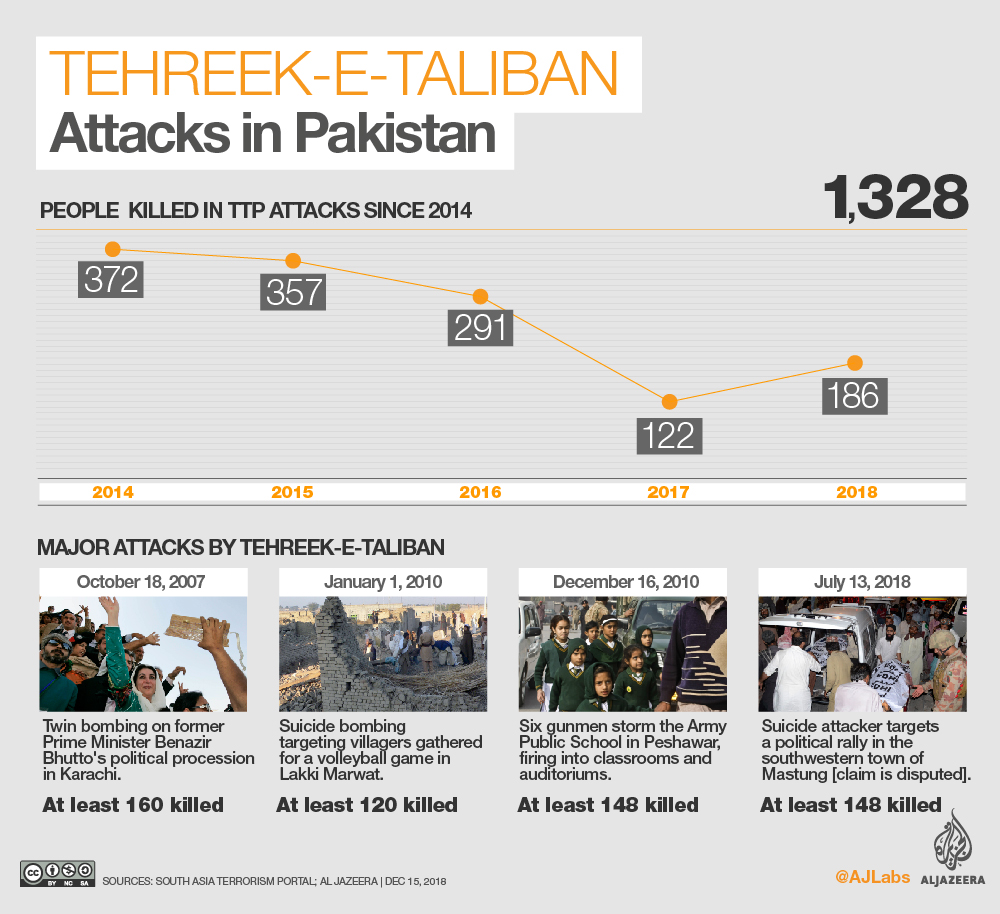
The data bears out the contention, with casualties from Tehreek-e-Taliban-linked attacks in Pakistan down from 372 in 2014 to 186 in 2018, according to data from the New Delhi-based South Asia Terrorism Portal (SATP).
The alleged shift across the border has seen the pattern of violence change, too. Since 2014, while the frequency of attacks has dropped significantly, it appears the Pakistan Taliban and its allied armed groups have refocused on launching sporadic large casualty attacks against civilian targets.
In November 2014, weeks before the Peshawar school attack, a Tehreek-e-Taliban suicide bomber killed at least 60 people at the Wagah border crossing between India and Pakistan.
In January 2015, at least 60 people were killed in a suicide bombing targeting members of the minority Shia Muslim sect in the southern city of Shikarpur.
In March 2016, at least 75 people were killed by a suicide bombing targeting Christians gathered at a Lahore park. Later that year, the Pakistan Taliban claimed responsibility for a bombing that killed more than 70 people at a hospital in the southwestern city of Quetta.
In 2018, the Pakistan Taliban claimed responsibility for a series of attacks ahead of the country's general election, including one in the southwestern town of Mastung that killed at least 145 people.
"The number of attacks rising [this year] is a sign that the Tehreek-e-Taliban is rehabilitating its networks in the country, in some way," says analyst Khan. "There is some kind of a local support network that is [needed for these attacks]."
 [Alia Chughtai/ Al Jazeera]

From Taliban to ISIL

In the vacuum created by the Tehreek-e-Taliban's displacement from Pakistan, a new force emerged in 2016, claiming a series of major attacks, mainly in the southwestern province of Balochistan.
The Islamic State of Iraq and the Levant (ISIL) had long claimed to have gained a foothold in South Asia, but Pakistan's military and analysts suggested that this was merely posturing, in the absence of any operational capacity.
In October 2016, however, gunmen stormed a police training college in Quetta, killing at least 61 people. A month later, more than 52 people were killed in an attack on a Sufi shrine in Balochistan's mountainous Khuzdar district. Three months later, another shrine was targeted, this time in the town of Sehwan in Sindh province, killing more than 88 people.
ISIL claimed responsibility for all three attacks, with the group's Amaq news agency releasing images of the attackers to corroborate the claim.
The group, however, worked mainly in conjunction with local armed groups, particularly the Lashkar-e-Jhangvi's al-Alami faction, analysts say. The group has "no organised presence" in Pakistan, according to the Pakistani military's statement.
"[ISIL] had got support from sectarian organisations in Pakistan [such as Lashkar-e-Jhangvi], because it is also sectarian in nature," says Zahid Hussain, an Islamabad-based analyst.
"But since Daesh has been almost decimated in Iraq and Syria [earlier this year], the appeal for fighters in Pakistan has gone down."
Moreover, says Hussain, the military and government have shown "zero tolerance" for ISIL, wary of the establishment of another armed group in the country.
Khan, the analyst, points out that ISIL's strategy in Arab countries has always been focused on the territorial acquisition, as opposed to al-Qaeda, the Taliban's old ally.
"The difference between ISIL and al-Qaeda is ... how they are reimagining themselves as a territorial group. Al-Qaeda always saw itself as a diffused transnational movement ... not a territorial entity," she says.
"Having sympathisers in some of the radical elements or hardcore extremists in Pakistan is a different thing from transplanting themselves as a viable organisation that has a presence in Pakistan."

Wounds and signs of trauma

As Pakistan touts its gains against armed groups operating in the country, having displaced the Tehreek-e-Taliban and its allies from the territory in the northwest they once occupied, analysts warn the war is far from over.
"[The armed groups were born] in a certain area, there were drivers of conflict in [the tribal districts], and to change that is what Pakistan needs to focus on," says Khan.
Earlier this year, Pakistan's parliament passed a bill that would merge the erstwhile Federally Administered Tribal Areas (FATA) into Khyber Pakhtunkhwa province, reversing decades of repressive state policies where the region was governed directly from Islamabad and where most Pakistani laws - including those relating to human rights - did not apply.
"This continuous security threat that the Tehreek-e-Taliban posed to daily movement and life, it starts where the repressive cycle of the Pakistani state begins [in FATA]," says Khan.
Since May, the government has been working on implementing a set of legal and administrative reforms that would see the former tribal districts governed in line with policy across the country, with greater resources devoted to governance and citizens allowed full rights and access to the country's justice system.
"Clear, hold, build and transfer are the cardinals of anti-insurgency operations," said the Pakistani military in a statement. "We have cleared, we are holding and building concurrently and we are selectively transferring according to the situation and threat matrix."
Hussain warns that there is another danger in Pakistan's policies: that of selective action against armed groups.
"The level of violence has come down, but the threat of militancy is far from over," he says. "It has taken different shapes. Sectarian militancy is still hounding the country."
Pakistan is home to roughly 32 million Shia Muslims, as well as millions of Christians, Hindus and members of other minority Muslim sects. These groups have often found themselves targeted by armed groups.
"The action against armed groups happened in a patchwork," says Hussain. "Some groups were targeted, but generally the campaign to curb extremism has fallen short of expectations."
Back in Peshawar, the cold winds of December are blowing once more.
"Like an old injury in the winter, when the cold comes, we can feel these wounds open up again every year," says Akbar Khan, 60, whose son Umar, now 20, was badly wounded in the attack on the Army Public School.
Umar still struggles, he says. From time to time, he will panic if he hears a loud noise, running through the house demanding that all the doors and windows be closed, latched, locked and secured.
"I see signs of the trauma, every day," says Khan, who says he still feels anger that such an attack could have happened.
"It is such a strange thing. What is a state? If the institutions of a state cannot function and keep people safe, then what is the point of them?"
https://www.aljazeera.com/news/2018/12/pakistan-wounds-peshawar-school-attack-reopen-winter-181216074137219.html

#APSPeshawar #16December #APSMartyrs - #APS, #Peshawar students’ blood continue haunting entire nation until complete elimination of terrorism, facilitators: Bilawal

Chairman Pakistan Peoples Party Bilawal Bhutto Zardari has said that blood of innocent children of Army Public School (APS) Peshawar shall continue to haunt entire nation until the monster terrorism, sponsors and facilitators are completely wiped out from the country.
In his message on the occasion of 4th martyrdom day anniversary of APS Peshawar students and teachers, the PPP chairman said the terrorists had made the whole country as well as the world to weep on this day four years ago through their ghastly attack on the innocent children. “Pakistan and its people continue to grieve and we stand by the bereaved parents and families in solidarity even today,” he added.
PPP Chairman pledged that his party would continue to lead the resistance against terrorism despite being the worst victim and target of the terrorists, adding his stance against the blood-thirsty beasts have finally been adopted by everyone in the country, said a press release.
Paying tributes to victims of APS, Bilawal Bhutto Zardari urged the party leaders to visit their families to express complete solidarity with them.
On this day four years ago the young students, the teachers and staff of the Army Public School Peshawar bore the brunt of the tyrants and religious fanatics and shed their blood that brought the entire nation together to resolve to fight the extremists to the finish.
“All those who were martyred in the gruesome attack on APS that day were national heroes and heroines and while we salute them we also pledge that their sacrifices will not go in vain,” he added.

https://www.brecorder.com/2018/12/16/459397/aps-peshawar-students-blood-continue-haunting-entire-nation-until-complete-elimination-of-terrorism-facilitators-bilawal/

Saturday, December 15, 2018

Video Report - Maroon 5 - Girls Like You ft. Cardi B

Video Report - White House Border Wall Debate With Pelosi, Schumer | The View

Michael Cohen’s Sentence, Michael Flynn’s Defense & Stormy Daniels’s Legal Woes | The Daily Show

The Late Show - Trump Cancels Christmas... For The Press

Video Report - #YellowVests #YellowVestProtests - French students rally in support of 'Yellow Vest' movement

Video Report - #YellowVests #YellowVestProtests - Bashar Al Assad Has Exposed Emannuel Macron

Video Report - #YellowVests #YellowVestProtests - Voices of the Yellow Vests: "We are just here peacefully, getting tear gassed."

#YellowVests #YellowVestProtests - #France's Yellow Vests gather for a fifth week of protests

Video Report - #YellowVestProtests - Water cannons and tear gas used to clear Champs-Elysees in Paris | ITV News

Video Report - #YellowVestProtests - ‘Macron resign’: 'Yellow Vests' protests rage in Paris for 5th weekend in a row

Pashto Music Video - Ya Gulab Mei Wala - Sardar Ali Takkar -

اسلام اباد کې د پښتنو خبریالانو د موسیقۍ بنډار

د جمعې پر مازدیګر د اسلام اباد په پرېس کلب کې د پښتنو خبريالانو اتحاديې د کلتوري ماښام په نوم د موسېقۍ یوه مېله جوړه کړې وه چې پکې د پښتو ژبې د یو شمېر وتلو سندغاړو په ګډون د پارلېمان غړي او وکیلان هم ورغلي ول. په دې غونډه کې سندرغاړو پښتو سندرې زمزمه کړې. په دې اړه دا ویډیويي رپورټ وګورئ.

''د فاټا ولس له لویې قانونې تشې سره مخامخ دی''

په داسې حال کې چې د خیبر پښتونخوا قبایلي ضلعې په صوبه د ورګډیدو نه وروستو د قانوني خلا ښکار دي، د خیبر پښتونخوا د قانون وزیر دغو سیمو ته د قوانینو غځولو او عدالتي نظام جوړولو لپاره په صوبايي اسمبلۍ کې یوه قانوني مسوده جمع کړی ده.

د قانون او پارلیماني چارو صوبايي وزیر سلطان محمد خان ویلي چې په راروانو پینځو کالونو کې به قبایلي ضلعو ته قوانین غځوي او هلته به یو عدالتي نظام جوړي.
نن د دیسېمبر پر ۱۴مه د خپل حکومت د سلو ورځو د کارکردګۍ په اړه پر سوشل میډیا په یوه ویډیو کې نوموړي زیاته کړه چې په قبایلي سیمو کې به د بشري حقونو د دفاع لپاره دفترونه پرانیزي او چارواکي به ټاکي.
''فاټا چې اوس په صوبه ورګډه شوې ده او اوس زموږ قبایلي ضلعې دي،دغلته به موږ په راتلونکیو ۵ کالونو کې قوانین غځوو او عدالتي نظام جوړوو. زموږ په ملک کې له بده مرغه د ابادۍ په حساب عدالتونه ډېر لږ دي نو موږ به په صوبه کې نوي عدالتونه جوړوو، د ججانو شمېره به ډېروو او د دې لپاره به جلا پانګه ږدو. د بشري حقونو د دفاع لپاره به په ټوله صوبه او په ځانګړې توګه په قبایلي ضلعو کې د بشري حقونو دفترونه پرانیزو او چارواکي به ټاکو.''
د زیارت په ورځ د قانون وزیر د صوبې په اسمبلۍ کې په دغه اړه یوه قانوني مسوده هم وړاندې کړې ده. د دې قانوني مسودې تر مخه به په قبایلي سیمو کې لېویز ځواکونو ته د پولیسو اختیارات ورکول کېږي او د ایکشن این اېډ اف سیول پاروز رېګولېشنز به د ولسمشر د منظورۍ سره تر هغه وخته عملي وي چې کله نوي قوانین نه وي عملي شوي.
د دې په رد عمل کې د قانوني چارو پوه او د فاټا اصلاحاتو د تحریک یو مشر کریم مسود بېګاه مشال ریډیو ته وویل چې حکومت د اصلاحاتو په عمليکولو کې له ځنډه کار اخلي او د ایکشن این ایډ قوانین د بشري حقونو سره په ټکر کې دی.

#Bangladesh - 47th Anniversary of Victory


Dr. Kamal Hossain

We are celebrating the 47th anniversary of our independence today. Our independence was won through the sacrifices of countless lives and untold sufferings. Our people have had to overcome innumerable challenges. In the words of a popular song, no one can search and find a country like ours. We could indeed readily agree. Which state can claim that it gained independence in nine months after overcoming a genocidal onslaught that claimed millions of lives? What was remarkable was that people then framed their Constitution within less than a year. The Constitution, which bears the signatures of Bangabandhu Sheikh Mujibur Rahman and includes those of Syed Nazrul Islam and Tajuddin Ahmed, came into force on this day 46 years ago.  Among the people's achievements is that after overcoming the challenges over these 46 years, the Constitution, signed by the framers, is still formally in force. A signed copy of the Constitution can be seen proudly displayed in our national museum.
The challenges we have overcome include the assassination of the Father of the Nation, within four years of independence, and the assassination of four national leaders, who were his closest associates, within a few months of his assassination. Another formidable challenge is to retain the 1972 Constitution, which came into force 46 years ago. During this period, powerful interventions took place which stopped short of the “abrogation” of the Constitution. The Constitution was “suspended” several times, but it has still survived. Some of the changes made in it through amendments, brought in after interventions by force, have since been held to be unconstitutional as a result of popular movements and court rulings.
The third challenge is the doubling of the population since 1971. Our population today is between seventeen to eighteen crores. Yet we have maintained the viability of the state, and the production capacity of our people has generated sustained economic growth.
The patriotism and love for their country by our people has been proved beyond doubt by the positive contribution they have continued to make. This has been done despite gaps in good governance and the rule of law, and despite parliament and other democratic institutions having not been allowed to function for certain periods; the protection of the rule of law and independence of judiciary were also undermined from time to time.
Notwithstanding these, we have completed 47 years of our existence as a sovereign state. We can now look forward to celebrating together the 50th anniversary of our independence in 2021. As we move forward towards 2021, it is imperative to undertake a hard-headed assessment, so that we can derive encouragement and strength from the positive achievements, but it is crucially important to know what is still to be achieved and the challenges to be overcome if the peoples' aspirations are to be realised.
It is necessary, therefore, that during the next 14 days, before the election scheduled for December 30, citizens throughout the country remain alert and vigilant in protecting their right to vote and the process of free and fair elections. Empowerment of the people is secured through a free and fair election. The use of “black money” that is injected into the electoral process has been the biggest obstacle to realising a democratic parliament. Article 118 of the Constitution provides that the election process must be conducted by an election commission, which shall be independent and be subject only to the Constitution and any other law.
I had the privilege of being Bangabandhu's chief election representative in 1970. I set up his election office in Dhaka. It was reported by Bengali employees that senior Central Government officers had arrived with huge amounts of money and were boasting that the election would be drowned by the amount of money brought. I reported this to Bangabandhu, stating that we must fight their money by mobilising the people, as we did not have that kind of money.
Bangabandhu's instruction was that people should be told that they should take as much money as they could but be aware that this was their money which was coming back to them. They should accept the money but not vote for those who were handing out the money.
I had more than a hundred young volunteers, including university boys and girls, with whom we undertook a house-to-house campaign, during which we got to know every street of Dhaka. Our task was to explain to convince each of the citizens of the importance of exercising their vote wisely and not to vote for those who had exploited them and robbed them of their money over the previous two decades. Our female volunteers were to convey the same message to the mothers and sisters in the houses.
We need to recall their historic role today as we move forward towards the election scheduled for December 30, 2018. We had made repeated demands to hold the coming election at least one or two months later, so as to allow us to reach the voters, but this was refused. Only an extension of one week was allowed fixing the date on December 30. This is too short a time for an adequate house-to-house and person-to-person campaign.
There is no doubt that those who fought for liberation and who sacrificed their lives never envisaged that the citizens' right to vote would be undermined by the use of money in crores of taka. It is, therefore, imperative to urge that every voter must play his or her role as owners of the state and exercise our right to vote and to ensure that the election is free and fair. Meaningful vigilance is essential by our citizens to see that the Election Commission discharges its constitutional duty of ensuring a free and fair election and to protect the electoral process from any kind of intervention by money, muscles or manipulation. Let this be how we celebrate the 47th anniversary of our independence.