Thursday, December 6, 2018

#Pakistan: Sectarian Savagery – Analysis


By Tushar Ranjan Mohanty
At least 33 people, including 22 Shias and three Sikhs, were killed and more than 51 were injured in a suicide attack near an imambargah (Shia place of worship) in the Kalaya town of Lower Orakzai District in Khyber Pakhtunkhwa (KP) on November 23, 2018. No group has claimed responsibility for the attack so far.
This is the worst sectarian attack’ in terms of fatalities, recorded in Pakistan since June 24, 2017, when at least 67 persons were killed and more than 200 injured in back-to-back explosions in the Turi Bazaar area of Parachinar, the headquarter of Kurram Agency, in the then Federally Administered Tribal Areas (FATA), when the market was crowed for Iftar(meal eaten by Muslims after sunset during Ramadan)and Eid(the day celebrated to mark the end of holy month of Ramadan). Initially, an explosion took place at the busy Turi Bazaar, moments after an Al Quds Day (an international day of solidarity with the Palestinian people) rally had concluded at the central imambargah. When people rushed to the spot to remove the injured and bodies, the second blast, which was more powerful, occurred, resulting in even greater death and destruction. The al-Alami (International) faction of Lashkar-i-Jhangvi (LeJ) had then claimed responsibility for the twin blasts, issuing a statement that it was targeting Shias and threatened more attacks over “Pakistanis fighting against Sunni militants in Syria’s civil war”.[FATA was merged with KP on May 31, 2018, and all the former Agencies are now Districts of KP].
Since June 25, 2014, Pakistan has recorded at least 10 incidents of sectarian killing resulting in 43 fatalities and 67 persons injured. Threeof these attacks were major incidents (each resulting in three or more fatalities):
October 5, 2017: At least 24 persons, including a Police constable, were killed and more than 30 were injured in a suicide attack just outside the Dargah (shrine) of Pir Rakhyal Shah in the Gandawa area of Fatehpur, a small town in the Jhal Magsi District of Balochistan. Islamic State (IS, aka Daesh) claimed responsibility for the attack.
September 10, 2017: Unidentified assailants opened fire at a vehicle coming from Chaman in the Kuchlak area of Quetta, the provincial capital of Balochistan, in the evening, leaviing five Shia Hazaras dead. No group claimed responsibility for the attack.
uly 19, 2017: At least four persons belonging to the ethnic Hazara Shia community were shot dead when unidentified assailants opened fire on their vehicle on the main RCD highway in the Mastung town of Balochistan.No group claimed responsibility for the attack.
According to partial data compiled by the South Asia Terrorism Portal (SATP), at least 4,607 persons have been killed and another 8,266 injured in 1,493 incidents of sectarian violence in Pakistan since 2001 (data till November 23, 2018). Some of the other major incidents of recent past include:
March 31, 2017: At least 24 persons were killed and another 100 injured in a suicide attack on an imambargah in the Noor market area of Parachinar town in the Kurram Agency of FATA. The explosion took place as people gathered for Friday prayers near the women´s entrance of imambargah. A witness stated that security personnel at the Imambargah were checking devotees when an unidentified person parked a car next to the building, which then exploded. The Jama’at-ul-Ahrar (JuA) faction of Tehreek-e-Taliban Pakistan (TTP) claimed responsibility for the attack. The attack was part of TTP’s “Operation Ghazi” and Shias were the targets, according to the outfit’s statement to the media.
February 16, 2017: At least 88 people were killed when a suicide bomber attacked the crowded Sufi shrine of Lal Shahbaz Qalandar in the Sehwan Sharif town of Jamshoro District in Sindh, injuring at least another 343. The blast took place inside the premises of the shrine as a dhamaal(Sufi ritual)was taking place. A large number of women and children were said to be among the casualties. Devotees throng the shrine of the revered Sufi saint every Thursday to participate in a dhamaal and prayers. Daesh claimed responsibility for the attack.
November 12, 2016: At least 52 persons were killed and 102 were injured in an explosion at the shrine of Shah Norani in the Khuzdar District of Balochistan. The explosion took place at the spot where the dhamaal was being performed, within the premises of the shrine. Daesh claimed responsibility for the attack. .
In Pakistan’s sectarianism-riddled society, Shias are the primary targets, with the second largest population (estimated at 20 to 30 per cent of the total) in the Sunni dominated nation. The primary players in this sectarian violence have been TTP and LeJ, which aim to transform Pakistan into a Sunni state, primarily through violence. The Islamic State of Khorasan is relatively new player in the sectarian bloodbath. Nevertheless, Daesh has claimed some of the major sectarian attacks in the recent past. The Pakistani establishment continues to deny the organised presence of Daesh in the country. After the Quetta Essa Nagri attack on April 15, 2018, in which two Christians were killed and another five were injured, Deputy Inspector General of Police (DIGP), Quetta, Abdul Razzaq Cheema stated, on April 16, 2018, that, “LeJ and its offshoot LeJ al-Alami, with the support of Daesh’s network operating in Afghanistan, are carrying out the attacks in Balochistan. LeJ and other sectarian groups have thrown their weight behind Daesh and they are working for them”. However, Zahid Hussain, a Pakistani security analyst, noted, on November 13, 2016, “IS may not have a formal structure in Pakistan, but certainly they have support among some of the banned terrorist groups, particularly Sunni sectarian groups like Lashkar-e-Jhangvi Al Alami (LeJ-AA)… It’s a kind of nexus that we are seeing between global jihadi groups and local sectarian groups.”
With the Pakistan military initiating lethal targeted operations against domestically oriented terror groups, like LeJ and TTP, and consequent significant reversers inflicted on them, the country has recorded a dramatic decline in all kinds of terrorism-related fatalities, including fatalities in sectarian violence. According to the SATP database, Pakistan has recorded a total of 675 terrorism-linked fatalities (367 civilians, 155 SF personnel and 153militants) thus far in 2018 (data till November 23, 2018). At its peak, Pakistan had saw 11,704 terrorism-linked fatalities (8,389 militants, 2,324 civilians and 991 SF personnel) in 2009. Similarly, the total sectarian violence-linked fatalities stood at 40 in 2018 (data till November 23, 2018). A peak of 558 fatalities in this category was recorded in 2013. In 2017, the number of such fatalities was 231.
The latest sectarian-suicide attack is a manifestation of the fact that sect-based hatred remains deeply rooted in Pakistan. Groupings involved in such violence have sadly been used for political gains since long. On January 10, 2017, for instance, the then Federal Minister of Interior Chaudhry Nisar Ali Khan created an uproar in the Senate (Upper House of National Assembly) by stating that “banned sectarian organisations could not be equated with other banned terrorist organisations”. The Minister made this remark to justify his meeting with Ahmed Ludhianvi, the chief of the banned sectarian Ahle-e-Sunnat Wal Jamaat (ASWJ).
Sunni militant groups backed by the authorities at the helm have sustained a violent campaign against Shia Muslims, particularly since the time of former dictator General Zia-ul-Haq. Prominent anti-Shia groups include the Lashkar-e-Jhangvi (LeJ), the Ahl-e-Sunnat Wal Jama’at (ASWJ), earlier known as Sipah-e-Sahaba Pakistan (SSP). SAIR noted in the past that both political parties and the military leadership have propped up and exploited Islamist extremist and sectarian formations, in pursuit of their own agendas. Increasingly, however, these radical groups are realizing their own power and capacity for mass mobilization and, instead of operating as proxies for others, seek a direct political role for themselves. The ‘political front’ of the United Nations (UN)-designated terrorist Hafiz Muhammad Saeed-led Jamaat-ud-Dawa (JuD), the Milli Muslim League (MML), radical groups like Tehreek-e-Labbaik Pakistan (TLP), sectarian groups like Alh-e-Sunnat-Wal-Jamaat (ASWJ) contested the General Elections of July 25, 2018, often in alliance or with the support of other political parties.
Islamabad has long been opportunistically complicit with Sunni sectarian elements, with state actors providing patronage and protection. While the rising tide of domestic terrorism has forced the state’s hand to act against domestically oriented terrorist formations – resulting in the targeting of TTP-affiliated sectarian outfits as well – the state’s orientation to Sunni sectarian violence remains ambivalent. The spectre of sectarian violence is unlikely to leave Pakistan in the foreseeable future.
Pakistan kicks out 18 charities after rejecting final appeal

By: KATHY GANNON

Pakistan is kicking out 18 international charities after rejecting their final appeal to stay in the country, a move that an aid group spokesman said Thursday would affect millions of desperately poor Pakistanis and lead to tens of millions of aid dollars lost.
The majority of the shuttered aid groups are U.S.-based, while the rest are from Britain and the European Union, according to a government list seen by The Associated Press.
Another 20 groups are at risk of also being expelled after authorities a few months ago singled out some 38 international aid groups for closure, without any explanation.
The development is the latest in a systematic crackdown on international organizations in Pakistan, with authorities using every bureaucratic excuse, such as discrepancies in visa and registration documentation, to target the organizations.
There is also a perception in Islamabad that the United States and European countries have secretly brought spies into Pakistan under the guise of aid workers.
On Thursday, Pakistan's Human Rights Minister Shireen Mazari said on Twitter the 18 groups that were asked to leave had spread disinformation. "They must leave. They need to work within their stated intent which these 18 didn't do," she said.
Umair Hasan, spokesman for the Pakistan Humanitarian Foundation - an umbrella representing 15 of the charities - said those charities alone help 11 million poor Pakistanis and contribute more than $130 million in assistance.
"No organization has been given a clear reason for the denial of its registration renewal applications," Hasan said.
Pakistan and its security forces are still stinging from a 2011 covert operation that involved a Pakistani doctor, an aid group and a vaccination scam to identify Osama bin Laden's home, aiding U.S. Navy Seals who tracked and later killed him.
Islamabad says the United States never notified it of the daring nighttime raid in the Pakistani garrison city of Abbottabad - just a few miles from Pakistan's top military academy - in advance and that the mission that nabbed bin Laden invaded its sovereignty.
Many believe the sweeping crackdown on aid groups is the fallout from the CIA sting operation in which Pakistani doctor Shakeel Afridi, posing as an international aid worker, used a fake hepatitis vaccination program to try to get DNA samples from bin Laden's family as a means of pinpointing his location.
Afridi was subsequently arrested and remains in jail in northwestern Pakistan. Washington has repeatedly demanded his release.
The crackdown "simply marks the latest chapter in an ongoing effort to push back against foreign NGOs in Pakistan," said Michael Kugelman, deputy director of the Asia Programs at the Washington-based Wilson Center. "It's hard to overstate the significance of the hunt for bin Laden and the impact it had on Pakistani perceptions of foreign NGOs."
Hasan said the 18 expelled groups, with the exception of two that are still in court trying to overturn their ouster, have closed their operations in Pakistan. The groups provided everything from education to health care to sanitary and clean water facilities, he said. Many worked in partnership with provincial governments, often supplementing meager development budgets.
Now local officials are being "told not to work with these" groups, added Hasan. "Government people up front will tell you they see the value of their work, but the decision has been taken."
Military spokesman Gen. Asif Ghafoor denies any link between the closures of aid groups and the bin Laden operation, insisting they simply did not meet the criteria, though many had operated for decades in Pakistan. Among the U.S.-based organizations are World Vision, Plan International and Catholic Relief Services.
Pakistan has cracked down on dissidents in recent months and its numerous television channels and newspapers have faced increasing censorship, which has been criticized by international as well as national media watchdogs.
"Civil society space has shrunk," said Hasan. "Next, they will go after local organizations who receive international funding. It will seriously compromise the independence of organizations, their flexibility of how to operate, where to operate."
"These crackdowns on charities will deliver another blow to Pakistan's image," said Kugelman. "While Pakistan certainly isn't the only country to be curtailing the activities of charitable groups, the reputational impacts could be particularly strong because it has a preexisting image problem."

https://www.boston25news.com/news/pakistan-kicks-out-18-charities-after-rejecting-final-appeal/884249591

Wednesday, December 5, 2018

Music Video - Alizée - J'ai pas vingt ans !

Video Report - #YellowVestProtests #protests #France #Insurrection 'Macron Le Pew': President's stink of globalism infuriating 'Yellow Vest' movement

Video - #YellowVestProtests #protests #France #Insurrection 'Yellow vests' vow more insurrection in France despite government cave-in fuel

Video - #YellowVestProtests - 'Gilets jaunes': protests continue in #France despite government's fuel tax climbdown

Video Report - #Yemen and the global arms trade | DW Documentary

Video - #BushFuneral #Bush41 - The key moments from George HW Bush's funeral

Video - #GeorgeHWBushFuneral - See how Obamas, Clintons greeted (or didn't greet) Trump

Video - George W. Bush eulogizes his father through tears, laughter

Video Report - #BushFuneral #Bush41 - Former Presidents and guests mingle before George H.W. Bush funeral

Video - #BushFuneral #Bush41 - Michelle Obama, George W. Bush share warm moment at funeral

Balochistan: Enforced-disappearances see no end as families continue their strike in Quetta

Pakistani forces have abducted several people from different areas of Balochistan including two brothers and their father. The enforced-disappearances dramatically accelerated despite govt’s claims to release previously abducted persons from Balochistan.
Pakistani forces have raided a house in Mondi area of Gwadar Balochistan Sunday and abducted at least one person.
The victim has been identified as Peer Jan son of Mohammad Ameen resident of Dasht area of Balochistan.
In another incident, Pakistan security agencies and FC raided several houses in Mand Maheer area of Kech district Balochistan and abducted at least five people.
The abducted men have been named Dad Mohammad, Fida son of Ababagr, Poza son Azam, Hothi son of Noor, and Abdul Wahid son of Adam. The aforementioned are residents of Maheer region of Mand Balochistan.
Meanwhile, a dead body has been discovered from Qambrani Road area of Quetta on Sunday.
The corpse was later identified as that of Mohammad Jan son of Peer Bakhsh. motives of his killing could not be ascertained immediately.
on Saturday, December 1, Pakistani security agencies offloaded a Baloch student from a passenger van at Balgatar check post while he was on way from Quetta to his hometown Gowarkop in district Kech, Balochistan Saturday.
The abducted student has been named as Dolat Baloch S/O Wahid Bakhsh.
Earlier on Friday (30 November) Pakistan forces attacked a funeral several and abducted at least seven men in district Panjgur Balochistan.
The victims have been named as, Abdul Gaffar son of Mohammed Yaqub, Sarvar son of Sanjar, Ali Akber son of Dad Bakhash, Lal Jan son of Ghulam Mohammed, Shah Dost son of Murad and Muslim son of Mannan.
The men were attending the funeral of two people who were earlier killed in a gun battle between Baloch fighters and Pakistani army backed death squad terrorists.
Also, on Friday, November 30, Pakistani forces raided a house in Tajaban area of district Kech Balochistan and abducted Shakir son of Miskan Baloch. He is a resident of Sang Abad Tajaban.
On Thursday night (29 November) Pakistani forces raided a house in Quetta and abducted two brothers along with their father.
The victims included Jiyand Baloch, the senior joint secretary of BSO and a student of Bahauddin Zakria University in Multan’s sociology department. Other two have been named Jihand’s younger brother Hasnain Baloch and their father Qayyum Baloch.
In a separate raid, Pakistani forces disappeared Ameen Baloch from his hostel room in Killi Ibrahimzai Quetta Friday. Ameen is a medical student originally from Balochistan’s Awaran district.
On 26 November Pakistani forces raid a house in Nizarabad area of in Tump in district Kech Balochistan and abducted a Balochi language singer.
The victim was later named as Balochi folk singer, Khursheed Ahmed.
Yet another similar offensive Pakistan FC raided the house of Abdul Majeed Baloch in Tump area of Baloch and abducted Zaheer Ahmad son of Abdul Majeed.
Sources informed BalochWarna News that Zaheer Ahmad is a tailor master by profession.
Meanwhile, hundreds of families including women and children continue their token hunger strike outside Quetta Press Club despite the cold weather. The families have been demanding for the safe recovery of their loved ones.
They have been demanding that if their loved one have committed any crimes and there are any charges against them they should be presented to a court of law otherwise they should be released.
Baloch human rights activists and pro-freedom political parties say that Pakistan security forces have abducted more than 20,0000 people since the beginning of the currently ongoing phase of Baloch struggle in the early 2000s.
http://balochwarna.com/2018/12/02/balochistan-enforced-disappearances-see-no-end-as-families-continue-their-strike-in-quetta/

PAKISTANI TRUCK DRIVERS HAVE TO PAY BHATTA TO AFGHAN TALIBAN IN PESHAWAR

The truckers bound for Afghanistan are being forced to pay Rs 5,000 extortion money per truck at the provincial city’s fruit and vegetable market in the name of the Afghan Taliban.
At the Peshawar district council, opposition leader Syed Zahir claimed that unidentified men were collecting extortion money from the truckers transporting fruits and vegetables to Afghanistan in Peshawar and those not making that payment got threatening calls from someone based in Afghanistan.
Speaking on a point of order, he said the truckers had no option but to pay extortion money.
DC declares matter dreadful, says will take it up with police for action
He distributed a receipt of Rs5,000 extortion payment to journalists and councillors.
The receipt carrying the logo of the so-called Islamic Emirate of Afghanistan’s Economic and Finance Commission had the truck’s number, the amount received, driver’s name and other details on it.
When contacted, several truck drivers and fruit and vegetable traders confirmed the extortion.
“I don’t know whether the people collecting extortion are the Afghan Taliban or not but it is true that money is being extorted from the people in the fruit and vegetable markets,” a vegetable dealer told Dawn on condition of anonymity. He said the illegal activity had been going on for around two months. He dealer said two unidentified people riding a motorcycle collected money from drivers as fruits or vegetables were loaded onto trucks.
“If the motorcyclists miss trucks inside the fruit and vegetable markets, then they catch them on the Ring Road to force drivers to pay extortion money before going away,” he said.
A fruit dealer said he and other businessmen couldn’t resist militants. He wondered if businessmen denied the militants extortion money, then who would protect them.
Opposition leader Syed Zahir demanded of Peshawar deputy commissioner Dr Imran Hamid Sheikh, who was present in the house, to take notice of the extortion. The DC declared the matter ‘dreadful’ and said the matter would be taken up with the police for action.
http://www.shiitenews.org/index.php/pakistan/item/36127-pakistani-truck-drivers-have-to-pay-bhatta-to-afghan-taliban-in-peshawar

Geo Pakistan investigates: Are incidents of child sexual abuse on the rise in Pakistan?


Incidents of child sexual abuse are being reported from across Pakistan. Are the police and FIA taking this issue with seriousness?

It’s barely been three years since the story of incessant child abuse and pornography scandal from Kasur shook the country to its very core. Several children were raped, subjected to sexual abuse and all of it was filmed. On one hand, the abused children and their families, mostly from low-income households, were extorted for money while these videos were being distributed and sold. It is alleged that this vicious cycle continued for ten years.
How this went unnoticed and worse ignored for so long is a question we still do not have a proper answer for. Many of those arrested in this case received bail and some were set free due to lack of evidence.
The nation might well have forgotten about these children if earlier this year the horrifying rape and murder of seven-year-old Zainabdidn’t serve as a stark reminder.
We had barely welcomed 2018 when the news of Zainab being abducted, raped, and her lifeless body being dumped in a garbage heap dominated headlines and our minds. Her picture flashed across TV screens and people felt the brutality of the crime as if the adorable light-eyed girl in the bubble-gum pink jacket was their own.
The smallest development in the story was followed ardently and law enforcers spread the investigation far and wide. Talk shows, news reports, columns, trends on social media, all remained dedicated till her rapist and murderer was tracked down, arrested, convicted, and eventually hanged ten months after the story first broke.
It is pertinent to mention here that it took nearly week-long protests for the media and authorities to pick up the news of Zainab’s abduction. This was after friends and close family had reported her missing to local police several times. Even after her news made it to mainstream media it took a few days to find her body, after which another round of protests hit the streets of Kasur over police inaction to find the person responsible.It was after the news of the horrific circumstances which the little girl had to endure and then leave this world that the nation was rudely awoken to the horrors children were being subjected to.
Sadly though it seems the boys in Kasur didn’t deserve the same attention.
In September this year, 120 kilometres from Kasur in a small area of Renala Khurd, Okara District another case of sexual abuse managed some space on two national newspapers.
Details of the story, as narrated to our correspondents, tell of a young boy coming home one day in tears. His father, a poor driver in a nearby area, showed great courage and acted swiftly in reporting the incident to the police. The boy had been allegedly subjected to sexual abuse twice in the last three days, the last time being the same day. The incident according to the victim was filmed.
The police filed a report and a forensic examination was conducted which proved he was abused. The accused was arrested but it didn’t seem like the investigation was going anywhere as the police said they didn’t recover any videos from the accused’s phone. Then there was confusion on whether the accused’s forensic sample was sent for examination.
We decided to investigate the matter further and, the deeper we dug, it started to seem that this case wasn’t an anomaly in the area.
It is important to mention that such incidents are known to take place across the country, however, the highest number of cases are reported in Punjab.  
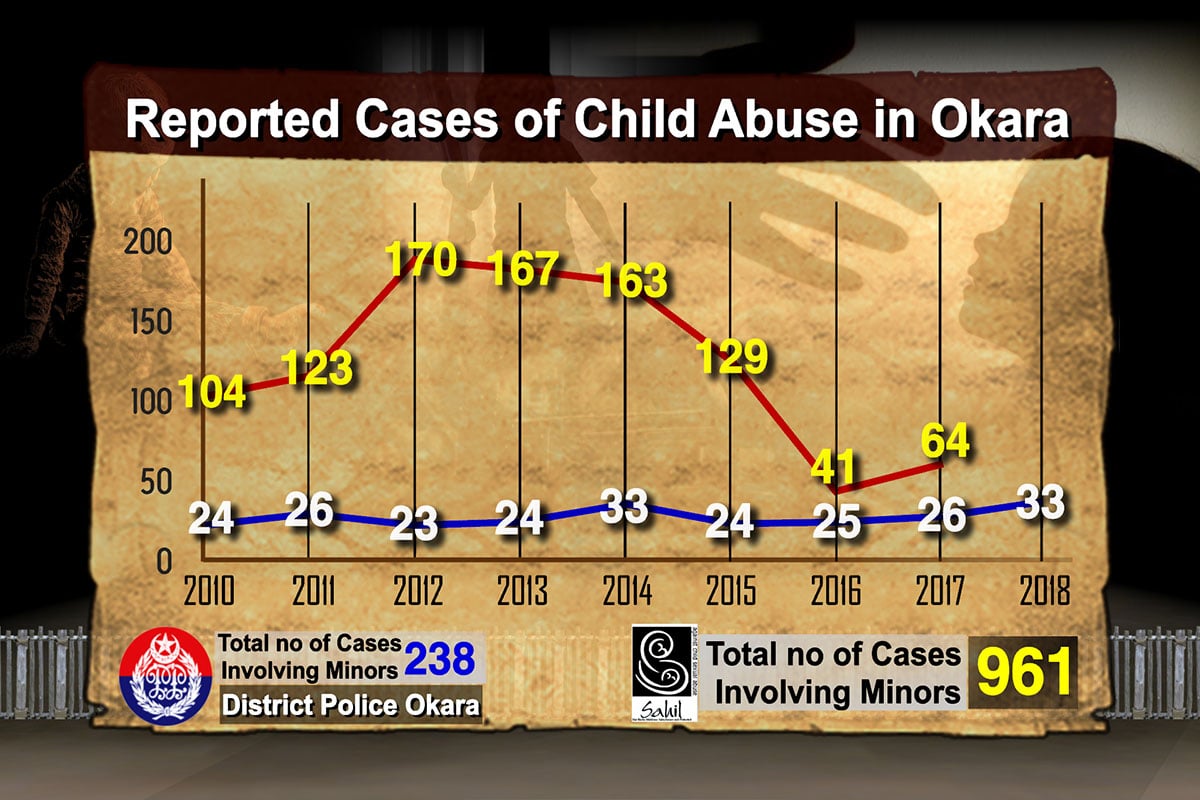
In fact, from 2010 to 2017, Sahil, an NGO dedicated to creating awareness and helping child survivors of sexual abuse, reported 961 cases from Okara. To clarify, these cases were not all directly reported to Sahil but their team monitors over 80 newspapers nationwide and collects data.
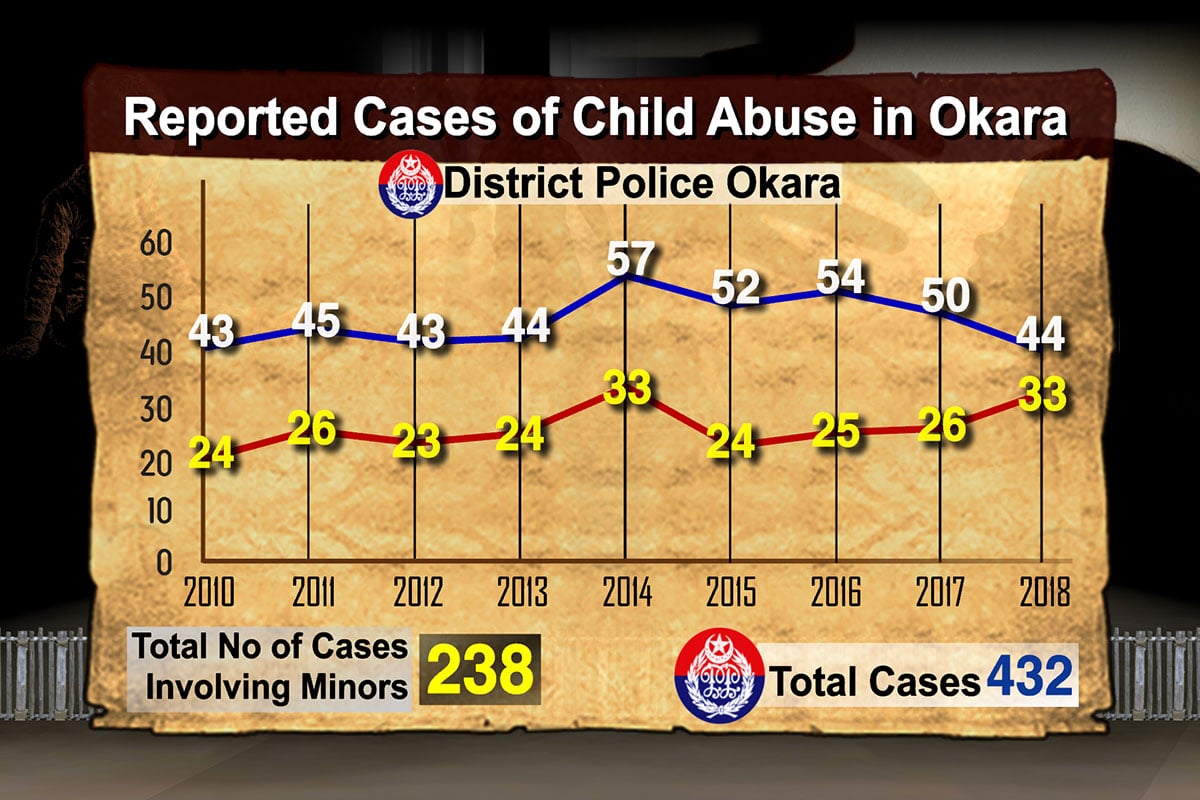
Meanwhile, 432 cases were filed under Section 377 (Unnatural Offences) in District Okara from 2010 to 2018. Of these, 198 victims were minors and an additional 40 cases of minors being raped were also reported. According to DPO Okara Athar Ismail, 45 cases were closed due to lack of evidence. 
This is the story of another teenage boy from the same area last year. He bravely shared his experience with Geo News to serve as a lesson to others and perhaps save them.
“I was on my way from school when this man offered me a ride home. He said he was going the same way but then he suddenly turned towards his house in Renala Khurd. I asked him where he was going. He replied that he quickly needed to pick something up. Once there, he offered me some water. I didn’t realise at the time that he had mixed something (drug) in it and I became unconscious. When I gained consciousness I realised he had sodomised me.”
Renala Khurd is a small area with a population of just over 70,000 people and covering a seven-kilometre radius. The number of cases should have been enough to raise alarms but it’s when we analysed data from certain parts of Punjab that a dangerous and highly disturbing trend emerged.
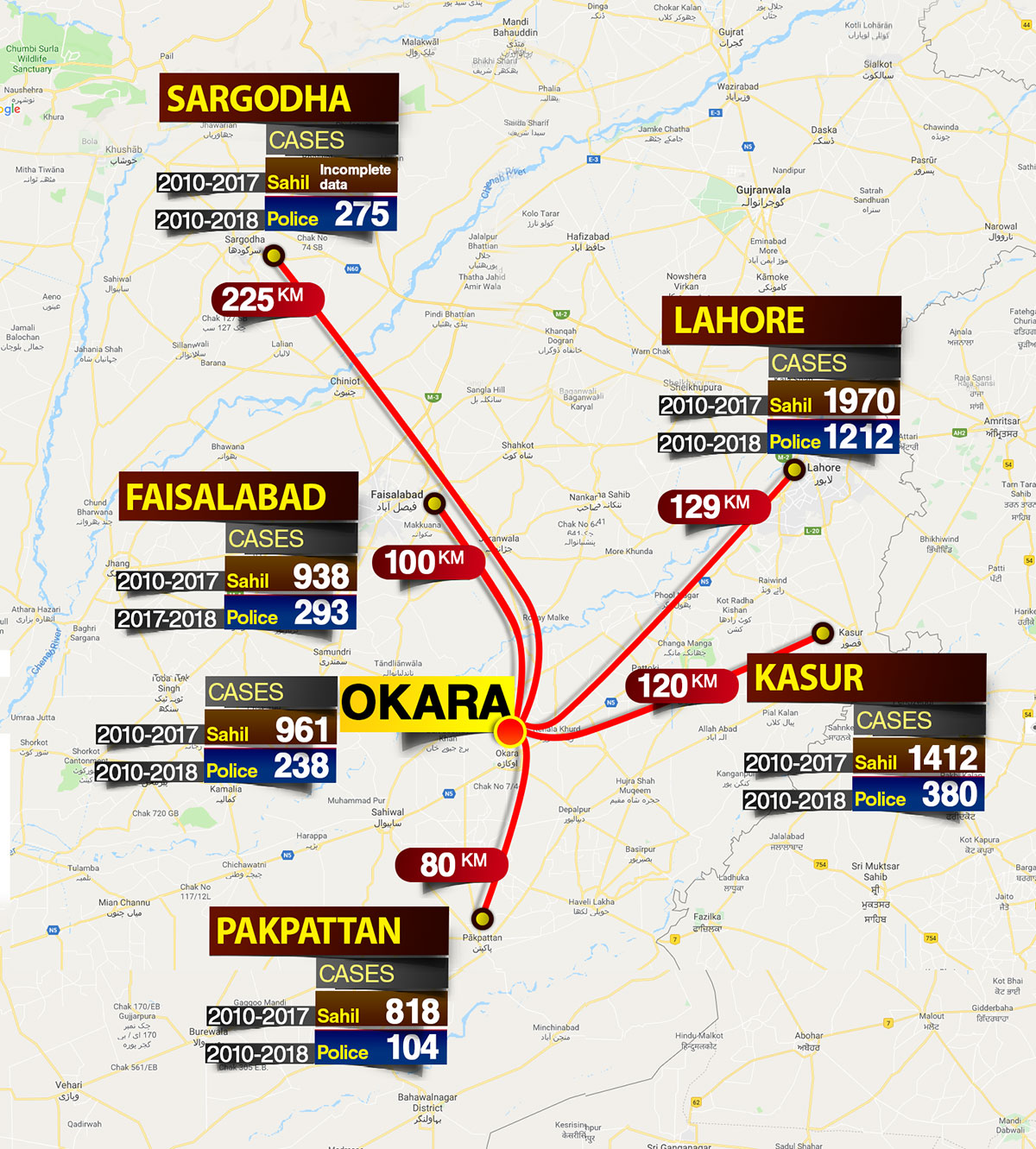
In 2017, Saadat Amin was arrested and convicted to seven years in prison for filming and selling pornographic material. He was caught at the airport while taking children to Norway for filming. More than 65,000 videos and pictures containing child pornography were confiscated. Sargodha is 225 kilometres from Okara.
If you refer to the map above, you can look at the identified districts in Punjab and the cases reported from there. If this isn’t enough to shake the police into action, it’s hard to understand what will.
The number of FIRs filed from these districts alone total 2,502. And these numbers reflect those families and survivors brave enough to make it to the police station and not silence themselves for fear of society, police insensitivity, and ineptitude.
District Superintendent of Police Ziaul Haq says there is no evidence to suggest a child pornography network exists in the area. The Federal Investigation Agency concurs with local authorities.
According to Director General for FIA’s Cybercrime Wing Capt (Retd) Muhammad Shoaib since the Prevention of Electronic Crimes Act was enacted in 2016 the major chunk of cases reported to the department are from Interpol or other consulates and embassies. An example is the case of Sadaat Amin where the Norwegian Embassy contacted them with the information.
But a large number of reports surfacing from Punjab and now Karachi and Tarbela all of children being abused, sodomised and filmed certainly demands a more collective and comprehensive investigation than what appears to be conducted by law enforcers.
Our investigation on abuse cases in Okara was still underway when reports of young girls being trafficked for prostitution broke.
Child Protection and Welfare Bureau (CPWB) officials raided two dens, reportedly brothels, and rescued two minor girls, aged 12 and three and a half. A suspect is reported to have fled the scene with a third minor girl. The rescued girls are in the custody of the CPWB.
In 2015, Pakistan topped the list for the nation of people searching for pornographic content. Okara DPO Athar Ismail says all their investigation points to perpetrators being influenced by pornographic material and, as a result, committing such vile crimes. 
https://www.geo.tv/latest/220703-geo-pakistan-investigates-child-sexual-abuse-in-pakistan

Has Pakistan started losing the hybrid war in Kashmir?

Pakistan’s desperation to expand terrorism to Punjab, as was evident in the recent blast in Amritsar, indicates that they are beginning to realise that Kashmir is now a losing battle or at best a stalemate.
The army chief, Gen. Bipin Rawat, during his talk at the Y.B. Chavan memorial lecture, ‘Addressing the challenges of hybrid conflict in the 21st century,’ stated that India should first resolve problems in Jammu and Kashmir through an integrated approach to tackle the ‘hybrid warfare’ unleashed by Pakistan instead of harbouring immediate notions of regaining PoK. He also stated that it should not lose sight of its goal of regaining PoK.
Hybrid warfare is an all-encompassing term which goes beyond destroying an enemy’s military capabilities. It covers a full spectrum combining conventional and irregular warfare alongside cyber and information warfare. It also includes fermenting internal disorder in the target country. Thus, while the term may be all-encompassing, it remains below the threshold of an all-out war and continues during peace and war.
‘Hybrid warfare’ unleashed by Pakistan in Kashmir includes use of irregulars in the 1947-48 and 1965 wars, Kargil adventure, instigation of stone throwers to disrupt security forces operations, bandhs leading to closure of schools, burning of schools and pushing in terrorists to target security forces and locals who do not support their view. Economic warfare, including pushing in counterfeit currency and employing hawala transactions to fund internal unrest, is part and parcel of the hybrid warfare. It also includes using propaganda to turn the population against the State employing social media.

Hybrid warfare is an all-encompassing term which goes beyond destroying an enemy’s military capabilities. It covers a full spectrum combining conventional and irregular warfare alongside cyber and information warfare. It also includes fermenting internal disorder in the target country.


It was Pakistan-based terrorists who were responsible for the massacre and migration of Kashmiri Pundits from the State, changing the demography of the region forever, which has benefitted them in extending the conflict. In the case of Pakistan, the world is aware that in every terrorist action, somewhere the hand of Pakistan emerges. Pakistan-run terrorist factories export their products to every part of the globe.
Over the years, Pakistan infiltrated terrorists were maintained at a level keeping threshold of Indian tolerance in mind. The attacks on Parliament and Mumbai tested Indian patience. Post the surgical strike, which Pakistan continues to deny, Pakistan realised that India can and would hit back. Strong response by India to Pak attempts at infiltrating terrorists, improving its anti-infiltration grid and enhancing its counter-terrorist operations based on firm intelligence has begun changing the scenario in the valley.
Post the elimination of Burhan Wani, the spurt of locals joining militancy was the success of hybrid warfare launched by Pakistan. It was sustained for a period. Presently, inputs indicate that the trend is waning.
With the onset of winter, attempts at infiltration will reduce in the valley, while they may increase in the plains. Relentless operations against terrorists based on flow of intelligence from locals who no longer desire to be associated with terrorism has enhanced their rate of elimination. In the month of November alone, 39 terrorists, of which nine are militant commanders, have been eliminated taking the total to over 225 this year. Only three militant leaders remain. The back of most of the terrorist organisations has been broken.

Over the years, Pakistan infiltrated terrorists were maintained at a level, keeping threshold of Indian tolerance in mind. The attacks on Parliament and Mumbai tested Indian patience.


Inputs from the valley also indicate that lesser numbers are now picking up the gun, compelling terrorist groups seeking to expand their recruitment to scout educational institutes located away from the valley. Violence in support of trapped terrorists has also shown a stark reduction. Violence is now localised and of lesser intensity than earlier. It follows the successful encounters but fades soon after. Calls for bandhs from separatists has dropped because there are hardly any takers as locals have realised the futility of such an exercise.
The brutal killing of locals and off-duty policemen by terrorists claiming them to be informers or anti-state has only alienated them further and reduced their support base. Daily inputs flow of terrorist presence, including local terrorists, who were earlier hidden from security forces. So accurate is the flow that operations are clean without any collateral damage. This is indicative of a changed approach across the valley.
Simultaneous has been the enhanced international pressure on Pakistan to act against terrorists on its soil. The US has been the most relentless in pushing Pakistan to act. Pakistan has slowly begun facing international isolation. A US spokesperson confirmed that apart from nominating Pakistan as a sponsor of international terrorism, every other form of pressure is also being applied on the state.

The recent political action by the Jammu and Kashmir Governor of dissolving the Assembly rather than permitting a government which only seeks political power without a common ideology has won the support of masses and local political leadership.


The recent political action by the Jammu and Kashmir Governor of dissolving the Assembly rather than permitting a government which only seeks political power without a common ideology has won the support of masses and local political leadership. Alongside this has been the increased turnout in the recently held local elections.
Winter has just commenced and as temperature drops, it would compel terrorists presently hiding away from populated regions to move inwards. Encounters would only increase and more would be eliminated. Pakistan’s desperation to expand terrorism to Punjab, as was evident in the recent blast in Amritsar, indicates that they are beginning to realise that Kashmir is now a losing battle or at best a stalemate.
While the Army has been able to bring down the levels of violence and has effectively reduced the number of terrorists present in the State, it is time for the government to act. It must engage with the youth and enhance employment avenues, thus taking them away from the streets and radicalisation. Engaging the youth would withdraw the only support which terrorists bank on in the valley, isolating them even more. This action would assist security forces in turning the tide of hybrid warfare.
Though these are early days, indicators are evident of the State gaining the upper hand. It is this moment which must be exploited to turn tables, failing which it would be one more missed opportunity.
https://www.orfonline.org/expert-speak/has-pakistan-started-losing-hybrid-war-kashmir-46027/

How Bangladeshi intellectuals disappeared two nights before Pakistan surrendered in 1971


After the 1971 war was over, a list of Bengali intellectuals (many of whom were killed) was found in Pakistan Maj. Gen. Farman Ali’s diary.

Two days before surrender, Pakistani troops made one final attack to cripple the emerging nation [of Bangladesh].
Asif Munier was 4 years old that year. He lived in his grandparents’ house in Dacca. Asif’s father Munier Chowdhury was a sensitive linguist who taught at the Dacca University. They used to live in a part of the campus near the British Council and after the crackdown on 25 March and the killing of academics they did not feel safe and left their home.
Munier Chowdhury taught English and Bengali and was a well-known playwright. Some of his writing was political — in the 1960s he wrote a play, Kobor, about the resurrection from death of the martyrs of the 1952 language movement. He was jailed, and his health suffered, so upon release he focused on writing and teaching and stayed away from overt politics, although he stayed engaged with ideas—he was part of the Pragatisheel Lekhok Songho (Progressive Writers’ Union). Munier was involved with the development of the Bengali keyboard for typewriters, and with the German company, Optima that developed a keyboard, Munier-Optima, which later became a standard in the industry. He was a strong proponent of Bangla.
On 14 December, Munier sat at home, listening diligently to the BBC and VOA. He said aloud, ‘It is reaching the end. The good day will come very soon, I can feel it’. Lily had had a surgery so she was resting. Asif’s grandmother was cooking lunch. His younger brother was in the shower. Asif had just had his bath and his father had wiped him dry.
The house had an iron gate. The main entrance had a courtyard.
Somebody knocked and shook the grill. Asif’s uncle went over to see who it was. When the gate was opened, Munier’s wife and mother could see that there were two or three boys whom they did not recognize, and they were wearing grey kurta pyjamas. The boys asked Asif’s uncle if he was Munier Chowdhury. Asif’s older brother who was 12 was standing nearby, so the uncle sent him away and spoke to the boys. ‘Can you call him? We need to talk to him,’ the boys said.
Lily saw a camouflaged van. She could not see the full car, but she could see its roof and its window. It had branches and leaves, and there was mud on the window.
Munier was about to have lunch—chapatis, vegetables, and fish which his mother had prepared. It was around 1:30 p.m. He got up, put on his white kurta and started going down. ‘They want to talk, let me find out’, he said.
Al-Badr took away many people like Munier that day and brought them to Rayer Bazaar in the Beribadh area of Dacca where potters had lived since Mughal times because the red earth of that area was excellent for making clay pots. The men and women brought here had been tortured and their hands were tied; they were killed near Turag River, where their bodies were dumped—Shahidullah Kaiser, an award-winning novelist from Mazupur; Santosh Chandra Bhattacharyya, a Sanskrit scholar; journalist Syed Nazmul Haque who was arrested during the war and taken to West Pakistan to testify against Sheikh Mujib in his secret trial and then returned to Dacca; linguist Mofazzal Haider Chaudhury whom Tagore’s university in India,Vishwabharati, had honoured; journalist Nizamuddin Ahmed, who frequently acted as a go-between for foreign correspondents, taking them to Mukti Bahini; Dr M.A.M. Faizul Mahi, who quietly helped Mukti Bahini; Sirajul Haque Khan, a US-trained educationist; historian Ghyasuddin Ahmed; physician Mohammad Fazle Rabbi; and poet and journalist Selina Parvin.
Between 14 –16 December Al-Badr and Al-Shams tried to enfeeble Bangladesh at its birth. The men and women became part of the clay of this land two days before it became free, their blood joining the water that flowed through the land.
Munier’s son Asif is one of the founders of Projonmo Ekattor, an organisation of people orphaned by the war. One night at my home in London he recounted the story of his father being taken away. ‘His body was never found; to us, he just disappeared,’ he said quietly.
Farhad Ghuznavi, who was a senior manager at ICI Pakistan, the British chemicals company’s subsidiary, had gone for a board meeting in Karachi on 3 December. The war had broken out so he decided to leave for London, because he had sent his family there. His departure was quite dramatic, as Bengalis leaving the country needed government permission to do so. He was able to leave because ICI had bought his ticket. He returned to Dacca in March. When he went to his home, his neighbour told him he was so glad Ghuznavi was not in Dacca during the final phase of the war. ‘They came for you three times between 3-14 December’, he told Ghuznavi. Ghuznavi’s mother and sister had already moved to her sister’s place, the home was empty.
‘Had I been in Dacca those days, I’d have been taken to Rayer Bazaar,’ he thinks.
Niloufer Huda heard about the fall of Jessore in a radio broadcast and decided to go to Jessore. They saw thousands of people walking to the border.
‘You know that poem, Jessore Road? I had the same image in my mind,’ she told me. ‘But this time they were going home.’
When she reached Jessore she heard that while most Pakistani forces had surrendered, a few platoons had not surrendered and Huda wasfighting them, trying to secure a microwave station in Bhatiyapara under the control of a Pakistani unit. He came on the 17th night, but when he saw her there was no smile on his face, nor any greeting. He held his head in his hands and fell on the bed. Niloufer asked him why he was looking so down and depressed despite the end of the war. He said, ‘You don’t know what they have done. They have killed all the intellectuals in Dacca. They didn’t spare doctors, lecturers, women, not even our family friend Dr Fazle Rabbi.’
While people in Bangladesh were quick to learn about the Rayer Bazaar killings, the international media, caught in the frenzy of Pakistani surrender, wasn’t there to witness the killings. Kann of the Wall Street Journal had heard that there had been an atrocity, but he never saw any bodies. ‘But I am prepared to believe it,’ he said. ‘It would have been consistent with Pakistani actions—towards the end of the war they were crazy as they were close to defeat. Killing a thousand or two thousand people at such a time would not have bothered the army at that time.’
Who had organized those killings? The Bangladesh International Crimes Tribunal has sentenced in absentia one British Bangladeshi for playing a role in those killings, but it has been widely assumed that Maj. Gen. Rao Farman Ali bore some responsibility. After the war was over, a list of Bengali intellectuals (most of whom were killed on 14 December) was found in a page of Farman Ali’s diary that he had left behind at the Governor’s House. Ali confirmed the list as genuine but denied that the aim was to kill the people. Altaf Gauhar, a former Pakistani journalist and bureaucrat, also confirmed the list. He said hehad seen the name of a friend of his on the list and requested Farman Ali to cancel it, and Farman Ali had obliged.
Gen. Farman Ali continued to deny that he had any role in those killings. But he understood the city well, knew the elite, and since Operation Searchlight, had a very good idea of what the troops were doing.
…
Farman Ali’s defence over the Rayer Bazaar killings is that the bodies were found only on 17 December, by which time the Pakistani army had surrendered. He claimed that a week earlier Maj. Gen. Jamshed had called him to the army headquarters and asked him to join him on a car ride.
During the journey he told him that they were thinking of making some arrests of civilians. Farman Ali claimed he advised against it and did not know what happened after that.
But in his book, The Betrayal of East Pakistan, Gen. Niazi described Farman Ali as an opportunist and a conspirator. Niazi also said that Farman Ali insisted on being sent back to Pakistan because ‘Mukti Bahini would kill him of his alleged massacre of the Bangalees and intellectuals on the night of 15-16 December. It was a pathetic sight to see him pale and almost on the verge of breakdown’. Brigadier Salik, whose memoir does not spare Niazi from criticism, wrote: ‘He [Farman] was the major general in charge of civil administration. As such nothing would happen which he would not know.’