Wednesday, October 31, 2018

#AasiaBibi - #AasiaBibiVerdict - Tributes pour in for Shaheed Salman Taseer as SC acquits Aasia Bibi


The Supreme Court on Wednesday overturned the conviction of Aasia Bibi, a Christian mother facing execution for blasphemy, in a landmark case which has incited deadly violence and reached as far as the Vatican.
A three-judge bench headed by Chief Justice Justice Saqib Nisar announced the landmark verdict. “The appeal is allowed. She has been acquitted. The judgement of high court as well as trial court is reversed. Her conviction is set aside,” said Justice Nisar.
Bibi appeared to be in state of disbelief after hearing the decision from her lawyer. “I can’t believe what I am hearing, will i go out now? Will they let me out, really?” Bibi told AFP by phone from prison after the ruling.
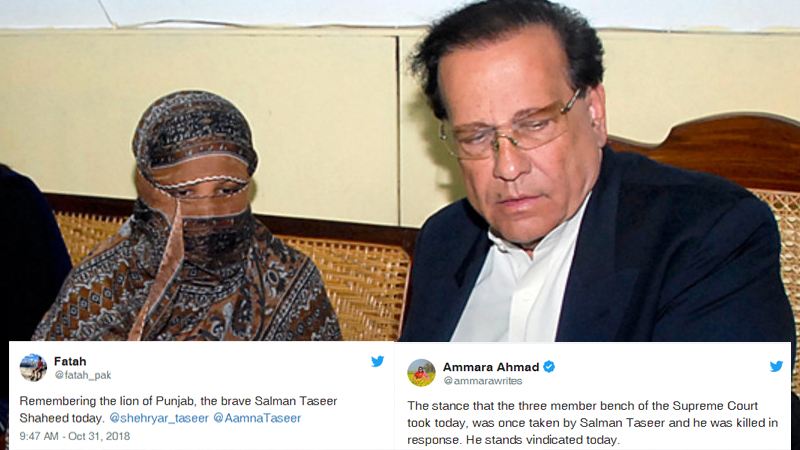
In 2011, former Punjab governor Shaheed Salman Taseer, who spoke out in support of Bibi, was gunned down in broad daylight in Islamabad. His assassin Mumtaz Qadri was executed earlier in 2016 after the court found him guilty of murder.
As soon as the SC announced its landmark verdict, social media users paid tributes to Mr Taseer for his bravery and for raising his voice in times when not many dared to. Users also paid tributes to Shahbaz Bhatti, the previous federal minister for minorities’ affairs, who bravely spoke out in favour of Aasia Bibi and was also assassinated.
Daily Times Editor Raza Ahmed Rumi said ‘one can not stop thinking of Salman Taseer and Shahbaz Bhatti – precious lives lost while standing up for the weak’.

‘Never tell me the odds’
Lawyer and activist Jibran Nasir said reforms to prevent abuse of religious laws to target innocent people – that were advocated by Mr Taseer – were need of the hour.
Prayers for well being of and her family. Today's verdict once again highlights need for reforms to prevent abuse of religious laws to victimize innocents. The same reforms which Salman Taseer advocated and was martyred for. That is the only way forward.
Journalist Umar Ali paid tribute to both Salman Taseer and Shahbaz Bhatti.
View image on TwitterView image on Twitter
History shall remember there were some among us who didn’t shy away from speaking the truth and defend the innocent when it was too dangerous and, in doing so, lost their lives.

Salam to Salman Taseer and Shehbaz Bhatti. We remember you.
Twitter user @KaalaKawaa lauded Shaheed Salman Taseer calling him a ‘true lion-heart’.
Nine years later, Salman Taseer stands vindicated. A true lionheart. The media that fanned the flames of hatred against him (including those who still have cushy jobs at Dawn News) should forever be ashamed of their role. And Mumtaz Qadri remains the pitiful coward he always was.
‘A brave man who raised his voice for Aasia Bibi and sacrificed his life’ says @Majid_PSF
View image on TwitterView image on Twitter
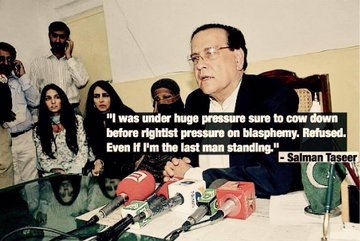
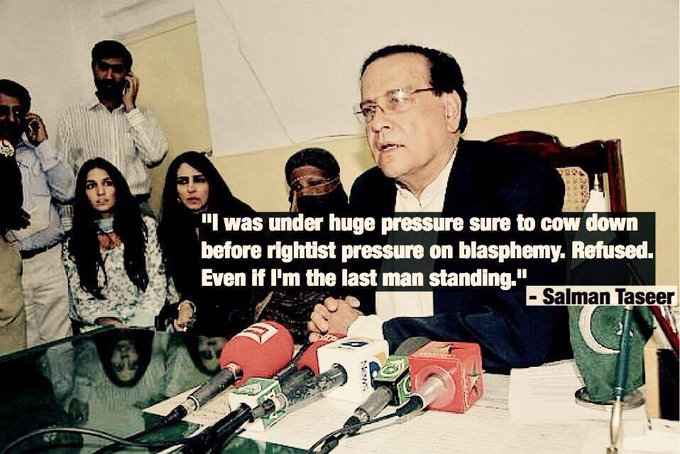
"I was under huge pressure sure to cow down rightist pressure and blasphemy. Reused. Even if I am the last man standing" Shaheed Salman Taseer.

Remembering Shaheed Salman Taseer, brave man who stood and raised voice for and sacrificed his life.@BakhtawarBZ @AseefaBZ
‘The lion of Punjab’
Journalist Ammara Ahmed: ‘Salman Taseer stands vindicated today’
The stance that the three member bench of the Supreme Court took today, was once taken by Salman Taseer and he was killed in response. He stands vindicated today.
‘Made a statement and stood by it like a fearless lion’ says @haimanejaz
Salman Taseer you WON!
Made a statement and stood by it like fearless lion, that's for you.
Justice prevailed. @shehryar_taseer @ShahbazTaseer

#AasiaBibi - #AasiaBibiVerdict - #Pakistan: Aasia Bibi verdict is a landmark victory for religious tolerance

Responding to the Pakistan Supreme Court’s decision to acquit Aasia Bibi, also known as Aasia Noreen, of blasphemy charges after she was sentenced to death by a trial court in 2010, Amnesty International’s Deputy South Asia Director, Omar Waraich, said:
“This is a landmark verdict and an important victory for religious tolerance in Pakistan. For nearly eight years, Aasia Bibi, a poor Christian farmhand and mother of five, had her life languish in limbo. On the basis of no credible evidence, she was sentenced to death in 2010. The people who spoke up for her were threatened and even killed.
“This was a case that was used to rouse angry and violent mobs, to justify the assassinations of two senior officials in 2011, and to intimidate the Pakistani state into submission. Mercifully, justice has prevailed. A clear message must now go out that the blasphemy laws will no longer be used to persecute Pakistan’s long-suffering religious minorities.”

Background

Aasia Bibi is a poor Christian farmhand and mother of five from a Punjabi village near Nankana Sahib.
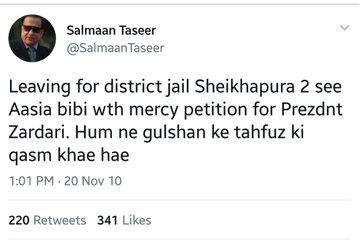
In November 2010, a trial court sentenced Aasia Bibi to death for blasphemy charges brought against her the year before. Later that month, Salmaan Taseer, the then Governor of Punjab, visited her in jail, asked her to fill out a mercy petition addressed to the President of Pakistan, and campaigned for her release.
Pakistan’s blasphemy laws are overbroad, vague and coercive. They have been used to target religious minorities, pursue personal vendettas, and carry out vigilante violence. On the basis of little or no evidence, the accused will struggle to establish their innocence while angry and violent mobs seek to intimidate the police, witnesses, prosecutors, lawyers and judges.
In January 2011, Salmaan Taseer, the Governor of Punjab, was assassinated by his own bodyguard, who shot him 27 times. In March 2011, Shahbaz Bhatti, the only Christian cabinet minister at the time, was assassinated outside his mother’s home in Islamabad.
In 2015, the Pakistan Supreme Court accepted Aasia Bibi’s appeal against her death sentence.
https://www.amnesty.org/en/latest/news/2018/10/pakistan-aasia-bibi-verdict-is-a-landmark-victory-for-religious-tolerance/

#AsiaBibiFreed #AsiaBibiVerdict - NA, other institutions should stand with Supreme Court: Bilawal

Pakistan Peoples Party (PPP) chairman Bilawal BhuttoZardari on Wednesday said the National Assembly and other institutions of the country should stand with the Supreme Court on its decision to acquit Asia Bibi.

“The Supreme Court is our national institutional. I think that the National Assembly along with all other institutions should stand with the Supreme,” Bilawal said while speaking to reporters.
The PPP chairman added that the country could not be run from the streets and had to be run according to the Constitution and rule of law. “I am waiting for the day when the country is run through the rule of law and not threats.”
Bilawal also spoke on the national action plan and how the previous and past governments had failed to implement it.
Earlier, the Supreme Court of Pakistan acquitted Asia Bibi, a Christian woman sentenced to death over blasphemy allegations. The apex court cleared Asia Bibi of all blasphemy allegations and ordered her immediate release.
http://www.thesindhtimes.com/pak/na-institutions-stand-supreme-court-bilawal/

Pakistan's High Court Acquits Asia Bibi, Christian Woman On Death Row For Blasphemy

Pakistan's Supreme Court on Wednesday announced the acquittal of Asia Bibi, a Pakistani Catholic woman who was convicted and sentenced to death in 2010 for blasphemy in a case that has divided the South Asian country and sparked international outrage.
Chief Justice Saqib Nisar read the ruling from the bench in Islamabad, saying the prosecution "categorically failed to prove its case beyond reasonable doubt," the BBC reports.
Her original conviction stemmed from an argument with her Muslim women coworkers on a farm over whether Bibi, as a Christian, was pure enough to share their water. The incident led to allegations that she had blasphemed the Prophet Muhammad.
If her death sentence had been carried out, Bibi would have been the first person executed by the state under the blasphemy laws.
The Supreme Court's verdict was officially decided on Oct. 8, but not publicly announced until Wednesday.
Bibi, a wife and mother of two children and three stepchildren, was on death row and held in solitary confinement for more than eight years. A previous appeal hearing was adjourned in 2016 on a legal technicality.
Bibi's case has been extremely divisive in Pakistan. The hard-line religious right has repeatedly called for her to be hanged. Following the announcement of Wednesday's verdict, the Pakistani Islamist party Tehreek-e-Labaik, or TLP, called for the death of the court's chief justice and two other judges who overturned the conviction. The party also called for the outster of Prime Minister Imran Khan.
"Ahead of the verdict, Khadim Hussain Rizvi, a hard-line cleric who has brought tens of thousands of people into the streets for past rallies, called on his supporters to gather in all major cities to express their love for the prophet and to protest if Bibi is released. Authorities have stepped up security at churches around the country.
Shortly after the ruling, hundreds of Islamists blocked a key road linking the city of Rawalpindi with the capital, Islamabad. Islamists in Pakistan's largest city of Karachi and in the northwestern city of Peshawar were also gathering for the protests. Similar rallies were held elsewhere. Police urged demonstrators to disperse peacefully."
 Upon her release, Bibi is expected to leave the country, the AP says.
Her case has elicited international concern since it first began.
In 2010, Pope Benedict XVI called for her release. Pope Francis met with her family in 2015. In the same year, Mayor of Paris Anne Hidalgo declared Bibi an honorary citizen of the French capital.
Pakistan's blasphemy laws and the the capital punishment for breaking them has drawn concern from international rights organizations, "not least because they are sometimes misused to settle feuds, grab land, or persecute religious minorities by making false allegations," NPR's Phillip Reeves has reported.
The state has never executed anyone under the law, but vigilantes have taken the punishment of those accused into their own hands. A young Pakistani Christian accused of blasphemy was murdered by a mob in 2014.
The blasphemy laws were made more strict in the 1980s under the military government of Zia-ul Haq, who sought to shore up his power by "Islamicising" Pakistan's laws.
The laws are strongly supported by the country's religious right. A provincial governor who spoke out in favor of Bibi and against the blasphemy laws was assassinated in 2011 by his bodyguard, who was subsequently hailed as a martyr by hard-liners.
Most Pakistani politicians and officials prefer to avoid publicly discussing the blasphemy laws altogether because of the dangers involved, Reeves reports.