Wednesday, October 24, 2018

#JamalKhashoggi: How Pakistan 'ignored' journalist's murder to secure Saudi loan

While many pulled out of the ongoing Saudi investment summi#JamalKhashoggi: How Pakistan 'ignored' journalist's murder to secure Saudi loant citing the murder of journalist Jamal Khashoggi, Pakistani PM Imran Khan chose to rub shoulders with the Saudis to seal a bailout package. Social media reacts.
Pakistani authorities announced on Tuesday that Prime Minister Imran Khan managed to secure a $6 billion (€5.25 billion) bailout package from Saudi Arabia to avoid further deterioration of the South Asian country's economy.
"A MoU (memorandum of understanding) was signed between Finance Minister Asad Umar and the Saudi Finance Minister Muhammad Abdullah Al-Jadaan. It was agreed Saudi Arabia will place a deposit of USD 3 Billion for a period of one year as balance of payment support," Pakistan's Foreign Office said in a statement.
It was further "agreed that a one year deferred payment facility for import of oil, up to $3 billion, will be provided by Saudi Arabia. This arrangement will be in place for three years, which will be reviewed thereafter."
The agreement was signed on the sidelines of the second edition of the annual Future Investment Initiative (FII) conference in the Saudi capital, Riyadh.
A number of world leaders had boycotted the Saudi summit, also called "Davos in the desert." The reason behind staying away from the high-profile investment conference was the criticism over journalist Jamal Khashoggi's murder inside a Saudi consulate in Istanbul. The Saudi royal family has come under sharp scrutiny over the journalist's killing, with Turkish President Recep Tayyip Erdogan claiming on Tuesday that the Saudis had "planned" Khashoggi's assassination.
But Khan, who won the July 25 general election and was inaugurated as prime minister in August, chose to look the other way on the Khashoggi killing.
Speaking to The Independent newspaper earlier this week, Khan said that although the murder of one of Saudi Arabia's biggest critics "shocked" him, the reason he was visiting Riyadh was "to take this opportunity because we are a country of 210 million people and we have the worst debt crisis in our history."
"We are desperate for money," Khan added. "Unless we get loans from friendly countries or IMF, we actually won't have foreign exchange to either service our debts or to pay for our imports, so unless we get loans, or investment from abroad, we'll have real, real problems," the Pakistani PM stressed.
A 'mercenary trade off'
Pakistan's human rights defenders, however, criticized the premier's decision to turn a blind eye to Khashoggi's "brutal" murder and cozy up with Saudi King Salman and Crown Prince Mohammed Bin Salman at a time when the international community is trying to mount pressure on the two.
In a sarcastic tweet on Tuesday, journalist Umar Cheema said: "#IK lets the world know he's desperate."
Former Pakistani Senator Farhatullah Babar said that PM Khan's visited Riyadh at a time when "new evidence in Khashoggi case ensnares [the] House of Al Saud."
"Kingdom's isolation and rattling monarchy may seem to create space for financial bailout. Remember, trade offs that are mercenary in character intrinsically unsustainable, will haunt Pakistan for long," Babar tweeted.

Imran in Riyadh as new evidence in Khashoggi case ensnare House of Al Saud. Kingdom's isolation and rattling monarchy may seem to create space for financial bailout. Remember, trade offs that are mercenary in character intrinsically unsustainable, will haunt Pakistan for long.
Pakistani TV anchor Syed Talat Hussain also lashed out at PM Khan for seeking a financial loan from the Saudis.
"Even those countries that are drowning don't say publicly 'we are desperate for funds.' It is graceless and denigrates the country. PM Imran [Khan] has said this and it is absolutely embarrassing," Hussain tweeted.

Even those countries that are drowning don't say publicly “we are desperate for funds.” It is graceless and denigrates the country. PM Imran has said this and it is absolutely embarrassing.
A 'diplomatic success'
But Khan's supporters lauded the premier for securing a much-needed financial bailout package. They argue that their country cannot afford a conflict with Riyadh, which has been one of Pakistan's biggest financiers for decades.
"$6 billion in aid from Saudi Arabia. Thank you. Good work by @ImranKhanPTI. Pakistan has to delicately manage complex regional dynamics and an insatiably hungry youth-based economy. This is a fine start. But this only buys oxygen for reform. The real test is reform," Mosharraf Zaidi wrote on Twitter.
Imran Khan's Pakistan Tehreek-e-Insaf (PTI, Movement for Justice) party projected the premier's meetings with Saudi officials as a great diplomatic success.
"Prime Minister @ImranKhanPTI meets Saudi Crown Prince Mohd Bin Salman, discusses matters related to mutual interests," said PTI's official Twitter account.
Moeed Pirzada, a TV anchor, took a dig at the former ruling party, the Pakistan Muslim League (Nawaz), for hoping that Khan's Saudi Arabia trip would be unsuccessful.
"Imran Khan, the skipper, you have played well! But I am feeling bad for all those in opposition, liberal fringes and media, who had high hopes of throwing out this govt. before December. Guys, you are gone, finished, history (that too only in N Media Cell)," Pirzada tweeted Tuesday.

Imran Khan, the skipper, you have played well! but I am feeling bad for all those in opposition, liberal fringes and media, who had high hopes of throwing out this govt. before December. Guys, you are gone, finished, history (that too only in N Media Cell)
A compromise on neutrality?
It is yet to be seen whether Khan's Riyadh visit was a success or a failure, but some rights activists and political analysts already fear that the Saudi cash will increase the kingdom's influence on Pakistan.
Sectarian conflict is rife in Pakistan, with Saudi Arabia and Iran engaged in a protracted proxy war in the South Asian country.
While Riyadh promotes its version of Wahhabi Islam — by supporting hardline Sunni groups, political parties and religious seminaries — Tehran, too, propagates Shiite Islam in the Muslim-majority nation through various channels.
Islamabad's ties with Tehran have been tense for quite some time, and PM Khan's decision to deepen relations with Saudi Arabia could raise eyebrows in Iran.
The sectarian strife in Pakistan has been ongoing for some time now, with militant Islamist groups unleashing terror on the minority Shiite groups in many parts of the country. Most of these outfits, including the Taliban, take inspiration from the hardline Wahhabi ideology.
"For Pakistan's Islamic fundamentalists, the country is already a 'Sunni Wall' against Shiite Iran," Siegfried O. Wolf, an expert at the University of Heidelberg's South Asia Institute, told DW in an interview.
Reacting to the latest Saudi bailout package for Pakistan, Michael Kugelman, a Washington-based South Asia analyst, wrote on Twitter: "Will the #Pakistan govt [government], which had initially telegraphed a desire for a more neutral position in the Saudi-Iranian rivalry, now need to revert to the norm and pivot closer to Riyadh? Could there be implications for Pakistan's energy/trade ties w/ #Iran?"
https://www.dw.com/en/jamal-khashoggi-how-pakistan-ignored-journalists-murder-to-secure-saudi-loan/a-46018052

#Pakistan - 'We're desperate' Imran, Pakistan secures $6B Saudi loan amid Khashoggi murder outrage


Pakistan's Prime Minister Imran Khan has secured $6 billion in financial support from Saudi Arabia as Riyadh reels from international outrage over the murder of journalist Jamal Khashoggi.
Islamabad announced the deal Tuesday night after Khan attended a Saudi investment conference, the so-called "Davos in the desert," even as several other leaders declined invitations over Khashoggi's death at the country's consulate in Istanbul on October 2.
Riyadh says insider-turned-critic Khashoggi died in a fistfight with Saudi officials, while Turkey says he was killed in a premeditated murder.
After Khashoggi's disappearance, business leaders and government officials pulled out of the Future Investment Initiative (FII) conference, but Pakistan is facing tough economic realities that Khan, who took office in August, can't ignore.
    Before this week's conference, Khan said that Pakistan, which is facing an acute balance of payments crisis, was "desperate" for Saudi loans to shore up the economy.
    "Unless we get loans from friendly countries or the IMF, we actually won't have in another two or three months enough foreign exchange to service our debts or to pay for our imports. So we're desperate at the moment," Khan reportedly told Middle East Eye.

    'We're desperate'

    In the deal agreed Tuesday, Saudi Arabia will give Islamabad $3 billion in foreign currency support for a year and a further loan worth up to $3 billion in deferred payments for oil imports.
    "This arrangement will be in place for three years, which will be reviewed thereafter," Pakistan's foreign ministry said in a statement.
    The deal comes after a previous visit by Khan to Riyadh, his first overseas trip since taking office in July, failed to produce significant results.
    Pakistan's Finance Minister Asad Umar recently said the country may need more than $12 billion to plug its finances as the current-account deficit widens and foreign-currency reserves plummet.
    Pakistan has devalued its currency multiple times since December and reserves have plunged to $8.1 billion, according to Bloomberg.
    This month Umar requested talks with the IMF, to discuss Pakistan's second bailout in five years, though he said it would be the country's last.

    Plaudits and criticism

    Khan faced domestic criticism for attending the conference but Riyadh's pledge of financial support, which was larger than analysts expected, has also won him plaudits.
    Dawn newspaper columnist Ayesha Ijaz Khan questioned whether Saudi Arabia will expect Khan to side with its version of events in the Khashoggi case over that of Turkey, another key ally of Islamabad.
    "These are important questions to ponder as there is no free lunch in this world," she said. Other critics asked whether the Sunni kingdom now expects Pakistani support for its controversial war in Yemen against Shia Houthi groups.
    Islamabad has so far resisted such a move, fearing it would create trouble with neighboring Shia-dominated Iran, which backs the Houthi, and worsen Sunni-Shia tensions within Pakistan.
    However, some analysts said the benefits of the deal outweigh the criticism it has attracted.
    "For Islamabad, the optics of seeking financial support from a Saudi regime with fresh blood on its hands and a tarnished image are poor, to say the least," Michael Kugelman, South Asia expert at the US-based Wilson Center, told CNN.
    But he added that in terms of Pakistan's interests, securing the assistance "qualifies as an unvarnished success."
    "Islamabad has secured badly needed cash that few states were willing to provide," he said.
    Mosharraf Zaidi, a columnist and political analyst said that the deal must be seen in the context of Pakistan having to delicately manage complex regional dynamics "and an insatiably hungry youth-based economy."
    "This is a fine start. But this only buys oxygen," he added. "The real test is reform."
    Analysts say the Saudi loans will also reduce the size of the bailout package needed from the IMF and strengthen Pakistan's negotiating position with the fund.
      US President Donald Trump's administration has signaled major reservations about the IMF granting Pakistan another bailout as Islamabad assumes billions of dollars in debt for the China-Pakistan Economic Corridor (CPEC), a multi-billion dollar series of Chinese funded infrastructure projects.
      "(Pakistan) can also now request a somewhat lesser sum from the IMF, which in turn will reduce some of the political risks of venturing to the Fund, a move that never plays well within the court of Pakistani opinion," said Kugelman.
      https://www.cnn.com/2018/10/24/middleeast/pakistan-saudi-khashoggi-loan-intl/index.html

      Chairman PPP Bilawal Bhutto strongly condemns the firing outside a school in Quetta

      Chairman Pakistan Peoples Party Bilawal Bhutto Zardari has strongly condemned the firing outside a school in Quetta on Wednesday, in which four school children were injured.

      In his statement, PPP Chairman said that targeting the school children is a most heinous crime and no excuse could be acceptable in this regard.


      “It should be the prime responsibility of the government to keep all crimes and criminals away from the schools and educational institutes to protect the bright future of the nation”, he added.
      He demanded the prompt action against the culprits and stressed for best medical treatment to the wounded school children and prayed for their early recovery.


      https://mediacellppp.wordpress.com/2018/10/24/chairman-ppp-bilawal-bhutto-zardari-strongly-condemns-the-firing-outside-a-school-in-quetta/

      #PolioFreePakistan - Aseefa Bhutto says making Pakistan a polio free has become her mission

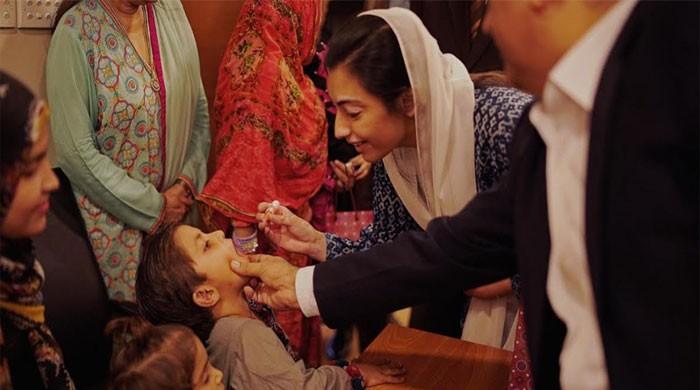
      Rotary Ambassador for Polio Aseefa Bhutto Zardari celebrated World Polio Day at the Emergency Operation Centre for Polio and inoculated children with two drops of the polio vaccine and met the people responsible for managing the polio programme in Sindh. EOC coordinator Fayaz Jatoi and Technical Focal Person EOC Sindh Dr. Ahmad Ali Shaikh welcomed her to the polio cell.
      During the ceremony Aseefa gave presents to children and conversed with their families. Following this there was a cake cutting ceremony to mark world polio day and after cutting the cake she appreciated the efforts made by the Sindh Polio team in the eradication of the virus.“Pakistan has come a long way in polio eradication, from 306 cases in 2014 to 6 cases this year, this shows vaccines work and that we are close to eradicating polio from this country," she said.
      "I appeal to all parents to vaccinate their children with two drops of the polio vaccine every time they are offered," she added. 
      After the ceremony Aseefa Bhutto Zardari tweeted "On #WorldPolioDay we recommit ourselves to the eradication of polio in Pakistan. We must protect every child from this crippling disease. It was the dream of my mother Shaheed Mohtarma #Benazir Bhutto to see a polio free Pakistan and it has become my mission to make her dream a reality."
      World Polio Day is celebrated on the 24th of October every year and is an opportunity to raise awareness around vaccination.
      Pakistan and Afghanistan are the last two countries in the world which are still polio endemic but great progress has been made with historically low cases in Pakistan in 2017.
      This shows that the country is taking concrete efforts to eradicate polio and the day is not far when we will have a polio free world.
      https://www.thenews.com.pk/latest/385003-aseefa-says-making-pakistan-a-polio-free-has-become-her-mission

      Tuesday, October 23, 2018

      G7: Saudi explanation of #Khashoggi’s death leaves many questions unanswered

      Foreign ministers from the Group of Seven leading industrialized nations (G7) have strongly denounced the murder of dissident Saudi journalist Jamal Khashoggi in the Saudi consulate in Istanbul and found Riyadh’s explanation of his death unconvincing since it has left “many questions unanswered.”
      In a joint statement released on Tuesday, the foreign ministers of every G7 nations – Canada, France, Italy, Japan, Germany, the UK, and the US – along with the high representative of the European Union condemned the journo’s death “in the strongest possible terms.”
      “The confirmation of Mr. Jamal Khashoggi’s death is a first step toward full transparency and accountability. However, the explanations offered [by Saudi Arabia] leave many questions unanswered,” the statement added.
      It also called on Riyadh to fully cooperate with the Ankara’s probe into the killing, and to provide a "thorough, credible and transparent” accounting of the circumstances surrounding Khashoggi’s death.
      The G7 ministers further called on Saudi Arabia to hold to account "those responsible for the killing... and put measures in place to ensure something like this can never happen again.”
      Khashoggi, an outspoken critic of the Saudi government, had been living in self-imposed exile in the United States since 2017, when Saudi authorities launched a massive crackdown on dissent.
      He was seeking to secure documentation for his forthcoming marriage when he entered the Saudi consulate in Istanbul on October 2, but never came out despite Riyadh’s initial claim that he exited the mission less than an hour after entering.
      The kingdom, however, later admitted that the journo had been murdered in the consulate after diplomatic pressure grew tremendously on Riyadh to give an account on the mysterious fate of its national. However, it said that it did not know the whereabouts of the journo’s body, which is widely believed to be dismembered.
      Meanwhile, Turkish Hurriyet daily said that police had found Khashoggi’s clothes inside two suspicious suitcases in the trunk of a Saudi consular car abandoned in a private parking lot in the Sultangazi district of Istanbul.
      Another report on Tuesday by UK-based Sky News broadcaster, citing unnamed sources, claimed that the journalist had been “cut up” and his face “disfigured.” One of the sources even suggested that Khashoggi's remains had been discovered in the garden of the Saudi consul general’s home.
      The report came after Turkish President Recep Tayyip Erdogan said body of ill-fated journalist had not been found, demanding Saudi officials to disclose its whereabouts.
      “Why has the body of someone who was officially said to be killed not been found yet?” Erdogan asked, during a speech he delivered at a meeting of his party's lawmakers in capital Ankara on Tuesday.
      He further criticized Riyadh’s contradictory reports in the days following his disappearance, saying Ankara will not stop its investigation until all major questions in the case are answered.
      Amnesty International has already said Riyadh’s explanation of Khashoggi's death in the Saudi consulate in Istanbul appeared to be a whitewash of “an appalling assassination.”
      The rights group also said the “impartiality” of a Saudi probe into the case would remain in question after the kingdom admitted that Khashoggi had been killed inside the consulate.
      https://www.presstv.com/Detail/2018/10/23/577894/G7-Khashoggi-Saudi-Arabia-Erdogan

      #Khashoggi's body parts found at #Saudi consul's residence in #Istanbul: Report

      Body parts belonging to murdered journalist JamalKhashoggi have been found, according to Sky News.
      Citing anonymous sources, the UK-based broadcaster reported Oct. 23 that the writer had been "cut up" and his face "disfigured".
      According to the report, one source suggested that Khashoggi's remains were discovered in the garden of the Saudi consul general's home.
      "I am aware of the reports, they are deeply disturbing ... the location of Mr Khashoggi's body is just one of the questions we need answers to and as such we await the full results of the Turkish investigation," British Prime Minister Theresa May's spokesman said on Oct. 23.
      The report came after Turkish President Recep Tayyip Erdoğan said Khashoggi's body had not been found and demanded Saudi officials reveal its whereabouts.
      "Why has the body of someone who was officially said to be killed not been found yet?" Erdoğan said in an address to his party's MPs in Ankara on Oct. 23, before accusing the consul general's stance after Khashoggi's disappearance.
      http://www.hurriyetdailynews.com/jamal-khashoggis-body-parts-found-report-138191

      OPINION THE U.S. HAS ENABLED SAUDI CRIMES FOR YEARS. WILL JAMAL KHASHOGGI'S MURDER CHANGE THAT? | OPINION

      PHYLLIS BENNIS
      The murder of Saudi journalist Jamal Khashoggi isn't the first atrocity committed by key U.S. ally Saudi Arabia. And Donald Trump isn't the first U.S. president to stand by and watch. America's red lines almost never apply to America's allies.
      But this time could be different.
      Khashoggi's murder was committed in broad daylight, in a Saudi diplomatic venue in another U.S. allied country. It was carried out by a special team flying in private jets known to be owned by the Saudi crown prince, including at least one "autopsy specialist" armed with his own bone saw, and followed up by a cleaning crew armed with buckets, scrub-brushes, and fresh paint. This wasn't normal, even by Saudi standards.
      Khashoggi was a mild, cautious journalist with close ties to the Saudi royals, who only recently emerged as a critic of the regime. A permanent legal resident of the United States who was friendly with Washington elites, the Washington Post columnist should have been untouchable. Going after him so brazenly could only be an attempt to intimidate all potential critics.
      His murder has generated massive press coverage and public outrage. And there's been some blowback in the form of high-visibility CEOs pulling out of the Saudi crown prince’s "Davos in the Desert" investment festival.
      The Saudis now admit the murder, blaming it on a "rogue operation." They've even made a few show arrests. Still, putative Saudi ruler Crown Prince Mohammed bin Salman (known widely as MBS) is plainly counting on Trump—and especially his BFF Jared Kushner—to do what they've always done in response to Saudi abuses: nothing.
      After all, the United States has done nothing to challenge any of the prince’s earlier stunts: launching a pointless economic blockade against Qatar; detaining the Lebanese prime minister; arresting over 200 Saudi princes and business leaders and extorting much of their private fortunes; and freezing trade relations with Canada over a mild human rights complaint. Most of all, there's Saudi Arabia's devastating, one-sided war on Yemen.
      Backed by U.S. military and political assistance, the Saudi and United Arab Emirates (UAE)-led assault has been overwhelmingly responsible for the more than 16,000 civilians killed and the tens of thousands more civilians injured in the Arab world's poorest country. Parents are still mourning the 40 children killed and 56 wounded last August in a U.S.-backed Saudi airstrike targeting a school bus. Meanwhile, the Saudis are blockading Yemeni ports crucial for both commercial and humanitarian goods, causing thousands of cholera deaths and creating a massive famine that the U.N. calls the worst anywhere in the last 100 years. In normal times, bad press like the Khashoggi crisis might make the prince a little jittery at the prospect of his U.S. military spigot being turned off. These days, the U.S. president accepts—and parrots—Saudi denials at face value. The crown prince, Trump breezily accepted, "totally denied any knowledge of what took place in their Turkish consulate." He even dispatched Secretary of State Mike Pompeo for an obsequious photo op sharing smiles and a warm handshake with MBS in Riyadh.

      Video Report - Khashoggi killing: "Saudi Arabia is trying to divert pressure away from the Crown Prince"

      Video Report - #Turkey - #SaudiArabia - #Erdogan speaks on #Khashoggimurder

      Ghazal - GHULAM ALI - SAQI SHARAB LA KEH TABIYAT UDAS HAI

      Ghazal - Sabko Maloom Hai Main Sharabi Nahin By Pankaj Udhas "

      #Pakistan - EDITORIAL: Forced conversions in Sindh

      Eleven-year-old Monika Luhano is back home safe and sound. Thankfully. Yet to point out that she is among the fortunate is an understatement. That she was recovered relatively swiftly speaks volumes of mobilisation efforts on the part of the Hindu community rather than, say, political impetus. Or, indeed, police efficiency. For the little girl was abducted over the weekend from her home in Sindh’s Matiari district; immediately giving rise to fears of forced conversion to Islam and, then, marriage.
      This case should persuade the PPP government sitting at the provincial helm that the time has come to revisit the question of legislating against forced conversions; a violent practice that the Hindu community terms ‘genocide’. Indeed, it is beyond shameful that the political set-up capitulated to the religious right back in 2016 at the final hurdle. For despite the Sindh Assembly having passed the Criminal Law (Protection of Minorities) Bill towards this end — the then provincial governor refrained from signing it into law.
      Hardliners opposed the Bill on the grounds that no obstacles may be put in the path of those wishing to embrace Islam. And when it comes to the question of forced marriages to Muslim men — religious clerics are quick to defend the supposed right of the girl child to elope and marry of her free will. When such moves undertaken even by adult Muslim women are sufficient to incite honour killings.
      Thus far women’s rights groups have been focusing on how the Sindh Child Marriages Restraint Act, 2013 puts the legal age of wedlock at 18 years. This is a good place to start. In fact, adopting a purely legal perspective serves to take some of the pressure off the Hindu community; which increasingly lives in fear of reprisals or worse. Yet the systematic overlooking of the religion question in the long-term risks strengthening the hand of the hardliners. Thus the way forward must see a concerted effort — led by the political set-up but in collaboration with civil society and right groups as well as moderate Muslim clerics — to frame forced conversion within the context of child marriage as not only statutory rape but also ethnic cleansing. And those at the forefront of such a campaign must build alliances within the majority Muslim community. For ideological extremists such as Hafiz Saeed and Khadim Rizvi harbour no love for the latter either. The endgame must therefore be to rob these actors of perceived moral legitimacy.
      Naturally, none of this can happen overnight. But the PPP, having spent a decade at the helm in Sindh, cannot afford to squander yet more opportunities to safeguard the province’s Hindu community; comprising some six percent of the overall population. Thus no more can it stand impotent as children are abducted in broad daylight and, in Monika’s case, from what should be the safety of their own homes.

      #Pakistan #PPP - #سلام_مادرِجمہوریت - Begum Nusrat Bhutto: Mother of democracy


      Bashir Riaz
      Begum Nusrat Bhutto was an iron lady who stood against undemocratic forces in Pakistan. She was awarded the highest civilian award for democratic struggle against dictatorship. She faced tyrannical rule of the dictator Zia ul Haq with utmost bravado. Despite house arrests and other difficulties created for her by the government, she persisted in her struggle to raise the flag of democracy in Pakistan. Her courage was a source of inspiration for the PPP workers. She led her people by example and gave them a clear message that there would be no compromise on the struggle for democracy even if it meant writing history with their blood.
      After she lost her husband to dictatorship, Begum Nusrat Bhutto took charge of PPP as the Chairperson and continued her struggle against martial law. The undemocratic forces were so terrified of this strong-willed lady that they tried to put out the spark burning for democracy by arrests and jails. The attempts to crush the voices of democracy were thwarted as Begum Bhutto kept the party flag aloft. When she was assaulted with baton charge at Gaddafi Stadium in Lahore, a photograph of the wounded Begum Bhutto was published in all the newspapers, revealing the ugly face of dictatorship. The photograph has been imprinted in the memory of the nation and they are haunted by the image when their mother was treated savagely by the autocratic ruler.
      When such tactics proved futile, the state resorted to emotional and mental torture by targeting Begum Bhutto’s children. Her daughter was put under house arrest and denied medical assistance. She was treated brutally in Sukkar jail and was kept away and separated from her mother. However, the resolve of the Bhutto ladies shook the dictator and added to his fear.
      After the judicial murder of Shaheed Zulfiqar Bhutto, Begum Bhutto redoubled her political struggle for democracy. Proving his cowardice, General Zia postponed the elections scheduled on 16 October, 1979. The voice of PPP, Musawat newspaper was shut down. Along with journalists, PPP workers were punished with lashes but the sky continued to witness their echoes of jiyaye Bhutto. If their leader was facing cruelties and yet marched on for democracy, the workers decided they would not let her down.
      During this era of darkness, Begum Bhutto also faced separation from both her sons, Mir Murtaza Bhutto and Shahnawaz Bhutto. Despite all the difficulties, she dashed all hopes of Zia ul Haq to easily sail through in his boat of dictatorship.
      Begum Bhutto was diagnosed with lung cancer during her long detention and the regime tried to seize the opportunity of taking revenge on its opponent by denying her aid. However, due to national and international pressure, she was allowed to go outside Pakistan for the sake of her health and treatment. On 22 November, 1982, Begum Bhutto reached Munich in Germany. Her health was very frail and she was accompanied by her sister as caretaker. Even though she was extremely ill, she addressed party workers who had gathered from different European countries:
      “For the sake of democracy in our country, human rights, and restoration of the constitution, you must come forward and protest without fearing the martial law. It is the duty of the workers of Pakistan People’s Party and all the democratic citizens of Pakistan to give a final shove to the apparently strong but hollow pillars of martial law to bring them down on the ground.”
      Benazir Bhutto proved true successor to her father Quaid-E-Awam Shaheed Zulfiqar Ali Bhutto as predicted by Begum Sahiba. She led party to victory twice against all odds. Shaheed Mohtarma Benazir Bhutto became leader of international stature. Begum Nusrat Bhutto proudly stated about Benazir Bhutto, “She is an intelligent, courageous, and politically enlightened girl who will play an important role in taking PPP to new heights of success. Bhutto Shaheed has especially given political training to his daughter. When Bhutto Shaheed was in jail, he was allowed one hour to meet with visitors. He used to give political lectures during this hour. This teaching during the last days of Bhutto Shaheed proved to be of immense importance for our daughter. Benazir has passed every test and will offer effective leadership to the party”.
      Begum Nusrat Bhutto’s resolve was so strong that it travelled from one generation to another. Her children continued her struggle against dictatorship and today her grandchild Bilawal Bhutto is a champion of democracy. There is no doubt that the contributions of the Bhutto family for democracy in Pakistan are invaluable.
      Begum Nusrat Bhutto was born on 23 March 1928 and she passed away on 23 October 2011.

      #سلام_مادرِجمہوریت - #BegumNusratBhutto - Rich tribute paid to Begum Nusrat Bhutto on her 7th death anniversary

      The seventh death anniversary of Begum Nusrat Bhutto was observed today. A large number of people gathered at Bhutto mausoleum and paid tribute to their leader. 

      Quran Khwani and Fateh Khwani was held on the occasion of Madar-e Jamhooriyat (Mother of Democracy) Begum Nusrat Bhutto’s 7th death anniversary at the Bilawal House today.

      http://www.thesindhtimes.com/sindh/7th-death-anniversary-begum-nusrat-bhutto-observed/