Wednesday, October 10, 2018

Dealing with Pakistan’s far-right

To what extent can the Imran Khan leadership, voted in by the majority, allow the far right's penetration into official discourse? A question that political mainstreaming struggles to answer.


These past six-weeks have left the nation with plenty to consider.
Despite their limited numerical strength and firm sectarian roots, Pakistan’s far right — led by Tehreek e Labbaik (TLP) – continues to stake its claim to key policy matters. From deciding who sits on the nation’s Economic Council, to dictating the fate of Pak-Dutch ties in wake of the blasphemous caricatures contest, their ability to demand leadership compliance through violence is a perilous practice. One which calls for a critical revision of Pakistan’s deradicalisation strategies, of both past and present.
Political mainstreaming of hardline outfits has clearly not paid off. Hundreds of candidates tied to outlawed groups like Jamaat-ud-Dawa (JuD) and Ahle Sunnah wal Jamaah (ASWJ) took part in the 2018, general elections, on the false premise that political integration shall render violent elements peaceful. Rather, outfits such as TLP have added to their anti-Ahmadiyya support base, using newfound political legitimacy to impose blasphemy checks on the PTI government. Just last month, its threat of marching on the capital to replicate the violent 201, sit-in, against the Dutch government, evoked endorsement from 2.2 million voters nationwide. While still a fraction of Pakistan’s overall population, TLP’s ability to override democratic autonomy, and take religio-political matters into its own hands, is alarmingly effective.
Despite their limited numerical strength and firm sectarian roots, Pakistan’s far right — led by Tehreek e Labbaik — continues to stake its claim to key policy matters. From deciding who sits on the nation’s Economic Council, to dictating the fate of Pak-Dutch ties in wake of the blasphemous caricatures contest, their ability to demand leadership compliance through violence is a perilous practice
To what extent can the Imran Khan leadership, voted in by the majority, allow the far right’s penetration into official discourse? A question that political mainstream struggles to answer.
A more plausible approach to dealing with the religious-right, is to let progressive economic and social commitments take their due course. Qualities of merit and integration drive this progression — both of which stand contrary to the divisive inclinations of the far-right.
A glimpse of this correlation was evident in Imran Khan’s decision to reconstitute an 18-member Economic Advisory Council, early in September. The need to deliver on Pakistan’s soaring debt crisis prompted PTI’s appointment of Dr. Atif Mian, whose association with the oppressed Ahmadi sect evoked mounting pressure from religio-political parties, including TLP. However, the government’s decision to publicly back the academic’s appointment, citing “the protection for minorities” and “a refusal to bow down to extremists”, came as a rare defiance to a highly contested issue.
Previous governments have steered clear of the disputatious Ahmadi issue, following the assassination of Punjab Governor Salman Taseer in 2011, and the resignation of PML-N Law Minister Zahid Hamid last year, at the behest of violent TLP protestors. For PTI to confront the deep-rooted dogma in its first month — through an Ahmadi’s nomination to the Council — set a positive precedent for future times.

In order to deliver on this precedent, however, the PTI government must learn to firmly resist pressure. Imran Khan’s last-minute decision to exclude Atif from EAC, amid fears of countrywide religious protests, was more a case of retaining long-term rule at the center. Moreover, Atif’s removal was contingent upon a ‘calling attention notice’ submitted in the Senate. Muttahida Majlis-i-Amal and Tehreek-e-Labbaik, the two parties pushing for a majority vote on the notice, made up for their dearth of seats by eyeing PML-N’s support. PML-N’s well-known differences with the serving government lay the groundwork for maximum signatories, and the economist’s immediate removal. The core message for Pakistan: if it wants to deter extremist-ideologies from aligning with big party interests, it must rethink its stance on political mainstreaming.
Amid inclusive economic and health reforms, Imran’s chances of demonstrating flexibility against the far-right rest on how accurately his political rhetoric aligns with his actions. For instance, electoral advocacy for Pakistan’s blasphemy laws, and presidential support from TLP members, make it increasingly difficult to design policies that are independent of far-right interests.
There are also important foreign policy implications. The United States continues to demand stronger checks on terrorism financing, specifically Jamaat-ud-Dawa, whose operations under the guise of charity, have long questioned Pakistan’s terror-financing regulations. Furthermore, the implementation of a 26-point FATF action plan is integral to Pakistan’s counter-terrorism narrative.
Despite repeated assurances, Pakistan’s efforts to scrap JuD’s fundraising operations remain inconsistent. On September 13, the Supreme Court allowed JuD and FIF to continue its ‘welfare operations’, dismissing the interior ministry’s plea for a ban. The plea, aimed at giving legal force to Pakistan’s crackdown against JuD, was dismissed because a petition by JuD chief was ‘still being heard’.
The fact that prohibited outfits continue to acquire legal stake, raises questions about the trichotomy of power in the nation. The decision also questions the judiciary’s application of Pakistan’s Anti Terrorism Act, amended via presidential ordinance in February, to facilitate the seizure of JuD and FIF properties across Punjab and KP.
If Pakistan is to come clean on its FATF commitments, and restore democratic autonomy at the center, it must determine what constitute its national interests. Especially, when radical outfits derive the benefit of the doubt under law, and emerge unscathed.
https://dailytimes.com.pk/308718/dealing-with-pakistans-far-right/

#Pakistan' Christains Under Attack - #AsiaBibi - The trials of one Bibi

The case of Asia Bibi is a test for Pakistan. The Supreme Court has found itself as the arbiter in many crucial verdicts that have shaped our political landscape in the recent past - now it faces another momentous decision. Asia Bibi’s case has become the touchstone for the debate on the misuse of the blasphemy law in the country, post 2009. Not only are its legal contents important – as their interpretation will act as a precedent on key questions related to the misuse of the blasphemy law – the chain of events which the case set off – culminating in the murder of Punjab Governor Salman Taseer and the death sentence given to Mumtaz Qadri – are veritable benchmarks in our nation’s collective journey down this contentious debate.
The detailed judgment of a special three-member bench of the SC is yet to come before the public as the verdict has been reserved. Till then the honourable Chief Justice has directed the media not to comment on the issue. His instructions are apppropriate and in fact necessary. Media, indeed, needs to show restraint considering the emotional response to issues relating to blasphemy.
From the legal point of view the case has two important aspects: firstly there are certain discrepancies in the case against the defendant, which if not identified and finally snubbed, will be a blot on Pakistan’s reputation on the treatment of its minorities. Secondly, the case carries importance for there are many jurisprudential misconceptions regarding the blasphemy law that have been deliberately used and misused to muddy the environment in our beloved country.
The courts in Pakistan should be wary of interpreting the vague and generalised section 295 C of the Pakistan Penal Code (PPC) in the most conservative fashion. The importance of the precedent that will be set in this case cannot be overemphasised.
Unfortunately, gaining political mileage on the highly delicate topic of the blasphemy law is nowadays a norm in Pakistan. The court has had to deal with an unforetold amount of pressure in the run up to the announcement of the verdict. It cannot be overstated that it is the bravery of the honorable Justices that the case has been fully heard. The urgency of this moment will see a historic judgement from the SC, no matter what the decision is. Aasia Bibi’s trials will end - one way or another.

https://nation.com.pk/09-Oct-2018/the-trials-of-one-bibi

#Pakistan - #IMF decision

IT took a crisis to get the government to focus on reality, but it finally happened.
The government’s announcement of seeking support from the IMF to help shore up the deteriorating balance of payments has triggered a frenzied debate in the country about the merits, and the underlying necessity, of the move, as well as unleashing feverish market sentiments.
Monday saw a rout on the trade floor, and on Tuesday, the panic spread to the currency markets as the exchange rate plunged by more than anyone can remember in recent years.
A Rs10 devaluation in one day is intense, even by Pakistani standards, and sentiments are set to be stirred further once the price effects of this adjustment work their way through the economy.
On top of this, further pressures have built up in the power sector and the public-sector enterprises and their finances.
The turmoil can now spread beyond the financial markets to the real sector if urgent action is not undertaken.
Almost two months after Prime Minister Imran Khan was sworn in, reality is now knocking hard on the doors of the government, and the country as well.
The markets are impervious to emotional appeals, and they cannot be inspired or otherwise persuaded, other than through the cold inducements of gain and loss.
This is a reality every government faces, and the PTI cannot expect to be the exception.
The minister of state for revenue hit the right note when he said that the challenge for his government is to “use the space offered by the bailout to undertake much delayed structural reforms”, which is how such bailouts are meant to be used.
The minister is right to identify the space as an opportunity to undertake the right reforms, but all governments have made this claim before him and the real challenge will be to keep to this goal.
The biggest enemy now is optics. What needs to be done is comparatively straightforward, and the best path forward can be mapped out quickly as well since the PTI leadership has no shortage of competent people to turn to for advice.
Perceptions, or optics, can derail the whole enterprise in a number of ways. One is if optics becomes the only priority of the government at the top.
A hint of this appeared on Tuesday night when news arrived of the appointment of a new spokesperson for economic affairs, who is known for his focus on optics than the facts.
A further hint was provided when the prime minister summoned his media team for a meeting on how to manage the perceptual fallout from the turmoil gripping the financial markets.
What need to be managed urgently right now are the fundamentals, not the perceptions. That is where the prime minister’s focus is immediately required.
https://www.dawn.com/news/1438031/imf-decision

#Pakistan -#PPP - Bilawal seeks to become party in Bhutto reference

Chairperson of the Pakistan Peoples Party (PPP) Bilawal Bhutto-Zardari on Tuesday requested the Supreme Court to allow him to become a party in a pending reference seeking to revisit the 1979 controversial death sentence handed down to former prime minister Zulfikar Ali Bhutto.
“Applicant’s grandfather Shaheed Zulfikar Ali Bhutto (ZAB) was brutally executed in consequence of a stroke of a pen,” the 10-page application drafted by Farooq H. Naek stated, adding that his (ZAB) life cannot be brought back by a similar stroke but his dignity and valour can be restored and reflected correctly to some extent in the books of precedents and legal history of this country.
“At the end of the day, the applicant before this esteemed Court is a ‘Nawasa’ fighting for the cause of his ‘Nana’,” the application stated.
Former president Asif Ali Zardari has moved a reference under Article 186 of the Constitution which was pending before an 11-judge special bench to seek court’s opinion on revisiting the 1979 conviction to ZAB, which critics call a ‘judicial murder’.

Says he wants to apprise SC of material facts which led to the ‘unjust and brutal judicial murder’ of his grandfather
The last time the hearing took place by the Supreme Court was in January 2012 when it had temporarily suspended licence of Advocate Babar Awan, pleading the reference, to practice law in the court. It also asked for replacement of the counsel with another counsel to represent Asif Zardari and while admitting that this was indeed one of the most important cases in the history of this court had also decided to resume further hearing when the former president nominates another counsel.
On Tuesday, Mr Bhutto-Zardari stated in the application that throughout his life ZAB wanted to uphold the rule of law and his motto of ‘Roti, Kapra aur Makan’ was a testament to his yearning that every man gets his fair due.
It was a loud cry echoing the chords of justice that “let justice be done though the heavens may fall,” the application argued, adding that this passion of the applicant’s grandfather, however, did not derail the irony that was to befall him.
The spirit of justice that ZAB so admired, was nowhere to be found when he himself was adorned with the noose of injustice, the application stated, adding that ZAB was charged, convicted of conspiracy to commit murder, sentenced and executed on the testimony of an approver in the greatest miscarriage of justice that was ever to befall this country.
The application argued that his grandfather was hanged but his ideology remained and for years to come the applicant’s family had to deal with the 1979 case.
“It is a blot not just on the history of the family but a wretched stain on the entire judicial system of Pakistan and remains so till date. It is in order to remove this stain and correct the wrong in history that the applicant has preferred the instant application of impalement as a party to the captioned reference,” the applicant contended.
Mr Bhutto-Zardari is now the heir to the trust and confidence that the people of Pakistan had reposed in his grandfather, the application stated, adding that the applicant was currently the chairman of PPP and was representing the desires of his family, the Jialas of PPP and the people of Pakistan in general.
“The applicant wants to apprise this Court of material facts which led to the unjust and brutal judicial murder of his late grandfather.”
The applicant has seen the worst in his life. His grandfather was hanged; both his paternal uncles were murdered. His mother, whose lap was God’s cradle for him, was martyred in a gun and bomb attack while displaying her passion to help the people of Pakistan.
“It is pertinent to mention that justice has not been dispensed in any of the cases above. So much sacrifice for this country itself warrants that the applicant be heard regarding the real facts and circumstances of the case surrounding the brutal and unlawful execution of his grandfather,” the application said.

https://www.dawn.com/news/1438064

Video - We Want Freedom - #Pakistani Journalists - New Tactics of Intimidation are Forcing Self-Censorship

New Tactics of Intimidation Forcing Self-Censorship in Pakistani Media

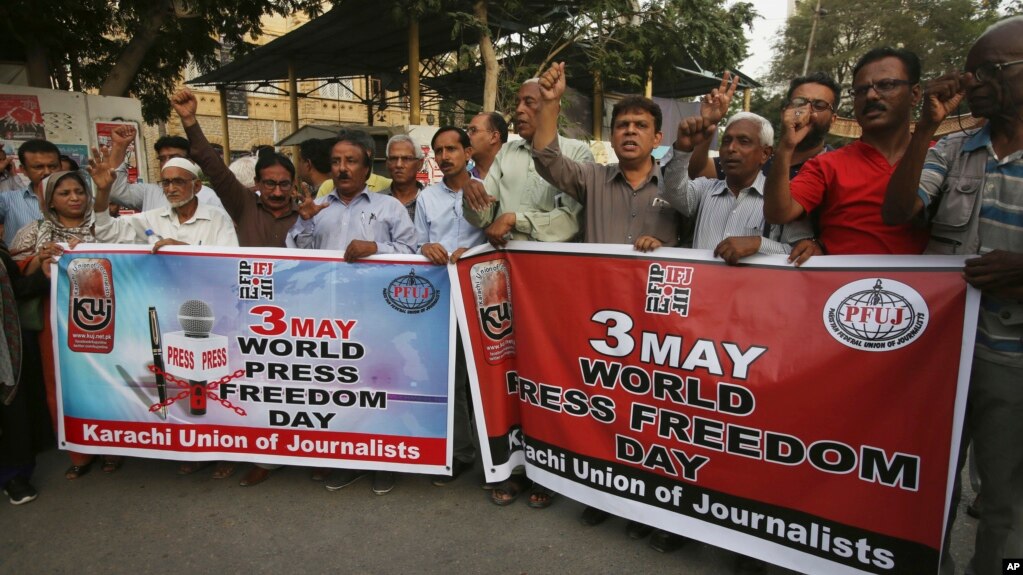
Various journalist unions across Pakistan protested Tuesday the direct and indirect intimidation they say they face while trying to do their job.
“The journalist is alive, Ayub saw it, Yahya saw it, now you will see it,” chanted a charged group of protesters in capital Islamabad calling out names of past dictators.
Pakistan has long been a dangerous country for journalists who report on issues like extremism, militancy, religious fundamentalism, or military interference in politics. A country with a history of military coups has recently witnessed an unprecedented period of civilian rule. But journalists say 10 years of democracy has not strengthened freedom of the press.
Veteran journalists Nasir Zaidi was one of the few who was flogged during the dictatorship of General Ziaul Haq in the 1980s. He called the current situation worse and more confusing for the working journalists, leading to an increasing trend of self-censorship.
“Today, we have a façade of democracy, the constitution is intact, but behind the scenes dark forces are using all means necessary to control journalism,” he said.
The “dark forces” is a euphemism for the country’s powerful military establishment and its intelligence agencies. According to the New York based Committee to Protect Journalists, Pakistan’s military uses both direct and indirect intimidation.
For several years, Pakistan was on the list of countries the CPJ considered most deadly for journalists. Its recent report acknowledges that killings of journalists in Pakistan has gone down. But it says the decline in deaths was accompanied by a decline in press freedom.
The report accuses the military of encouraging self-censorship.
“Journalists who push back or are overly critical of authorities are attacked, threatened, or arrested,” the report said.
Meanwhile, Pakistan’s new civilian government of Pakistan Tehreek e Insaf, elected in a July election, said it will ensure press freedom.
“We have a track record of freeing institutions of political interference in KPK,” said Faisal Javed Khan, a young senator of PTI, and additional secretary to the information minister. PTI is the ruling party in KPK province since 2013. He said, however, his government in the center was new and needed time to deliver on its promises.
On the other hand, PTI, which is considered close to the military, has already started facing criticism for its treatment of the media.
Journalist Umber Khairi wrote in her column in the Sunday edition of The News, an English language publication, that PTI had tried to block critical reporting by “threatening certain media groups with denial of access to official functions and personalities, uninviting their reporters and editors from meetings with the PM.”
A senior journalist and television anchor Nusrat Javed said media owners and editors in Pakistan are under pressure to either control or get rid of journalists deemed too critical of the establishment or the new government. The establishment in Pakistan is usually considered to be the powerful military and the intelligence agencies linked with it.
Earlier this week, prominent journalist Cyril Almeida was ordered to appear in court to face accusations of treason, a capital offense. He had published an on the record interview with former prime minister Nawaz Sharif in which Sharif talked about cross border terrorism, particularly an attack on Indian financial capital Mumbai in which more than 150 people, including Westerners, died. Sharif seemed to imply that Pakistan should do more to curb such attacks and the people responsible for it. India and the United States have long held Pakistan based group Lashkar e Taiba responsible for the attack. After the attack, the group was placed on the U.S. and U.N. lists of terrorist groups.
Amina Malik, the woman who filed the petition to charge Almeida, along with Sharif and another former Pakistani premier, Shahid Khaqan Abbasi, with treason said the Sharif interview damaged Pakistan’s reputation in the world and Almeida should never have published his comments.
“Article 19 of the constitution gives you the right to freedom of expression. But it does not give you the right to speak against your own country or your own institutions,” she said.
The Human Rights Commission of Pakistan said the journalist was “hounded for nothing more than doing his job” and that the move would “further choke press freedom in Pakistan.”
At Tuesday’s protest in Islamabad, organized by Pakistan Federal Union of Journalists, another veteran journalist said the combination of the threats to media with apparent freedom led to a culture of self-censorship.
“You don’t know which lines you could cross and which you couldn’t. So, in the fear of crossing the wrong lines, you decide not to publish or air a story,” he said.
https://www.voanews.com/a/pakistan-press-freedom/4607205.html

Tuesday, October 9, 2018

Video Report - Where is Jamal Khashoggi? Saudi Arabia denies abduction of missing journalist

Video Report - Media coverage of missing Saudi journalist Jamal Khashoggi

Video Report - Nikki Haley resigns: Why is the US ambassador to the UN stepping down?

Video Report - CNN poll: Democrats maintain a strong 2018 lead

Video Report - Hillary Clinton says Democrats can't be civil right now

Be Prepared for an India-Pakistan Limited War

Pakistan Army orders 2,550 fancy staff cars as govt seeks an IMF bailout

 and 

Amidst Pakistan’s economic crisis, army orders 2,550 staff cars
Jungjoo Gernail, an anonymous Twitter user known for his scathing remarks on the Pakistan Army, posted a confidential document on the social media platform that mentioned details of the organisation buying 2,550 staff cars for the forces.
According to the document, the cars are to be ordered from Honda Atlas Cars Pakistan Ltd at a whooping cost of Rs 4,057 million.
It further read that the old cars have “completed their life and the maintenance cost occurring on said cars are on higher side.”
Mere aziz humwatano!

Quit crying and pay increased prices for gas; while world no1 fauj gifts itself 2550 brand new Honda Atlas cars, ofcourse in national interest.
Gernail mocked the government for this step saying that the army has ordered so many cars thinking it was in the national interest.
He also took a dig at the government claiming that borrowing money may lead to growth of terrorism in the state. He referred to Saudi Arabia’s funding of Osama Bin Laden, who was killed by the US forces in Pakistan’s Abbottabad district.

Told Imran, we have bad experience when borrowing loans in arabon, make sure you negotiate well. He asked, which loan went bad? Replied, remember when arabs loaned bin laden??

https://theprint.in/go-to-pakistan/in-asia-bibi-blasphemy-case-pakistan-top-court-reserves-judgment/131772/ 

Saudi Arabia may not be part of CPEC, but Pakistan set to use Kingdom to offset growing Chinese debt

By  Vinay Kaura 
Pakistan has clarified that Saudi Arabia will not be made part of the Beijing-led China-Pakistan Economic Corridor (CPEC) framework and Riyadh's proposed investments in Pakistan are set to fall under a separate bilateral arrangement. Pakistan's new PTI government had recently claimed that Saudi Arabia was poised to become the third partner in the CPEC — that consists of major infrastructure projects in Pakistan. The announcement was made after Pakistani prime minister Imran Khan's first official State visit to Riyadh.

Ever since assuming power, the Khan-led government has been trying to make use of the CPEC as a bargaining chip in Pakistan's vital bilateral relationships. His government is seriously contemplating a reduction of its spending on the CPEC project that could rejuvenate its outdated rail network, while proposing several changes in the existing and future projects. These drastic measures are in part aimed to correcting a difficult financial condition aggravated by an unsustainable current account deficit.
Criticising his predecessor Nawaz Sharif, for lack of transparency in the CPEC projects, Khan has argued that the former prime minister could not visualise the fallout of massive inflows of Chinese machinery on the country's external finances. During his 6 October visit to Quetta, the capital of Balochistan province, he expressed complete awareness about the reservations of Baloch people about the CPEC projects. He asserted that "Balochistan would be paid more than its due share in the CPEC projects," while arguing that the province was ignored by the previous governments.

It needs to be recalled that immediately after Chinese foreign minister Wang Yi's Islamabad visit last month, a senior Pakistani government official termed his country's deals with China as "unfair" because the CPEC agreements tended to benefit Chinese companies alone. Abdul Razak Dawood, the prime minister's advisor, was quoted as saying that "the previous government did a bad job negotiating with China on CPEC — they didn’t do their homework correctly and didn’t negotiate correctly so they gave away a lot." However, the Pakistan government immediately swung into action and refuted this controversial statement while reaffirming the all-weather friendship between the two countries. Pakistan’s finance minister Asad Umar candidly admitted, "We don’t intend to handle this process like Mahathir (Mohamad, Prime Minister of Malaysia)." It needs to be mentioned that Kuala Lumpur has recently cancelled three major China-backed pipeline projects and put a showpiece Belt Road Initiative (BRI) rail link under the scanner.
After much dilly-dallying, Umar finally hinted on 5 October that Pakistan is going to apply to the International Monetary Fund (IMF) for a balance of payments bailout as he expressed Pakistan’s readiness to take "further corrective measures" proposed by the IMF to restore economic stability. But this bailout will not come without a political cost. Khan has been reluctant to seek an IMF bailout during his first 100 days in office because his electoral campaign had been based on getting rid of the begging bowl. This reasoning has led him to meet funding requirements from friendly countries as well as through bringing home foreign wealth of Pakistani nationals.
But the government's economic advisors are totally against this impracticable way as Pakistan requires around $12 billion of additional infusion during the current fiscal year. Moreover, the US secretary of state Mike Pompeo has publicly spoken against lending any American money by the IMF to Islamabad for settling Pakistan's Chinese debts.
It is understandable that the PTI government is looking to Riyadh to bail it out of its financial woes, which made Khan to break his so-called pledge of not travelling abroad in his first three months in office. Within four weeks of coming to power, his decision to visit Riyadh reflected the desperation of his situation as well as the fear of the political consequences of being seen weak among his supporters. He received a very warm welcome in Riyadh, which indicated a new beginning of a very critical relationship that was badly hit when the previous PML-N government refused to send Pakistani troops to Saudi Arabia to fight in Yemen in 2015. This fateful decision had also affected Pakistan's ties with other Gulf countries. But despite the recent lack of warmth in bilateral ties, the Kingdom’s close ties with the Pakistani military remains intact, as exemplified by the appointment of retired army chief Raheel Sharif as head of the so-called ‘Islamic alliance force’. However, Khan’s decision to invite Saudi Arabia to develop a refinery at Gwadar also indicates Pakistan’s willingness to serve its geopolitical interests through the CPEC. The Pakistani finance minister has admitted that Islamabad did not keep Beijing in the loop, and China was only informed of Pakistan’s intent to involve a third-party investor.Pakistan was also trying to use Gwadar as leverage to persuade Riyadh to provide Islamabad with oil on a deferred-payment basis which would substantially reduce the amount of borrowing from the IMF. The Saudis are equally interested in investing in some big-ticked projects in Pakistan as part of their "Vision 2030" development plans that seek to expand their economic horizons and diversify from a largely oil-based model through collaboration and foreign investments.The entry of Saudi Arabia in the equation — the most important non-NATO ally of the US in West Asia — clearly indicates the protection of American geopolitical interests in the CPEC, directly or indirectly. The ambitious Saudi crown prince Mohammad bin Salman has courted the Donald Trump administration to counter Iran's growing influence in the West Asian region. Salman has involved Saudi Arabia in a bloody military conflict in Yemen against the Iranian-backed Houthi militia. It is believed that Pakistan’s CPEC offer to Saudi Arabia to invest in western Balochistan bordering Iran and Afghanistan could upset Tehran. The fears that allowing Saudi Arabia to play an active role close to the Iranian border may fuel sectarian conflict in Pakistan are not entirely baseless. Moreover, Iran would certainly not desire a Saudi presence in Gwadar which is not very far from the Chabahar port.
Although Saudi Arabia has been China’s largest trading partner in West Asia, since the dynamics between them within the CPEC would redefine the engagement in West Asia in terms of global politics and economy, Beijing cannot be expected to remain a mute spectator to this sudden turn of events at a time of greater global geopolitical turbulence. Since the issue of issue of inviting Saudi Arabia into the CPEC involves a number of questions about new geopolitical alignments, the PTI government has taken a U-turn, at least in public. Speaking at a joint news conference with Pakistan's information minister Fawad Chaudhry on 2 October, Minister for Planning and Development Khusro Bakhtiar clarified that there was no decision to bring Saudi Arabia under the framework of the CPEC. He said, "Saudi Arabia is not to become a collateral strategic partner in the CPEC. This impression is not true... The framework between China and Pakistan is bilateral, and Saudi Arabia is not entering that framework as a third-party investor, rather the base of CPEC will be broadened and its pace will be expedited."
Whatever the semantics, there is a strong possibility that Saudi Arabia is going to invest heavily in Pakistan's infrastructure projects, within or without the CPEC.
China has been turning the CPEC into a grand project to maintain incontestable hegemony in Pakistan. Beijing continued to believe that Pakistani government would remain perpetually loyal to China for the CPEC windfall and keep on reaping its benefits without hesitation or any hint of incredulity to Pakistani people, however inconsistent, contradictory, or at odds with the ground realities. This has become unsustainable now. Most surprisingly, Maulana Samiul Haq, who is known as the 'Father of the Taliban', and who favours more Chinese involvement in the resolution of the Afghan conflict, has urged the PTI government to treat China with caution while dealing with a worsening financial crisis. He is reported to have said, "I don’t approve of a relationship that leads us to slavery. Given their (Chinese) handling of Muslims at home, the Chinese will behave like the British East India Company once they dig their feet deeper into Pakistan." As local resentment has begun to move from the streets to government, China seems to be facing the growing challenge of a tactical shift in Pakistan’s official tone from uncritical gratitude to grudging support.
Trying to prevail over critically fragile public finances as well as realising the advantages of hard-bitten realism, Khan has begun to make concerted efforts to revise the terms of engagement on the CPEC projects. When he goes to China in November for a week-long official visit, Beijing is expected to try hard to pacify him by offering more agreeable terms of CPEC projects as well as by agreeing to reschedule some of the bilateral debt. This development simply vindicates India's s principled stand of consistently opposing the Chinese model of infrastructure development through its ambitious BRI which is nothing but a disguised form of ‘debt-trap diplomacy’. Therefore, India should continue to work with the US and other partners in the Indo-Pacific region to develop credible alternatives to the China-led BRI.
https://www.firstpost.com/world/saudi-arabia-may-not-be-part-of-cpec-but-pakistan-set-to-use-kingdom-to-leverage-chinese-debt-5336801.html

Dollar closes at all-time high of Rs133.6 as #Pakistan goes to #IMF

The dollar closed at its highest ever rate of Rs133.6 on Tuesday after another round of the rupee’s depreciation as news broke of Pakistan seeking an IMF bailout.
The dollar surged by Rs9.26 and was traded at Rs133.6 at the close of the interbank market. This was the biggest single day jump in the dollar rate this year.

Its interbank rate at the close of market was up Rs9.26 or 7.4% from the previous day’s tally of Rs124.33.
On Monday, Prime Minister Imran Khan gave a green signal to his finance team for an IMF programme when they meet representatives of the Washington-based lender in Bali later this week. The loan will save Pakistan from defaulting on foreign payments. However, it comes with its own set of restrictions.
One of the conditions is a free float exchange rate as opposed to a managed exchange rate. This means that the central bank will not intervene in the market, and let market forces determine the actual rate of the US dollar against the Pakistani rupee. And this is precisely what seems to have happened.
The dollar surged to Rs133.6, up 7.4% from Monday’s rate of Rs124.3. This is because the central bank is not selling dollars in the market or asking other banks to do it, say market sources.
“Yes, there is an upward movement in the dollar and market expectations are driving it,” State Bank of Pakistan Chief Spokesperson Abid Qamar told SAMAA Digital.
The government decision to seek an IMF bailout package affected market expectations, Qamar said, adding that in such situations the dollar initially shoots up but settles at a lower rate by the day’s end.
The SBP spokesperson said that he could not quote any rate at the moment because there were more than 30 banks quoting different rates, and it was changing every minute. “We will know the actual rate and the high and low points when the market closes. All banks report their exchange rates to us,” he said.
The interbank market rate is the benchmark rate to evaluate the dollar’s value, according to experts.
It is the interbank rate that determines the open market rate, which is usually slightly above the former, but does not indicate the actual value of the dollar.
Pakistan is seeking the IMF loan programme because its monthly imports exceed its exports by $2.7 billion, which leaves it with fewer reserves than it needs to pay for essential imports (oil, raw materials, machinery etc), and to repay its foreign loans (more than $90 billion).
According to the latest data, the government has $8.4 billion in reserves, which is the lowest level of foreign exchange reserves in the last four years and is not enough to sustain even two months of imports. During the tenure of former finance minister Ishaq Dar, the government used these reserves to manage the exchange rate at Rs106. The policy was criticised by both international and local experts.
Once Dar stepped down, the Pakistani rupee experienced several episodes of depreciation against the US dollar. Since December 2017, the dollar has appreciated 18% but sources familiar with the matter say the IMF wants Pakistan to shift from a managed exchange rate regime to a free-float regime, allowing market sources to determine dollar value.
If Pakistan adjusts its exchange rate, experts believe that the dollar will shoot up to Rs140, and may even hit Rs150. However, others believe that it will settle at around Rs135.

https://www.samaa.tv/news/2018/10/dollar-surges-to-rs134-as-pakistan-seeks-bailout-from-imf/

Economics Pakistan Devalues Rupee as It Prepares to Seek 13th IMF Bailout

By Kamran Haider and Faseeh Mangi
Pakistan devalued its currency while its stocks and bonds rose after the government said it would seek the nation’s 13th International Monetary Fund bailout since the late 1980s in a bid to stabilize the economy.
The South Asian nation’s key stock measure snapped six days of losses to advance 1.6 percent, the most in three weeks, at the close while its dollar-denominated bonds maturing in 2027 climbed the most since July 26 before paring gains. The rupee, a managed float, fell 7.5 percent to 133.64 against the dollar, the most in a single day since Bloomberg started tracking data from 2000. The move is speculated to have been pushed by authorities in response to the IMF’s calls for a weaker exchange rate.
After consulting with “leading economists”, Pakistan will formally approach the IMF for support and Finance Minister Asad Umar will hold talks with officials during the lender’s annual meetings in Bali this week, the Finance Ministry said in a statement late Monday. Umar told Bloomberg in August that the government may need more than $12 billion. Prime Minister Imran Khan, who came to power after July elections, is under pressure to generate external funding as the country faces the latest in a long line of financial blowouts. The IMF said last week that recent government efforts haven’t been sufficient to stem a looming crisis.
“The challenge for the current government is to ensure that fundamental economic structural reforms are carried out to ensure that this spiral of being in an IMF program every few years is broken once and for all,” the Finance Ministry said. “To correct the underlying imbalances, fiscal and monetary actions needed to be undertaken without delay.”
Foreign-currency reserves have plunged 40 percent in 2018 to the lowest in almost four years, while the nation is running twin current-account and budget deficits of more than 5 percent of gross domestic product. Authorities have devalued the rupee multiple times since December.The currency’s latest drop comes after the IMF repeatedly stated that the rupee was overvalued. “The currency move is definitely a devaluation,” said Shahid Habib, chief executive officer at Arif Habib Ltd.“The market knows the macroeconomic conditions and based on those, they are having their own expectations for the exchange rate,” said Abid Qamar, a spokesman at Pakistan’s central bank.
The central bank has raised interest rates to the highest in three years to help shore up confidence in the economy.
Bailout Addiction
“Going to the IMF was a matter of when, not if. For an economy that has become addicted to foreign loans and bailouts, the future is very much like the past,” said Uzair Younus, a South Asia director at Washington-based consultancy Albright Stonebridge Group LLC. “Pakistan may very well find itself seeking another bailout in the next three to four years if it does not do structural reforms.”
The government has deep problems to fix. Less than 1 percent of the nation’s more than 200 million people file tax returns and its exports, including textiles, lag the region. However, Pakistan has yet to formally approach the IMF, the lender’s Chief Economist Maurice Obstfeld told reporters in Bali.
“We’ll be listening very attentively when and if they come to us,” Obstfeld said. “The government expressed a desire to enact deep structural reforms that might break the cycle of Pakistan needing financial support from the fund frequently. That is a very good sign going forward.”
U.S. Approval
Islamabad has also taken on projects valued at more than $60 billion that include loans from China to bolster its decrepit infrastructure. Critics see that as part of a debt diplomacy trap by Beijing and question whether Pakistan will be ever be able to make the repayments.
Those vast debts have prompted worries from U.S. Secretary of State Mike Pompeo, who warned in July that he would be watching to see if Khan’s government uses IMF funds to pay off the opaque Chinese loans. “Securing U.S. approval on the IMF Executive Board will require Pakistan to strike a fine geopolitical balance between the Trump administration’s concerns over China’s growing economic engagement in Pakistan and the country’s bilateral commitments,” said Bilal Khan, a senior economist at Standard Chartered Plc.
Pakistan’s economic outlook is also at risk from eroding gains in macroeconomic stability and growth may moderate to 4 percent in 2019 and slow to about 3 percent in the medium term, the IMF said on Tuesday.
“We will have to swallow this bitter pill,” Pakistan’s Maritime Affairs Minister Syed Ali Haider Zaidi told Bloomberg in Karachi on Tuesday. “We have looked at all our options.”


https://www.bloomberg.com/news/articles/2018-10-08/pakistan-to-seek-imf-bailout-to-stabilize-deteriorating-finances