Sunday, August 26, 2018

Imran Khan wants to create a Medina-like Pakistan but he is no sentinel of human rights


By GUL BUKHARI
Imran Khan’s die-hard fans refuse to acknowledge the infinite contradictions in the man and his less-than-holy rise to the top.
Imran Khan has promised to deliver to his citizens a Naya Pakistan based on Medina, a city founded by Prophet Muhammad in the 7th Century. Cynically manipulating the sense of prevailing deprivation and inequality, Khan offered them a grand mirage by locating the country in the golden era of a perfect Islamic society.
In his victory speech, he referred to the humanitarian and egalitarian grounds on which Medina was built and the rights given to the downtrodden, the widows, the orphans in the city.
Khan invoked the traditional Islamic Hadith about the Khalifa Hazrat Umar (one of the most powerful caliphs) who had said he could not sleep easy at night even if a dog went hungry in his administered state. I immediately thought of Imran Khan’s own poor dog, who he is said to have almost run over and not given a toss about while driving home with his second wife Reham Khan.
Of course, the responsibility of a hungry dog was also invoked by Gen Zia ul-Haq in his post-coup speech.
That hungry and thirsty dog on the banks of Euphrates will continue to be used in speeches...

I also thought of the donkey his supporters painted Nawaz Sharif’s name on and tortured to death – and the lack of any statement from Imran Khan over the inhuman and cruel treatment of a helpless animal in a vile and puerile game of political scoring. Such is his detachment in reality from the notions of a kind society that he did not even think to condemn supporters of his arch-rival and former Prime Minister Nawaz Sharif when they shot a dog after painting Imran Khan’s name over its body.
Setting aside donkeys and dogs, Khan has never raised a voice for human rights activists and journalists abducted and tortured for dissenting against or criticising his patrons’ political meddling. He has not stammered out a defence once for the Pakistani media, which is in fetters because it is instructed to censor speeches and events of his opponents and protect Khan and his party. Khan has implicitly encouraged attacks, abuse and threats against his detractors on social media by never condemning them and he has encouraged vigilante violence on his opponents by accusing them time and again of blasphemy.
Khan speaks of Medina as a utopia, a heaven for human rights and an egalitarian society that he wants to replicate in Pakistan. If his records on these issues in the recent past are any indication of his future conduct, one shudders to think of the Medina he will create.
It would be too embarrassing to mention all the nominated speakers and cabinet members of the new Medina, but to name just a few: the speaker of the Punjab assembly Pervaiz Elahi is someone Imran Khan had nicknamed ‘Punjab ka sabb se bara daku’ and is now busy taking back corruption charges he filed against the man back in the day. The chief minister of Punjab Usman Buzdar has criminal records for murdering six men and getting off by paying blood money. The chief minister of Khyber Pakhtunkhwa Mehmood Khan was kicked out of the KP cabinet for corruption charges against him, proven by Imran Khan himself. Defence minister Pervez Khattak is someone who has massive cases of corruption against him.
In his widely-praised victory speech after the elections, Khan remained at pains to drive home to the audiences that he drew his inspiration for a new Pakistani state from the welfare state created by the Prophet Muhammad; that his government policies would revolve around upliftment the weak, like the labourers and farmers who do not get their due and are not able to feed their children.
The mention of farmers brings to mind Khan’s right-hand man for the past five years, Jahangir Tareen, a prominent actor within the sugar producers’ cartel in Pakistan. The cartel is alleged to have regularly cheated farmers out of their due by refusing to buy crops on time to depress prices. Tareen is also a convicted insider-trader, having bought and sold stock market shares through his cook and gardener after having manipulated prices whilst being a minister in General Musharraf’s regime. He got away by simply returning the swindled money to the Securities and Exchange Commission of Pakistan instead of being fined and jailed, because he was part of the dictator’s cabinet. The ‘weakest of the weak’ mention also brings to mind transgenders in Khyber Pakhtunkhwa who were killed with impunity throughout the Khan government’s tenure in the province. KP was the only province which caved into Islamist pressure when it came to legislating against violence that women faced, and sent the women’s protection bill to the Council of Islamic Ideology instead. All other provinces fought to successfully legislate for protection of women, children and minorities.
Khan also made an abrupt reference to China’s success in alleviating poverty, rather incongruously, while talking about his mirage of an Islamic welfare state. He mentioned ‘rule of law’ and ‘equal before the law’, but he has trampled upon it and climbed on the shoulders of those not considered ‘equal before the law’ to reach the top.
It is ironical that this ‘rule of law’ and ‘equality before the law’ exonerated Imran Khan and his cronies. No matter how many offshore companies, undisclosed properties or bank accounts, fake no-objection-certificates or affidavits, perjury in court, undisclosed offspring in election nomination forms, the ‘rule of law’ smiled upon Imran Khan and his party. Conversely, it frowned upon opponents for supposed misdemeanours 30 years ago, or it simply arrested his opponents to prevent them from contesting elections before charges were framed against them.
Khan has climbed the rubble of the Pakistani constitution, law, institutions, and democracy created by military gunships and tanks to reach the top of a pile of a sorry mess to croon of a Medina to a divided country. His die-hard fans refuse to acknowledge or reconcile the unforgivably infinite contradictions about the man and his less-than-holy rise – in an era where he could have fought an honest battle.
https://theprint.in/opinion/imran-khan-wants-to-create-a-medina-like-pakistan-but-he-is-no-sentinel-of-human-rights/104903/

Saturday, August 25, 2018

Elissa - Hob Kol Hayati- إليسا - حب كل حياتي

Video - Christiane Amanpour - Being “Truthful, Not Neutral” | The Daily Show

#SaudiStruggle - Canada criticises Saudi Arabia again over jailed activists


Foreign ministry says it is 'extremely concerned' for detained rights activists, including Israa al-Ghomgham, who faces the death penalty.

The Canadian foreign ministry has once again criticised Saudi Arabia for its crackdown on rights activists, after reports emerged this week of a female human rights defender facing possible execution in the kingdom.
Diplomatic relations between two countries were ruptured earlier this month after the foreign ministry urged Saudi Arabia in a tweet to “immediately release” women’s rights and human rights activists held in its jails.
Saudi Arabia has since recalled its ambassador, suspended trade and flights to and from Canada, and forced Saudi students and patients to leave, among other measures.
On Wednesday, Canada's foreign ministry reiterated its concern for women’s rights activists, including Israa al-Ghomgham, a Saudi human rights activist sentenced to death early this month.  
“Canada is extremely concerned by the arrests of women’s rights activists,” Adam Austen, a spokesperson for the foreign affairs minister, Chrystia Freeland, told Canada's Globe and Mail newspaper.
“These concerns have been raised with the Saudi government. Canada will always stand up for the protection of human rights, including women’s rights and freedom of expression around the world.”
On 6 August, the Saudi public prosecutor recommended a death penalty for Ghomgham and five others, including her husband Moussa al-Hashem, after their first hearing before the Specialised Criminal Court (SCC) in the capital Riyadh.
The six defendants had been in pre-trial detention for nearly three years on charges of organising anti-government protests, incitement to disobedience of the ruler, and providing moral support to participants in anti-government protests in the Shia-majority eastern region of Qatif.
Saudi human rights activists have told Middle East Eye that Ghomgham could possibly face beheading after a final court session scheduled for 28 October. The execution of a female activist would be a dangerous precedent, particularly since all the charges against her are related to her peaceful activism, they said.
Executions, most commonly beheadings, usually take place in Saudi Arabia after the decision is ratified by the king - in this case, King Salman bin Abdulaziz.

'Revenge against the Arab Spring'

Ghomgham, 29, and Hashem were arrested on 8 December 2015 at their house in Qatif. She had been a leading figure in the anti-government protests organised in Qatif since 2011, mainly demanding an end to discrimination against the Shia minority and the release of political prisoners.
“[The sentencing of Ghomgham] is largely a revenge against the Arab Spring, and a punishment for Qatif, which witnessed the largest protests since 2011,” Ali Adubisi, the director of the European Saudi Organisation for Human Rights (ESOHR), told MEE earlier this week
According to ESOHR's latest tally, at least 58 people, most of them Shia, are currently on death row in Saudi Arabia, 31 of whom had their verdicts confirmed by the high court.
Human Rights Watch condemned the death penalty in a statement on Tuesday.
“Any execution is appalling, but seeking the death penalty for activists like Israa al-Ghomgham, who are not even accused of violent behaviour, is monstrous,” said Sarah Leah Whitson, Middle East director at Human Rights Watch. “Every day, the Saudi monarchy’s unrestrained despotism makes it harder for its public relations teams to spin the fairy tale of ‘reform’ to allies and international business.”
According to Human Rights Watch, at least 13 women’s rights activists have been detained recently in Saudi Arabia. Those currently in jail are Samar Badawi, who has family members in Canada, Loujain al-Hathloul, Aziza al-Yousef, Eman al-Nafjan, Nouf Abdelaziz, Mayaa al-Zahrani, Hatoon al-Fassi, Nassema al-Sadah, and Amal al-Harbi.
MEE has asked the Canadian foreign ministry and the Saudi embassy in London to comment.

#YemenWar - Saudi-led coalition has failed to credibly investigate Yemen strikes: HRW


According to Human Rights Watch, coalition members have evaded accountability thanks to an opaque internal investigation system.

Despite mounting evidence of violations of international law in the ongoing conflict in Yemen, investigations by coalition forces have been “woefully inadequate” and contributed to shielding participating countries from being held accountable, according to a Human Rights Watch report released on Friday.
The report, titled “Hiding Behind the Coalition: Failure to Credibly Investigate and Provide Redress for Unlawful Attacks in Yemen”, details the Saudi-led coalition investigative body’s “failure” to adequately investigate abuses.
Since March 2015, coalition officials have repeatedly made false statements about coalition compliance with the laws of the war
- Human Rights Watch 
The Saudi-led alliance has intervened since 2015 to back the country’s internationally recognised government after Houthi rebels forced President Abed Rabbuh Mansour Hadi out of the capital, Sanaa.
The coalition’s investigative body - the subject of the report - has a mandate to investigate, collect evidence and issue recommendations on “claims and accidents” during coalition operations  in Yemen.
But according to HRW, the Joint Incidents Assessment Team (JIAT) has dismissed allegations of coalition violations, or “severely” downplayed their scope. The report also criticises JIAT’s lack of transparency in their methods of investigation.

The UN has documented 6,592 civilian deaths and the wounding of 10,470 in Yemen, with air strikes by the Saudi-led coalition causing the majority of the verified civilian casualties. “The limited information available to the public shows a general failing by JIAT - for unclear reasons - to provide credible, impartial, and transparent investigations into alleged coalition laws-of-war violations,” the report said. 
The Saudi-led campaign exacerbated the humanitarian impact of the war through intense aerial bombardments, causing mass civilian casualties. Saudi control of ports of entry and exit has hindered the delivery of food and basic necessities, creating what has been deemed the world's largest humanitarian catastrophe.
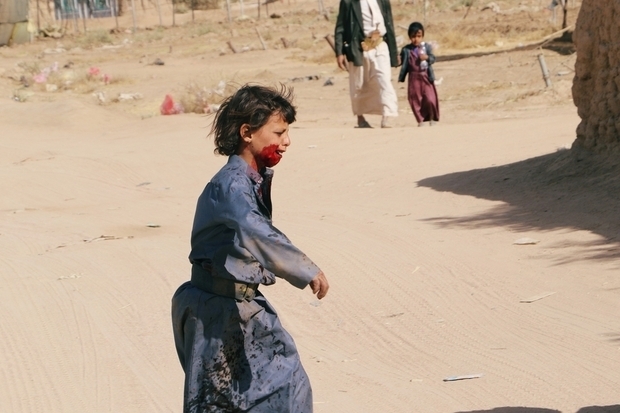
An injured boy cries as he flees an area where air strikes hit a house in Saada, Yemen on 27 February, 2018 (Reuters)
The report accuses coalition members of seeking to evade their “international legal obligation to investigate alleged laws-of-war violations by their forces by hiding behind the coalition and not providing information about their role in possibly unlawful air strikes.”
Under the 1949 Geneva Conventions, states are obligated to use their influence to prevent violations of the laws of war.
Saudi Crown Prince Mohammed bin Salman has served as the commander of the coalition since March 2015, and he oversaw the first air strike.
According to the report, JIAT has failed to provide information on the various forces involved in specific air strikes, effectively shielding coalition states involved in violations.
Human Rights Watch examined the way in which investigations were carried out by JIAT, asserting that the body “has failed to meet international standards regarding transparency, impartiality, and independence”.
“JIAT appears only to have investigated coalition air strikes, but not other alleged violations of international law by coalition members, such as UAE abuses against people in detention,” the report added.
In six of the attacks discussed in the report, Human Rights Watch identified US-origin munitions used in the attack.
The report also calls for the US to publicly clarify its role in the conflict in Yemen. 
A coalition air strike hit a school bus earlier this month in Yemen's northern Saada province, killing scores of people including at least 40 children. An investigation by the Washington Post found that US munition was used in the deadly attack.
Meanwhile, 27 civilians, the majority of them children, were killed by an alleged coalition air strike on Thursday evening as they were trying to flee the embattled city of Hodeidah. 

Video Report - War in #Yemen: Eid Al-Adha a difficult time for Yemeni refugees

Video Report - Sweden: Truth, lies & manipulated narratives? - BBC Newsnight

#US - #China trade war: the end of free #trade as we know it?

Video Report - U.S.-China tensions rise over trade war and Taiwan

Video Report - Scaramucci: 'Nightmare' if Trump fires Sessions

Video Report - #CNN obtains copy of former Trump World Tower doorman's agreement

Video Report - - ‘All Bolton did was threaten people’ – Ron Paul on US-Russia security meeting

Music Video - #AhmedFaraz - AB KE HUM BICHDE TO SHAYAD KABHI KHWABON MAIN MILE - MEHDI HASSAN.

Video - #AhmedFaraz - پیشہ ور قاتلو - احمد فراز

#MiranshahSitIn - میرانشاہ میں دھرنا، ’ذمہ دار افسران کا کورٹ مارشل کیا جائے‘

خیبر پختونخوا میں ضم ہونے والے قبائلی علاقے شمالی وزیرستان میں مقامی افراد نے جمعہ کو مبینہ طور پر فائرنگ کے نتیجے میں دو افراد کی ہلاکت کے خلاف میرانشاہ بازار میں دھرنا دیا ہوا ہے اور مطالبہ کیا ہے کہ ذمہ دار افسران کا کورٹ مارشل کیا جائے۔
شمالی ویرستان سے نومنتخب رکن قومی اسمبلی اور پختون تحفظ موومنٹ کے رہنما محسن داوڑ اس دھرنے میں موجود ہیں۔
انھوں نے ایک ویڈیو پیغام میں کہا ہے کہ ’پرامن احتجاج کرنے والے مقامی افراد پر فائرنگ کی گئی ہے جس کے خلاف یہ دھرنا دیا گیا ہے۔‘
محسن داوڑ کا کہنا تھا کہ ’کہیں بھی اگر کوئی دھماکہ ہو جاتا ہے تو اس علاقے میں آپریشن شروع کر دیا جاتا ہے، لوگوں کو گرفتار کر کے ان پر تشدد کیا جاتا ہے اور لوگوں کی بے عزتی کی جاتی ہے۔ دھرنا اس وقت تک جاری رہے گا جب تک ذمہ دار افسران کا کورٹ مارشل نہیں کیا جاتا۔‘
تاہم مقامی لوگوں نے بتایا کہ مظاہرین نے شام کے وقت ایک 11 رکنی کمیٹی قائم کی ہے جو انتظامیہ اور دیگر حکام سے مذاکرات کر رہے ہیں۔
جمعے کے روز میرانشاہ سے چند کلومیٹر دور مغرب میں ہمزونی گاؤں کے افراد غیر قانونی گرفتاریوں کے خلاف احتجاج کر رہے تھے اور جب مظاہرین سکیورٹی فورسز کی چوکی کے قریب پہنچے تو وہاں فائرنگ کی گئی۔
مقامی لوگوں کا دعویٰ ہے کہ سکیورٹی اہلکاروں نے مظاہرین پر فائرنگ کی ہے جس میں اب تک دو افراد ہلاک اور چھ زخمی ہوئے ہیں۔
یہ دھرنا میرانشاہ بازار ہسپتال کے سامنے دیا گیا ہے جہاں عینی شاہدین کے مطابق بڑی تعداد میں لوگ موجود ہیں۔
اس دھرنے کے لیے مختلف علاقوں جیسے جنوبی وزیرستان، باجوڑ اور خیبر پختونخوا کے مختلف علاقوں سے لوگ پہنچے ہیں۔
مقامی لوگوں نے بتایا کہ جمعہ کو فائرنگ کے واقعے کے بعد لوگ مشتعل ہو گئے تھے اور بھرپور احتجاج کیا اور سنیچر کی صبح سے دھرنا جاری ہے۔
اس بارے میں ضلعی انتظامیہ کے دفتر رابطے کی کوششیں کی گئیں لیکن کسی سے رابطہ نہیں ہو سکا تھا۔
صفدرتصویر کے کاپی رائٹSAFDAR DAWAR
یہ احتجاج علاقے میں دھماکوں کے بعد کی جانے والی گرفتاریوں کے خلاف کیا جا رہا تھا ۔ مقامی لوگوں نے بتایا کہ اس علاقے میں چند روز پہلے ایک دھماکے کے بعد سرچ آپریشن میں سکیورٹی فورسز نے گرفتاریاں کی تھیں۔
اسی علاقے میں کچھ عرصہ پہلے بھی گرفتاریاں کی گئی تھیں جس پر مقامی لوگوں نے احتجاج کیا تھا جب شدت پسندوں کے حملے میں ایک فوجی افسر ہلاک ہو گئے تھے۔
چند روز پہلے میرانشاہ سے چند کلومیٹر دور ڈانڈے کلے میں سکیورٹی فورسز کے بم ڈسپوزل سکواڈ کے قریب دیسی ساختہ بم دھماکہ ہوا تھا جس میں ایک اہلکار ہلاک اور تین زخمی ہو گئے تھے۔
یاد رہے کہ شمالی وزیرستان میں آپریشن ضرب عضب جون سال 2014 میں شروع کیا گیا تھا جس سے کوئی دس لاکھ لوگوں نے نقل مکانی کی تھی۔ گذشتہ سال اکثر متاثرین اپنے علاقوں کو واپس چلے گئے تھے لیکن اب بھی کچھ علاقے ایسے ہیں جہاں متاثرین کی واپسی نہیں ہو سکی۔

#Pakistan - #Ahmedi Muslim's worship place burnt down, 30 injured in #Faisalabad


At least 30 people, including six belonging to Ahmadiyya community, were injured and Ahmedis’ place of worship was set on fire after a petty dispute was blown out of proportion into a violent clash in Faisalabad’s Ghaseetpura area on the second day of Eid.
According to an FIR registered on behalf of the state at police station concerned, the dispute took place at 7:30pm between a group of youth over a chicken belonging to an Ahmedi ran over by a person from another group.
After a heated argument, slogans were raised, shots were fired, stones were pelted, and a nearby Ahmedi place of worship was ransacked and set on fire — all in the presence of police officials, reported a media outlet.
According to a tweet shared by Jamaat Ahmadiyya Spokesperson Saleemuddin, a minor altercation between two individuals was “manipulated by mullahs and miscreants” to attack the worship place. The mob, allegedly armed with weapons, ransacked the worship place and set it on fire, the spokesperson claimed on his twitter handle. “As a result of the firing, at least six people got wounded.”
Over a minor dispute between 2 persons that was manipulated by mullahs & miscreants an armed mob attacked Ahmadiyya Baitulzikr in Chak 69 RB (Ghaseetpura) district Faisalabad. 6 Ahmadis got injured in the attack. Situation is relatively under control but tense.
چک ۶۹ رب گھسیٹ پورہ ضلع فیصل آباد میں دو آشخاص کے درمیان ہونے والے معمولی نوعیت کے تنازعہ کو ہوا دیکر مذہبی ایشو بنا کر احمدیہ بیت الذکر پر مسلح حملہ کیا گیا بیت الذکر کو آگ لگائی گئی اور توڑ پھوڑ کی گئی فائرنگ بھی کی گئی جس کے نتیجہ میں ۶ احمدی افراد زخمی ہیں ۔
Talking to Pakistan Today, Balochni Police Station SHO [Station House Officer] Zahid Abbas said that the dispute between the two groups was not religious in nature at first.
“Ahmedis had attacked the houses of the other group first over a minor dispute,” he claimed, adding that following the attack the other group gathered outside the Ahmedis’ place of worship and started pelting stones at it. “The first shot was fired from inside the place of worship,” he further claimed.
“The situation was so tense, if the police hadn’t reached the spot on time, there would have been much more loss of lives and properties,” Zahid claimed.
Responding to a question pertaining to the news doing rounds on social media, saying that the houses of Ahmedis were also burned down, Zahid said that no other place was harmed or attacked except for the place of worship.
However, Mian Amer Mehmood, in charge of the community’s press section, alleged that besides the place of worship, a shop belonging to a community member was also attacked.
Information Minister Fawad Chaudary played down the incident, saying it was a clash that had nothing to do with religion as it was ‘personal clash’ between two individuals.
A case has been registered under sections 324 (attempt to commit qatl-i-amd), 295-A (deliberate and malicious acts intended to outrage religious feelings of any class by insulting its religion or religious beliefs), 436 (mischief by fire or explosive substance with intent to destroy house, etc.), 427 (mischief causing damage to the amount of fifty rupees or upwards), 148 (rioting, armed with deadly weapon), 149 (every member of unlawful assembly guilty of offence committed in prosecution of common object) of the Pakistan Penal Code and section 7 (punishment for acts of terrorism) of the Anti-Terrorism Act, 1997.
On May 24, 2018, a similar incident took place in Sialkot when a mob— allegedly comprising members of Tehreek-e-Labbaik Ya Rasool Allah (TRLY) and Pakistan Tehreek-e-Insaf (PTI)— in connivance with the Tehsil Municipal Administration (TMA) and police officials had attacked an Ahmedi place of worship.
According to 2017 annual report released by Ahmedi community, at least “77 Ahmedis were booked under discriminatory religious laws in 2017, with nine still in prison “on faith-related allegations”, and four Ahmedis were murdered in hate crimes in Pakistan”. While another report on Pakistani media listed 3,936 news items and 532 editorial pieces from Pakistan’s Urdu-language media that contained “hate propaganda” against the Ahmedi community.

#Pakistan - #SHIA MUSLIMS PROTEST ON EIDUL AZHA AGAINST TARGETED KILLINGS

Majlis-e-Wahdat-e-Muslimeen (MWM), Asgharia Organisation and their student wing observed a day of protest against the targeted killings of Shia Muslims in Dera Ismail Khan and tragic death of Allama Hassan Javadi who was subjected to enforced death and torture that triggered his death.

MWM Sindh chapter secretary general Allama Maqsood Ali Domki addressed the main congregation of the protesters where he condemned the takfiri terrorists of banned outfits for killings innocent Shia Muslims in Dera Ismail Khan.
He also denounced the rogue elements who picked up Allama Hassan Javadi son of Allama Haider Ali Javadi from his house at midnight and subjected him to enforced disappearance for four months in which he suffered fatal kidney disease and died within days after release from captivity.
The supporters of MWM, AO and other sympathizers wore black armbands as a token of protest against the targeted murders of Shia Muslims in Dera Ismail Khan.
“Religious scholar Hassan Javadi was taken into illegal custody four months ago and was detained illegally and subjected to torture during detention,” he said, adding that he died of kidney failure within days after release while he was admitted at SIUT for treatment.
Allama Domki said a peaceful and law-abiding patriot religious scholar Hassan Javadi, son of renowned senior Shia scholar Allama Haider Ali Javadi was picked up like criminals without any formal charge against him and he was subjected to unjustifiable torture. He demanded action against those responsible for his death and capital punishment to those who are killing Shia Muslims.

http://www.shiitenews.org/index.php/pakistan/item/35383-shia-muslims-protest-on-eidul-azha-against-targeted-killings

#AhmedFaraz - Suna Hai Log Usay Ankh Bhar Ke Dekhte Hain

#AhmedFaraz - Death Anniversary of Ahmed Faraz being observed today

Death anniversary of renowned poet Ahmed Faraz is being observed today on August 25.
The real name of Ahmed Faraz was Syed Ahmad Shah and he was born in Kohat on 12th January in 1931. He was awarded with numerous awards including Adam Jee Literary Award, Sitara-e-Imtiaz and Hilal-e-Imtiaz.
Ahmed Faraz did his Masters in Urdu, Persian, and English literature and began his practical life from Radio Pakistan. Later he joined Peshawar University as lecturer.
His works include Tanha Tanha, Dard-e-Ashub, Nayaft, Shab Khoon, Meray Khwab Reza Reza, Janan Janan, Beawaz Gali Kochon Mein, Nabina Shehr, Sub Awazein Meri Hein, Pasandaz Mausam. Bodlik, Ghazal Bahana Karun, and Aye Ishq-e-Junoon.
Ahmed Faraz died in Islamabad on August 25, 2008 and was laid to rest at main graveyard of Islamabad.


https://nation.com.pk/25-Aug-2018/death-anniversary-of-ahmed-faraz-being-observed-today

#Pakistani-origin mathematicians in the world, zero: A Pakistani Hawking?


By Pervez Hoodbhoy

WHEN the legendary physicist Stephen Hawking died earlier this year, it was headline news across the world. Soon thereafter universities and colleges in Lahore and Islamabad asked me to speak upon his life and scientific work before non-scientific audiences. The Q&A sessions that followed were interesting reflections of the current mindset of young Pakistanis. Their concern and fear about the relation between science and religion was also apparent.
One earnest student — staggered by the depth of questions that Hawking had attempted to answer — wistfully asked me: Sir, when do you think there will be a Pakistani Stephen Hawking? Don’t we have the resources?
It seems like a fair question. Pakistan has produced good cricketers, squash players, fighter pilots, soldiers, musicians, artists, poets, writers, and doctors. Pakistani-origin entrepreneurs have hit it big in Silicon Valley and Pakistani-origin doctors in America are fabulously rich. Searching the faculty list of American and European universities you will also find some Pakistani-origin faculty — mostly historians, political scientists, economists, and even a few biologists and medical researchers.
And yet, totally absent are mathematicians. My web search for Pakistani-origin mathematicians in the world’s 20 top math departments yielded exactly zero; the only South Asian names are Indian (and there are plenty of them). I saw some Iranian names as well. And, of course, the Chinese are always present.
Pakistan has produced many good cricketers and businessmen but not a single mathematician.
Next, I looked at second-tier overseas universities. Again, this drew a blank. You simply do not find Pakistani names on the faculty of math departments. Physicists are only slightly more plentiful. A web search, together with estimates from six overseas colleagues who I contacted before writing this article, suggests there are only 15-20 Pakistani-origin physicists (all fields, not just theoretical) who hold faculty positions in the entire Western world.
What explains this damning intellectual poverty? Money is not the issue. The theoretical sciences demand no expensive equipment or elaborate laboratories. All that’s needed is good school education that forms nimble minds adept at problem solving, followed by higher education with professors who actually know their math-physics.
This condition is not fulfilled. Pakistan’s university math departments are 90 per cent junk, staffed mostly by third-raters who neither know nor care for their subject. Although they release floods of so-called research papers, nobody reads them because they are not worth reading. Were these professors confronted with the kind of questions that sophomore (2nd year BSc) students need to solve for passing their exams at a good US university, 90pc would flunk.
Institutional dysfunction makes nurturing talent in Pakistan dauntingly difficult. Still, one had hoped that the Lahore University of Management Sciences would harbour a nucleus of exceptional minds that, although nowhere close to Hawking and Cambridge, could eventually move math-physics forward. But when jealous colleagues recently succeeded in ousting Pakistan’s finest mathematician from there — probably the single one who can land a math-physics professorship at Harvard or MIT today — the hope dimmed.
At the post-Hawking events, not everyone was impressed by what this extraordinary paraplegic had achieved. One student had read on the internet that Hawking had been hyped up. He asked: Hawking didn’t invent any new machine or device, and his black holes are useless because you can’t see them anyway. So why so much noise?
Implicit in his question was disparagement of pure science, a common attitude. The work of this mathematically minded genius is largely about the universe’s origin and the intricate properties of space and time. It takes years of intense effort to understand such complexities. But what after that? No money-making, life-saving invention — or even a bigger bomb — can ever come from such discoveries. Pure math-science cheerfully admits to being useless; it is strictly driven by human curiosity and the insatiable urge to know what’s up there. The famous English mathematician G.H. Hardy (1877-1947) took enormous pride in the lack of application of his theorems to anything in the real world. (He would be flabbergasted to know of their wide use today!)
Nonetheless, human progress owes solidly to foundational works in pure math-physics and other sciences. Without them you and I would be herding goats or growing wheat and corn, travelling on camels and horses, and most of us would be dead or dying before reaching the age of 40. Science — and math-physics in particular — has given us the world we know today, but in an incredibly devious way.
A nation of farmers, shopkeepers, property dealers, businessmen and soldiers can neither know this nor care. The duffers of American society — those of the Bible Belt and the Trump-supporting cowboy mid-Westerners — have no patience for such nonsense. Even less do they want to hear of climate science or evolutionary biology. Still, at least for now, large parts of America and Europe are protected by the enlightened part of their population. There, Albert Einstein and Stephen Hawking achieved fame that will long outlive the transients enjoyed by sports stars and rock musicians. Educated people know that math-physics is the highest point of human intellectual evolution and that we are separated from lower species in a key respect: humans alone can think mathematically and follow long chains of closely reasoned statements. Knowing this helps propel the best and brightest young minds towards ‘useless’ math-physics. Hawking was the product of a society that understands science and appreciates it for what it is — the most exciting of all human ventures.
There are lots of smart Pakistani kids around; a precocious 10-year old I just met in Karachi left me gasping — and envious. He had already mastered the multi-variable calculus that I had learned at age 18. And yet he, like countless others, will probably end up in something mundane like banking or insurance. Ultimately, social values determine outcome.
Pakistan will get its Hawking when its brightest and best kids yearn to become scientists rather than doctors, lawyers, preachers, or army officers. But, like the rest of the world, it will first have to disentangle science from religion, encourage curiosity in its schools, create strict meritocracy in its universities, and elevate brain over brawn. That’s not happening soon, so don’t hold your breath.

The dollar going up could make it harder for Pakistan to repay its debts, warns Moody’s

Moody’s Investors Service said on Friday that Pakistan is among the top countries most vulnerable to dollar appreciation. This means that it would be harder for Pakistan to repay its foreign loans.

Assessing frontier and emerging markets based on their balance of payment situation and foreign exchange reserves, the New York-based investors’ service said Pakistan is facing even higher external pressures. This is because of a high domestic demand and heavy investment in the China-Pakistan Economic Corridor that resulted in higher imports and widened the trade gap to $18 billion as imports exceed exports.

This trade deficit is likely to touch 4.8% of the GDP this year, Moody’s warned.

Pakistan’s gross borrowing requirements are among the highest on Moody’s list, around 27 to 30% of its GDP, because of the government’s heavy reliance on short-term borrowing. Around one-third of the government debt, which stands at around Rs27 trillion, has to be paid in dollars.

Any sharp and sustained increase in the dollar would significantly weaken Pakistan’s debt affordability, meaning its ability to pay back its debts.

Foreign reserve coverage of external debt repayments is $10.23 billion, barely enough to pay for a month-and-a-half worth of imports. Improving dollar reserves is essential, which could be achieved through and in combination with an IMF programme, it said.

The sovereign ratings agency also warned that a weak rupee could lead to higher inflation and prompt the central bank to increase interest rates, which could weaken the government’s already fragile fiscal position.

https://www.samaa.tv/news/2018/08/the-dollar-going-up-could-make-it-harder-for-pakistan-to-repay-its-debts-warns-moodys/

Video - #Afghanistan president Ashraf Ghani to Imran Khan - demands answers from #Pakistan over #Ghazni attacks

Friday, August 24, 2018

Unidentified Helicopters Support Militants In #Afghanistan: Russia

Russia’s Foreign Ministry says there is no reaction to these events from Afghan security and defense agencies or the US and NATO forces in Afghanistan.
Russia has recorded flights of unidentified helicopters delivering weapons to the Taliban and Daesh militants in Afghanistan, Russian Foreign Ministry Spokeswoman Maria Zakharova said at a briefing on Thursday.
“We again draw attention to flights by “unidentified” helicopters in northern Afghanistan to deliver arms and ammunition to local ISIS (Daesh) militants and the Taliban cooperating with this terrorist group. Specifically, Afghan media and local residents claim that these flights have been recorded in the Sar-e-Pul Province," the Russian diplomat said.
“We note that this is happening in the direct vicinity of Central Asian states’ borders and many ISIS (Daesh) militants in Afghanistan hail from these countries. There is no reaction to these events either from Afghan security, defense and law-enforcement agencies or the command of the US/NATO contingent deployed there.
The Russian diplomat said they want to know who is behind these flights.
“It is legitimate to ask, who is behind these flights? Who is arming the terrorists and secretly creating their bases near the southern borders of the CIS? Why is this happening if NATO command is effectively in control of Afghanistan’s airspace?” she asked.
Russia has made these claims many times. In February, Russia’s Ambassador to Afghanistan Alexander Mantytsky, quoted by TASS news agency, said Moscow has not received any information from Western partners on the origin of helicopters that could be involved in transporting terrorists to Afghanistan.
"Unfortunately, neither official Kabul nor our Western partners have been able to give any accurate and credible information on the origin and the goals of unidentified helicopters flying over the territory of the IRA (the Islamic Republic of Afghanistan) and possibly involved in transporting terrorists of the IS [Daesh] and the equipment they need," the Russian ambassador said in February.
TASS reported that the Russian diplomat stressed Russia has repeatedly raised the issue – also with UNAMA.

http://prod.tolonews.com/afghanistan/unidentified-helicopters-support-militants-afghanistan-russia

#Afghanistan: Who Is Winning? – Analysis


By Neville Teller
“You have been in Afghanistan, I perceive,” says Sherlock Holmes on first meeting Dr Watson, later to be his great friend and companion. But already, in the first words of the first Sherlock Holmes novel, A Study in Scarlet, Watson has provided an account of his unhappy experiences in the Second Anglo-Afghan War.
Because of its position plumb in the middle of central Asia, Afghanistan is a prize that has been fought over and won by foreign occupiers many times in its long history. Its domestic story is equally turbulent, with warring tribes battling it out over the centuries for power and control. In 2018 the basic pattern persists.
It was in the first part of the 19th century, at the apogee of its imperial history, that Great Britain perceived Afghanistan to be a major strategic objective. The Russian empire was expanding rapidly to its south, and Afghanistan, which lay adjacent to Britain’s Indian Raj, could not be allowed to fall within the Russian sphere of influence and thus threaten India. Britain first invaded the country in 1838, at the start of what came to be known as “the Great Game” – a struggle for power and influence in Central Asia between the British and the Russian empires. It was a disaster. Nothing deterred it invaded a second time in 1878, and was more successful. It gained control over Afghanistan’s external affairs, and established the country as a permanent buffer between its Indian empire and Russia.
The dynamics of the situation changed dramatically following Britain’s withdrawal from India in 1947. From the early 1950s pro- Communist, indeed pro-Soviet, rulers prevailed in Afghanistan, and twenty years later general Mohammed Daoud Khan overthrew the monarchy and established a republic closely aligned to the USSR, with himself as president. When he was killed in a coup five years later a battle for power ensued, but a new element had entered the situation − the rise of conservative Islamic and ethnic religious leaders. Swiftly gaining clout, they established a guerilla movement called the Mujahadeen and engineered an armed revolt against the pro-Soviet leadership.
When President Nur Mohammad Taraki was assassinated, alarm bells were set ringing in the Kremlin, and in 1979 the USSR invaded. The Mujahadeen rebels united against the Soviet invaders as well as the USSR-backed Afghan Army, and the fighting dragged on year after year. Finally the situation became a microcosm of the Cold War, and by 1986 the Mujahadeen were receiving arms from the United States and Britain.
In 1989 the USSR admitted defeat and withdrew its troops, but the turbulence had left its legacy − the establishment by Osama bin Laden of the jihadist group al-Qaeda, later the rise of the Islamist organization calling itself the Taliban, and finally the incursion into Afghanistan of Islamic State (IS). A series of terrorist attacks by al-Qaeda against American embassies in Africa led to demands for bin Laden to be handed over – demands ignored by the Taliban. The final straw came with the destruction of the twin towers in New York on September 11, 2001. Within a month US and British forces began air-strikes against Taliban targets in Afghanistan, prior to an invasion by ground troops. The Taliban were chased from their strongholds.
But 17 years later, despite enormous efforts by the US and Britain to stabilize the country, train the military and establish a democratic form of government, the Taliban are still fighting against government forces around Kabul and engaged in a three-way battle against IS in the north.
IS first emerged in Afghanistan in 2015. Although the caliphate it proclaimed in Iraq and Syria has been swept away, the Afghan branch has endured. It has built a stronghold in the north-eastern province of Nangarhar and parts of Kunar. The local populations have been beaten into cowed submission. Beheadings and public executions have become commonplace. Neither US-led counter-terrorism forces, nor the Taliban, have managed to root it out. Meanwhile the Taliban seem to be gaining military, political and diplomatic influence with its assault on the strategically important town of Ghazni city, which links Kabul with southern Afghanistan. On July 29 discussions actually took place between the Taliban and the US about possible peace talks. The Taliban have also been gaining increased attention from Russia recently − Washington has accused Moscow of arming them. The most significant sign of the Taliban’s increasing clout was the four-day meeting early in August between a Taliban delegation and the Uzbekistan government, following an offer made by Uzbek President Shavkat Mirziyoyev in March to broker peace in Afghanistan. Suhail Shaheen, spokesman for the Taliban, said that discussions had covered everything from withdrawal of international troops from Afghanistan to possible Uzbek-funded development projects that could include railway lines and electricity.
The West, however, has taken a hard line against the Taliban’s latest campaigns. On August 13 the UK prime minister, Theresa May, announced that 440 more British military personnel would join the NATO mission in Afghanistan whose task is to train, advise and assist the Afghan security forces. It is, in a way, an admission of defeat. It is almost four years since British troops left the heat and dust of Afghanistan’s Helmand province where hundreds lost their lives. Today the Taliban still control most of Helmand.
The same is largely true of the Americans. Although they returned two years ago in smaller numbers than previously, their commander, Brigadier General Ben Watson, thought the decision in 2014 by US and British forces to leave “premature”. If the Americans had not returned, he says: “I would imagine that Helmand would be pretty solidly under the Taliban right now.”
History shows that Afghanistan is both a military quagmire and a political and diplomatic minefield. The current fighting seems to have narrowed down to a battle for Western values against the Islamist aspirations of both the Taliban and IS. It does not seem to be a battle with a foreseeable outcome.

#Pakistan - Mob attacks #Ahmadi Muslim's Mosque in #Faisalabad

A Pakistani mob attacked an Ahmadi Mosque in Ghaseet Pura, Faisalabad on Thursday evening, during the clash two Ahmadis were injured. According to the Police report the mob attack occurred around 7PM Thursday evening, allegedly due to a dispute between Ahmadi & Sunni teenagers over a cockfight.
Police claimed that the dispute escalated when some individuals opened fire, six people including two Ahmadis were injured as a result. The mob then went down to the local Ahmadi Mosque and started burning items in there.
Spokesperson for the Ahmadiyya Community in Pakistan, Saleemuddin claimed that at least 6 Ahmadis had been injured and “a minor dispute between 2 persons” was “manipulated by the Mullahs”.

https://www.rabwah.net/mob-attacks-ahmadi-mosque-in-faisalabad/