Thursday, August 16, 2018

#twitter is threatened in #pakistan - German envoy voices concern over Pakistan Twitter shutdown reports


German Ambassador to Pakistan Martin Kobler on Thursday expressed concern over reports that Twitter may face shutdown in Pakistan. "Worried about press reports that #twitter is threatened in #pakistan," he wrote on Twitter.


The German envoy said social media must be handled with responsibility but it must not be blocked.
"A free country needs free social media," said he.


View image on TwitterView image on Twitter

Worried about press reports that is threatened in . I love my followers. I learn so much from you. Social media must be handled with responsibility but must not be blocked. A free country needs free social media!

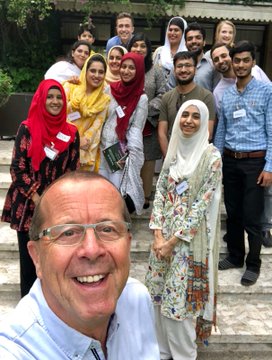
The Ambassador also shared a picture of himself with Pakistani students in his Twitter post.
The German envoy Ambassador who often uses Urdu language in his tweets  is arguably the most famous foreign diplomat in Islamabad who frequently shares his photos from his visits to different parts of the country.
https://www.thenews.com.pk/latest/355988-german-envoy-voices-concern-over-pakistan-twitter-shutdown-reports

#Twitter Threatened With Shutdown in #Pakistan

Twitter is in danger of being banned in Pakistan because of the government's inability to force the tech giant to bend to its notions of what is suitable for public consumption or falls within the constitutional realm of legitimate free speech.
Micro-blogging platform Twitter has been asked by the Pak­istan Telecommuni­cation Authority (PTA) to comply with its requests to block objectionable content or face a shutdown in the country, the media reported on Thursday. According to a report in Dawn online, Twitter is in danger of being banned in Pakistan because of the government's inability to force the tech giant to bend to its notions of what is suitable for public consumption or falls within the constitutional realm of legitimate free speech.
The PTA on Wednesday informed the Senate Standing Com­mittee on Cabinet Secre­tariat that while Facebook, YouTube and other social media platforms complied with requests from the government to block objectionable content, Twitter did not. "Out of a hundred requests from Pakistan to block certain offensive material, roughly five per cent are entertained. Twitter ignored all the remaining requests," Director General of PTA's Internet Policy and Web Analysis, Nisar Ahmed, told the committee.
The committee met for a briefing on penalties fixed by the PTA against "derogatory" comments spread through social media targeting the state, its citizens and its institutions. Ahmed informed the committee about last week's Islamabad High Court (IHC) directive to serve Twitter with a final notice, asking the micro-blogger site to respond to requests from Pakistan or face the risk of being blocked in the country.
"The PTA has conveyed the court's concern to Twitter, but has not got a response. The regulatory authority will implement court orders if Twitter does not respond to the final notice," said Ahmed. He also said that Twitter was not as popular in Pakistan as Facebook, so it had little to lose if it was blocked. However, the platform would lose business if it was shut down in the country, another official said.
"The court is determined to teach Twitter a lesson -- they will lose business," the official added. Pakistan Tehreek-e-Insaf (PTI) Information Sectary Fawad Chaudhry said that his party was against any kind of censorship on free media. "Those who do not wish to see objectionable and offensive content should not search for such content. Social media is not just for recreation and entertainment. There are jobs and households associated with the business," said Chaudhry, who is tipped to become Information Minister in the new government.
"Blocking social media websites will have both social and economic impacts," he added.

https://www.news18.com/news/tech/twitter-threatened-with-shutdown-in-pakistan-1846711.html

Pakistan at Seventy-One: the Search for a New Pakistan


Today is Pakistan’s seventy-first independence day. The newly elected members of the National Assembly have been sworn in, and the new prime minister–designate, Imran Khan, will take his oath of office on August 18. Last month’s national election took place amid great controversy. Opposition leaders and independent observers made considerable allegations of tampering and malfeasance, bombings marred the run-up to the election and the day of voting, and there were widespread reports of the army tilting the playing field in advance in favor of Khan, casting a shadow over the results. Even so, government formation trundles along.
Prime minister–designate Imran Khan spoke during his campaign about his vision for a “naya Pakistan,” a “new Pakistan.” As the new Pakistani government assumes office, it confronts the same old problems that stymied its predecessors: a looming economic crisis, tensions with each neighbor, internal civil-military issues, challenging human development and governance concerns, and of course the decades-long problem of terrorism. Two of these problems in particular present immediate headaches for the new Pakistani government: the economic crisis and terrorism.
The economic crisis is already preoccupying Pakistan’s incoming finance minister, and estimates of Pakistan’s financing needs are tipping upward from a reported $8–10 billion bailout on July 22, to “more than” $12 billion by August 2. Should Pakistan approach the International Monetary Fund (IMF) for a bailout, it would be its thirteenth and largest ever. But the geopolitics of this economic crisis are now different than they were in the past, since the advent of the China-Pakistan Economic Corridor has created a massive $62 billion initiative with unclear debt obligations to China. U.S. Secretary of State Mike Pompeo said publicly that there is “no rationale” for IMF “tax dollars” to “bail out Chinese bondholders or China itself.” Watch this space.
Equally troubling in a different way is the terrorism crisis, and by extension the state of U.S.-Pakistan ties. Relations between Washington and Islamabad were deteriorating already by the end of the Barack Obama administration—and as I have written before, it was former Secretary of Defense Ashton Carter who, in 2016, was unable to certify that Pakistan had taken sufficient actions against the Haqqani network and therefore withheld a third of the coalition support funds security assistance that year. (These are funds the United States gives Pakistan as reimbursement for its support to the war in Afghanistan.) Secretary of Defense Jim Mattis faced the same situation in 2017. By January of 2018 the Donald J. Trump administration chose to suspend security assistance to Pakistan. The Financial Action Task Force (FATF), an anti–money laundering and counter–terrorist finance watchdog group, placed Pakistan on a “gray list” in June, citing the country’s need to improve its financial controls to end flows to terrorist groups. And last Friday reports emerged that the security assistance suspension will now also prevent participation of Pakistani military officers in the long-running International Military Education and Training (IMET) program.
Against this backdrop, it is hard to see at the moment how things might improve. Despite the FATF designation, candidates affiliated with designated terrorist groups stood for election in Pakistan in July. As a FATF team visited the country to review Pakistan’s implementation plan, the individually designated terrorist Hafiz Saeed, head of a group long listed under UN and U.S. terrorism designations and held responsible for the Mumbai attacks of 2008 (Lashkar-e-Taiba aka Jamaat-ud-Dawa), offered up a speech on YouTube for Pakistan’s independence day. The lack of limitations on, let alone prosecution of, this organization even at a time of heightened scrutiny defies logic.
Pakistan’s new government has its work cut out for it. Whether Imran Khan and his government can deliver a “naya Pakistan” will hinge significantly on how they address these two urgent problems on their long list of challenges.

TREVOR NOAH - PAKISTAN GETS ITS OWN VERSION OF DONALD TRUMP

Bilawal Bhutto condoles demise of former Indian PM Atal Bihari Vajpayee

PPP chairman Bilawal Bhutto Zardari has expressed his sincere condolences on the death of former Prime Minister of India Atal Behari Vajpayee.
"Prime Minister Vajpayee’s efforts towards establishing an atmosphere of trust between India and Pakistan will be his lasting legacy,"Bilawal said, hoping that India’s current leadership exhibits similar intentions and commitment towards sustainable peace in South Asia.
Three-time Indian prime minister died on Thursday, sparking tributes from across the political spectrum as current leader Narendra Modi mourned the "irreplaceable loss" of the respected statesman.
The 93-year-old had battled poor health for years but his condition deteriorated sharply in recent days, with doctors placing him on life support.
The sudden turn sparked a flurry of visits from top dignitaries, including Modi, who credited Vajpayee with laying the foundations for the meteoric rise of the right-wing Bharatiya Janata Party (BJP) that rules India today.
"Atal Ji´s passing away is a personal and irreplaceable loss for me," Modi said in a tweet Thursday, using a Hindi-language honorific.
"It was Atal Ji´s exemplary leadership that set the foundations for a strong, prosperous and inclusive India in the 21st century.
"It was due to the perseverance and struggles of Atal Ji that the BJP was built brick by brick."
Vajpayee was being treated at the All India Institute of Medical Sciences (AIIMS) in Delhi, where he was admitted nine weeks ago.
https://www.thenews.com.pk/latest/356024-bilawal-bhutto-condoles-demise-of-former-indian-pm-atal-bihari-vajpayee

Chairman PPP Bilawal Bhutto congratulates Syed Murad Ali Shah on his election as Sindh Chief Minister second time

Pakistan People’s Party (PPP) Chairman Bilawal Bhutto Zardari has congratulated Syed Murad Ali Shah on his election as Sindh Chief Minister (CM) second time.
In his statement, he said that he has fervent hope and expectation that the CM Shah would set up new trends in public service sector and with the toiling efforts in this context, Sindh province would once again take a lead in servicing its people and making gigantic developments as compared to other provinces.

Bilawal Bhutto Zardari said that PPP’s provincial government would carry all areas of the province, say the rural and the urban zones equally and without any discrimination. The PPP’s provincial government would take the province to the heights of developments and improved infrastructure.
He said that while implementing the party manifesto in letter and spirit, the PPP would prioritised the education, health, infrastructure and human development and would ensure best progress in these sectors.

He said further that the people’s elected CM, cabinet ministers and MPAs would work harder to complete the mission of Shaheed Mohtarma Benazir Bhutto.
The PPP Chairman said that PPP’s ideology and public service and welfare and sacrifices are the hallmarks of the party.

https://mediacellppp.wordpress.com/2018/08/16/chairman-ppp-bilawal-bhutto-zardari-congratulates-syed-murad-ali-shah-on-his-election-as-sindh-chief-minister-second-time/

#MuradAliShah - #PPP’s Murad Ali Shah becomes the Sindh chief minister again

The Pakistan Peoples Party’s Syed Murad Ali Shah was elected as the chief minister of Sindh for the second time on Thursday.
He received 97 out of total 168 votes in the assembly. His opponent Shehryar Mahar of the Grand Democratic Alliance got 61 votes.
Murad was elected as an MPA from Sehwan’s PS-34. This is his second time as CM. The first time he was appointed to the post was after his predecessor Syed Qaim Ali Shah resigned in July 2016. Murad’s father Abdullah Shah served as the province’s CM from 1993 to 1996.

https://www.samaa.tv/news/2018/08/ppps-murad-ali-shah-becomes-the-sindh-chief-minister-again/

Wednesday, August 15, 2018

Pashto Music - Sardar Ali Takkar - ''HUSAN'' - GHANI KHAN

Commentary: The new face of Afghanistan’s war

By Peter Apps
On the streets of the city of Ghazni this week, Afghan troops and Taliban fighters battled for the future of Afghanistan.
It was a savage fight. Several hundred Taliban insurgents attacked the town on Friday, and at the height of the battle they dominated the city, pushing back Afghan security forces to only a few key strongpoints while residents cowered in their homes. The Taliban said Wednesday it was pulling back its fighters from the city, but the government said an attack on an army base nearby killed at least 44 police and soldiers.
Should the Taliban have captured Ghazni, it would have been the first major urban victory since a short-lived 2015 takeover of Kunduz. Instead, they demonstrated once again their limitations. The insurgents remain adept at savage, one-off attacks, grabbing headlines and continuing to seize control of rural areas – this week they overrun several countryside districts in the broader Ghazni Province. But they have proved unable to grab control of Afghanistan’s key urban areas from a government with access to U.S. and Western airpower as well as its own increasingly capable security forces.
Now more than ever, for the Taliban action on the battlefield is aimed at political effects as much as military. This week's assault looks less like an attempt to capture ground and more a deliberate demonstration of the group’s reach and capability, essentially setting the groundwork for negotiations already quietly underway. On Tuesday, several Taliban sources said the group was considering a ceasefire for the Eid-al Adha holiday next week, building on a similar but previously unprecedented truce in June.
Seventeen years after the 9/11 attacks and invasion of Afghanistan that followed, this is how war in that country works now. Individual battles are important, but primarily for the way in which they shape the larger political fight. For both the Taliban and the government, both violence and negotiation are very much part of the same process.
The dynamics are very different from when the United States and its allies deployed tens of thousands of NATO troops in the hope of smashing the insurgency for good. It was a strategy always doomed to failure, not least because the Taliban always knew the foreign forces could not maintain that pressure forever. “You may all have the watches,” a Taliban sympathizer reportedly told a senior American official in Kabul, “but we have all the time.”
He was right – but only up to a point. Faced with mounting casualties and diminishing results – and having spent breathtaking amounts of money, an estimated $1 trillion to $6 trillion depending on what is measured – the West pulled back its large troop formations in 2014. But that's when the real Afghan war began, between a rebooted Western-trained and supported Afghan National Army and a Taliban that knows they may now be the ones losing the long-term battle.
The United Nations estimates that by 2050 half of Afghanistan’s population will live in cities, up from 27 percent in 2016. The population of Kabul skyrocketed from 1.5 million in 2001 to almost 6 million now, making it the fifth fastest-growing city globally. The society an increasingly urbanized Afghanistan produces is inevitably more liberal and outward-looking, much less susceptible to the neo-medieval philosophies of the Taliban. The insurgents know this – and it clearly infuriates them.
Between April and June, suicide bombers killed dozens in a succession of attacks in and around Kabul. The Taliban took credit for most, although some were also claimed by the Afghan branch of Islamic State, which has increasingly attempted to pitch itself as a rival to the more established insurgents through its own series of brutally effective attacks.
Those assaults came amid a wider propaganda battle between the Afghan government and the Taliban, coupled with Afghan President Ashraf Ghani’s unconditional offer in February of peace talks.
Factionalism amongst the Taliban makes tracking that process particularly difficult, but it is clear the group is tentatively stepping towards negotiations. In June, it rejected the peace talks offer despite an unprecedented Eid holiday ceasefire, but informal outreach continues. In July, Taliban sources said they had held “indirect talks” with U.S. officials, while last week a delegation from the group visited Uzbekistan to discuss issues including peace in Afghanistan, another apparent sign of renewed diplomatic enthusiasm.
As this weekend’s fighting makes clear, such activity does not preclude further bloodshed. The Afghan government, too, remains broadly on the offensive, its military shortly to be bolstered with new foreign trainers and equipment. Many of those who fight with its army now have little memory of the time before the U.S.-led intervention, and no appetite to return to the days of outright Taliban control.
Ultimately, the future of Afghanistan will be won through diplomatic and political negotiation as well as on the battlefield. The situation remains extremely complex, with interventions of neighboring states, particularly Pakistan, rubbing up against ongoing Afghan issues like massive corruption. The war has now gone on so long that it has produced entire economies and career structures, and that itself make it harder to manage, let alone end. Put simply, from corrupt military contracts to protection rackets, some powerful people would simply now rather the current conflict and instability continues.
A number of wild cards remain in play, not least U.S. President Donald Trump, whose comments before taking office suggested he might favor removing U.S. troops entirely, but subsequently ordered an increase in U.S. troops and air strikes in Afghanistan. International support to the Afghan military remains vital, but it is equally important that the country stands more on its own two feet.
Ultimately, the idea conflict in Afghanistan could somehow be America’s, Britain’s or anyone else’s war was always doomed to failure. It’s now turning back into what it should perhaps always have been, a confrontation between the country’s own power centers in which the outside world does what it can to push things in the right direction. If the Afghan government can win its current battle, that may finally be beginning to show tentative signs of success.


PAKISTAN ANTITERRORISM CREDENTIALS IN FATF LINKED WITH ASIA PACIFIC GROUP REPORT

Counterterrorism credentials of Pakistan is now linked with the Asia Pacific Group (APG) report as its delegation is visiting Pakistan nowadays and conclude its trip on Thursday. The APG is to complete its review of Pakistan’s compliance with international obligations over fighting money laundering and terror financing in order to submit its report to the Paris-based Financial Action Task Force (FATF).

By the end of September next year, Pakistan has to comply with a 10-point action plan it committed with the FATF in June this year to combat terror financing and money laundering to get out of the grey list or else fall into the black list, a finance ministry official said.
He said the six-member APG delegation did not have any meeting scheduled with caretaker Finance Minister Shamshad Akhtar, but was expected to have a wind-up session with the federal finance secretary after going through a checklist of 26 actionable points with other stakeholders, including the Financial Monitoring Unit (FMU) of the State Bank of Pakistan, Securities and Exchange Commission of Pakistan (SECP), National Counter Terrorism Authority (Nacta), Federal Investigation Agency (FIA) and representatives of the ministries of foreign affairs and interior.
Pakistan has to comply with 10-point action by end of September next year to get out of FATF grey list
The official said the response to the checklist by the authorities had already been finalised for sharing it with the APG after a plan to improve laws and strengthen the agencies concerned was approved by the caretaker cabinet last month.
Under the plan, the FMU will be upgraded, punishments and penalties will be enhanced to check smuggling of currency and two legal documents — Anti-Money Laundering Ordinance 2010 and Foreign Exchange Regulation Act 1947 — will be strengthened to meet the requirements of United Nations resolutions.
The official said the homework to address serious deficiencies had been completed and its implementation was in progress and would be completed within the time frame committed with the FATF. He said there were some positive vibes from European capitals to help Pakistan make progress in a manner that it did not become a victim of geopolitics and avoid a repeat of the June 27-29 FATF plenary in Paris when it was included in the grey list.
The official said the SECP and the SBP had recently taken steps for strengthening the regulatory regime on AML/CFL even though these had already been very stringent since 2015. To address risk-based challenges and changing identities and titles, the regulators have streamlined documentations for all individuals and entities in financial dealings.
To ensure that “criminals are not able to hide their identity through use of complex ownership structure of companies, partnerships, trusts or other similar forms, the financial institutions are required to identify the ultimate beneficial owner, who is a natural person, of all legal persons and legal arrangements before offering their services to them”.
Pakistan was found deficient in four areas such as supervision of AML/CTF, illicit cross-border movement of currency by terror groups, weak investigation and poor outcome of prosecution on terror financing and unsatisfactory implementation of UNSC resolutions 1267 and 1373.
By January next year, Pakistan will identify and assess domestic and international terror financing risks to and from its system to strengthen investigations and improve on inter-agency (FIA, SBP, SECP, banks, home and interior departments and associated agencies) coordination as well as federal and provincial coordination to combat these risks.
Also by January 2019, the government will complete the profiling (preparing data banks) of terror groups or suspected terrorists, their financial assets and stren­gths, besides their members and their family backgrounds, and make them inter-agency accessible.
Besides, banks, exchange companies and all agencies will be upgraded and trained about risks associated with AML/CTF issues, obligations and responsibilities for sharing and start imposing penalties on violations.
Over the next nine months i.e. till September 2019, the government will complete the investigation into the widest range of terror financing activities, including appeals and calls for donations and collection of funds, besides their movements and uses.
The focus will be on curbing smuggling of funds and misuse of not-for-profit titles of the blacklisted organisations. The government will also proactively request and provide international cooperation in targeting, investigating and prosecuting terror financing cases and clearly demonstrate that it has included police-to-police, customs-to-customs, financial investigation unit-to-unit and formal cooperation in the mutual legal assistance regimes.
Focus will remain on action against the UNSC-sanctioned entities, freezing their accounts and assets, limiting their activities, closing down their charitable and social service organisations and ensuring they are incapacitated in all manifestations. The outcome will be published at least twice before September next year.
http://www.shiitenews.org/index.php/pakistan/item/35327-pakistan-antiterrorism-credentials-in-fatf-linked-with-asia-pacific-group-report

#PAKISTAN - We will resolve every problem facing people, country in parliament: Bilawal Bhutto


Pakistan People’s Party (PPP) chairman Bilawal Bhutto Zardari on Wednesday said that his party will solve all the problems of the people and the country in the parliament.
“The problems of the country can only be solved in the parliament. We will serve the country and solve the problems of people while sitting in the opposition’’, he said while talking to media on his arrival to cast a vote for speaker of the national assembly (NA).
He further held that he will try that the prime minister (PM) is elected from the opposition and if it does not happen then he will carry out a real opposition and do whatever he has to do in the country’s interest.

Bilawal says will urge PML-N to change its PM nominee

Pakistan People’s Party (PPP) chief Bilawal Bhutto Zardari on Wednesday said that his party will urge the Pakistan Muslim League-Nawaz (PML-N) to change its nominee for premiership, ARY News reported.

The PPP chief and newly elected MNA was speaking to media in the federal capital when one of the reporters asked if his party’s parliamentarians will vote for PML-N president Shehbaz Sharif during the election of PM.
“We will urge PML-N to change its PM nominee,” answered Bilawal.

An opposition alliance comprising PPP, PML-N, ANP, MMA and other parties on August 7 jointly nominated Shehbaz Sharif as their candidate for premiership.
The opposition alliance named “alliance for free and fair elections” had earlier decided to support a PML-N candidate for PM, a PPP nominee for speaker and MMA one for deputy speaker slot.
The elections for speaker and deputy speaker slot were held earlier today in the National Assembly wherein PTI’s Asad Qaiser and Qasim Suri elected as the speaker and deputy speaker.
Asad Qaisar was contesting against PPP nominee Khursheed Shah. Qaiser received 176 votes whereas Shah got 146 votes.
The opposition alliance reportedly voted for PPP nominee as planned.

https://arynews.tv/en/bilawal-pml-n-pm-nominee-shehbaz/

Tuesday, August 14, 2018

Video - AP Investigation: Behind the Scenes in Yemen, U.S.-Backed Saudi Coalition Is Working with al-Qaeda

Video Report - #Cuba constitutional reform: "the state will still be calling the shots"

Video - Bridge collapses in Italy after violent storm

Video - #Omarosa Is Starting To Think Trump Might Be Racist

Video - #Omarosa’s Secret White House Tapes | The Daily Show

Pashto Music - Saqi | Ajmal Khattak | Sardar Ali Takkar | ساقي | اجمل خټک | سردارعلي ټکر

Pakistan: What Does a Loan From China Mean for the Already Indebted Country?


As Imran Khan prepares to take over as prime minister, his administration's first challenge will be to address Pakistan's depleting foreign exchange reserves. While Khan could turn to the International Monetary Fund for a loan, China — Pakistan's strongest partner on the world stage — is another option. But a bailout from Beijing will add to Pakistan's heavy debt to China, offering a test case for whether Islamabad will eventually have to sign over strategic assets to pay down its obligations. 

What Happened
China has reportedly agreed to give Islamabad a loan to shore up Pakistan's plummeting foreign exchange reserves as its import bill grows. Although the two countries have yet to sign a deal, the prospective loan — reportedly on the order of at least $10 billion — would enable Pakistani Prime Minister-elect Imran Khan's incoming administration to avoid turning to the International Monetary Fund (IMF) for help, as Pakistan has done 12 times in its history. The IMF attaches conditions to its loans, and austerity measures such as spending cuts, tax hikes and structural reforms would undermine Khan's ability to fund his populist vision for Pakistan: to turn the country into a social welfare state aimed at improving the lives of the poor.
Some Background
China has already lent Pakistan $5 billion in a mix of bilateral and commercial loans during the latest fiscal year, which ended June 30. But rising oil prices continue to drive up Pakistan's import bill, and remittances and exports aren't growing quickly enough to keep up. The result is a growing current account deficit; in July, it reached $18 billion, double the goal amount Islamabad had set.
From Beijing's standpoint, bailing Pakistan out is necessary to ensure the country's stability, given its strategic significance. Pakistan is China's strongest partner in South Asia, while China is Pakistan's strongest global partner. Their relationship, forged in the 1960s, is rooted in a shared desire to counterbalance India, which Pakistan views as an existential adversary and Beijing considers a rival (if less powerful) Asian military power.
In 2013, Pakistan and China's relationship assumed a more robust economic dimension when the two countries launched the China-Pakistan Economic Corridor, a network of roads, power plants, ports and special economic zones now worth $62 billion in total. The project, meant to spur development in western China's landlocked Xinjiang province by linking it to the Arabian Sea through the port of Gwadar, is part of Beijing's broader strategy to lessen its reliance on the Strait of Malacca. The economic corridor itself is a branch of Beijing's Belt and Road Initiative, which spans the entire Eurasian landmass.
Why China's Loan to India Matters
If the loan goes through, it will prompt questions about China's role as an alternative lender to U.S.-backed institutions like the IMF. And though Chinese foreign exchange loans to Pakistan have lacked conditions in the past, critics in the country nevertheless point to China's majority stake in Sri Lanka's Hambantota port as a cautionary tale of what Beijing could expect from Islamabad if it, too, fails to service its growing debt. Such a large bailout, at a time when Pakistan may struggle to make payments, probably will come with some strings attached, but it is not yet clear what sorts of commitments China might expect in return.


#Pakistan - As a nation,we have to protect our core values: Bilawal Bhutto

Pakistan Peoples Party chairman Bilawal Bhutto Zardari said on Monday that his party would continue to work for strengthening of democratic practices in the country

He was speaking to the media after taking oath as a member of the National Assembly.

“The sacrifices given by Shaheed Zulfikar Ali Bhutto, Shaheed Mohtarma Benazir Bhutto and thousands of party workers teach us to defend democracy and to stand by it,” he said, adding that he would struggle for the rights of the people and democracy.

In his greetings to the nation on the occasion of the Independence Day, Bilawal said that there was a need to strive for the country dreamt by the founder, Quaid-e-Azam Mohammad Ali Jinnah.

The PPP chairman said that Shaheed Zulfikar Ali Bhutto and Shaheed Mohtarma Benazir Bhutto pursued the vision of Quaid-e-Azam in their struggle for an egalitarian and democratic country, and eventually laid down their lives to uphold those principles. “Extremism and terrorism are two major diseases ailing our society. Both have to be completely routed out to put Pakistan on the path of peace, progress and prosperity,” he said, adding, “as a nation, we have to protect and promote our core values, which have been eroded by those seeking chaos and darkness.”

Bilawal further said that only a democratic order and constitutionalism could strengthen the nation and parliamentary supremacy needed to be respected as the institution represented the will of the people.

Former president Asif Ali Zardari also addressed the media after the inaugural NA session. He said that the workers of PPP were heirs to a great legacy. He said that he was proud of the party workers who were without a match in Pakistani politics. “No other party can claim to have as devoted, dedicated and fearless workers as the PPP,” he said, adding that Zulfikar Ali Bhutto held deep compassion for the downtrodden masses. The former president pledged to make Pakistan a democratic, progressive, liberal and welfare oriented country.

http://paktribune.com/news/As-a-nationwe-have-to-protect-our-core-values-Bilawal-Bhutto-281225.html

‘Felt like Nelson Mandela’: Tanzeela Qambrani on taking oath as Pakistan’s first Sheedi woman MPA

The historic oath-taking ceremony held at the Sindh Assembly on Monday saw Tanzeela Qambrani ascending the seat as Pakistan’s first Sindhi Sheedi woman to become part of provincial legislature.

Tanzeela, who was nominated by Pakistan People’s Party (PPP) on the quota of reserved seats for women, shared how she feels about becoming a voice for her community as Member of Provincial Assembly (MPA).

Being a woman of African descent, Tanzeela revealed that she has an emotional connect with great revolutionist Mandela, probably the biggest leader that Africa has ever produced and that she herself feels like Mandela.
“Arriving at the oath-taking ceremony I was overwhelmed by emotions. I thought I am Nelson Mandela. As I descended the stairs of the Sindh Assembly, I felt like kissing the ground, the very ground that has blessed mewith so much respect, love and acceptance,” she shared while in conversation with media.
Talking about the surreal experience of being sworn in as provincial legislator, she said, “Now that I am an MPA I feel I am highly responsible, especially for women and my community, at large. I feel happy on this achievement, but responsible at the same time.”
Shedding light upon the issues she is passionate working for, Tanzeela stated, “My objectives are very clear. I aim to work towards furthering women empowerment. In addition to that, I want to work for the education sector as well as access to clean drinking water.”
Tanzeela, whose ancestors came to Sindh from Tanzania, believes that the apt representation of minorities in assemblies has only been done by Pakistan People’s Party.
“When I say that PPP gives the earth and the sky to its workers, I strongly believe that it is the only party that works for the representation of minorities. If you take a glance at history, you’ll notice that PPP has always brought women, minorities to the forefront and has worked for the oppressed; at times in the face of Krishna (first Hindu Dalit woman from Thar to become Senator), Surendar Valasai, or in the shape of Tanzeela,” she said.
To have minorities’ representation is highly imperative, as they are an unavoidable, eminent part of the society, Tanzeela further added.
“My vision, my ideology rests in working to provide education opportunities to women as well as children who cannot afford it,” asserted the 39-year-old post-graduate in Computer Science.
 http://www.thesindhtimes.com/sindh/08/felt-like-nelson-mandela-tanzeela-qambrani-taking-oath-pakistans-first-sheedi-woman-mpa/

PPP Chairman Bilawal Bhutto congratulates nation on 71th Independence Day


Chairman Pakistan Peoples Party Bilawal Bhutto Zardari has extended greetings to the fellow Pakistanis on the Independence Day and urged the nation to gear up for regaining the Pakistan, our founder Quaid-e-Azam Mohammad Ali Jinnah had dreamt of.
In his message on the occasion, the PPP Chairman reiterated that vision of Quaid-e-Azam was pursued by Shaheed Zulfikar Ali Bhutto and Shaheed Mohtarma Benazir Bhutto who struggled during their whole for an egalitarian and democratic Pakistan eventually laying down their lives for their principles and ideals.
Bilawal Bhutto Zardari said that extremism and terrorism are two major diseases ailing the whole country and its society. Both these diseases have to be completely routed out to put Pakistan on a real path to peace, progress and prosperity, he added.
He said that as a nation we have to protect and promote our core values, which were being eroded by the elements chaos and darkness to shatter the mission of the founding fathers.
Bilawal Bhutto Zardari further said that only a democratic order and constitutionalism can strengthen the nation and parliamentary supremacy shall be respected as people’s voice.
PPP Chairman said that his Party was struggling for an egalitarian Pakistan to be a role-model Muslim democratic nation on the world map and a source of inspiration for Muslims around the globe.
Bilawal Bhutto Zardari pledged that the PPP was bound by the commitment of its past leadership for working towards the interest of downtrodden people and bring equal opportunities for all the segments of society so that fruits of independence should not remain limited to few corridors.
https://mediacellppp.wordpress.com/2018/08/13/ppp-chairman-bilawal-bhutto-zardari-congratulates-nation-on-71th-independence-day/