Tuesday, July 24, 2018

#PTI - #PrimeMinisterImranKhan - #Pakistan - Imran Khan: A Taliban Goebbels? 08/05/2010

By —Dr Mohammad Taqi
Daily times
8/5/2010

The PTI and its leader are perhaps politically insignificant, but conceding space to such Ziaist propaganda has the potential to radicalise the nation, especially our youth. Fortunately, Mr Khan is not perceived as an American stooge — he is seen as a Taliban apologist
“The lowest form of popular culture — lack of information, misinformation, disinformation, and a contempt for the truth or the reality of most people’s lives — has overrun real journalism. Today, ordinary Americans are being stuffed with garbage” — Carl Bernstein, US journalist.


Perhaps ordinary Pakistanis are not much better off either. But it is not just the journalists embedded with the jihadists who are peddling nonsense. Among the politicians, Mr Imran Khan keeps outdoing himself in the craft of black propaganda. He has been stuffing people with this Goebbels-speak for years and, unfortunately, the western print media is one such avenue he uses to push his outlandish assertions.

While the Tehrik-e-Taliban Pakistan (TTP) spokesman, Muslim Khan, had the dubious courage to clearly own up to the savagery of his outfit, Mr Imran Khan, who is the head and de facto chief spokesman of his Pakistan Tehreek-e-Insaf (PTI) party, stoops to the lowest levels of skulduggery in defending Taliban atrocities. Sheer disinformation, misinformation, contempt for truth, and an utter disregard for the realities of people’s lives, particularly of the Pashtuns, are what Mr Khan’s spoken and written words are all about.

He seems to have perfected the art of repeating half-truths and quite often just plain lies over and over again. In his article ‘Don’t blame Pakistan for the failure of the war’ (The Times, UK, July 27, 2010), he has some real gems to share. He writes: “Before the West invaded Afghanistan, my country had no suicide bombers, no jihad and no Talibanisation.”

Perhaps Mr Khan had been too busy playing cricket to take note of al Qaeda’s activities in the early 1990s at Abdullah Azzam’s Maktab-al-Khidmat — a base camp in Peshawar for Arab jihadists. Ayman al-Zawahiri and Osama bin Laden met each other in Peshawar courtesy Professor Azzam. Suicide bombings were not a norm then, but Azzam himself was killed in a car bombing in November 1989, allegedly orchestrated by his more extremist friends. He disagreed with their concept of takfir, i.e. declaring people who did not meet their definition of Muslim as infidels, who they believed deserved to be murdered. Benazir Bhutto, Dr Najibullah, several Arab rulers and Muslim minorities were placed in this category.

The early 1990s were the formative years of world jihadism and these men in Peshawar were not confined to just Afghanistan. The Afghan-Arabs, as they became known, worked hand in glove with all varieties of Pakistani jihadists and after 1992, Afghan territory was used for their cause. For example, training and sanctuary were provided at the Al-Badr camp in Khost to terrorists who unleashed havoc in Pakistan and around the world.

Mr Khan has completely glossed over the terrorist acts of the jihadists trained in the Pak-Afghan border regions. Riaz Basra of Lashkar-e-Jhangvi was one such figure who was involved in over 300 acts of terror on Pakistani soil, including an attempt on Mian Nawaz Sharif’s life, way before the US forces had set foot in Afghanistan. Along with Akram Lahori and Malik Ishaq, Basra had used the training facilities in Sarobi (near Jalalabad). This was the beginning of Talibanisation in Pakistan.

While the terrorist cadres were trained in Afghanistan, their leadership was groomed at various madrassas in Pakistan. However, Mr Imran Khan is either ignorant of this fact or is protecting such nefarious characters when he writes, “Until that point [army action in FATA in 2004], we had no militant Taliban in Pakistan. We had militant groups, but our own military establishment was able to control them. We had madrassas, but none of them produced militants intent on jihad until we became a frontline state in the war on terror.”

Only two entities from what is literally the Ivy League of the jihadist network need a mention to refute Mr Khan’s claim. Karachi’s Jamia Islamia aka Binori Mosque has produced hundreds of jihadist leaders that include Maulana Azam Tariq of Sipah-e-Sahaba, Qari Saifullah Akhtar and Maulana Fazlur Rahman Khalil, the leaders of Harkatul Jihad Al-Islami, and the founder of Jaish-e-Mohammed, Maulana Masood Azhar. The association of this madrassa’s patron (Mufti Nizamuddin Shamzai) with the Afghan Taliban, especially Mullah Omar, is well known.

It might not have dawned on Mr Imran Khan but Jalaluddin Haqqani carries the title Haqqani for a reason — he had spent six years at Darul-Uloom Haqqaniah in Akora Khattak. Among the top 32 officials in Mullah Omar’s government, 11 — including six top ministers — were educated in madrassas in Pakistan. Out of these 11, seven were students at the Haqqaniah seminary. The US was nowhere in the picture when the alumni of these madrassas were on a killing spree in Pakistan and Afghanistan.

Mr Khan betters himself still when he claims, “After the WikiLeaks revelations yesterday, reports are being floated that the Inter-Services Intelligence (ISI) is aiding the Afghan militancy. The fact is that the ISI is not that powerful, but certainly in an environment of chaos and uncertainty Pakistan will need to protect its interests through all means necessary.” Even the ISI may take serious offence to this, as it is positioning itself as the power that can deliver the Taliban, especially the Haqqani network, provided the new set-up in Kabul is to its liking.

These assertions by Mr Khan might even be amusing if he was not capable of even worse assertions. Blaming the US for all ills is one thing, but he has as easily blamed the victims of terrorism. Writing about the Karsaz bombing in ‘Benazir Bhutto has only herself to blame’ (The Telegraph, UK, October 21, 2007), he noted, “I am sorry to say this, but the bombing of Benazir Bhutto’s cavalcade as she paraded through Karachi on Thursday night was a tragedy almost waiting to happen. You could argue it was inevitable...it is different for me campaigning in public, even in the frontier region, because I am not perceived as an American stooge, or a supporter of the war on terror.” Benazir and not the takfiris were to be blamed as per Mr Khan’s views!

The PTI and its leader are perhaps politically insignificant, but conceding space to such Ziaist propaganda has the potential to radicalise the nation, especially our youth. Fortunately, Mr Khan is not perceived as an American stooge — he is seen as a Taliban apologist.

Video - #YourFutureIsInYourHand #Elections2018 - #ElectionPakistan - #PPP - Bilawal -

#ElectionPakistan - #Pakistan election raises fears of 'creeping coup'


By M Ilyas Khan
A day before Pakistan's 11th national election, the country's dream of undiluted democracy appears to be receding - again.

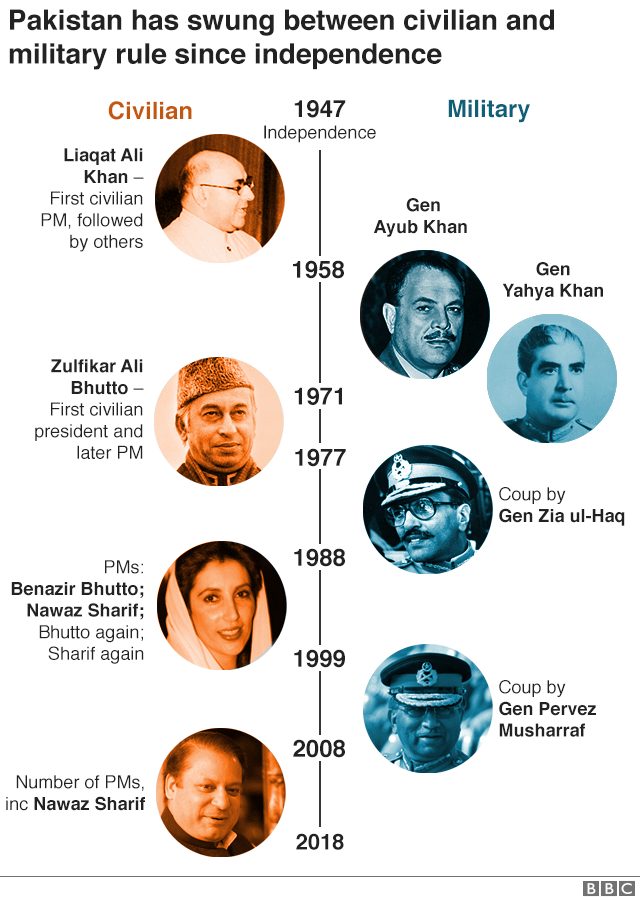
In its 70-year history, Pakistan has alternated between quasi-democracy and pure military rule. In the process it has become embroiled in international conflicts and morphed into a home base for Islamist militancy.
Over the past decade, Pakistanis have witnessed democracy at its most undiluted thus far, but it's now under threat from what some say appears to be a "democratic coup" of sorts.
And just as in the past, the country's powerful military establishment remains the chief suspect behind the fresh round of political manipulation.
In the past, the military used to either stage a direct coup or use special powers to sack an elected government and then manipulate elections to ensure it wasn't re-elected.
In 2008, those special powers were done away with, leading to a first in 2013: an elected government completing its five-year term.
But since then the tide appears to have reversed, and critics say the establishment is resorting to more primitive tactics to recover its edge.
A three-pronged approach is in evidence.
First, as some legal experts have observed, the courts have selectively applied the law to clip the wings of the outgoing government, thereby creating an advantage for its rivals.
On Sunday, Justice Shaukat Aziz Siddiqui of the Islamabad High Court said that the ISI intelligence service was interfering in the judiciary, and had pressured judges not to release convicted ex-PM Nawaz Sharif ahead of the vote.
Mr Sharif was disqualified from office by the Supreme Court on questionable grounds last year, and has since been sentenced to 10 years in jail by a trial court, in a ruling which one legal expert described as an embarrassment to his community.
According to the Dawn newspaper, Justice Siddiqui told the Rawalpindi Bar Association he was not afraid of speaking out against the powerful ISI, saying: "I am not afraid even if I am assassinated."
Second, authorities have either looked the other way as banned militant groups have joined the election process, or have actively helped them to do so. And third, the military has been given what many call an obscenely large role in administering the voting process on election day.

#ElectionPakistan2018 - 'Terrorist' Turned Candidate: Pakistani Extremists Contest National Elections


Frud Bezhan ,Daud Khattak 
Chaudhry Saeed Gujjar is a member of the Milli Muslim League, a radical Islamist party blacklisted by the United States as a terrorist group.
He is also a candidate in the country's July 25 national elections, vying for a seat in the lower house of parliament, the National Assembly. Gujjar’s bid to represent the capital, Islamabad, has been approved by the Pakistan Election Commission.
Gujjar is among an unprecedented number of religious extremists and members of militant groups running for seats in the national and provincial assemblies in Pakistan, which has long been accused of failing to crack down on extremist groups. Numbering more than 1,500, the unparalleled presence of candidates from radical religious and militant groups among the more than 12,000 candidates overall has raised fears they could bring extremist ideologies into the political mainstream.
When Pakistan's election authorities refused to register the Milli Muslim League (MML) for the elections, Gujjar and other MML members entered the field under the banner of Allah-o-Akbar Tehreek (AAT), another hard-line Islamist party in Pakistan.
"Groups that were refused registration by the Election Commission are now simply participating under another name," says Ahmed Bilal Mehboob, the head of the Pakistan Institute of Legislative Development and Transparency, an Islamabad-based think tank. The United States considers the MML to be a foreign terrorist group, calling it a front for the Lashkar-e Taiba (LeT) militant group co-founded by U.S.-designated terrorist Hafiz Saeed, who has a $10 million bounty on his head.
The United States and India accuse Saeed of masterminding LeT's 2008 attacks in Mumbai that left 166 people dead, an allegation he denies. LeT is an Al-Qaeda-linked armed militant group that is fighting against Indian control in the divided Himalayan region of Kashmir and was banned in 2002 after being linked to an attack on India's parliament. AAT has more than 260 candidates contesting the polls. Its campaign posters feature Saeed’s face alongside their candidates and are emblazoned with the name of the MML, which has officially endorsed the AAT. Gujjar, the candidate, rejects that he is a member of MML, although other candidates openly admit that AAT and the MML "are one party."
"The mainstream political parties have disappointed the people of Pakistan, and our aim is to bring real change," Gujjar told RFE/RL’s Radio Mashaal.
Gujjar insisted that AAT is not an armed group and seeks a peaceful solution to the "Kashmir dispute." The majority-Muslim Himalayan region is divided between India and Pakistan. Each country claims the region in its entirety and have fought two wars over it.
Extremist Tickets
Lashkar-e Taiba is not the only extremist group suspected of running in the elections under the guise of another political party. Many of the militant groups deny exploiting the loophole, but a list of candidates published by election authorities suggests otherwise. Sectarian groups such as the Ahle Sunnat Wahl Jamaat (ASWJ) – banned by the United States and Pakistan – are fielding candidates under the banner of the little-known Rah-e Haq party. The ASWJ was banned for allegedly being the political wing of the militant group Lashkar-e-Jhangvi (LeJ), which has been allied with Al-Qaeda and the Islamic State (IS) extremist group and is responsible for the killing of hundreds of Shi'a. More than 150 candidates with former ties to the ASWJ are running with the Rah-e Haq party or as independents. Muhammad Amir Rana, whose Islamabad-based Pakistan Institute of Peace Studies has long tracked radical groups in the region, says that while banned groups have resurfaced under different names, their ideologies remain the same.
"These new entrants are still exploiting religion and religious sentiments to further their cause," Rana says.
It's a practice that Mehboob says should not be allowed. "If a party is banned, it should not be allowed to contest under another name," he says.
Others suggest that while such parties are unlikely to sweep to power by using this method, their influence on the vote is potentially significant.
"By enabling these groups to contest elections, you bring toxic views into the political mainstream and risk legitimizing the types of ideologies that can spawn radicalization," says Michael Kugelman, South Asia associate at the Woodrow Wilson International Center for Scholars in Washington. "That's a particularly bad thing in Pakistan, where society is already radicalized to a great extent."
'Political Motive'
Many extremist candidates were taken off Pakistan’s terrorism watch list by the caretaker government in place to oversee the elections. Election authorities say they have simply followed court orders. But activists say the courts are influenced by the country's all-powerful military, which has an oversize role in domestic and foreign affairs. Over the weekend, protesters lined the streets outside the army headquarters in the city of Rawalpindi in a show of defiance. Demonstrators condemned the army and its spy agency, the Inter Services Intelligence (ISI) agency, for alleged manipulation of the vote.
Many in Pakistan have criticized the move.
"The interior minister should reveal how [members of] banned organizations were allowed to contest the elections," Senator Raza Rabbani, a member of the Pakistan People's Party, said on July 16. "How were the names of [members of] banned outfits removed from the Fourth Schedule?" added Rabbani, referring to the name of Pakistan’s terrorism watch list. "People from the Fourth Schedule are being allowed to contest the poll," Senator Pervaiz Rasheed, a member of the ruling Pakistan Muslim League-Nawaz (PML-N), said the same day. "Be afraid of the day when those people will be present in this [parliament]." Shamila Chaudhary, a senior South Asia fellow at the New America Foundation in Washington, says that the participation of extremists in elections could, in theory, offer them an incentive to abandon extremist views.
"But based on the extremist candidates running for office and their rhetoric, there is no evidence to suggest they will refashion themselves," says Chaudhary.
Kugelman suggests that the Pakistani establishment, dominated by the military, could benefit from extremists vying for office.
"The establishment hopes to use these groups as a tool to siphon off votes from the PML-N, which the military does not want to return to power," he says.
Opposition leader Imran Khan's Tehreek-e-Insaf party (PTI) is seen by many as the military’s favored party. Ousted Prime Minister Nawaz Sharif fell out with the military brass and the PML-N has accused the army of trying to deny it a second term. The military has rejected allegations that it is interfering in the vote.
Sharif was dismissed from office by the Supreme Court in July 2017 for allegedly concealing assets abroad and other corruption allegations. He denies any wrongdoing. Allies of the three-time prime minister, who was toppled in a military coup in 1999, have called the proceedings a political vendetta and suggested the army might be behind it.
Kugelman says the presence of extremists in the elections could have unintended consequences.
"Supporters of conservative parties like the PTI and PML-N may simply gravitate to these hard-line groups instead," he says. "In this sense, the establishment risks undercutting the electoral prospects of PTI, the very party that the establishment is likely trying to bolster at the polls."

Video - #YourFutureIsInYourHand - Former President of Pakistan Asif Ali Zardari interview with Faisal Rehman on PTV-World, Jul 11, 2018

#YourFutureIsInYourHand - #PPP - Bilawal Bhutto — the leader among politicians


Amara Shah

By his less than a month long electioneering, young Bilawal Bhutto has turned out to be the most experienced and mature politician of them all.

Nawabzadah Nasrullah, one of the last vestiges of our lost civilised culture of politics, and famous for his penchant for Urdu poetry and witty remarks, was once vying to coble a political alliance against the then government.
With Turkish cap perched on his head and hukkah simmering before him, he was sitting with Shujaat Hussain when he was asked “politics remained your cup of tea before and after partition. What difference do you feel in the then politics and politics now?”
The elderly Nawabzadah jerked pipe of the hukkah, took a long sigh and lamented, “that time I used to sit with political stalwarts like Nehru, Abul Kalam Azaad, Mohammad Ali Jinnah, Attaullah Shah Bukhari, Mahatmah Gandhi and their likes and now I am sitting with these jugglers.”
I think the same miserable episode of decadence encounters our generation.
My late father used to tell me about his long journeys to attend political jalsas and rallies right from Balakot to Rawalpindi and Lahore. In astonishment, I used to ask why would he make such a tiring journey just to listen to abusive language, character assassination of the opponents and stinking jugglery.
He used to reply, “things were different at that time as we were not lucky enough to go to universities to learn enough politics and rights. Whatever I learnt about politics, constitution, fundamental rights, I learnt through these jalsas.” He used to fondly remember and exactly quote excerpts from ZAB’s speeches.
Nowadays, the self-proclaimed ‘leaders’ and saviours of the down-trodden use such foul language in their speeches that PEMRA and Election Commission have to ban them. Resultantly, the threads of respect, civic sense, sobriety, culture, etiquette and civilisation have worn out from our social fabric.
However, in this politically abusive gala, one shrilled voice beats the tympanic membrane of my ear. Neither character assassination, nor abusive language, nor false accusation, nor political buffoonery, nor hollow rhetoric. A very composed, confident, persuasive and politically canvassing voice of PPP Chairman Bilawal Bhutto.
Many analysts used to say that Bilawal was not politically mature.
“He is too young to comprehend the complexities of Pakistani politics. He can’t stand the sizzling heat of July and August as he is used to comfort and cozy weather of London. He has been brought up in palaces, how can he peep into thatched mud houses in the nook and corner of country?” some would say.
While others would claim: “He is a pampered child, how can you expect political shrewdness and politically incisive cognitive abilities from him? He is not a Bhutto. He is not a good orator. He is just a puppet and a poster boy as his strings are being pulled by ‘corrupt Zardari’.”
The PPP Chairman has proved them all wrong. In the topsy-turvy political landscape of Pakistan, Bilawal drew attention when he interacted with international media at Davos and HardTalk at BBC.
Bilawal revived the reminiscence of ZAB speaking at security council meeting in 70s; confident, composed, full command over diplomacy and language, starring into the eyes of addressees and delivering his message without any murmur and spooning.
Having seen Nawaz Sharif fumbling papers in his hands and Imran Khan stammering while giving nonsensical answers to the HardTalk anchor’s pointed questions, Bilawal’s political maturity was a refreshing change.
The nation saw partially fledged Bilawal leaving his nest and out-flying his over-fledged political rivals. By his less than a month long electioneering, young Bilawal Bhutto has turned out to be the most experienced and mature politician of them all.
He has got guts to call a spade a spade while addressing the issues of Talibanisation, stands on the right side of history while taking on the establishment, takes sides with the oppressed while discussing religious persecution, holds out her mother’s illustrious life while encouraging women to play their due role in society and remains articulate on the mark with well calculated and thought out words while responding to the pinching questions of the journalists.
The Bilawal who roars like a lion while promising to carry his mother’s legacy on is seen sobbing while offering fateha at Bilour House in Peshawar and Sarawan House inQuetta.
The fledgling Bilawal, in the political aviary, sprinkled splashes of shame on all hooters when on the incidents of shahadat of Haroon Bilour and Siraj Raisani, he declined to make any political statements.
On this occasion his words were, “you may put political questions to me on other occasions because I cant I cant sloganeer while standing on the graves of my illustrious countrymen.”
It was a tight slap to all so called propagandists in the garb of analysts and his political opponents. His composure, maturity and empathetic heart reverberates in every inquisitive mind that Bhuttos need not be apprentice for politics and sacrifices.

Monday, July 23, 2018

#JeetKaNishaanTeer - #PPP Chairman Bilawal Bhutto Zardari addresses public gathering in Miro Khan

BILAWAL ASKS DEMOCRATIC PARTIES TO DRAW LINE BETWEEN BANNED OUTFITS AND POLITICS

Pakistan People’s Party Chairman Bilawal Bhutto Zardari said that Pakistan Muslim League-Nawaz and Pakistan Tehreek-e-Insaf went into an electoral alliance with proscribed (takfiri) organisations against his party.
Addressing a press conference, the PPP chairman said that the nexus between banned (takfiri militant) organisation and the political parties is evident in Malir District of Karachi.
"We have to set redline against extremism in the politics," he said. "We have to think what message we are giving to the world."

http://www.shiitenews.org/index.php/pakistan/item/35093-bilawal-asks-democratic-parties-to-draw-line-between-banned-outfits-and-politics

#PakistanElection2018 - OP-ED - #Vote for the right people

Yasser Latif Hamdani
Admittedly, the choices we have on July 25 are nothing to write home about. Still, there are a few incredible young people who have stepped forth to take responsibility for the country.

Two days from now, many of you will get the opportunity to exercise your right to vote. Even if it in means precious little in the end — especially after the active persecution of PML-N in Punjab and PPP in Sindh — please exercise your right to vote wisely and cautiously. Because whatever little it means, it still is a grave responsibility for us as citizens. Admittedly, the choices we have are nothing to write home about. Still, there are a few incredible young people who have stepped forth to take responsibility for the country. There is of course Bilawal Bhutto Zardari, who alone has led a campaign befitting the honour and dignity of a major party. There is the indefatigable Jibran Nasir who has refused to cower down to fanaticism. Then there is Ammar Rashid of Awami Workers Party in Islamabad who has fought for equality, justice and basic rights. Thankfully, young women are not far behind. Consider for example Nosheen Jatoi, a young female advocate who campaigns in conservative Multan on a motorcycle. There are also some brave young transgender candidates. It seems a new truly gender inclusive Pakistan seems to be just around the corner. Most of us however, will not have the opportunity to vote for any of these admirable young people. We must therefore vote for the candidate who will cause the least harm.
Imran Khan’s PTI has been completely focused on tackling corruption as its main agenda, even though there is a lot that is questionable about the way this party ruled KP over the last five years
The criterion for least damaging and most appropriate is not a subjective one. It automatically rules out the militants who have come into the fray, such as the Allah-hu-Akbar Tehrik (AAT). These ‘candidates’ are members of banned outfits and should be kept as far away from the halls of our legislatures as possible. Make no mistake: if you are voting for any candidate who has been a member of a banned organization or is a suspected terrorist, you are doing grave damage to Pakistan’s future. Pakistan does not exist in isolation. We have to do business with the world and if Pakistan now slips from the FATF greylist to the blacklist, it will do irreparable harm to the country. Next there are members of the Tehrik-e-Labaik Pakistan (TLP), who led by the foulmouthed cleric Khadim Rizvi, uses the sacred name of our holiest personage to advocate violence and genocide of a minority group. A vote for this party would be an endorsement of a vision of both religion and country that is completely at odds with the march of humanity. We have the Mutahida Majlis-e-Amal (MMA) who have based their entire campaign on the idea that they will usher in the new Islamic age. While this religious alliance is certainly better than the first two, they envision Pakistan as a theocracy and frankly we cannot afford any more of such adventures. Already, too much damage has been done to the idea of Pakistan.
Imran Khan’s PTI has been completely focused on tackling corruption as its main agenda, even though there is a lot that is questionable about the way this party ruled KP over the last five years. It tells a sorry tale of mismanagement, maladministration and outright incompetence. The party promised 350 dams and surplus power, both of which turned out to be hollow promises. After much criticism of PML-N’s jangla bus service, PTI ended up spending twice as much and has nothing to show for it. Early in 2014, PTI had claimed that it was building a state of the art education city in KP where Universities of Oxford, Cambridge, London and Pennsylvania would open campuses. Four years later, there is no such education city to be found. Going by their promises, Peshawar would be modern metropolis attracting foreign investment and leading Pakistan at least in innovation in science and technology. Needless to say, that has not come to pass. Even more dangerous is the patronage the KP government has given to extremists over the last five years. The huge amount disbursed to Darul-Uloom Haqqania was one example. Another is the reversal of changes made to the curriculum by the ANP government.
Imran Khan was always more interested in bringing down the central government than his own province. His performance as a legislator was also pitiful. His total attendance of the parliamentary sessions was five percent, even when he claimed all the benefits of his position as an MNA. Some of his followers in their youthful exuberance or utter ignorance like to compare him to Mr. Jinnah but the fact is that Quaid-e-Azam’s attendance over his 40 years as a parliamentarian was 100 percent till the time he fell sick. This was despite the fact that he was the busiest lawyer in British India. Imran Khan meanwhile lists parliamentarian as his full time occupation and has nothing else to do, except living off the generosity of his rich patrons, who are as shady and dubious as anyone else in Pakistan. In my humble opinion, PTI is not worthy of anyone’s vote for these and many more reasons.
Despite their many flaws, PML-N and PPP remain the best choices for Pakistan. Contrary to the propaganda against them, both these parties have performed admirably over the last five years. PML-N’s infrastructure projects have helped the poorest people most of all. Improvement of girls’ enrolment in schools is another achievement. Health services have improved greatly and in the last five years, Pakistan has added 11,000 megawatts to the national grid, nearly doubling its capacity. Similarly, PPP to its credit has been very focused on provision of health services all over Sindh and has instituted some state of the art health projects, including the world’s only free of cost Cyber-knife in Karachi’s Jinnah Postgraduate Medical Centre for combating cancer. Cyber-knife technology was brought to Pakistan through a public-private partnership between the Sindh Government and Patient Aid Foundation. Whatever reservations one might have about these two parties, they are finally putting decades of political and administrative experience to good use. Pakistan needs these two parties to play the same role that Democrats and Republicans do in the US. This does not mean that there is no space for smaller parties. One hopes ANP regains lost ground in KP, especially if nothing else emerges as a credible opposition in the province. Achakzai’s PK map and the BAP in Balochistan are two very important nationalist forces whose presence in the parliament will only strengthen the federation. Similarly, a reformed MQM as well as PSP can play a role in effectively representing the urban population of the largest city in Pakistan. Communist parties have never done well in this country, but one hopes that in the Awami Workers Party (AWP) we may still find a party that can at least speak up on key issues such as katchi abadis being demolished on court orders.
I have no doubt that a grand conspiracy is afoot to steal the people’s mandate. The main beneficiaries of this conspiracy are going to PTI, GDA and Jeepers creepers. All one can hope for is that you the reader will make an informed choice about who to vote for. The electorate’s priorities should be equality, citizenship for all and civilian supremacy. Perhaps even at this late hour, better sense could prevail. Vote for principled honest people like Jibran Nasir and reject career politicians who the powers that be may try to force upon us. Otherwise, this election will not be taken seriously by anyone. After all giving Army officers the powers of a magistrate is entirely unconstitutional. One fears what this development could mean for the country’s future.

Video Report - #PakistanElection2018 - Islamists push religion to fore in Pakistan poll

Viewpoint: Pakistan's dirtiest election in years


The run-up to Pakistan's general election on Wednesday has been marred by allegations of pre-poll rigging, intimidation and the muzzling of the media, writes Gul Bukhari, who was briefly kidnapped by masked men in Lahore's army cantonment area in June.
Until a few months ago, protest chants accusing Pakistan's powerful military of terrorism were rarely heard in the country's main cities.
But they came to central Lahore on 13 July, the day former Prime Minister Nawaz Sharif and his daughter Maryam returned from London to begin their prison sentences.
By last Friday, the chant - "ye jo dehshat gardi hai, is ke peehchay wardi hai" ("the military uniform is behind this terrorism") - could be heard on the streets of Rawalpindi, not far from military headquarters.
In a stunningly brazen move, a hearing for a seven-year-old narcotics case involving Mr Sharif's PML-N party stalwart Hanif Abbasi was moved forward from August to 21 July, and a life sentence handed down at 23:30 on Saturday, four days ahead of the general election, effectively knocking him out of the race.
Mr Abbasi was the frontrunner in his constituency against Sheikh Rashid Ahmed, who served in both Gen Zia and Gen Musharraf's governments and is an ally of Mr Sharif's arch-rival Imran Khan, who leads the PTI party. Any focus on the merits of the case was overshadowed by outrage at the timing of the verdict.
Thousands attended rallies to welcome Nawaz Sharif back, but the media did not carry any of the protests in Lahore or Rawalpindi. Social media, in contrast, was flooded with pictures, videos and discussion.
Contrary to the establishment's expectations, the popularity of Mr Sharif and his party held its ground after he was ousted on corruption charges in July last year. His accusations of military interference caught the public's imagination.
To counter this, a fierce crackdown on the media was unleashed. Market leader Geo Television was taken off air in April, and the distribution of Pakistan's oldest newspaper, Dawn, has been disrupted since May.
After months of financial losses, Geo reportedly agreed to the security establishment's demands to self-censor and abide by strict guidelines. After this surrender, the industry as a whole fell into line and none of the media houses dared show Mr Sharif's political rallies or his daughter's fiery speeches.
With the media on its knees, it was left to activists on Twitter and Facebook to continue the fight. The voices here remained feisty and openly angry at the judicial-military nexus, accusing them of violating their mandate and preventing voters from exercising their will in the general election.
The conversation on social media continues to survive and thrive amid a terrifying onslaught of threats and abductions. Journalists, too, have taken to social media to air what they cannot on their screens or in their newspaper stories and op-eds.
Mr Sharif seems to have won this round of the battle. Seen as a man who could have lived a comfortable life in exile and attended to his seriously ill spouse, he has returned to Pakistan to face certain incarceration in his fight for civil supremacy.
Successive opinion polls putting him ahead against all opponents, and the social media backlash, indicate he has managed to win sympathy for himself - and resentment at attempts by the judicial-military nexus to re-engineer the political landscape.

With dimming hopes the public will reject Mr Sharif and embrace the former cricketer-turned-politician, the courts have been redeployed at the frontlines - Mr Abbasi's shock life sentence being a case in point.
Clearly, with scores of candidates disqualified, jailed or coerced away from standing for the PML-N, and journalists and social media users harassed amid an atmosphere of terror, Mr Sharif's party is no longer expected to sweep the polls come 25 July.
But if his party bags anything over 90 of the 272 directly elected seats in the National Assembly, down from about 130 in 2013, it could well remain the largest party in parliament. That would be viewed as a vindication of Mr Sharif's open defiance of the military, which has ruled Pakistan for nearly half of its history.
Infographic showing civilian and military periods since 1947

Zulfikar Ali Bhutto!!!! - (January 5, 1928-April 4, 1979) - Still rules hearts and minds

By: M Waqar 


The possibility of the secular, democratic Pakistan that he had in mind, like Pakistan 's founder, Jinnah has earned ZAB the title of Quaid-i-Awam . Z. A. Bhutto has still more charisma than any politician in Pakistan. Mr Bhutto was inducted into office as the President of Pakistan in 1971 and was removed in 1977, both events took place around midnight; one in the wake of a war and the other in the shadow of a civil war. In between he gave the country what even his sympathizers and admirers would concede was a 'strong' government, he mobilized his country's first mass-based political party around a socialist ideology and highly independent foreign policy. Pakistan's modernizer Zulfikar Ali Bhutto left deep footprints in the sands of history. 
To his lasting credit remains the 1973 Constitution of the country, the Shimla Accord of 1972 which brought the longest peace between India and Pakistan, the social reforms to build an egalitarian society, the non-aligned foreign policy, the nuclear programme and the building of the social, economic and military infrastructure of the country. He was a thinker, author and orator. He was deliberate, discreet, and competent; honest, upright and keeper of his covenants. He was a friend of the poor, downtrodden and oppressed. Fearless in his beliefs he refused to bow before any man or power other than the Almighty. His courage was such that he preferred to face death for his beliefs and embraced martyrdom. He had profound faith in freedom and the liberation of humanity. Under his government, Pakistan gave overt and covert support to the African nations than under apartheid and minority rule. He rejected fanaticism. He gave pride to the poor.

He gave voice to the voiceless and power to the powerless of the country. He helped them shape their own destiny and the destiny of their country. He was a man of honour who gave honour and raised the honour of his country and his people. He was able to do this because the people of the country from Khyber to the shores of the Arabian sea in Karachi loved him and supported him. Bhutto brought back 90,000 prisoners of war, prevented their war crime trials and also restored the territory lost on the battlefield. As leader of the Third World he spoke boldly against racism, colonialism and imperialism. He fearlessly defended the right of nations to independence. When the 1973 Ramazan war broke out, he sent Pakistan's military to defend the borders of the Muslim countries, including the Golan Heights of Syria. ZAB's short life of 50 years was spent in the service of many international, regional and national causes. The most important and the most enduring legacy of the Quaid-i-Awam was raising the consciousness of the people for democracy. He awakened the masses, making them realise they were the legitimate fountainhead of political power. He enlightened the farmer, the industrial worker, the student, the woman and the rest of the common people of their importance and of their right of franchise, which is the definite means of bringing changes for the betterment of the lives of the common people. Z. A. Bhutto's rule brought a transformation of Pakistan's rules of the game, a new populist style of governance, a new governmentality, he favoured a much more active role of the state in relation to society, he reshaped the economic and political landscape of Pakistan. He reached out to masses, aroused their feelings and disciplined their minds. The role of Bhutto family in the uplifting of the poor is unforgettable. 
Z A Bhutto is the first person in Pakistan who has given voice to the common people. Z. A. Bhutto remains alive in hearts of millions of Pakistanis. It was a miracle that in less than half a decade a defeated nation had become a significant entity in the comity of nations. Pakistan had friends all around the globe from Africa to the far corner of Asia and from Europe to South America. We were regarded as a nation which had proved itself. Pakistani manpower was exported in the Middle East and the statesmanship of Shaheed Zulfikar Ali Bhutto had started bearing fruit. Under Z A Bhutto's rule, a new vision of Pakistan was born. Within a few years of the defeat in 1971, Pakistan began to see itself not as some beleaguered non-entity in South Asia, as the Indian establishment was prone to see it, but as a strategically located middle-sized power straddling the two worlds of South and West Asia, uniquely poised to take advantage of a host of geopolitical possibilities and enjoying widespread support among the Islamic states. He is one of the few Pakistani leaders that energized the nation and gave it a sense of optimism. Z A Bhutto, saw the future of Pakistan. 
Like Jinnah he outwitted Indira Gandhi at Shimla and formed alliances with various world leaders, from Sadaat, to Boumediene to Qaddafi to Faisal. Pakistan survives today because of those alliances that enabled him to build the Nuclear bomb. Zulfikar Ali Bhutto understood the geo-political realities of the region. Zulfikar Ali Bhutto has earned a place in the pantheon of leaders from the Third World who earned everlasting fame in the struggle against colonialism and imperialism. He had the privilege of interacting with many of those leaders who played a great role in the epic struggle for national independence in the 20th century, including Mao Tse Tung, Ahmed Soekarno, Chou-en Lai, Gamal Abdel Nasser and Salvador Allende. During the period between the end of the Second World War and the end of the Cold War, the world was divided into two blocs: The Capitalist West and the Socialist East. All these leaders aspired to aspects of a socialist pattern of economy. Bhutto shared their faith in a leading role for the public sector as an instrument of self-reliance. Bhutto's foundation of the PPP was a setback for the reactionary forces in a country long dominated by the Right. The slogan of "Food, Shelter and Clothing" shifted the focus of Pakistan politics from theological to economic issues. Zulfikar Ali Bhutto had the courage of his conviction to decide to lay down his life rather than compromise or seek appeasement. 
The last chapter of his life is a glorious example of martyrdom for the cause of resurrection of democracy. At the time of his overthrow, Bhutto was emerging as a spokesman of the World of Islam and the leader of the Third World. The age of Bhutto was an Age of Revolution, he was the architect of the China Policy, Pakistan Steel Mill, Agriculture Reforms. Although his life and career were cruelly terminated, Zulfikar Ali Bhutto will forever shine in history as one of the Great leaders who took part in the liberation of the Third World from the yoke of Imperialism and Neo Colonialism during the Twentieth Century. He could have easily entered into a deal, as others did, at the cost of principles, to save his life and move out. How cruel it strikes to bring down such a sincere leader like Bhutto with rare caliber, competence and integrity, Bhutto never colluded with generals, he confronted them. Mr. Bhutto remains a memorable figure . He commanded the allegiance of millions of people inside Pakistan, across the Muslim world and in the Third World as a hero of the people. His leadership gave pride to his followers, to his Nation and to oppressed people everywhere. He conquered the hearts of a Nation through supreme qualities of leadership, vision, intellectual breadth, charisma, dauntlessness, bravery, boldness and a programme for political redemption of an exploited people, he built the foundations of education and industrialization in the country. He liberated the small farmers and peasants from the repression and cruelty of big landlords and banished the jagirdari and sardari system declaring that all citizens are born equal and must live with equal rights. The Taliban, the terrorist groups and the new war against terror are the direct result of the overthrow of the modernizing government of Z. A. Bhutto and its replacement by a clique of military officers that cynically used the name of religion to promote their own illegal stay in power. Quaid e Awam was murdered but his memory lives on in the monuments he built. It lives on in his ideas. And it lives on in the hearts of all men and women who believe that humanity can only progress when there is tolerance, freedom, dignity and equal opportunity for all. Pakistan survived due to the leadership of a bold and courageous leader, a people's leader, who had the vision to break the shackles of poverty to emancipate his people and lead them into a new decade of glory, strength and achievement. Quaid e Awam built the most modern schools, colleges, universities, professional colleges, vocational training institutes, including Quaid-e-Azam University, Allama Iqbal Open University, Chandka Medical College and many others. He built hospitals to take care of the sick and poor. He opened the way for the middle classes to develop and prosper in the fields of medicine, engineering , law and other specialist studies. He introduced peaceful nuclear energy to help treat cancer setting up the first cancer treating institutes in the four provinces of Pakistan. He built roads in the tribal areas and the Northern areas knowing how poor and oppressed people in the distant areas of Pakistan were. Internationally, using his experience as Foreign Minister, he hosted the Islamic Summit Conference in Lahore. It was at this conference that the Palestinian Liberation Organization was recognized as the authentic voice of the Muslims. He advocated closer relations with the Muslim countries arguing for a common economic bloc with banking and other financial institutions long before regional blocs became identified as the economic way forward. Bhutto pushed politics out of the posh drawing rooms into real Pakistan - into the muddy lanes and villages of the poor. Bhutto's inspiring leadership filled Pakistanis with hope, energy and strength. 
There was a sense of purpose and direction in the country in pursuit of peace and prosperity. The economic growth rate increased and money poured in from expatriates who got the universal right to passport. The Muslim countries donated roughly $500 million annually to Pakistan, freeing it of international financial institutions. The people got jobs and opportunities. Women of the country were emancipated entering the police force, Foreign, Civil Service and subordinate judiciary for the first time in the country's history. There is a story that the American President John F. Kennedy was much impressed with the then Foreign Minister Zulfikar Ali Bhutto. When they met, Kennedy walked with him in the Rose Garden and said, "Bhutto, if you were an American, you would be in my Cabinet". To which Zulfikar Ali Bhutto smilingly replied, "No, Mr. President. If I were an American, you would be in my cabinet". Z A Bhutto, was highly skilled negotiator and an international statesman, he secured the agreement between USSR and Pakistan, he signed an agreement with China on demarcation of the Sino-Pak boundary. When he became President, Pakistan had innumerable problems, but he was not a man to be cowed down by knotty problems, he was in fact, a dynamo of inexhaustible and boundless creative energy, he was born to solve problems , he had to tackle the problems of shattered country by a methodical system of fixing priorities. Bhutto the adroit politician and statesman tackled the difficult problems of his country one by one with devotion, determination and patriotic zeal and solved them successfully. Since his assumption of power this great man of vision and destiny, equipped with resolute will, extraordinary intelligence and seething patriotic zeal fought successfully against the landlords, capitalists, industrialists, religious fanatics, corrupt bureaucrats, saboteurs, foreign intriguers and spies, he stood like a rock against all odds and achieved national unity, he worked hard for the emancipation of the exploited working class and illiterate masses. His cruel and barbaric murder by military despots caused revulsion across the globe, Z A Bhutto dedicated his life to remove the sorrows from the hearts of the poor and the oppressed, to remove the tears from the children of his poor nation. He lived consciously to make history and to leave a legacy in the form of the development of his nation, his fight was a fight against the policies of IMF, which serve to perpetuate the backwardness of the developing nations. 

Bhutto is rightfully credited with saving Pakistan at this dark moment in its history, as French President Giscard d'Estaing said, "he was the man who incarnated Pakistan at a dramatic hour of its history. Tolstoy in the last volume of his War and Peace expressed that history is a movement of ideas in which political leaders play a minor role. Sometimes the movement of ideas is indeed rapid. Yet, at times, the movement of ideas is slower than the melting of the glaciers. The movement of ideas is facilitated in a vibrant political and democratic culture, which gives room for dissent and disagreement. In dictatorial societies, history remains static in a cold freeze. And so it was in Pakistan before Quaid-i-Awam. He was the one who converted that static and decayed dictatorial polity into a vibrant and dynamic democratic society; the cost of which he paid with his own life. He who gave his blood, and the blood of his sons and daughter, 
Shaheed Mohtarma Benazir Bhutto, knew that there can be no sacrifice greater than the sacrifice for the people whose respect, honour and dignity is the respect and dignity of the Nation. Quaid e Awam made the people proud of themselves and of their Nation. The 20th century has seen many great leaders, Zulfikar Ali Bhutto is one of them. Due to his glorious achievements, Mr. Bhutto rules the hearts of the Pakistani people from his grave. He was not only the leader of Pakistan, he was the leader of an Islamic world, the leader of Third World. He will forever be remembered by his countrymen as Quaid-e-Awam. As his followers say, "Zinda Hai Bhutto, Zinda Hai"--Bhutto lives, he lives. Indeed he does, in the hearts of all those who dream of a better tomorrow.

Long Live Bhuttoism….

Video - #JeetKaNishaanTeer - Bilawal Bhutto Message for You.....

Video - #PPP Chairman Bilawal Bhutto Zardari addresses public gathering in Jacobabad

#JeetKaNishaanTeer - Not afraid of undemocratic tactics: Bilawal Bhutto

Pakistan Peoples Party chairperson Bilawal Bhutto Zardari remarked on Monday that he is not afraid of undemocratic tactics.

Bilawal was addressing a corner meeting in Qambar district on the last day of election campaigning.
“I am out on streets to save Pakistan,” said the PPP scion, urging voters to support him the same way they supported his grandfather and deceased PPP leader Zulfikar Ali Bhutto.
While speaking in Ratodero, Bilawal remarked: “The general election will play an integral role in the strengthening of country’s democracy.”
“I will complete the mission of Benazir Bhutto,” he said.
Fake politicians formed an alliance to create hurdles in the way of the PPP, he said, adding that the forces working against the nation will be defeated in the forthcoming general elections.
Bilawal is contesting elections from NA-8 (Malakand), NA-200 (Larkana) and NA-246 (Karachi South 1).
Today marks the last day for candidates to convince citizens to vote for them.
Political parties have till 12am to conclude their electoral campaign. In this regard, rallies will be held across the country today.
http://www.thesindhtimes.com/sindh/07/not-afraid-undemocratic-tactics-bilawal-bhutto/

Bilawal Bhutto Zardari ends his election campaign on Monday night by offering fateha at the Bhutto Mausoleum at Garhi Khuda Bakhsh

Chairman Pakistan People’s Party (PPP) Bilawal Bhutto-Zardari ended his election campaign on Monday night by offering fateha (prayers) at the Bhutto Mausoleum at Garhi Khuda Bakhsh.
On Monday, Chairman PPP also visited Shahadkot, Garhi Khairi, Jacobabad, Shikarpur and Garhi Yasin. The PPP Chairman reiterated his party’s commitment to democracy.
“During my entire campaign, I have taken PPP’s Manifesto everywhere with me. The reason is simple: I want to let the people of Pakistan know what the PPP stands for. We believe in freedoms, democratic principles and we want the best for our nation,” said Chairman Bilawal Bhutto.
Chairman PPP remarked how other parties only indulged in point-scoring and calling each other names while the PPP leadership actually raised issues related to the well-being of the people of Pakistan.
“We have never resorted to name-calling. Such tactics are only used by those who don’t have anything substantial to say. I am here to serve my nation; nothing else matters. Fulfilling Shaheed Mohtarma Benazir Bhutto’s mission is my ultimate goal.”
Chairman PPP said he believes in a progressive Pakistan. “We will defeat extremism and terrorism. We will make Pakistan a tolerant country. While some leaders have only perpetuated a culture of intolerance in our society, the PPP leadership has set an example of civilised discourse. We cannot allow our society to be exploited by the forces of extremism. This is a very dangerous route and we must not go down this road, ever!”

https://mediacellppp.wordpress.com/2018/07/23/bilawal-bhutto-zardari-ends-his-election-campaign-on-monday-night-by-offering-fateha-at-the-bhutto-mausoleum-at-garhi-khuda-bakhsh/

Sunday, July 22, 2018

#PPP - Ab Waqt Ki Zaban Hai BILAWAL ... BILAWAL - #SindhKiAwazPPP

Video - Janat Ke Phool Hain Hamare Bhutto - #SindhKiAwazPPP

Video - #PPP - Dila Teer Bija

Video #PPP - Zulfiqar Ali Bhutto Speeches - #SindhKiAwazPPP

Video - #PPP - Her Gher Se Bhutto Nikley Ga - #SindhKiAwazPPP

Video - #SindhKiAwazPPP - #PPP - Bilawal Bhutto’s Great message for #Pakistani nation. ❤️🖤💚

Hardline Islamists push religion to center of Pakistan election


Asif Shahzad, Kay Johnson
Pakistani cleric Hafiz Saeed is one of the United States’ most-wanted terrorist suspects, accused over the 2008 Mumbai attacks that killed 166 people. At home, his charities are banned, as is a new Islamist political party launched by his followers.
None of that has stopped Saeed from hitting the campaign trail for Pakistan’s July 25 general election, denouncing the outgoing government as “traitors” and whipping up support for the more than 200 candidates he backs.
“The politics of the American servants is coming to an end!” Saeed thundered at a rally this month in the eastern city of Lahore, where supporters showered him with rose petals.
The main race in Wednesday’s vote is between the party of now-jailed former Prime Minister Nawaz Sharif, which is seeking a second consecutive term despite its leader’s downfall on corruption charges, and the party of former cricket star Imran Khan, perceived as the favorite of the powerful military.
But a bumper crop of ultra-Islamist groups are also contesting the poll, with the potential to reshape the political landscape of the nuclear-armed Muslim country of 208 million people with anti-Western rhetoric and calls for ever-stricter interpretation of sharia, or Islamic law.
The proliferation of religious parties appears to be a fulfilment of a proposal made by Pakistan’s military to “mainstream” armed Islamists and other extremists into politics, though the parties and the army deny any links. Even if, as expected, they win few seats, liberal and secular-minded Pakistanis say the sheer number of religious party candidates, combined with their ultra-conservative rhetoric, has already shifted the agenda in their direction. With the new parties routinely accusing opponents of blasphemy or treason, mainstream parties have echoed their language in attacking Sharif’s Pakistan Muslim League-Nawaz (PML-N).
“The ostensible attempt to mainstream the religious right-wing is not making these parties take relatively moderate positions,” said Saroop Ijaz, a lawyer for Human Rights Watch. “But rather, it’s radicalizing the mainstream.”
VIOLENT RHETORIC
Religious parties - some new, others established - are fielding more than 1,500 candidates for national and provincial assemblies, compared with a few hundred in 2013.
While Pakistan has always had Islamist parties, the new entries are notable for their alleged links to militants and their rhetorical attacks on mainstream politicians’ piety or patriotism.
Pakistan’s three main parties all stress devotion to Islam, but the new religious parties portray them – especially the PML-N - as leading Pakistan down a Western-inspired path away from the country’s Islamic values.
One new party, Tehreek-e-Labaik Pakistan, campaigns under the rallying cry “death to blasphemers” and is fielding 566 candidates.
Its candidates rail against the PML-N as blasphemers for a small abortive change last year to election law, which was quickly reversed after nationwide protests in which at least seven people were killed.
The change was to the swearing-in oath for candidates - from a religious vow to a simple declaration - stating the Prophet Mohammad was God’s last messenger, a central tenet of Islam. In May, a man police identified as a Labaik supporter shot and wounded then-Interior Minister Ahsan Iqbal as he left a meeting. He told interrogators Iqbal had to die because he was a blasphemer.
Tehreek-e-Labaik leader Khadim Hussain Rizvi condemned Iqbal’s shooting. But this month, he said the party could not be held responsible.
“We didn’t instigate anyone. These are the emotions of the nation,” Rizvi told Reuters, adding. “In a way, it rightly happened.”
Leaders of the mainstream opposition parties all condemned the attack on Iqbal. Still, Imran Khan has also invoked the blasphemy controversy in campaign speeches, defending such language in a recent interview with Reuters. “You cannot be a Muslim if you don’t believe that the Prophet, our Prophet, is the last prophet,” Khan said. “So to reiterate and support it is just standing with your faith.”
BANNED GROUPS
While Tehreek-e-Labaik is a legally registered party, other movements fielding candidates are officially banned in Pakistan but have bypassed the legal restrictions. Pakistan’s Election Commission this year rejected Saeed’s Islamic charity’s application to register a political party, the Milli Muslim League, but the group later registered candidates under the name of an existing party, Allahu Akbar Tehreek, which now campaigns with Saeed’s image on its posters. Saeed is accused of masterminding the 2008 attacks on India’s financial capital. The United States offers a $10 million reward for his conviction over the attacks, in which several Americans were killed. Saeed denies any involvement. Another party, the Sunni extremist Ahl-e-Sunnat Wal Jamaat (ASWJ), is also fielding dozens of candidates under a different name, even though it is banned as the political wing of Lashkar-e-Jhangvi (LeJ), which has killed hundreds of minority Shi’ite Muslims. The party denies links with LeJ. Last month, ASWJ leader Muhammad Ahmed Ludhianvi’s name was removed by a caretaker government from Pakistan’s terrorism watchlist, cementing his own candidacy.
A spokesman for the Election Commission of Pakistan, Altaf Khan, asked about the banned groups’ candidates, said no illegal group had been registered.
“If some political party is registered with us, and it has come through the (legal) process, what’s wrong in it?,” Khan said.
He added that the commission was investigating complaints of banned parties campaigning under different names.
A military spokesman declined to comment on religious parties. The army denies interfering in politics. However, the military did propose “mainstreaming” militant-linked groups into politics in a 2016 National Security meeting, military and government sources have told Reuters. The plan was pitched as a way to reduce violence and extremism under the model of the Northern Ireland peace process.
Critics say the real goal is for new ultra-religious parties to cut into the conservative base of Sharif’s party and confer legitimacy to Islamist militants the army has long been accused of nurturing as proxies in its rivalry with India. “They have to be taken care of,” political commentator Raza Rumi said of such groups. “So this election is a test case as to how far the goal of mainstreaming these groups can be achieved.”
Analysts say even with the increase in candidates, Islamists are unlikely to win more than a dozen or so seats in parliament.
But that might not be the point. Pakistani author and analyst Ayesha Siddiqa, a longtime critic of the military, believes the army, tired of civilian governments challenging its grip on foreign policy and large chunks of the economy, is seeking to weaken mainstream parties.
“The military wants to alter, engineer the national discourse,” Siddiqa said. “They want to build a new nationalism. They want a new identity, and that is Islamic identity.”

#SindhKiAwazPPP - Will come to Power and Work on the Restoration of Basic Rights of People: Bilawal Bhutto

#SindhKiAwazPPP - #PPP Chairman Bilawal Bhutto Zardari addresses Public Gathering in #Dadu

#SindhKiAwazPPP - Chairman #PPP Bilawal Bhutto addressing public gathering in #Larkana

Video - #SindhKiAwazPPP - Exclusive interview of Chairman PPP Bilawal Bhutto with Syed Anwaar Ul Hassan on PTV News

#SindhKiAwazPPP - A weak democracy is still better than a dictatorship, says Bilawal

Pakistan Peoples Party Chairperson Bilawal Bhutto Zardari has said that a weak democracy is still better than a dictatorship.

He was talking to the press at the shrine of Lal Shahbaz Qalandar in Sehwan on Sunday.

Bilawal said that the electoral process should not be made controversial.

The PPP head said that his party is focused on the elections and he will campaign as much as he can. He went on to say that his party enjoys support from the entire country.

“We will foil each and every conspiracy against us. Only our party can resolve the issues of Pakistan,” he added.

https://www.samaa.tv/news/2018/07/a-weak-democracy-is-still-better-than-a-dictatorship-says-bilawal/