Saturday, July 7, 2018

PPP’s manifesto is the manifesto of the poor laborers and farmers : Aseefa Bhutto


The daughter of Muhtarma Benazir Bhutto Aseefa BhuttoZardari has said that the manifesto of PPP is farmer, labourer and poor friendly manifesto. She was addressing to ladies of Larkana during a corner meeting for Chairman PPP  Bilawal Bhutto Zardari  NA 200.

http://www.thesindhtimes.com/sindh/07/ppps-manifesto-poor-friendly-aseefa-bhutto-zardari/

Bilawal Bhutto launches campaign in Punjab

PPP Chairperson Bilawal Bhutto-Zardari reiterated on Friday his party’s stance to make a new province in south Punjab.
He was addressing a big gathering at Nawazabad near Bhong in Sadiqabad, 53 kilometres from Rahim Yar Khan.
Mr Bhutto-Zardari said the PML-N and the Pakistan Tehreek-i-Insaf did nothing for the welfare of the people while the PPP always served the poor masses. He said though the PPP did not run metro buses but in Sindh, his government provided free medical treatment, jobs and good quality education through 14 new universities to the masses. He said 1,800 kilomteres of water channels were brick lined.
He added that the 2018 elections were not for power but to solve the people’s problems. He was contesting polls for farmers, labourers and unemployed people. He said that after coming into power, the PPP would counter food paucity by issuing food cards while farmers would be provided loans and subsidies through kissan cards. He said that PPP established eight hospitals of cardiology in Sindh where patients from all over Pakistan were treated.
He was scheduled to arrive in Punjab on July 5 but the charged crowd along the roads delayed his arrival.
https://www.dawn.com/news/1418489/bilawal-launches-campaign-in-punjab

عوام اور کسان دوست منشور دیا، کے پی حکومت نے مایوس کیا، جنوبی پنجاب صوبہ بنائیں گے، بلاول


چیئرمین پیپلزپارٹی بلاول بھٹو زرداری نے کہا ہے کہ خیبرپختونخوا حکومت نے مایوس کیا، ہمارامنشور عوام دوست، کسان دوست منشور ہے ، سندھ میں مزدوروں ، کسانوں اور محنت کشوں کیلئے بہت کام کیا، سندھ میں 14 یونیورسٹیاں بنائی گئیں جہاں پر غریب طلباء و طالبات مفت تعلیم حاصل کرینگے، سندھ بھر میں8نئے اسپتال کھولےجہاں پر غریبوں کا مفت علاج معالجہ ہوتا ہے، تخت رائیونڈ نےجنوبی پنجاب کی محرومیوں کے ازالے کیلئے کچھ نہیں کیا،پیپلزپارٹی جنوبی پنجاب صوبہ کا قیام عمل میں لائےگی ۔ وہ جمعہ کو چانگ فارم نواز آباد میںجلسے سے خطاب کر رہے تھے۔بلاول بھٹو زرداری نے کہاکہ برسر اقتدار آکر ملک سے بے روزگاری کا خاتمہ کرینگے ، پیپلزپارٹی کے منشور میں شامل ہے کہ جنوبی پنجاب کو ہر صورت صوبہ بنائیں گے، اپنے لئے نہیں بلکہ عوام کیلئے اقتدار چاہتاہوں۔ انہوں نے کہا کہ شاندار استقبال نےثابت کردیا کہ صادق آباد پیپلزپارٹی کا منی لاڑکانہ ہے۔تمام سیاسی جماعتیں پیپلزپارٹی کو کمزور سمجھنے کی بجائے 25جولائی کے دن میدان میں آکر مقابلہ کریں ، عوام کے ووٹ کی طاقت سے 1970ء والی تاریخ دہرائیں گے ، جنوبی پنجاب صوبہ کا قیام پاکستان پیپلزپارٹی کی اولین ترجیح ہے، پیپلزپارٹی نے اپنے منشور میں نیاپاکستان بنانےاور غربت کو
ختم کرنے کا تہیہ کر رکھا ہے ،ظلم اور جبر کی کالی رات بہت جلد ختم ہونے والی ہے۔ صدرپیپلزپارٹی جنوبی پنجاب ا حمد محمود نے کہاکہ مسلم لیگ ن کا مستقبل مکمل طور پر تاریک ہو چکا ہے 2018ء کے الیکشن میں مسلم لیگ ن کی قیادت نے جو غلط فیصلے کیے اس کا خمیازہ بھگتنا پڑے گا۔جلسے سے پی پی امیدوار پیپلزپارٹی حلقہ این اے 180مرتضیٰ محمود، امیدوار حلقہ پی پی 266ممتاز خان چانگ، ضلعی صدر پیپلزپارٹی حبیب الرحمان گوپانگ نے بھی خطاب کیا۔
https://jang.com.pk/news/517252#_

#Pakistan - The challenge of religious militancy


By Afrasiab Khattak
An important but not properly debated aspect of GE 2018 is participation of militant/suspected terrorist organisations in the electoral process as a part of the “mainstreaming ” launched by state security agencies. The recent criticism of Nawaz Sharif at not taking the case against accused persons in Mumbai terrorist attack to logical conclusion clearly indicates the split between civilian and military ruling elites on the issue. The split also explains the inability of the state to act decisively against the religious militancy in Pakistan. The National Action Plan ( NAP) approved by an All Parties Conference in December 2014 is history now. It is quite clear by now that it was more of an exercise in public relations on international level rather than a serious decision to combat religious militancy.
The phenomenon of religious militancy emerged in 1970es after the disintegration of Pakistan. Some religious political parties and their supporters in the armed forces believed that the main cause of the country’s disintegration was the lack of proper “Islamisation” of state and society. They acted quite smartly to build their campaign. On the one hand they convinced Zulfikar Ali Bhutto to become leader of the Islamic world rather than confining himself to Pakistan and on the other hand they encouraged the opposition political parties to demand the imposition of Islamic system. That was the aim of formation of Pakistan National Alliance ( PNA) in 1977 and Islami Jamhori Itehad ( IJI) in 1989. One of the main reasons for launching a military coup against ZAB by fundamentalist military officers was his failure in the eyes of putschists to adopt Islamisation as nation building and state building strategy. Religious extremism is for this fundamentalist mindset a tool to deconstruct ethnic and cultural diversity that can threaten the country’s unity. The Afghan Jihad, supported by dollars and petro dollars was a golden opportunity for the followers of religious fundamentalism to promote their cause. Religious seminaries for spreading Wahhabism/Salfism and Jihad became big business under state patronage. Using the so called non state actors to fight wars of attrition in neighbouring countries also became an industry. This is something that Pakistan has failed to jettison so far, the loud pious noises to the contrary not withstanding.
After 9/11 the project of religious militancy underwent some changes as it wasn’t anymore possible to continue it in the old form. So a distinction was created between “good” and “bad” terrorists. Afghan Taliban are for example “good Taliban” like LeT and JeM as they don’t fight inside Pakistan and are ready to be used as foreign policy tool for the country’s military establishment. The so called proscribed organisations are allowed to operate under new names. The latest technique of “ maintaining “ the religious militant organisations by contesting elections is dangerous as it has the potential of opening the floodgates for spreading the religious extremism and militancy. There are certain SOPs for de radicalisation the world over. Former militant organisations have to go through certain procedures like proper disarming and renouncing militant ideologies. But here a mere change in nomenclature is accepted as a justification for legalising the proscribed organisations.
The reported death of a Taliban Commander Abdullah in a US drone strike in Datta Khel ( north Waziristan) on July 4 is a proof of the presence of Taliban in the former FATA region. It belies the claims of clearing the area from terrorists. Pakistan has gone in once again into grey list by the international watchdog of terror financing and is not far from getting into the black list. The country is facing international isolation on this issue. Traditional and close friends like China feel frustrated over Pakistan’s failure to decisively act against religious militancy which is justly regarded by China as a serious hurdle on the path of Belt & Road Initiative. After launching CPEC and joining Shanghai Cooperation Organisation, it isn’t possible for Pakistan to keep on appeasing religious extremism. Pakistan has already wasted long years in supporting Talibanisation in Afghanistan. The country could have leaped forward on the road of economic development by getting into Central Asian markets. Unfortunately the Jihadist tail has been wagging the dog far too long. It has internally radicalised the state and society and has externally led to the country’s isolation.
The approval of National Action Plan ( NAP) by every political party in 2014 has clearly demonstrated a national consensus on a paradigm shift in regard to combating extremism and terrorism. Non implementation of the said Plan has seriously undermined the country’s transition from geo strategic to geo economic in the post Cold War era. It goes without saying that supremacy of the elected representatives and respect for constitutional system is a pre requisite for such development. But the large scale and blatant political engineering underway in the current electoral process clearly proves that Pakistan has a long way to go for reaching that stage. Democratic forces need to wage a determined struggle for that.

Friday, July 6, 2018

Video - Bhutto Benazir

Video - #PPP - kitne Maqbool hain Bhutto ...

Video - EK HI RASTA - (Zulfiqar Ali Bhutto)

Video - PPP Leader Aitzaz Ahsan reaction after Avenfield Reference verdict

Video - PPP Chairman Bilawal Bhutto Zardari Addressing a huge Public Gathering in Rahim Yar Khan

Video - Exclusive interview of Chairman PPP @BBhuttoZardari with @AsmaShirazi on AAJ TV June 29, June 2018

Nawaz Sharif, Ex-Pakistani Leader, Is Sentenced to Prison for Corruption


By Salman Masood
Former Prime Minister Nawaz Sharif was convicted and sentenced to prison in absentia by a Pakistani anticorruption court on Friday, in a verdict that is likely to further disrupt an already chaotic campaign for national elections this month.

The sentence, 10 years in prison and a fine of 8 million pounds, or $10.6 million, came almost a year after Pakistan’s Supreme Court removed Mr. Sharif from office and less than five months after the court barred him from holding office for life. The case stemmed from the so-called Panama Papers leak that disclosed expensive and undeclared property owned by the Sharif family in London.
The verdict marked a further fall for Mr. Sharif, who has been Pakistan’s prime minister three times but never completed a term.
He has been a towering figure in modern Pakistani politics who now stands as an exemplar of two of the country’s most central issues: as a staunch defender of civilian governance amid military manipulation, and as a symbol of a venal Pakistani elite that has alienated much of the public.
From the start of Mr. Sharif’s legal troubles in 2016, his supporters have accused the country’s powerful military establishment of pressing the case against Mr. Sharif, whose first term ended in resignation under military pressure and whose second was cut short by an army coup.
Mr. Sharif’s daughter Maryam Nawaz Sharif and her husband, Muhammad Safdar, were also convicted, with Ms. Sharif sentenced to seven years in prison and a fine of 2 million pounds and Mr. Safdar sentenced to one year in prison. The court also ordered the seizure of the Sharif family’s four apartments at Avenfield House, a luxury building next to Hyde Park in London.
The Pakistani news media reported that Mr. Sharif and his daughter were in those apartments as they listened to the verdict.
Mr. Sharif, Ms. Sharif and Mr. Safdar have all denied any wrongdoing in the corruption case. But in the ruling that ousted Mr. Sharif from office last year, the Supreme Court concluded that he and his family members could not adequately explain how they were able to afford the expensive London apartments and that they failed to provide a money trail.
Now, the verdict and sentence, announced by Muhammad Bashir, a justice on the accountability court in Islamabad, could see them imprisoned. But at least on Friday, it appeared unlikely that either Mr. Sharif or his daughter would appear in Pakistan to go to jail. The family is in London tending to Mr. Sharif’s ailing wife, Kulsoom Nawaz Sharif. She has cancer and has been on a ventilator, according to officials with Mr. Sharif’s political party, Pakistan Muslim League-Nawaz. His request that the verdict be delayed for at least one week was rejected by the judge earlier on Friday.
Mr. Sharif, speaking to reporters in London late Friday, said he planned to return to Pakistan and was willing to go to prison in his effort to free Pakistanis “of the slavery imposed on them by some generals and judges,” He did not say when he would return. Members of the Sharif family had said before the verdict that they would appeal any convictions, but they are unlikely to get relief from the higher courts.
The conviction also bars Maryam Sharif from contesting the July 25 elections, in a blow to Mr. Sharif’s ambitions for his daughter to play a leading role in national and party politics. Ms. Sharif has emerged in recent months as a powerful voice for civilian rule and against the military’s interference in politics.
Mr. Safdar, the son-in-law, is in Pakistan but was not in court when the verdict was announced. He is campaigning in his hometown of Mansehra in the country’s northwestern Khyber-Pakhtunkhwa Province and was expected to hold a news conference later on Friday. Mr. Sharif and his daughter have said that they are not afraid to go to jail, but it remains to be seen whether they will return to Pakistan before the elections. Political opponents have already said that the Sharif family is in an unannounced exile.
Their absence is bound to further worsen the fortunes of their party, known by the abbreviation PML-N.
Several other senior figures in the party have also been barred by courts from running in the July 25 elections. Others have defected to other parties or simply left, though the PML-N leadership says that those desertions have come under pressure from the military.
Outside the party’s offices in Lahore, a handful of pro-Shairf protesters gathered Friday evening.
“We don’t accept the court’s decision, but it will make our election campaign even stronger,” said Muhammad Ammar Ali, 32.
Military officials have denied taking any role in manipulating the upcoming elections. But at the same time, stark evidence of military pressure on the news media, the PML-N and an ethnic Pashtun rights and political movement has led rights advocates and others to describe the campaign season as more of a soft military coup than a democratic election.


A silent coup has taken place, far softer and subtler than any previous coups. As a result of that coup, there is a civilian govt but without powers; there is media but without freedoms; there are election candidates without freedom to choose a political platform
“The crackdown has been very ham-fisted and heavy-handed,” said Ahmed Rasheed, a foreign policy analyst and author. “Yes, the PML-N is corrupt, but they don’t deserve to be harassed in elections like this.”
Mr. Rasheed called the PML-N and other family-run political parties “banana republics” but said the “key tragedy” in Pakistan was the military’s intervention in politics. Despite the actions against it, the PML-N retains strong support in Punjab, the country’s most populous and prosperous province. Results in Punjab are often critical for a party’s national electoral fortunes.
Shehbaz Sharif, the younger brother of Mr. Sharif and former chief minister of Punjab, is now the party’s standard-bearer, and he presented the party’s agenda on Thursday at the party secretariat in Lahore. He said the party would focus on economic development and social initiatives.
But in a fraught election season, the younger Sharif has seemed to lack some of the popular appeal of his brother, even as the party has come under heavy pressure.

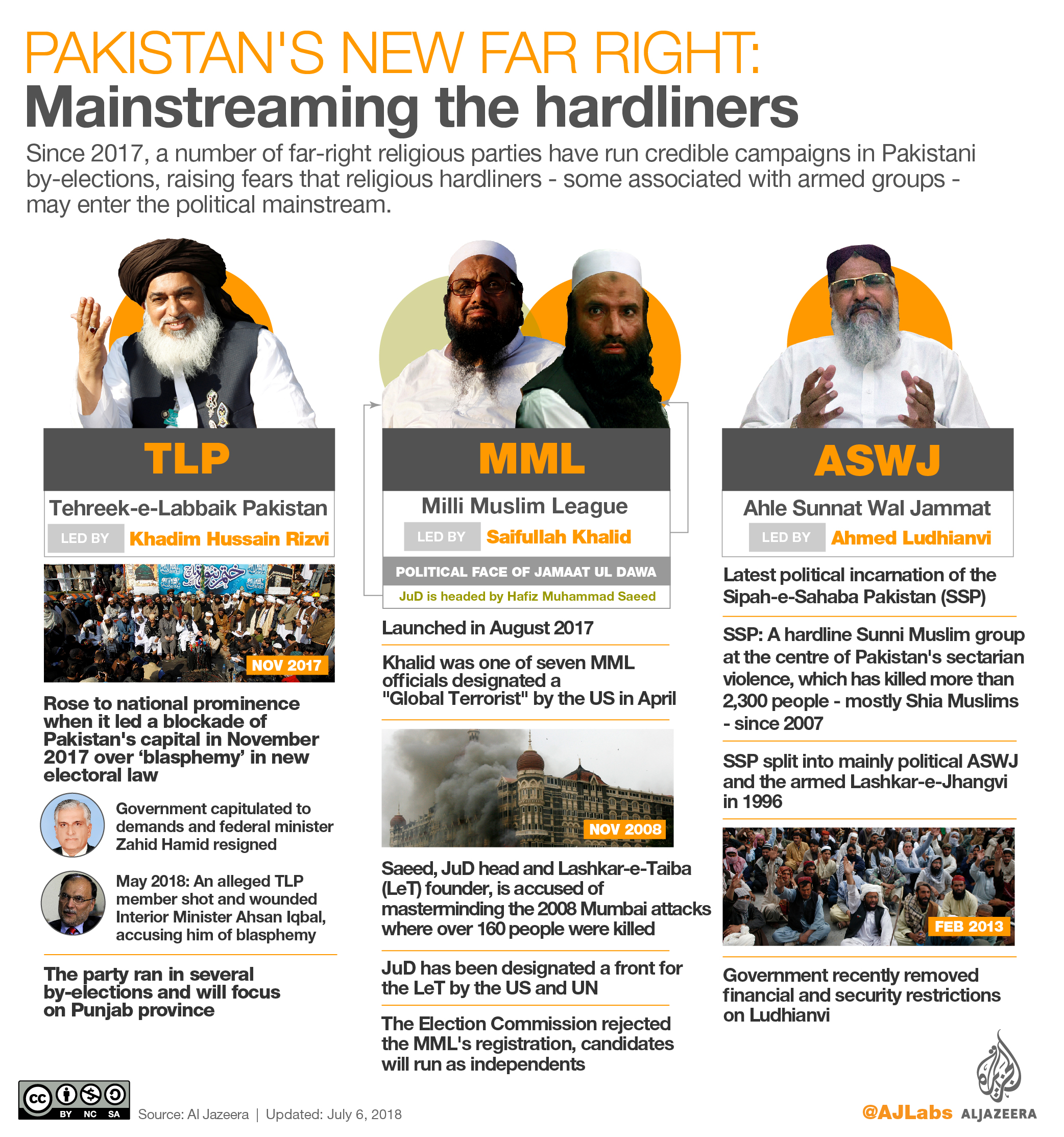
Who is behind Pakistan's new far right: Mainstreaming the hardliners


By Alia Chughtai & Asad Hashim


Who is behind the hardline religious parties gaining momentum ahead of upcoming elections?

Since 2017, a number of far-right religious parties have run credible campaigns in Pakistani by-elections, raising fears that religious hardliners - some associated with armed groups - may enter the political mainstream.

Tehreek-e-Labbaik Pakistan (TLP)

Led by firebrand far-right cleric Khadim Hussain Rizvi, Tehreek-e-Labbaik Pakistan rose to national prominence when it blockaded a major motorway into the Pakistani capital, Islamabad, for three weeks last year, protesting a change to the electoral law that they deemed blasphemous. The government capitulated to TLP's demands, including the resignation of a federal minister.
In May 2018, a man claiming to be a TLP member shot and wounded Ahsan Iqbal, Pakistan's interior minister, accusing him of blasphemy. The party has fought several by-elections and will be targeting Punjab province.

Milli Muslim League (MML)

Launched in August 2017, the Milli Muslim League is headed by Saifullah Khalid, who was among seven party leaders named in April on a US terrorist sanctions list.
MML is the political face of the Jamaat-ud-Dawa (JuD) humanitarian organisation, which has been designated a front for the Lashkar-e-Taiba armed group by the United Nations and the United States.
JuD is headed by Hafiz Muhammad Saeed, the alleged mastermind behind the 2008 Mumbai attacks, which killed more than 160 people in the Indian port city. The party's registration has so far been rejected by the Election Commission, and its candidates will likely stand as independents.

Ahle Sunnat Wal Jammat (ASWJ)

The Ahle Sunnat Wal Jammat (ASWJ) is the latest political incarnation of the Sipah-e-Sahaba Pakistan (SSP), a Sunni hardline group which has been linked to sectarian violence that killed more than 2,300 people - most of them Shia Muslims - since 2007.
The SSP broke apart into the mainly political ASWJ and the armed Lashkar-e-Jhangvi (LeJ) in 1996.
Both are banned and classified as terrorist organisations under Pakistani law, but ASWJ candidates have openly stood for elections for more than a decade. LeJ has carried out a wave of shootings and bombings targeting Pakistan's Shia minority, with recent attacks focused on Balochistan province.

Endeavouring to fulfill Benazir’s promises, save Pakistan: Bilawal

Pakistan Peoples Party Chairperson Bilawal Bhutto Zardari remarked on Friday that he is endeavouring to fulfill promises of his deceased mother Benazir Bhutto and save Pakistan.
While addressing a party rally in Rahim Yar Khan, he said that a vacuum was created after the death of his mother, which was filled by his father and former president Asif Ali Zardari.
Taking jibe at his political opponents, he claimed that PPP believes in serving the nation rather than constructing metro projects. He also questioned if the throne of Raiwind (indirect reference to Sharif family) did anything to solve the problems of people in South Punjab.
Moreover, he said that the Khyber Pakhtunkhwa government failed to build a single hospital or university for its people.
“Poverty is the biggest challenge facing Pakistan right now,” he said, adding PPP will work towards getting all the farmers registered. “We will issue Benazir Kisan cards to all the farmers, which will allow them to attain interest-free loans and subsidies.”
He further remarked that PPP’s manifesto is ‘people-friendly’, sharing that he wants to come to power to eliminate the menace of terrorism. “I want to come to power for people.” 
https://www.geo.tv/latest/202152-endeavouring-to-fulfill-benazirs-promises-save-pakistan-bilawal

Some forces still trying to weaken democracy: Bilawal Bhutto

Pakistan People’s Party (PPP) Chairman Bilawal BhuttoThursday termed July 5 one of the darkest days in Pakistan’s history. “This was the day back in 1977 when an elected government of Shaheed Zulfikar Ali Bhutto was overthrown by a military dictator,” he told a press conference at the residence of former minister Muhammad Bux Mahar.
Bilawal said the PPP has a history of fighting the undemocratic forces. “Pakistan’s democracy is in trouble once again. It seems that there are some forces that are still trying to weaken it,” he said.
Bilawal strongly condemned the elements who were trying to strong-arm politicians into changing loyalties. “Muhammad Bux Meher is one amongst many of my candidates who are being pressurised to jump the ship,” he claimed.
Bilawal said his party wants to contest a free and fair election, not some sort of ‘selection’. He pledged to protect true democratic norms and vowed that he will not let any anti-democratic forces to usurp power from the elected representatives of the people. He said that a strong democracy needs a free media as freedom of expression is an essential part of the democratic process.
Speaking to media in Sukkur, Bilawal reacted to Nawaz Sharif’s request for delaying Avenfield reference verdict for a week, stating that the accused is not in a position to dictate courts. However, he said that the announcement of the verdict should not portray Nawaz as a victim. “The timing of the verdict should not give an impression that it was not as transparent or effective as it should have been,” he said. The PPP chief noted that the protection of fundamental rights is the real essence of democracy and any compromise on it is not possible.
He stressed that that democracy is not defined by merely holding elections. “While it is a positive development that the country is going to witness its second election, we must continue this trend and bring stability to it,” he said. The country still has many weaknesses that need to be removed, he added.
http://www.thesindhtimes.com/sindh/07/forces-still-trying-weaken-democracy-bilawal-bhutto/

Thursday, July 5, 2018

Bilawal - Women make up 51% of the population - and the economy will not pick up until they are given the space which is their right

#PPP - Dilan Teer Bija -

Video - Z A Bhutto's historical speech

#PPP - Mai Bhutto Hon -

#PPP - Kal Bhi Bhutto Zinda Tha,Ajj Bhi Bhutto Zinda Hai

Video - Bilawal Bhutto QAZI AHMED Speech

Video - Bilawal Bhutto’s Rally in #Sukkur

Video - BIlawal Bhutto Rally NOsheroferoz

Video - #PPP Chairman Bilawal Bhutto Zardari addressing to public rally at Sakrand

Video - BILAWAL Bhutto Speech in GHAS MANDI Lyari

Video - Bilawal Ki Soorat Main Bhutto Nazar Aya

PERSPECTIVES - Bilawal will carry the Jinnah-Bhutto vision forward


Mian Aamir Hassan
The next election is going to be PPP's chance to bring Pakistan the glory it so rightly deserves.


Elections are going to be held on July 25, and we need to take stock of the current situation while keeping Jinnah’s words in mind. Which party truly believes in democracy, complete equality of mankind, fraternity, equality and liberty?
A bird’s eye view upon the past would help us in understanding today’s Pakistan. Ironically, Pakistan came into being in 1947, but could not hold direct elections until 1970. At that time, Pakistan Peoples Party (PPP) got a clear-cut majority in the areas comprising present day Pakistan. However, the dream for a better tomorrow was shattered by General Zia in 1977.
His coup gave a severe blow to state institutions and inflicted an irreparable loss to the state itself. Zia conquered his own country by force against the people’s will, held the constitution in abeyance and suspended civil liberties. In one stroke, he was able to dethrone an elected government and hang an elected prime minister.
Change is coming, and its name is Bilawal. With PPP’s latest party manifesto, the grandson of Zulfikar Ali Bhutto and son of Benazir Bhutto has shown his commitment to introducing Jinnah’s vision far and wide in the country
Zulfikar Ali Bhutto was the one who had managed to reclaim 5,000 miles worth of area from the enemy’s occupation. He was the one to get 90,000 soldiers released from enemy prisons. It was Bhutto who helped establish the nuclear program to make the country impregnable. And he was the one to give the country its first consensual constitution. Bhutto was the man who inspired the people of Pakistan to live respectably in the comity of nations and laid the first brick for a welfare state in Pakistan.
Jinnah wanted Pakistan to be a republic, but that did not happen due to his untimely demise. It was Zulfikar Ali Bhutto, who managed to pick up the pieces.
In 1970, general elections were held on the basis of one person one vote. However, General Yahya delayed transfer of power, hatched conspiracies and used violence as a tool. It led to the dismemberment of Pakistan.
Yahya Khan had to hand over the government to Bhutto Sahib who started his journey of progress step by step. During his rule, the war torn country got on its feet within years. When the 1977 general elections were held, invisible hands helped form the Pakistan National Alliance (PNA) but in vain. They were swept away by Bhutto’s wave of popularity; however, the PNA blamed rigging when it faced defeat.
At a time when negotiations between the government and the opposition were about to take a positive turn, martial law was imposed. The problems which we witness today are the direct result of that martial law. The seeds of intolerance, sectarianism, extremism, terrorism, Kalashnikov culture, ethnicity-based politics, corruption and load shedding were sown in the country. Our centuries old social values saw a decline during Zia’s rule. Hypocrisy, double dealing, selfishness, greed and violence penetrated the society and swelled unchecked.
The present Pakistan is the perfect place for the rich and mighty. However, this elite group is just a minority in this country and PPP wants to ensure that it is the majority that begins to think of Pakistan as the perfect place to live
During Zia’s time, when someone asked for their rights they were instead given imprisonment — many were beaten to death in dark jail cells. Those who weren’t crushed were exiled. Conservative and extremist forces were used to destroy people and run society into the ground with extremism. Later, these extremists became the breeding ground for terrorism in the country. Despite all efforts, PPP was not destroyed and its workers did not surrender. Owing to their struggle and sacrifices, the country is on the track towards democracy today. The constitution of 1973 has been restored in its true form. For this act, the former president of Pakistan, Asif Ali Zardari’s role is laudable. As July 25 approaches, I advise my readers to look at the PPP manifesto, which covers all aspects of state and society. The 10th manifesto is called “BB ka waada nibhana hai, Pakistan bachana hai,” which translate to: “We have to fulfil our promise to Benazir and save Pakistan”. The vision mentioned in the preamble makes clear that PPP wants to make Pakistan a peaceful, prosperous and progressive country.
The present Pakistan is the perfect place for the rich and mighty. However, this elite group is just a minority in this country and PPP wants to ensure that it is the majority that begins to think of Pakistan as the perfect place to live.
While unveiling the manifesto, Chairman Bilawal Bhutto made a commitment that PPP’s main concern is human rights and they would criminalise enforced disappearances and torture, and ensure that Pakistan as a state honours international treaties and covenants. He resolved to give rights to women; history is a witness that no other party has empowered women more than the PPP.
With this manifesto, the grandson of Zulfikar Ali Bhutto and son of Benazir Bhutto has shown his commitment to introduing Jinnah’s vision (picked by his grandfather and bequeathed to his mother) far and wide in the country.
Each word of this manifesto is soaked with the resolves of martyrs who have sacrificed their lives for the sake of democracy as well as for the betterment of Pakistan itself. The PPP has focused on resolving the issues relating to education, health and other basic necessities. The party will also resolve two major issues distressing the youth — unemployment and lack of opportunities.
The next election is going to be PPP’s chance to bring Pakistan glory.

Bilawal is the only future that Pakistan can look forward to


Senator Rehman Malik


As an elder politician, I recognise a lot of potential in our young leadership and see the courage and wisdom of Shaheed Mohtarma Benazir Bhutto in Bilawal's actions and speeches.

A manifesto is basically a reference book for a party to move forward. Manifestos define a political party and demonstrate its seriousness in addressing the major issues of a country at the policy level. It should contain the way forward for every faction of the society starting from the betterment of the common citizen and improvement of all vital components of the society and the state. It should have the ability to counter the main national challenges and to give relief to a common person. It creates confidence and hope in the minds of voters.
Pakistan Peoples Party (PPP) is the first party to have launched its manifesto for the upcoming elections and I have not yet seen the manifestos of Pakistan Muslim League — Noon (PML-N) and Pakistan Tehreek-e-Insaf (PTI), giving me no chance to make some comparison. I decided to write my views upon it after reading this great people-friendly manifesto. I do not have the other manifestos, as the other parties have not been able to make their manifestos public yet.
Allow me to say that the PPP chairman is more efficient as compared to other party leaders and I would like to congratulate him for this lead. The important salient features of PPP’s manifesto are discussed hereunder:
Bilawal’s manifesto starts with the slogan “BB Ka Wada Nibhana Hai, Pakistan Bachana Hai” (by honouring Benazir Bhutto’s promise, we will save Pakistan). Taking up his mother’s vision for a prosperous Pakistan, the manifesto truly addresses a variety of challenges and issues confronting our country.
The manifesto contains ideas for economic restructuring and growth, which work for all and beyond, and address the crisis management that is to come. The ideas include measures for an independent and rigorous assessment of the macroeconomic situation facing the country, including public debt, external and fiscal imbalances. It does this with the help of working groupsconsisting of Pakistani experts, who cover all aspects of the economic crisis. The economic policies shall devise a mechanism for evolving consensus on a basic national economic reforms agenda, for the medium-term.
Bilawal’s manifesto starts with the slogan: BB Ka Wada Nibhana Hai, Pakistan Bachana Hai. Taking up his mother’s vision for a prosperous Pakistan, the manifesto truly addresses a wide spectrum of challenges and issues confronting our country today
A Joint Parliamentary Committee of both Houses would be constituted, representing all political parties to incorporate a consensus for the basic national economic reform agenda. The PPP chairman visualised that a joint parliamentary committee of both Houses, with representation from all major parties, would be the need of the day to prepare a basic national economic agenda on issues of national economic importance to ensure cross-party commitment to broaden parameters of reforms on taxation, government spending and public debt.
The manifesto says that in order to enhance competitiveness of the export sector, surcharges for the five export-oriented sectors will be rationalised. All free trade agreements (FTAs) will be reviewed; Export Development Fund (EDF) will be given to the Ministry of Commerce and managed by an independent board of private experts, with an independent third-party evaluation of EDF. Established foreign brands would be facilitated to develop their foreign buying offices near Karachi, Lahore, Sialkot, Multan, Peshawar and Islamabad airports. Exclusive economic zones will be established wherein foreign companies, on their own or with local joint ventures, would establish factories on the condition that at least fifty per cent of the goods manufactured would be exported. Trading arrangements involving currency swaps will be pursued to reduce dependence on foreign currencies.
In case of public financing, the Federal Board of Revenue (FBR) would be restructured by turning it into three separate entities, namely Direct Tax Authority, Sales Tax Authority and Customs Authority, in order to avoid any administrative disharmony within the FBR and for evaluation of the performance of each authority against its specified targets. Moreover, the tax rebates for non-export oriented sectors would be withdrawn.
According to the manifesto, the agricultural sector, which occupies a central position in the national economic programme, would not only provide food to the people but also supply raw materials to sustain the manufacturing sector and exports, as the true potential for agriculture has remained unfulfilled due to the lack of policy attention and erratic decision-making in recent years.
The chairman has pledged in the manifesto to rebuild an economy that works for all and to reinvigorate the agriculture sector through an ambitious Zarai Inqilab Renewal Strategy built around three objectives: “(i) hunger eradication and food security, (ii) livelihoods and poverty reduction and (iii) economic growth and restructuring.” The strategy would be based on providing support to the agricultural sector to achieve these objectives and providing direct support to specific segments of the agricultural economy, such as small farmers, agricultural labour, women agricultural workers, and farmers in marginalised regions.
Despite the change of governments, the party has seen immense success of its BISP programme and so the manifesto pledges the registration of farmers and agricultural workers under the Benazir Kissan Card scheme. Subsidies, price support system and crop insurance scheme for small farmers has also been ensured. Legal recognition and registration of women agricultural workers would be made under the Benazir Women Agricultural Workers Programme.
The chairman is considering water as an essential resource for the country’s economic development, and has expressed the need to support efficient irrigation systems in the agriculture sector. It is also an important resource for the functioning of industries and urban centres. The party, taking into account the climate change trends, which indicate that Pakistan may run dry by 2025, with a 50 per cent gap between demand and supply, would address this in a comprehensive manner across multiple dimensions; (i) efficiency and conservation, (ii) augmenting supply by investing in new technologies, (iii) improving water quality management, (iv) and addressing waterlogging and salinity.
It has been promised in the manifesto that PPP’s focus would be to raise funds to finance the Bhasha Dam project as it is of immense economic value to Pakistan and therefore an important project.
About industrial policy, the PPP leader said that Pakistan’s declining manufacturing base is a cause of serious concern. Manufacturing as a share of GDP has declined from close to 20 per cent to 13.5 per cent. He said that the PPP government would prioritise the revival of these industries through the following measures; “(i) devising a rehabilitation scheme through the State Bank of Pakistan for the revival of economically viable but closed sick units, (ii) and ensuring proper supply and viable tariffs on electricity to remove the energy bottlenecks that the industries have suffered”.
He said that the PPP government would identify sectors where the possibility of creating a niche market for exports is possible and then the identified sectors would be provided credit through a direct credit line created by the State Bank of Pakistan.
About trade policy, the PPP Chairman said that the country’s exports have been on a downward spiral and there is a need not only to arrest this sharp decline in exports but also to restructure exports in the medium and long terms. He said that the PPP government would provide special incentives for the promotion of non-traditional and high value added exports.
The PPP would also provide an effective health management system. The family health services would link all elements of health provisioning into a unified individual centred system and health data management at union council and district levels.
PPP would also bring educational reforms in the curriculum and encourage the use of technology and social-emotional leaning.  Career counselling centres would also be built to develop workplaces of skill of communication, leadership, collaboration etc. The quality of education would also be improved. The PPP leader announced that he would end the ban on student and trade unions in the country.
The manifesto includes great energy sector reforms as well. The PPP will adopt a four-pronged strategy for addressing the energy requirements of a growing population and economy on a sustainable basis, by providing adequate, affordable and progressively cleaner energy to all. This four-pronged strategy includes; “(i) diversification of energy mix, (ii) prioritising efficiency and conservation, (iii) revamping transmission and distribution, and (iv) rationalising oil and gas polices.
PPP has also talked of tax measures in the manifesto making it possible to achieve 15 per cent of the target of the tax-GDP ratio through the measures including making use of the proven effectiveness of provincial tax authorities by delegating the administration of federal taxes to them through a partnership between the Federal Board of Revenue (FBR) and provincial tax authorities.
The manifesto has also addressed the key issue of our foreign policy that we lack in, as we have had no foreign minister for as many as four years. The chairman has pledged that under a pro-active foreign policy, his party would highlight the human rights abuses being committed by the Indian forces in the Indian-occupied Kashmir.
The young PPP chairman has a pragmatic road map to pull the country out of the crises and challenges it faces. The manifesto reflects his love for his people and especially the youth. I was to make an independent comparison of the manifestos issued by all the parties but unfortunately, I could not find the manifesto of any other political party.
The vision of the chairman of PPP is well reflected and his proposals and determination reflects his way forward to pulling the nation out of the crises. The chairman will require more professionals to implement his vision.
I as an elder politician foresee a lot of potential in our young leadership and see the courage and wisdom of Shaheed Mohtarma Benazir Bhutto in Bilawal’s actions and speeches.
I hope and wish to see him as the prime minister as he truly deserves to lead the nation.

#Pakistan - #PPP workers, candidates facing threats, claims Bilawal Bhutto

Pakistan People’s Party chairman Bilawal Bhutto Zardari has claimed that his party workers and candidates are being threatened during the election campaign.

“We need free and fair elections. The powerful forces should not interfere in the affairs of democracy. They should trust the masses who are the ultimate decision makers,” Bilawal said.

He said the anti-PPP alliance of political parties in Sindh ‘is against the interests of Pakistan.’

The PPP leader was addressing a press conference in Sukkur from where he resumed the party’s ‘Karachi-to-Khyber’ road caravan on the fourth consecutive day on Thursday.

The PPP chairman is supposed to reach Punjab’s Sadiqabad city on Friday.

The procession is scheduled to reach Rahim Yar Khan Saturday and Muzaffargarh Sunday. It will reach Multan on July 8th.

The PPP chairman will stay in Multan till July 10 and visit areas in Southern Punjab before leading the election caravan to Khyber Pakhtunkhwa.

https://www.samaa.tv/news/2018/07/ppp-workers-candidates-facing-threats-claims-bilawal-bhutto/

Nawaz Sharif has got political asylum in London, claims Zardari


Pakistan People’s Party (PPP) Co-Chairman Asif Ali Zardari has claimed that former prime minister Nawaz Sharif has got political asylum in London.
In an interview with private TV, Asif Ali Zardari said he wanted to see his son Bilawal Bhutto Zardari as prime minister, however, Bilawal would also learn while sitting on opposition benches.

Former president said whether Shahbaz Sharif run fast or slow, Mian Sahab (Nawaz Sharif) would receive vote and Mian Sahab’s vote would be shifted to her daughter Maryam Nawaz.To a question, Zardari said he would have no complain with Chaudhry Nisar but with Nawaz Sharif.

https://www.thenews.com.pk/latest/337478-nawaz-got-political-asylum-in-london-claims-zardari