Wednesday, June 27, 2018

U.S: - Democrats see major upset as socialist beats top-ranking US congressman

Alexandria Ocasio-Cortez, a 28-year-old Democratic socialist from the Bronx, has unseated Joe Crowley, a 20-year congressman, in a stunning political upset that sent shockwaves through the party.
The victory, in a New York district primary election to determine who stands against the Republicans in November’s midterms for a seat in Congress, immediately prompted debate about the wider ramifications for the Democrats, and whether it heralds a further move to the left.
Ocasio-Cortez is a member of the Democratic Socialists of America and a former organizer for Bernie Sanders. She would be the youngest female member of Congress in history if she wins as expected in November.
She won by a margin of 57.5%- 42.5% over Crowley in a majority minority district that included parts of Queens and the Bronx.
In the election – one of several primary victories by progressives – Ocasio-Cortez won 57.5% of the vote and Crowley had 42.5%. The district includes parts of Queens and the Bronx.
When the result was called, a visibly shocked Ocasio-Cortez clasped her hands to her mouth. “Oh my God. Oh my God. Oh my God,” she repeated. She then said: “We meet a machine with a movement, and that is what we have done today … working-class Americans want a clear champion and there is nothing radical about moral clarity in 2018.”
Crowley, head of the Queens county Democratic party and the fourth-ranking Democrat in the House of Representatives, was widely rumored to have ambitions to succeed Nancy Pelosi as Democratic leader in the House when the California Democrat stepped down. He had raised over $3m for his campaign, 10 times the amount raised by Ocasio-Cortez.
He had expressed confidence about the race in private conversations and as one national Democratic strategist told the Guardian: “The Crowley team did not raise red flags or ask allies for help with his primary.” Prior to 2018, Crowley had not even faced a primary since 2004, years before his 28-year-old opponent was even eligible to vote.
The upset was compared by observers to the shock defeat of Eric Cantor, the number two House Republican, to a Tea Party candidate, David Brat, in 2014. Cantor’s defeat stopped any momentum for Republicans in Congress on immigration reform. It also helped to create the hard-right House Freedom Caucus and drive out the former speaker John Boehner.
Pelosi, who is under pressure to step aside and pave the way for a new generation, insisted the win for the left of the party was not representative of a wider trend.
Pelosi said: “They made a choice in one district. The fact that in a very progressive district in New York, it went more progressive … is about that district. It is not to be viewed as something that stands for anything else.”
Asked if Democratic leadership should be more reflective of a party that is increasingly diverse, progressive and young, Pelosi replied: “I’m female, I’m progressive – so what’s your problem? Two out of three ain’t bad.”
Ocasio-Cortez ran on an unapologetically left wing platform that included a federal jobs guarantee program and abolishing Immigration and Customs Enforcement, the agency responsible for border enforcement. The Puerto Rican American also benefited from the changing demographics of a district with a growing Hispanic population and attacked Crowley for his ties to Wall Street, accusing him of being out of touch with his increasingly diverse district.
She ran on a platform of universal healthcare, a federal jobs guarantee program and abolishing Immigration and Customs Enforcement (Ice), the agency responsible for border enforcement. Like Sanders, she shunned corporate donations and attacked her opponent’s ties to Wall Street, accusing him of being out of touch with his increasingly diverse district.
“I think a lot of working-class Americans and voters here have been waiting for an unapologetic champion for economic, social and racial dignity in the United States,” Ocasio-Cortez told CBS. “And we provided a very direct message, a very clear message.”
Speaking in the Oval Office on Wednesday, Donald Trump weighed in on the result, taking shots at the Democratic incumbent: “For Crowley to lose that election was a shocker. I was surprised.” Trump added: “I think he probably took it for granted. I can’t say that I’m disappointed because I was never a big fan. But he lost his election, he probably shouldn’t have lost his election.”

Victories for progressives

In Maryland, Ben Jealous, the former president of the NAACP, won the Democratic primary for governor against the Prince George’s county executive, Rushern Baker. Jealous ran as an ardent liberal and touted national supporters such as Bernie Sanders as he called for free college tuition and marijuana legalization. Baker ran as a mainstream Democrat with a host of local establishment endorsements. Jealous will face the incumbent Republican Larry Hogan in November.
In Colorado, congressman Jared Polis won the primary for governor. Polis ran on a leftwing platform, including single-payer healthcare. He will face off against the Republican Walker Stapleton, a member of the Bush political dynasty, in November.
Two Republican candidates endorsed by Donald Trump also held off primary challengers Tuesday night.
On Staten Island, the former congressman Michael Grimm failed in his comeback attempt against the incumbent Dan Donovan. Donovan, a comparative moderate, received Trump’s endorsement as part of an effort by Republicans to keep themselves from making a seat that Obama won in 2012 even more vulnerable in the midterms.
In South Carolina, just one day after Donald Trump appeared on his behalf at a raucous rally, Governor Henry McMaster pulled off a narrow victory against the businessman John Warren in the runoff for the Republican gubernatorial nomination.
McMaster will face the Democratic state representative James Smith in the November election.


#PPP Song - Ab Waqt Ki Zaban Hai BILAWAL

#Pakistan - NAB seeks police help for producing Shehbaz Sharif

The National Accountability Bureau (NAB) on Wednesday sought help from the police for producing Shehbaz Sharif before NAB Lahore in the Saaf Paani case, a private TV channel reported.
Shehbaz has been summoned on July 5 to appear before the accountability watchdog. NAB reached out to the Lahore capital city police officer and directed the relevant authorities to ensure that Shehbaz appears before the bureau. NAB will also direct the SHO concerned to submit a report of the notice served to Shehbaz. The report will be submitted before July 4 with details of Shehbaz’s appearance and delivery of notice. The notice will be sent to Shehbaz’s official address in Model Town.
On Monday NAB arrested Engineer Qamarul Islam Raja – former chairman of Punjab government’s Saaf Pani Company – for his alleged role in awarding contracts to ‘favourites’. He is also the Pakistan Muslim League-Nawaz (PML-N) pick in the general elections against the party’s disgruntled leader Chaudhry Nisar Ali Khan from Rawalpindi’s NA-59 constituency. Interestingly, the arrest took place within 24 hours of Raja’s nomination as the PML-N candidate for NA-59 and the PP-10 constituencies of Rawalpindi.
Meanwhile, PML-N’s former finance minister Miftah Ismail has been summoned by NAB Karachi on July 5. Senator Rubina Khalid was summoned on Wednesday at NAB Rawalpindi. The bureau has authorised complaint verification against Senator Rana Mehmoodul Hassan for having accumulated assets beyond known sources of income.

https://dailytimes.com.pk/259148/nab-seeks-police-help-for-producing-shehbaz-sharif/

Pakistan Army’s Graduation from Military Coups to “Judicial Coups”

By Dr Subhash Kapila
Published: 2017
Pakistan Army yet again succeeded in overturning the strong electoral mandate with which PM Nawaz Sharif rode into power for the third time in 2013 and this time by a “Judicial Coup” with a complicit Supreme Court Judiciary.
The Pakistan Army has moved away from its traditional military coups for regime changes of its elected Prime Ministers to ‘soft political coups ‘attempted by the previous Pak Army Chief General Raheel Sharif, and in 2017 finally succeeded in displacing PM Nawaz Sharif through a “Judicial Coup” with full complicity of Pakistan’s Supreme Court Judiciary and Pakistan’s pretender for Prime Ministership Imran Khan who is widely believed to be a stool pigeon of the Pakistan Army military hierarchy and the ISI.
The above was foreseen presciently by noted Indian Columnist and policy analyst, M.D. Nalapat who had noted this in his writings in the Indian media organ ‘Sunday Guardian’ of 16 November 2016 wherein he noted that: “Analysts in key countries who are engaged in tracking developments in Pakistan warn that General Headquarters, Rawalpindi has initiated a plan to remove Prime Minister Nawaz before middle of 2017. Instead of a Musharraf-style military coup this time around the planning is for Pakistan’s Supreme Court to perform the (not very difficult) task of finding Nawaz Sharif guilty of corruption and initiating his prosecution. The grounds given will be the Panama Papers revelations along with fresh evidence gathered by GHQ Rawalpindi, military intelligence authorities including undeclared assets in the United States and Canada”.
Pakistan Army’s HQ, Rawalpindi, script has panned out as scripted with a compliant Pakistan Supreme Court Judiciary as a willing accomplice.
The case and implicit charges of complicity of Pakistan’s Supreme Court Judiciary stand articulated by Pakistan’s noted Human Rights activist and lawyer, Asma Jahangir who has commented scathingly on this whole process of judicial fudge-up to remove PM Nawaz Sharif from office. The main charges made by her against the Pakistan Supreme Court Judiciary are as follows: (1) JIT report was an investigation report by an agency. Veracity is still to be proven (2) Unprecedented for a JIT to include ISI and Military Intelligence officers as members of JIT investigating allegations against the Prime Minister (3) Investigation report is not a verdict.
Asma Jahangir pointedly observed that Panama Papers included names of many other Pakistanis. Why have they not been included in the ambit of JIT investigations which focussed on PM Nawaz only? More pointedly, Asma Jahangir notes that why did Pakistan’s Supreme Court not proceed against PM Nawaz Sharif as long as he was seen close to the Pakistan Army GHQ and why now when Pakistan Army GHQ perceives that Nawaz Sharif was not toeing the Pakistan Army GHQ line? Could complicity of Pakistan Supreme Court Judiciary with Pakistan Army GHQ need to be proven further?
Observers have pointed out that ousting of Pakistani Prime Ministers by judicial intervention is becoming a trend and cited past such judicial interventions of unseating PM Gilani (2008-12) and PM Raja Pervez (2013-13).
The New York Times commenting on PM Nawaz Sharif’s ouster last week observed that Pakistan’s Supreme Court legalised three military coups in the past in 1958, 1977 and 1999 under the dubious pretext of the “Doctrine of Necessity”. In another stirring indictment of Pakistan Supreme Court Judiciary commented that: “The empowered judges have become media-courting populists and having typically joined forces with the military by using allegations of corruption against disobedient prime ministers.”
It was also observed that no Supreme Court Judge has ever proceeded against Pakistan Army generals for Human Rights violations or on corruption allegations.
The ouster of PM Nawaz by a judicial coup would certainly impact the internal dynamics of Pakistan’s political landscape. In an ‘Opinion ‘article in the English Daily ‘The Independent’ it has been observed that “For a State that has been dominated by the military throughout its 70 years of existence, and where every military coup has been sanctioned by the judiciary,, yet another premature dismissal of an elected leader, even if on perfectly legal grounds —- could further tarnish the credibility of the civilian authority and reinforce the Army’s grip on the country’s fate”.
Crucially, there are two questions that hover in the analysis of PM Nawaz Sharif’s ouster by the Pakistan Army through the instrument of a ‘Judicial Coup” by a complicit and compliant Supreme Court Judiciary. The first is why has the Pakistan Army struck now when there was hardly a year for PM Nawaz Sharif’s five year tenure to have ended—the fist by any Pakistani Prime Minister? Secondly, where did the external stimulus come from for the Pakistan Army regime-change impulse at this juncture?
Pakistan Army’s intense dislike for PM Nawaz Sharif and the political direction that he wanted to give to Pakistani foreign policies are well-known and well-discussed in media analyses. Suffice it to say, that the Pakistan Army was deadly against PM Nawaz Sharif’s soft line approaches to India and the Kashmir issue and also Afghanistan. This clashed with Pakistan Army’s strategies. Also was the Pakistan Army’s displeasure with PM Nawaz Sharif not letting General Musharraf off the legal straightjacket as desired by the Pak Army?
In terms of external stimulus for regime change in Pakistan, it can be logically analysed that this stimulus has come in a big way from China. China openly has been calling for an orderly transfer of power. But the main question, pray may I ask is the transfer of power to whom?
Relative to the CPEC, while Pakistan’s civilian leadership including PM Nawaz Sharif, himself as a good businessman, were well-disposed to the CPEC but China was intensely concerned that with the deteriorating law and order situation in Baluchistan and Gilgit-Baltistan could hit its CPEC massive investments and CPEC could be derailed. The Pakistan Army in a much stronger driver’s mode in Pakistan’s affairs was seen by China as the preferred insurance to protect its CPEC investments. This again has to be viewed in the backdrop of the growing resentment in Pakistani civilian circles of the Pakistani wisdom of joining and facilitating the CPEC to please China. Some have questioned the Army’s commitment unreservedly.
China however was not in favour of an outright direct military coup which could in contemporary circumstances have possibly invited economic sanctions from the US and the West besides stringent criticism of China already under attack on its complicity over the North Korea missile tests issue.
A Pakistan Army GHQ engineered “Judicial Coup” was seen by China as a no-cost low-cost option especially it could be passed-of as yet another Pak Army-Supreme Court Judiciary complicity traditional pattern.
Pakistan seems set for yet another one year of political turmoil till the My2018 General Elections. Who knows that the Pakistan Army GHQ could prolong Pakistan’s political turbulence by directly stepping-in on its traditional pretexts of restoring law and order? Logically, vociferous protests and demonstrations by Sharif’s supporters to bring Pakistan Army’s accomplice Imran Khan also for legal trial over similar allegations could rock Pakistan’s domestic scene.
So while China gains it is the United States and India as the other pivotal powers with a stake in South Asia peace and security that would be significantly impacted by Pakistani turmoil. While India is accustomed and conditioned to Pakistan’s turmoil, the danger is that the United States should not stumble again into adopting Pakistan-appeasement policies.
Concluding, perceptionaly, it is not Prime Minister Nawaz Sharif who stands guilty today but the unholy nexus and complicity of Pakistan’s Supreme Court Judiciary with Pakistan Army GHQ in derailing Pakistan’s nascent democracy. Ironically the Pakistan masses ELECTED LEADERS are always rejected by the Pakistan Army GHQ-Supreme Court nexus through dubious “Judicial Coups”.

Pakistan’s July General Elections – Analysis

By Dr Subhash Kapila
Pakistan’s General Elections are scheduled for mid-July 2018 but the perspectives on it remain clouded in that in the run-up what has become abundantly clear is that the Pakistan Army-Supreme Court Chief Justice Combine carried out a “Judicial Coup” and thereby attempting scripting the outcome by pre-empting the return to power of Former Prime Minister Nawaz Sharif by an unprecedented verdict of his ‘Disqualification for Life.”
Reinforcing the above contention, Pakistan’s politically hyper-activist Supreme Court Chief Justice Saqib Nasir passed orders that all remaining appeals of Former PM Nawaz Sharif be decided upon before the General Elections. Implicit in such an order was the over-drive to convict Nawaz Sharif before the General Elections are held.
Before a further analysis of perspectives of Pakistan General Elections 2018 is attempted what needs to be flagged is that the future of Pakistan’s democracy is at stake. The Pakistan Army got the jitters at the prospect of Former PM Nawaz Sharif completing a full five year term in office. Fortunately, the Pakistan Army had in place a Supreme Court Chief Justice with identical aims and the result was not only the unseating of the Prime Minister but also his ‘Disqualification for Life”. That prompted my Paper in Julyn2017 entitled “Pakistan Army Graduates from Military Coups to “Judicial Coups”. The last named term thereafter entered public discourse.
Also needs to be flagged is the fact that how long can the Pakistan Army continue to dominate civil-military relations in Pakistan and determine the course of Pakistan’s political destiny? Pakistan General Elections 2018 do not foretell that a change is around the corner. Till that political dawn materialises Pakistan’s political dynamics will see no change.
Pakistan’s first military dictator initiated the concept of “Guided Democracy” for Pakistan and the Pakistan Army is intent on a continuance of its divine right to ‘Guide Pakistan’s Political Destiny.” It is a pity that whatever civil society that exists in Pakistan could not galvanise the Pakistanis- at- large to overturn this self-proclaimed dubious role.
Contextually, the above overhang needed to be highlighted before attempting to explore the relevant perspectives that emerge in the confused and complex political dynamics at play on Pakistan’s domestic scene. The above overhang generates a number of political developments that could likely determine the final outcome of Pakistan’s General Elections in July 2018.
With the new Pakistan Army-Judiciary Combine at play in Pakistan for last couple of months and which seems determined not only to prevent the return to power of Former PM Nawaz Sharif but also to return to power of Pakistan Muslim League-N to power, this has spawned two political developments. The Army-Judiciary Combine has signalled that the favoured Establishment’s Political Party is Imran Khan’s Pakistan Tehreek-e Insaaf Party (PTI).
Pakistan Army has an intense dislike for Former PM Nawaz Sharif for two reasons and what it perceives is that Nawaz Sharif is inclined to encroach on Pakistan Army’s traditional turf of foreign policy towards India and changing existing equations in civil- military relations. Reconciliation with India and development of friendly relations with India has been in the past the electoral plank of Nawaz Sharif.
In Pakistan’s traditional ‘Lota Politics’(defections) this has magnetised the PTI as the natural choice for all defectors from PML-N willing to cross-over to the perceived favourite political party of the Establishment. However, the number of such PML-N defectors is not too large. It mainly is composed of politicians of Southern Punjab wanting a separate State. On current indications, Former PM Nawaz Sharif and his PML-N party’s strongholds in Heartland Punjab seem to be intact.
Pakistani political analysts still root for the return to power of the PML-N as Imran Khan’s PTI has not been able to make major inroads in Heartland Punjab. The PPP also does not seem to have been able to make a sizeable political presence in Heartland Punjab. It is Punjab as the majority province that determines who will form the civilian government in Islamabad.
If that be so, then what becomes debatable is whether the political script choreographed by the Pakistan Army-Supreme Court Judiciary Combine to prevent the return to power of PML-N would hold good or unravel? It can only hold good if the Establishment resorts to wholesale rigging. The Establishment in such an eventuality would have to run the gauntlet of the Pakistani media-watch and international observers.
Moving to the personal popularity of the political leaders of the three major Pakistani political parties former PML-N PM Nawaz still leads over PPP’s Zardari and PTI’s Imran Khan, despite the Pakistan Supreme Court’s political disqualification. Zardari may have been President of Pakistan in earlier years but has no widespread political support in Pakistan. The same applies to Imran Khan.
Perceptionaly, Former PM Nawaz Sharif being prosecuted on flimsy grounds by the Supreme Court emerges as a political leader grievously wronged by the Establishment and hence will be seen as a ‘political martyr’. How much political capital accrues to Nawaz Sharif because of the foregoing will become evident only in end-July 2018.
Because of the Ramzan period which ended last week hectic political activity was not noticeable, but now it can be expected to pick up and also become acrimonious because of the high stakes involved for all major political parties and moreso for the Pakistani Establishment whose single-point agenda has been to prevent the return to power of PML-N conscious of the fact that even with Nawaz Sharif politically disqualified, he would still continue to be the Mentor-in-Chief of the PML-N alternatively led by his brother Shahbaz Sharif.
Political analysts in Pakistan are worried that voter turn-out in General Elections 2018 may not be all that high because of the July weather and maybe possible heavy rains. In Punjab this could affect the PML-N traditional vote banks. But the reverse side of this aspect could also be a reality that Pakistani voters in Punjab may turn out in larger numbers impelled by the belief that Nawaz Sharif has been wronged by a politically-activist Chief Justice of Supreme Court straying into Pakistan’s political minefields perceptionaly his own or at the behest of the Pakistan Army.
Pakistan’s General Elections are also susceptible to influences of major external powers that may not directly intervene to determine the outcome of the elections but resort to other means still to protect their national interest. The United States and China have the biggest stakes in the outcome of Pakistan General Elections 2018. The United States present interest in Pakistan is in relation to US military presence in Afghanistan where the Pakistan Army is the major disruptive factor. China has major strategic investments in Pakistan far outweighing those of the United States. China has effectively colonised Pakistan today.
Both the United States and China prefer to deal with the Pakistan Army in power or a political party enjoying the support of the Pakistan Army. But it cannot be forgotten that China’s prestigious $ 64 billion China Pakistan Economic Corridor was concluded with PML-N Government in power headed by Former PM Nawaz Sharif.
Not visible on the electoral scene in Pakistan with just a month to go for General Elections 2018 is heated and hectic election campaigneering. Many reasons contribute towards this phenomenon. In the recent past the Pakistan Establishment has clamped down hard on media personalities including forced disappearances of journalists, including women. Within Pakistan, it is being speculated that the Establishment has thrown many subtle hints that the PML-N should not be given prominence in coverage.
The other plausible reason could be a sense of weary resignation within Pakistan that the election outcome is a foregone conclusion in that the Pakistan Army-Supreme Court Judiciary Combine will ultimately have is way according to their scripted version.
There is another scenario in which the Pakistan Punjab electorate unmindful of the Establishment’s preferences votes back PML-N to power both in Punjab and in Islamabad. What would then be GHQ Rawalpindi’s options? Accept the verdict or engineer another constitutional breakdown?
In Conclusion, what emerges from the above perspectives is that Pakistan’s political landscape will remain clouded not only in the run-up to General Elections2018 but possibly shortly thereafter. In the overall analysis, the final outcome of Pakistan’s General Elections is not determined by the verdict of the ballot boxes but by Pakistan Army’s jackboots and regrettably in 2018 even by the tilted scales of Justice of Pakistan’s highest Judiciary in the persona of the politically activist Chief Justice of Pakistan Supreme Court.

#Pakistan - #PPP - ‘Sindh Nahi Darbaari Ka’, Bilawal reacts to Shahbaz’s statement over Sindh

Pakistan People’s Party (PPP) Chairman Bilawal BhuttoZardari has strongly reacted to PMLN President Shahbaz Sharif’s election campaign in Karachi, saying ‘Vote Mangnay Niklay Hein–Rasta Tak Pata Nahi Liyari Ka” (They came here to ask for vote even they don’t know the route to Lyari).
Bilawal took to twitter after Shahbaz Sharif kick started election campaign in Karachi here Tuesday. PPP Chairman said “Mazdoor Ka Hay Haari Ka —Sindh Nahi Darbaari Ka’ (Sindh does not belongs to sycophant, it belongs to peasants and labourers)
Upon his arrival in Karachi on Monday to kick start his election campaign, Sharif avowed to strive for progress and affluence for the metropolis.
“We will make Karachi better than Lahore if given a chance. You are free to compare our performance with that of our competitors,” Shahbaz said.

http://www.thesindhtimes.com/sindh/06/sindh-nahi-darbaari-ka-bilawal-reacts-shahbazs-statement-sindh/

Tuesday, June 26, 2018

Video Report - The migration crisis: an unholy rift.

Video Report - ‘Crack Hill’: Drug epidemic took over north of Paris

New American Civil War? Some people think it’s already begun


From celebrities calling on citizens to take to the streets, to members of Congress calling for the public harassment of White House officials, to mob justice at restaurants — is the US heading toward a new kind of Civil War?
Well, some people think the seeds of a new Civil War have already been sown — and in a recent article, University of Tennessee Law Professor Glenn Harlan Reynolds argued in a USA Today column that this new war is indeed “well underway.”
Reynolds was echoing similar comments from political scientist Thomas Schaller who wrote in a recent Bloomberg column that America is “at the beginning of a soft civil war,” and author Tom Ricks who agreed that the country seems to be“lurching” in that direction.
Much of the recent disquiet has been spurred on by the Trump administration’s “zero tolerance” immigration policies and the decision to separate children from their parents at the US-Mexico border, but things have been bubbling up since Trump took office 18 months ago.

1. ‘God is on our side!’

Representative Maxine Waters (D-California) caused a huge stir last week when she encouraged critics of the White House’s immigration policies to go out and harass members of the Trump administration in public. Waters made an impassioned call for citizens to ensure there would be “no sleep, no peace” for White House officials.
"If you see anybody from that cabinet in a restaurant, in a department store, at a gasoline station, you get out and you create a crowd. You push back on them. Tell them they’re not welcome anymore, anywhere," she said.
But her comments were so extreme and incendiary that it prompted a former secret service agent to call them “dangerous”and warned they “go beyond breaking the norms” of civil discourse and criticized her for “endorsing mob-rule to satisfy a political goal.”
Not long after Waters’ comments, White House Press Secretary Sarah Sanders was asked to leave a restaurant in Virginia because she works for the Trump administration.

2. ‘Surround their homes and schools in protest!’

Celebrities are getting in on the action, too, encouraging Americans to take to the streets in the millions to protest the Trump administration.
Last week, comments by actor Peter Fonda put the secret service on alert when he suggested that Trump’s 12-year-old son Barron should be taken from his mother Melania and put “in a cage with pedophiles” and that citizens should “surround the schools” of administration officials’ children in response to the child-separation policy.
Somewhat less dramatically, other Hollywood figures have called for protests and change. Actor John Cusack accused the Trump administration of “fascism” and “torturing” children — while musician Serj Tankian wrote on Instagram that the US is in a state of “utter regression” and that it is time for a “peaceful revolution.”

3. Confederate monuments controversy

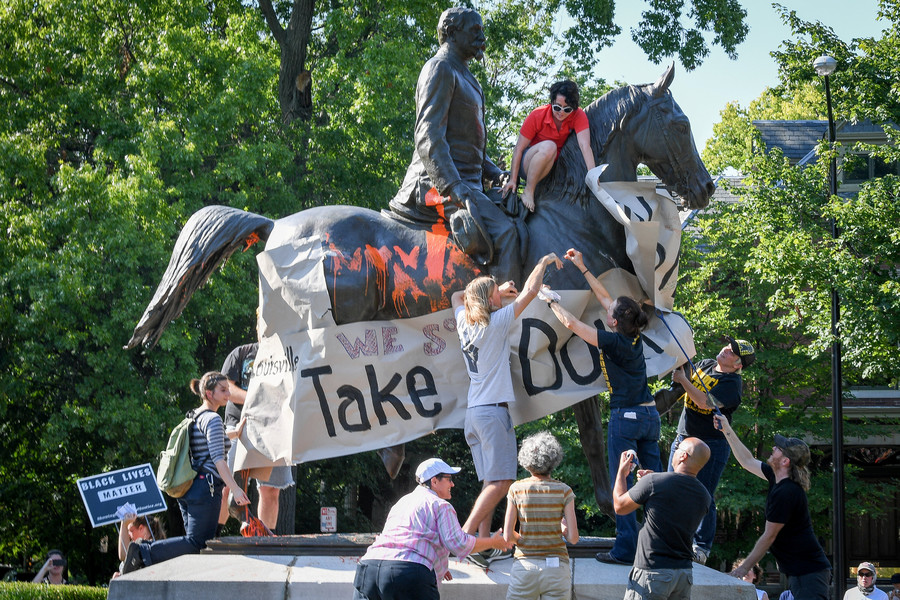
The fierce debate over the removal of confederate monuments and symbols across the US epitomizes the current political and social divide and the competing interpretations of American history, with one side believing the monuments revere figures who fought to maintain slavery while the other side believes they honor great patriots.
When white supremacist Dylann Roof killed nine black Americans attending a prayer service in Virginia in 2015, it prompted a movement to have Confederate monuments removed from public spaces across the country. More than 100 publicly-supported monuments and symbols have been removed since 2015 — but not without controversy and counter-protests. While monuments are being removed across the US, other groups are pushing for new ones to be erected.
Last year a ‘Unite the Right’ rally called in protest at the planned removal of a statue of Robert E. Lee in Charlottesville, Virginia turned violent when a protester drove a car through a crowd of counter-protesters, killing activist Heather Heyer.

4. Media wars, polarization of opinion

All of this social discord is playing out, magnified, on Americans’ TV screens in a way that appears to be exacerbating the problem. Eager to up their ratings, news networks invite the most polarizing of guests for daily screaming matches to be beamed into people’s homes. Far from the days of simply favoring one news channel over another, now if Americans don’t like how something is reported, it instantly becomes “fake news” or “propaganda.”
In his article, Reynolds wrote that news media which “promote shrieking outrage in pursuit of ratings and page views, are making the problem worse” and reminisced about a time when Americans could disagree with each other without hating each other.

5. Stratification of society

While all this is being played out on TV screens and social media, those at the fringes of society are feeling the effects of a sick system perhaps more than anyone. The socio-economic stratification of American society appears more obvious than it has at any time in recent years.
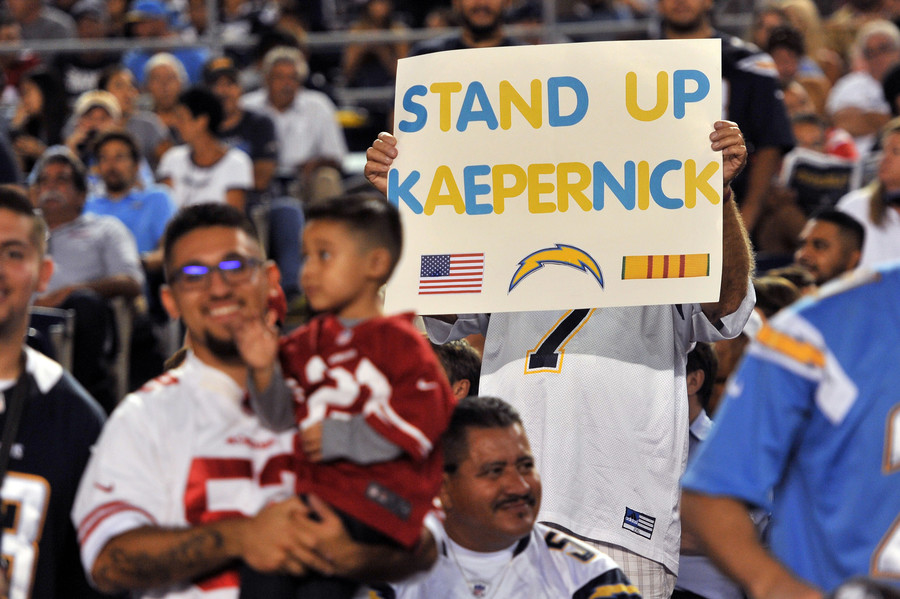
Inequality and rampant police violence against African-Americans prompted the NFL kneeling protests, which turned into a nationwide controversy between Americans who are proud of their flag and national anthem and all they stand for — and those who believe true freedom and justice have not yet come to America. A devastating opioid crisis, one of the highest child poverty rates in the world, and a strict adherence to policies which make the poor poorer and the rich richer, have all helped take anger in America from a simmer to a boil.
Reynolds wrote that part of the problem now is that Americans don’t feel social ties which transcend politics. It’s all us vs. them — and nothing in between. He argues that churches, fraternal organizations and neighborhoods used to cross political lines, but that this America has “shrunk and decayed” and people are increasingly finding their identity only in politics.
Marriage counselors, Reynolds explains, say that a relationship is doomed to fail when the couple begin to view each other with contempt — and in America today, there seems to be nothing but feelings of contempt felt on both sides of the political spectrum.

Video - How The Red Hen Could've Treated Sarah Huckabee Sanders

Video - White House Officials Get Left-Swiped | The Daily Show

شہبازشریف کا دورہ کراچی ،بلاول کا شعری تبصرہ


پیپلز پارٹی کے چیئرمین بلاول بھٹو نے شہبازشریف کے دورہ کراچی اور انتخابی مہم پر شعری انداز میں تبصرہ کیا ۔

سماجی رابطے کی ویب سائٹ ٹوئٹر پر ردعمل دیتے ہوئے بلاول بھٹو نے کہا کہ ’مزدور کا ہے ہاری کا ۔۔ سندھ نہیں درباری کا ، ووٹ مانگنے نکلے ہیں ۔۔ راستہ تک پتہ نہیں لیاری کا ‘۔
https://jang.com.pk/news/511911

مخالفین کے پاس جھوٹا پروپیگنڈا اور کھوکھلے نعرے ہیں،زرداری

مخالفین کے پاس جھوٹا پروپیگنڈا اور کھوکھلے نعرے ہیں،زرداری
سابق صدر اور پیپلز پارٹی کے مرکزی رہنما آصف علی زرداری نے کہا ہے کہ مخالفین کے پاس الزام تراشی، جھوٹے پروپیگنڈا اور کھوکھلے نعروں کے سوا کچھ نہیں۔
بلاول ہاؤس لاہور میں کارکنوں سے خطاب میں آصف علی زرداری کا کہنا تھا کہکارکن باہمی اتحاد اور جذبے سے پارٹی امیدواروں کی کامیابی کے لیے کام کریں۔
انہوں نے کہا کہ پیپلز پارٹی نے ادارے بنائے اور عوام کی فلاح وبہبود کے لیے کام کیا ہے، مخالفین نے دھاندلی اور چور دروازے سے اقتدار میں آکر عوام کو انتقام کا نشانہ بنایا۔
آصف علی زرداری کا کہنا ہے کہ پیپلز پارٹی عوام کی طاقت سے اقتدار میں آکر ملک کی خدمت کرتی ہے،ہماری جدوجہد سماجی انصاف اور برابری کے لئے ہے۔
https://jang.com.pk/news/511902

#Pakistan - Justice for Benazir Bhutto


The new Tehreek-e-Taliban Pakistan (TTP) chief is no ordinary militant. Indeed, Abu Mansoor Mufti Noor Wali is of particular interest to this country. Not least because of an important confession contained in his Urdu-language book, Inqilab Mehsud South Waziristan: From British Raj to American Imperialism. Posted online back in November 2017 — a decade after former Prime Minister Benazir Bhutto was assassinated — it confirms for the first time that the TTP was behind the murder.
Fast-forward to the present and he is known to be making the most of militant safe-havens on the other side of the Durand Line. In the company of the so-called second suicide bomber, known as Ikramullah; that is, the man who served as back-up in case the first failed to detonate. He was identified as such in Mufti Noor Wali’s book.
According to a BBC report this week, Ikramullah now belongs to a TTP splinter group; though it does not disclose the name. Be that as it may, he has now released a video statement denying all involvement in the plot to murder the first woman to lead a Muslim nation. Though the Beeb suggests that this is a staged ‘retraction’; in response to purported threats to his family from the Pakistani security establishment. There is also the question of other Afghanistan-based militants attacking him last year.
Be that as it may, a video message is no substitute for due process. Not when there is a penned confession naming Ikramullah as the second suicide bomber. Not when other suspects have identified him by name before the Pakistani courts.  Not when the latter features on list of this country’s most wanted terrorist suspects. Towards this end, therefore, we fully support Senator Rehman Malik’s calls for Kabul to hand over both Ikramullah and Mufti Noor Wali to Pakistan. Just as we fully back the PPP stalwart’s moves to urge the interim set-up to approach Interpol with a view to issuing Red Notices for the ‘extradition’ of both terrorists. It is, after all, a matter of national interest and justice.
Similarly, we hope that the Ghani government next door will do the needful. After all, it is clear that both the US and Afghanistan must do more, more, more to contain the anti-Pakistan terror threat emanating from across the border. The targeted strike against Mullah Fazlullah Rehman earlier this month is, in and of itself, simply not good enough. For what we are talking about here are terrorists who have the blood of a twice-elected premier on their hands; and who have not been flushed out from their safe-havens by a military occupying power that happens to the most sophisticated in the world. This is to say nothing of the presence of the NATO war machine in Afghanistan.
In short, Pakistan needs both men alive. For there is a vast difference between pulling the trigger in remote-controlled warfare and bringing the guilty to book.  And we know which Benazir deserves.

Fears over disfiguring parasitic disease as cases double in northern Pakistan


By Ben Farmer


Cases of a disfiguring parasitic disease have more than doubled in northern Pakistan with doctors saying they are left badly in need of drugs to treat victims.
Numbers of people detected with Leishmaniasis in Khyber Pakhtunwa province have jumped from 1,000 in the whole of 2017 to 1,700 cases in the first half of this year alone.
Better monitoring is starting to reveal the scale of the disease which is endemic in the province's remote districts and causes gruesome lifelong ulcers and scars on exposed parts of the body, officials said.
The most dangerous form of Leishmaniasis, which occurs elsewhere in the world, kills without treatment. While gaining less attention than some other diseases, Leishmaniasis is the world's second most deadly parasitic infection.
Health officials in Peshawar said the preferred drug for treating victims was not available in Pakistan and the province was reliant on doses supplied by international organisations including Doctors Without Borders (MSF) and the World Health Organisation (WHO).
Dr Ayub Rose, director of health services in the province, told the Telegraph: “We are terribly in need of drugs to control the disease. The shortage of drugs is the main issue that we are facing. The increase in detection of cases is also due to improved monitoring and surveillance in all the endemic districts and tribal areas due to which we are reporting more cases.
“Injection of glucantime is the only drug of choice for its treatment which is not available in Pakistan.
“We have been urging the government to register the same drug in Pakistan so it could be provided to the patients. We also want the Drug Regulatory Authority of Pakistan (DRAP) to start its production locally because the disease is endemic in the country and we need its uninterrupted supply.”
The WHO has supplied 1,100 injections to hospitals in the worst affected districts in recent months and MSF has given 450.
The disease is closely linked to poverty and poor nutrition. Ulcers often develop on exposed limbs and the face and Dr Rose said girls and women were often most badly affected by any disfigurement.
He said: “The disease is a source of problems for females because it leaves lesions on the skin which cause them social problems.”
Dr Pervez Khan, of MSF in Peshawar, said: “One feature of this is that it leaves a sore on exposed parts of the body. It affects all ages, but mostly the working class.”


The local government last month set up a 10-bed provincial referral centre in Peshawar and Dr Rose said officials were trying to improve monitoring of the disease. He said there was also a need for an awareness campaign to persuade people to use bed nets and avoid sandfly bites.
Worldwide there are an estimated 700 000 to 1 million new cases of Leishmaniasis each year. Most people are struck by the cutaneous form found in Pakistan, but around 20 000 to 30 000 die elsewhere from the visceral form, also known as kala-azar, which attacks the liver and spleen.

#Pakistan Media Says It’s Targeted in Army’s ‘Systematic, Creeping, Coup’


By Saeed Shah
A major Pakistani newspaper recently discovered the new limits of press freedom here after it published an interview with ousted Prime Minister Nawaz Sharif in which he questioned the military’s counterterrorism efforts.
Soldiers confiscated copies of the Dawn newspaper in army-controlled regions, officials harassed its distributors, and cable TV networks dropped the group’s TV news station, the company says. The government, then still run Mr. Sharif’s own party, “condemned the fallacious assertions” made by him, after a meeting with top military brass.
Pakistan’s powerful military is stifling the media ahead of a July 25 election, part of a larger power grab that seeks to ensure a pliant government emerges from the polls, say human-rights groups, politicians and media personnel.
“I’ve not seen this before under any democratic rule, not even under martial law,” said Hameed Haroon, Dawn’s CEO and president of the All Pakistan Newspapers Society, which represents newspaper owners. “They seek to influence the election results, influence the national narrative and liquidate the press.”
The military declined to comment. But it has denied accusations of press censorship or political interference, and says it supports democracy.
Pakistan’s armed forces have staged several coups in the past. But since democracy was last restored in 2008, critics say the military has instead focused on gaining influence over civilian spheres from behind the scenes. The military has since gained leverage over government policy, the political opposition, moved against dissent in civil society, and allied with the courts, critics say.
That effort gained momentum over the past couple of years as Mr. Sharif’s government clashed with the armed forces over his desire to make peace with India and his call for action against jihadist groups operating from Pakistan.
Washington has long accused the Pakistan army of using militant groups as its proxies, including the Taliban in Afghanistan, a charge it denies. Pakistan’s military alleges that India uses Afghan territory to support Pakistani insurgents, an accusation that Delhi denies.
The media has long been an irritant to the military.
In periods of martial law, the military imposed official censorship, with Pakistan’s state broadcaster a prime target. In a now democratic Pakistan with an abundance of private media, more subtle forms of censorship and self-censorship pervade, reporters and lawmakers say. “There has been a systematic, creeping coup. The powers have been taken over by the security establishment,” said Farhatullah Babar, a recently retired opposition senator. “Without taking over a single television station, the media has been tamed.” In this election, the military seeks to boost the party of Mr. Sharif’s toughest challenger, Imran Khan, to ensure that Mr. Sharif’s party loses its majority in parliament and must forge a coalition, say Mr. Babar and analysts. Both the military and Mr. Khan’s party—which brought the lawsuit that led to Mr. Sharif’s court-ruled ouster and his current corruption trial—dismiss any links to one another. Mr. Sharif denies any corruption. The judiciary says it is independent.
Polls show Mr. Sharif’s party is ahead in the election race, which journalists say explains a recent ratcheting up of repression against the media. One result, these people say: What little reporting there is on sensitive national security issues is told from the military’s viewpoint. Criticizing the military “would be suicidal,” said one media executive who has clashed with the military.
For example, TV stations have virtually avoided covering a new protest movementlambasting the military for human-rights abuses of the Pashtun ethnic minority. Dozens of the protest movement’s followers have been charged, including with sedition.
Meanwhile, many newer private news channels are owned by industrial tycoons outside the media, from tobacco to cooking oil, trying to gain influence, the journalists say. Those owners won’t often take a stand on editorial freedom, and some openly support the military’s stance, these people say.
In practice, the military contacts many TV channel owners about content it finds troubling, who in turn convey editorial direction to their journalists, say reporters at several channels, adding that the military also exercises influence over some hirings and firings at the stations.
Broadcasters have also reduced live programming to allow time to edit out dissenting opinion, these reporters say.
Cable distribution is also manipulated through its owners. The owners of four cable TV local distribution companies told The Wall Street Journal that they have been told directly by security officials to take particular channels off the air in recent months. Geo News, the leading news channel, was taken off air by cable companies for several weeks this year until it negotiated directly with senior military officials to be allowed back, say two people familiar with the talks. Several columnists at the group’s newspapers recently tweeted their reports when the papers wouldn’t publish them. Geo declined to comment. Security officials privately say they found Geo’s coverage too sympathetic toward Mr. Sharif. The Pakistan Broadcasters Association, which represents many channels, didn’t respond to a request to comment. But one of its members disputed the notion that editorial policy is compromised.
“By and large I don’t see any coercive pressure,” said Taher Khan, owner of the News One channel and an association board member. “As a responsible media, we shouldn’t say anything that’s antistate,” he said. In Pakistan, the term antistate is often used to describe opinion critical of the military.
At a press conference this month, Maj. Gen. Asif Ghafoor, the military’s spokesman, challenged any media owner or journalist who was told what to report by the military to disclose it on air. Maj. Gen. Ghafoor also displayed a chart showing which journalists have retweeted “antistate and anti-army” posts on Twitter. He said “anti-Pakistan” Twitter accounts based abroad had grown fivefold between January and May this year.
“We have to stay united, we have to defeat them,” he told journalists.
The next day, Gul Bukhari, a journalist and military critic with dual British-Pakistani citizenship, was abducted by uniformed and plain clothes men in the Lahore military zone. She was released hours later after her channel publicized the news and an outcry ensued. But journalists said the message was clear: No one is safe. In an interview, Ms. Bukhari said she has since sought police protection. Police say they are investigating.
The military denies involvement in her abduction.
Last year, five bloggers critical of the military said they were kidnapped by security officials, held for more than three weeks and badly tortured, they said after they were freed and fled abroad. One of the bloggers, Ahmad Waqass Goraya, said his parents, still in Pakistan, were threatened by military officials this month. The military denies involvement.
Independent-minded reporters say they will persevere.
“People who know the craft, they somehow push out information, using metaphors, sarcasm, signs, tone,” said Murtaza Solongi, the host of a political talk show on TV. “I don’t see censorship and self-censorship working.”

https://www.wsj.com/articles/pakistan-media-says-its-targeted-in-armys-systematic-creeping-coup-1530019669