Monday, June 18, 2018

U.S. - All 5 first ladies speak out against family-separation immigration policy

All five living first ladies have weighed in on the the Trump administration's immigration policy this week, an unusual move even as Melania Trump had her spokeswoman issue a statement on it.
The policy of separating children from their family members when they cross the border illegally has prompted debate in Washington, with many rights groups calling the practice inhumane.
The Trump administration has said it's simply enforcing a law to prosecute adults that come into the U.S. illegally and that children cannot be housed with adults while they are going through the criminal process.
A spokeswoman for First Lady Melania Trump said she "hates to see" families separated and called on both Democrats and Republicans to change immigration laws.
"Mrs. Trump hates to see children separated from their families and hopes both sides of the aisle can finally come together to achieve successful immigration reform," the first lady's spokeswoman, Stephanie Grisham, said in a statement. "She believes we need to be a country that follows all laws, but also a country that governs with heart."
Laura Bush wrote in an opinion piece for the Washington Post on Sunday that she understands the need to secure the borders but that the current situation reminds her of Japanese Internment Camps.
Michelle Obama retweeted Bush, adding that "sometimes truth transcends party."
Hillary Clinton also shared Bush's article and said there is no law to support the policy, tweeting that the situation is a "humanitarian crisis" and that parents should be "outraged."
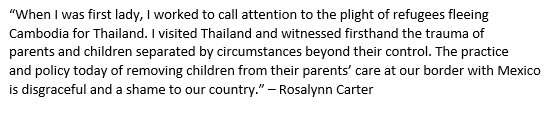
Rosalynn Carter also weighed in, calling the policy a disgrace and that she has seen first hand the trauma of separating children from their parents.

#PPP - Kal Bhi Bhutto Zinda Tha, Ajj Bhi Bhutto Zinda Hai

Nawaz brought Pakistan to place where world mocks us: Zardari


Former president and Pakistan Peoples Party (PPP) co-chairman Asif Ali Zardari said on Sunday that former prime minister Nawaz Sharif has brought Pakistan to a place where the world is making fun of the country.

Talking to the media after a visit to PPP leader Abdul Haq Bhurt’s house here, Zardari said that the PPP has always indulged in politics of principles.
The PPP co-chairman claimed further that the party’s candidates will emerge victorious in the upcoming general election on July 25 and the party will form a government.
Zardari added that the incoming PPP government will right the wrongs committed by the Nawaz-led government which was dissolved on May 31 this year.
Separately, PPP leader and former opposition leader in the National Assembly Khursheed Shah said that whenever Nawaz heeded his advice, he [Nawaz] was saved but failure to do so always resulted in Nawaz finding himself in trouble.
Moreover, addressing an Eid ceremony in his hometown of Sukkur, Shah claimed that the upcoming election should not be taken lightly as it can strengthen or weaken the country.
He added that it would be a dangerous thing if someone somewhere commits a mistake or mischief and turns the polls controversial. 

https://www.geo.tv/latest/199604-nawaz-brought-pakistan-to-place-where-world-mocks-us-zardari

'Campaign of fear' drives Pakistan's journalists to self-censorship as pressure mounts ahead of General Election


Suddaf Chaudry
"Militant organisations, who call them non-state actors, are active," said former Pakistani prime minister Nawaz Sharif in an interview to Dawn, one of the country’s oldest and leading English dailies. In the interview published on 12 May, the former prime minister went on to ask: "Should we allow them to cross the borderand kill 150 people in Mumbai? Explain it to me.”
India was quick to react, claiming the statement confirmed Pakistan government’s support to the terrorists who attacked Mumbai. The Pakistan government responded by disrupting Dawn's distribution in different parts of the country since 15 May, especially in Balochistan and the Sindh province, and to civilians living in military cantonments. The Press Council of Pakistan too issued a notice to Dawn for what it called "violating the ethical code of conduct". The PCP's action has raised concern at the Pakistan Federal Union of Journalists (PFUJ). With the Pakistan general elections scheduled for 25 July, the action against Dawn has been described by Pakistan’s journalists as a "campaign of fear against anyone criticising the establishment". Apparently, the Pakistan military was particularly upset with the interview, including the part where Sharif asked "why can’t we complete the trials", referring to the many pending prosecutions of those accused of involvement in the 2008 Mumbai attacks.
Pakistan had responded to India’s statements as a “gross misinterpretation of Sharif’s comments".
The pressure against Dawn, in particular, and the Pakistani media, in general, has been mounting for some time. Dawn editor Zaffar Abbas in a recent tweet described the unannounced policy of "self-censorship" as "suffocating", though he refused to comment for this story. In fact, there has been no official response to the disruption of distribution of Dawn editions. After the publication of the interview, on 4 June, Pakistan Army’s spokesman, Major General Asif Ghafoor, accused a number of journalists of anti-state activities while presenting a slideshow featuring their social media accounts. “We do have the capability to monitor social media, to see who is doing what,” he said.
In response, the PFUJ issued a statement on 6 June, requesting the Inter-Services Public Relations (ISPR), the media wing of Pakistan's Armed Forces, “to withdraw its sweeping statements against journalists”.
However, two days later, PFUJ president Afzal Butt said that Major General Ghafoor's presentation mentioning the social media accounts of journalists was "not meant to target any individual or the journalist community”. Many journalists mentioned in that presentation found Butt's clarification an abject surrender to the military. Butt and PFUJ secretary Ayub Jan Sarhandi did not respond to our request for a comment.
88 percent journalists self-censor stories
Steven Butler of the Committee to Protect Journalists (CPJ), a non-profit based out of New York that promotes press freedom worldwide, said in a tweet that “displaying photos of journalists who allegedly are helping push anti-state propaganda is tantamount to painting a giant target on their backs".
Aliya Iftikhar, CPJ’s Asia associate, in response to an email request for comments, said, “Pakistan has long been a dangerous environment for journalists to work in, but this appears to be a particularly trying time for the press, as the country prepares for elections. If there is a climate of fear and the media isn’t able to do its job properly, Pakistan cannot ensure that its elections will be free and fair."
A number of journalists from leading broadcast and print publications that the writer spoke with allege an increase in trolling against those raising concerns about press freedom. One reporter, who spoke on the condition of anonymity said: “We are forced to practice self-censorship. If we do not delete a tweet then our management will face the consequences.”
According to Media Matters for Democracy, a policy research initiative based in Islamabad, 88 percent of journalist’s in Pakistan self-censor their stories, especially on subjects relating to security and religion. Major General Ghafoor held an undisclosed four-and-a-half-hour-long meeting with a select group of journalists on 8 June. A journalist who was present at the meeting, said, “Reporters were briefed on the slide presentation and asked whether that had impacted the safety of journalists mentioned. We were asked if we objected to the ISPR slides publicising the names of journalists. All the journalists present said the names should not have been published."
Major General Ghafoor apologised for the slides saying, "In hindsight, it wasn’t right, we are learning too," the journalist added.
Agencies keeping watch on scribes
The actions against Dawn and the incident at Geo TV — its journalist and social media activist Gul Bukhari was "abducted" for a few hours — indicate increasing pressure against free and fair reporting by journalists without fear of intimidation.
Bukhari was reportedly whisked away by unknown assailants on her way to Waqt News to appear on a show. The producer of the show said, “She was perhaps abducted by agencies. We know from our driver who was beaten up." Bukhari was freed a few hours later and her experience was mentioned in the 8 June meeting between Ghafoor and the select group of journalists. The army spokesman did not elaborate on the subject, sticking to the official comment of supporting investigation of the abduction. However, in a lighter and more candid vein, the general did quip: “what good is an intelligence agency if it leaves traces behind.” Amnesty International released a report last week urging authorities to end the crackdown on press freedom ahead of the 25 July elections. But Iftikhar said the challenges to this are manifold.
“The pervasive climate of threat that journalists face, some perpetuated by the Pakistan Army, means the country cannot make meaningful progress in improving the climate of press freedom,” she said.
Pakistan ranks 139 out of 180 countries in Reporters Sans Frontiers 2018 World Press Freedom Index.

Watchdog says Pakistan's military is intimidating reporters

Pakistan's military is strong-arming the media in an attempt to stifle criticism of its behind-the-scenes political power ahead of next month's elections, an international watchdog said Monday. The Vienna-based Independent Press Institute released a report documenting a nationwide campaign of intimidation, including everything from threats to abductions.
It cited the disappearance of journalist Gul Bokhari, who was abducted for several hours, and the assault of journalist Asad Kharal, who was roughed up in the eastern city of Lahore. Pakistan's powerful intelligence agency was suspected of involvement.
The IPI says it is "worried that the continued persecution of the independent media is designed to convey a clear message: that any criticism of the military's involvement in civilian affairs will have dire consequences for the survival of an independent press in Pakistan."
https://abcnews.go.com/Politics/pushing-back-trump-senate-dems-now-back-bill/story?id=55973013

Global watchdog to put Pakistan back on terrorist financing watchlist: sources


A global money-laundering watchdog has decided to place Pakistan back on its terrorist financing watchlist, a government official and a diplomat said on Friday, in a likely blow to Pakistan’s economy and its strained relations with the United States.
The move is part of a broader U.S. strategy to pressure Pakistan to cut alleged links to Islamist militants unleashing chaos in neighboring Afghanistan and backing attacks in India. The Pakistani government official said the South Asian nation would be officially placed on the Financial Action Task Force (FATF) watchlist in June at its next meeting, which is why the FATF statement on Friday did not mention Pakistan.
The change comes days after reports that Pakistan had been given a three-month reprieve before being placed on the list, which analysts say could hamper banking and hurt foreign investment. The United States spent the past week lobbying member countries of the Financial Action Task Force (FATF) to place Pakistan on a so-called gray list of nations that are not doing enough to combat terrorism financing.
In Washington, acting Assistat Secretary of State Alice Wells was unable to confirm the FATF decision. She said, however, that the U.S. effort to have Pakistan put on the list was partly due to Islamabad’s failure to act against Hafiz Saeed, an Islamist who heads Jamaat-ud-Dawa (JuD), a charity accused by Washington of being a front for militant group Lashkar-e-Taiba. “When we saw terrorists like Hafiz Saeed be released for the sixth time from house arrest or saw charitable arms of Lashkar-i-Taiba or Jaish-i-Mohammad operate freely, sometimes in front of police stations doing fund-raising exercises, it obviously raises serious concerns,” Wells said in an interview.
Lashkar-i-Taiba has been accused by the United States and India of being behind 2008 militant attacks on the Indian city of Mumbai in which 166 people died.
Pakistan made last-minute efforts to avoid being placed on the watchlist, such as taking over charities linked to Saeed.
But the moves proved insufficient and FATF decided late on Thursday that Pakistan would be put back on the watchlist, a senior Pakistani official and a diplomat with knowledge of the latest FATF discussions told Reuters. “The decision was taken yesterday,” the diplomat said. “So the political decision was made now, but the consequences will kick in three months down the line.”
Both officials spoke on condition of anonymity.
Pakistan’s foreign ministry spokesman declined to confirm or deny the news at a regular news briefing on Friday, saying the FATF would make an announcement. Pakistan was on the list for three years until 2015. Pakistani officials say the country managed to grow its economy during this period and raise money on international bond markets, so the economic impact will not be as big as some fear.
PAINFUL CONSEQUENCES?
Earlier in the week China, Turkey, and the Gulf Cooperation Council (GCC) were opposing the U.S.-led move against Pakistan but by late on Thursday, both China and the GCC dropped their opposition, the diplomatic source said. The Pakistani official who was familiar with the negotiations said the Saudi-led GCC had been “flipped” by the United States between Tuesday and Thursday. But he played down China’s role, saying the Chinese were “helpful” to Pakistan. Pakistan, the government source said, was convinced it would have three months to satisfy all other FATF issues and was negotiating with FATF co-chairs from Italy and America about what they need to do ahead of the June session when the United States demanded to raise its motion again late on Thursday.
The U.S. Embassy in Islamabad did not respond to a request for comment.
Pakistani businessmen fear being on the FATF list could endanger Pakistan’s handful of remaining banking links to the outside world, causing real financial pain to the economy just as a general election looms. Under FATF rules one country’s opposition is not enough to prevent a motion from being successful. Britain, France and Germany backed the U.S. move. Pakistan has sought to head off its inclusion on the list by amending its anti-terrorism laws and by taking over organizations controlled by Saeed.
U.S. President Donald Trump last month ordered a suspension in security aid to Pakistan over what the United States sees as its failure to crack down on militants.
Pakistan rejects accusations that it sponsors Taliban militants fighting U.S. forces in neighboring Afghanistan and says it is doing all it can to combat militancy.

https://www.reuters.com/article/us-pakistan-militants-financing/global-watchdog-to-put-pakistan-back-on-terrorist-financing-watchlist-sources-idUSKCN1G70X7

Sunday, June 17, 2018

Music Video - Miley Cyrus - Party In The U.S.A.

Video - Guns N' Roses - Paradise City

Music Video - The 1975 - Give Yourself A Try

Music Video - The 1975 - Girls

Music Video - HAIM - Little of Your Love

Kim Jong Un Crossed The Rubicon: The Future Of North Korea – OpEd

North Korean leader Kim finally walked out to the Western world and met with US President Trump. This historic engagement means much for the future of the reclusive country, which has earned an international reputation for its continued pathological and lawless behavior. Trump has done enough on the international stage and showed the outcast regime remarkable patience and humanity. The ball is now in Kim’s court.
It is noteworthy that, for the first time, North Korea broke the protocols of keeping the leader’s whereabouts ultra-secret. The state-run media announced Kim’s trip to Singapore ahead of the summit and even mentioned Kim was aboard an Air China 747 flight for his trip, instead of his outdated and unreliable Soviet-era jet. These are signs of unprecedented openness by the isolated Orwellian regime, which has long established that the leader’s safety and well-being are the sole reason for the existence of the regime and its people. The implications are breathtaking, and the unthinkable probably have already started.
The process of North Korea’s denuclearization as an essential part of peace building with the United States cannot go backward once it takes off on the international stage of this caliber. Should the signed agreement be revoked by North Korea, the United States would be justified to wage war with the regime with full moral support from the American people and the allies. Trump has taken pains to avoid the course of action his predecessor took for Iraq. This is truly good for the people in North Korea and for the world and, with some cautionary and optimistic notes, it can be said that another potentially devastating war was narrowly averted.
But we should not forget that it is President Trump’s resolve and US military readiness that have reversed the course and forced Kim to surrender. Last winter, Trump gave the Pentagon a green light to attack, but North Korea escaped a war by the hair’s breadth when Kim chose to guard down and came out to the open. History may liken this Singapore summit to Japan’s Instrument of Surrender aboard USS Missouri on Sept. 2, 1945. Among Trump’s ten books for deep reading is the Art of War by Sun Tzu, a highly influential and widely read Chinese military strategist of the fifth century BC, who said “to fight and conquer in all your battles is not supreme excellence; supreme excellence consists in breaking the enemy’s resistance without fighting.”
News media poured out two diametrically opposing commentaries and analyses of Trump’s handling of North Korea: a colossal failure vs. a huge success. Suffice it to say that Kim took humiliation and waved white flags because he had no other choice. The road ahead to complete denuclearization depends entirely on Kim’s action, and the world will watch how sincerely and well North Korea is going to keep their promise. Trump had a mindful movie trailer entitled Two Men, Two Leaders, One Destiny, played for Kim during the summit. What better captures the tone of this summit?
The United States has demanded complete denuclearization of North Korea, and North Korea has, in return, asked for complete security guarantees. On the surface, these two demands may seem incompatible and imply a virtual dead end. By Occam’s Razor, however, there may be a point of convergence and both sides can find a way out, if they genuinely want healthy long-term relations and seek peace and prosperity. If the two sides become allies, the dead end will dissolve as a mirage. The prosperous path of Japan after WWII under US influence and alliance is a good model for North Korea, too.
It is an interesting misconception that North Korea is solely ruled by Kim Jong Un. The system has undergone internal change with ramifications to the power elite in natural ways, as it evolved over time and has found its own life. This regime, too, has characteristics of a living organization and can act as a group on matters of vital national interest. Their group action was clearly seen when the elite decided to have Kim’s uncle and number 2 strongman, Jang Song Thaek, executed in 2013. A small portion of the elite in Pyongyang has formed a super-wealthy class called donju and they wield considerable power. Does the elite want to go to war with the United States and have themselves devastated for nothing? Kim’s several summits help us gauge choreographed moves in the background that indicate group-stage decisions and preparedness within the regime.
The whole Korean situation, in fact, has resulted from interests of the world’s powers since the 1945 Yalta Conference. Is anything wrong or inconceivable if North Korea sides with the United States instead and keeps a distance from its cold-war allies, China and Russia? Chairman Mao distanced himself from the Soviet Union after his meeting with then-president Nixon in 1972. Geopolitical and economic situations change, and so does international politics. From the ruins and debris of the Korean War, the South has risen as an economic power with US help, whereas the North has remained an impoverished pariah state under Chinese influence. North Korea has every reason to get out of the cycle of degeneration and maniacal obsession. It is understandable why Trump calls North Korea’s denuclearization a “process” and the one-page agreement signed with Kim at the summit a “comprehensive” document. It reminds us of the Treaty of Kanagawa between Japan’s Tokugawa shogunate and US Commodore Perry in 1854.
Some foreseeable or potential roadblocks to peace building between the United States and North Korea include (a) Chinese interference in the process and (b) abrupt change in political situations in North Korea. Kim’s adversaries are not just “hostile US forces in South Korea.” Domestic dissidents and regime-internal political and military groups closely linked to China are serious threats to Kim’s rule.
There were revolts and coup attempt against the Kim family in the past, but the state’s tight control and surveillance system successfully blocked them. A weakened control system in the peace-building process with the United States might however encourage inside attempts for power and impede the peace process. Also, Beijing is unlikely to watch a US-North Korea alliance with arms crossed; Beijing would almost certainly interpose into the process and try to keep North Korea under their influence. But China has difficulty of sorts in other fronts, including the uncertainty of their ambitious, yet bleeding, One-Belt-One-Road project, recent developments in US-Taiwan relations, and the on-going trade war with the United States. Thus, Beijing’s attempt to interfere with Pyongyang probably would not have much success, but that’s where cautionary notes are certainly called for.
It is our hope and responsibility to have a better future on a different timeline.

Video Report - Susan Rice: Kim Jong Un beat Trump at summit

Video Report - Trump administration under fire for separating immigrant children from parents

Video Report - Lawmakers to Trump: End border separation policy now

Video Report - US vs the world? Trump's trade rifts - Counting the Cost

Pashto Music Video - Ahmad Zahir ( Obe derta Rawrlem)

Pakistan: Christians of Punjab village in limbo after church force-closed for being 'affront to Muslim faith'

The community of 40 Christian families in this village of 400 people in Toba Tek Singh district near Faisalabad has since been holding weekly prayers in their homes.

Community cries foul after parish blasted as affront to Muslim faith but new land deeds outside village still not forthcoming

Christians have been told to remove all religious symbols from the church in Nayya Sarabah village in Pakistan’s Punjab province, which belongs to the Full Gospel Assemblies (FGA) group. 

Six months after villagers in Muslim-majority Nayya Sarabah in Pakistan’s Punjab province colluded with police to shut down the only Christian church in the village, negotiations remain deadlocked pending a new land deal.

Christians claim they are being persecuted after the church, run by Pastor Samuel Masih, held its last service in December and has since been sealed, with orders in June to remove all religious symbols and traces of Christianity from the property.

The community of 40 Christian families in this village of 400 people in Toba Tek Singh district near Faisalabad has since been holding weekly prayers in their homes.

But they claim they are being treated unfairly in not being able to practice their religion freely and are now operating under almost impossible conditions.

"We paid to have this church built," said 70-year-old Christian Rafaqat Masih, a retired army officer and union councilor for minorities who is at the vanguard of efforts to resolve the issue.

"You can still smell the fresh coat of paint."


http://timesofahmad.blogspot.com/2018/06/pakistan-christians-of-punjab-village.html

#Pakistan - Zulfi Bukhari - Imran Niazi --- A Phone Call Away - Disregard for the laws


The last five years have been dedicated to politics against corruption and money laundering. Most of the conversations were geared around these two themes and these have become the criterion for upcoming elections as well. One of the parties championing this cause was the Pakistan Tehreek-i-Insaaf (PTI), especially after the Panama case came to the forefront.

However, Imran Khan’s recent visit to Saudi Arab disregards the party’s own stance by getting close aide Zulfi Bukhari on a one time ticket out of Pakistan.

 Bukhari’s name had been placed on the Exit Control List (ECL) on the recommendation of the National Accountability Bureau (NAB) and an investigation was going on to confirm his alleged ten offshore companies.
For such a person, who is currently being investigated by an institution of the country, to be able to get a clearance last minute on the airport showcases the amount of disregard for the laws of this country. 

Many - journalists, politicians, civil society activists, and the masses on social media - are rightfully angered by this move because it shows that the ideology of the party which claims a moral high ground is no different from the mainstream parties it demonises on the same grounds. NAB expressed serious alarm over the Ministry of Interior allowing Zulfi to travel. Legally the Interior Ministry is required to seek permission of the institution which placed the ban on the individual in case of a one-time visit permit, although it is not allowed. However, no such permission was sought, which is why the interim setup is being viewed with suspicion.
The caretaker Prime Minister Nasirul Mulk has demanded an inquiry report on why Zulfi Bukhari was allowed to travel because such special favors are not granted at the last minute, especially not to those under an investigation for offshore companies. There is absolutely no justification for the action and those disrespecting the legal barriers in place must be held accountable. The law should not be at the disposal of certain individuals, it should be applicable to all equally.

Zardari vows to hand ‘exemplary’ defeat to opponents in elections

Pakistan Peoples Party (PPP) co-Chairman Asif Ali Zardari on Sunday vowed to hand an ‘exemplary’ defeat to political rivals in general elections 2018 and make Pakistan prosperous and strong by coming into power.
Speaking to a ceremony in Nawab Shah, Zardari said that the PPP is the party of people and will always work for the welfare of people. He asked the PPP workers to prepare for elections and said that the party will decisively win the elections and make Pakistan stronger than ever.
He added that from today, he has officially kick-started his election campaign and that despite Faryal Talpur’s efforts in Nawab Shah, there is still a lot to be done.
Zardari said that he will make Nawab Shah a model of development and will invite the leaders from Lahore to witness development in real terms.

https://dailytimes.com.pk/254463/zardari-vows-to-hand-exemplary-defeat-to-opponents-in-elections/

#Pakistan - Bilawal Bhutto sends flower bouquet to Begum Kulsoom Nawaz

Chairman Pakistan Peoples Party Bilawal Bhutto Zardari who is on a private visit to London sent flower bouquet to ailing Begum Kulsoom Nawaz in hospital yesterday (Saturday), wishing her early recovery.
A section of the media has incorrectly reported that Bilawal Bhutto Zardari personally visited Begum Kulsoom Nawaz in the London hospital

Chairman PPP is scheduled to return to Pakistan Monday evening.

https://mediacellppp.wordpress.com/2018/06/17/bilawal-bhutto-sends-flower-bouquet-to-begum-kulsoom-nawaz/