Tuesday, June 5, 2018

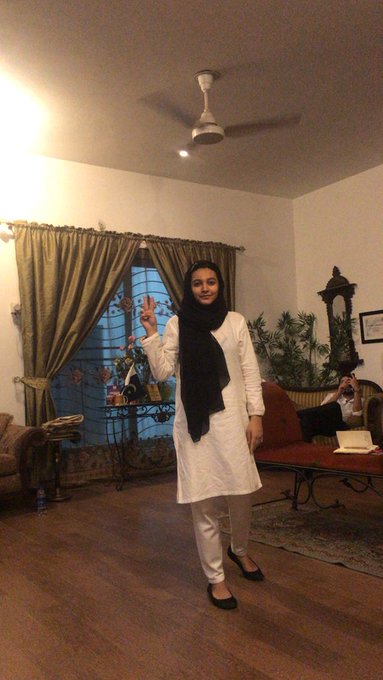
#Pakistani Generals are Afraid of Educated,Strong women. #GulBukhari - Female journalist Gul Bukhari 'abducted' in Lahore

Journalist and activist Gul Bukhari was abducted by unknown persons in Lahore on Tuesday night, police sources said.
According to sources, Bukhari was on her way to the Waqt TV studio on Fatimah Jinnah Road (Queen's Road) for a show when she was intercepted and abducted on Sherpao Bridge in Lahore's Cantonment area. Her family has reported her missing to the police.
Punjab police say Bukhari has not been detained by police personnel.
According to a journalist employed at Waqt TV, Bukhari was on her way to the studio to appear in a show when unknown persons stopped her vehicle and asked her to come out.
A vocal critic of the military, Bukhari is a journalist and activist who has worked in broadcast and print for several media groups in Pakistan. Bukhari is presently a contributing Op-Ed writer at The Nation and was set to appear as an analyst on Waqt TV show '2vs2'.
Concerns about freedom of expression and press censorship grow in the country in the run-up to election. In recent months, the Jang Group’s Geo TV was pushed off the airwaves across most of the country.
Last week, former prime minister Shahid Khaqan Abbasi said days before Pakistan's caretaker government took over that his government did not believe in resorting to media censorship but urged the media to adopt a mechanism for self-regulation.
In April, a Reporters Without Borders report said the Pakistani media are regarded as among the most vibrant in Asia but due to pressure being exerted by extremist groups and intelligence agencies they are increasingly resorting to self-censorship, according to a report by a global watchdog.
As news of Bukhari's disappearance made the rounds, journalists took to Twitter to express concerns about her safety.
Journalist attacked in Lahore
In a separate incident, broadcast journalist Asad Kharal was beaten by masked men in Lahore on Tuesday, police said.
SP Bilal Zaffar Cantonment Division confirmed the attack on Bol YV anchor Kharal, whose car was intercepted by masked men who physically assaulted him. Kharal was then taken to Services Hospital to be treated for his injuries.

How the Pashtun Tahafuz Movement can save Pakistan from its own worst impulses


SHANTANU MUKHARJI
Islamabad should heed anti-discriminatory protests like the PTM. By doing so, it will correct the course of its own flawed history.
Pakistan is raring to go for its parliamentary elections to be held on July 25 – hectic political activities are gaining centre-stage in the country. But, alongside, it is also getting more and more saddled with multiple problems of different kinds – and practically no solutions in sight.
Pakistan’s military and civil establishments are on a path of confrontation, with no parties agreeing to blink first.
Former PM Nawaz Sharif’s recent outburst against his detractors, coming down heavily on their reported endorsement on allowing Pakistan’s security agencies dispatching home-grown terrorists to go across to Mumbai and carry out the dreaded 26/11 terror attacks, causing at least 166 deaths, has wreaked havoc in the country. Pakistanis, by and large, are surprised over Nawaz Sharif’s statements as never before has an ex-Prime Minister criticised one’s own government so boldly and so vehemently, directly insinuating military generals in charges of having fomented terror in India and failing abjectly at reining in Pakistan-based terrorists Meanwhile, as the international community frowns upon such revelations and Pakistan gets more visibly isolated in the international community, the Pashtun Movement (PTM) looks like a new rallying force in the embattled country.
The PTM espouses the cause of the neglected Pashtuns. This mint-fresh protest now adds to the already existing protest movements led by the Balochs and the Mohajirs, seeking their share of fresh air, and thus threatening the sovereignty of the tightly controlled nation. The seed of the current movement started when a Pashtun, Naqeebullah Mehsud, and some of his brethren were killed by unprovoked police firing in Karachi on April 8.
The incident was apparently caused by a discriminatory and insensitive police force, led by an allegedly brutal police officer called Rao Anwar. This incident led to Pashtun leadership being taken on by a 26-year-old Pashtun named Manzoor Ahmad Pashteen, who has galvanised thousands of disgruntled Pashtuns, organising protest marches drawing attention of the government to their demands to be fair to the community, which is otherwise heavily discriminated against, principally by the brute domination of Punjabis. The latter in Pakistan have always been more muscular, using strong-arm tactics to suppress the Pashtuns and other minorities.
The PTM espouses the cause of the neglected Pashtuns. This mint-fresh protest now adds to the already existing protest movements led by the Balochs and the Mohajirs, seeking their share of fresh air, and thus threatening the sovereignty of the tightly controlled nation.
The seed of the current movement started when a Pashtun, Naqeebullah Mehsud, and some of his brethren were killed by unprovoked police firing in Karachi on April 8.
The incident was apparently caused by a discriminatory and insensitive police force, led by an allegedly brutal police officer called Rao Anwar. This incident led to Pashtun leadership being taken on by a 26-year-old Pashtun named Manzoor Ahmad Pashteen, who has galvanised thousands of disgruntled Pashtuns, organising protest marches drawing attention of the government to their demands to be fair to the community, which is otherwise heavily discriminated against, principally by the brute domination of Punjabis. The latter in Pakistan have always been more muscular, using strong-arm tactics to suppress the Pashtuns and other minorities.
This young Pashtun’s meteoric rise and organising ability pose immense threat to the Pakistani establishment.
This has conveniently labelled Indian intelligence agencies as masterminding operations to arouse passions amongst the Pashtuns to rebel against the government. These allegations don’t hold much water though as for the Baluch uprising too was blamed on Indian outfits for apparently fomenting dissent. Earlier, Pakistan shifted the blame to external quarters for its internal discontent over the Mohajir Quami Movement (MQM), which continues to haunt the Pakistani establishment. It is worth recalling that Pakistan’s step-motherly treatment towards the Bengalis cost Pakistan so dearly that it led to the birth of Bangladesh as a new nation in 1971.
This proved the “two nation” theory of Mohammad Ali Jinnah as being totally wrong, various forces in Pakistan aspiring for more freedom. Like the Bengalis, the Baluchis and the Sindhis are no exception to this aspiration. More importantly, now the present Pashtun Tahafuz Movement is a force to reckon with – and it has definitely the promise to carry forward a robust movement.
The leader of this Pashtun movement, Manzoor Ahmad Pashteen, is a known human rights activist with a clear goal. He has a dedicated cadre with serious ground experience of clearing land mines, helping the Federally Administered Tribal Administration (FATA). Having been involved in such militarised tasks, it is assumed the agitating Pashtuns must be armed with some degree of discipline and training, which will be handy for a large-scale movement.
The ongoing Pashtun movement is in fact reminiscent of the great Pashtun leader Abdul Ghaffar Khan or Badshah Khan, who led a movement earning him the title of “Frontier Gandhi”. Such giants surface in history after many, many years, but given the organising prowess and the strategic vision of Manzoor, any Pashtun movement now is expected to have and navigate a clear road map. "Frontier Gandhi" remains a great inspiration.
Pakistan has been meddling, rather violently, in the internal affairs of its neighbours, particularly India (specifically within Kashmir ) and Afghanistan, though without much success. Yet, it continues to indulge in these misadventures – without realising its own backyard is burning today with internal problems of immense multitudes threatening the unity of the country. 

It must also be borne in mind that history is always a testimony to the fact that those who do not learn from its lessons are the ones who suffer from eventual disintegration. 

 Now that Jinnah’s "two nation" theory stands repudiated by history itself, religious extremism and fanaticism should be expected to take a backseat in the years to come, with mass leaders like Manzoor Pashteen instead emerging as torch bearers to lead the country into a state bereft of any religious bias. As it is, Pakistan’s Shias, Ahmediyas, Baluchis, Pashtuns and such like continue to face the brunt of religious discrimination due to state parochialism and a distinctly prejudiced approach; they are often even targeted in a systematic manner.
Its military leadership and the Pakistani polity must jointly do serious brainstorming to address the growing dissent lest it is too late and a Bangladesh kind of situation is allowed to come to the fore – with disastrous consequences for Pakistan again.
Therefore, Pakistan needs to watch the ongoing just and anti-establishment movements and take corrective measures with a non-discriminatory approach. It can thus keep its own house in order – and stop blaming India for every bit of the fallout of its own flawed policies and actions.

#StopUsingTalibanAgainstPT - #Pakistan - Pashtun Tahaffuz Movement Comes Under Militant Attack

The Cost of Extreme Media Censorship – a View From Pakistan


By Adnan Rehmat
The latest round of coercive censorship is an attempt to ensure that media narratives conform to the goals and objectives of the intended outcomes of the elections scheduled for the summer.
There is a price to pay for professional broadcast journalism in Pakistan. That was the sobering message for the media from the blatant, but unofficial, blackout in large swathes of the country in April 2018 of Geo News, the market leader among 37 current affairs 24/7 channels. The blackout seemed arbitrary but not without method — transmission was disrupted intermittently, thereby delaying public awareness about the odd phenomenon.
Puzzlingly, for the public at least, there did not seem to be any explanation. The reason: neither did Jang Media Group, which owns Geo, publicise the matter at first or protest nor did the remainder of the media industry report it even when it understood what was happening. Social media leaks were the primary source of information about the blackout.
Analysts and commentators soon started connecting the dots with allied developments — popular commentators, analysts and writers across several newspapers, including The News, The Express Tribune and Jang complained that their regular write-ups were being declined. Clearly, overt censorship was at play and it was spreading across mediums and media groups. Some current affairs analysts, like Babar Sattar, Gul Bukhari and Mosharraf Zaidi, retaliated by sharing their declined write-ups on social media.
It was only after international media, including BBC, Al Jazeera, Reuters, The Economist, The New York Times and The Hindu picked up the story and reported extensively on it that the public discovered what was happening. And what they discovered from these reports is deeply troubling.
The security establishment, it appears, is enacting a wider enforcement of undeclared censorship on both the quantum and tone of ongoing current affairs news threads. Geo has refused to publicly acknowledge any discussions on the matter with the establishment even though in private its functionaries are not shy about mentioning their inevitable capitulation. The broadcast media’s regulator, the Pakistan Electronic Media Regulatory Authority (PEMRA), has denied ordering any of its licensed cable distributors to censor Geo while the superior judiciary seems uninterested in investigating the matter beyond PEMRA’s explanation.
Pakistan’s history is replete with state-enforced censorship. But what explains the severely coercive nature of undeclared censorship now? Media managers privately say that the angry but spirited resistance put up by Nawaz Sharif and Maryam Nawaz to the restrictions on their political ambitions and careers, the media caricaturisation of rising judicial activism against the political classes, the spontaneous civil society-driven rights movement piloted by Manzoor Pashteen capturing popular imagination, and the scathing media blowback and social media commentary about the reported ‘Bajwa Doctrine’ appear to have hit a nerve. Any freewheeling discussion and sound bite on the mainstream media on these topics seem to have become unacceptable to quarters that seek – and to a large degree have achieved – a national current affairs narrative mostly articulated through a security perspective.
Even a cursory examination of the 147 daily current affairs talk shows on 37 TV channels reveal a telling trend: caricaturisation of politics, parliament and politicians; promotion of security doctrines, overt criticism of Nawaz Sharif by mostly censoring out his perspectives in favour of near-unbridled coverage of his opponents; mostly uncritical coverage of political statements and other activism by the judges; total blackout of the otherwise phenomenal Pashteen-led rights movement; and an army of retired military officials populating most of the talk shows to ensure that the discussions remain generally subservient to manipulated narratives and interests.
The recent actions against the likes of the Jang and Dawn groups, which now remain about the only sections of the mainstream media that make an effort to accommodate pluralist perspectives, came precisely because of this. The latest round of coercive censorship is an attempt to ensure that media narratives conform to the goals and objectives of the intended outcomes of the elections scheduled for the summer. Media professionalism is apparently not part of the plan.

#Pakistan - Bilawal Bhutto Zardari expresses deep concern over the reports of clashes in Wana

Chairman Pakistan Peoples Party Bilawal Bhutto Zardari has expressed deep concern over the reports of clashes in Wana and called for handling the situation very carefully.

In a press statement, the PPP Chairman said that reports emanating from various media sources were worrying and called for a probe into the circumstances surrounding the reported clashes resulting also in casualties.


The PPP Chairman also expressed sympathies with the families of those who lost their lives in clashes or suffered injuries.


https://mediacellppp.wordpress.com/2018/06/05/bilawal-bhutto-zardari-expresses-deep-concern-over-the-reports-of-clashes-in-wana/

Monday, June 4, 2018

#Pakistan - #PTI’s pandering to the religious right. We should all be worried


Farhan Janjua
Pakistan Tehreek-e-Insaf (PTI) has entered the battlefield with full force ahead of the general election 2018 and isn’t keeping its ambitions to secure right wing votes a secret. PTI wants to play the holier than thou game even if it has to pander to the murderous narrative of extremist parties such as the Tehreek i Labbaik Pakistan (TLP).
Here are six instances that have worried even the well-meaning supporters of the PTI.
Recommendation of Orya Maqbool Jan as Punjab’s caretaker CM
Amidst much confusion in the party, its Opposition Leader in Punjab Mehmoodur Rasheed has insisted that Orya Maqbool Jan is still one of the recommendations made by his party. Orya is notorious for his pro-Taliban, anti-minority, misogynistic, violence-inciting and pro-TLP stances. He not only praised TLP leader Khadim Rizvi during sit-ins against the government, he publicly announced full support.
In his prime time show, he not only declared bloggers arrested last year as blasphemers but also called for their executions.
The party first made its ambition known last year when its ally and Awami Muslim League (AML) chief Sheikh Rasheed on a TV show discussed how Mumtaz Qadri, the murderer of Punjab governor Salmaan Taseer had emerged as a political force and how that ‘huge vote bank’ will help Imran Khan. Here’s the video if you don’t believe it.
The maverick TV presenter Aamir Liaquat is now in PTI. In April, he actively used his TV platform to incite violence against Pashtun Tahafuz Movement (PTM) leaders and went so far as calling them Indian agents and blasphemers.
Even though the party spokesperson Fawad Chaudhry said it was Aamir Liaquat’s personal opinion, Liaquat persisted on his actions.
In Sialkot, a PTI ticket holder led demolition of an Ahmadi worship place
In May 2018, the person who led the mob to destroy an Ahmadi place of worship (also a historic site) in Sialkot was a PTI supporter. Hamid Raza along with TLP operatives destroyed the site and openly took responsibility for it. The PTI later distanced itself from Raza but there is clear evidence such as photos with the leader Imran Khan, local level party activism and contesting election from PTI platform.

PTI leader fanning sectarian conflict to prove how big of an ‘Aashiq-e-Rasool’ he is
Everyone remembers Aamir Liaquat’s dramatic exit from his own show Ramazan mei Bol after one of the clerics, Qari Khalilur Rehman objected to Liaquat’s implication that Dr Zakir Naik was blasphemer. The next few days Dr Liaquat along with fellow Berlavi clerics continued targeting the Salafi sect saying it was ‘disrespectful’ to the religious personalities including the Prophet (PBUH). The stunt backfired and Aamir Liaquat had to face massive criticism including from party supporters on social media and he ended up apologising and bringing back the Salafi cleric.
Possible alliance with TLP
Aamir Liaquat in his Friday’s show discussed with the TLP’s Lahore candidate Allama Khizrul Islam who appeared in his show as one of the clerics how PTI and TLP would work together. The cleric nodded saying they can definitely work with PTI. Imran Khan had earlier tried to please the TLP by attending the Khatm e Nabuvvat conference last year.

#Pakistan - Bilawal Bhutto to vie for NA-246, files nomination papers


Bilawal Bhutto Zardari is all set to contest the upcoming election on NA-246.
He submitted his nomination form through his counsel, Farooq Naek, to the returning officer of District South on Monday.
Candidates have begun filing their nomination papers. Monday is the first day. The exercise will continue till June 8. The list of candidates will be displayed on June 8.
Pakistan polls its next government into power on July 25.


https://www.samaa.tv/pakistan/2018/06/bilawal-to-vie-for-na-246-files-nomination-papers/

Pashtun protests a test for Pakistan’s democracy


Maria Bastos 

The state has been openly hostile towards the Pashtun Tahafuz movement — the right to protest must be protected.


PAKISTAN is set to go to the polls on July 25th. Trusting the general elections will go ahead, they will mark an important step towards strengthening the country’s democratic process. But there is still much more to be done: democracy is not confined to the ballot box. Despite the progress made in the past decade, Pakistan continues to be bewitched by an array of partially real, partially imagined threats. The figures at very top of Pakistani society have spun a powerful narrative of a nation under constant attack, which dismisses any criticism or dissent as either ‘foreign influence’ or ‘anti-patriotic’ politics; a tactic that has been deployed in response to protests by the country’s ethnic minority communities. How Pakistan responds to these nascent movements is as much a test case for democracy as the forthcoming elections. 
Pakistan is slowly moving away from a decade that was marked by a wave of terrorism. According to the South Asia Terrorism Portal, a website that monitors terrorism across the region, civilian deaths from terrorist attacks have fallen from 3000 in 2013 to 540 in 2017. Indiscriminate attacks have posed a constant challenge for the state, and civilians have paid the price of the country’s unconditional support for the United States-led ‘war on terror’. Only after a ruthless attack on a school in Peshawar in 2014 which killed 132 pupils has the government made a decisive turn towards a fully-fledged counterterrorism strategy, with the aim of eliminating once and for all the menace that has left severe open wounds across the country.
One of those open wounds can be located within the Pashtun community. Pashtuns live predominantly in the north-west regions that border Afghanistan, which includes the federally administrative tribal areas and Khyber-Pakhtunkhwa. Since 1979, after the Soviet invasion of Afghanistan, the populations of these regions have been engulfed by state-led conflicts. A guerrilla war that served Pakistan and US designs against the Soviets, fuelled radicalisation, and perpetuated colonial-style rule, created the conditions for two of Pakistan’s most underdeveloped regions to be further marginalised.
Pashtuns have been demonised as violent extremists, traffickers, and Taliban sympathisers. Pashtun students have been profiled by security forces and have been subject to harassment and abuse, which, in the case of Mashal Khan back in 2017, ended with his brutal assassination at the hands of religious extremists. Several hundreds of Pashtuns have been reported missing; earlier this year, a UN human rights body said it had received over 700 reports of enforced disappearances in Pakistan. The promised dignity that democratic rule brings to all citizens has not been experienced by Pashtuns or by most of Pakistanis in general.
After decades of being misunderstood, dehumanised, deprived by the state, Pashtuns are finally awakening, peacefully. A new social movement known as PTM, or Pashtun Tahafuz Movement (Pashtun Protection Movement), formed in 2014, has organised several protests to demand dignity and rights not just for themselves but all Pakistanis. PTM is demanding what, by definition, a functional democratic state must guarantee to all her citizens.
Reactions to PTM are conferring the movement a crescent legitimacy. The top military leadership classified PTM as a movement supported by ‘foreign forces’ and an obstacle to their fight against terrorism. More recently, attempts to link PTM to the Taliban have been circulated on social media, which the organisation denies. The right to protest and to demand human rights and dignity should not be equated with army efforts to bring peace and stability to Pakistan. PTM, like any other citizen, or civilian group, has the right to be critical of the military.
The English-language media within Pakistan have covered PTM’s protests, however, they reach only a fraction of the population. TV channels, however, have not covered the protests seemingly due to ‘self-imposed’ censorship from above. Karachi’s PTM gathering in May was disrupted hundreds of miles away, with the movement’s leader being barred from boarding two flights, first in Islamabad, and, some hours later, in Lahore. Political leaders from main parties like PPP or PML-N, perhaps motivated by the upcoming elections, have voiced their concerns on attempted censorship of the PTM.
Social movements are constitutive of every democratic society, and play an important role in making them more just and progressive. Parliament’s recent decision to merge the federally administered tribal areas with Khyber Pakhtunkhwa is a step in the right direction to bring constitutional rights to all citizens in Pakistan. The existence of a social movement borne in a region where democracy and constitutional rights were a mirage is a sign that young people in Pakistan’s most remote regions are eager to be part of democratic processes.
Although the army’s anti-terrorism campaign has been successful in reducing the number of attacks, it must acknowledge that it’s past errors have contributed to the marginalisation of ethnic communities like the Pashtuns. Secondly, the military must come to terms with the fact that democracy grows out of the right to protest. If it continues to see democracy only in the narrow terms of the ballot box, the dream of a fully democratic Pakistan will not be realised.

#StopUsingTalibanAgainstPTM - #Pashtun activists killed in #Pakistan, blame militants and security forces


Saud Mehsud, Jibran Ahmad

Several Pashtun ethnic rights activists were killed and at least 25 were wounded in a Pakistan tribal region on Sunday, when Taliban militants attacked their gathering and security forces opened fire on protesters during disturbances that followed.
The violence took place in Wana, the main administrative center for South Waziristan, one of the most volatile of the tribal lands on Pakistan’s border with Afghanistan.
Local tribesmen and one security official, speaking on condition on anonymity, said two people were killed and 25 wounded. But Manzoor Pashteen, the head of the Pashtun Tahaffuz Movement (PTM), said in a posting on social media that at least 10 people died and 30 were wounded during Sunday’s violence. In his Twitter post, Pashteen described how Taliban fighters had first attacked the PTM gathering. Later angry protesters threw stones, prompting “indiscriminate” firing by security forces, he said.
The PTM became prominent after the killing of a Pashtun youth by police in the southern city of Karachi in January. Since then it has held rallies across many towns and cities.
Ali Wazir, a PTM leader who was wounded in the attack, told Reuters that the militants wanted PTM to leave the area and were “dictating an end to PTM activities in Wana”. Some PTM members said they suspected the gunmen who attacked them belonged to a Taliban faction that has covert support from Pakistan’s powerful military. The military, which denies fostering proxy groups, did not respond to a Reuters request for comment.
The PTM alleges that thousands of Pashtuns were targeted in state-organized killings after Pakistan joined the U.S.-led war on terror in 2001 and launched major military operations against militant strongholds in tribal areas between 2009 and 2014. The military has been engaged in talks with PTM members to address some of their grievances. Pashteen called for protests at U.N offices in response to the latest outrage.
“Pashtuns wherever should protest now and those who cannot should do it tomorrow in front of the UN offices because this state doesn’t listen to our voice,” Pashteen said.
PTM supporters in Peshawar protested outside the Islamabad Press Club late on Sunday evening.
The Khyber Pakhtunkhwa (KP) assembly on May 27 approved the merger of the province with the semi autonomous tribal areas and frontier regions, in a move aimed at bringing them into Pakistan’s political mainstream.

#JusticeForKhadija - #Pakistan where Taliban & killers Can Get Away With Murder ......Khadija Siddiqui’s attacker acquitted by Lahore High Court

So in Pakistan, killers, terrorists, Rapist can really get away with murder. Corrupt Pakistani elite is sending a very wrong message to its younger generation and to the world community. It's just shameful and disgusting.

The Lahore High Court (LHC) on Monday acquitted Shah Hussain, who had been sentenced for attacking Khadija Siddiqui.
The decision was announced by LHC judge, Justice Ahmed Naeem after hearing arguments from both parties.
In July 2017, Shah Hussain was found guilty of stabbing Khadija at least 23 times on Lahore’s Davis Road. 
The single bench of the LHC acquitted the convict today, giving him the benefit of doubt, after he appealed against his five-year sentence.
During the proceedings, the convict’s lawyer stated that his client has been facing punishment over baseless allegations.
He said that Shah Hussain was not present at the time of the attack and the evidence against him is insufficient. Following the arguments, the LHC acquitted the convict. 
After the verdict came in favour of Hussain, #JusticeForKhadija became a top trend on social media.


Last year, a local court sentenced Shah to seven years in prison, which was later reduced to five by a district and sessions court on March 30, this year.
After committing the attack, the suspect had managed to flee from the scene of the crime but was captured on a mobile camera by an eyewitness. Siddiqui was saved by her driver, who had tried to overpower the attacker, forcing him to flee from the scene on May 3, 2016.
The attack was witnessed by hundreds of people in front of a hotel on Davis Road.
A few days later of the assault, Khadija had identified her attacker and got him booked on charges of attempted murder. 
After the registration of a case, the accused, Shah Hussain, requested a sessions court for bail before arrest, which was turned down. Hussain, whose father happens to be a renowned lawyer, was aided by a number of other lawyers to flee from court premises after his request was turned down.
https://www.geo.tv/latest/197990-khadija-siddiquis-attacker-acquitted-by-lahore-high-court