Sunday, June 3, 2018

'Everybody Is Scared': Pakistani Media Fighting -- And Losing -- Battle With 'Extreme' Censorship


Military rule, religious extremism, and war have long made Pakistan one of the world's toughest beats for journalists.
But Pakistani reporters say free media is now being shackled like never before, as veteran reporters have been leaving after experiencing threats, the nation's most popular TV station was forced off the air, and nationwide distribution of Pakistan's oldest newspaper has been halted.
The developments are threatening the independence of the already depleted ranks of free-press torchbearers, who have come under pressure from the all-powerful army, hard-line religious groups, and militant groups.

Threats, Kidnapping

Prominent Pakistani journalist Taha Siddiqui left Pakistan in January, shortly after armed men beat, threatened, and attempted to kidnap him in broad daylight as he took a taxi to the airport in the capital, Islamabad.
"The army and intelligence agencies were threatening me and I suspect the people who tried to kidnap me were from the army," says Siddiqui, speaking to RFE/RL from Paris, where he has relocated. "They do not like investigative reporting that uncovers the wrongdoings of those institutions."
A well-known reporter, the 33-year-old's work has appeared in The New York Times, The Guardian, and other Western media outlets. In 2014, he was awarded the Albert Londres Prize, the French equivalent of the Pulitzer Prize, for his coverage of Pakistan.
Siddiqui is known in his homeland for his critical reporting on the military, which has an oversized role in domestic and foreign affairs in the South Asian country.
The Islamabad bureau chief for India's World Is One News channel, Siddiqui says he was questioned and warned by the army after a 2015 article he wrote for The New York Times about torture and abuse at army-run detention centers. He followed that up with another critical story about the army confiscating land from farmers for a military-owned housing scheme.
He says he was warned by intelligence officers that he was "writing against the country's interests and we will make a fake drugs case against you."
The Pakistani military and its notorious intelligence services have long been accused of stifling independent media and silencing opposition through intimidation, censorship, and even assassination.

'Muzzling Of Debate'

Pakistani media have come under unprecedented pressure in recent months.
Since May 15, the distribution of the country's oldest newspaper, Dawn, has been disrupted across most of the country. The disruption came days after Dawn published an interview with ousted Prime Minister Nawaz Sharif, in which the former premier criticized the army and alleged it was backing militants who carried out the deadly attacks in the Indian city of Mumbai in 2008.
On April 1, Geo TV, part of Pakistan's largest commercial media group, Jang, was taken off the air in many parts of the country. The ban only ended a month later after talks between the military and the network's chiefs, who reportedly pledged to make sure the network’s coverage does not cross the military’s line.
Meanwhile, prominent Pakistani columnists have had articles rejected by news outlets. Pakistani journalist Syed Talat Hussain wrote on Twitter on May 28 that his regular column was rejected for its content.
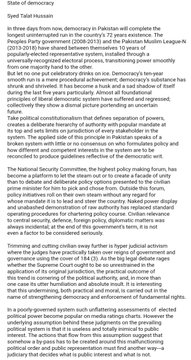
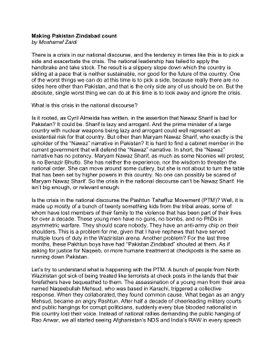
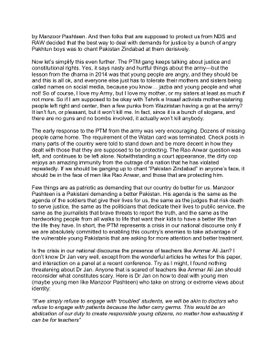
Pakistani writers have also seen the quashing of articles that cover antigovernment protests by the Pashtun ethnic minority, toward which the army has been accused of forced disappearances, extrajudicial killings, and discrimination. Journalist Mosharraf Zaidi said on April 17 that his story about the Pashtun Protection Movement was rejected.
'Extreme Level Of Censorship'

Some journalists have resorted to self-censorship to keep their jobs and remain safe.
"Everyone is exercising self-censorship and even I was doing the same," says Siddiqui. "Only those media and journalists who toe the line or observe self-censorship can survive and continue their professional work without threat."

Pakistan ranks 139th out of 180 countries listed on the World Press Freedom Index 2017, compiled by Reporters Without Borders, and threats to journalists are growing.
Raza Rumi, a TV anchor and respected reporter, narrowly escaped death when gunmen opened fire on his car in an attack that killed his driver in March 2014.
He is an outspoken critic of militant groups in Pakistan and the army's alleged support for militant groups in neighboring India and Afghanistan.
Shortly after the assassination attempt, Rumi moved to the United States, where he has continued his career as an editor for Pakistan's Daily Times.
"There is an extreme level of censorship being applied to media," says Rumi, who is based in New York. "There are no formal directives, but everybody has seen the fate of two major media outlets, Geo and Dawn, and everybody is scared of crossing the line."
Rumi is planning to visit Pakistan again for the first time since the attack on his life. But he insists he cannot work as a reporter in Pakistan in the current climate.
"I'm scared and do not feel very comfortable," he says. "The killers of my driver have been detained but not punished yet."
Fear of retribution even haunts journalists who have fled Pakistan.
Cyril Almeida, a leading columnist and assistant editor at Dawn, was barred from leaving the country in 2016 shortly after he wrote an article about a rift between the government and the military. He left for New York when the government order was lifted weeks later.

PAKISTAN WAVES A BIN LADEN OLIVE BRANCH AT US, AS CHINESE CASH LOSES SHINE


BY KASWAR KLASRA

Amid disquiet over deepening China ties, Islamabad mulls the release of Shakil Afridi – who helped the CIA capture and kill the world’s most wanted man – as it seeks a way back into Washington’s embrace.
The anticipation around the possible release of an imprisoned Pakistani doctor may coincide with a thaw in the South Asian nation’s relations with its traditional ally, the United States, and disquiet over the financial hazards of deepening ties with China.
In the corridors of power in Islamabad, there is a growing expectation that Pakistan could free Shakil Afridi – who helped the CIA find Osama bin Laden – as part of a goodwill gesture towards the US. Pakistani sources said Islamabad is not averse to using Afridi as a bargaining chip to mend fences with Washington. The two sides are said to be in talks over Afridi, who has been languishing in a jail in Peshawar since 2011 due to his alleged links with militants.
Jail authorities recently shifted Afridi to an unknown location, fuelling the speculation he may be released soon. His lawyer, Qamar Nadeem, confirmed the transfer but said he was not sure where his client had been taken.
Pakistan’s Foreign Office has, however, denied knowledge of any move to free Afridi. Rumours include Washington offering to exchange Afridi for Pakistani neuroscientist Aafia Siddiqui, who has been sentenced to 86 years in prison in the United States. Russian news agency Sputnik recently ran a story quoting sources claiming the CIA had tried to stage a prison break to rescue Afridi.
Pakistan accuses Afridi of treason for running a fake vaccine campaign to obtain DNA samples that helped the Americans confirm the whereabouts of Osama bin Laden in the garrison town of Abbottabad in northern Pakistan.
It caused immense embarrassment to Pakistan, which had denied knowledge of bin Laden’s whereabouts. His vaccine campaign paved the way for a US Navy Seal raid that killed the world’s most wanted man in May 2011. A tribunal sentenced him to 33 years in prison for ties with terrorists. His sentence was reduced to 23 years in 2014.
Contrary to Pakistan’s claim, The Spy Chronicles , a recent book co-authored by the former spy masters of Pakistan and India, revealed the US took General Ashfaq Pervez Kayani, Pakistan’s army chief, into confidence two days before the raid. The book also said a retired Pakistani intelligence officer may have informed the Americans about bin Laden’s presence in Pakistan in return for a possible reward of US$50 million.
The US, where Afridi is something of a hero for helping locate bin Laden, had termed his conviction “unjust and unwarranted”. Pakistan sees him as a traitor who violated the law of the land and compromised its sovereignty. US Secretary of State Mike Pompeo has vowed to expedite Afridi’s release. Last week, he told Congress: “I don’t see any reason whatsoever to give the government of Pakistan any money … in terms of our foreign aid until Dr Afridi, the man who helped us bring justice to Osama bin Laden, [is released].
“Please be aware that it’s at my heart and I know it’s important and we can do that. We can achieve that outcome.”
Afridi’s continued imprisonment has been a point of contention between Islamabad and Washington, which believes the indictment is proof of Pakistan’s insincerity in the fight against terror. Pakistan, on the other hand, still bears a grudge against the US for violating its sovereignty by co-opting Afridi and conducting the raid on bin Laden’s compound without informing Pakistani authorities.
Since 2011, US assistance to Pakistan has diminished. Since Donald Trump became president, the US has hardened its stance towards Pakistan, halting aid and grants to its erstwhile ally. Pakistan’s refusal to release Afridi prompted US lawmakers to suggest even tougher measures against Pakistan for working against US interests. Since 2002, the US has provided Pakistan with nearly US$33.1 billion in foreign aid, including approximately US$3.9 billion in foreign military financing.
In his first tweet this year, Trump announced Pakistan would receive no more US assistance: “The United States has foolishly given Pakistan more than 33 billion dollars in aid over the last 15 years, and they have given us nothing but lies and deceit. They give safe haven to the terrorists we hunt in Afghanistan, with little help. No more!” Pakistan has since cosied up to its “all-weather friend” China, which in turn has been showering it with development aid. But last year, international lending institutions and Pakistan’s central bank warned the Pakistani government that rising Chinese imports for the China Pakistan Economic Corridor (CPEC), which is part of Beijing’s global trade “Belt and Road Initiative”, had deepened Pakistan’s balance of payments problems. Chinese machinery imports for power generation and transport infrastructure are expected to reach US$27.8 billion by 2021.
Islamabad announced last year that projects worth US$16 billion are expected to be implemented by 2030, which will raise the overall cost of the CPEC from US$46 billion to US$55 billion.
Pakistan would reportedly have to pay US$90 billion to China over 30 years against the loan and investment portfolio worth US$50 billion under the CPEC. In a report last year, Topline Securities estimated annual average repayments of as much as US$4 billion after 2020.
Analysts warn that would be too rich for an economy of Pakistan’s size. This has led to talks over the pitfalls of substituting the US with China and the need for Pakistan to make amends with its old ally.
“Pakistan needs to repair ties with the US, which has pumped billion of US dollars in aid over the years,” said Mustansar Abbas, an expert on security and defence.
Sohail Iqbal Bhatti, another defence and security expert, believes China will not provide a viable replacement for American aid.
“Shaking hands with the US is in the better interests of 220 million Pakistanis,” said Sohail, pointing out that Pakistan has had to pull out of a dam project because of the high funding costs.
“Pakistan’s dependence on China is bound to increase and we understand it. But Pakistani authorities must keep in mind it would be a double-edged sword and comes with its own problems.” Pakistani experts are also urging reconciliation with the US to avoid isolation internationally, which would only make Pakistan more reliant on China.
First Trump, then China: as Pakistan loses support, it should lose the pretence on cross-border terror “It would make it far easier for China to advance its projects on its own terms,” said Mohammad Iqbal, an assistant professor of international relations at the Punjab University. Currently, Pakistan is seeking Chinese loans worth as much as US$2 billion to help avert a balance of payments crisis. Lending to Pakistan by China and its commercial banks is on track to hit US$5 billion in the financial year ending this month.
The new Chinese loans aim to bolster Pakistan’s rapidly depleting foreign exchange reserves, which tumbled to US$10.3 billion in May from US$16.4 billion in May 2017. In a recent editorial warning the government about Chinese loans, Pakistan’s most influential newspaper Dawn said: “Borrowing on commercial terms from state-owned Chinese banks as a way to finance the growing external sector deficit is fast becoming the new norm, a fact that has very troubling implications for the country.” ■

The Generals and the Art of Undermining Democracy in Pakistan


By Abbas Nasir
On Friday Pakistan moved toward its second democratic transition of power in its 71-year-old history as Nasirul Mulk, a retired judge, was sworn in as caretaker prime minister for two months to preside over national elections on July 25. He was jointly nominated by the governing party, the Pakistan Muslim League (Nawaz) and the opposition.
In a country where generals have directly ruled for 31 years, this would qualify as a cause for celebration. Instead, Pakistanis see the return of “tutelary democracy,” as the military disempowers politicians who stray from its positions on foreign policy and national security, supports a new king’s party and punishes the press for providing fair coverage to its perceived opponents.
The current season of troubles began in April 2016 after the Panama Papers had named then Prime Minister Nawaz Sharif’s three children as having purchased luxury properties in London using offshore companies. Mr. Sharif’s name did not appear in the papers. Opposition politicians, including Imran Khan, the former cricket star, whose Pakistan Tehreek-e-Insaaf Party is seen as the military’s favorite, took the case to the Supreme Court.
Tensions between the civilian government and the military establishment escalated in October 2016 after Mr. Sharif began asserting himself on foreign policy and national security, which the military considers its domain. In April 2017, the Supreme Court of Pakistan set up a team to investigate the allegations against Mr. Sharif and his family arising out of the Panama Papers. Surprisingly, the investigative team included officials from Pakistan’s spy agencies — Inter-Services Intelligence and Military Intelligence. Three months later, the Supreme Court disqualified Mr. Sharif from holding public office on account of a misdeclaration. The court ruled that Mr. Sharif had not been “honest” and “truthful” — necessary conditions to hold public office, according to the Constitution of Pakistan. He resigned as prime minister. Shahid Khaqan Abbasi, a minister from his party, was appointed in his place. Mr. Sharif and his family members are being tried for corruption in a lower court.
Mr. Sharif understands the ways of tutelary democracy well because his party was the military favorite in the 1980s, when Gen. Muhammad Zia-ul-Haq promoted him.
The relations between Mr. Sharif and the military worsened after the publication of a report in Dawn, the oldest and most respected newspaper in Pakistan, in October 2016. The newspaper revealed that Mr. Sharif, and his younger brother and aide Shahbaz Sharif, had warned the military leadership of Pakistan’s growing international isolation because of its continued support of militant groups. Mr. Sharif had already refused to extend the retiring army chief’s term in office. The generals were livid that the rebuke was leaked to the media. The military whipped up hysteria over the report, which appeared in Dawn, implying that Mr. Sharif’s government was toeing the line of adversarial foreign powers and demanded that the source of the leak be named. Social media users and television personalities known for their proximity to the intelligence services vilified Mr. Sharif’s government; Dawn; its editor, Zaffar Abbas; and the writer Cyril Almeida. Numerous young army officers, whose colleagues were killed fighting the Taliban on the Pakistan-Afghanistan border, believed the rhetoric about the treacherous civilian leadership and journalists. They confronted the military leadership and demanded that they act against what they felt were treasonous civilians.
Mr. Sharif’s government was forced to order an inquiry. Federal ministers, Mr. Abbas and Mr. Almeida were questioned. The journalists refused to reveal their sources. Subsequently, a new army chief was named and a tenuous calm followed.
But the military hadn’t forgotten or forgiven Mr. Sharif. The investigation by a team that included intelligence officers into the Panama Papers allegations paved the way for Mr. Sharif’s ouster. Despite losing his job and being barred from contesting elections, Mr. Sharif remained popular and exercised power through Shahid Khaqan Abbasi, the prime minister he got appointed, and through his younger brother, who heads his party.
Two months before the elections, a concerted campaign by the military establishment seems underway to engineer the political process to ensure that Mr. Sharif can’t even exercise power vicariously and is relegated to history. In the past few weeks, there has been a series of defections from Mr. Sharif’s party to Mr. Khan’s Pakistan Tehreek-e-Insaaf.
Officials from the intelligence services have been making threatening calls to journalists objecting to accurate reporting of Mr. Sharif and his family’s corruption trial. Journalists at one newspaper told me that they had received phone calls objecting to their reporting on the defense counsel’s pointing out of inaccuracies and gaps in the testimony of Wajid Zia, a top officer of the country’s Federal Investigation Agency and the prosecution’s star witness against the Sharifs.
The military has also been unhappy about the peaceful, widespread protests by young Pashtuns and their articulate questions about disappearances, extrajudicial killings and mistreatment of their people during counterinsurgency operations in northwestern Pakistan along the border with Afghanistan. The media was told to completely black out the Pashtun movement. Jang Group, Pakistan’s largest media group, which runs several newspapers and Geo Television, the leading news network, took a defiant posture for months. Intelligence operatives got cable operators to force the network off air in most parts of the country. The network’s ratings and advertising revenue fell, and it was unable to pay its staff for three months. Eventually, the network capitulated and settled on the military’s terms.
Dawn remained the lone voice of defiance and independent journalism. Pakistan’s military is one of the biggest real estate developers in the country, and it owns or runs some of the most upmarket residential areas in all major urban centers. The circulation of Dawn is being impeded in those areas where a large number of its readers may reside. News agents are being warned against distributing the paper in the rural Pakistan as well. Real estate giants such as the military-controlled Defense Housing Authority have withheld advertisements from Dawn as a punitive measure.
On Wednesday, Hameed Haroon, the chief executive of Dawn and the president of the All Pakistan Newspapers Society, spoke about the “blatant attacks on the freedoms of expression” by the state institutions: “We will not be a party to the upturning of the Article 19 of the Constitution. And we will not be a party to the killing of the freedom of expression in the country.” But Mr. Haroon’s newspaper is being choked to force it to its knees or die. That would be a tragedy as it is about the only media organization in Pakistan where editorial decisions are made by journalists and not by the owners. I edited the paper from 2006 to 2010.
Zaffar Abbas, my friend and successor, survived two murderous attacks earlier in his career and more recently received death threats. He has continued publishing the paper without flinching. But the emerging scenario seems scarier.
An unfair and disputed election would unleash turbulence that Pakistan could well do without. The Pakistani people have suffered terribly in the past two decades of pitiless terrorism and war. They deserve to be governed by representatives elected in a free and fair election. And they deserve a robust press — one that raises necessary questions.

Saturday, June 2, 2018

Video Report - Trudeau On Trump: Insulting & Unacceptable That Canada Seen As A Threat | Meet The Press | NBC News

Video - Where is Melania? - Between the Scenes | The Daily Show

Video - Trump’s Off-The-Cuff Rally In Nashville & The "Spygate" Gambit | The Daily Show

U.S. - Trump's 'tragic' policies likely to make child poverty much worse, says UN


By Ed Pilkington
New report finds millions of children are without food and homes, and the prospect of escaping poverty is impossible under Trump.

The Trump administration must pay urgent attention to the shockingly high number of children living in poverty in the US, the United Nations special rapporteur on extreme poverty declares in a heavyweight report on the condition of America today – warning of the prospect of the American dream “becoming the American illusion”.

Philip Alston, who acts as the UN’s watchdog on poverty and inequality around the world, spells out in blunt and unremitting terms the damage wrought by child poverty in one of the world’s richest countries. In his findings on conditions in the US, he highlights the personal suffering of millions of children who are left without food, homes and futures and warns that such deprivation is killing the American dream.
He lays out the brutal statistics:
  • 18% of American children – some 13.3 million – were living in poverty in 2016, making up almost a third of the total poor;
  • more than one in five homeless people are children, including 1.3 million school students who were without a home during the academic year;
  • infant mortality, at 5.8 deaths per 1,000 live births, is almost 50% higher than other advanced nations;
  • the US ranks 25th out of 29 industrialised countries in terms of the amount it invests in young children.
“This is tragic and unconscionable, to treat so many children in this way, but it is also a totally self-defeating economic policy,” Alston said in an interview with the Guardian. “The ramifications are clear and considerable – the US is building a future citizenry that is under-nourished, under-educated, under-stimulated, and that in turn will rebound dramatically on the society itself.”

Children who grow up in poverty have very little prospect of escaping from it. That's being locked in
Philip Alston

While child poverty has been a pressing problem for many years in the US, Alston warns that policies being pursued by the Trump White House are likely to make it much worse. Food stamps, known as the Supplemental Nutrition Assistance Program, or Snap, helped almost four million children stay out of the clutches of poverty in 2015 – now Trump is proposing in his 2019 budget to cut the program by almost a third.
Carolyn Miles, president and chief executive of Save the Children US, said the food stamp program was critical for struggling families. “This is certainly not the time to be cutting these benefits in America,” she said.
A new report by Save the Children on the US finds that children in America are at least twice as likely to be poor as children in Norway, Iceland, Slovenia, Ireland, Sweden and Germany. That disparity rises to more than five times as likely to be poor when compared to children in Finland and Denmark.
One of the most insidious aspects of poverty among the under-18s is how it eviscerates individuals’ prospects of advancement, and thus undercuts one of the main glues of American society – the almost universally shared belief in the “American dream” of an equal opportunity to achieve success through hard work and aspiration. Alston points out that the US has one of the lowest rates of social mobility between generations of any rich country – not least because child poverty is so prevalent.
“We know children who grow up in poverty have very little prospect of escaping from it,” he said. “That’s being locked in, here, ensuring the American dream is rapidly becoming the American illusion.”
Some of the most visceral child poverty can be found in rural areas, particularly in the midwest and deep south, paradoxically where a lot of Trump voters live. Carolyn Miles recently returned from Duncan, Mississippi, a small town of about 500 people in the heart of depressed cotton country where a stunning 80% of the children live in poverty.
“This area is completely desolate, it’s a really rough place to live for kids. Families can’t put food on the table every day. Every single child in local schools is on the federal school lunch program, many schools serve breakfast and some even dinner,” she said.
Save the Children works with Mississippi children to try to improve literacy rates. They have found that by the time they start kindergarten at age four, many kids are already 18 months behind the national average educational ability.
“We are trying to get these kids a shot, just to have a chance at an even playing field,” she said.
The paucity of health care and other services, particularly in rural areas, forces parents into having to make painful decisions about how to allocate their meager incomes. Alston, who carried out an official UN fact-finding mission in December that took him to some of the poorest parts of the US, came across a particularly emotive dilemma.
“Parents explained they had to decide between buying their child a Christmas present or saving it for essential food or shoes. There was no money to spare, and anything that was done out of the ordinary, such as buying a present, would penalize the child,” he said.

U.S. - Donald Trump and the erosion of democratic norms in America


Tom McCarthy 

For some, the president’s efforts to undermine the justice department and the Mueller investigation represent a threat to democracy.

Ask people with deep knowledge of the US justice department about the damage Donald Trump might be doing to the country, and the conversation quickly flips back to Watergate.
Following Richard Nixon’s failed attempt to pull the plug on a special prosecutor who turned out to be on to something, the need for investigators to work free from White House interference was recognized by the public and reinforced by elected officials.
But now Trump is president, the public can seem apathetic or amnesiac and the norms governing justice department independence are being tested. Severely.
In interviews, two former assistant attorneys general, law professors and analysts from across the political spectrum used recurring words to describe Trump’s assault on justice: “dangerous”, “alarming”, “high-stakes”.
Some analysts warn that national security has also been endangered, as Trump has undermined public trust in the Federal Bureau of Investigation (FBI) and intelligence agencies whose work is often conducted in secret and who therefore depend uniquely on such trust to function.
The question is whether Trump’s snips and snaps at the norms of justice department independence represent some greater dislocation: a constitutional crisis of some kind or even an erosion of the rule of law in America, as some commentators have posited.
In recent weeks, Trump has escalated his war on his perceived foes in the Department of Justice (DoJ), which hosts the office of special counsel Robert Mueller, who is investigating alleged collusion between Moscow and Trump campaign officials.
That investigation, Trump has informed his Twitter followers, is the work of a “criminal deep state” engaged in a “WITCH HUNT” originally engineered by none other than Barack Obama.
If the Trump-supporting public is bothered by that kind of freewheeling conspiracy talk, there’s little sign of it. The president’s average approval rating is hovering close to 42%, pretty good for him. But others are deeply bothered by Trump’s seemingly nonstop provocations directed at the FBI, the attorney general, the intelligence apparatus and other DoJ agencies.
On Thursday, Trump casually granted a pardon to the race-baitingconservative commentator Dinesh D’Souza, who pleaded guilty in 2014 to campaign finance charges. The pardon was taken as a potential signal to former associates not to “flip” and cooperate with federal prosecutors – because even if they are convicted, a pardon may be waiting.
In an interview aboard Air Force One, the president mentioned he was considering pardoning other boldface names with “unfair” convictions.
“We’ve never had a president attack the intelligence and law enforcement agencies that work for him in this way,” Jack Goldsmith, a Harvard law professor and former assistant attorney general under George W Bush, said in an email. “He’s attacking them in order to discredit the Mueller investigation. But the baleful impact on those agencies’ morale and on public trust in them unfortunately extends far beyond that investigation.”
While whispers of a “constitutional crisis” are in the air, many mainstream analyses reject that idea, pointing out among other things that the Mueller investigation continues full steam ahead, no matter how much Trump might whine about it. The bad news is that it doesn’t take a constitutional crisis to constitute a national emergency, said Eric Posner, a University of Chicago professor specializing in constitutional law.

“I think the problem with thinking about this in terms of crisis is that we should be concerned about what Trump is doing whether or not there ever is a crisis,” Posner said. “It’s perfectly possible, for example, that Trump could undermine Mueller’s investigation without causing a constitutional crisis.

You could slide into an authoritarian regime without a real crisis ever taking place
Eric Posner, University of Chicago


“I think what people are worried about, when you look at other countries that have slid into authoritarianism, what has happened is that the leaders of those countries have proceeded incrementally, and so when he does some things initially that people didn’t resist, that enhances his power. Once he has more power he can do more things, take more action.
“And you could slide into an authoritarian regime without a real crisis ever taking place, and I think that’s what people should be focusing on.”

‘Things subtly changing’

Shortly after Trump’s election, Amy Siskind, a former Wall Street executive, started a website called The Weekly List, seeking to catalogue news stories documenting “eroding norms under the current regime”.
The site, which Siskind said gets up to a million visitors a week and which this year produced a book blurbed by current Trump target Samantha Bee, bears this tagline: “Experts in authoritarianism advise to keep a list of things subtly changing around you, so you’ll remember.”
“At my book events, again and again, people tell me ‘you’re keeping me sane’,” Siskind said. “There’s such an effort at gaslighting, that this is not happening. Then at the end of the week people are able to sit down and read all the things that happened.”
Two recent Trump provocations have proven particularly incendiary. First, he cooperated with Republican congressman Devin Nunes and others in a campaign that led to the disclosure of the identity of an FBI informant. Then, Trump ordered the justice department to investigate its own investigation – of him.
“I hereby demand,” Trump tweeted, “that the Department of Justice look into whether or not the FBI/DoJ infiltrated or surveilled the Trump Campaign for Political Purposes – and if any such demands or requests were made by people within the Obama Administration!”
David Kris, founder of Culper Partners consulting firm and a former assistant attorney general under Obama, warned that Trump’s continued assault on norms of justice department independence rose to the level of a threat to the rule of law.
“None of what we’re seeing in my view is at all normal and a lot of it is very dangerous,” said Kris.
“The norm of apolitical law enforcement, and the norm of intelligence activity under law, including honest bipartisan congressional oversight, as well as basic norms like conflict of interest and the White House staying out of particular investigations – all are essential elements of the even more fundamental value of the rule of law,” Kris said. “Which is itself essential to any modern functioning democracy. So the stakes are very high.”
Goldsmith, who has diagnosed and debunked ‘The Cycles of Panicked Reactions To Trump’, said that “there are bad things going on in our country” but that the infrastructure of justice was holding up so far.
“Despite Trump’s onslaught, his political appointees, all of whom he could fire, have continued to support the Mueller investigation fully and the investigation carries on to Trump’s intense displeasure,” Goldsmith wrote. “That is an amazing testament to justice department’s independence.

Trump has certainly violated norms, but whether they erode will depend on what happens after Trump leaves
Jack Goldsmith, Harvard Law

“As for norms eroding, Trump has certainly violated norms, but whether they erode will depend on what happens after Trump leaves.”
The question of the elasticity of norms – will they bounce back or are they forever dented? – is one that occupies Kris and others.
“I think the answer depends a lot on what happens next,” Kris said. “I think we can count on President Trump to keep pushing as hard and as long as he can to do what he believes is in his self-interest regardless of these norms. And if in hindsight it is perceived that he ended badly in part because of that, then others will be deterred from using the same tactics in the future and we may even see a strengthening of some of these norms.
“This is what happened after President Nixon’s misconduct in Watergate, the rule of law and independent norms were strengthened.
“On the other hand, if Trump continues to profit, and is perceived in hindsight as having benefited from these quite radical norm violations, then we can expect future holders of the highest office of the land to engage in the sincerest form of flattery available.
“It depends, in short, on how this comes out. We’re engaged right now in a very high-stakes experiment.”

Sharab Cheez He Aisi Hai - Pankaj Udhas

Pashto Music - Mama Day - Rahim Shah

Pashto Music - Rahim shah - Da zra zama nadan

Pashto Music - Ta Khkule Qodrati | Raheem Shah |

Video - BBC Pashto TV News - Naray Da Wakht: 02 June 2018

Afghanistan: Taliban, ‘Talks’ And Blind Optimism – Analysis


By Ajit Kumar Singh
The latest round of efforts to bring Taliban to ‘talks table’ has commenced. Sounding optimistic, Atturahman Saleem, Deputy of Afghanistan’s High Peace Council (HPC), when asked whether the Council would wait for a Taliban response, stated on May 20, 2018, “Absolutely. Necessary pressures, military, political and religious, should be built on the Taliban. Sooner or later it will work, and the Taliban would have no other option but to join the peace process.”
Notably, Afghanistan President Ashraf Ghani, addressing the second Kabul Process conference on February 28, 2018, offered unconditional peace talks to the Taliban. Ghani stated, unequivocally, “We are making this offer without preconditions in order to lead to a peace agreement. The Taliban are expected to give input to the peace-making process, the goal of which is to draw the Taliban, as an organisation, to peace talks.”
Before the beginning of the conference, the Afghanistan Government released a document titled “Offering Peace: Framing the Kabul Conference of February 28, 2018” where it suggested “seven building blocks for peace-making”, including “a political process: ceasefire, recognition as political party, transitional confidence building arrangements, and inclusive, credible, free and fair elections”. The first round of the Kabul Process had been held on June 6, 2017.
The developments between February 28, 2018, and May 20, 2018, and thereafter clearly suggest that Atturahman Saleem’s optimism is entirely misplaced.
To begin with, in the absence of any ‘official’ response from Taliban, the High Peace Council (HPC) on March 5, 2018, warned the Taliban against the consequences if the group rejected Ghani’s peace proposal. Despite the warning, the Taliban indicated, on numerous occasions, that it was not going to accept the proposal. In an ‘article’ posted on its website, Alemarah, on March 6, 2018, it stated, “the Americans gave the Kabul regime orders to start the calls for peace and negotiations… in order to make up for their defeat in the military and political arena which they have been facing constantly.” Again in a statement released on March 10, 2018, the Taliban called the Kabul administration “illegitimate” and described the peace process as “propaganda and deceptive”.
Further on April 14, 2018, when Ghani reiterated the offer asking the Taliban “to act as a political party and participate in the elections while utilizing the prevailing opportunity and the peace offer”, the Taliban was quite clear in its response. A day later, on April 15, it stated that Afghanistan is occupied, with thousands of foreign troops in the country and that major political and military decisions are “taken by the occupiers”. “We have seen in past elections that people have been cheated and the final decision was taken by John Kerry (former US Secretary of State), and the National Unity Government was created at the US embassy in Kabul,” the statement read.
A relatively peaceful conduct of the Parliamentary and District Council elections scheduled to be held on October 20, 2018, is essential for Afghanistan, as indefinite delay in the democratic process can only add to the country’s present misery. However, the challenges of holding this massive electoral exercise within circumstances of enveloping violence across wide areas of the country remain overwhelming.
And there are no indications that violence will diminish, as the Taliban went ahead with its declaration of the ‘annual spring offensive’. In a statement released on April 25, 2018, in which it announced the launch of its ‘Al Khandaq (the Trench)’ campaign, the Taliban stated,
On top of the… aggressive, ideological and licentious ambitions of their American masters, the deceptive efforts launched by the ineffectual and corrupt officials of the puppet regime inside and outside the country are nothing but a conspiracy orchestrated by the foreign occupiers for enervating, crushing and eventually pacifying the ongoing legitimate Afghan resistance and are not efforts for ending the war and restoring lasting peace…
Partial data compiled by the South Asia Terrorism Portal (SATP) indicates that, since April 25, 2018, Afghanistan has recorded at least 2,145 terrorism-linked fatalities (data till May 27, 2018). These fatalities include 178 civilians, 157 SF personnel, and 1,810 militants.
There has, in fact, been no respite from terror in the country for years. According to the United Nations Assistance Mission in Afghanistan (UNAMA), civilian casualties were in four digits till 2013, but entered five digits in 2014 for the first time since 2009, when UNAMA started documenting civilian casualties, and have since remained in five digits. There were 10,453 casualties (3,438 deaths and 7,015 injured) in 2017. In the current year, as of March 30, 2018, such casualties had already reached 2,258 (763 deaths and 1,495 injured).
The Taliban remains a resurgent force. According to the Special Inspector General for Afghanistan Reconstruction (SIGAR)’s latest quarterly report released April 30, 2018,
Since SIGAR began receiving population-control data in August 2016, Afghan government control has decreased by roughly four percentage points, and the overall trend for the insurgency is rising control over the population (from 9% in August 2016 to 12% in January 2018)… Using Afghanistan’s 407 districts as the unit of assessment, as of January 31, 2018, 229 districts were under Afghan government control (73 districts) or influence (156) — an increase of two districts under government influence since last quarter. This brings Afghan government control or influence to 56.3% of Afghanistan’s total districts. There were 59 districts under insurgent control (13) or influence (46), an increase of one district under insurgent influence since last quarter. Therefore, 14.5% of the country’s total districts are now under insurgent control or influence, only a slight increase from last quarter, but a more than three percentage point increase from the same period in 2016. The remaining 119 districts (29.2%) are contested—controlled by neither the Afghan government nor the insurgency. The Afghan government’s control of districts is at its second lowest level, and the insurgency’s at its highest level, since SIGAR began receiving district control data in November 2015.
It is imprudent on the part of the Ghani Government to invite Taliban for peace talks at this juncture. Past experiences clearly demonstrate that terrorist formations never join peace talks in good faith when their influence and capacities on the ground are at an upswing. Ignoring the cumulative experience of counter-insurgency within Afghanistan and in theatres across the world, Ghani has chosen to push his ‘peace proposal’ forward, giving some credence to Taliban’s assertion that the Afghan Government and its ‘foreign masters’ are losing the battle. The rising desperation visible in the offer of talks can only further embolden the Taliban, even as the hasty decision of premature withdrawal by the US did. Nothing positive could possibly be achieved as a result of either decision. Indeed, Afghanistan’s Second Vice President General Abdul Rashid Dostum stated on May 14, 2018,
Reconciliation with the Taliban should be handled from the position of strength, and not from the position of appeasement and weakness… We can reach a peaceful settlement with Taliban, if we are determined to win the war. So by softening the tone asking Taliban for reconciliation, we failed. And neither will it work in the future…
The Kabul Process was initiated to confer a pivotal role in the peace talks on Afghanistan. Almost all the earlier initiatives, including the Qatar Process and the Quadrilateral Coordination Group (QCG) process had given centrality to Pakistan, largely because Pakistan had deceived a willfully gullible international community into believing that peace could only be achieved by making the Taliban the ‘principal stakeholder’ in the talks process. Now it appears that the Kabul Process also has also lost its way. It will be wise on the part of the Ghani Government to initiate immediate course correction.