Saturday, June 2, 2018

#Pakistan Election woes - Welcome to election 2018


Afrasiab Khattak
Despite several bad omens, hiccups and uncertainties election season has finally arrived. Electoral machine has started rolling. Election Commission has announced schedule for the general elections of 2018 and count down for July 26, the polling day, has started. National Assembly and Provincial Assemblies have completed their constitutional term for the second time in the 71 years history of Pakistan, although the elected Prime Minister Nawaz Sharif was removed by the Supreme Court (like Yosuf Raza Gilani of the PPP in 2012) through a judgement that did not impress the legal experts. Federal government, that was almost moribund at the hands of a creeping coup, finished its innings in a quiet grace under Prime Minister Shahid Khaqan Abbasi.Abbasi’s patience, humility and composure in the face of constant affronts and pin pricking by the putschists was remarkable and was appreciated even by his opponents.
There are a few factors that set the forthcoming general elections apart from the previous ones. Although Pakistan has experienced a controlled democracy after Zia-ul- Haq’s martial law in 1980s but the civilian leaderships relentlessly struggled to maintain a semblance of democratic system. However, after the success of the creeping coup that has been unfolding since 2014, the shadow of authoritarianism has deepened to an extent where even the facade of democracy is vanishing. Freedom of expression is one of the most fundamental ingredient of a democratic system. But Pakistani media has come under severe constraints during the last few months. Media groups that weren’t ready to dance to the tunes of the deep state experienced excruciating squeezes. Unlike the civilian governments that put pressure on media by using black laws and rules the deep state doesn’t even care about the pretence of recourse to any legal procedure. It goes for strangulating dissent by resorting to crude fascist like methods. Prime Minister of Pakistan, the chief executive of the country and the Information Minister were helpless. The Chief Justice of the Supreme Court took the matter up but to no avail. One of the media groups that was targeted some time ago was ultimately forced to have “ compromise” with the forces that be. Another well known group has been targeted recently and is currently at the receiving end of relentless attack.
The other serous issue of the human rights is that of the enforced disappearances. There are thousands of reported cases of the missing persons and the civil executive and judiciary have totally failed to make any headway in resolving the issue. Court orders for production of the abducted persons remain ineffective as the concerned security agencies deny their involvement in enforced disappearances. New cases are being reported from different parts of the country while the old ones aren’t resolved. This situation creates fear and helplessness that can be extremely unsettling for ordinary citizens even for living a normal life let alone taking part in free and fair election.
The significance of a level playing field for all political parties contesting elections cannot be ignored for holding free and fair elections. In Pakistan there have been complaints in the past about the attitude of the state institutions towards different political players. During the last elections, the electoral campaign of the relatively progressive political parties was brazenly attacked by terrorists. ANP bore the brunt of these attacks. The election campaign of PPP and MQM was also disrupted by terrorist onslaught. The state had clearly failed in providing security to the aforementioned political parties during the elections. But this time round not so very subtle political engineering seems to be the name of the game. Defeating Muslim League (N) in the forthcoming election appears to be at the top of agenda. Every trick in the book is being used to malign and demonise it. Lots of efforts have gone into encouraging desertions from the so called ruling party over the last few months. Herding electable candidates to PTI, that has emerged as the new king’s party, and controlling media in its favour, seem to be the main strategies for achieving desired results in elections. The main focus of the political engineering by the deep state is on the Punjab because it is not only the main political base of Nawaz Sharif but winning Punjab also means winning Islamabad.
Be that as it may, this bleak situation is not without its silver lining. There are at least four new factors in the political situation that can turn the tables on the political engineering of the deep state. One, Nawaz Sharif, the three time elected Prime Minister, with a large scale following in the country, particularly in the key province of Punjab, has decided to challenge the political role of the deep state. Spending long years in politics, both in the government and in the opposition, he is the most experienced politician in the country. Now when his party is not any more part of the system, he can speak more openly about and give details of the creeping coup against his elected government. Moreover, the deep state can’t cross certain limits against its opponents in the Punjab because most of the army also comes from the same province. Two, contradiction between the deep state and the elected representatives in the government is an open secret by now and the common people know as to who calls the shots in making important decisions. As we know the popular movement recently launched by PTM didn’t raise a single slogan against the PML (N) because they knew that the state policy which hurt the Pashtuns wasn’t shaped by the ruling party. Nawaz Sharif has successfully projected his victimhood at the hands of the forces of dictatorship among the masses. Business classes in general and Punjabi bourgeoisie in particular has come to believe that the deep state has thrown Nawaz Sharif out because he was taking the country from the geo strategic of the Cold War to the geo economic of the 21st century. Hence their sympathies for him.

Broad sections of society are prepared to forget Nawaz Sharif’s past mistakes and judge him on what he stands for today. Three, the growing international isolation of the country on the question of extremist violence is a source of concern for most of Pakistanis and they know that Nawaz Sharif, like most of other political leaders is opposed to appeasement of extremism and terrorism. Four, last but not the least the growing role of social media has changed the rules of engagement when it comes to control over media and public opinion. Welcome to election 2018 (that’s if they are held!).

#Pakistan - Child Marriages Threaten Lives and Rights of Girls in #Balochistan


By: Munaj Gul Mohammad
Our world today believes in the Sustainable Development Goals and their promise to create progress that will improve lives across the world. But when every year young girls are married off, they are ultimately locked away from a better life. Young girls in Balochistan are no exception. Some with great dreams of future and some too young to envisage anything about themselves, are married off.

Child marriage stands as one of the major hindrances in the way of progress not only for the young girls of Balochistan but it may block the way of prosperity of the region as a whole. The world today recognizes the right of every girl to have a say, to have an education and a better life.  Girls are also seen as an important part of the social structure. However, since a larger part of Balochistan’s population is not literate and is unaware of constitutional laws and individual rights, a larger number of young girls are married off before the age of 18. Their young age at marriage makes them vulnerable not only of violation of their rights but also makes them fall victims of honour killing, vacid attacks, complete economic dependence, marital rape, and maternal mortality.
Child marriage is a cycle of disadvantages which begins from denying girls from their most fundamental rights such as to learn, and develop. It also traps their families in a cycle of poverty. Among many other reasons, child marriage is one behind the underdevelopment of Balochistan. True, there are not many opportunities for these girls but if they are protected, and provided with educational and learning opportunities, they may contribute socially and economically for the province rather than falling victim of violence, poverty and early death.
Time and again serious questions are raised against this norm but unfortunately it continues; are females born to have a discouraged life in Balochistan? Don’t they have the right to be educated? Why has government not been able to provide equal opportunities to these young girls?

In a few months, I will still be a child but I will be raising a child.

To have a clear picture of the situation, The Balochistan Point talked to 14-year-old, Maheen, who is married to a man much older than her age. She is 3 months pregnant. She said, “My marriage is a misery for me but I feel blessed to have this baby. In a few months, I will still be a child but I will be raising a child.” Maheen would have led a better life if she was not married off.

In Balochistan approximately 2 out of every ten boys and 6 out of every ten girls are married before the age of 18.

In Balochistan approximately 22 percent boys and 63 percent girls are married before the age of 18. Child marriage affects both boys and girls. This also includes children of age 10 to 14. Because of early marriages mortality ratio during pregnancy is high.
Sara, 16, another ambitious young girl from rural Balochistan says “I was interested in education and wanted to become a school teacher but my dreams meant nothing for anyone. I was married before I could raise a voice for my rights”.
There are countless stories of many such girls from all over Balochistan that need attention of the government. Each young girl deserves a better life and it is the responsibility of the government not only to gather statistics of these miseries but to ensure protection of the rights of girls.

#Pakistan - Nawaz, two ex-generals among 21 ‘poll manipulators’ summoned by SC


–CJP asks AGP about govt’s plan to recover money used to rig 1990 general elections, to hear case on June 6
–Seals report of federal cabinet’s meeting on AGP’s request that it be kept confidential 
The Supreme Court (SC) on Saturday issued notices to 21 people, including former army generals and senior political leaders, connected to the Asghar Khan case.
The 21 individuals include deposed prime minister Nawaz Sharif, Javed Hashmi and Abida Hussain, and former army chief General (r) Mirza Aslam Beg and former director general of the Inter-Services Intelligence (ISI) Lt Gen (r) Asad Durrani. The court has also summoned officials of the National Accountability Bureau (NAB) and Federal Investigation Agency (FIA).
Hearing the Asghar Khan case at the SC’s Lahore Registry, Chief Justice of Pakistan (CJP) Mian Saqib Nisar asked Attorney General of Pakistan (AGP) Ashtar Ausaf if the federal cabinet had decided to implement the court’s verdict issued in the case in 2012. The AGP responded that the former government had decided to act upon the court’s decision and had directed the FIA to continue the investigation.
The CJP also asked Ashtar how the federal cabinet planned to recover the money that had been spent on manipulating the general elections in 1990. Ashtar, however, did not give a specific answer and requested the CJP to seal the report of the cabinet meeting that he had submitted to the court as it was confidential. Justice Nisar granted this request.
In 2012, the apex court had ordered the federal government to take necessary legal action against Gen (r) Beg and Lt Gen (r) Durrani for their role in ‘facilitating’ a group of politicians and political parties to ensure their success in the 1990 elections, by paying them millions of rupees.
The hearing of the case was adjourned until June 6.
At the last hearing on Friday, the CJP said that the Pakistan Muslim League-Nawaz (PML-N) government ‘ran away’ from its responsibility to come up with a plan of action against former army generals accused of manipulating the 1990 elections, by leaving the Asghar Khan case matter into the hands of a sub-committee.
Nisar questioned the deputy attorney general (DAG) about the cabinet’s decision on the case to which he was told that the matter would be briefed upon by Attorney General of Pakistan (AGP) Ashtar Ausaf Ali. However, Ashtar was absent from court.
“This is such an important case and the attorney general is least bothered. This the performance of the attorney general’s office,” a visibly irritated CJP said, as he summoned the AGP to appear in court on June 2.
Earlier on May 31, the CJP had expressed similar dislike over the federal government’s failure to make a breakthrough in the Asghar Khan case.
“Why hasn’t the federal cabinet done anything regarding the Asghar Khan case verdict?” Chief Justice Nisar asked, adding that he could not comprehend the government’s nonchalance towards such a serious case.
Nisar had further said that the court after giving its order on the case had rejected review petitions of Gen Beg and Lt Gen Durrani. “Now, the implementation of the verdict remains. To-date the federal government did not do anything,” he lamented.
On October 19, 2012, the apex court had issued a 141-page verdict, ordering legal proceedings against Gen (r) Beg and retired Lt Gen Durrani in a case filed 16 years ago by former air chief Air Marshal Asghar Khan.
Khan, who passed away in January this year, is being represented in the Supreme Court (SC) by Advocate Salman Akram Raja.
Khan had petitioned the SC in 1996 alleging that the two senior army officers and the then-president Ghulam Ishaq Khan had doled out Rs140 million among several politicians ahead of the 1990 polls to ensure Benazir Bhutto’s defeat in the polls.
The Islamic Jamhoori Ittehad (IJI), consisting of nine parties including the Pakistan Muslim League (PML), National Peoples Party (NPP) and Jamaat-e-Islami (JI), had won the 1990 elections, with Nawaz Sharif being elected prime minister. The alliance had been formed to oppose the Benazir Bhutto-led Pakistan People’s Party (PPP).
In 1996, Khan had written a letter to the then SC chief justice Nasim Hassan Shah naming Beg, Durrani and ex-Habib Bank Sindh chief and Mehran Bank owner Younis Habib about the unlawful disbursement of public money and its misuse for political purposes.
The 2012 apex court judgement, authored by the then-chief justice of Pakistan Iftikhar Chaudhry, had directed the Federal Investigation Agency (FIA) to initiate a transparent investigation and subsequent trial if sufficient evidence is found against the former army officers.
That investigation is yet to conclude.
In May 2017, the Pakistan Tehreek-e-Insaaf (PTI) had said it would approach the SC over the FIA’s failure to follow through on the apex court’s order in the case.

#Pakistan - #PPP - IHC, BHC, LHC verdicts cause for concern to delay polls: Bilawal Bhutto

Pakistan Peoples Party (PPP) Chairman Bilawal Bhutto Zardari emphasized principled opposition to delay in General Elections 2018.
Taking to social-networking website Twitter, Bilawal expressed concerns over the decisions of Lahore High Court (LHC), Islamabad High Court (IHC) and Balochistan High Court (BHC) regarding nomination papers and delimitations.
“IHC, BHC and LHC decisions and timings cause for concern particularly given nominations were to start tomorrow,” he stated.
He also expressed reservations over the letter of Khyber Pakhtunkhwa (KP) CM and Balochistan Assembly‘s resolution to extend date of the elections.
“The IHC, BHC and LHC decisions and timings are cause for concern particularly given nominations were to start tomorrow,” said senior PPP leader Aitzaz Ahsan.
Emphasizing “principled” opposition to delay in elections, Aitzaz said delimitations of different constituencies were nullified by the IHC, BHC and LHC, so the Election Commission of Pakistan (ECP) would now have to approach the Supreme Court over it which will raise reservations and likely cause delay in elections.
“Reservations would again find their places, if delimitations are marked again as people can find faults in new delimitations,” he said.
It appeared as if “some system” was pushing the process of elections in abeyance, he said adding that, “Elections should not be delayed. Nomination forms were supposed to be issued today and submitted tomorrow and if nominations could not be made on the delimitations nullified by the courts then all the time it will take to resubmission of forms will most likely delay elections.”

Friday, June 1, 2018

Music Video - Sayyo Ni Mera Mahi Mere Bhaag Jagawan Aa Geya

Music Video - Noor Jahan Jadon Holi Jai lenda mera naam

Music Video - Sanu Nehar Walay Pul Tay Bula Kay.... Noor jahan

Punjabi Music Video - NI JINDRIYE KIVEIN MEIN MANAWAN - NOOR JAHAN

Music Video - Lokan do do yaar banaye - Afshan Zebi

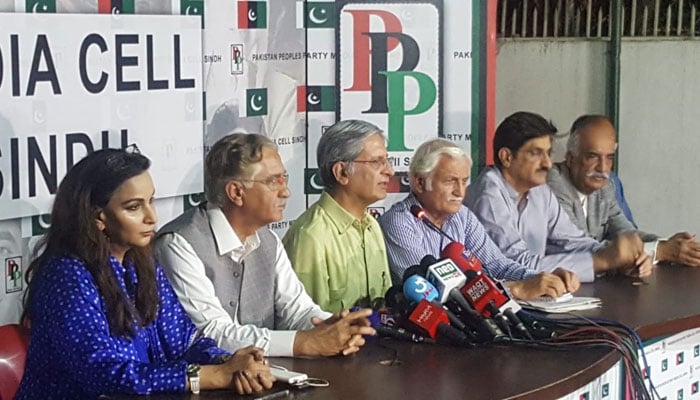
Video - #PPP Central Leaderships addressing a Press Conference at Media Cell Bilawal House Karachi

Perspective: #Pakistan’s Ahmadi Inquisition

This dark episode of Spanish history is repeating itself in Pakistan

In the 15th Century, the Catholic Monarch Ferdinand II and Isabella I of the Spanish Empire established a particular panel or tribunal of ‘inquisition’ which worked till the 19th Century. It was a panel that aimed to ‘decontaminate’ Catholic orthodoxy and religious unification among the Christians in the Empire.

Steadily, the rulers came under the influence of the pope and an institution of the ‘Grand Inquisitor’ emerged. In the 16th Century, the clergy and the priests were appointed as the judges of the inquisition tribunals, and the church became the symbol of power that determined the faith and beliefs of the people.

This eventually led to the hegemony of the pope. Individuals suffered horrible punishments during the Inquisition. Some stern punishments included physical torture, starvation, hanging from the arms, and life imprisonment.

One of the key objectives of the Spanish Inquisition was to eradicate religious differences in the Spanish society and to amalgamate the nation. Brutalities during the inquisition gave a sense of unrest among the Jews and Muslims in Spain.

This rigid strand of the Spanish Catholic thought led to the society becoming radicalised under the aegis and supervision of the state. Both state and church had a mutual, vested interest in doing this. Now sadly, this dark episode of Spanish history is repeating itself in Pakistan.

The Islamabad High Court’s interference in personal matters of religion or its efforts to determine the faith of citizens is contrary to Pakistan’s constitution and Jinnah’s vision for the country

The national and international political forces used the ‘religion’ card to destabilise Pakistan. The establishment was also allegedly involved in supporting religious extremists to execute its policies. India’s RAW, the CIA and Mossad in Israel all used radical groups to perpetuate terrorism in Pakistan.

According to a NADRA report presented before Islamabad High Court’s (IHC) Chief Justice, Shaukat Aziz Siddiqui in the case of the Election Act of 2017, there are 167,000 Ahmadis in Pakistan. 10205 Pakistanis, meanwhile, have converted to Ahmadiat while 6000 of them moved abroad on new passports.

One’s religion and faith is a private issue, but the IHC tried to make official matters pertaining to faith and made it mandatory for every citizen “to get their identity with authentic particulars” by declaring his or her faith and belief. According to the court, no Muslim is allowed to appear as a non-Muslim while no non-Muslim can appear as a Muslim.

The court also ordered submitting an affidavit based “on the definition of Muslim and non-Muslim” as per article 260(3)(a)(b) of the Constitution to get a CNIC, birth certificate, and passport. This raises the question of why the state should force an independent citizen to profess his or her faith.

The court interfering in personal matters of religion or its efforts to determine the faith of citizens is also contrary to Pakistan’s constitution. The contents of the IHC’s order are also against the spirit of Mr Jinnah, the founding father of Pakistan.

Such orders also affect nationalism in Pakistan, and become the reason for a rising tide of hatred and difference between religious communities and sects. Such a strand of ‘officialised Islam’, moreover, also creates a sense of insecurity among minority communities like Ahmadis because Pakistan’s courts are taking decisions according to the wishes of extremist ‘mullahs’, which stands against the ethos of a prosperous Pakistan.

The orders of the IHC will also further marginalise the Ahmadia community. The state and the court’s efforts to codify Islam are producing disastrous consequences, since several Khatm-i-Nabuwat conferences and seminars were held in Punjab in the wake of this court order. These conferences passed many resolutions against Ahmadis that stipulated the strict implementation of anti-Ahmadia laws.

In Sialkot, a religious extremist and an alleged PTI political worker Hamid Raza led a mob on May 23, 2018 during the night of Holy Month of the Ramazan that demolished a historic Ahmadia Baitul Zikar. Raza later thanked the state elements such as the DPO, the DCO, and municipal corporation officials for helping them in demolishing the worship place.

Ahmadis are also facing increasing threats and marginalisation in professions and jobs. An Ahmadi, Safian Ahmad in the Punjab Prison Department, for instance, and a female teacher in Kot Momin are facing severe difficulties in this regard. Ahmadis are also in a constant state of insecurity and anxiety despite all the contributions they make to Pakistan.

Last week, in Chak No 368 Khumbi District Layyah, an issue occurred among Ahmadis and non-Ahmadis when Ahmadis wanted to bury the dead body of an Ahmadi in a joint grave yard. This is yet another example of the state supporting anti-Ahmadia activities which is leading to a sharp rise in the challenges Ahmadis face in Pakistan.

In the present paradigm, the Pakistani judiciary, particularly the IHC has failed to take action against elements that hold dharnas, and their extremist and anti-state statements and activities. Despite the orders of the higher judiciary, the leadership of the Tehreek-e-Labaik Ya Rasool Ullah has still not been arrested which is a substantial taint on Pakistan’s judicial system.

http://timesofahmad.blogspot.com/2018/05/perspective-pakistans-ahmadi.html

Taliban Taking Over #Pakistan ?NEW INTERNAL SECURITY POLICY SEEKS TO GIVE CLEAN CHIT TO TAKFIRI TERRORISTS?

The outgoing government on Thursday unveiled a new National Internal Security Policy (NISP) proposing reconciliation with individuals and groups willing to shun the path of violence. However, it is being inferred that banned takfiri terrorist groups are likely to enjoy facilities under this policy because it appears they will not be punished for their unpardonable crimes against humanity in all over Pakistan because their ringleaders still enjoy protocol while innocent Shia Muslims have been subjected to enforced disappearance. 
The incentives for shunning of violence and militancy and for re-integration have to be made greater than the continuation of militancy and anti-societal discourse and practices, the NISP 2018-2023 asserts.
It refers to the successful formulation of programmes for re-integration and of reconciliation pursued by many Muslim countries including Indonesia and Bangladesh, and notes that key priority areas in this regard have to be the worst affected areas due to insecurity and terrorism; it is strange to cited Bangladesh where pro-Pakistan Jamaat-e-Islami leaders were convicted or hanged.
In this regard, the policy acknowledges that formerly Fata region, Balochistan, and areas of KP and Karachi have to be paid particular attention. Due to social and political contestation, these areas have been hotbeds of unrest and targets of subsequent security operations.
An incentive structure to provide a way out to militants stuck in the cycle of violence, de-radicalisation and rehabilitation programmes and an outright ban on the use of violence for achieving political goals are key to improve security, reads the policy document.
Efforts will be made to build consensus on offering incentives for militants under clear and transparent terms to shun violence. For this purpose the following reforms shall take place:
A mechanism will be developed to review cases of militants who agree to cooperate with the law enforcement agencies.
De-radicalisation and rehabilitation programmes will be used to enable former militants to join the mainstream. Professionals and moderate scholars will be engaged for the said purpose.
Alternative livelihoods either by providing jobs, vocational training or other means will be provided to former militants once they are certified not being a security risk, while the children of suspected terrorists under custody will be taken care of.
No armed group must be allowed to operate a political wing and participate in electoral processes and vice versa. National Counter Terrorism Authority (NACTA) will compile data on Pakistani individuals linked with terror organisations involved in war theatres abroad. Appropriate action will be taken to deal with returning fighters.
The policy aims to protect the life, property and fundamental rights of the citizens of Pakistan by establishing the rule of law. To this effect, it recognises that this requires enforcement of state laws/regulations in letter and spirit through an effective coordination between various constituents of the criminal justice system.
Violation of human rights can become a crucial driver for extremism and radicalisation, and it is, therefore, essential to establish the rule of law and deliver justice, the Policy observes.

http://www.shiitenews.org/index.php/pakistan/item/34675-new-internal-security-policy-seeks-to-give-clean-chit-to-takfiri-terrorists

پیپلز پارٹی کا عام انتخابات 25 جولائی کو کرانے کا مطالبہ

پیپلز پارٹی کا عام انتخابات 25 جولائی کو کرانے کا مطالبہ
پاکستان پیپلز پارٹی نے آئندہ عام انتخابات ہر صورت مقررہ تاریخ 25 جولائی کو کرانے کا مطالبہ کرتے ہوئے خبردار کیا ہے کہ اگر انتخابات موخر ہوئے تو ملک بے چینی اور ہیجان کا شکار ہوجائیگا۔
پیپلز پارٹی کے رہنما اعتزاز احسن، نیئر بخاری، فرحت اللہ بابر، شیری رحمان، خورشید احمد شاہ، مراد علی شاہ اور سعید غنی نے میڈیا سیل بلاول ہائوس میں ہنگامی پریس کانفرنس سے خطاب کرتے ہوئے کہا کہ نامزدگی فارم پر قانون سازی پارلیمینٹ کا حق ہے، جسے عدالتی حکم کے ذریعے تبدیل نہیں کیا جاسکتا۔
اعتزاز احسن کا کہنا تھا کہ گزشتہ ایک دو روز کے دوران ہونے والی سیاسی پیش رفت سے لگتا ہے کہ جیسے کوئی سسٹم ہے، جو انتخابات کو التویٰ میں ڈالنا چاہتا ہے، اسلام آباد ہائی کورٹ الیکشن کمیشن کی جانب سے کی گئی متعدد حلقہ بندیوں کو کالعدم قرار دے چکی ہے اور بلوچستان ہائی کورٹ سے بھی اسی طرح کے فیصلے متوقع ہیں، عدالتی فیصلوں کی روشنی میں ازسر نو حلقہ بندیاں کی گئیں، تو ازسر نو اعتراضات بھی سامنے آئیں گے جس کیلئے مزید وقت درکار ہوگا۔
ان کا کہنا تھا کہ اگر کل سے نامزدگی فارم کا اجراء نہ ہوا اور عدالتی حکم کے تحت فارمز کی چھپائی کا کام بھی ازسر نو شروع کیا گیا تو اس عمل کو مکمل ہونے میں بھی وقت درکار ہوگا، جس کے باعث انتخابات میں تاخیر ہوسکتی ہے، پی پی پی اس طرح کی تاخیر کے حق میں نہیں ہے، پیپلز پارٹی کا موقف غیرمبہم ہے کہ انتخابات ہر صورت مقررہ تاریخ 25 جولائی کو ہونے چاہئیں۔
https://jang.com.pk/news/501225

#Pakistan - Mainstreaming #FATA and the #PPP’s role


By Shahzad Tahir
History bears testimony to the extensive bloodshed, unimpeded anarchy, atrocities and rampant human-rights violations of the WWII that bolstered the conscience of the world. Consequently, this led to the adoption of the Universal Declaration of Human Rights in December 1948 in Paris at the UN General Assembly. The declaration entitled every human being to a set of 30 basic human rights. If the aforesaid premise was to be reflected in a nutshell, it wouldn’t be imprecise to assert that it took the ‘world’ a ‘world war’ to devise and agree on a basic set of human rights.

Until March 24th 2018, the Federally Administered Tribal Areas in Pakistan inhabited by 15 million Pakhtuns continued to be a subject of human-rights violations due to its governance framework, the Frontier Crimes Regulations. A relic of the British colonial rule, the FCR denied basic human rights to Fata. Notably under the notion of collective responsibility, an entire tribe would share the penalty for a crime committed by a single tribesman. The FCR also denied right to justice due to a bar from approaching a court of law. In addition, another relic of the British colonial regime, Article 247 of the Constitution of Pakistan provided for vesting the executive and legislative authority of Fata with the president, similar to the British viceroy. Glad that now its history.
Arguably, it took the incumbent government a lot of resentment to agree to the mainstreaming of Fata by merging it with the Khyber-Pakhtunkhwa province via the 31st Amendment, it is a moment of pride and triumph for democracy and human rights in Pakistan. The story of Fata’s mainstreaming is neither of a day, nor a month, year or a decade but of decades in which generations of the Pakistan Peoples Party have remained resilient advocates of the rights of the people of Fata; a story the world needs to know.
Being the architect of 1973 Constitution of Pakistan, PPP’s founder, Zulfikar Ali Bhutto, inserted Article 247-6 in the Constitution which envisaged merger of Fata with Pakistan’s mainstream in consultation with the tribal jirga. In this regard, the first serious attempt in Pakistan’s history to mainstream Fata was made by then prime minister ZA Bhutto. Bhutto constituted a ministerial committee comprising senior members of the PPP to devise a framework for the merger of Fata with North West Frontier Province (now K-P) enabling political and economic reforms, chiefly giving the adult franchise right to vote, which they previously didn’t have.
Fearing imbalance in the tribal region on the other side of the Durand Line, the merger was hesitantly delayed for a while at international request and was decided to be taken up after the 1977 elections with a fresh mandate. However, before Bhutto’s envisioned effort could be resumed, democracy was toppled over by General Ziaul Haq’s coup d’état on July 5th 1977. The government’s report titled ‘Report of the Committee on Fata Reforms 2016’ which led to the merger of Fata with K-P reiterates this fact stating “This initiative [of ZA Bhutto’s government] would have succeeded had the 1977 military coup not occurred.”
Fata’s cause made slight progress when Benazir Bhutto’s government extended the Adult Franchise Act of 1996 to the region granting every adult the right to vote for their representatives previously whereas the tribal chieftains or Maliks only were eligible to vote. But unfortunately democracy was paralysed again when Benazir Bhutto’s second elected government was ousted.
Battling forces that conspired against the will of the people, democratic forces in the country continued the struggle towards Fata’s mainstreaming that ZA Bhutto and Benazir Bhutto had envisioned. In March 2004, Benazir Bhutto constituted the Fata Reforms Committee of the PPP; the first dedicated segment of a political party tasked with Fata reforms.
In the same year, Benazir Bhutto invoked her party’s representation in parliament to solicit parliamentary channels for Fata reforms. Eventually in 2004, a PPP presented resolution was unanimously passed in the Senate seeking reforms in Fata followed by the Senate’s adoption of a PPP-led Human Rights Committee’s report seeking changes in Senate.
Fata’s unabridged mainstreaming remained Benazir Bhutto’s key agendas. Her next target was filling the political vacuum in Fata. A constitutional petition in the Supreme Court was filed by Benazir in 2006 demanding extension of the Political Parties Act of 1962 to Fata. “Fata is a unit of the federation, but it has been handed over to religious parties operating from mosques and madrassas,” the petition stated.
Benazir used all available channels to secure basic rights for the people of Fata. The Shaheed Bhutto Foundation under patronage of Benazir carried out studies on Fata, extensively engaged stakeholders and rigorously campaigned to seek a political way forward for mainstreaming Fata. The government’s Fata reforms report has endorsed the foundation’s efforts.
In 2007, Fata’s cause suffered a huge blowback with the assassination of Benazir Bhutto. PPP once again came into power in 2008 and then prime minister Yousaf Raza Gillani in his first address to parliament committed to change the FCR.
In April 2008, a committee of the cabinet was constituted to propose FCR reforms. Respecting the traditions of the land, the government consulted a jirga of tribal elders to restore peace and eventually consensus was developed with stakeholders on reforms. The jirga was invited by president Asif Zardari and a political, judicial and administrative reforms package was announced on Independence Day eventually however, it had to face delays due to opposition under various pretexts.
Two years later, having developed some consensus and disregarding some opposition, president Zardari gave assent to ‘Amendments in FCR 2011’ and extension of ‘Political Parties Order 2002’ to tribal areas. Meanwhile a PPP bill seeking amendments to Article 247 was also adopted by the Senate. Recently, a Fata Youth Jirga emerged as a powerful forum demanding the mainstreaming of Fata which was fully endorsed by a third generation of PPP’s leadership, Bilawal.
It might have taken the government a lot of resistance in the form of political powers in parliament, the Pashtun Tahaffuz Movement and forums like the Fata Youth Jirga to eventually give rights to Fata, similarly as the world realised to agree on the UN’s Universal Declaration of Human Rights after WWII, but it is a victory for the people of Pakistan, democracy, political stability of the country and the region and the PPP’s role must not be forgotten during this voyage.

Thursday, May 31, 2018

Video - 'Russia-US direct conflict in Syria was close, but avoided' – Assad to RT (EXCLUSIVE)

The New Silk Road: China's Route to Europe? | DW English

US slaps Europe, Canada & Mexico with steel, aluminum tariffs

Video - 'Hello': RT journalist visits North Korean leader’s private palace, talks to Kim Jong-un's sister

Video Report - 🇷🇺 🇰🇵 Russian foreign minister Sergey Lavrov meets Kim Jong-un

Persian Music Video - Leila Forouhar - Jooni Joonom | لیلا فروهر - جونی جونم

Pashto Music Video - Ramsha Shifa - Maste Mangai -

Music Video - Runa Laila - Dama Dam Mast Qalandar

Music Video - Runa Laila - Jab sy gya hai Mera Bachpan

پېښور کې د چرنجیت سېنګ وژنې ضد مظاهره شوې

Insecurity, fraud undermine upcoming #Afghan elections

Elections in Afghanistan are vital for the war-torn country to continue the democratic process that started after the fall of the Taliban regime in 2001, but most people in the country show little interest in elections.
Afghanistan's parliamentary and district council elections are scheduled for October 20 of this year, but attacks by militant Islamists have already raised concerns whether the elections will be held on time.
Taliban and "Islamic State" (IS) continue to target voter registration centers in different parts of the strife-torn country. An IS-claimed attack at a voters' office in Kabul last month killed 57 people, including women and children, underlining the fact that the participation in the election process comes with a huge risk for the Afghan people.
But a lack of security is not the only reason behind people's reluctance to participate enthusiastically in the election process; the voting procedure, marred with fraud and irregularities, has left many people pessimistic about the entire system.
Lack of interest in elections
Political commentators say that many Afghans have little faith in the election process.
"Afghanistan's Independent Election Commission (IEC) has the responsibility to restore trust among the Afghan people in the electoral procedure, but it has so far failed to do so," Fazal Ahmad Manawi, former head of the IEC, told DW.
The IEC launched a campaign in April to register at least 14 million voters before the October polls, but so far only 4 million have registered.
Manawi said that even the 4-million figure was exaggerated and that he doubted its accuracy.
"We know that fewer people actually registered," Manawi said.
The current state of the Afghan parliament is also a reason why many Afghans are not interested in the election process, say experts. Human rights activists accuse Afghan lawmakers of nepotism, corruption and even crimes like smuggling. People fear the next parliament will be no different.
"Candidates who use illegal money to contest and win elections won't care much about the voters. They will only be interested in getting their money back once they get elected," Naim Ayobzada, head of the Transparent Election Foundation of Afghanistan NGO, told DW.
The only way forward
Despite electoral frauds and Afghans' lack of interest in the October polls, many believe that elections are the only way forward for a country struggling to get on its feet. The continuation of democratic process could be the only option for Afghans to make their voices heard and defeat unlawful forces, including militants, analysts say.
A good omen is that a number of educated young candidates are also running for parliament and district councils. This gives hope that Afghanistan could see better governance in the years to come should the democratic process continues.
Obiadullah Azizi, a candidate for a district council in Balkh province, hopes the participation of youth in the election could turn things around for his country.
"People must vote for young, educated and committed candidates who I believe will represent them best," he told DW.
Tariq Iqtedari of the Generation Positive organization has launched a social media campaign to urge voters to cast their ballot wisely.
"We should not make any mistake. Those who buy votes will definitely compromise on our national interests," the organization said in a Facebook video message.

#Pakistan - Political Immaturity


Amidst suggesting a caretaker Chief Minister and then taking the recommendation back almost immediately, Pakistan Tehreek-i-Insaaf (PTI) has certainly been active in its demands for the care-taker government. It has now followed with further demands for the caretaker Prime Minister, Nasir-ul-Haq, to remover certain appointments the party is not happy with, particularly that of Ali Jahangir Siddique, Pakistan’s ambassador to the United States.
The complaint came in the form of a letter, penned by PTI’s spokesperson Fawad Chaudhary, which said that Siddiqui is “facing NAB cases” and to make him an ambassador is equivalent to the “murder of national interest. Chaudhary today demanded that Siddiqui’s appointment be declared void and that a “competent and seasoned” person be chosen to replace him.
It is true that Siddique’s appointment has been controversial since the start, considering the fact that he was relatively young and inexperienced for the job, and there were suspicions that Prime Minister Shahid Khaqan Abbasi’s past affiliations with him may have resulted in the appointment. Chaudhry’s accusation that Siddique is being investigated by NAB is true, however, the weight of this is uncertain considering the national debate that NAB has been overstepping its bounds.
Even if all the allegations against Siddique are true, to expect the caretaker PM to take such an actively political step is highly irresponsible of PTI and reveals the party’s political immaturity. Such a demand is clearly out of the mandate of a caretaker PM. Siddique has been appointed by an elected government and should be removed from his position by next elected if required. Removal of the envoy will only serve to propagate the PTI view ahead of the elections. Such decisions should be left to the incoming government. The current Caretaker PM should focus on running the executive and holding an unbiased election.

#Pakistan - #FATA in the interim


The FATA-Khyber Pakhtunkhwa merger is a done deal. And this is a good thing. The process of transition is to be completed within two years. Yet the journey from starting point to final destination has already got off to a rocky beginning.
The President still has to sign off on official paperwork; meaning the 31st Constitutional Amendment. This is no biggie given that this piece of legislation had to first go before Parliament, which it duly did on Sunday. Both Upper and Lower houses as well as the KP assembly gave their due stamps of approval. Moreover, it makes sense to first ink the FATA Interim Governance Regulation, 2018 — a set of provisional rules with which to govern the tribal areas during the adjustment period.
The big takeaway from this is the repealing of Frontier Crimes Regulation (FRC); that draconian colonial overhang that is responsible for trampling on the fundamental rights as well as aspirations of the tribal people. Something that it has taken the Pakistani state more than seven decades to undo.
Except that the new interim Regulation appears to have done this in name only. The ‘promotion’ of the Political Agent to Deputy Commissioner is highly problematic given the powers that come with it. These include having the authority to fine entire communities if there “appears good reason to believe” that residents of a particular village have abetted a crime, failed to arrest those involved or suppressed evidence. Then there is the question of the Council of Elders which will hear all criminal cases. This is a jirga by another name and the Deputy Commissioner enjoys the freedom to appoint its members. The most worrying part of all is how the new Regulation provides that no civil court has the jurisdiction to challenge anything in the tribal areas. Thus what happens in FATA stays in FATA; quite literally.
All of which raises important questions.
The most crucial being: why did the FATA Interim Governance Regulation, 2018 not go to Parliament? This is a legitimate query.
We understand that there was no malevolent intent on the part of the outgoing government. That being said, this will cause problems for the new set-up. For now that the KP and Sindh assemblies are already dissolved — and with Balochistan and the Punjab completing their respective tenures tomorrow — the people of FATA and KP will likely have to wait until the next Parliament to receive clarity on several points. These include the possibility of introducing a sunset clause to the Regulation as well as resolving once and for all the issue of civilian court jurisdiction.
Yet as things currently stand, the incumbent regime has effectively thrown out the baby with the bathwater. That is, in its rush to put the merger on the books — so as to avert any future stalling on this front when new assemblies are elected — it has bypassed the elected representatives of the tribal people. This “Doctrine of Necessity” is a serious misstep. Indeed, it strengthens the hands of political players such as Maulana Fazlur Rehman. The latter has never been backwards in coming forwards regarding his staunch opposition to the merger on the grounds that only a separate province would afford the people of FATA true self-determination.
Sadly, the tribal people of Pakistan will have to wait until a new set-up in KP is elected to decide just how much better off they will be. In the interim.

Pakistan’s censorship model An image- and identity-obsessed country


On May 12, Dawn, Pakistan’s oldest and most prestigious English daily, published
an interview with former Prime Minister Nawaz Sharif, in which Sharif uttered four relatively oblique sentences: “Militant organizations are active. Call them non-state actors, should we allow them to cross the border and kill 150 people in Mumbai? Explain it to me. Why can’t we complete the trial?” He was referring, ostensibly, to Lashkar-e-Taiba’s involvement in the 2008 Mumbai attack. Lashkar and its leader, Hafiz Saeed, have not been held accountable, and the trial has stalled in an anti-terrorism court in Pakistan.


The alleged connections between Pakistan’s intelligence agencies and militant non-state actors that target India such as the Lashkar-e-Taiba are well known outside Pakistan, but less understood within the country—deliberately so, since this serves to maintain the perception of the army’s moral supremacy.
Sharif’s interview created an instant furor in Pakistan. Many Pakistanis are skeptical of his motives as he fights for his political survival after being disqualified as prime minister by the Supreme Court last year on corruption-related charges. Sharif says the charges against him are politically motivated, and suggests they were pursued by a military that disliked his independence. He is punching back whenever he can.

BLOCKING COVERAGE OF NON-STATE MILITANTS

After the Dawn interview was published, the Pakistan Press Council served the newspaper’s editor with a notice that it breached the council’s code of conduct by publishing content that “may bring into contempt Pakistan or its people or tends to undermine its sovereignty or integrity as an independent country.” Distribution of the newspaper was subsequently blocked in parts of the country.
No one doubts the military’s involvement in this censorship. It is the latest example of a steadily accumulating set of suppressive measures it seems to be taking against the media in recent months, to various ends: to control its own narrative and maintain its hold on the country, to control Pakistan’s global image, to weaken Sharif, and to try to meddle in the upcoming general election this July.
Both Pakistan’s military and its civilian government want to project the image of a country that has successfully tackled its security issues. The military has given tours of a cleaned-up Waziristan, which had been off-limits to the media during the army operation against the Pakistan Taliban in that area. Its ministers and ambassadors give a standard spiel abroad that touts Pakistan’s successes against domestic terrorism and the Pakistan Taliban—especially in the wake of criticism from the Trump administration—deflecting away from connections with the Lashkar-e-Taiba and the Afghan Taliban. It is true that the number of terrorist attacks in Pakistan has decreased drastically in recent years, as have deaths as a result of violence. But terrorism continues at a lower tick, and extremism thrives, as attested to by the street power of the fundamentalist group Tehreek-e-Labaik, whose signature concern is the preservation of Pakistan’s regressive blasphemy laws.

BLOCKING COVERAGE OF AN ETHNIC RIGHTS MOVEMENT

But groups like that don’t bother the military (it refused to take physical action against Tehreek-e-Labaik protesters in December 2017, and handed out money to them when the protest disbanded). The biggest thorn in the military’s side right now, other than Sharif, is the Pashtun Tahaffuz Movement (or PTM; Tahaffuz means protection). The movement alleges widespread human rights abuses by the military, including forced disappearances and extrajudicial killings, during the army operations against the Pakistan Taliban in the country’s northwest in the last decade. It has led fiery rallies across the country and in Pakistan’s urban centers, with a charismatic 24 year-old, Manzoor Pashteen, at the helm.
Coverage of the movement is all but blacked out in the Pakistani media. That is not surprising, since they make some quite shocking claims: that the military is connected to the (Pakistan) Taliban—even going further and saying they are one and the same—and that under cover of the military operation, the military shuffled the Taliban to Afghanistan.
I had heard this exact narrative and rhetoric from a group of Pashtun students at a university in Lahore three years ago, in 2015, while I was conducting focus group interviews for my book. My discussion with these students had lasted for hours—and I came away surprised and with a deeper understanding of Pakistan itself. My interviewees were intensely critical of the army and angry over what Pakistan’s northwest and tribal areas were going through. They questioned Pakistan’s religious ideology, something I had not heard much of elsewhere. They noted that their views would have them branded as traitors. But their most stunning remarks came when I asked them who was conducting terrorism in Pakistan. They linked the army to the attack that killed more than 130 schoolchildren at the Peshawar Army Public School in December 2014. They were skeptical of the Zarb-e-Azb military operation, arguing that the media blackout was covering up collusion with the Taliban.
In my book, I noted that these students’ nonconformist views on the Pakistan narrative were refreshing to hear; but on the connections between the army and the Pakistan Taliban—which had attacked so much of the army itself—they seemed conspiratorial. Nevertheless, it was a significant perspective that I hadn’t heard before, and I only heard it again when the Pashtun Tahaffuz Movement went mainstream this year.  
Because the state has banned coverage of the movement, most Pakistanis don’t know about, or understand, the grievances of other ethnicities against the state—similar to a media blackout of the insurgency in the restive province of Baluchistan. Prominent op-ed writers, for the first time in many years of writing for the same newspapers, have seen their columns on the PTM pulled; in turn, their write-ups about crackdowns on media freedom are also being censored. This means that a proper, national conversation cannot be had about these issues. The movement is being discussed on social media, where you see two echo chambers: those against the movement, and those supportive of it. In the absence of open coverage, there is no political discussion about the military’s alleged abuses—nor questions raised by PTM enthusiasts about what the movement gets wrong about the army’s connections to the Pakistan Taliban versus the Afghan Taliban, or where its rhetoric peddles in conspiracies. Nor, in this blackout, can Pakistanis understand how many terrorists were actually in the mix in the cleanup undertaken by the Pakistani state in the tribal areas. The PTM demands a truth and reconciliation commission. The state owes it that, but before that, it owes the movement, and all Pakistanis, an open national conversation.

CENSORED—TO WHAT END?

Pakistan’s military believes it can clamp down on dissent via censorship—and continue to control the image and identity of the country as it has defined it, as an Islamic state under threat from India. Ethnic grievances and military abuses brought to light by the PTM, and Sharif’s discussion of non-state actors targeting India (thus implicating Pakistan in aggression against India), threaten the state-cultivated image of the country and sully the military. So, it keeps them under wraps.
The military’s censorship is selective—not blanket, à la Erdoğan in Turkey—which gives it plausible deniability. While coverage of the PTM is blacked out, its rallies have been allowed to continue. Not all journalists and bloggers critical of the military are disappeared or threatened—but some are, enough to have a chilling effect and to lead to self-censorship. Television channels critical of the military are taken off air, or given a lower rung on the lineup.
To what end? Given the existence of social media, the military only comes in for more criticism internationally. But in the country, it succeeds in controlling its image. And so it continues. Yet it has chilled the national debate and discussion, and only alienated those already marginalized. Pakistan needs only to look to 1971, when its eastern half seceded to form Bangladesh, to see the potentially disastrous effects of such ethnic and political alienation. The right approach to its own citizens and to criticism is clear: engagement, not censorship.

https://www.brookings.edu/blog/order-from-chaos/2018/05/30/pakistans-censorship-model/

Bilawal Bhutto to contest 2018 general elections from Larkana


Pakistan Peoples Party (PPP) chairman Bilawal Bhutto Zardari has announced to contest forthcoming general elections from NA-200, Larkana constituency.
Announcing his decision following a meeting of the party’s parliamentary board at Bilawal House on Thursday, Bilawal said Larkana had elected Shaheed Zulfikar Ali Bhutto and Shaheed Mohtarma Benazir Bhutto with overwhelming majority in every election they contested.
He said that election 2018 was a huge test for, what he called, jiyalas and democratic workers. He urged the supporters to gear up their preparation to ensure victory of the candidates across the country.
Earlier on Thursday, the board conducted last round of interviews from candidacy aspirants for eight seats of the national and 17 of the provincial assembly from the division.
Interviews from candidates from five divisions of the province were completed on Wednesday.
Other members of the board present during the interviews included President PPP Women Wing Faryal Talpur, Senator Sherry Rehman, Syed Qaim Ali Shah, Syed Khursheed Shah, Murad Ali Shah, Naveed Qamar, Nisar Ahmed Khuhro, Waqar Mehdi and Shagufta Jumani.