Friday, May 25, 2018

#Pakistani mob attack against #Ahmadi Mosque prompts global condemnation

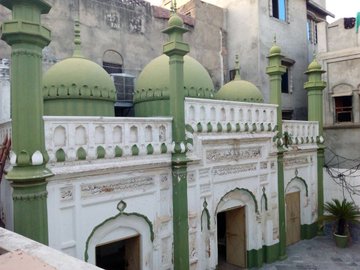
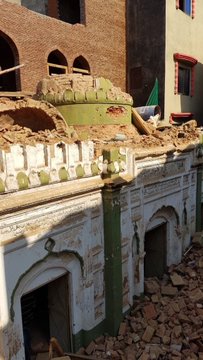
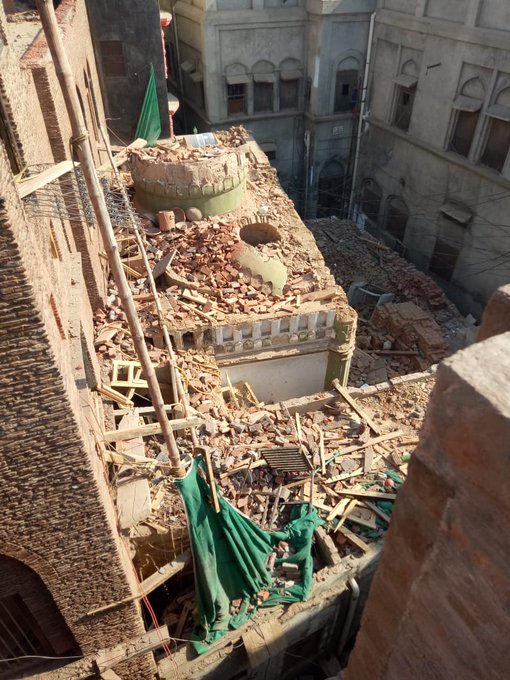
Widespread condemnation followed the mob attack against an Ahmadiyya Mosque in the Pakistani city of Sialkot. U.S. joined lawmakers from Canada and UK to condemn the attack which resulted in the destruction of a historic 100-year-old Mosque.
The attack which was led by Hafiz Hamid Raza, a member of Pakistan Tehrik-e-Insaf happened between the night of May 23rd and early morning of the May 24th. During the attack, a mob of around 500 Muslims chanted slogans against the minority Ahmadiyya Muslims as they destroyed the Mosque structure and an adjoining building.
The attack drew worldwide condemnation and shocked the already persecuted Ahmadiyya Muslim Community of Pakistan.
U.S. Special Advisor for Religious Minorities, Knox Thames condemned the attack saying:
The U.S. strongly condemns the destruction of Ahmadiyya Muslim Community mosque in Sialkot Pakistan. We urge authorities to hold all perpetrators accountable and ensure the mosque is restored.
The U.S. strongly condemns the destruction of Ahmadiyya Muslim Community mosque in . We urge authorities to hold all perpetrators accountable and ensure the mosque is restored. https://twitter.com/tariqahmadbt/status/999583484640448512 …
Similarly, UK Secretary of State for Foreign & Commonwealth Affairs, Boris Johnson also denounced the attack saying:
I condemn this attack and urge Pakistan to protect all its communities, including Ahmadi Muslims.
View image on TwitterView image on Twitter
UK @foreignoffice @ukinpakistan has repeatedly called for Pakistan @CMShehbaz to protect all communities & faiths -yet last night we again see a frenzied mob destroy a beautiful&historic mosque in -the tragedy of the continued persecution of @alislam
Terrible to hear reports of the attack on an Ahmadi mosque in Sialkot, Pakistan, last night. Will be addressing the issue when I speak in @HouseofCommons this afternoon on persecution of Ahmadiyya community.
Condemnations also came from Canadian Members of Parliament, including Jagmeet Singh, leader of NDP, Kamal Khera, Judy Srgo, Omar Al-Ghabra, Garnett Genuis, Deb Schulte and Ruby Sahota.
I strongly condemn the violence against the Ahmadiyya Muslim Community in Pakistan

The recent destruction of a 100 yr old mosque by a mob is just one example of the continuous persecution faced by Ahmadi Muslims

The Pakistani Govt must seek justice & protect freedom of religion
Extremely disappointed to hear about the destruction of Ahmadi Mosque in Sailkot, Pakistan, specially during the month of Ramadan. All those responsible should be held accountabe. Religious freedom is a fundamental human right that be respected and afforded to all! https://twitter.com/omaralghabra/status/999802392056139776 …
Shocking! I am very saddened & concerned to learn of the news of the demolished Ahmadiyya mosque in Sialkot city in Pakistan. Especially considering this occurrence has taken place during the holy month of Ramadan. @ahmadiyyacanada @FdAffan @PFA_Ahmadiyya
I’m appalled by the destruction of an historic Ahmadi mosque in Sialkot, Pakistan. Perpetrators should be held accountable. Religious freedom is a fundamental human rights that should be afforded to all
Another horrific attack in Pakistan, this time targeting Ahmadiyyas. Last night, personnel from the municipal committee in Sialkot City and an accompanying mob attacked important Ahmadiyya buildings while police looked on. Pakistan must do more to protect minorities.
Last night in Pakistan a mob of over 600 destroyed an historical property of significance to the Ahmadiyya community and damaged the adjacent Mosque in Sialkot City. Pakistan must do more to protect minorities and uphold the rule of law. @ahmadiyyacanada
I’m profoundly disappointed by the destruction of an historic Ahmadi mosque in Sialkot, Pakistan. All those involved should be held accountable. Religious freedom is a fundamental human rights that should be afforded to all.

Pakistani politicians who are normally wary of commenting on the Ahmadiyya persecution also followed suit.
However, at the same time, Irum Azeem Farooque, member of Sindh Provincial Assembly was barred from submitting a resolution condemning the attack. In a tweet Farooque said:
I wasn’t allowed to submit my condemnation Resolution in Sindh Assembly, Even though most of the members agreed with me that every sect has the right to their religious belief but still no one wanted to sign&condemn the attack on the praying site of Ahmedis.

Italy student flies home from Pakistan after forced abortion

A student has returned to Italy after accusing her family in Pakistan of luring her home to terminate her pregnancy.
The 19-year-old, named Farah, had been studying in Verona when she became pregnant a few months ago.
Her family took her back to Pakistan in February and later she appealed to friends for help, saying her baby had been aborted against her will.
She was finally rescued by Pakistani police in Islamabad last week.
She arrived at Milan's Malpensa airport, having been looked after for several days at the Italian ambassador's residence in the Pakistani capital. She is due to discuss her ordeal with police in Verona.
"They sedated me, tied me to a bed and forced me to have an abortion," said Farah of her family, in one of the messages published by Italian media.
Farah's story emerged weeks after the death of an Italian woman in Pakistan amid reports that she may have been murdered by relatives in an honour killing.
Friends in the city of Brescia, to the west of Verona, said Sana Cheema, 26, had wanted to marry a Pakistani-Italian man in Italy despite opposition from her family.
"Farah has finally returned to Italy and is now in a safe place," said Foreign Minister Angelino Alfano, who praised the collaboration of the Pakistani authorities in securing her safety.
According to Italian reports, her family had moved to Verona in 2008.
She met her fiance while studying there and became pregnant.
Farah had first approached social services in the city in September and had been given protection by a local centre offering refuge to women facing gender violence. Her father had been reported to local authorities for maltreatment.
However, she was eventually reconciled with her family and travelled to Pakistan in the belief that her brother was getting married.
The alarm was eventually raised by her friends, who alerted teachers at the college where she had been studying in Verona.
A social services official said her documents had been stolen and she was under close observation from her family.
As the student is not an Italian citizen, Verona police and the Italian foreign ministry approached Pakistani authorities, who traced her to a house in Islamabad.

The Plight of Pakistan's Journalists


In Pakistan, journalists’ woes have been one constant. Whether under civilian or military rule, the multidimensional challenges faced by journalists have remained the same. Kamran Khan, the well-known Pakistani anchor on Dunya TV, in a recent program equated journalists’ current predicament to the conditions under former dictator General Zia-ul-Haq’s (1977-88) rule. Adding support to his argument, Islamabad, the capital city, has reportedly been dubbed the “most dangerous place to practice journalism in Pakistan.”
Indeed, journalists are living in a constant nightmare in the capital following cases of abductions and beatings; on some occasions reporters have been targeted just because of their journalistic work. As a result, there are also reports of journalists fleeing Islamabad. A case in point is that of outspoken journalist Taha Siddiqui, who is currently living in exile in France.
Democracy was restored in Pakistan in 2008. In 2018, for only the second time in Pakistan’s history, the country will mark a peaceful transfer of power between civilian governments. Yet despite these developments, mainstream political parties have not paid any serious attention to the press. Even pro-democracy political parties have failed to provide succor for a free and vibrant press. Instead, these parties have only further bullied the press and media organizations upon coming.
It is constitutionally guaranteed in Pakistan that journalists can perform their duties independently. A free and independent press protects the fundamental norms of democracy. But unfortunately, in Pakistan, even so-called champions of democracy have ditched the media organizations, unless they are trying to use the media for their own vested interests.
In a telling example, Pakistan’s most famous television network, Geo TV, was shut down in April and told to remain off the air unless or until a deal was reached with the establishment for Geo TV to avoid reporting on certain issues, including the military and judiciary.
After that warning shot, Pakistani columnists shared their articles on Twitter, saying The News had refused to publish them. (The News and Geo TV are both owned by the Jang Group). One of The News’ regular columnists, Mosharraf Zaidi, claimed on Twitter that this was the first time in 10 years that the English-language paper had refused to publish his article.
This pressure on the media comes just a few months ahead of the 2018 general elections in Pakistan. Journalists and politicians, especially those belonging to the ruling Pakistan Muslim League-Nawaz (PML-N), fear that control over the press is meant to manipulate the elections. In the recent Senate elections, the PML-N’s candidate could not win the chair despite the party holding the most seats. All the other parties rallied together against Sharif and his party; the same thing is expected in the upcoming general elections.
The PML-N, led by disqualified former Prime Minister Nawaz Sharif, is part of the anti-establishment camp and faces criticism from all sides. Sharif and current Prime Minister Shahid Khaqan Abbasi have said that elections would be a contest between them and “aliens” – meaning the behind-the-scenes establishment.
Against that backdrop, space for a free media is increasingly shrinking. According to some journalists, the press is being deliberately suffocated.
Pakistan’s Pakistan Electronic Media Regulatory Authority (PEMRA) has ordered the private TV channel AAJ not to air programs by the BBC, Voice of America, and Deutsche Welle. The order from PEMRA is highly undemocratic and against basic the principles of freedom of the press. What is more disturbing is that the ban is in line with common rhetoric that labels foreign media organizations in Pakistan as anti-state, anti-army, and agents of foreign countries intent on harming the interests of Pakistan.
Recently, Dawn, Pakistan’s leading English newspaper (which this author works with), ran an interview with Sharif. The former prime minister asked some tough question that angered Pakistan’s military establishment, including calling into question the military’s commitment to fighting terrorists. “Militant organizations are active. Call them non-state actors, should we allow them to cross the border and kill 150 people in Mumbai? Explain it to me. Why can’t we complete the trial?” Sharif asked in the interview.
As a result, at the Pakistan Army’s suggestion, a meeting of the National Security Committee (NSC) was held in Islamabad to discuss the interview. It did not end there. Instead, Pakistani authorities reportedly blocked the distribution of Dawn in remote areas of the country, particularly in Balochistan and Sindh. The Press Council of Pakistan has also served Dawn a notice that running the interview of Nawaz Sharif violated the Ethical Code of Practice.
Dawn’s crime is simple: it ran and published the interview. Although Dawn is Pakistan’s oldest newspaper — started by Pakistan’s founder Mohammad Ali Jinnah on October 26, 1941, in Delhi before the partition – it is currently being put under tremendous pressure over its independent policies, which the paper is trying to maintain against all odds.
International NGO Reporters Without Borders denounced the move to block distribution of Dawn. “It is clear that the military high command does not want to allow a democratic debate in the months preceding a general election. We call on the authorities to stop interfering in the dissemination of independent media and to restore distribution of Dawn throughout Pakistan,” Reporters Without Borders said.
The future of free and independent press in Pakistan is at stake. Electronic media is already controlled, and now print media is being brought to heel — precisely because it provides space to dissent, critical thinking, and independent reporting.
Beyond the upcoming election, one of the main reasons for the current crackdown is the Pashtun Tahafuz Movement (PTM). This social movement erupted in Pakistan under the leadership of Manzoor Pashteen following the killing of a young Pastun man, Naqeeb Ullah Mehsud, in Karachi in a fake encounter.
The movement demands that the downtrodden Pashtuns of the Federally Administered Tribal Areas (FATA) be given their constitutional rights, and the speeches given by Pashteen are critical of Pakistan’s military establishment. For this reason, electronic media in Pakistan has completely blacked out Pashteen’s speeches. PTM rallies and speeches are being reported only in a few English newspapers.
Following the blackout by Pakistan’s electronic media, however, Pashteen’s speeches have been given coverage in the international media. The PTM has been discussed by The New York Times, CNN, the Wall Street Journal, and the BBC, among others. Voices like Pashteen’s cannot be suppressed in this current digital era.

Pakistani forces attack protest camp against enforced disappearances in Sindh

Pakistani forces have attacked the protest camp settled by the families of missing Sindhi political activists abducted by the PakistaniMilitary Intelligence and the Inter-Services Intelligence (ISI).

The families of missing Sindhi political activists conducted a three-day hunger strike camp in front of Karachi press club Sunday morning.
The protest camp was joined by various political parties and human rights organizations including Jeay Sindh Muttahida Mahaz (JSMM), Jeay Sindh Qaumi Mahaz -A, JSQM-B, AWP, Human Rights Commission of Pakistan (HRCP), and others.
The Police and Rangers circled the camp in afternoon and unleashed baton-charge against the protestors. The protesters resisted the action and many of them got injured and some were arrested by the forces.
The protestors led by Sasui and Sorath Lohar, the daughters of missing teacher Hidayat Lohar, later marched towards press club and protested the action.
Susui Lohar told the media that police and rangers attacked the protest camp unprovoked, tortured the attendants and tore her clothes on resistance.
She added that although the camp was settled for 72 hours, now will continue until their missing relatives are not released.
The activists raised the slogans of “yeh jo dehshatgardi hai, is ke peechy wardi hai” after the attack.
JSMM Chairman Shafi Burfat condemned the use of force against the protestors in a Facebook live session.
He said, “The state forces have violated the sanctity of Sindhi values and democratic right to protest the state-inflicted violations of human rights in Sindh. The act of tearing the clothes of women, dragging them on the roads and torturing the protestors is an act of aggression, violence, and fascism. Sindhi, Baloch, and Pashtuns are under the occupation of Punjabi civil-military establishment in the unnatural, undemocratic, forced framework of Pakistan.”
“The Pakistani forces are committing utter fascism and apartheid against Sindhi, Baloch and Pashtun national movements while this theocratic Islamo-fascist Pakistani state is patronizing and sponsoring the radical Islamist terrorist forces,” he added.
He also appealed to all Sindhi political organizations and nation to mobilize and protest the fascist actions of Pakistani forces and state in solidarity with the families of missing Sindhi political activists. 

http://balochwarna.com/2018/05/21/pakistani-forces-attack-protest-camp-against-enforced-disappearances-in-sindh/

Nawaz should make it clear if he is with Pakistan, says Zardari

Pakistan Peoples Party (PPP) Co-Chairman Asif Ali Zardari on Friday questioned Nawaz Sharif's loyalties to the country. 
The former prime minister was addressing a press conference in the federal capital along with senior PPP leaders including Sherry Rehman. 
"Mian sahib should make it clear whether he is with Pakistan," said Zardari, accusing the PML-N supremo of playing a double game. 
"He [Nawaz] was playing a double game in the past and he is doing the same now," alleged the PPP co-chairman. 
Taking the credit for the recently approved merger of Federally Administered Tribal Areas (FATA) with Khyber Pakhtunkhwa (KP), Zardari said that the idea was a dream of Zulfikar Ali Bhutto and his daughter Benazir. 
"We were unable to implement the idea [of the merger] during our time in the office because of the game Nawaz had played," said Zardari. 
The PPP co-chairman accused those who had opposed the merger of being on an agenda. "They are afraid that their monopoly would end," he said. 

https://www.geo.tv/latest/196839-nawaz-should-make-it-clear-if-he-is-with-pakistan-says-zardari

Student unions integral to empowering democracy: Bilawal

Pakistan Peoples Party (PPP) chairman Bilawal Bhutto-Zardari on Thursday called for restoring students union in educational institutes.
Addressing office bearers of the People Students Federation (PSF) here in Islamabad, the PPP chairman said that students formed an essential part of resistance to oppression and dictatorship.
A statement quoted Mr Bhutto-Zardari of having said that “student unions are very important. Students must, in addition to getting a good education, also be aware of the political environment of the country.”
Sources said that the PPP chairman told students that the PSF had a rich history and that students had suffered a lot in Gen Ziaul Haq’s dictatorship. He said the PPP was working to bring democracy and economic justice to the country. “Students are my strength, and together we will change our society”, he said.
The PPP chairman said students were future leaders of the country. Some of them may decide to join politics and lead the nation. He asked students to work for promoting peace and democracy.
PPP leaders Syed Nayyar Hussain Bukhari, Farhatullah Babar, Qamar Zaman Kaira and Chaudhry Manzoor were present on the occasion.
In August last year, the Senate Committee of the Whole under the chairmanship of then chairman Raza Rabbani had recommended revival of student unions in educational institutions and had also adopted a resolution.
The Committee of the Whole is the result of an amendment in the Senate rules that allows the entire membership of the House to sit as a committee on important matters. The committee has the authority to summon any individual, documents or records from any institution or organisation when in session.
In a session of the Committee of the Whole last year, Senator Pervaiz Rasheed said: “It was Zia’s doctrine that dictated a ban on student unions. Gen Zia wanted to target teachers who had independent voices, so he first outlawed student unions to avoid resistance.”
The members of the committee had said that banning student unions was a step to quell dissent against the dictatorship of Zia and his policies. They said unions provided a platform for students to excel in political careers and raise their voices for rights. However, student unions in educational institutes have still not been restored.
Meanwhile, according to a press statement, the president of Pakistan Tehreek-i-Insaf Kamalia city — a town in Toba Tek Singh — called on Mr Bhutto-Zardari in Islamabad and announced joining the PPP.
PPP leaders from Mandi Bahauddin Azmatullah Marth, retired Brigadier Izharul Hassan, Arsalan Gondal, National Assembly member Shahida Rehman, Usman Saifullah, Rana Nasim Iqbal, president of PPP Islamabad Iftikhar Shahzada and Salman Rana also held meetings with the PPP chairman.
https://www.dawn.com/news/1409821/student-unions-integral-to-empowering-democracy-bilawal