Saturday, April 7, 2018

Blackout For Pakistani TV Channel Amid Tug-Of-War With Military


Frud Bezhan


Pakistani media outlets and journalists often face consequences for refusing to toe the line of the country’s all-powerful military.
The Pakistani military and its notorious intelligence services have long been accused of stifling the independent media and silencing opposition through intimidation, censorship, and even assassination.
Now observers say Pakistan’s popular Geo TV is being punished for its tug-of-war with the military. Geo TV, part of Pakistan's largest commercial media group, Jang, was taken off the air in many parts of the country on April 1, with media watchdogs and journalists claiming foul play.
The Pakistan Electronic Media Regulatory Authority (PERMA) and the Islamabad government have insisted they were not behind the suspension of the channel. Interior Minister Ahsan Iqbal said he launched an investigation on April 3, but the perpetrators have still not been found or named.
With no claim of responsibility, many suspect the military, which has an oversized role in domestic and foreign affairs in the South Asian country.
"There’s no doubt that the military is behind the blackout," says Ayesha Siddiqa, a Pakistani military analyst and author.
Last month, Army Chief General Qamar Javed Bajwa held an off-the-record briefing with a group of journalists in Rawalpindi that was widely reported. Bajwa described Geo TV as "subversive" and warned the channel that it would face consequences for crossing "red lines" by challenging the military, several reporters with knowledge about what was discussed during the briefing told RFE/RL. The military has rejected this account of events.
"The military doesn’t want any channel to report about anything that is against [its] interests, certainly not in its ongoing political battle," says Siddiqa. "Geo TV is one of the few Pakistani media outlets that are ready to provide an alternative perspective."
The Pakistani military did not respond to a request for comment.
Tug-Of-War
Geo TV and the military have been at odds since 2014, when Geo TV anchor and journalist Hamid Mir was shot in the port city of Karachi. Mir accused the military’s Inter-Services Intelligence (ISI) spy agency of ordering the assassination attempt. Geo TV publicly backed Mir’s claims, while the military denied any involvement.
Recently, Geo TV has refused to follow the military's line on the corruption case against ousted Prime Minister Nawaz Sharif, who is embroiled in an ongoing war of words with the military. The Supreme Court in July 2017 disqualified Sharif from office due to corruption charges, which he has refuted. Sharif blamed "hidden hands" for his ousting, an apparent reference to the military.
Allies of the three-time prime minister, who was toppled in a military coup in 1999, have called the case a political vendetta and suggested the military might be behind it.
Pakistani journalists say Geo TV has been of the few outlets in Pakistan that has reported independently on the corruption case and given the side of the Sharif family.
"The establishment wants to scuttle any dissent covered by the media, especially to prevent the voice of Nawaz Sharif from reaching the public," says Marvi Sirmed, an Islamabad-based journalist and human rights activist. "It is important ahead of elections in order to get the public opinion manipulated through other, more obedient media outlets."
Geo TV anchors and senior journalists have also taken a stance against the rolling back of the 18th amendment, which in 2010 decentralized power in Pakistan and brought about a parliamentary system, reversing many changes made by military rulers to the constitution over the last few decades.
"This is not just about Nawaz Sharif, but also about dissent over rolling back the 18th amendment, too," says Sirmed, who claims the military wants to roll back the constitutional amendment "because it is affecting the establishment’s ability to manipulate policy" and its "control on resources."
Bajwa, in his off-the-record briefing with journalists, was quoted widely as saying that the 18th amendment was "more dangerous than Sheikh Mujibur Rehman’s six points."
Rehman was the founding father of Bangladesh, which gained independence from Pakistan after a devastating war in 1971. His six points were a demand for greater autonomy five years before the Bengali war of independence erupted.
The Pakistani military has said Bajwa's comments were taken out of context and that the military was not opposed to the 18th amendment.
‘Too Frightened’
Geo TV’s suspension has outraged many Pakistani journalists and media activists who have called it a blatant suppression of press freedom.
Pakistani columnist and analyst Imtiaz Alam has called the suspension of Geo TV an example of "blatant suppression of freedom of press and freedom of expression and people’s right to know."
"Time and again it has been proven that a ban is counterproductive, whether it [is] on a party, person, or on media," Pakistani journalist Mazhar Abbas tweeted on April 1. "Yet we have a habit of repeating the same mistakes time and again..."

Unseen forces, unseen actions, unknown reasons. Time and again it has been proven that ban is counterproductive, whether it on a party, person or on media. Yet, we have a habit of repeating same mistakes time and again..
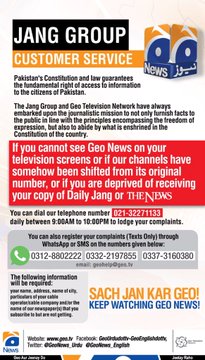
A statement on Geo TV's website says that "Pakistan's constitution and law[s] guarantee the fundamental right of access to information to the citizens of Pakistan."


View image on TwitterView image on Twitter

If viewers/readers cannot watch Geo News on their TV screens or if our channels have somehow been shifted from their original numbers, or if they are deprived of receiving their copies of Daily Jang or/and The News, they can lodge complaints at telephone number: 021-32271133
"The arbitrary suspension of Geo TV on cable TV is a direct assault on Pakistan's constitutionally guaranteed right to access information," says Steven Butler, the Asia program coordinator at the Committee To Protect Journalists. "It's outrageous that authorities are either unable to find or too frightened to name those powerful enough to orchestrate the blocking of news distribution."

#Pakistan - #Malala and APS


By Imran Khan


Malala came back, and so did her haters. Scanning through any Facebook post on Malala’s injury or achievements, one could see the irreverent ‘laugh’ or ‘angry’ emoticons taking over the ‘like’, ‘sad’ or ‘love’ emoticons. A cursory glance at the profiles of this lot revealed quite a diversified group when it came to appearances.
What united them, however, was their penchant for coming up with ridiculous conspiracy theories to discredit Malala. While they have failed on every account, the only success they have had so far is to disprove Malala’s faith in education as the cure for hate and intolerance. On that front, the educated among this lot disprove Malala with their mere existence.
This hate for Malala lies in our pre-APS narrative on terrorism, where the Taliban were portrayed as ‘our people’ fighting us because we were a part of ‘Amreeka ki jung’ (US’s war on terror). These were the days when Imran Khan would assure us that the Taliban would disarm as soon as we disassociated ourselves from that war. Similarly, Shahbaz Sharif was reminding the TTP of common foes and, in doing so, making a case for them to spare Punjab. The only solution proposed by this lot was to conduct ‘muzakrat’ (negotiations) with the Taliban.
The attack on Malala challenged the narrative of this muzakrat group of political parties. A helpless 15-year-old girl was shot point blank and the TTP was proudly taking the responsibility for it. She was not attacked because she supported drones nor was she a politician allied with the US. All she wanted was an education. In that, she was the dream child of every parent across Pakistan. Introspection at the national level would have been a natural consequence, probably resulting in calls for a reprisal against the TTP. But then the negotiations narrative was at stake and that was to be the vote-winner for the 2013 elections. And out came its defenders with conspiracy theories and slander campaigns.
We have come a long way since those days. Ever since the group of parties that wanted negotiations won the 2013 elections, Malala has been vindicated over and over again. She was vindicated when the PML-N, PTI, JI and JUI-F, agreed to launch Operation Zarb-e-Azb against the TTP. Malala’s 2011 insistence on the need to punish Fazlullah was a timely warning, well ahead of Fazlullah’s massacre of the APS children in 2014. Malala’s 2011 plea against the high-handedness in the Swat operation is presently being echoed by thousands in Fata. Today, most Malala-haters would agree with what she stood up for in 2011. Yet, their selective amnesia compels them to still call her a drama and question her achievements.
To understand Malala’s achievements, one has to understand the concept of ‘common good’. The term refers to interests that are shared by everyone in society, whether it is the freedom of speech, religion or, for that matter, the freedom to acquire an education. It is the adhesive that holds society together, as these common interests represent overlapping incentives. A contribution to the common good could be volunteering to clean up areas of one’s city, or in the case of Malala, taking a bullet for one’s right to be educated.
If you are someone who thinks that education is a waste of time, then you are absolutely right about Malala; she has not contributed much. If you are a parent who thinks that education is important for your children, imagine how much their education means to you. What would you do if a band of armed thugs stopped your children from going to school? Would you encourage them to speak openly for their rights at the risk of their lives? Would you have the courage to speak up?
If you were an adult Pakistani back in 2012, it is very likely that you chose to remain silent, mostly because of fear. There is no shame in admitting that, but then it is shameful to not recognise the courage shown by Malala and her parents when they chose to speak out against the menace that the Taliban had become in Swat. They did not do this only for themselves, as they too had the option of remaining silent like the rest. Instead, Malala, backed by her parents, took a bullet for the common good. She took a bullet so that young girls were not forced to stop pursuing their education. Malala took a bullet to highlight the danger that children like Waleed Khan faced for their ‘crime’ of going to school.
We recognise and appreciate displays of courage, especially when done for the common good. Malala’s global recognition was not for her intelligence or the severity of her injury, but for her bravery. It is indeed bewildering that many of those who, back then, didn’t even let out a whimper out of fear of the Taliban, now fail to understand what makes Malala special.
Malala-haters need to resolve their internal contradictions. A prerequisite for mourning the APS massacre would be apologising to Malala. That is because her ‘drama’ warned us about the dangers the likes of Fazlullah posed. The TTP claimed responsibility for not only the APS massacre but also the attack on Malala. Do Malala-haters imply that both those incidents were ‘dramas’? That would be one way to resolve the problem of inconsistency here. The other would be to accept the fact that those were attacks on our children – children who paid the price for the follies and fearfulness of their elders.

#PPP - AYA AYA BILAWAL...

#PPP Music - ''Aayega Bilawal Aayega''

Video - Chairman PPP Bilawal Bhutto Zardari addressing party workers in Multan. 07 April 2018

Imran Khan indulges in politics of lies: Bilawal Bhutto

Bilawal Bhutto Zardari on Friday said Pakistan Tehreek-e-Insaf chairman Imran Khan voted for Pakistan Peoples Party (PPP) in the Senate elections despite saying he will not.
“Imran Khan indulges in politics of lies. He said he will not vote for PPP in Senate elections but voted for our candidate for deputy Senate chairman,” the PPP chairman said while addressing the media in Mirpur Mathelo.
Responding to a question, Bilawal said Karachi’s mayorship and Karachi Metropolitan Corporation (KMC) are under the Muttahida Qaumi Movement. “MQM leaders are now fighting amongst each other and not doing any work nor letting anyone else do so,” he added.
He further said, “Everyone knows who was behind politics of violence in Karachiand the first time, people of Karachi will get the independence to elect candidates of their own choice.”
“I am also preparing for elections and will fight against all parties,” Bilawal added.
He further alleged that former prime minister Nawaz Sharif is harming democracy in an attempt to cover his faults. However, he said, “Democracy is not in danger.”
“All Nawaz Sharif wants is to save himself,” he added.
Regarding the government’s amnesty scheme, Bilawal said he hasn’t read it as yet “but it seems like a Panama amnesty scheme introduced to save themselves.”
http://www.thesindhtimes.com/sindh/04/imran-khan-indulges-politics-lies-bilawal-bhutto/

Video Report - President #PPPP Asif Ali Zardari addressing inauguration ceremony of Press Club Benazirabad

Friday, April 6, 2018

Video - Azealia Banks - Movin' On Up

Video - Pakistan: "The military is in charge of foreign policy"

China strikes back at U.S. unilateralism with equal tariff plan

China on Wednesday unveiled a list of products worth 50 billion U.S. dollars imported from the United States that will be subject to higher tariffs, including soybeans, automobiles, aircraft and chemical products.
The decision was made by the Customs Tariff Commission of the State Council, involving a possible additional tariff of 25 percent on 106 items of products under 14 categories, the Ministry of Finance (MOF) said on its website.
The move was taken after the U.S. administration announced a proposed list of products subject to additional tariffs, which covers Chinese exports worth 50 billion dollars with a suggested tariff rate of 25 percent.
"The date of implementation will depend on when the U.S. government imposes the tariffs on Chinese products," the MOF said.
PRODUCTS INVOLVED
The U.S.-proposed list covers approximately 1,300 products imported from China from industries such as aerospace, information and communication technology, robotics and machinery, the Office of U.S. Trade Representative said in a statement.
The proposed tariff list is based on a Section 301 investigation into alleged Chinese intellectual property and technology transfer practices launched by the U.S. administration in August 2017.
In response, China's list includes a wide variety of agricultural products such as soybeans, corn, beef, orange juice and tobacco.
U.S. soybeans sold to China account for 62 percent of its total soybean exports, with 32.85 million tonnes of soybeans exported to China in 2017, or 34.39 percent of China's total imports, Vice Finance Minister Zhu Guangyao said at a press conference.
While U.S. farmers can get the benefits from healthy Sino-U.S. economic ties, the export amount to China was "too big," he said.
Chinese farmers have petitioned industry associations, claiming that U.S. subsidies hurt the interests of Chinese soybean growers, and China must respect its farmers' demands, Zhu said.
"That's why soybeans became one of our choices as a countermeasure," he added. China was forced to bring forward the product list, and there are grounds for the specific items and their order on the list, Zhu said.
A range of chemicals and automobiles, as well as certain aircraft, will also be subject to the tariffs, according to the list.
The Boeing 737 narrow body jet falls under the description and may have to face additional tariffs when entering China.
Boeing's shares plunged more than 4 percent in premarket trading Wednesday.
REACTION WITH "RESTRAINT"
"Disregarding serious representations by China, the United States announced tariff proposals that are completely unfounded, a typical unilateralist and protectionist practice that China strongly condemns and firmly opposes," the Ministry of Commerce (MOC) said on its website.
The U.S. move was "an evident violation of rules of the World Trade Organization (WTO)," the MOC said.
Its measures "severely infringed on the legitimate rights and interests that China enjoys in accordance with the WTO rules, and threatened China's economic interests and security," the MOC said.
New tariffs China decided to impose on U.S. products were a reaction to "the emergency caused by the U.S. violation of international obligations," it added.
China has filed a request for consultations under the WTO dispute settlement framework over the U.S.-proposed list, the MOC said in a separate statement.
"China is an active participant, firm supporter and an important contributor in multilateral trade mechanisms," said the statement, citing an unnamed spokesperson.
"We hope and believe that the WTO dispute settlement body will deal with the case in an objective and just manner to safeguard rule-based international trade order," the spokesperson said.
The economies of China and the United States are highly complementary, and "cooperation is the only right choice for the two countries," the MOF said.
Since the two countries established diplomatic relations in 1979, bilateral trade has surged more than 230 times to 580 billion dollars in 2017, data showed.
"I have to say that we were forced to take countermeasures, and we have reacted with restraint," Vice Minister of Commerce Wang Shouwen told reporters.
Both countries should stay rational, enhance communication and manage differences in a constructive manner, according to the MOF.
They should seek constructive measures to deal with problems and challenges so as to bring bilateral economic ties back to a healthy and stable track, Zhu said.
China does not want a trade war, as there will be no winners, according to Wang.
"But we are also not afraid of it. If someone insists on starting such a war, we will fight till the end," Wang said.

Video Report - ‘Useless quick fixes’: US schools face backlash over measures against gun violence

Video Report - Russia: Chinese, Indian and Iranian defence ministers praise security co-operation with Russia

Video - 🇺🇸 Kennedy's historic speech on MLK's death remembered

Video - NYPD Defend Fatal Shooting With Video, 911 Calls

Video - Here's what's in your bottled water

Video - Vaping an epidemic in US high schools

Michelle Obama Brilliantly Mocks Trump On His Awful Leadership - Full Interview

Brazil cane industry blasts Pakistan, India sugar export policies


Bruno Federowski
Brazil’s sugarcane industry on Thursday took aim at policies undertaken by Pakistan and India to protect local producers and boost sugar exports, arguing they could further depress global prices.
Pakistan, whose stature as a sugar producer has been growing in recent years, in January quadrupled the volume of sugar eligible for export subsidies to 2 million tonnes in a bid to reduce excessive domestic supplies.
Eduardo Leão de Sousa, the director for cane industry group Unica, said the organization was assessing whether those practices comply with World Trade Organization (WTO) rules.
“We’ve made our concerns known to the Brazilian government,” he told Reuters. “We are speaking to our government and other countries over the possibility of action at the WTO.”
Export subsidies could drive Pakistani farmers to rotate from rice to sugar, permanently boosting global supply and pushing down prices, he said. That was the case with Thailand, which rose to become the world’s second-largest sugar exporter thanks to price controls.
In January, the Thai government eliminated domestic control of sugar prices and administration of sales as part of a regulatory overhaul to settle a Brazilian WTO challenge.
Pakistan is expected to produce around 6.5 million tonnes of sugar in the 2017-18 season ending on Sept. 30, according to the U.S. Department of Agriculture.
In comparison, output at the world’s second-largest producer India is likely to reach a record 29.5 million tonnes, with local prices already falling by more than 17 percent over the last six months.
Facing a bloated domestic surplus, India scrapped a 20 percent sugar export tax and allowed millers exporting sugar this season to import raw sugar duty-free for the following two seasons through September 2021. Even without that tax, however, high production costs mean India will likely struggle to export at competitive prices.
“If that record harvest materializes, we expect that surplus to go to market with subsidies,” Sousa said.

Pakistan’s military is waging a quiet war on journalists


By 

As activists and journalists are kidnapped, entire regions of the country are going silent.

On December 2, 2017, 40-year-old Raza Khan, a Pakistani political activist, disappeared from his home. When Raza wouldn’t answer his phone, Khan’s brother went to his residence in Lahore. He found the lights on, the curtains drawn, and the doors locked — but no sign of Raza.
It wasn’t until one of Raza’s activist colleagues visited the house that they found a clue to why he’d disappeared: Raza’s computer was missing. Diep Saeeda, Reza’s colleague, immediately thought that one of Pakistan’s notorious intelligence agencies had taken him. “It could be no one else,” she told me.
Saeeda visited police stations, hospitals, restaurants, and the morgue, looking for any trace of Raza. But she turned up nothing, and the authorities had no information either.
Almost three months later, Raza is still missing, and it’s become clear that his disappearance is part of a larger trend.
Pakistan is one of the most dangerous countries in the world for activists and reporters:According to the Human Rights Commission of Pakistan, nearly 10,000 people have gone missing in the country since 2001, with nearly 3,000 still unaccounted for. In 2016 alone, there were 728 disappearances. The HRCP and human rights activists say these numbers are significantly underreported.
Pakistani civil society members and university students shout slogans and wave placards as they protest against the killing of Mashal Khan a journalism student, in Islamabad on April 15, 2017. 
Pakistani activists and university students shout slogans and wave placards as they protest against the killing of Mashal Khan, a journalism student, in Islamabad on April 15, 2017. 
Farooq Naeem/AFP/Getty Images
Pakistan’s powerful and secretive security establishment — which ranges from its feared intelligence agency, the ISI, to the country’s military, which has carried out three coups since its inception in 1947 — has long used abductions to silence anyone who dares to question and expose their actions. This matters, of course, for ordinary Pakistanis, who can’t speak freely about their government. It also affects Pakistani lawmakers, whose ability to craft legislation is hampered by the lack of information.
But the disappearances have real consequences for the rest of the world as well.
In his first tweet of 2018, President Trump took aim at Pakistan’s government and what he called their failure to assist the US in the global war on terror. “The United States has foolishly given Pakistan more than 33 billion dollars in aid over the last 15 years, and they have given us nothing but lies & deceit,” he wrote. “They give safe haven to the terrorists we hunt in Afghanistan, with little help.”
While many may disagree with the US president’s view, his tweet speaks to a larger issue: Pakistan, which is a nuclear power, is battling its own war on terror. Many parts of the country, including Waziristan, on its porous border with Afghanistan, have turned into safe havens for militants and terror groups. The Pakistani military has been accused of working closely with and even aiding terrorists there.
Pakistani soldiers patrol next to a newly erected border fence along Afghan border at Kitton Orchard Post in North Waziristan on October 18, 2017.
Pakistani soldiers patrol next to a newly erected fence along the Afghan border in North Waziristan on October 18, 2017.
 Aamir Qureshi/AFP/Getty Images
So as Pakistan becomes a black hole of information due to the lack of reporting and independent voices on the ground, we lose sight of what’s actually taking place. This not only complicates global efforts to counter terrorism but puts the region and the world at large at risk.
In January, the Trump administration announced it would suspend $900 million in security aid to Pakistan until the country got serious about cracking down on terrorist groups like the Taliban and Haqqani network. But without objective observers and reporting in the region, there’s no way to verify if this is happening.

Pakistan’s intelligence agencies operate like an independent arm of the state

Back in 2015, I experienced the power of the country’s deep state firsthand.
In April, Sabeen Mahmud, a friend of mine and one of the country’s most prominent free speech activists, hosted a panel about disappearances in the country’s largest province, Balochistan. The Pakistani government is fighting a separatist uprising there of Baloch nationalists, and though accurate numbers are difficult to find, more than 20,000 people have reportedly gone missing. The same evening, after the panel concluded, Mahmud was shot and killed by unknown gunmen.
I wrote about her death for an Indian magazine and started receiving threats myself from agents with ISI, Pakistan’s infamous government intelligence agency. They repeatedly told me, both in person and over the phone, that I was going to be killed like my friend Sabeen, “and no one will find who did it.”
I also learned that killing one person and then using their death to generate more fear was a common tactic that the Pakistani intelligence agencies used against journalists. It leads to self-censorship, and it works almost every time.
I was no exception. Since the ISI threatened my life, I’ve been too afraid to live and report in Pakistan, and currently divide my time between New York and Turkey.
It’s important to note that Pakistan’s government, although democratically elected, does not have the power to control or influence the far-reaching and powerful military establishment. Intelligence agencies gained more power after 9/11; the ISI in particular received funding and resources from the US and Pakistani governments to help fight the war on terror. The new resources helped the ISI expand its influence and freedom to act however it saw fit, and it began operating much like an independent arm of the government.
The intelligence agencies hold so much power that even the police can’t touch them. An officer at Peshawar’s police headquarters told me the police see several abduction cases a week but can’t write up official police reports. “We have orders not to meddle in such cases that might be part of an anti-terror campaign,” he told me. “The military … is an institution with higher power.”
And despite criticism and warnings from international groups, and pledges by the government of Pakistan, these disappearances seem to be getting worse.
Last year, Pakistan’s Commission on Inquiry on Enforced Disappearances “received nearly 300 cases of alleged enforced disappearances from August to October 2017, by far the largest number in a three month period in recent years,” according to the commission.
And in early 2017, three Pakistani bloggers who were critical of the government disappeared for weeks, without a trace. When they were released, all three described torture and sexual abuse at the hands of Pakistani security personnel.
Protesters hold images of three bloggers who disappeared during a rally in Lahore on January 12, 2017.
Protesters hold images of three bloggers who disappeared during a rally in Lahore on January 12, 2017. 
Rana Sajid Hussain/Pacific Press/LightRocket via Getty Images
Waqass Goraya, one of the bloggers, said he was detained by a government organization with ties to the Pakistani military. “More and more people are being harmed — our friends, our colleagues — so how can we stop [speaking out]? Someone has to stand up,” he told the BBC. Goraya currently lives in the Netherlands, where he continues his activism from afar.

Reporting on the Pakistani military’s abuses is important. It’s also really dangerous.

Trump alluded in his January tweet to the Pakistani military’s reputation for working closely with terrorist groups. This extends back several decades: In the 1980s, the US covertly sent about $5 billion to Pakistan to fund militant groups to help fight the Soviet occupation of Afghanistan. Pakistan continued to train and fund militants to help in the fight over Kashmir, a disputed border area between India and Pakistan.
The US ramped up funding to Pakistan again in the wake of 9/11 in exchange for Pakistan’s help in fighting the war on terror. US officials say, however, that they have not seen resultsand that much of the money has been lost due to corruption, or ended up in the hands of terrorist groups.
In 2011, Saleem Shahzad, a freelance journalist, reported about how Pakistani naval officerswere involved in aiding a terrorist attack on Pakistani naval headquarters in Mehran, a short distance from the capital of Karachi. Afterward, Shahzad was brutally murdered. His death received much publicity, and since then, it appears that no Pakistani journalists have dared to report in depth about the military’s links with terrorist groups.
“Anyone who reports on Balochistan, or terrorism in Pakistan, knows that the military agencies will come after them,” said Khushal Khan, a research officer at the HRCP.
Waziristan, the restive region on the Western border with Afghanistan, is one of the most underreported places in the country. There’s almost no information that hasn’t been vetted or censored by the military going in or out.
The Pakistani military has claimed several times that they defeated terrorism in this area and forced out the terrorists — but the military refuses to let journalists or NGOs visit the area to verify their claims.
Anyone who attempts to report on what’s happening in Pakistan now runs the risk of disappearing. When I was investigating abductions of civilians from Waziristan in 2015, my sources were threatened and told that they “should not speak to journalists.”
A leading activist in the region, Manzoor Pashteen, told me that hundreds of people who have been critical of the military in the region disappeared in 2017, and dozens more have vanished this year. “Every other day I get a call … [someone] is missing or someone’s body has been found,” Pashteen said.
Last month, when I visited Dera Ismail Khan, a city near Waziristan, I met with more than a dozen civilian sources who said they knew people who had been abducted from the region. The people who were taken had direct knowledge of the alleged close relationship between the Pakistani military and terrorist groups like the Taliban and the Haqqani network, my sources told me.
In November 2017, Pashteen was abducted by intelligence agencies that told him to stop working as an activist and speaking out against the military establishment. But Pashteen said he would continue to be vocal against the continuing abductions.
“What kind of state is this, against its own people?” Pashteen asked me. “This country is also ours, and the state needs to stop treating us like terrorists.”

Pakistan military shuts down main TV news channel in media crackdown


Concerns grow about increasing censorship by security forces.


Pakistan’s most widely-viewed TV channel says it has been “forced off the air” this week, fuelling fears that the country’s security forces are “flexing their authority over civilian institutions” including the government itself.
As signals to the Geo TV network vanished across most of the nation, the Pakistan Electronic Media Regulatory Authority insisted that it is not behind the blackout - leaving fingers pointing at the country’s military.
The channel, which in recent years has switched from a pro-security stance to an anti-military agenda, appears to be the latest casualty in a crusade against dissenting media organisations by the Inter-Services Intelligence (ISI), Pakistan’s feared intelligence agency.
According to The New York Times, Geo TV officials “took pains not to publicly blame the military” for the closure of their network, amid fears of retribution. However, the newspaper says that “the action against Geo is being seen as an unmistakable message from the country’s generals that they would accept no negative reporting”.
Vox goes further, claiming Geo’s forced closure is part of a wider attempt by the Pakistani military to wage a “quiet war on journalists”.
What is happening to the press in Pakistan?
Since its birth as a nation in 1947, Pakistan has had a chequered history when it comes to journalistic freedom.
Civil society groups in the country say the freedom of press in the country is “increasingly at risk”, German newspaper Deutsche Welle reports. The Paris-based campaign group Reporters Without Borders (RSF) ranks Pakistan ranks 139th out of 179 countries on its press freedom index.
According to RSF, media organisations in Pakistan are frequently targeted by what it calls “predators of press freedom”, consisting of extremist organisations, fundamentalist Islamic groups and - most intriguingly - the country’s own military and the ISI, which act entirely independently of the state and have been responsible for three coup d’etats since Pakistan’s inception.
With murders, forced disappearances, death threats and censure of journalists and media outlets becoming increasingly common, concerns have been raised about the extensive influence of the powerful military establishment.
The military’s stranglehold means that “anyone who attempts to report on what’s happening in Pakistan now runs the risk of disappearing”, says Vox, describing the country as a “black hole of information”.
The crackdown on press freedom may have wide-reaching consequences on the world stage. The military blackout of media correspondence out of regions such as Waziristan, which borders Afghanistan and is known to be the base of numerous terrorist organisations, has fanned accusations from the international community that Pakistan both protects and funds terrorism. 
What does this mean for civil government?
At a recent conference hosted by London-based think-tank Democracy Forum, former Reuters journalist and author Myra MacDonald said that Pakistan’s separation of military and government is a by-product of the former looming threat of an Indian land invasion.
The two countries’ nuclear tests of 1998 “should, in theory, have created parity between them, since Pakistan no longer had any reason to feel insecure about an Indian invasion”, she said, according to The Economic Times.
Instead, the dominance of the military in Pakistan not only undermined democracy but threatened to turn it into a failing state, MacDonald argued.
“The intelligence agencies hold so much power that even the police can’t touch them,” Vox adds. As for the military establishment more broadly, “even when not in power, it is seen as exerting influence over security and foreign strategies”, says Bloomberg.
“With its substantial business interests - an empire that covers everything from food, schools and cement - the military stays in the public eye and enjoys local support,” the news website reports.
International relations scholar Atta Rasool Malik disagrees, arguing in an article for the Asia Times that the fears of a takeover are overblown.
“There is a lot of disinformation concerning Pakistan’s armed forces and ISI coming from domestic and foreign media houses”,  encouraged by “a few politicians and liberals in Pakistan... [who] want to garner international support by criticising Pakistan’s armed forces”, he writes. “Domestic bashing by mainstream political parties could derail the ongoing battle against radicals and extremists.”

Video - Chairman PPP Bilawal Bhutto Zardari holds press conference in Mirpur Mathelo

#Pakistan - Imran voted for PPP in Senate elections despite saying he won't: Bilawal


Bilawal Bhutto Zardari on Friday said Pakistan Tehreek-e-Insaf chairman Imran Khan voted for Pakistan Peoples Party (PPP) in the Senate elections despite saying he will not.
“Imran Khan indulges in politics of lies. He said he will not vote for PPP in Senate elections but voted for our candidate for deputy Senate chairman,” the PPP chairman said while addressing the media in Mirpur Mathelo.
Responding to a question, Bilawal said Karachi’s mayorship and Karachi Metropolitan Corporation (KMC) are under the Muttahida Qaumi Movement. “MQM leaders are now fighting amongst each other and not doing any work nor letting anyone else do so,” he added.
He further said, “Everyone knows who was behind politics of violence in Karachi and the first time, people of Karachi will get the independence to elect candidates of their own choice.”
“I am also preparing for elections and will fight against all parties,” Bilawal added.
He further alleged that former prime minister Nawaz Sharif is harming democracy in an attempt to cover his faults. However, he said, “Democracy is not in danger.”
“All Nawaz Sharif wants is to save himself,” he added.
Regarding the government’s amnesty scheme, Bilawal said he hasn’t read it as yet “but it seems like a Panama amnesty scheme introduced to save themselves.”

'Opponents handing over state-owned companies to their close aides'

 Earlier today, while addressing the media in Ghotki, Bilawal alleged the party’s opponents are handing over state-owned companies such as Pakistan International Airlines (PIA) and Pakistan Steel Mills (PSM) to their close aides.
“Our opponents are snatching PIA and PSM and giving them to their friends and close aides,” Bilawal said.
Claiming that the party’s opponents are involved in the politics of the rich, Bilawal said, “They introduce tax amnesty schemes for the rich and exempt them from giving taxes and paying their debts.”
Stating that the PPP has always worked for the poor, Bilawal said, “Zulfikar Ali Bhutto took land from feudal lords and gave it to the poor.”
Bilawal further claimed, “We initiated the Benazir Income Support Programme (BISP) to help poor women but they [opposing parties] are snatching their rights and ending the programme.”
Regarding Pakistan Tehreek-e-Insaf chief, the PPP chairman said, “Imran Khan is involved in strange politics.”
“On one side he’s speaking against corruption and on the other side he roams around with a provincial chief minister who Sindh dismissed over corruption charges,” Bilawal concluded in an apparent reference to Mumtaz Bhutto.