Saturday, December 23, 2017

Remembering Noor Jehan on her death anniversary


It has been 17 years since Pakistan’s most iconic female singer, Noor Jehan, passed away. Renowned as one of the greatest and most influential singers of her time in South Asia, Noor Jehan was given the honorific title of Malika-e-Tarannum.
Born as Allah Wasai on September 21, 1926, in Kasur, Noor Jehan started her musical career from Calcutta at the age of nine as a child singer.
After partition, she moved from Bombay and started her film career in Pakistan as an actress and a singer, and the first female film director with the film Chann Wey in 1951.
Her last film as an actress was Ghalib which was released in 1961.
Noor Jehan recorded about 10,000 songs in various languages, including Urdu, Hindi, Punjabi and Sindhi.
She had ruled the film industry for more than 35 years and was not only a celebrated playback but also a gifted ghazal singer.
In 1957, Noor Jehan was awarded the President's Award for her acting and singing prowess.
On December 23, 2000, Noor Jehan passed away as a result of heart failure and was buried in Karachi.

The Robin Hoods of India and Pakistan


By Mubashir Zaidi
Some 30 youngsters gathered on a Sunday morning this month at Karsaz in Karachi. Anmol, 20, was taking a roll-call. In the next 30 minutes they all left in cars for the 13-D basti in the city’s Gulshan area. These are volunteers of Robin Hood Army Pakistan (RHA), a social initiative aimed at eliminating hunger by distributing food to poor families. In the slum, the youth, wearing green shirts, began by singing the national anthem. As it ended, some carts were brought in by the local residents.
Mohammed Rafique, hailing from southern Punjab, said the RHA volunteers had been visiting the Gulshan area regularly for the past two years. They bring biryani and dal chawal. Sometimes, pizza too. For children, they have biscuits, juices, candies and pastries. Delivering them in disposable plates, the volunteers go to every makeshift residence, asking for the number of people. Separately, children make a circle in the nearby playground, in the middle of which a volunteer begins singing poems. “I love everything about Robin Hood Army. This is such a fulfilling and unusual experience for me, said Maryam Ahmed, 20, a volunteer. “When I meet these people, I get to know about the difficulties in their lives. I love to interact with them and motivate them.”
Sameer Beg, who leads the RHA in Pakistan, is happy that the wedding season has begun. Till now, the RHA has been collecting surplus food from restaurants. They have also managed to convince wedding planners and caterers to provide them surplus food, which they can distribute to the hungry. The RHA now has more than 300 volunteers. Lahore and Islamabad are planning to join the initiative from early next year.
The RHA was established by an Indian student, Neel Ghose, when he returned from London in 2014 after doing masters in finance. Born and brought up in Kolkata, Mr. Ghose started working in Delhi with Zomato, a restaurant aggregator. On a trip to Portugal, he heard about Re-Food, an initiative to distribute surplus food to the hungry and the poor. That led him to found the RHA in India.
Mr. Ghose, who is now doing MBA from Harvard Business School, says the name of the Robin Hood Army came up suddenly. “I and my friend Arooshi were thinking about Robin Hood, who got things from the rich and distributed them to the poor. Then we decided to name our initiative after him. Now we have 10,000 volunteers in 75 Indian cities, he said on the phone from the U.S. “In Pune, the Robin Hood Army is run by retired citizens. They are, in fact, doing a better job.”
Crossing the border
After founding the Indian operations, he contacted his Pakistani classmate Sara Afridi and encouraged her to begin the RHA here. “Since both countries face similar problems of inequality and hunger, we chatted and she, along with her husband Sarfraz, founded the RHA Pakistan,” Mr. Ghose said. Ms. Afridi began the initiative on February 15, 2015, when Pakistan and India played against each other in the Cricket World Cup. She began with six of her relatives. Sameer Beg, the current team leader, was the ninth volunteer.
Today, the initiative is spread over 15 countries, mostly in South and Southeast Asia. The team leaders have a joint Whatsapp group called Robin Hood Boiler Room. Both Mr. Ghose and Mr. Beg are less concerned about the government-to-government relationship between India and Pakistan. “More people die of hunger in both countries than terrorism. So we have taken up the initiative to eliminate hunger from our countries,” Mr. Ghose said.

#Pakistan - #RazaKhan - A prison of our own making


Tariq Khosa


IN Shakespeare’s Hamlet, the prince greets two visitors to the royal court by asking what they have “deserved at the hands of fortune that she sends you to prison hither?” Surprised, one visitor asks what he means by ‘prison’. Hamlet says, “Denmark is a prison.” The other visitor comments that if so, the whole world is a prison. Hamlet says it is, and “a goodly one, in which there are many confines, wards and dungeons, Denmark being one o’ th’ worst”. The other visitor disagrees. Hamlet’s reply is profound: “Why, then, ‘tis none to you, for there is nothing either good or bad, but thinking makes it so. To me it is a prison.”
Raza Khan, a social activist, went missing in Lahore on Dec 2. His fault? The courage to express his opinions openly, invoking the wrath of the invisible, dark forces who consider themselves above the law. The message for him and others of his ilk is clear: you are no longer safe in your own homes. It is better to be silent and cow before the forces of darkness. “But we will not be silenced,” said the select group of lawyers and activists at a recent press conference, adding that “we will use every single platform we have available to agitate” against this latest case of enforced disappearance.

Raza is the seventh activist to go missing this year. Before they returned to their homes, for up to two months the others were ‘imprisoned’, silenced and disgraced for advocating for causes they believed in. Their bodily bruises may have healed by now, but their mutilated souls will remain tormented. Raza is the latest ‘prisoner’ apparently taken to purgatory to purge him of views that are perceived as ‘foul’ or ‘seditious’ by the invisible guardians of our national interests. Hopefully, he will return alive to breathe in a wider prison, as in the words of Richard Lovelace, “Stone walls do not a prison make, nor iron bars a cage.” He stands divested of liberty and freedom, and will carry the burden of the beastly behaviour meted out to him.
The deep state is like an unbridled horse, without the reins of constitutional oversight.
This brings me back to Hamlet’s cry, “Something is rotten in the state of Denmark.” Pakistan, too, is a prison for all those conscientious, courageous activists and thinkers who strive to improve the lives of others. Rising above narrow self-interest, they want to promote peace, progress and tolerance. They have a right to dream big. Why should this right be denied? If, consciously or unconsciously, they break any law, the constitutional requirement of due process, fair investigation and transparent trial cannot be denied to them. Unfortunately, Pakistan is not only a ‘prison’ for political dissidents and social activists — it has become an inferno for religious minorities facing persecution and summary prosecution at the hands of bigoted brigades.
My complaint is against the guardians of the Constitution who take an oath to abide by it, ie the state institutions that are letting down the people they serve by acting either as cowards or culprits. Take the police: either they do not register cases of enforced disappearance, or file an FIR against ‘unknown’ culprits while waiting for the victim to be ‘found’ dead or alive. Highly professional, competent senior police officers avoid taking the path where angels fear to tread. Culprits are known, but are considered to be above the law. Why bother to swim against the tide? Based on circumstantial evidence, formal questions are not asked from the heads of ‘secret agencies’. Thus, a culture of impunity is further entrenched among institutions that are not governed under any legal framework.
The other complaint I want to respectfully lodge is with the esteemed judiciary. Why has no suo motu notice been taken of the recent disappearances? The present chief justice of Pakistan himself inquired into the disappearance, torture and death of journalist Saleem Shahzad. He recommended that the intelligence agencies be made accountable and be governed under a legal framework — back in 2011-12. The executive and parliament failed to implement his recommendations. To date, the deep state is like an unbridled horse, without the reins of law or control through judicial or parliamentary oversight.
During the days of judicial activism in 2007, when I was IGP Balochistan, the then chief justice of Pakistan took strong notice of the missing persons issue. Police, civil armed forces and intelligence agencies were made to identify and recover many ‘missing’ persons, and the military regime was forced to cough up many illegally kidnapped victims of state tyranny.
My recommendation then to the federal government was based on the law: detain the suspects under the Maintenance of Public Order Ordinance for up to three months in duly notified lock-ups and commission a probe by joint interrogation teams comprising members of the police’s counterterrorism department and intelligence agencies. Those against whom no evidence was found should be declared ‘white’ and released; those against whom strong suspicion but no solid evidence existed should be declared ‘grey’ and conditionally released with restricted movement; and those against whom sufficient evidence was collected should be declared ‘black’ and prosecuted in anti-terrorism courts — but no illegal detentions at secret locations, please. This was a combination of administrative and judicial processes in view of the extraordinary challenges faced by the state.
If the judiciary can undertake firm accountability of allegedly corrupt politicians, why should it not take strong notice of transgressions of the executive arms of the state trampling upon the fundamental rights of citizens whose voices are being muzzled by the barrel of the gun? As the year draws to a close, with the spectre of enforced disappearances haunting us all, I say with a heavy heart that we are indeed living in a prison. To me, safeguarding freedom of expression, right of peaceful dissent, avoiding illegal detentions and ensuring due process of law are more if not equally important to combating corruption across the board — including among our sacred cows.

#Pakistan - The fundamental contradiction


By Afrasiab Khattak
Everyone will love to see a peaceful and level playing field for all political forces in preparation for the coming elections as that’s the only path to the future political stability. 

 Important developments during this week ( public explanation by the Chief Justice about recent court orders and the COAS’s Senate briefing) seem to have somewhat helped in defusing the crippling tension that had gripped the political situation during the last few weeks with a severely negative fall out for governance system in the country. It was because the high voltage tension wasn’t just confined to deep polarisation among political parties. Different state institutions also appeared to be not only at loggerheads but their internecine conflict was also clearly undermining the basic functioning of the state system.
The deep state that was believed to be behind the creeping coup since the aggressive sit ins of 2014 in Islamabad was also regarded to be the moving spirit behind the dubious court order for sacking an elected Prime Minister. The Joint Investigation Team ( JIT) that paved ground for the aforementioned court order by presenting a biased report was dominated by intelligence agencies of the army. Security establishment was clearly using the shoulder of higher judiciary for sacking Prime Minister Nawaz Sharif who had earned its wrath on two counts. One, Nawaz Sharif had arraigned former military dictator General Pervez Musharraf before a special tribunal under Article 6 of the Constitution meant for punishing the abrogators. Two, Nawaz Sharif wanted to have normal relationships with neighbours, specially with India. His desire to open economic cooperation with India was in particular a red rag to the security establishment. But when Nawaz Sharif, even after getting disqualified, demonstrated strong defiance new pressures had to be brought in against the government. NS led a mammoth march from Islamabad to his hometown and also his political base Lahore questioning the controversial court order. The putschists responded by deploying their shock forces. The siege of Islamabad by religious extremists in November was the ugliest stage of the creeping coup that considerably weakened the government. But the security establishment’s “ neutrality” during this conflict between the state and anti state elements and its role as a “mediator” in the last stage also created disturbing questions in the minds of the people. The video clips of a senior army officer in uniform distributing money among fanatics and endearing himself to them said it all.
There can be two possible reasons for the effort for damage control on the part of security establishment and the higher judiciary. One, there is a realisation that the role of their institutions in ousting the elected Prime Minister has crossed the limits of propriety and has become questionable. So they have to step back a little bit. Two, the conservatives in the PML (n) have been able to convince Nawaz Sharif to accept the terms of the security establishment for peaceful coexistence. The nomination of Shahbaz Sharif as a candidate for Prime Ministership is the most important manifestation of the alleged deal. Be that as it may, the recent Supreme Court decisions for political balancing and passage of delimitation bill by Parliament appear to clear way for the coming elections. For now the speculations about the extra Constitutional measures such as establishment of a prolonged care taker government ( to be remote controlled by the security establishment) have been put to rest. But the recent crises has left all the state institutions in shambles. Civilian institutions are particularly in bad shape. In terms of image higher judiciary has lost the most. The Apex Court has demonstrated a crusader’s zeal in cases against political figures demonised by the security establishment but it has failed to prosecute the generals even if they are retired. Failure in prosecuting General Musharraf is the most notorious case. Judges with record of corruption and misconduct also enjoy impunity and the situation is quite pathetic on this front. That the Chief Justice of the Supreme Court had to refer to the model of primitive village Panchayat for claiming legitimacy in public speaks volumes of the weak wicket on which his institution has been playing. Parliament has also not come out of this crises in flying colours. Unfortunately the elected houses have remained side lined during the last few years in most of state affairs and national affairs. But the delay in passage of delimitation bill exposed the vulnerability of the Parliament to anti democratic intrigues. To be fair the political parties, some of them with tall claims about their commitment to democracy, need to take responsibility and go for introspection. The failure of political parties in rallying on a common minimum program for safeguarding democracy hasn’t raised their credibility since their leaders stuck to the quest of individual power and interest.
The defusing of crises will obviously be a welcome development. Everyone will love to see a peaceful and level playing field for all political forces in preparation for the coming elections as that’s the only path to the future political stability. But it would be naive to expect such smooth sailing without resolving the fundamental contradictions present in the current state system. At the core of current crises has been the imbalanced civil military relations. There are no two opinions about the significance of military’s role as a bulwark for defending the country. Also no one grudges military’s feedback in formation of national security ad foreign policies. That is something normal. But the problem starts when some of the generals regard themselves “ the state” to the exclusion of all other institutions. We are totally justified in calling out the elected leaders when they behave like absolute monarchs over and above the law and the Constitution and not accountable. But it should also be the case with top civil and military bureaucrats when they cross the limits of grade 22 officers in the service of state and consider themselves to be the “ real rulers “. That’s where a the phenomenon of a state within a state appears. This is something not only unconstitutional but also not sustainable. Political parties get a mandate from people on certain socio political program. But if the civil or military bureaucracy arrogates itself the right to veto the program approved by the people democracy will become meaningless. Resolution of this fundamental contradiction is a pre requisite for having a stable democracy in the country. This problem cannot be pushed under the rug indefinitely.

#Pakistan - Government asked to address root causes of intolerance, extremism


The Interfaith Advisory Commission (IAC) has called upon the government to address the extremism and root causes of intolerance and protect freedom of everyone at any cost, as the Constitution 1973 already declared all citizens equal.
In a statement, Hafiz Abdul Gaffar Roopri, Pastor Dr Majeed Able, Allama Shakeelur Rehman Nasir, Javaid William, Allama Syed Mufti Ashiq Hussain, Dr Masood Ahmed Mujahid, Allama Mahdi Hassan, Hafiz Samiullah and Allama Abdur Rab Amjad condemned the attack on Quetta’s Bethel Memorial Methodist Church on Sunday.
Along with Punjab Minister for Human Rights and Minorities Affairs Khalil Tahir Sandhu and MNA Asiya Nasir, the delegation visited the church and injured in Quetta’s hospitals and extended their condolences to the victim families. They prayed for the victims and their families. The delegation asked the authorities to protect everyone during the Christmas.
They said that the government would have to ensure intolerance and peaceful coexistence in Pakistan. “We must remember tolerance is the key to ensuring peace,” they said. The attackers carried out the brutal attack on the third Sunday of Advent at the Methodist Church in the provincial capital of Balochistan.
The church had organised different programmes all throughout December to mark Christmas, according to its Facebook page, and was holding a Sunday School Christmas Programme at the time of the attack. A witness said that several children attending Sunday school had taken shelter while firing continued around them.
The Interfaith Advisory Commission also said that the whole nation was united in the fight against terrorism and had the determination to confront it. “We are working on inter- and intra-faith peace and harmony amongst different religious communities to harmonise their living and coexistence,” said Javaid William. “Our approach is participative and national with a good effect to the grass root level,” he said.

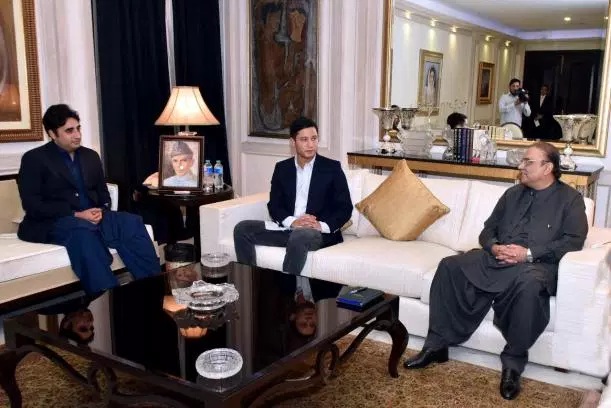
Prince of Malaysia called on Bilawal and Asif Ali Zardari

Tengku Fahad Ahmad Shah, Prince of Malaysia called on the PPP Chairman Bilawal Bhutto Zardari and the President of PPPP and former President of Pakistan Asif Ali Zardari at Bilawal House on Saturday.
The visiting dignitary exchanged views on the matters of mutual interests with the PPP leadership.
Former MNA Alizeh Iqbal Haider was also present on the occasion.

http://www.thesindhtimes.com/sindh/prince-malaysia-called-bilawal-asif-ali-zardari/

PPP delegation visited families of victims of Quetta Church terrorist attack


A delegation of Pakistan Peoples Party comprised of its Secretary General Nayyar Hussain Bukhari, Senator Farhatullah Babar and Senator Sherry Rehman visited the families of victims of Quetta Church terrorist attack in Balochistan capital today to express solidarity with them.
The delegation flew from Islamabad to Quetta and were joined by PPP Balochistan President Ali Madad Jattak and other provincial office-bearers during their visit to the victims’ families.
Bishop Sadiq Daniel, Samuel Bashir and Chaudhry Shan Salamat Provincial Senior Vice President PPP Minority Wing Balochistan were also present.
The delegation, which visited the Quetta Church terrorist attack victims’ families on behalf of the PPP and its Chairman extended full solidarity to the Christian community and assured them that PPP would always stand with the weak and vulnerable and provide full protection to them.
They further said that terrorists were attacking from schools to hospitals, churches to mosques and civilians to armed forces in their attempts to cripple our entire nation but pledged that their nefarious designs will be foiled with national unity and collective fight by the people of Pakistan.

https://mediacellppp.wordpress.com/

#Pakistan - Govt continues to ignore Balochistan, Sherry

Vice President PPPP, Senator Sherry Rehman while expressing concern over federal government’s policy of neglect and ignorance after the Quetta Church attack said, “The government should stop treating people of Balochistan and minorities as aliens. They need to be treated well and owned by the federal government”.
A PPP delegation comprised of Vice President PPPP Senator Sherry Rehman, Secretary General Nayyar Hussain Bokhari and Senator Farhatullah Babar visited Quetta on the advice of Chairman Bilwal Bhutto Zardari to express solidarity with the families of victims of the Quetta Church attack.
“I am shocked and appalled that no one either from federal or provincial governments has visited the victims of the Sunday Quetta church blast. The Methodist Church where the suicide bombers attacked is still spattered with blood and broken glass, a silent testament to the tragedy that Sunday school congregation saw unfold, with women and children caught in the crosshairs of this terrorist attack”, said Sherry Rehman.
Talking to the locals, Senator Rehman said, “We have come here to assure this community that they are neither alone nor without help. Quetta has witnessed repeated attacks on non-Muslims and Hazara populations which live increasingly fragile lives in this border province, with little protection or concern shown by the government.”
The PPP leaders assured Bishop Sadiq Daniel and others that they will help with rebuilding their lives, taking care of the severely injured in Karachi if needed, and that no citizen of Pakistan should have to suffer such heinous discrimination based on their faith or sect.
Provincial Senior Vice President PPP Minority Wing, Chaudhry Shan Salamat, PPP Balochistan President Ali Madad Jattak, and other provincial office-bearers were also present on the occasion.
https://mediacellppp.wordpress.com/2017/12/23/govt-continues-to-ignore-balochistan-sherry/

Friday, December 22, 2017

Pashto Music - ساقي | اجمل خټک | سردارعلي ټکر

Pakistan - The evil in us


By Quratulain Fatima
The malevolence within us takes pleasure in the pain of those who are foreign to us...
December remains a gloomy month in Pakistan. From the fall of Dhaka to the massacre of innocent children at the Army Public School (APS) Peshawar; our history is marked with profound tragedies in the month of December, apart from the blunders which take place around the year.
This cold and dark month is notorious for bringing out despair worldwide. So much so that it had to be lit up through the custom of Christmas, a happy custom that was recently bloodied by the terrorist attack on a Methodist Church in Quetta.
According to the South Asia Terrorism Portal (SATP), Pakistan remains one of the countries with the highest number of terror related fatalities. We have suffered 62,928 causalities in the past 17 years. A large number of these causalities are minorities. Though, the APS incident of December 2014 remains the most brutal till now. The habit of portraying people subjected to an untimely death as a result of these bombings as martyrs is perplexing. No one goes to a church, mosque, bazaar or school to become a martyr. This cloak of martyrdom is shamelessly used to diminish state failures to protect its people.
Daily bombings were also taking place on the other side of the western border during the Zia era. In its naiveté, the Pakistani public believed we were fighting a just war and it would remain outside our borders. We were proven very wrong. Resultantly, our children are now exposed to terror related violence and bloodshed. We have used religion as a tool of convenience to craft out our national and foreign policies. Terrorism and the death ridden landscape of Pakistan are the disastrous consequences of this foolish approach.
A question that often baffles concerned Pakistani citizens and the international community that nervously follow bizarre developments in our nuclear empowered Pakistan. That question is “What is wrong with Pakistan”.
We have used religion as a tool of convenience to craft our national and foreign policies. Terrorism and the death ridden landscape of Pakistan are the disastrous consequences of this foolish approach.
Pakistan is a country created through charismatic leadership and a political party that changed the course of history was derailed from its promising path and thrown into a pit of chaos. What went wrong? There have been papers and books written on the topic on where we went wrong and we are still a thousand miles away from reaching the right answer to this question.
There have been many nations who completely wrecked themselves. Germany turning Nazi can be quoted as an example. But most of these countries could steer themselves away from the iniquitous paths of oblivion. Pakistan shows glimpses of promise occasionally spinning out of sane control. The question that needs to be asked now is not what went wrong with us but what is wrong in us.
From the ideology debate which has remained ongoing since the creation of Pakistan to our concurrent and persistent memory loss, the story of Pakistan is an eerily similar and unpredictable cycle of disappointments marked by periodical highs of elusive promising policies. Policies that are big on words and small on actions.
Pakistan’s creation was opposed by all renowned Islamic parties of British India. The inheritors of the same parties are now leading wars in name of existence of Pakistan, cowing down the democratic government of Pakistan through blockades and destruction.
Pakistan grapples (mostly unsuccessfully) with violence unleashed by Islamic extremists. Recently we bowed down to a mob blocking the capital city on the pretext of religion. The systematic oppression of minorities through bias and violence has become the norm. From Ahmedis to Christians and Hindus to Sikhs, unfortunately no minority feels safe in Pakistan. They are constantly subjected to forced marriages and violent attacks apart from other heinous crimes.
It is not just the blood thirsty fundamentalist that threatens the very existence of non-Muslim citizens of Pakistan. The hatred and reluctance to accept minorities as our equals is visible through the attitude of the ordinary Pakistani. It is the ordinary Pakistani that has become intolerant. This can be seen through the refusal to share the same utensils with our Christian employees who very honourably do the unfortunate task of cleaning our sewers and collecting our garbage. Mainly, because we have closed many other professional doors for them. Our abhorrence to the ‘other’ is also visible through many other unfortunate actions, such as this one I saw firsthand. A few years ago an elderly couple, one of the very few from Pakistan’s Goan Christian community was living in the Cantt area of Rawalpindi. Being my friends, one day they called me frantically for help. When I reached their humble house, I witnessed a very educated man from the community writing kafir on their front door. These non-Muslim friends of mine were patriots. They chose to stay in Pakistan when everyone in their family was telling them to leave this intolerant country. In the end, they had to, because harassing them became a daily ritual for their ‘respectable’ neighbours. The malevolence within us takes pleasure in the pain of those who are foreign to us.
There is something very wrong with our society’s mentality. A number of factors ranging from our constitutional adventures to the media has contributed in our way of life. Noone wants to remember that the hardcore religious parties opposed Pakistan. Ironically since the inclusion of the objective resolution, religion has become our weapon of choice when dealing with dissent.
It is high time we stop searching for the reasons of our misfortunes outside. We must delve into ourselves to deal with our truths. The time is now.

Inflation on the rise in Pakistan


The Sensitive Price Indicator (SPI) based weekly inflation for the week ended on December 21 for the combined income groups increased by 0.16 percent as compared to the previous week.
The SPI for the week under review in the above mentioned group was recorded at 226.00 points against 225.65 points last week, according to the latest data released by Pakistan Bureau of Statistics (PBS) on Friday.
As compared to the corresponding week of last year, the SPI for the combined group in the week under review witnessed increase of 3.46 per cent.
The weekly SPI has been computed with base 2007, 2008=100, covering 17 urban centers and 53 essential items for all income groups.
Meanwhile, the SPI for the lowest income group up to Rs 8,000 witnessed nominal increase of 0.05 percent as it went up from 215.56 points in the previous week to 215.67 points in the week under review.
As compared to the last week, the SPI for the income groups from Rs 8001 to 12,000, Rs 12,001 to 18,000, Rs 18,001 to 35,000 and above Rs35,000, also increased by 0.10 percent, 0.13 percent, 0.16 percent and 0.19 percent respectively.
During the week under review, average prices of 8 items registered decrease, while 12 items increased with the remaining 33 items’ prices unchanged.
The items, which registered decrease in their prices during the week under review included potatoes, eggs, onions, sugar, mash pulse, chilly, mustard oil and wheat flour.
The items, which registered increase in their prices included chicken, tomatoes, bananas, LPG cylinder, garlic, firewood, gur, moong pulse, masoor pulse, gram pulse, rice (basmati broken) and wheat.
The items with no change in their average prices during the week under review included rice (irri-6), bread, beef, mutton, milk (fresh), curd, milk (powdered), cooking oil (tin), vegetable ghee (tin), vegetable ghee (loose), salt, tea (packet), cooked beef, cooked daal, tea (prepared), cigarettes, long cloth, shirting, lawn, cigarettes, gents sandal, gents chappal, ladies sandal, electricity charges, gas charges, kerosene oil, electric bulb, washing soap, match box, petrol, diesel, telephone local call and bath soap. 

#PPP delegation visited families of victims of #QuettaChurch terrorist attack

A delegation of Pakistan Peoples Party comprised of its Secretary General Nayyar Hussain Bukhari, Senator Farhatullah Babar and Senator Sherry Rehman visited the families of victims of Quetta Church terrorist attack in Balochistan capital today to express solidarity with them.

The delegation flew from Islamabad to Quetta and were joined by PPP Balochistan President Ali Madad Jattak and other provincial office-bearers during their visit to the victims’ families.
Bishop Sadiq Daniel, Samuel Bashir and Chaudhry Shan Salamat Provincial Senior Vice President PPP Minority Wing Balochistan were also present.

The delegation, which visited the Quetta Church terrorist attack victims’ families on behalf of the PPP and its Chairman extended full solidarity to the Christian community and assured them that PPP would always stand with the weak and vulnerable and provide full protection to them.

They further said that terrorists were attacking from schools to hospitals, churches to mosques and civilians to armed forces in their attempts to cripple our entire nation but pledged that their nefarious designs will be foiled with national unity and collective fight by the people of Pakistan.


https://mediacellppp.wordpress.com/2017/12/22/ppp-delegation-visited-families-of-victims-of-quetta-church-terrorist-attack/

Bilawal Bhutto summons CEC meeting on December 26th

Chairman Pakistan Peoples Party Bilawal Bhutto Zardari has summoned an special meeting of the Central Executive Committee (CEC) of the Party at Naudero House on Tuesday December 26, 2017.
The CEC meeting scheduled on the eve of 10th martyrdom anniversary of Shaheed Mohtarma Benazir Bhutto will discuss the overall political situation of the country.

https://mediacellppp.wordpress.com/

Thursday, December 21, 2017

Music Video - James Blunt - You're Beautiful

Video - Can Liberals Survive the Apocalypse?: The Daily Show

Video Report - Puerto Rico's Governor To Organize Latinos To Vote Against #GOP

Video Report - One in three French ministers are millionaires

Video Report - Don Lemon & Panel LAUGH OUT LOUD At Trump Admin. Celebration SPEECH

Malala makes it to Bazaar's 150 Visionary Women list


Harper's Bazaar UK commemorated its 150th anniversary year with a list "celebrating the most influential female leaders in the UK."
And guess what? Malala Yousafzai's on it.
The magazine's Bazaar 150 Visionary Women list calls these women "forward-thinking, high-achieving and inspirational role models to women everywhere," and there's little doubt that Malala has earned her spot on it.
The youngest Nobel Peace Prize laureate has been honoured for playing an active role towards female education in Pakistan and opening a school for Syrian refugee girls in Lebanon. Listed under the 'Opinion Formers' category, Malala joins the likes of Amal Clooney, Emma Watson and J.K. Rowling.
Other women of prominence who have also been listed are Kate Middleton (Duchess of Cambridge), Victoria Beckham and Kate Winslet. Full list here.
Malala is currently enrolled at Oxford University and is studying for the PPE degree (Politics, Philosophy and Economics).
https://images.dawn.com/news/1178841/malala-makes-it-to-bazaars-150-visionary-women-list

#Pakistan - #FATA - Traditions that need to go


Even in 2017, the women of the Federally Administered Tribal Areas (FATA) continue to bear the brunt of oppressive customs. There has been little debate on the custom of ‘ghag’ prevalent in FATA and some areas of Khyber Pakhtunkwa (KP), whereby a man announces his intention to marry a particular woman by sending a person to the bride’s house or sometimes even by firing shots before naming his chosen bride. Several reports attest that the man in question is not obligated to marry her despite the announcement but the woman is barred from marrying anyone else after the announcement is made.
The custom is often used as a tool to play revenge on the women’s family and settle personal scores. A number of women are said to have committed suicide in FATA because of the emotional trauma they go through in instances where men who used ‘ghag’ refuse to marry them later.
A woman from Bajaur Agency recently filed a case in the Peshawar High Court (PHC)against a man allegedly invoking ghag against her when she was two-years-old. The court on Monday disposed of the petition and termed the custom ‘against the fundamental rights of an individual guaranteed in the constitution’. Although the KP Assembly had passed a law against the custom in 2013, it does not extend to FATA which is why women of FATA continue to face the inhumane practice. This custom is yet another reason why the government must not delay implementation of FATA reforms any further, so that the law applicable in the rest of the country can be extended to FATA.
However, the government must address the concerns of women activists from FATA about the Riwaj Act that will replace the draconian Frontier Crimes Regulation (FCR). Local jirgas in the region encourage practices of ‘ghag’ in the name of tribal custom and the Riwaj Act has legitimised the jirgas. It needs to be revisited by taking on board the women of FATA since we do not want one set of draconian laws being replaced by another.

Why the Taliban Is Winning in Pakistan

The conflict in Afghanistan demands a new approach. Giving Pakistan another opportunity to target the Taliban is a false hope.
U.S. Defense Secretary James Mattis visited Pakistan in early December. The purpose of his trip was to give the Pakistani government a final opportunity to target the terrorist groups that are attacking Afghanistan and coalition forces, according to Voice of America. On October, Secretary Mattis told the House Armed Service Committee that the United States needed “to try one more time” to make its strategy work “by, with and through the Pakistanis.” If, in the end, its best efforts failed, then President Trump would be “prepared to take whatever steps are necessary,” he said. In response to the secretary’s remark, a Pakistani official, who spoke on the condition of anonymity, told Pakistan Today, an English-language Pakistani newspaper, that Pakistan has taken action against all terror groups inside Pakistan. However, the official’s statement is false. Gen. John Nicholson, head of U.S. and NATO forces in Afghanistan, has noted that the Taliban are still living comfortably in Pakistan. Pakistan hasn’t taken action against the Taliban.
In fact, Pakistan has significant interests in supporting the Taliban. The Taliban is an asset to the country. Christine Fair, an expert on South Asia at the Center for Peace and Security Studies at Georgetown University, has labeled the Taliban as a state proxy. At the Raisina Dialogue, Fair noted that these proxies operate with the Pakistani government’s support and “are tools of statecraft.” According to a Rand Corporation report titled “India’s and Pakistan’s Strategies in Afghanistan,” Pakistan has several objectives in Afghanistan. Pakistan desires to block Indian influence in Afghanistan, undermine Kabul’s claims on the disputed territories near the border, maintain a strategic depth in Afghanistan, establish safe havens in Afghanistan for Pakistani-trained extremists, and to prevent Afghanistan’s regional integration. All of Pakistan’s objectives in Afghanistan can only be achieved through Pakistan’s patronage of the Taliban.
Pakistan’s support for the Taliban is part of its long-term strategic goal of exerting significant influence in the region. Pakistan’s goal is to attain regional hegemony to counter India’s influence. Fair notes in her book, Fighting to the End: the Pakistan Army’s Way of War, that “Pakistan’s defense literature clearly maintains that Pakistan’s army aims to resists India’s position of regional dominance and its slow but steady global ascent.” To achieve that goal, Peter Tomsen, former U.S. ambassador and special envoy to Afghanistan, notes in his article published in World Policy Institute, that Pakistan seeks to “forge a broader Islamist bloc of Pakistan, Kashmir, Afghanistan, and eventually Central Asia to balance India, Pakistan’s traditional rival.” Pakistan is attempting to install a puppet regime in Afghanistan via its proxies. Pakistan’s success in Afghanistan would be a starting point for creating an Islamist bloc that would counter India.
Since the inception of the Afghan National Unity Government, Ashraf Ghani, president of Afghanistan, has put significant effort in attempting to convince Pakistan that Kabul is a reliable partner. The National Unity Government tried to work with its eastern neighbor to convince them that Islamabad can secure its interests in Afghanistan without proxies. According to Ghani, “I extended my hand to Pakistan, and they spit on it because they thought they could overthrow us. So let’s call facts facts.” In 2014, the Afghan government froze its requests for lethal weapons from India to relieve Pakistan’s security anxieties of an increase in Indian influence in Afghanistan. Since 2015, Kabul has sent its cadets to Pakistan for training to counterbalance the training offered by India. In 2015, the Afghan government signed an intelligence-sharing agreement with Pakistan to counter terrorism in the region. In 2016, Kabul gave its share of electricity from the regional CASA-1000 project to Pakistan due to the dire energy crisis in the country. Still, Islamabad views Kabul as an adversary.
Last month, Nicholson told reporters at a NATO meeting in Brussels that he hasn’t seen a change in Pakistan’s behavior or its efforts to eliminate the Taliban’s safe havens inside the country. Why is that the case? Why hasn’t Pakistan taken action against its proxies that target Afghanistan and the coalition forces? The answer is: the Pakistani military. Academic research has shown that a state views the intention of its adversaries’ actions through the state’s individual and organizational biases/interests. Based on these biases, the state will subjectively refine and judge its adversaries’ intentions. In Pakistan, the army is the most powerful institution. Pakistan’s military runs the state’s foreign policy. A core belief of the army is that Pakistan is an insecure state. The army views all of its neighbors, except for China, as threats. Therefore, any sincere action from Kabul to improve its ties with Islamabad will be in vain. Pakistan will not view Kabul as a bona fide partner.
Furthermore, the Pakistani army benefits from maintaining Pakistan in a state of crises with its neighbors. The army exploits the perceived threat from Kabul and a rising India. These perceived threats justify the Pakistani army’s overarching role in the government. An article published in the New York Times notes that Pakistan’s former prime minister, Nawaz Sharif, was ousted because he pursued “conciliatory policies toward India as well as Afghanistan and by reportedly demanding that Inter-Services Intelligence end its use of militant groups as tools of foreign policy.” According to Tomsen, Pakistan’s current “strategy exactly mirrored Pakistan’s strategy from 1994 to 1998, when Pakistan organized, armed, and sent thousands of Taliban, Pakistani, and other extremists into Afghanistan to overthrow the Mujahidin government in Kabul.” Since 9/11, Pakistan hasn’t changed its policies of supporting proxy groups. Therefore, the Afghan government and the Trump administration need to raise the cost for Pakistan’s pursuit of such policies. Currently, Pakistan bears no cost for pursuing such policy.
Foremost, the Afghan government needs to pursue a hawkish-policy towards Pakistan’s support for proxy groups. Kabul needs to use all of its state resources to address Pakistan’s support for the Taliban. Moreover, the Trump administration needs to translate its determination to increase pressure on Pakistan to a concrete policy.
As President Trump said, “We cannot solve our problems by making the same failed assumptions and repeating the same failed strategies of the past. Old challenges demand new approaches.” The conflict in Afghanistan demands such a new approach. Giving Pakistan another opportunity to target the Taliban is a false hope.

#Pakistan's State Under Siege


#Pakistan - #PPP - Not Nawaz, but nation would decide between Shahbaz and Bilawal for next PM: Khursheed

Opposition leader in the National Assembly Syed Khurhseed Shah said on Thursday that the nation and not Nawaz Sharif would decide whether the next prime minister would be Shahbaz Sharif or Bilawal Bhutto.
Addressing the party workers here, the opposition leader questioned how come Nawaz Sharif could decide on who will become the next prime minister? The nation will decide among Shahbaz Sharif, Bilawal Bhutto and Imran Khan for the next prime minister.
Mian Sahab (Nawaz Sharif) had been asking why was he ousted while the other (Shahbaz Sharif) was asking why was he summoned, Shah said.
He said that the PPP would make a history by giving Fata its rights.

https://www.thenews.com.pk/latest/258946-not-nawaz-but-nation-would-decide-between-shahbaz-and-bilawal-for-next-pm-khursheed