Friday, December 15, 2017

Pakistan Army As Politically Disruptive Force In Nation-Building – OpEd


By Dr Subhash Kapila

Pakistan Army having ruled over Pakistan for nearly half its existence since 1947 has no credits to distinguish itself in terms of Pakistan’s nation-building; the contrary is true in that despite its pretentions of being the “Glue that Holds Pakistan Together”, Pakistan as a nation in 2017 is unstuck and dysfunctional.
Pakistan as the minor inheritor of British India along with much larger India with much larger challenges in nation-building could have emerged as an equally democratic, progressive and economically vibrant nation like India. But what picture does Pakistan project as the second decade of the 21st Century draws to a close?
Pakistan today projects a picture of a dysfunctional nation steeped and slipping into an abyss of medieval Islamic obscurantism—-sadly into the very opposite conception of Pakistan which its founder Jinnah had visualised. Pakistan’s liberalist sections and the educated middle class stands drowned by the Pakistan Army-Mullah nexus, both intent on keeping Pakistan as a nation state embracing 21st Century modernity.
Pakistan today presents sordid picture where the Pakistan Army as the main dominant force presiding over Pakistan’s political directions and so also its foreign policies has strongly and disruptively impeded Pakistan’s emergence as a moderate, democratic .and progressive Islamic State. A progressive and democratic Pakistan would be expected to clamp down on the Pakistan Army-Islamic Theocracy combine and also bring the Pakistan Army under firm civilian control.
The Pakistan Army has done so not due to any external or domestic pressures but by its own volition and its own compulsions to remain and sustain its privileged monopoly of State power and governance. The Pakistan Army could have achieved the same end as many other Armies of the world in similar situations have done without resorting to enlisting the support of Islamic Mullahs (clerics), Islamic Jihadi terrorist outfits and Islamic fundamentalists of the most medieval type as its mainstays to rule and stay in power in Pakistan.
The Pakistan Army misappropriates the lion’s share of Pakistan’s National Budget for empowering itself with nuclear weapons, nuclear-tipped long range ballistic missiles and advanced military hardware. All of this at great cost and at the expense of impoverished Pakistani masses. Good education and health services in Pakistan suffer on this account.
The Pakistan Army also spends large amounts of money other than that allotted in its lion’s share of the defence budget for subsidising Pakistan Army sponsored proxy war against India and Afghanistan by use of the various Islamic Jihadi terrorist groups affiliated and subsidised by it. Reports suggest that such money also is derived from illicit drugs money trade resorted to by Pakistan Army’s intelligence agency—the ISI.
Contextually therefore, in light of the above overview profile on the Pakistan Army, some pertinent questions that this Paper attempts to examine are as follows: (1) Is Pakistan Army really the glue which holds Pakistan together? (2) What are the salient dimensions of Pakistan Army’s politically disruptive activities that impede Pakistan’s nation-building? (3) How has the Pakistan Army been able to get away for decades without adverse domestic accountability costs in as a politically disruptive force in Pakistan’s national affairs? (4) How has the Pakistan Army been able to get away from its external accountability for ethnic genocides/ second Partition of Pakistan in 1971/nuclear weapons proliferation/and officially sponsored Islamic Jihadi terrorism not only against its immediate neighbours but also against the United States, namely the horrific 9/11bombings in New York and in Washington?
Pakistan Army has failed in promoting or adding to cohesion of the Pakistani State going by its demonstrated performance record. On the contrary, the Pakistan Army emerges as the main instrument of Pakistan’s breakup into two separate nations of the rump state of Pakistan and Bangladesh. Pakistan Army may soon repeat the same blunder in Balochistan and Gilgit regions. Pakistan Army continues to support its Sunni-predominant Islamist theocratic allies against the legitimate existence of Pakistan’s sectarian minorities—- the Shias and the Ahmediyas. Pakistan as a nation has selected a “strange type of glue” to hold Pakistan together. But then will the Pakistan Army ever allow the Pakistan citizenry to select the appropriate glue to hold Pakistan together?
Salient dimensions of Pakistan Army’s politically disruptive activities to impede Pakistan’s nation building and emergence as a progressive nation incorporate (1) Genuine democracy being prevented to strike roots by frequent military rule interventions whenever the Pakistan Army perceived that the balance of political power was getting shifted in favour of civilian governments (2) Towards this end, the Pakistan Army contrived critical law& order situations projecting imminent state-collapse due to civilian government mis governance. (3) Dividing Pakistan’s political parties through use of political surrogates and elections financed and manipulated by the ISI. (4) Not permitting civilian governments to complete their full five years tenure.
Pakistan Army has managed to get away from domestic accountability for its politically disruptive activities on the strength of its suppressive and coercive capacities of the ISI against any vocal opposition surfacing against it. Pakistan Army has never been held accountable for its loss of East Pakistan, its defeat in the 1965 and 1971 Wars that it launched against India, the Kargil military misadventure against India in 1999 and the complicity of the Pakistan Army hierarchy in facilitating United States Special Operations to strike deep in Pakistan’s heartland and in its major garrison town to liquidate Osama bin Laden.
Pakistan’s above referred military misadventures are quoted as politically disruptive activities as these impeded and interrupted Pakistan’s economic progress and also enabled Pakistan Army to divert domestic attention from its mis governance and corruption during long spells of military rule.
Pakistan Army has been adept at getting away from any external accountability for its ethnic genocides, proxy war sponsorship and use of Islamic Jihadi terrorism because of the permissiveness of its strategic patrons who exploited the rental Army instincts of the Pakistan Army military hierarchy for their own politically expedient strategic ends. Earlier the United States and now China have used the Pakistan Army as a willing accomplice for furthering their geopolitical ends in the region.
Both the United States and China preferred long spells of military rule in Pakistan so as to achieve their strategic objectives for which the Pakistan Army traded its strategic utility for silence of its external patrons on Pakistan’ Army’s hold on Pakistan’s political directions, foreign policy and to say the least Pakistan Army’s nuclear weapons technology proliferation. During the Cold War, the United Sates used the Pakistan Army to balance India’s non-alignment and now China uses Pakistan Army as its frontline state against India and the United States.
However, the Pakistan Army cannot endlessly get away with its perpetuation of controlling the destiny of Pakistan to suit neither its narrow vested corporate interests nor the vested interests of its new strategic patron China. With social media as a rising global phenomenon and its potential to open Pakistani masses windows to a wider globalised world of opportunities, especially economic, Pakistani masses cannot remain as mute spectators to the virtually colonial yoke of the Pakistan Army on Pakistan’s future and destiny. Winds of opposition to the Pakistan Army are visible in Pakistan’s civil society.
Observations made by me in the Paper above stand validated by the comments which I happened to come across as I was racing towards the Concluding Comments. Pakistan’s noted former distinguished diplomat Ashraf Jahangir Qazi in an article in DAWN today had some very scathing comments to make on the sordid state that Pakistan finds itself today.
The more notable excerpts from this scathing piece are appended below:
  • “Given the triumph of religious obscurantism, the politically motivated security establishment, and the utterly corrupt and cowardly governance, what can another election do?”

  • “Learned analyses of Pakistan’s political, security, economic, social and external challenges, and discussions about roadmaps and timelines for their possible resolution are all rendered irrelevant by the tragic state it has been reduced to by its rulers and guardians(read Pakistan Army)”

  • “Moreover, the country’s elites, who rule without conscience or pity, readily plead their inability to address the situation while doing everything to ensure that it remains unaddressed. They deliberately rob the people of faith in themselves.”
The Pakistan Army to perpetuate its role as arbiter of Pakistan’s destiny, security and holding Pakistan together has obsessively quoted the ‘India Threat within Pakistan to the Pakistani masses. The Pakistan Army has played this canard for far too long. This myth also stands shattered by Ambassador Qazi in his scathing piece quoted above with the remarks: “Why should India try to destroy Pakistan when the country’s rulers are destroying themselves.”
Concluding, I would like to assert that though the Pakistan Army and its Islamic Jihadi cohorts who perpetuate the existing unfortunate state of affairs as a politically disruptive force in Pakistan’s nation-building, must remember that while their faith may temporarily be numbed, they need to recall their resilient mass surge of 2007-09 when the Pakistan Army and its military ruler then, General Musharraf was forced to relent and leave office by Pakistani peoples power manifested on the streets of Islamabad and the march from Lahore to Islamabad. The people of Pakistan need to say “Yes, we can” and end the politically disruptive role of the Pakistan Army and propel 21sst Century Pakistan to a modern, moderate, democratic and economically vibrant future.

Pakistan: Power Cuts Dampen Christmas Season


By Kamran Chaudhry
Christians in Pakistan are aggrieved that an official blind eye has been turned to requests for Christmas exemptions to annual load-shedding power cuts.
“There will be no electricity, especially in Christian-majority settlements on Christmas, I can bet on it,” Father Inayat Bernard told ucanews.
The rector of the Sacred Heart Cathedral of Lahore was referring to power cuts that resumed across the country this month.
There are four-hour daily cuts to the supply of electricity as temperatures fall to minus 12°C in some areas.
“They don’t care about us,” Father Bernard said.
“We are not considered equal citizens or even humans.”
The government had a poor track record when it came to facilitating the religious celebrations of minorities, he added.
The lack of electricity was also affecting Christian marriages, which are popular during the Christmas season.
Archbishop Sebastian Shaw of Lahore and Protestant leaders were continuing to press for special consideration in regard to load-shedding.
Khalil Tahir Sandhu, the Christian Minister for Human Rights and Minorities Affairs in Punjab Province, also requested “uninterrupted supply” during the Christmas period.
The representation was made by Sandhu in a Dec. 5 letter to the federal minister responsible for water and power supplies.
Father Inayat Bernard lauded the minister for his efforts, but said he did not trust the government.
In 2012, the then State Minister for National Harmony, Akram Masih Gill, had given an assurance that power would not be interrupted.
“It was a lie,” Father Bernard complained.
For the past five years, generators had been needed to conduct Christmas and New Year masses, incurring additional cost.
Prime Minister Shahid Khaqan Abbasi on Dec. 9 reportedly said that the government had successfully accomplished the mission of ridding Pakistan of load-shedding, besides launching projects to meet all the country’s power needs going forward to 2030.
Addressing the groundbreaking ceremony of the 1263-megawatt Punjab Power Plant in Jhang district, Abbasi said that there were no longer any instances of load-shedding in the country except in areas where cases of power theft had been reported.
The first phase of the LNG-fuelled project is expected to be completed in 14 months and generate 810MW of electricity while the output would reach 1263 MW after completion of the second phase in 26 months, AFP reported.
Riding the country of load-shedding was an election promise of Abassi’s Pakistan Muslim League-Nawaz.
When the government came into power in 2013, power cuts were at their worst with load-shedding up to 20 hours a day during summer, which sparked riots and attacks on the offices of power distribution companies by angry protestors.

For how long can Indian and Pakistani Muslims resist the Saudi influence?


By Christophe Jaffrelot and Laurence Louer
The two-way traffic of the nineteenth century, when Muslim scholars of South Asia and the Middle East—including clerics of Mecca and Medina—were in a conversation, is something of the past. Indeed, as shown by Ayesha Sidiqqa, the “madrasa system in Pakistan now represents a one-way traffic in which financial patronage has shaped the discourse in the country since the 1980s.” However, Gulf influence is not unequivocal as the Wahhabi-Salafi brand of Islam widespread in Arabia is transformed while travelling to South Asia, having to adapt and coexist with South Asian understandings of Islam.

Hence Samina Yasmeen argues that Lashkar-e-Taiba could attract followers only by “indigenising the Salafi narrative,” especially in respect to and regarding women. In spite of…attacks, dargahs remain part of popular Islam and Muslims continue to visit them, along with Hindus, Christians, and Sikhs. Yet while this dimension of the religious scene is true across South Asia, it is the most obvious on the Indian side. Pilgrims continue to attend Urs festivities, and Pakistanis apply for visas to visit the Ajmer Dargah. Sharif and other shrines. Interestingly…Sufism has also made some inroads into the Gulf monarchies, following in the footsteps of the South Asian diaspora there and establishing links with the local Sufi networks eager to find support at home against the encroachment of Salafi ultra-orthodoxy. Regionalism—often mixed with Sufism—has also been an antidote to Salafism in different provinces of South Asia.

 It has contained the Salafi external influences even more effectively when local cultures combined with the popular religion par excellence that is Sufism. Sindh is a case in point. Sindhi nationalists look at themselves as the descendants of the Indus civilization. Their ideologue in chief, GM Syed (1904–95) used to say, “I am Sindhi for 5,000 years, I am Muslim for 1,400 years, I am Pakistani for 63 years.”Sufism has also mamonarchies.
“Saudi Arabisation” in Pakistan
Clearly, despite the resilience of local perceptions and practices of Islam, a process of “Saudi Arabisation” of Islam is taking place across South Asia. In Pakistan, the state is a major actor in this process—a point that needs to be re-emphasised. As mentioned by several contributors to this volume, the growing religious influence of Saudi Arabia in Pakistan is one of the legacies of Zia’s Islamisation policy. Since then, the government has oscillated between long phases of greater rapprochement with the Saudis and short episodes of equidistant relations with Saudi Arabia and Iran.
Islamabad has been closer to Riyadh when rulers came from the army or the Pakistan Muslim League (Nawaz), a party whose leader, Nawaz Sharif, had found refuge in Jeddah from 2000 to 2007 when General Musharraf exiled him after the 1999 coup. The Sharifs had already good relations with the Saudi ruling family, but these links intensified. Not only did one of Nawaz’s daughters marry a grandson of King Fahd, but Nawaz and his brother developed several businesses in Saudi Arabia—a country they visited very often, for more than pilgrimages.
By contrast, when the People’s Pakistan Party was in office, the government tried to promote better relations with Iran, a policy Riyadh attributed to the Shi‘a background of the Bhutto family. While Zulfikar Ali Bhutto, the founder of the party, never declared whether he was a Shi‘a or not, he married an Iranian woman, a decision that fostered suspicion. When Asif Zardari, the widower of Benazir Bhutto, became president in 2008, he favoured a balanced attitude vis-à-vis Iran.
On the Indian side, a similar development has taken shape with the creation of Peace TV channel by Abdul Karim Zakir Naik who has reached a reported 100 million viewers. Zakir Naik speaks against Sufi devotions and Shi‘ism in more or less explicit terms. Besides electronic media, physical communications have also intensified. The number of Pakistanis who performed the Hajj has jumped from 12,300 in 1948 to 58,743 in 1974 and then crossed 100,000 by the late twentieth century, reaching 190,000 in 2012. Islamic influences are also conveyed via migrations. Individual stories of Indian Muslims who have become more orthodox during their stay in the Gulf are numerous.
Beyond individual trajectories, Saudis are supporting Salafi enterprises in South India, including Kerala where former migrants have resettled. According to a cable of the Saudi embassy in Delhi, millions of Riyals have been reserved for the Islamic Mission Trust of Malappuram (Kerala), the Islamic Welfare Trust, and the Palghat Mujahideen Arabic College (Kerala). Recently, two new Islamic organisations have started to benefit from Saudi financial support in South India, and more especially in Kerala: the Popular Front of India and the Social Democratic Party of India.
Filippo and Caroline Osella point out that the “pan-Islamic orientation” of Muslims of this state has increased over the last 30 years for two reasons: “not only has Gulf migration brought thousands of Malayali Muslims close to what they imagine as the heartland of Islam and exposed them—with all ensuing contradictions and ambivalences—to life in Muslim-majority countries, but it has also renewed ties with Arab religious scholars. There is a sense of participating in a worldwide renaissance of Islamic “moral values and culture.” Today, the attractiveness of Salafism increases with education—a major factor of social transformation in Kerala; so much so that the cult of saints and Sufism are “associated to ignorance, superstition and uncouthness; it is seen as characteristic of either rural (Mappila) or poor Muslims.”
Transnational Shi‘ism and Iranian influence
Finally, as far as Shi‘a Islam is concerned, this volume has confirmed that the transnational networks woven around the centres of religious authority in Iraq and Iran continue to wield a great deal of influence in the structuring of the landscape of South Asian Shi‘ism. Studying in Iraq or Iran is still a must for any ambitious South Asian Shi‘a cleric. It confers a great amount of symbolic legitimacy but also access to financial resources. No such thing is witnessed among Sunnis, where the new religious centrality of Arabia has not materialised in such a firmly established monopoly over religious authority. The centrality of Iraq and Iran for South Asian Shi‘as should be seen both as a reflection of the old Indo-Persian dynamic that, in particular, shaped the politics and culture of the Mughal empire, and of the resilience of the old Shi‘a clerical institutions which, far from having been sidelined by the emergence and development of political Islam, has been at the very heart of this activist brand of Shi‘ism.
On one hand, the rise of Hindu nationalism in India is gradually transforming Indian Muslims into second-class citizens, while on the other, the South Asian brand of Islam has lost some of its “autonomy” because of the growing influence coming from the Gulf. The Sufi traditions are already under attack in Pakistan, where sectarian repertoires are gaining momentum, and Sunni militants rallying around the idea of the Caliphate once again. Even if it shows some resilience, the Indo-Islamic civilisation will inevitably transform itself into something new in the course of the 21st century.

#APSPeshawar - #Pakistan: Three years after 140 died in the #Peshawar school massacre, what has changed?


Rachel Roberts
Some labelled the attack 'Pakistan’s 9/11 moment'


What was the Peshawar school massacre?
Described as the “massacre of the innocents”, the devastating Taliban attack left at least 141 people dead, including 132 children and nine members of mainly female staff at their Peshawar Army Public School in the north-west of Pakistan.
Seven terrorists burst in and opened fire, killing many of the young victims at point-blank range and detonating bombs around the school.
The world reacted with horror to the deaths of so many children, who ranged in age from eight to 18, with some labelling it “Pakistan’s 9/11 moment” and a call to wake up to the clear and present danger posed by the Taliban.
Who was responsible?
The hardline Islamist gunmen who carried out the attack were all foreign nationals, including a Chechen, three Arabs and two Afghans.
Affiliated with the Tehrik and Taliban Pakistan (TTP) militant movement, all six were killed by the Pakistan Army’s Special Services Group (SSG), who rescued a total of 960 people in an eight-hour operation.
At the time of the attack, the Taliban had been weakened through Pakistani military operations in the region and it was believed the slaughter was carried out in response to the crackdown.
How did Pakistan respond to the atrocity?
The then-Prime Minister Nawaz Sharif and leaders of various political and religious parties were united in their strong condemnation of the abhorrent attack and vowed to do more to wipe out terrorism. For days following the massacre, Pakistanis in major cities held candlelit vigils, with the initial grief giving way to anger as they took to the streets to demand action against pro-Taliban preachers.
The government restored the death penalty, hanging four militants involved in the Peshawar massacre in 2015, and placing hundreds of prisoners on death row.
Extra security measures were ordered around schools following the slaughter
The man believed to have masterminded the attack, Omar Khorasani, was killed in a drone strike in eastern Afghanistan in October 2017.
Who are the TTP?
The Tehrik-i-Taliban Pakistan is a loose association of various militant groups who oppose the Pakistani state and want to implement Sharia law. Most of the Taliban militants are believed to have their origins in groups sponsored, aided and abetted in some way by the state.
Following the Peshawar atrocity, the Prime Minister recognised the country had appeared ambivalent towards the extremists, and vowed to end the distinction between “good” and “bad” Taliban.
Mr Sharif said of the new approach: “All Taliban are bad Taliban. Extremism of any kind – of thought, action, religious or political extremism – is bad. We have to eliminate them wherever we find them.”
He also vowed to “regulate” madrassa – the teaching of Islam – admitting that unregulated education could be “very dangerous”.
The Taliban has controlled areas in the north-west of Pakistan for recent years, as well as proving a major force in Afghanistan.
Three years on, has anything changed in Pakistan?
Despite the promises in the wake of the massacre, little appears to have been done to drive out the Taliban.
The National Counter-Terrorism Authority was formed eight years ago, but the Pakistani government is accused of failing to properly fund and develop the organisation.
Militant attacks are down in number compared to three years ago, but the minority Shias continue to be targeted by extremist groups.
In spite of the promises to crack down on extremist ideology, supposedly banned sectarian groups are still finding ways to field candidates in local elections and the promised regulation of madrassa has also failed to amount to anything more than words, according to those monitoring the situation.

Video - #multanbhuttoka - Mai Baghi Hoon (Jeyay Bhutto) - Long Live Bhuttoism !!!

#multanbhuttoka - Kitne Maqbool Hain Bhutto Hamaray

#MultanBhuttoKa - Dilan Teer Bijan Dhol

#MultanBhuttoKa - Kal bi bhutto Zinda tha Ajj bi Bhutto Zinda hai

Video - #MultanBhuttoKa - Waqt Ki Zaban Hai BILAWAL

Video - #MultanBhuttoKa - Chairman PPP Bilawal Bhutto Zardari Addressing Public Gathering in Multan. 15th Dec, 2017

#MultanBhuttoKa - Former President of Pakistan & PPPP President Asif Ali Zardari Addressing Public Gathering in Multan

#MultanBhuttoKa - #PPP’s Multan Rally: Will give South Punjab provincial status, says Bilawal


Pakistan Peoples Party (PPP) Chairperson Bilawal Bhutto Zardari has said that his party [after coming into power] would give South Punjab the provincial status.
He was addressing a public rally at Qasim Bagh stadium, Multan on Friday.
Bilawal said that the Pakistan Muslim League-Nawaz (PML-N) government captured the resources of South Punjab, adding that the government had done nothing for the reformers.
Taking a jab at Punjab Chief Minister Shehbaz Sharif, he said the Punjab government had failed to safeguard the interests of the region.
“No single hospital is made in Punjab during Shehbaz’s tenure ,” Bilawal said, adding that PPP’s government in Sindh made several hospitals which were providing free medical facilities to the citizens.
He further said that the chief minister Punjab would have to pay for his wrongdoings. “Shehbaz Sharif, you will be held accountable for the Model Town tregedy,” He said.
He went on to say that the ousted premier Nawaz Sharif was responsible for weak democracy in Pakistan.
“You[Nawaz Sharif] are responsible for the weak parliament in the country,” he said.
Bilawal also critcised Pakistan Tehreek-e-Insaf (PTI) Chairman Imran Khan saying: “Imran claims himself the leader of the youth. But my question is; what you have done for the youth?”
He said that Imran introduced the culture of abusive language in the country.
He advised the PTI chief to “learn the ethics of politics”
Bilawal also urged the people of South Punjab to pledge their support for PPP.
Earlier, PPP Co-Chairperson Asif Ali Zardari and other senior party leaders addressed the rally which was held as the part of the party’s pre-election campaign in the province.

#Pakistan - ATM out of order, Bilawal tweets after Jahangir Tareen’s disqualification

Pakistan Peoples Party Chairman, Bilawal Bhutto Zardari tweeted his response to the Supreme Court disqualifying Pakistan Tehreek-e-Insaf leader Jahangir Tareen.
“ATM out of order #TareenOUT,” Bilawal said on Twitter after the apex court announced its verdict.

The Supreme Court on Friday disqualified Tareen but cleared PTI chairman Imran Khan in the disqualification case against them.
Reading the judgment, the chief justice ruled that Imran is not disqualified as a parliamentarian as the petitioner was not directly affected in the foreign funding case.
The court also ruled that the ECP will impartially investigate the foreign funding claims against the PTI chief by scrutinising accounts up till five years ago.
With regards to Tareen, the judgment stated that the PTI secretary general had pleaded guilty to insider trading.
Tareen cannot be termed honest and stands disqualified for life as per Article 62(1)(f) of the Constitution, according to the Supreme Court judgment.
http://www.thesindhtimes.com/pak/atm-order-bilawal-tweets-jahangir-tareens-disqualification/

PPP Chairman Bilawal Bhutto to address historical the public rally in Multan today


Pakistan Peoples Party (PPP) is set to demonstrate its political power in Multan’s Qasim Bagh stadium on Friday. All arrangements have been finalised and the venue has been decorated with party flags, flexes, and posters. The former prime minister Yousif Raza gilani has said that PPP chairman will address a historical public gathering today. 
Khawaja Rizwan Alam, the party’s senior vice-president for South Punjab, briefed the media that as many as 80,000 chairs have been set up for the party workers at the Qasim Bagh stadium, and the party is expecting 150,000 people to attend the gathering.
The rally organisers have claimed that the stage will have the capacity to accommodate 200 leaders.
PPPP’s president Asif Ali Zardari, former prime minister Yousuf Raza Gilani, Opposition Leader Khursheed Shah, former premier Raja Pervez Asharf, PPP South Punjab President Makhdoom Ahmed Mehmood and other party leaders will also address the public gathering today.
http://www.thesindhtimes.com/pak/ppp-chairman-bilawal-bhutto-address-historical-public-rally-multan-today-gilani/

Thursday, December 14, 2017

Video - What is net neutrality?

Video Report - Elizabeth Warren On Defending Net Neutrality From Trump

Video - Bernie Sanders Slams Republicans For Abandoning Net Neutrality, CHIP

US regulator scraps net neutrality rules that protect open internet


By - Dominic Rushe in New York and Lauren Gambino in Washington


The US’s top media regulator voted to end rules protecting an open internet on Thursday, a move critics warn will hand control of the future of the web to cable and telecoms companies.
At a packed meeting of the Federal Communications Commission (FCC) in Washington, the watchdog’s commissioners voted three to two to dismantle the “net neutrality” rules that prevent internet service providers (ISPs) from charging websites more for delivering certain services or blocking others should they, for example, compete with services the cable company also offers.
Outside, protesters angrily called on Congress to block the FCC’s efforts. Bouquets of flowers and white candles were placed on the grass outside the building, an apparent reference to the “death” of open internet. Posters of the angry-face emoji covered the walkway.
And activists carried hand-made signs that read: “Don’t make the internet a private toll road”; “Ajit Pai doesn’t want you to meet your fiancé online”; and “Don’t undermine our democracy – that’s Russia’s job”.
The meeting was briefly interrupted by a security threat.
FCC commissioner Mignon Clyburn, a Democrat, denounced the move. “I dissent because I am among the millions outraged, outraged because the FCC pulls its own teeth, abdicating responsibility to to protect the nation’s broadband consumers,” she said.
Fellow Democratic commissioner Jessica Rosenworcel said the FCC had shown “contempt” for public opinion during the review. She called the process “corrupt”. “As a result of today’s misguided actions, our broadband providers will get extraordinary new powers,” she said.
But FCC chair Ajit Pai and his two fellow Republicans voted for the repeal. Pai said the current rules had impeded innovation and addressed non-existent concerns. “We are restoring the light-touch framework that has governed the internet for much of its existence.” He called claims that the move would kill the internet “outlandish”.
Net neutrality’s advocates argue that an open internet has been essential to the creation of today’s web, and has allowed companies like Skype to compete with telecoms providers and Netflix to change the media landscape. They say the removal of the rules will affect consumers worldwide.
Cable companies have attempted to block or slow competing services in the past, and the rules were meant to prevent such cases arising in future. Removing the rules, critics argue, will stifle the online innovations that have been enjoyed by people worldwide and set a dangerous precedent for other countries looking to take firmer control of the internet or to hand oversight to corporations.
Evan Greer, campaign director for internet activists Fight for the Future, said: “Killing net neutrality in the US will impact internet users all over the world. So many of the best ideas will be lost, squashed by the largest corporations at the expense of the global internet-using public.” Michael Cheah of Vimeo said: “ISPs probably won’t immediately begin blocking content outright, given the uproar that this would provoke. What’s more likely is a transition to a pay-for-play business model that will ultimately stifle startups and innovation, and lead to higher prices and less choice for consumers.”
Passing the plan is a major victory for Pai, a Donald Trump appointee and former Verizon lawyer who has been a long-term critic of the net neutrality rules brought in under Barack Obama in 2015.
The FCC will require internet providers to disclose how they treat traffic, but regulation of the internet will essentially move to the Federal Trade Commission (FTC), removing barriers to potential abuses and leaving the FTC to assess violations after the fact. Cable companies have dismissed critics’ concerns and said they remain committed to an open internet.
“This is not the end of net neutrality,” Comcast’s senior executive vice-president wrote in a blogpost. “Despite repeated distortions and biased information, our internet service is not going to change. Comcast customers will continue to enjoy all of the benefits of an open internet today, tomorrow, and in the future. Period.”
But critics charge that as cable companies become ever bigger investors in media (Comcast owns NBC Universal, and AT&T is trying to buy Time Warner) the incentives to hamper competition are increasing.
Pai’s proposal still faces heavy opposition. A record 22 million comments were submitted to the FCC by the general public before the vote – the majority in favor of keeping the rules.
Millions of comments submitted in support of Pai’s decision were found to be fake and are now being investigated by New York attorney general Eric Schneiderman. On Wednesday morning, two US senators, Susan Collins and Angus King, both of Maine, called on the FCC to cancel the vote. “Repealing the FCC’s net neutrality rules will undermine long-standing protections that that have ensured the open internet as a powerful and transformative platform of innovation and economic opportunity,” they wrote. Eighteen attorneys general, dozens of Democratic congressmen and two Republicans had pushed for a delay to the ruling. Critics and activists will now push for Congress to step in and pass a resolution of disapproval using the Congressional Review Act to overturn the FCC’s order.
The FCC is also likely to face a legal challenge to the order, which has been attacked by internet companies including Etsy, Bittorrent, Netflix, Pinterest, Pornhub, Spotify and Wikipedia. Passing the vote is just the latest in a series of controversial moves made by Pai in his 11-month tenure. The FCC has also relaxed local media ownership rules, potentially ushering in a wave of consolidation, cut a high-speed internet internet scheme for low-income families and allowed broadband providers to raise rates for businesses.

U.S. : FCC Repeals Title II Net Neutrality Protections Amid Uproar


By Ryan Grenoble
The FCC ignored 18 state attorneys general who asked that the vote be delayed for an investigation into the “corrupted” public comment process.
In a victory for internet service providers like AT&T, Comcast and Verizon, the Federal Communications Commission voted Thursday to repeal net neutrality rules.
FCC Commissioner Ajit Pai, who was appointed by President Donald Trump, forged ahead with the vote, despite widespread opposition and a request from 18 state attorneys general to delay it over concerns that the public comment process was corrupted by fraudulent messages. The repeal proposal passed 3-2 on party lines.
The hearing was temporarily delayed — and the room evacuated — by a bomb threat before Pai could cast the fifth and final vote. Commissioners were permitted to continue after police and dogs searched the empty chamber.
The repeal rolls back so-called “Title II” regulations that classified the internet as a public utility, and which, among other things, required internet service providers, or ISPs, to treat all of the data traveling on their networks equally.
Without the protections of Title II, those ISPs can now legally begin treating data from some websites differently than others.
So Comcast, for instance, could charge customers who use Netflix extra for using so much bandwidth; AT&T could, in theory, decide to block access to some websites entirely; or Verizon, which owns HuffPost’s parent company Oath, could hypothetically decide wireless customers won’t be charged data when they’re viewing HuffPost content.
(HuffPost’s union is represented by the Writers Guild of America, East, which supports net neutrality and opposed its repeal.)
Immediately after Thursday’s vote, New York Attorney General Eric Schneiderman pledged to sue to halt the FCC’s actions.
In Congress, Sen. Ed Markey (D-Mass.) joined with 15 other senators to contest the FCC decision via a Congressional Review Act (CRA) resolution.
“We will fight the FCC’s decisions in the courts, and we will fight it in the halls of Congress,” Markey said in a statement. “With this CRA, Congress can correct the Commission’s misguided and partisan decision and keep the internet in the hands of the people, not big corporations.”
Large tech companies like Netflix and Twitter also reiterated their support for the now-defunct rules.
In a conference call with reporters Wednesday ahead of the vote, telecom industry executives sought to calm the storm of public opinion.
Michael Powell, the head of the National Cable & Telecommunications Association and a former FCC chairman, argued that just because it’s now legal for ISPs to discriminate against internet traffic and create fast lanes doesn’t mean they will.
“We can’t live by a principle that just because there isn’t a rule banning something, it doesn’t mean necessarily that something is going to happen,” he said.
“There are a lot of things in our society we don’t expressly prohibit, but it doesn’t mean that they’re going to happen,” he added. “There’s no law that says I can’t paint my house hot pink, but I assure you I have no intention of doing it.”
He called arguments to the contrary — that ISPs are only repealing net neutrality rules so they can engage in the sort of behavior that would otherwise have been prohibited — “a very lazy and unfounded way of looking at the problem.” While ISPs have previously pledged not to prioritize web traffic in this manner, under the new rules, customers can’t do much but take them at their word. And their word is no ironclad guarantee. Last week, Comcast quietly altered a net neutrality pledge that had been on its website since 2014, removing a promise that it wouldn’t “prioritize internet traffic or create paid fast lanes” and replacing it with a much more cautious pledge to “not block, throttle, or discriminate against lawful content.” If Comcast decides on a whim to change its pledge again next week, it absolutely can.
In addition to repealing net neutrality, the new FCC rules also strip state and local governments of the power to enact their own laws regulating broadband service.
That provision alarmed a group of nearly five dozen mayors from across the political spectrum, who signed a public letter last week slamming the FCC’s actions as a “stark, inexplicable, and unwarranted attack on the constitutional principles that lie at the heart of our system of government.”
A collective of internet activist groups that have united under the banner of “Team Internet” responded to the repeal by calling on Congress to review and overturn the FCC’s action.
“The telecom industry spent millions lobbying and spreading misinformation to pit Internet users against each other and turn net neutrality into a partisan issue,” the group said in an emailed statement to HuffPost. “They have failed.”
“Net neutrality has more public support now than it ever has before. Internet users are educated, outraged, and strategic, and they know that Congress has the power to overturn the FCC vote,” the statement continued. “Lawmakers cannot hide from their constituents on this issue. The Internet has given ordinary people more power than ever before. We’re going to fight tooth and nail to make sure no one takes that power away.”

Video Report - Michael Smerconish on Democrat Doug Jones Wins Alabama Senate Race. #Alabama #Smerconish #Breaking

Video Report - USA Today Editorial Board Slams President Donald Trump. #DonaldTrump #USAToday

Video Report - Congresswoman: Use 25th Amendment to remove Trump

Video Report - "Trump Should Resign!" Bernie Sanders' Brilliant Rant On Trump and Moore Election

Video - Black Women Save America from Roy Moore: The Daily Show

#PPP Song - Zara Sochna - Tribute To Shaheed Benazir Bhutto ...

#Pakistan - #RAZAKhan - Silencing dissent


By Zahid Hussain


RAZA Khan, a young civil society activist, is the latest addition to a long list of those subjected to enforced disappearances. He has been missing from his home in Lahore for several weeks. His family and friends believe he has been detained by the security agencies. His crime is that he has a thinking mind and idealises regional peace and coexistence, something that is unacceptable to the self-appointed guardians of our ideological frontiers.
In this atmosphere of fear, few dare to raise their voice against the witch-hunt. There is a criminal silence from our legislators over illegal detentions that are no more restricted to the conflict zones. Many more people are now being picked up from cities for reasons never disclosed. Some of them may have returned home after suffering torture, but many others have not been so lucky. No one knows what crime they have committed or are even accused of.
Raza is among the scores of victims of the latest wave of what is widely seen as state-sponsored disappearances. It has been reported that he is the seventh civil society activist to go missing from his home this year. In January, six bloggers and civil rights activists were picked up from their homes in Islamabad and cities of Punjab.
Apart from one, who remains missing, they returned to their homes within two months after protests from rights groups and pressure from the international community. They were reportedly tortured in detention. Moreover, a systematic campaign was launched on electronic media accusing them of blasphemy, thus putting their lives at risk.
The indiscriminate use of coercive power by the state to silence dissent undermines national solidarity.
Last year, security agencies allegedly abducted from Karachi Abdul Wahid Baloch, a progressive man of letters who also worked as a telephone operator. He returned home after four months and was so shaken that like the others he would not speak about his ordeal. Obviously, no action would be taken against those responsible for his unlawful detention.
Another high-profile case of suspected enforced disappearance is that of Zeenat Shahzadi, a young journalist who was abducted by armed men in Lahore in August 2015. She had been investigating the disappearance of Hamid Ansari, an Indian national. While there were recent reports that she had returned, nothing has been heard of her since. Her younger brother was so traumatised by her disappearance that he committed suicide.
Raza in his late 30s had reportedly formed a group called Aaghaz-i-Dosti, a platform to further the cause of peace between India and Pakistan. The group collected paintings and letters made and written by schoolchildren focusing on the themes of peace and coexistence. The paintings were published in calendar form. He was also active with a group working for environmental protection. One wonders how any of his activities could have threatened national security.
Raza may come back as happened in the case of most of the bloggers. But the real question is whether we have any rule of law in this country. No legal recourse seems to be in sight for the families of missing persons — a euphemism for those allegedly abducted by the security agencies. A recently published Amnesty International report rightly described the rising number of enforced disappearances as a “blight on Pakistan’s human rights record”.
According to the report, hundreds and possibly thousands of cases have been reported across the country over the past several years. “Victims of enforced disappearances are at considerable risk of torture and other ill treatment and even death. To date, not a single perpetrator of the crime has been brought to justice,” the report said.
What is most alarming is that the number of missing persons has marked a massive rise this year under democratic rule. The Commission of Inquiry on Enforced Disappearances set up by the government received nearly 300 complaints of alleged enforced disappearances from August to October 2017, by far the largest number in a three-month period in recent years.
Although most of these victims belong to Balochistan, there have also been reports of a large number of political and rights activists having been allegedly picked up by the security agencies in Sindh. Some were released after sometime, but the fate of the others is uncertain. It is a pity that the national media reports only a few of these incidents. It is despicable when a state meekly surrenders to a group of blackmailers resorting to violence in the name of religion but uses strong-arm tactics against people who dare to speak their mind without breaking any law. A narrow and twisted interpretation of national security comes in handy to silence them.
There have been some recent reports of a crackdown on Facebook pages supporting diversity of association, thought and expression in the country. Many of these pages have been shut down and their moderators face threats. Such illegitimate actions are often justified in the name of national interest undermining democratic and basic human rights enshrined in the Constitution.
It would have been more prudent to allow the law to take its course if someone is engaged in any wrongdoing. Justice must not be denied on any pretext of national security. In fact, the indiscriminate use of coercive power by the state to silence dissent undermines national solidarity and integrity.
We have seen how such a repressive approach has caused alienation in Balochistan, creating favourable conditions for the insurgents and for foreign intelligence agencies to meddle. The recent wave of enforced disappearances is particularly alarming as the military authorities claim to have contained the insurgency. Now this wide-scale crackdown on rights activists demonstrates the continuing impunity of the security agencies despite protests inside and outside the country. The enforced disappearance of Raza and so many others before him highlights how dangerous the country is becoming for rights activists and for those who dare to raise their voice against excesses perpetrated by the state. It is despicable that this cruel practice is being used against the people who are fighting the forces of obscurantism to make this country more liveable.
It is shameful for a country that is a signatory to the UN Charter of Human Rights that it should have thousands of cases of enforced disappearance unresolved.

Pakistan - Betrayal of the FATA people


By Marvi Sirmed
The way the government has been handling these proposals and their presentation to the House amply proves that some political parties have lost all ability to think beyond their selfish agenda of gaining more and more power.
The government once again went back on its commitment to introduce the FATA reforms bill in the lower house of the parliament, despite putting it on the Order of the Day for the third sitting of the 50th session of the National Assembly. For the third consecutive day, the opposition continued its boycott of the house proceedings against this withdrawal. Citing “technical reasons”, the Parliamentary Affairs Minister Sheikh Aftab Ahmad said the government desired to present the Fata reforms bill in parliament after developing consensus among all parties. There are none in this position as the opposition was never briefed about the ‘technical reasons’ cited, nor was nay discussed in either the business advisory committee or with the leader of the opposition.
This was not the first time that the government faltered on its commitments pertaining to FATA reforms, apparently under the severe pressure of its coalition partners who want to grind their own axe while the coalition leader, PMLN, is fighting for survival after the disqualification of Mian Nawaz Sharif. The problems which emerged for the party in the aftermath of the Faizabad sit-in, the offshoot of which is still lingering in Lahore, has also continue to make life difficult for the PML-N.

Ever since the process of Fata reforms was initiated in the wake of the establishment of the FATA Reforms Committee under the chairpersonship of Sartaj Aziz, there has been a fierce display of conflicting vested interests from different quarters including the bureaucratic structure that has been in unquestionable, unchallengeable control of FATA, and the political parties pursuing their narrow and selfish political agenda.
For the JUI-F, the best-case scenario is if FATA becomes a seperate province. This otherwise marginal party cannot foresee itself heading a provincial government in KP or Balochistan where it has pockets of influence
The Committee had proposed in 2015 a set of political, administrative, judicial and security reforms alongside a comprehensive and phased program for reconstruction and rehabilitation in order to prepare FATA for the eventual merger with KP in five years. The recommendations included in addition to the merger, the repeal of the draconian colonial FCR imposed upon the hapless people of FATA. The federal cabinet approved this package of necessary reforms along with the phased program for implementation, on March 2, 2017.

But before that, the government had already announced the plan in January 2017 to eventually merge FATA with KP as was recommended by the Committee.Following which, the Bill was approved by the Cabinet in March. One bill, the Tribal Areas Rewaj Bill 2017 was presented in the National Assembly in May. Instead of referring it to the Standing Committee on Law & Justice, the Speaker sent it to the Committee on SAFRON. It was the wrong decision because the SAFRON ministry has conflict of interest as far as FATA’s merger with KP is concerned. The ministry would stand dissolved in case of a merger, or at lease, would completely lose its relevance. It was not rocket science to see that not only would the Committee not get an objective brief from its corresponding ministry, but also, the bill would not have gotten objective treatment from the committee chaired by a member whose party has been (and still is) fiercely against the merger. Which is exactly what happened. The Chair of the Committee abruptly called off the meeting and deferred the discussion on the bill indefinitely. Subsequently, the government decided to bring a new bill in place of the Tribal Areas Rewaj Bill, which became controversial because of its provisions that safeguarded continuation of the FCR. The new bill was to abolish the Frontier Crimes Regulation (FCR) and extend the jurisdiction of the superior judiciary to FATA. But when it came out finally, it proposed extension of Islamabad High Court to FATA instead of the previously decided Peshawar High Court. FATA parliamentarians, range of politicians, civil society and intelligentsia belonging to FATA strongly protested. Upon which, consensus was developed during a meeting held in Islamabad on 29 September. Minister for SAFRON Lt-Gen (Retd) Abdul Qadir Baloch chaired the meeting while 16 out of the 19 lawmakers from FATA attended it. The three absent lawmakers were also consulted via phone that also agreed on the merger. SAFRON Minister announced this new consensus in a presser the same evening. After a long wait of over two months and massive protest sit-in by the FATA people, this new bill had come once again. Only to be taken off the agenda yet again, without any debate.
The way the government has been handling these proposals and their presentation to the House amply proves that some political parties have lost all ability to think beyond their selfish agenda of gaining more and more power. The brown sahibs of bureaucracy, who have been ruling FATA like Moguls for seven decades have their vested interest in maintaining the current status quo. The powers that have been using FATA as an invisible buffer belt between Afghanistan and ‘settled’ Pakistan, also appear to be adamant on keeping the FATA people invisible and unsettled irrespective of their public claims of supporting the reforms process. Every power-holder seems to have its own definition of ‘reforms’.
For the JUI-F, the best-case scenario is if FATA becomes a separate province. This otherwise marginal party in other provinces cannot foresee itself heading a provincial government in either KP or Balochistan — the two provinces where it has some pockets of influence. In FATA on the other hand, this party seems to have more sway than any other party owing to state policies that have historically supported religious puritanism and socio-cultural retrogression, mainly to counter the progressive but ethno-nationalist ideologies. If FATA was to become a separate province, the JUI-F would have its own Chief Minister in at least one province alongside an equal number of seats in the Senate. By insisting on a separate province — despite having a pan-Islamist ideology that discourages boundaries among Muslims — this party can milk the status quo till the lengthy and slow process of the establishment of a new province. Being very politically shrewd, the JUI-F leadership knows very well that Pakistan’s current state of economy cannot afford a new province. Since the situation suits a powerful ‘strategic lobby’, the Maulanas see green pastures ahead. For the ethno-nationalist, progressive and almost secular (although its manifesto doesn’t use the word secular), PkMAP, the merger of FATA and KP would mean the dilution of its political rhetoric on the Durand Line, which in its leadership’s view would be compromised if FATA loses its special status and becomes settled in near-mainland Pakistan. More than the people of FATA, this party appears to be caring more for its strategic constituency among the ethno-nationalists in Afghanistan, which is quite upset on the merger proposal and has expressed so in no uncertain terms.
Amidst all this, FATA people are still waiting for their rights. Seventy years on.

#Pakistan - Another setback to #FATA merger


After yet again backtracking on its commitment to table the FATA reforms bill on Monday, the government finds itself in a tight spot.
On Monday, the united opposition had boycotted the National Assembly session and announced that it would not attend the proceedings until the bill was tabled in the Parliament. Then, the Jamaat-e-Islami (JI) threatened to stage a sit-in at the Faizabad interchange if the process for FATA merger is not kicked off by December 31.
Alongside the mainstream opposition parties, a newly-formed FATA youth jirga has also been raising its voice on the issue, demanding expedited efforts for the merger of the region with the Khyber-Pukhtunkhwa (KP) province.
Unlike mainstream parties, however, the jirga members have rightly protested the failure of the authorities concerned to take into account the views of women and other marginalised communities of the region. These are legitimate concerns and must be addressed as the merger process gets underway. Addressing these concerns will entail ensuring wide-ranging consultations with FATA’s civil society and political actors.
Mainstreaming FATA should have been done 70-years ago. The region has been a part of this country and yet has been governed using draconian colonial era Frontier Crimes Regulation. This has robbed generations after generations in FATA of their fundamental right of self-determination, not to mention that it has made a mockery of Pakistan’s credentials as a democratic republic.
Only two parties in alliance with the ruling PML-N have consistently been opposing the merger option. The ruling party needs to fast track its consultations with these allies. The fate of an entire region and its people cannot be held hostage to the wishes of two political parties, who may or may not be popular in the region to begin with.
The constitution needs to be extended to the region immediately

Tillerson: Terror Group Ties Could Cost Pakistan Territorial Control


The United States has warned Pakistan it could lose control of its territory unless Islamabad abandons ties with terrorist groups operating in the country that are growing in "size and influence."
U.S. Secretary of State Rex Tillerson issued the warning as Washington and Islamabad renew efforts to improve bilateral relations and find "common ground" to promote peace in neighboring Afghanistan.
"We want to work with Pakistan to stamp out terrorism within their boundaries as well, but Pakistan has to begin the process of changing its relationship with the Haqqani Network and with others," Tillerson said at a public talk in Washington on Tuesday.
A U.S.-led military coalition is helping the Afghan National Defense and Security Forces (ANDSF) to contain a resurgent Taliban insurgency.
Insurgents and leaders of a group allied with the Haqqani Network are allegedly orchestrating attacks from sanctuaries in Pakistan, with the help of the neighboring country's spy agency.
"Pakistan has allowed so many terrorist organizations to find safe haven within its territories, and these organizations are growing in size and influence," Tillerson said.
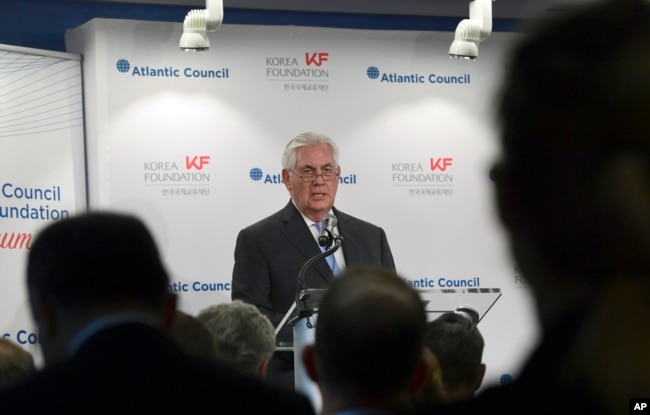
Secretary of State Rex Tillerson speaks at the 2017 Atlantic Council-Korea Foundation Forum in Washington, Dec. 12, 2017.
The secretary said he had warned Pakistani leaders that the terrorist groups might turn their attention from Kabul and decide they like Islamabad better as a target. He cautioned, "If they're not careful, Pakistan is going to lose control of their own country."
While there has been no formal response to Tillerson's remarks, a senior Pakistani government official has rejected the U.S. assertions as unfounded.
"In the last three years, our counterterrorism operations have effectively dismantled all terrorist groups on Pakistani soil while more than 200,000 of our troops are still deployed to areas bordering Afghanistan to consolidate the gains," the official told VOA, requesting anonymity.
The Pakistani government has also vowed to take action against any terrorists on its soil linked to the Afghan violence if U.S. officials share "actionable" intelligence with Islamabad.
Tillerson on Tuesday indicated Washington might start sharing such information because it is really concerned about Pakistan's stability.
"We want to work with them in a positive way. We're willing to share information with them and we want them to be successful. But we cannot continue with the status quo, where terrorist organizations are allowed to find safe haven inside of Pakistan," he said.
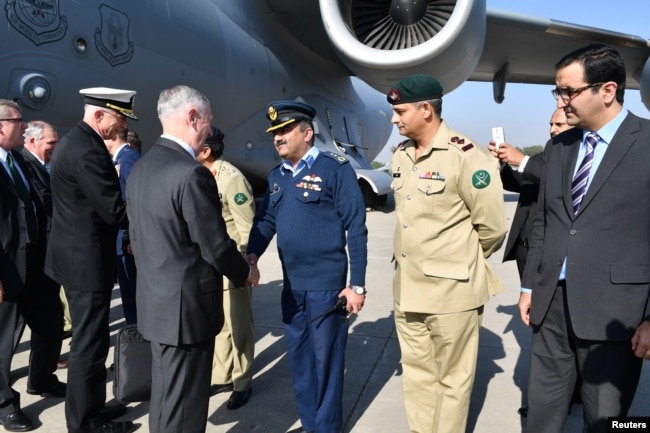
FILE - A handout from the US Embassy shows US Defense Secretary Jim Mattis being greeted by Pakistani military officials as he arrives in Islamabad, Pakistan, Dec. 4, 2017.
Earlier this month, U.S. Defense Secretary Jim Mattis visited Islamabad, where he also called on Pakistani leaders to redouble efforts against terrorist groups operating out of their country. He also called for Pakistan to play its vital role in promoting a process in Afghanistan to end the conflict there.
At a public talk in Islamabad following the Mattis visit, Foreign Minister Khawaja Asif reiterated that his country had made unmatched sacrifices in the fight against terrorism and was making all possible efforts to promote peace talks between the Afghan government and the Taliban.
"Peace in Afghanistan is of extreme importance to us. We are almost on all the platforms or forums from where peace in Afghanistan is being pursued. Our participation is with total sincerity with total commitment," Asif said.
He added that continued Afghan hostilities were hampering Pakistan's efforts to improve its economy and expand its trade to central Asian states.
"I think after Afghanistan the biggest stakeholder in peace in this region or in Afghanistan, is Pakistan," the foreign minister asserted.