Thursday, December 14, 2017

Pakistan - Betrayal of the FATA people


By Marvi Sirmed
The way the government has been handling these proposals and their presentation to the House amply proves that some political parties have lost all ability to think beyond their selfish agenda of gaining more and more power.
The government once again went back on its commitment to introduce the FATA reforms bill in the lower house of the parliament, despite putting it on the Order of the Day for the third sitting of the 50th session of the National Assembly. For the third consecutive day, the opposition continued its boycott of the house proceedings against this withdrawal. Citing “technical reasons”, the Parliamentary Affairs Minister Sheikh Aftab Ahmad said the government desired to present the Fata reforms bill in parliament after developing consensus among all parties. There are none in this position as the opposition was never briefed about the ‘technical reasons’ cited, nor was nay discussed in either the business advisory committee or with the leader of the opposition.
This was not the first time that the government faltered on its commitments pertaining to FATA reforms, apparently under the severe pressure of its coalition partners who want to grind their own axe while the coalition leader, PMLN, is fighting for survival after the disqualification of Mian Nawaz Sharif. The problems which emerged for the party in the aftermath of the Faizabad sit-in, the offshoot of which is still lingering in Lahore, has also continue to make life difficult for the PML-N.

Ever since the process of Fata reforms was initiated in the wake of the establishment of the FATA Reforms Committee under the chairpersonship of Sartaj Aziz, there has been a fierce display of conflicting vested interests from different quarters including the bureaucratic structure that has been in unquestionable, unchallengeable control of FATA, and the political parties pursuing their narrow and selfish political agenda.
For the JUI-F, the best-case scenario is if FATA becomes a seperate province. This otherwise marginal party cannot foresee itself heading a provincial government in KP or Balochistan where it has pockets of influence
The Committee had proposed in 2015 a set of political, administrative, judicial and security reforms alongside a comprehensive and phased program for reconstruction and rehabilitation in order to prepare FATA for the eventual merger with KP in five years. The recommendations included in addition to the merger, the repeal of the draconian colonial FCR imposed upon the hapless people of FATA. The federal cabinet approved this package of necessary reforms along with the phased program for implementation, on March 2, 2017.

But before that, the government had already announced the plan in January 2017 to eventually merge FATA with KP as was recommended by the Committee.Following which, the Bill was approved by the Cabinet in March. One bill, the Tribal Areas Rewaj Bill 2017 was presented in the National Assembly in May. Instead of referring it to the Standing Committee on Law & Justice, the Speaker sent it to the Committee on SAFRON. It was the wrong decision because the SAFRON ministry has conflict of interest as far as FATA’s merger with KP is concerned. The ministry would stand dissolved in case of a merger, or at lease, would completely lose its relevance. It was not rocket science to see that not only would the Committee not get an objective brief from its corresponding ministry, but also, the bill would not have gotten objective treatment from the committee chaired by a member whose party has been (and still is) fiercely against the merger. Which is exactly what happened. The Chair of the Committee abruptly called off the meeting and deferred the discussion on the bill indefinitely. Subsequently, the government decided to bring a new bill in place of the Tribal Areas Rewaj Bill, which became controversial because of its provisions that safeguarded continuation of the FCR. The new bill was to abolish the Frontier Crimes Regulation (FCR) and extend the jurisdiction of the superior judiciary to FATA. But when it came out finally, it proposed extension of Islamabad High Court to FATA instead of the previously decided Peshawar High Court. FATA parliamentarians, range of politicians, civil society and intelligentsia belonging to FATA strongly protested. Upon which, consensus was developed during a meeting held in Islamabad on 29 September. Minister for SAFRON Lt-Gen (Retd) Abdul Qadir Baloch chaired the meeting while 16 out of the 19 lawmakers from FATA attended it. The three absent lawmakers were also consulted via phone that also agreed on the merger. SAFRON Minister announced this new consensus in a presser the same evening. After a long wait of over two months and massive protest sit-in by the FATA people, this new bill had come once again. Only to be taken off the agenda yet again, without any debate.
The way the government has been handling these proposals and their presentation to the House amply proves that some political parties have lost all ability to think beyond their selfish agenda of gaining more and more power. The brown sahibs of bureaucracy, who have been ruling FATA like Moguls for seven decades have their vested interest in maintaining the current status quo. The powers that have been using FATA as an invisible buffer belt between Afghanistan and ‘settled’ Pakistan, also appear to be adamant on keeping the FATA people invisible and unsettled irrespective of their public claims of supporting the reforms process. Every power-holder seems to have its own definition of ‘reforms’.
For the JUI-F, the best-case scenario is if FATA becomes a separate province. This otherwise marginal party in other provinces cannot foresee itself heading a provincial government in either KP or Balochistan — the two provinces where it has some pockets of influence. In FATA on the other hand, this party seems to have more sway than any other party owing to state policies that have historically supported religious puritanism and socio-cultural retrogression, mainly to counter the progressive but ethno-nationalist ideologies. If FATA was to become a separate province, the JUI-F would have its own Chief Minister in at least one province alongside an equal number of seats in the Senate. By insisting on a separate province — despite having a pan-Islamist ideology that discourages boundaries among Muslims — this party can milk the status quo till the lengthy and slow process of the establishment of a new province. Being very politically shrewd, the JUI-F leadership knows very well that Pakistan’s current state of economy cannot afford a new province. Since the situation suits a powerful ‘strategic lobby’, the Maulanas see green pastures ahead. For the ethno-nationalist, progressive and almost secular (although its manifesto doesn’t use the word secular), PkMAP, the merger of FATA and KP would mean the dilution of its political rhetoric on the Durand Line, which in its leadership’s view would be compromised if FATA loses its special status and becomes settled in near-mainland Pakistan. More than the people of FATA, this party appears to be caring more for its strategic constituency among the ethno-nationalists in Afghanistan, which is quite upset on the merger proposal and has expressed so in no uncertain terms.
Amidst all this, FATA people are still waiting for their rights. Seventy years on.

#Pakistan - Another setback to #FATA merger


After yet again backtracking on its commitment to table the FATA reforms bill on Monday, the government finds itself in a tight spot.
On Monday, the united opposition had boycotted the National Assembly session and announced that it would not attend the proceedings until the bill was tabled in the Parliament. Then, the Jamaat-e-Islami (JI) threatened to stage a sit-in at the Faizabad interchange if the process for FATA merger is not kicked off by December 31.
Alongside the mainstream opposition parties, a newly-formed FATA youth jirga has also been raising its voice on the issue, demanding expedited efforts for the merger of the region with the Khyber-Pukhtunkhwa (KP) province.
Unlike mainstream parties, however, the jirga members have rightly protested the failure of the authorities concerned to take into account the views of women and other marginalised communities of the region. These are legitimate concerns and must be addressed as the merger process gets underway. Addressing these concerns will entail ensuring wide-ranging consultations with FATA’s civil society and political actors.
Mainstreaming FATA should have been done 70-years ago. The region has been a part of this country and yet has been governed using draconian colonial era Frontier Crimes Regulation. This has robbed generations after generations in FATA of their fundamental right of self-determination, not to mention that it has made a mockery of Pakistan’s credentials as a democratic republic.
Only two parties in alliance with the ruling PML-N have consistently been opposing the merger option. The ruling party needs to fast track its consultations with these allies. The fate of an entire region and its people cannot be held hostage to the wishes of two political parties, who may or may not be popular in the region to begin with.
The constitution needs to be extended to the region immediately

Tillerson: Terror Group Ties Could Cost Pakistan Territorial Control


The United States has warned Pakistan it could lose control of its territory unless Islamabad abandons ties with terrorist groups operating in the country that are growing in "size and influence."
U.S. Secretary of State Rex Tillerson issued the warning as Washington and Islamabad renew efforts to improve bilateral relations and find "common ground" to promote peace in neighboring Afghanistan.
"We want to work with Pakistan to stamp out terrorism within their boundaries as well, but Pakistan has to begin the process of changing its relationship with the Haqqani Network and with others," Tillerson said at a public talk in Washington on Tuesday.
A U.S.-led military coalition is helping the Afghan National Defense and Security Forces (ANDSF) to contain a resurgent Taliban insurgency.
Insurgents and leaders of a group allied with the Haqqani Network are allegedly orchestrating attacks from sanctuaries in Pakistan, with the help of the neighboring country's spy agency.
"Pakistan has allowed so many terrorist organizations to find safe haven within its territories, and these organizations are growing in size and influence," Tillerson said.
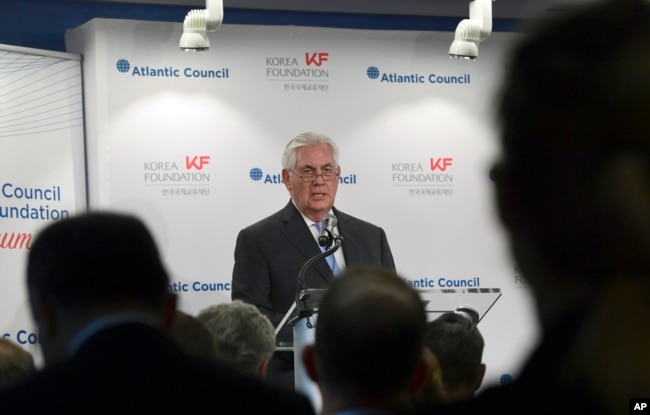
Secretary of State Rex Tillerson speaks at the 2017 Atlantic Council-Korea Foundation Forum in Washington, Dec. 12, 2017.
The secretary said he had warned Pakistani leaders that the terrorist groups might turn their attention from Kabul and decide they like Islamabad better as a target. He cautioned, "If they're not careful, Pakistan is going to lose control of their own country."
While there has been no formal response to Tillerson's remarks, a senior Pakistani government official has rejected the U.S. assertions as unfounded.
"In the last three years, our counterterrorism operations have effectively dismantled all terrorist groups on Pakistani soil while more than 200,000 of our troops are still deployed to areas bordering Afghanistan to consolidate the gains," the official told VOA, requesting anonymity.
The Pakistani government has also vowed to take action against any terrorists on its soil linked to the Afghan violence if U.S. officials share "actionable" intelligence with Islamabad.
Tillerson on Tuesday indicated Washington might start sharing such information because it is really concerned about Pakistan's stability.
"We want to work with them in a positive way. We're willing to share information with them and we want them to be successful. But we cannot continue with the status quo, where terrorist organizations are allowed to find safe haven inside of Pakistan," he said.
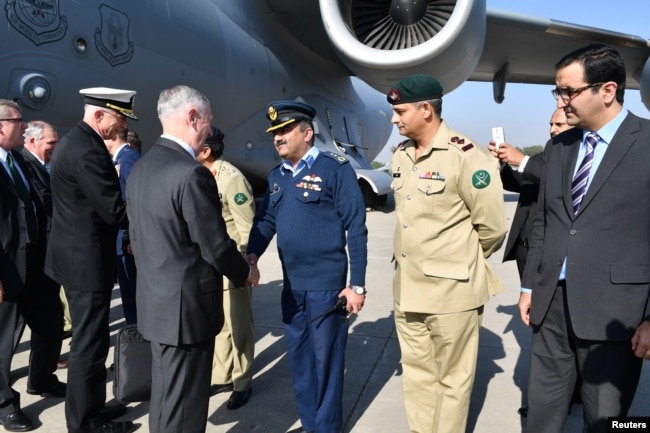
FILE - A handout from the US Embassy shows US Defense Secretary Jim Mattis being greeted by Pakistani military officials as he arrives in Islamabad, Pakistan, Dec. 4, 2017.
Earlier this month, U.S. Defense Secretary Jim Mattis visited Islamabad, where he also called on Pakistani leaders to redouble efforts against terrorist groups operating out of their country. He also called for Pakistan to play its vital role in promoting a process in Afghanistan to end the conflict there.
At a public talk in Islamabad following the Mattis visit, Foreign Minister Khawaja Asif reiterated that his country had made unmatched sacrifices in the fight against terrorism and was making all possible efforts to promote peace talks between the Afghan government and the Taliban.
"Peace in Afghanistan is of extreme importance to us. We are almost on all the platforms or forums from where peace in Afghanistan is being pursued. Our participation is with total sincerity with total commitment," Asif said.
He added that continued Afghan hostilities were hampering Pakistan's efforts to improve its economy and expand its trade to central Asian states.
"I think after Afghanistan the biggest stakeholder in peace in this region or in Afghanistan, is Pakistan," the foreign minister asserted.

The Mullah-Military Takeover of Pakistan


It might still be premature to read too much into former military dictator Gen (R) Pervez Musharraf talking about a political alliance with the Lashkar-e-Taiba (LeT) and its offshoot Jamaat-ud-Dawa (JuD). Not because these groups are officially banned in Pakistan, but because Musharraf is a largely irrelevant political entity these days.
However, events of recent weeks suggest that the unlikely merger of the Musharraf-led “grand alliance of 23 political parties” with the Hafiz Saeed-led proscribed groups would perfectly symbolize the mullah-military takeover of Pakistan.
Four days before the state surrendered to radical Islamist thugs in the capital, the Lahore High Court review board refused to extend Saeed’s 10-month detention period owing to “lack of evidence.” Saeed’s release, coupled with the civil-military leadership kowtowing to a radical Islamist group that has already contested two by-elections in the country, is the formal completion of the political mainstreaming of jihadists in Pakistan.
This mainstreaming has not only been planned by the military leadership, it has also been pushed by them, resulting in the Dawn Leaks episode last year, from which the civilian government never managed to recover.
On cue, the JuD’s first statements following Saeed’s release was accusing the government of “taking orders from India” to further delegitimize the civilian leaders as “anti-national.” Fittingly, Saeed also confirmed that he will be taking part in the 2018 elections under the banner of the Milli Muslim League (MML) – the latest LeT/JuD offshoot, which is yet to be registered by the Election Commission of Pakistan.
The military’s support to the Tehrik Labbaik Ya Rasool Allah (TLY) protesters was epitomized by the video of the DG Rangers handing out cash coupons to those prisoners released as per agreement with the state.
For the military establishment, bolstering these Islamist groups not only dents the vote bank of the ruling Pakistan Muslim League-Nawaz (PML-N), which 12 months ago was the overwhelming favourite to win the 2018 elections with an even bigger majority. Giving formal political shape to the decades-old mullah-military nexus also further aids the military’s strategic interests in Afghanistan and Kashmir.
This is where Musharraf joining hands with Hafiz Saeed to represent a mega coalition of Islamists and the fringe parties that he already has on board would carry symbolic value, if nothing else.
The ongoing treason trial against Musharraf, which the former army chief escaped from, was among the first sources of conflict after PML-N took over in 2013. Musharraf has further been declared an absconder in the murder case of former Prime Minister Benazir Bhutto.  And so for a former army chief, who has been sanctioned as an absconder in cases pertaining to breaching the Constitution and killing a former elected prime minister, to return to Pakistan and head a political coalition would complete civilian subjugation to the Army.
Tahir-ul-Qadri’s Pakistan Awami Tehrik (PAT) is among the parties that are a part of Musharraf’s coalition. PAT had joined the Pakistan Tehrik-e-Insaf (PTI) in 2014 to demand then-Prime Minister Nawaz Sharif’s resignation in a four month long protest in the capital – a plot backed by a section of the military establishment.
Qadri is now in Lahore, plotting the overthrowing of the Punjab government, which has been targeted by a damning report of the leaders’ involvement in the 2014 Model Town killings.
Even so, Musharraf’s coalition, even if it takes MML on board, or the potential resumption of the Muttahida Majlis-e-Amal (MMA) – an alliance of nationwide Islamist parties – would do little in terms of electoral damage, let alone have a chance of forming the government following next year’s elections.
That means that the military establishment’s main player would remain the PTI and its chief Imran Khan, who have not only gone toe-to-toe with the PML-N in by-elections over the past four years, but have gained the most from the PML-N’s losses in recent months.
And so, what the military leadership is ideally looking at is a PTI government with perhaps a Musharraf and/or Saeed-led coalition a part of the opposition – just to rub in who’s actually in charge, if nothing else.

Why #Pakistan Is Hyphenating #Palestine and #Kashmir


The rest of the world has long distanced itself from the Islamist struggle in Kashmir – unlike Palestine.
In his meeting with Palestinian ambassador Walid A.M. Abu Ali on Tuesday, Pakistan Army Chief Gen. Qamar Javed Bajwa said that “Pakistan views the unresolved Palestine issue at par with the Kashmir issue.”
In the Organization of Islamic Cooperation (OIC) on Wednesday, Prime Minister Shahid Khaqan Abbasi also juxtaposed Palestine and Kashmir, maintaining that Israeli control over Palestine is similar to Indian occupation of Kashmir.
Similar efforts were witnessed on the sidelines of United Nations General Assembly in September, where Foreign Minister Khawaja Asif met Arab League Secretary General Ahmed Aboul Gheit to express “grave concern on the ongoing situation in Palestine and occupied Kashmir.”

The conflation perhaps got a bit carried away when the Pakistani envoy to the United Nations presented a picture from Gaza to make Islamabad’s case for Kashmir.
While Pakistan has always maintained that it sees the Palestinian issue with the same lens as Kashmir, it has traditionally been a gesture to highlight how important the former is for Islamabad. However, not only has Pakistan upped the ante on hyphenating the two in recent years, it seems to be using the Palestine cause as a vehicle for its narrative on Indian-administered Kashmir.
This has been visible since Indian Prime Minister Narendra Modi’s visit to Israel earlier this year, which not only symbolized tighter ties between the two states, but also gave birth to outrageous conspiracy theories in Pakistan.
Modi’s trip also had multiple joint references to “terrorism” affecting India and Israel, as exemplified by the Israeli foreign ministry’s reiteration of “mutual cooperation in the fight against terrorism.” And since militancy in Palestine and Kashmir has metamorphosed from nationalist to Islamist nature, these vows for counterterror unity was an attempt to collectively delegitimize freedom fights in both regions.
With Islamist leaders orchestrating militancy in Kashmir being sanctioned by the West – like Syed Salahuddinand Hafiz Saeed, who was recently released by Lahore High Court – the rest of the world has long distanced itself from the Islamist struggle in Kashmir – unlike Palestine.
Pakistan has been instrumental in delegitimizing its own narrative on Kashmir, by backing jihadist usurpation of the indigenous freedom struggle and also curbing human rights in its own administered Kashmir.
This is why there hasn’t been a single UN Security Council resolution on Kashmir since 1957, and 47 on the Israel-Palestine issue.
By hyphenating Kashmir and Palestine, Pakistan is clearly bidding to bring its own narrative to the forefront. But what this is inadvertently doing is further damaging not only Islamabad’s own position, but also both struggles, by reducing the conflicts to the Muslim-non Muslim binary, which is the way the jihadists see them.
Relying on the Islamist card has long been Pakistan’s strategy not only to ensure that the jihadist groups it backs remain ideologically fueled, but also because it has not had a leg to stand on when it comes to human rights. This is not only true for Pakistan-administered Kashmir and Balochistan – two conflict areas – but also the rest of the country, where many fundamental rights are constitutionally curbed.
But Islamabad remains inconsistent even in the aforementioned Islamist binary, considering that China remains its economic lifeline while Beijing implements anti-Muslim policies, most notably in the Xinjiang region. That the China-Pakistan Economic Corridor connects Xinjiang and Balochistan at its two ends perfectly symbolizes not just disregard for human rights, but Islamabad’s own duplicity over a non-Muslim majority subjugating a Muslim separatist movement.
And yet, ironically, Pakistan’s own contradictions make the Kashmir-Palestine hyphenation a perfectly rational strategy.
Pakistan can’t speak up for the East Turkestan Islamic Movement, obviously fearing Chinese backlash. And it can’t undo many human rights breaches at home since both Pakistan-administered Kashmir and Balochistan have separatist movements of their own, while the rest of the country is increasingly coming under the influence of the perilous mullah-military alliance.
Hence, Islamabad is pinning its hopes on Palestine to keep the Kashmir issue alive.

Pakistan moves to evict 21 foreign aid groups


By Munir Ahmed
Pakistan has ordered 21 foreign aid groups to wrap up their activities and prepare to leave after they failed to re-register under tough regulations introduced two years ago, officials said Thursday.
The officials said Open Society Foundations, the charity founded by George Soros, and the South Africa-based ActionAid were among the groups informed of the decision this week, without providing a complete list. The non-governmental organizations have been given two months to close their offices and vacate the country. The government is scrutinizing the documents of another 19 foreign aid groups to determine whether they should be allowed to remain in the country. The officials spoke on condition of anonymity because they are not authorized to brief reporters.
Pakistan has long treated foreign aid groups with suspicion, fearing they could mask efforts to spy on the country. It stepped up its monitoring after the CIA used a vaccination campaign as a front to gather information on Osama bin Laden ahead of the U.S. commando raid that killed him in 2011.
Jonathan Birchall, the spokesman for Open Society Foundations, confirmed receiving a letter from the Interior Ministry rejecting the group’s re-registration. He declined to provide further details.
The group said Monday it was seeking clarification after the Interior Ministry told it and other organizations that they must halt operations in Pakistan within 60 days. It said that in 2015 Pakistan ordered all NGOs already operating in the country to register with the ministry, a process that entailed submitting detailed accounts of their funding.
“At the end of November, the Interior Ministry issued letters advising more than a dozen international NGOs that their applications to register had been rejected but giving no reasons. The affected organizations may lodge an appeal within 90 days, but it is not clear how this process will be managed,” Open Society Foundations said.
Pakistan Humanitarian Forum, which represents scores of foreign aid groups, says their work directly benefits about 29 million people in Pakistan. Foreign aid groups contributed some $285 million in funding for development and emergency relief in 2016, and employ over 5,000 local staff, it said.
The Open Society Foundations first started working in Pakistan in 2005, providing $3 million of emergency relief for victims of a devastating earthquake. It provided another $6 million in emergency funds after severe flooding in 2010.

#PPP mulls over reorganisation strategy in #Lahore

A meeting to discuss the reorganisational matters and mobilising party workers was held at Bilawal House in Lahore on Thursday. 
The meeting was presided over by the party's Chairman Bilawal Bhutto Zardari and attended by important leaders in the province including the party's Central Information Secretary Chaudhry Manzoor Ahmed, PPP's Central Punjab President Qamaruz Zaman Kaira, and PPP's Lahore President Mian Azizur Rehman Chan.
https://www.geo.tv/latest/172303-nab-to-use-interpol-to-bring-ishaq-dar-back-to-pakistan

#Pakistan - Corruption rampant in Khyber Pakhtunkhwa Government

President Pakistan Peoples Party Khyber Pakhtunkhwa, Humayun Khan has said that corruption is wide spread in KP Government and the Chief Minister KP and his cabinet is busy in charming Imran Niazi.
Humayun Khan said that Pervaiz Khattak also failed to complete quorum in KP Assembly. Accountability institutions have been locked and corruption is continued unchecked. Imran Niazi claim about education institutions in government sector are false as over a thousand government educational institutions have been closed down in the province.
He said that contracts of all natural resources have been given to Jahangir Tareen and all the money is being siphoned to Bani Gala. On one hand KP government is on a deforestation drive and millions of trees have been cut down and on the other billions have been gulped in the name of tree planting drive. Imran Niazi is a fake individual in every respect, Humayun Khan concluded.

https://mediacellppp.wordpress.com/2017/12/13/corruption-rampant-in-kp-government-humayun-khan/

Wednesday, December 13, 2017

Music Video - Sir Mix A Lot - Baby Got Back

Music Video - MC Hammer - U Can't Touch This

Music Video - Los Del Rio - La Macarena

Blockade could push Yemen into 'humanitarian catastrophe': WFP


By Heba Kanso
Yemen, ravaged by war, hunger and disease, is seeing a spike in diphtheria cases that will inevitably erupt into a larger, deadly outbreak because so few people have been immunized, aid officials said on Wednesday.
At highest risk are children, who account for many of the more than 280 suspected diphtheria cases and 33 associated deaths reported as of Tuesday, according to the World Health Organization (WHO).
Most of the cases and deaths involved children who had not been immunized against the disease, a contagious and potentially fatal bacterial infection that spreads easily, WHO said. “Left unchecked, diphtheria can cause devastating epidemics, mainly affecting children,” Tarik Jasarevic, a WHO spokesman, told the Thomson Reuters Foundation by email.
The diphtheria spread is inevitable in Yemen due to low vaccination rates, lack of access to medical care and so many people moving around and coming in contact with those infected, said WHO and officials with Medecins Sans Frontieres (MSF).
Civil war in the Middle Eastern country, which lies at the tip of the Arabian peninsula south of Saudi Arabia, has killed more than 10,000 people and displaced more than two million others. Diphtheria spreads as easily as the common cold through sneezing, coughing or even talking, according to health officials.
Yemen also is battling a cholera epidemic that has infected about one million people. The epidemic, which worsened this past April, has caused more than 2,000 deaths, WHO said in October. Diphtheria could be more fatal than cholera, especially among unvaccinated children under 5 years old, according to MSF. As many as two in five diphtheria cases end in death, MSF said. “There is the potential for a larger-scale outbreak of diphtheria, given that not everyone has been vaccinated,” said Marc Poncin, emergency coordinator in Yemen for the medical charity, also by email.
Calling it “very worrisome,” Caroline Boustany, an aid worker with the International Rescue Committee, told the Foundation: “We have a spike in cases of a very easily preventable disease.” Yemen also faces soaring food prices and fuel shortages, and some 8.4 million Yemenis are considered to be a step away from famine, the United Nations said on Monday.
A Saudi-led military coalition fighting the Iran-aligned Houthi movement in Yemen’s civil war blockaded ports last month. The blockade has eased, but its impact limited supplies of desperately needed fuel, food and medicine, aid officials say. “Even for patients who want to seek treatment, the blockade on fuel and consequent surge in prices means that they cannot afford to travel to the very few health centers still operational,” said Poncin of MSF.

Israeli Intel Minister to Saudi Media: Israel Can Strike Iranian Missile Plants in Lebanon, 'As Is Happening in Syria'


Noa Landau and Hagar Shezaf


Yisrael Katz invites Saudi Crown Prince Mohammed bin Salman to visit Israel ■ Describing Saudi Arabia as leader of Arab world, Katz proposes that kingdom would be sponsor of Israeli-Palestinian peace process.

Intelligence Affairs Minister Yisrael Katz told Saudi Arabian media that Israel will act to prevent an Iranian military presence in Lebanon on Wednesday, and invited Saudi Arabia's Crown Prince Mohammad bin Salman to visit Israel.

Katz confirmed to Haaretz that he extended the invitation in an interview to the Saudi online newspaper Elaph, however, the online publication chose to edit the invitation out.

Saudi Arabia does not have official diplomatic ties with Israel.

Describing Saudi Arabia as the leader of the Arab world, Katz proposed that the kingdom would be a sponsor of the Israeli-Palestinian peace process. Katz added that Israel would be happy to participate in such negotiations.

Katz said Israel is aware that Iran has been building weapons plants in Lebanon. "We have information that Iran is building advanced missile plants in Lebanon, and I want to emphasize that we have drawn a new red line, and we will not allow them to do this at any cost."

Asked by his interviewer whether Israel views the visit of an Iraqi militia leader to south of Lebanon as an Iranian attempt to send a message to Israel, Katz said Iran doesn't need to send a message, adding that Israel knows exactly what the Iranians are doing in the region. When his interviewer asked whether Israel could bomb the missile plants in Lebanon, Katz replied: "Yes. We will also act militarily and prevent them, as is happening in Syria."

"The more accurate that Hezbollah's missiles get, the stronger and wider Israel's strike will be. This time, all of Lebanon will be a target."
Referring to the Second Lebanon War that Israel fought against Hezbollah in 2006, Katz added: "What happened in 2006 will be a picnic compared to what we can do. I remember a Saudi minister saying they will send Hezbollah back to their caves in south Lebanon. I am telling you that we will return Lebanon to the Stone Age."
"At the same time, we don’t want war, and we have no interest in destroying Lebanon, but we will not accept a Lebanese assault on us. For example, I recently suggested to Prime Minister [Benjamin] Netanyahu that we act militarily and economically to implement [United Nations Security Council Resolution] 1701 that was adopted unanimously after the Second Lebanon War in 2006 and that we apply sanctions on Hezbollah and Iran and that, under the leadership of the United States and with the consent of China and Russia, we intervene militarily if there is a need."

Katz continued: "The prime minister spoke about this with French President [Emmanuel] Macron and with the European Union. This is a decision that was taken unambiguously, and instead of adopting new resolutions, we will invoke this to deprive Hezbollah of its weapons. The Arab League considers Hezbollah as a terrorist organization as does Saudi Arabia [as does] Egypt and Jordan. The entire world. And in my view, this is a particularly excellent opportunity following [Lebanese Prime Minister] Saad Hariri's decision and his resignation from Saudi Arabia," a decision that Hariri has since retracted. "In practice, he pulled the rug out from under Hezbollah and Iran," Katz said.

Also on Wednesday, Saudi Arabia's King Salman commented on U.S. President Donald Trump's recognition of Jerusalem as Israel's capital, saying that the Palestinians have a right to East Jerusalem as the capital of a future Palestinian state. Salman made his comments as Arab and Muslim leaders gathered in Istanbul to discuss Trump's decision.

King Salman appointed his son, 32-year-old Mohammad bin Salman, also known by his initials MBS, as Saudi Arabia's heir to the throne in June. Many expect that in the not-too-distant future, King Salman, who is elderly and ill, will step down and hand the scepter to bin Salman.

The prince's firm anti-Iranian position makes him an important partner to the U.S. and Israel. Several Arab websites have reported in the past few years that bin Salman has met with several top Israelis.

According to these reports, one such meeting took place in Eilat in 2015; another on the margins of the Arab summit in Jordan this March, and there are regular meetings between Saudi and Israeli officers in the joint war room where Jordan, Saudi Arabia and the United States coordinate.

Last month, Elaph published an unprecedented interview with the Israeli military chief, Lt. Gen. Gadi Eisenkot, marking the first time any senior Israel Defense Forces officer, let alone the chief of staff, was interviewed by a media organization in Saudi Arabia.

In the interview, Eisenkot called Iran the "real and largest threat to the region." He said Israel and Saudi Arabia are in complete agreement about Iran's intentions and noted that the two countries have never fought each other.

read more: https://www.haaretz.com/israel-news/1.828759

China slams HRW’s report on alleged Xinjiang human rights violations

By Li Ruohan

China on Wednesday slammed a report that accused the country of violating human rights by collecting DNA samples in Northwest China's Xinjiang Uyghur Autonomous Region, saying there's no need to spend time on such false statements. 

According to a Wednesday report from the New York-based Human Rights Watch, authorities in Xinjiang are collecting DNA samples, fingerprints, iris scans and blood types of all residents in the region between the age of 12 and 65, quoting experts as saying it's "a gross violation of international human rights norms."

Collecting such information has been partly advocated in Xinjiang, such as the cities of Yining and Korla, since the second half of the year, for accurate demographic and diverse biological information in the regions, government documents show. For instance, in Korla, photos and finger prints are collected and will be included in the new version of ID cards, while DNA, iris and blood type information will be entered in a local biological database, government documents show. 

In Yining, such information would be collected for a demographic database to help accurately identify people and for information-sharing among government departments.

China's government has the right to take measures it deems as proper to protect national security, and the collection of such information is not harmful to the residents, nor does it affect people's rights, Turgunjan Tursun, a professor at Zhejiang Normal University, told the Global Times on Wednesday.

Such measures, as well as the collecting of fingerprints in other cities in China, help secure public security, and claims of human rights violations are groundless, he added. 

The organization has always made false statements on issues involving China and I suggested there's no need to spend time on such remarks, China's Foreign Ministry spokesperson Lu Kang said at a daily briefing on Wednesday.

"Xinjiang has witnessed economic development and social stability, and the people there are living and working in a joyful mood, a scene that some people overseas might be unwilling to see," Lu said.

China's government will continue to protect the national unity and the prosperity in the region and promote the development of the region, he added.

Video - #China Lowers Flag to Half mast for #Nanjing Massacre Victims

Video - #China - Xi Attends State Memorial Ceremony for #Nanjing Massacre Victims

Video - Russian TU-22M3 bombers arrive home after Syrian mission

GOP Committing Political Suicide As Two-Thirds Of America Think Tax Proposal Is A Scam


By  


The poll comes as GOP lawmakers have reportedly come to an agreement on a final plan they believe would have the votes to pass through Congress.
Donald Trump and Republicans marched forward with their tax plan on Wednesday, fresh off a stunning defeat in the Alabama senate race, but a new poll shows that most of the country believes the proposal is a massive scam. According to a new Harvard CAPS-Harris poll, nearly two-thirds of the country – 64 percent – oppose the GOP bill, which has been exposed as a massive handout to the wealthiest Americans at the expense of middle and low-income folks.
The numbers are worse when independents weigh in on the plan, as 70 percent of that voting bloc opposes the proposal. Unsurprisingly, 89 percent of Democratic respondents say the legislation is garbage. A majority are also against the central staple of the plan: lowering the corporate tax rate from 35 percent to 21 percent, which is the proposed rate under the new plan.
The poll comes as GOP lawmakers have reportedly come to an agreement on a final plan they believe would have the votes to pass through Congress. As The Hill reported on Wednesday, “Senate and House Republicans have struck an ‘agreement in principle’ on a sweeping tax-cut bill that if passed would be the first major piece of legislation signed by President Trump.” The report notes that Republican leaders believe they could pass the proposal as early as next week, just before the Christmas holiday.
If the GOP thinks that they will improve their political fortunes by passing a tax scam that the vast majority of the country doesn’t want and has been exposed as a massive handout to the wealthiest individuals and corporations, they will be in for a rude awakening come Nov. 2018.

Video Report - Doug Jones, Alabama's Senator-Elect, sits down with us for an interview

Video - The Treasury Department's Tax Analysis Doesn't Add Up: The Daily Show

Comedy - Trump's Most Shameless Tweet Of 2017?

USA Today bashes Trump as ‘not fit to clean the toilets’ in Obama’s presidential library

USA Today isn’t known for its blistering opinion pieces. Which makes the one the paper’s editorial board just published on President Donald Trump all the more savage.
“With his latest tweet, clearly implying that a United States senator would trade sexual favors for campaign cash, President Trump has shown he is not fit for office,” reads the editorial. “Rock bottom is no impediment for a president who can always find room for a new low.”
The reference here is Trump’s tweet Tuesday morning in which he said that Democratic Sen. Kirsten Gillibrand of New York was “begging” him for campaign contributions not long ago “and would do anything for them.”
White House press secretary Sarah Sanders insisted Tuesday that only people with their minds “in the gutter” could possibly conclude that there was sexual innuendo in that tweet language.
The USA Today editorial didn’t buy that explanation.
“A president who would all but call Sen. Kirsten Gillibrand a whore is not fit to clean the toilets in the Barack Obama Presidential Library or to shine the shoes of George W. Bush,” reads the piece.”This isn’t about the policy differences we have with all presidents or our disappointment in some of their decisions. Obama and Bush both failed in many ways. They broke promises and told untruths, but the basic decency of each man was never in doubt.”
This is not the first time that the editorial board at USA Today has made its views on Trump’s fitness for office known.
In September 2016, the editorial board broke with its long-standing tradition of not endorsing a candidate in presidential elections by penning an editorial entitled “Trump is ‘unfit for the presidency.” It wasn’t so much an endorsement of Hillary Clinton as it was an anti-endorsement of Trump.
“This year, the choice isn’t between two capable major party nominees who happen to have significant ideological differences,” read the piece. “This year, one of the candidates — Republican nominee Donald Trump — is, by unanimous consensus of the Editorial Board, unfit for the presidency.”
Trump — and his allies — will undoubtedly cite that history as a way to lump USA Today’s editorial board in with the biased liberal news media who hate the President so much that they are blind to the everyday realities of the average American.
And, for a chunk of Republicans loyal to Trump, that rhetoric will work. But USA Today is far from a reactionary leftist operation. And the disdain dripping from every word of the editorial board’s condemnation of the president is truly searing.
These words, which end the editorial, are particularly striking: “A president who shows such disrespect for the truth, for ethics, for the basic duties of the job and for decency toward others fails at the very essence of what has always made America great.”
http://wgntv.com/2017/12/13/usa-today-bashes-trump-as-not-fit-to-clean-the-toilets-in-obamas-presidential-library/

#AlabamaSenateElection - Roy Moore Loses, Sanity Reigns


That Alabama’s voters chose Doug Jones for the United States Senate is cause for celebration. A triumph for decency and common sense in a state that seemed for a time at risk of abandoning both, Mr. Jones’s win narrows the Republicans’ Senate majority and delivers a deeply deserved rebuke to President Trump. It is hard to get too intoxicated by a slim victory over an atrocious candidate, a suspected sexual abuser with bigoted politics, but Alabama, the Senate and the nation will be a whole lot better off with Mr. Jones than with Roy Moore.
Alabama’s deep-red politics argued against Mr. Jones’s chances. A former federal prosecutor, Mr. Jones won convictions of two Ku Klux Klan members for the 1963 bombing of Birmingham’s 16th Street Baptist Church that killed four girls, and no Democrat had won a Senate race in two decades. But a report in The Washington Post in which four women accused Mr. Moore of sexually harassing or abusing them as teenagers turned the race into a close contest. Mr. Jones’s victory came thanks to overwhelming support from Alabama’s African-American voters.
Mr. Jones received support from various luminaries, including Barack Obama, as well as an unexpected assist from Alabama’s senior senator, Richard Shelby, a Republican. “I couldn’t vote for Roy Moore,” Mr. Shelby said. “The state of Alabama deserves better.” Maybe it shouldn’t count as statesmanship to oppose a cartoonishly unfit candidate, but during the degrading and hyperpolitical Trump presidency, it does. Mr. Moore’s campaign has been a shame for Alabama, one of the nation’s poorest states, whose need for better-paying jobs, health care, education and infrastructure he almost entirely neglected. He did not abandon the race even as the sex abuse charges multiplied; instead, aided by the political nihilist Steve Bannon, he doubled down, insisting the women were lying, part of a plot by the “establishment” and “fake news” to prevent him from changing Washington.
Mr. Moore was twice removed from Alabama’s Supreme Court, once for flouting a federal court order to remove a Ten Commandments monument that he’d commissioned for the court building, later for ignoring the United States Supreme Court’s protection of gay marriage by ordering Alabama probate judges not to issue same-sex marriage licenses, saying it was their “ministerial duty.” After that uproar, he decided to run for the seat vacated by Jeff Sessions, when Mr. Trump appointed him attorney general.
Mr. Moore repulsed many Alabamians even before the campaign. He has referred to Native Americans and Asians as “reds and yellows,” called gay people “perverts” and homosexuality “an inherent evil,” and falsely claimed that Shariah law exists in Illinois and Indiana. Until Mr. Moore (and Mr. Trump) came along, it was difficult to find many candidates so unfit that credible charges of child molestation could seem only the latest disqualifying feature. Their popularity underscores some Christian conservatives’ seeming determination to apply the law, constitutional or moral, only to their opponents. Some Republicans have taken to describing Mr. Moore as a type of biblical plague visited upon them. That ignores the complicity of a party in thrall to its extremists. At every pivotal moment, Mr. Moore was aided by party leaders unwilling to take a united, moral stand against him.
“Roy Moore will always vote with us,” Mr. Trump tweeted on Election Day. Alabamians said there was more at stake in this race, choosing a candidate whose record was cause for pride, not shame, one who spent his career battling bigotry, not exploiting it.

Video Report - #DougJones: Decency wins in #Alabama

Video Report - Roy Moore accuser reacts to his defeat

Video Report - Bernie Sanders Slams Republicans For Abandoning Net Neutrality, CHIP

Video Report - Elizabeth Warren Calls For #DougJones To Be Seated Before Tax Vote

Video - #JoeBiden on #DougJones' victory in #Alabama, #Trump, and 2020