Wednesday, December 13, 2017

Sindh Chief Minister Murad says dictators put dent in pluralistic society of Sindh


Sindh has not produced any terrorist in its history because it is the land of Sufis where people from different religions and school of thought live together in tranquility, but due to defective and unrealistic policies of dictators, various serious problems have emerged in the society.
This was stated by Sindh Chief Minister Murad Ali Shah while addressing the delegation of probationary officers of Pakistan Administrative Services receiving training at Civil Services Academy.
“Sindh is the land of saints and Sufis and it is free from bigotry, hatred, and religious or sectarian discrimination but dictatorial rules in the country created problems in the society which PPP government has cleared to some extent and still there is a lot to do to purge the society,” he said.
The chief minister said that heroine, Kalashnikov, religious and sectarian divides and exodus of illegal immigrants were few of the dangerous legacies General Zia left behind him for his successors.
Similarly, Gen Musharraf left behind extremists and terrorists as his legacy which his successors are still working to cleanse. Moreover, he destroyed the governance system by introducing devolution programme.
CM Sindh said that these dictatorial rules badly affected a tolerant society in Sindh. “Extremists who penetrate from Balochistan border into Sindh have created problems in cities like Jacobabad, Shikarpur, Kandhkot, Kashmore and managed to reach up to Dadu district which resulted in the bomb blast at the shrine of Lal Shahbaz Qalandar,” he said.
He added the PPP government during its first and the current term have been fighting against the terrorists and gangs and has successfully eliminated them but still their remnants create issues some times.
The chief minister said that he was working on developing a plural society free from all kind of hatred and divide to return the legacy of Lal Shahbaz Qalandar, Shah Latif and Sachal and Sami back to Sindh.
He said that the government has waged a war against terrorists, extortionists, target killers in Karachi through intelligence-based targeted operations. “The objective of the targeted operation was to crush the outlaws without disturbing normal life and shedding blood of innocents,” he said.
He appreciated the law enforcement agencies for working professionally. “Today, Karachi which was left with poor trade activities, hotel industry was yawning, industrialist were flying their capital, small traders had come to their heels have again started flourishing.”
He said that investors are in queue to invest in energy, industry, agriculture, fisheries and in various other sectors and the government is going to launch some new special industrial zones. He said that his government has served people of Sindh and the PPP has deep roots among them.

Benazir Bhutto’s untested son takes up his #Pakistani destiny


A decade after Pakistan’s first female leader Benazir Bhutto was assassinated, her son Bilawal is striving to reclaim his mother’s mantle, the latest act in a Shakespearean saga of tragedy and power.
But reviving the wilted fortunes of his family’s political dynasty ahead of a general election due next year will be a tough ask for the Oxford-educated scion, who at 29 years old has never held political office.
His family once dominated Pakistani politics.
Grandfather Zulfikar Ali Bhutto founded the Pakistan People’s Party (PPP) and ascended to the highest civil office in the land, followed by Benazir, who became prime minister twice and was running a third time when she was killed in a gun and bomb attack on December 27, 2007.
Since her death the PPP has seen its fortunes plunge, and few are willing to bet on Bilawal Bhutto Zardari, now the party’s chairman, shepherding it back to glory.
But there are flickers of life.
When Bilawal took the stage at the PPP’s golden jubilee celebrations in Islamabad last week, surprised observers put the crowd at around 25,000, higher than recent rival gatherings.
Much like his charismatic mother, Bilawal has decided to confront the militancy and challenged the political might of the country.
“We have to continue our progressive struggle and defeat the conspiracies of dictatorship,” he thundered as the crowd roared.
But away from the podium he cuts a shyer persona.
“My mother often said that she didn’t choose this life, it chose her,” he tells AFP at his family home in Karachi. “The same applies to me.”
Great expectations
Bilawal’s grandfather Zulfikar forged the PPP in southern Sindh province 50 years ago, his slogan of “roti, kapra, makkan” (“bread, clothing, shelter”) turning the party founded by a feudal landlord into Pakistan’s first populist force.
“He gave every Pakistani a sense of pride,” beams Bilawal.
But Zulfikar was deposed by General Zia-al-Haq in a coup and hanged in 1979 despite an international outcry.
Benazir, as her son would be decades later, was thrust into the spotlight. Following Zia’s death in 1988, she was elected prime minister at the age of 35.
Her government was undercut by military interference and allegations of corruption, however, and despite becoming prime minister twice she never completed a term.
Ousted in 1996, she spent most of the military dictatorship years of Pervez Musharraf in self-exile, returning in 2007 to contest another election.
But hopes sparked by her return were shattered by her assassination weeks later.
Her murder was pinned on jihadists, with a UN investigation accusing Musharraf of failing to provide sufficient security.
“It was a bitter blow for those who had hoped for a different Pakistan,” says Ayesha Jalal, of the centre for South Asian studies at Tufts University.
That includes the Bhuttos.
“If they stopped assassinating us then my mother would be in the foreign office and I would still be a student,” says Bilawal.
Netflix a ‘lifesaver’
Bilawal was named PPP chairman after his mother’s death but, still just a student, he returned to Oxford.
His father Asif Ali Zardari — nicknamed “Mr 10 Percent” over the many graft claims against him — took control as the party swept the 2008 elections, presiding over its years of decay, fuelled by allegations of corruption and incompetence.
Questions linger over Bilawal’s ability to lead the PPP if power still ultimately rests with Zardari.
Bilawal argues his youth is an asset: “I have time on my side”.
Reports suggest he plans to contest his mother’s old seat in Sindh. He dismisses concerns over his own security, saying: “We don’t give in to fear”.
But observers note the protection surrounding Bilawal, his elite status and time abroad could be sequestering him from voters.
His task is a lonely one, the bachelor admits. “If I was to say I had a life, that would be a lie,” he tells AFP. “Netflix is a lifesaver.”
Analysts say he faces an uphill battle in 2018, with cricketer-turned-opposition stalwart Imran Khan on the ascent and the ruling party of deposed prime minister Nawaz Sharif clawing at support.
Some Pakistanis want more than just another scion.
“Under the dynastic politics, democracy has been laid to rest,” said Karachi resident Sardar Zulfiqar.
But attendees at the golden jubilee have faith, clinging to the PPP’s progressiveness as Pakistan remains locked in a tug-of-war between Islamist extremism and democratic moderates.
Asma Gillani, 52, has supported the party since she first listened to Zulfikar on the radio as a child, right up to the moment she lost hearing in one ear as she was hit by the blast wave in the attack that killed Benazir.
As Benazir’s young son takes the stage she remarks: “God willing he will lead this country.” 

ماله بله لاره نشته د جنون او د جانانه - Pashto Music - SARDAR ALI TAKKAR

Tuesday, December 12, 2017

Pakistan - As FATA waits

The Fata reforms package, which has been under consideration since the PML-N government came into power, could have been the signature achievement of the ruling party. Instead it is increasingly looking like the package may never even be implemented. Part of the Fata reforms bill, including extending the writ of the Supreme Court and the Peshawar High Court to the tribal areas, was on the agenda for the National Assembly session on Monday. A last-minute decision to remove it led to a walk-out from the opposition parties and brought a premature end to the day’s proceedings. The next day, too, the opposition parties walked out and said they would boycott the session over any further delays to the bill. On Tuesday, the Jamaat-e-Islami took out a long march in favour of the reforms. As it reached Islamabad, others like the PPP’s Khursheed Ahmed Shah joined it. There is a broad consensus that the cruel Frontier Crimes Regulation needs to be repealed and Fata merged with Khyber Pakhtunkhwa so that it is brought under the protection of the constitution. Although the government has claimed that the delay in the bill is due to some technical errors, it has been unable to explain what those errors are. For many political analysts, the reforms are being withheld to keep the JUI-F happy since the party, along with the Pakhtunkhwa Milli Awami Party, is the only one that has opposed the Fata reforms bill. Its reasons for doing so are purely parochial. The JUI-F does not have a support base in Fata so making the tribal areas part of Khyber Pakhtunkhwa could dilute the party’s support in the province.
One would think that, on its own, the JUI-F shouldn’t have the power to bend the PML-N its way. But the ruling party is also in a bit of a dilemma – and needs to stop bleeding support. Five of its own members have announced their resignations from the National Assembly and Punjab Assembly. Attempts to reach out to the PPP have been rebuffed. The JUI-F is one of the only parties left in the PML-N camp. That, though, should not be enough to cause the death of the Fata reforms bill. The bill itself is imperfect since it delays the merger of Fata and Khyber Pakhtunkhwa for five years and replaces the FCR with a similar law for an interim period. Even passing the reforms bill will only be the start of a long process that requires the Council of Common Interests to decide how much of the divisible pool should be allocated to Fata. But taking that first step is essential. The opposition parties have now formed a committee to discuss Fata reforms with the government and devise a solution. The government should work with the committee to ensure the passage of the reforms. The PML-N government had claimed to be committed to the people of Fata and their rights. It is time to make good on that promise.

Pakistan - A sorry state...


By Babar Ayaz
‘SORRY’ is a five-letter word seldom used in Pakistani society. The ability to acknowledge and apologise for having made a mistake is an unpopular virtue, particularly among those in power. Let’s examine a few glaring examples where the mistakes of powerful groups and institutions have cost the nation great losses.
The most recent example is the six-point agreement between the government (or, rather, the establishment) and the participants of the Faizabad sit-in. Nowhere in the agreement is there any regret that millions of the twin cities’ citizens suffered because of the sit-in. There were also reports that at least two people died because they could not reach hospitals in time. The TLYR leadership may claim that protesting for a holy cause justifies the sacrifices made by citizens. One could accept this argument had the long-suffering citizenry voluntarily chosen to make such sacrifices, rather than under the duress of TLYR danda brigades.
Similarly, no matter how unreasonable the protesters’ demands, the government too did not show any remorse for the people’s suffering by delaying their eventual acceptance of the demands. Nor do they seem to have considered the long-term ramifications of the agreement they signed. Prodded by the establishment, the government’s agreement has set a terrible precedent.
Let’s take another example, where in the Nawaz Sharif disqualification case the honourable court used the dictionary meaning of the word ‘receivable’ instead of the legal definition given in tax laws. When Sharif’s lawyers filed a review petition it was heard by the same judges, which is customary, although it shouldn’t be. The review petition should be heard by another bench because we cannot expect the judges, who are also human beings, to rise above themselves and admit to being wrong in their initial judgement.
We can’t progress until we accept our mistakes.
Falling prey to populism during the tumultuous tenure of chief justice Iftikhar Chaudhry, the judiciary gave three decisions in commercial cases (Reko Diq, Pakistan Steel Mills and Karkey Karadeniz) that were lauded by the immature media and politicians alike, but at the end of the day are going to cost the nation billions of dollars. But is there any tradition among the honourable members of the judiciary to admit that they may have made a mistake?
Now let’s return to political and military decisions, for which the leadership owes an apology for incorrect decisions. Take the decision by the government under Jinnah declaring that Urdu alone would be the national language, which the people of East Pakistan found unacceptable, protested against and even died for. Eventually, the government had to agree to give Bengali national language status. Nobody said sorry, or admitted that the initial decision was wrong.
Nobody apologised for the creation of One Unit, depriving East Bengal of its position as the largest province. Nobody said sorry for abrogating the 1956 constitution, which was created seven years after the nation was founded. Nobody ever apologised for the grand mistake of imposing martial law in 1958, which stunted the democratic process and further alienated the people of East Pakistan.
Nobody ever accepted the blunder of launching a covert operation in Kashmir in 1965 that resulted in full-fledged war between India and Pakistan. With our war resources exhausted, Pakistan had to accept the ceasefire after 17 days since, had the war continued for longer, we could have been badly defeated.
Nobody had the moral courage to apologise to the people of Bangladesh for exploiting them like a colony and then launching a military operation against them. Nobody in the establishment has the grace to accept that getting involved in the Soviet-Afghan war during Gen Zia’s regime was our greatest blunder. For the last three decades, Pakistan and Afghanistan are bleeding because of Zia’s military adventure. Arms proliferation and the introduction of violence in politics are the ramifications of Zia’s jihad adventure.
Nobody apologised for launching the Kargil adventure, where many of our soldiers were martyred while fighting ostensibly as Kashmiri mujahids. When we started losing the Kargil battle we had to rush to Uncle Sam to ask India to commit to a ceasefire.
I have not even listed here the many adventures of non-state actors, allegedly backed by our establishment, who sabotage the peace process with India. The trouble is, because we don’t say sorry and accepts our mistakes, we have not been able to correct ourselves and instead claim that we are the victims of an international conspiracy against us. Our establishment and the majority of the media are suffering from self-righteousness. May God help us!

Militants & Military: Pakistan’s Unholy Alliance


Pakistan has largely escaped the ghastly destruction of the civil wars in the Middle East—despite its continuing struggle with homegrown Islamist extremism and terrorism. Since September 11, 2001, Pakistani governments have tried to fly under the radar, attracting minimal international pressure even though its territory has been used as a sanctuary by the Afghan Taliban, al-Qaeda, Kashmiri militants, and other extremists from the region. But the US and NATO have now begun to express their concerns. 
The international community is worried because there is a growing domestic political crisis in this nuclear-armed nation that is fueled by extremists at home and by a foreign policy that involves harboring insurgent groups, which has become unacceptable to the world as well as to Pakistan’s neighbors in South Asia. President Donald Trump and NATO have clearly signaled they will no longer tolerate the Pakistani army’s alleged duplicity—that while it fights those terrorists who threaten the state of Pakistan, it shelters outside groups like the Afghan Taliban, which does its fighting elsewhere. Pakistan’s response is to accuse the Americans of looking for scapegoats, having lost the war in Afghanistan. 
The Pakistani “miltablishment”—a name coined by the weekly Friday Times that describes the alliance between the army, its all-powerful Inter-Services Intelligence agency (ISI), the senior judiciary, the government bureaucracy, and some politicians—is now deeply at odds with itself. A power vacuum has developed into which has stepped a bewildering array of Islamist extremists. The future of Pakistan itself is at risk.
During a harrowing three weeks in November, a small, almost unknown fringe group of well-armed Sunni militants blocked the capital Islamabad’s main highway and demanded the resignation of the justice minister and other officials for trying to change the stringent blasphemy law and for being sympathetic to the Ahmadis, a Muslim sect controversially proscribed by the state. The group, which calls itself Tehreek-e-Labaik (TEL), or the Movement in Service to the Finality of the Prophet, then ordered its followers to block major roads all over the country. For several days, traffic across Pakistan ground to a halt. Six or seven people were killed and more than two hundred were injured. 
As public speculation grew about which part of the “miltablishment” was allowing food, water, and blankets to reach the militants, the government seemed paralyzed—unwilling to act decisively or to send in the 8,000 police officers at its disposal to arrest those mounting the blockades, who never numbered more than 3,000 in Islamabad. At long last, the government called in the army to clear the barricades. But none of the militants was arrested, and when the army arrived, it was to broker a deal, which the militants quickly accepted—and to which the government, too, was obliged to accede. 
The entire episode had the air of a well-rehearsed drama. The army and the government gave in to all the militants’ demands, including the resignation of the justice minister, the release of all the group’s prisoners, compensation to the protesters, and further entrenchment of the harsh blasphemy law. An ISI general signed the agreement as its “guarantor.” 
The BBC World Service subsequently broadcast a video that showed a senior army officer giving 1,000 Rupee ($10) banknotes to the protesters to pay for their fare home. “This is a gift from us to you,” the major-general is heard telling one bearded militant. The clip went viral. Meanwhile, the High Court in Islamabad asked how the army could act as a mediator between the government and a party the court had already declared a terrorist group. 
Islamabad has seen unrest many times before. In 2007, the assassination of the democratic icon Benazir Bhutto led to widespread rioting. The same year, heavily armed militants took over the Red Mosque and fought a pitched battle with security forces. In 2014, supporters of Imran Khan, the cricketer turned politician, laid siege to the city for months to press Khan’s demand that Prime Minister Nawaz Sharif resign. This time around, there was a new pitch to the public’s anger and despair as the state surrendered to mob rule.
“There has hardly been an instance where the state capitulated so humiliatingly to a group of extremists holding the nation’s capital hostage,” said Zahid Hussain, a leading newspaper columnist. Still, no politician spoke up—but for the courageous Bilawal Bhutto, son and young political heir to his mother Benazir’s legacy. “It was demoralizing for my entire generation in the last few days to see the writ of the state erode… to see the rule of law made a mockery of… but now I want to give a message to all the forces that enough is enough and let the country move ahead,” Bhutto said, in a clear jibe at the army. 
Moving ahead is difficult, though, when Pakistanis are still at odds over who is holding back the country and allowing extremists to run riot in the capital.
The latest round of crises began in July when the thrice-elected prime minister, Nawaz Sharif, was forced to resign after a controversial Supreme Court ruling disqualified him from holding office because of corruption charges. Sharif’s term was plagued by allegations of corruption against ministers, by incompetence, and by maladministration—all exacerbated by a permanent state of conflict with the army, which has always detested Sharif. Sharif wanted to assert civilian rule, while the army wanted to assert its influence, especially over foreign policy. Only the army, the officer class maintains, can define and protect the national interest. Sharif’s replacement as prime minister, Shahid Khaqan Abbasi, has governed better than Sharif, but it is the ousted Sharif who still runs the Pakistan Muslim League party and calls the political shots. 
There has been enough discreet signaling through the media for every Pakistani to know that the military wants Sharif and several other leading politicians to go quietly or face prosecution. But the army miscalculated when they expected Sharif to heed such signals and his popularity to plummet once he left office. That never happened. After holding a series of political rallies, Sharif bounced back, and may still emerge as the major contender in critical elections next summer. As a result, there is endless speculation about what the army’s plan is now. Nobody believes that the military will intervene or take power, but will elections be held on time, or will the judiciary come up with rulings that delay, postpone, or even cancel them? 
The Islamabad fiasco brought to the surface another deep concern: the growing sectarianism among the Islamist groups. For two decades, Sunni extremists have been killing Shia Muslims in both Pakistan and Afghanistan. These Sunni militants usually belong to the Wahabbi or Deobandi sects, or offshoots of them, and these include al-Qaeda, the Taliban, and the Islamic State. Their interpretations of Islam are severe, and they reject Shi’ism and Sufism (the mystical side of Islam). The largest Sunni sect in Pakistan is the Barelvis, who have a moderate and more gentle interpretation of Islam partly inspired by Sufism. Until now, they have been largely peaceful and tolerant, and not inclined to religious violence. 
That is changing. The Tehreek-e-Labaik are Barelvis who have become extremist in response to what they claim is a lack of respect for the Prophet Muhammad. Barelvi militancy remains a fringe phenomena, but its spread could endanger stability in Punjab, Pakistan’s most populous and prosperous province, where it is a majority belief. It could also lead to future Deobandi-Barelvi rivalries and conflicts. 
At the same time, the military is helping resurrect extremist groups that were used by General Zia ul-Haq back in the 1980s, or by General Pervez Musharraf after 2001. Hafiz Saeed, the leader of the extremist anti-India group Lashkar-e-Taiba (LT), was freed from house arrest in Lahore in late November after terrorism charges against him could not be proven. LT carried out the deadly 2008 Mumbai attack that left 166 people dead, including many foreigners, as well as attacks on Indian outposts in Kashmir. The US government imposed a $10 million bounty on Saeed and LT was declared a terrorist group by the United Nations, yet the Lahore court saw fit to release him. In the interim, the group had turned itself into a charitable organization and got permission to form a new political party, the Milli Muslim League, which will take part in elections next year under Saeed’s leadership. Indian officials are apoplectic about this legitimization of Saeed—the White House called the release of Hafiz Saeed a step that “belies Pakistani claims that it will not provide sanctuary for terrorists on its soil.” 
Another cause for concern is the revival of the Muttahida Majlis-e-Amal (MMA), an alliance of half a dozen Islamist parliamentary parties that are not necessarily extremist but are certainly pro-Taliban. President Musharraf created the alliance in 2002 to give political cover to retreating Taliban fighters coming over the Afghan border and provide them a sanctuary in Pakistan. The MMA won the 2002 elections in two provinces on the frontier with Afghanistan and it hosted thousands of defeated Taliban arriving from Afghanistan. 
None of this would have been possible without the army’s assent. At times, the military claims this is part of the process of reconciling former terrorists with the state, but Pakistan has no national program of deradicalization; there is no mechanism for militants to surrender their arms or seek amnesty. A twenty-point charter to counter extremism that was signed by the military and all the political parties two years ago has largely been abandoned. 
The paradox is that even as extremist groups are being rehabilitated, Pakistan faces unrelenting terrorist attacks. On November 29, nine people were killed and thirty-seven injured when at least three terrorists dressed in burkas stormed a student hostel in Peshawar. The attack was claimed by the Pakistani Taliban, which is partly based in Afghanistan and carries out cross-border raids. Pakistan said the attackers had received support from both Indian and Afghan intelligence agencies. A week earlier, Peshawar’s second-highest ranking police officer was killed in a suicide attack. Meanwhile, hundreds of police and civilians have died in Balochistan province, where there is also a separatist insurgency. Pakistan blames India and Afghanistan for what is largely home-grown terrorism. 
Despite the ire of the US, NATO, and neighboring states over Pakistan’s refusal to reign in the terrorist groups on its soil, the government in Islamabad either says nothing or parrots the army’s claim that it’s all the Taliban and an Afghan problem. But the US under President Trump is ratcheting up the pressure, including by slashing military aid to Pakistan. On November 30, a US drone strike hit a militant compound insidePakistan close to the Afghan border, killing three militants. The attack clearly signaled that the US was prepared to carry out more like it, but a more aggressive approach from Washington carries risks; the Pakistani army could respond by shutting down the US supply route for its troops from Karachi port to Afghanistan. A reckless tweet from Trump himself could even prompt an anti-American backlash from a broad cross-section of Islamists—as happened in 1979, when President Zia sat on his hands while a mob burned down the US embassy.
It is not only the US, though, that has been urging Pakistan to stop nurturing the Taliban; Pakistan’s ally China, as well as Iran and the Central Asian republics, have joined the chorus. According to Western diplomats, the Chinese were deeply worried by the recent siege. They have reason to be, since their investment in Pakistan as part of the One Belt, One Road project is worth some $56 billion. Tens of thousands of Chinese technicians are now working in Pakistan; for Beijing, their security is paramount.
Pakistan’s strategic reason for maintaining its support for the Taliban is to prevent Indian involvement in Afghanistan and to assert its influence in any future political settlement there. But there is no sign that Islamabad is taking any initiative of its own, let alone holding peace talks. Instead, it blames Washington for the stasis. 
On Pakistan’s eastern border with India, frequent shelling by both armies in the disputed territory of Kashmir reflects increased tension between the two countries. India remains the Pakistani military’s central obsession, and this is the underlying cause of a permanent strife between the army and civilian governments, which would prefer peace and trade with both India and Afghanistan rather than perpetual war. 
Even as the Pakistani public is questioning the purpose of the army’s efforts at geopolitical engineering, the parliamentary Islamist parties are being revived to form an electoral bloc that will counter mainstream democratic parties like Sharif’s Pakistan Muslim League and Bilawal Bhutto’s Pakistan Peoples Party—neither of which the “miltablishment” likes. And for the first time, extremist groups like LT are being integrated into the political system, a dangerous and provocative move. Their purpose is also to take votes from the larger parties and help to create a fragmented parliament in which no party has a governing majority—and which the army can more easily control.
Admitting extremist Islamists into the electoral process—groups that have not reconciled with the state and do not subscribe to the constitution or to democracy itself—will pave the way for an even more deadly cycle of violence. If a small fringe group can force the resignation of the justice minister for not being religious enough, the future looks grim. A genuine opposition that could be a counterweight to these machinations—a strong middle class, modern democratic political parties, a vibrant civil society, robust human rights groups, and free media—barely exists. What little there is has been cowed. 
Pakistan could have so much going for it—if it dedicated itself to bringing peace to the region and denied militant groups a base. The choices it makes today will determine the future of the region.

Bilawal flays govt for withdrawing reforms bill


Pakistan People’s Party Chairperson Bilawal Bhutto Zardari strongly condemned the government’s move of withdrawing the Federally-Administered Tribal Areas Reforms Bill at the eleventh hour from the National Assembly Agenda on Monday.
In a statement, the PPP chairman said that the decision of the Pakistan Muslim League-Nawaz (PML-N) to withdraw the bill smells of its “hatred” towards the people of the Fata.
He pledged that his party would merge the Fata into the Khyber-Pakhtunkhwa as per the aspiration of the people of the tribal areas.
Bilawal pointed out that in August 2011, President Asif Ali Zardari amended the Frontier Crime Regulation (FCR), a British-era law curtailing the Fata residents’ rights, and extended the Political Parties Act 2002 to the tribal areas.
The PPP chief further said that party had already vowed to integrate the Fata into the Khyber-Pakhtunkhwa, the extension of high court’s jurisdiction and to end the FCR.
http://nation.com.pk/12-Dec-2017/bilawal-flays-govt-for-withdrawing-reforms-bill


Bilawal Bhutto takes notice of mishandling growers’ protest


Pakistan People’s Party Chairman Bilawal Bhutto Zardari has taken serious notice of mishandling a protest of growers outside the Bilawal House in Karachi the other day and said that the use of violence should be averted while dealing with political protests. In a statement, the PPP chairman pointed out that it was a sheer negligence of the Pakistan Muslim League-Nawaz (PML-N) government for not tackling the issue of piling up surplus sugar stock in country go-downs, which had eventually generated uncertainty and unrest among sugarcane growers.

He said that the Sindh government should take the farmer community along with their mainstream representative organisations into confidence over the issues cropping up due to inaction on the part of federal government.
“Agriculture economy was booming when the PPP was in power but it was undo by the PML-N government since it assumed office in 2013,” said Bilawal. He also asked the Sindh government to keep a vigilant eye on political opponents impersonating as growers to exploit the situation for their political mileage.

Monday, December 11, 2017

Music Video - Shakira - Rabiosa (Spanish Version) ft. El Cata

Music Video - WIDY - Yahabibi

Music Video - INNA - Yalla

Chinese - Pop Music - SD5男团 - Shining Diamond

Russian Pop Music Video - NYUSHA - GDE TY TAM YA

Though Withdrawing from Syria, Russia ‘Is Back in the Middle East’


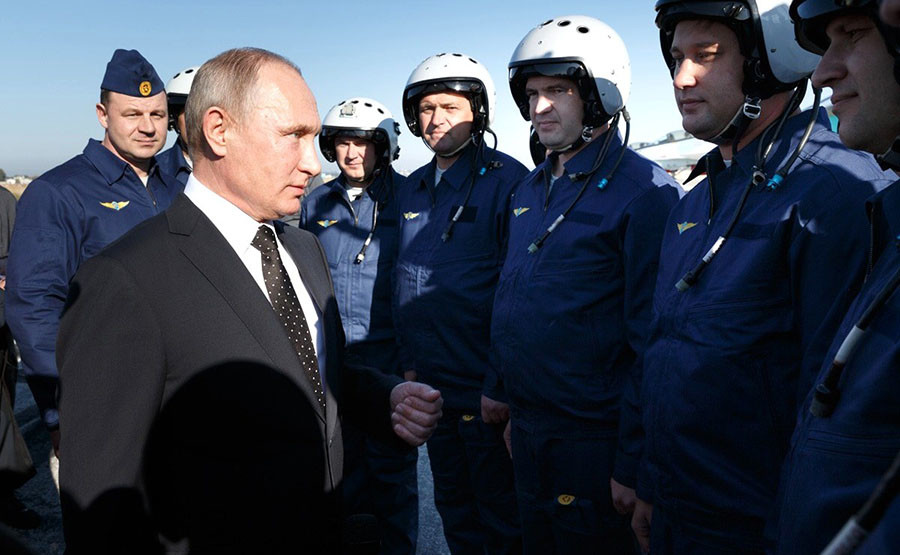
Russian President Vladimir Putin paid a surprise visit to Syria on Monday, where he announced that his nation would begin to withdraw “a significant part” of their military forces deployed in the Middle Eastern nation as its long civil war draws to a close.
Putin's announcement was discussed on Radio Sputnik's Loud & Clear by hosts Brian Becker and John Kiriakou and guests Mark Sleboda and Rick Sterling. Sleboda is a Russia-based international relations and security analyst and frequent critic of US policy, while Sterling is a journalist and member of the Syria Solidarity Movement, an organization that supports the Syrian government.

​"It was a surprise," said Sleboda. "Putin was obviously headed on the way to Cairo, and then on the way back to Turkey, but the side trip to Syria and particularly to the Russian airbase in Syria certainly was a surprise. As for this announcement, this ‘mission accomplished' moment… we've heard several previous such ‘Russia is withdrawing their military forces from Syria' claims before."
"I think there were certainly enough caveats and qualifications to Putin's statement that, while recognizing the significant victories that have been achieved, we should take this announcement with a grain of salt. Russia is not leaving Syria, they are not leaving their military bases. There remain significant military hurdles: significant terrorist concentrations, the entirety of Idlib governance is under the control of al Qaeda. I think this was probably primarily an announcement for domestic political consumption, as Putin announces his intent to run again for another six-year term in 2018."
"It's also a reminder to the Americans that at least the majority of the fighting in east Syria against [Daesh] is done," Sleboda added. "They no longer at least hold any urban areas, at least there the military mission is accomplished. The US no longer has any excuse, not that they ever had any legal remit for their operations in east Syria. But Putin was letting them know that it's time for them to pack their bags and go home."
Becker pointed out a CNN headline from early 2016 that was quite similar to the recent one — but Russia did not pull forces out as CNN claimed; they actually intensified their military involvement.
Sterling elaborated on Moscow's movements: "It's an indication of an intent. They don't plan on maintaining a large military force there indefinitely, but they can come back if needed. The fact is that Russia is not very far from Syria, only about 600 miles from Sochi, their air base. It's not very hard for the Russian Air Force to move at least some of their airplanes and pilots and so forth up into southern Russia, and if needed they can still be called into duty in Syria."
Kiriakou asked the guests if they believed it possible that Russia could end up in an quagmire in Syria, similar to what has happened to the US in Iraq and Afghanistan. Sleboda replied that Russia was likely to remain in the Middle East for years to come, but of their own volition.
"Russia is back in a big way in the Middle East. Suddenly everyone in the Middle East [is working with Moscow]: Iraq, which the government there, although showing a lot of the signs of independence, was installed as a result of the US invasion and regime change there. Saudi Arabia has come to the table with Russia to sign oil deals and potential military deals after losing this oil price war."
"Qatar, Turkey, the United Arab Emirates, Kuwait, they're all now looking to Russia because Russia has showed the willpower, resolve, and capability to back up military force with hard diplomacy and achieve results in the Middle East — something that the US and all of their regime change and intervention has not shown anything with anywhere near so positive a result."
"So Russia is back in the Middle East. They're not leaving Syria, they have no intentions of leaving Syria."

Video Report - Vladimir Putin visits Egypt: arrival

Video Report - #Putin to #Russian Soldiers: The Homeland is proud of you! You are returning victorious to your homes!

Video Report - Putin and Egypt's Sisi make joint statement after meeting in Cairo

Video & Report - #Putin orders withdrawal of #Russian troops from #Syria during surprise visit to Khmeimim Airbase

Russian President Vladimir Putin has ordered the withdrawal of Russian troops from Syria. He announced the move during his first visit to the country, as he arrived with no advance notice at Khmeimim Airbase in Syria’s Latakia province on Monday morning. A “significant part” of the Russian military contingent in Syria should return to Russia, Putin announced, addressing Russian military personnel at Khmeimim. The order to withdraw followed the defeat of “the most battle-hardened grouping of international terrorists” by the Russian and Syrian militaries in the space of two years.

As he arrived at the base, which houses Russian forces assisting Syria in the battle against Islamic State terrorists (IS, formerly ISIS), Putin was greeted by his Syrian counterpart, Bashar Assad, and by Russian Defense Minister Sergey Shoigu, in a brief stop on the Russian leader's way to bilateral talks with Egyptian President Abdel Fattah al-Sisi in Cairo, followed by a meeting with Turkish President Recep Tayyip Erdogan in Ankara.

The commander of the Russian forces in Syria, Colonel-General Sergey Surovikin, informed Putin that about 70,000 sq km of Syrian territory had been liberated and 32,000 terrorists killed in the last seven months of the operation. Russian special forces, military police, sapper teams and 25 aircraft will now leave Syria, and the field hospital will be removed.
Putin also warned that should terrorists attempt to “rear their heads” in Syria again, Russia will strike them as “they have never seen before.” Russia will continue to use Khmeimim Airbase and the Syrian port of Tartus, which provides technical support for the Russian Navy, while the Russian Reconciliation Center for Syria will also remain.

Syria was “preserved as a sovereign and independent state” and refugees are returning home, the Russian president noted. He is expected to discuss the organization of a Syrian people’s congress and further steps towards peaceful settlement, with the leaders of Egypt and Turkey on Monday.
President Assad once again expressed deep gratitude to the Russian Air Force, following up on his surprise visit to Russia’s Sochi just three weeks ago, when the Syrian leader had also expressed thanks for Moscow’s help in the fight against terrorism. 


The Russian General Staff declared the liberation of Syria from IS on December 6, saying that “all terrorist units of ISIS” in the country had been destroyed. Putin later said that the military work was completed “with a full victory,” adding that there “might be some spots of resistance.”  
Russia’s campaign in Syria was launched on September 30, 2015, after Damascus asked for Moscow’s help in the fight against extremist Islamist forces trying to overthrow the government. In March 2016, Russia partially withdrew its air force from Khmeimim Airbase, saying its objectives there had been largely achieved. 

Music Video - The B-52's - "Love Shack"

Video - #Alabama Senator Warns Against Roy Moore

Video Report - The Situation Room With Wolf Blitzer 12/11/17: TRUMP ACCUSERS SPEAKS OUT, DEMAND CONGRESSIONAL PROBE

Video Report - New York explosion suspect identified , 27-year-old of #Bangladeshi descent

New York police have named 27-year-old Brooklyn resident Akayed Ullah as the suspect who was wearing a homemade explosive device that detonated at the Port Authority bus terminal near Times Square. Ullah is of Bangladeshi descent. New York Mayor Bill Di Blasio has describe the event as an attempted terrorist attack.

Video Report - NY mayor: Attempted terrorist attack near Times Square

Video - #Karachi - Murad Ali Shah Speech 11 December 2017 @MediaCellPPP

UN Women Pakistan’s Human Rights Day video has everyone in awe

UN Women Pakistan unveiled their #LeaveNoOneBehind campaign on this International Day of Human Rights and had a strong message everyone should pay attention to. This year, they dedicated their campaign to highlight the plight of transgender persons in Pakistan and how they are discriminated against in every walk of life.
The video also presents a beautiful picture of how this marginalised section of society can become equally productive if provided with equal opportunities.

Pakistan - Bilawal Bhutto condemns withdrawal of FATA Reforms Bill by PML-N from NA

Chairman Pakistan Peoples Party Bilawal Bhutto Zardari has strongly condemned PML-N government’s move of withdrawal of FATA Reforms Bill at the eleventh from the National Assembly Agenda on Monday.
In a statement, the PPP Chairman said that the decision of PML-N to withdraw the Bill smells its hatred towards the people of FATA but pledged that his Party would merge FATA into Khyber-Pakhtunkhwa as per the aspiration of the people of tribal areas.
Bilawal Bhutto Zardari pointed out that in August 2011, President Asif Ali Zardari amended the Frontier Crimes Regulation (FCR), a British-era law curtailing FATA residents’ rights, and extended the Political Parties Act (PPA) 2002 to the tribal areas.
PPP Chairman further said that PPP has already vowed to integrate FATA in KPK, extension of High Courts jurisdiction and end to FCR.


https://mediacellppp.wordpress.com/2017/12/11/bilawal-bhutto-zardari-condemns-withdrawal-of-fata-reforms-bill-by-pml-n-from-na/

#Pakistan - Opposition irked by govt failure to present FATA Reforms Bill in NA


The government on Monday failed to table a bill pertaining to FATA's merger with Khyber Pakhtunkhwa province, drawing the opposition's ire over the delay.
Lawmakers from the Pakistan Peoples Party (PPP), Pakistan Tehreek-e-Insaf (PTI) and those from FATA tore copies of the assembly agenda in protest over the delay.
MNA Shahabuddin, who is also a member of the ruling Pakistan Muslim League-Nawaz (PML-N) from FATA, protested over the change in the assembly agenda. He was joined by other lawmakers from tribal areas.
The protesting members said the agenda included the FATA Reforms Bill and questioned why it was changed.
Sheikh Aftab Ahmed, minister for parliamentary affairs, said a debate on FATA reforms was temporarily postponed and the matter would soon be made part of the assembly agenda.
"There is further consultation required on the bill, which is why it was not tabled," Aftab explained.
Opposition Leader Khursheed Shah also criticised the government for putting the matter on hold and referred to the entire episode as a "joke".
"Another joke was played today. The matter is under process since the incumbent government came into power and it is beyond comprehension as to why the matter was excluded from the agenda after its inclusion," Shah said.
"The entire nation wants FATA to become a constitutional part of the country, but the government is merely passing its time in the parliament."
Murtaza Javed Abbasi, the deputy speaker of the assembly, intervened and attempted to defuse the situation.
"The minister for parliamentary affairs has given an explanation and the bill would be tabled in the house in the next two to three days," Abbasi said, adding that the bill could not be included in the agenda on "technical basis."
At this, the opposition leader warned that they would continue to stage a walk-out from the assembly if the matter was not resolved.
Some members of the opposition also tore copies of the agenda and staged a sit-in before the speaker's dais, followed by a walk-out by PPP members.
PTI's Shah Mehmood Qureshi lamented that all the members of the House were given agenda of Monday's session a night before, which had the FATA Reforms Bill, but it was excluded from the agenda copies distributed today.
"They are showing us the way that issues are resolved through sit-ins, not by the parliament," Qureshi said.
The opposition members rejected all explanations furnished by the treasury.
The opposition leader added the government should clearly state that a few individuals are against this bill. "Or at least tell us why this bill was excluded from the agenda," he demanded.
Later, all opposition members walked out of the assembly hall, after which the session was adjourned until 10:30am on Tuesday.
The recommendations to bring FATA at par with the rest of the country were approved at the Cabinet meeting on FATA reforms on March 2.
Once FATA is made part of KP, the province's share in the National Finance Commission will increase, as 3 per cent will be earmarked for the region.
The KP Assembly had adopted a resolution on December 14, 2016, in favour of merging FATA with KP that would help rehabilitate and reconstruct the infrastructure including roads, communications, power lines, water supply, education and health facilities.

#Pakistan - Bilawal Bhutto concerned over human rights violations by PML-N


Pakistan People’s Party Chairman Bilawal Bhutto Zardari has said that violent extremism poses severe threats to the human rights in the country, which needs to be tackled carefully.
In his message on the Human Rights Day, the PPP chairman also expressed concern over the violations of human rights during PML-N government.
Bilawal Bhutto Zardari stated that PPP believes in the full protection of human rights . PPP passed several laws and established institutions to safeguard basic human rightsof the people of Pakistan, he added. He pledged that PPP won’t tolerate violations of human rights as it was not only a national inclusive political party but is the nation’s largest movement for human rights as well.
Bilawal Bhutto Zardari said that strong and democratic nations keep human rights as their highest priority and we also need more efforts to improve the situation.
He reiterated that PPP leadership and workers would continue their fight for the protection of human rights in the country as well as in the world.
Meanwhile, in a statement issued on Sunday, PPPP Senator Aajiz Dhamrah responded to Shebaz Sharif over leveling allegations of corruption on Shehbaz Sharif and said that chief minister Punjab has lost his mind after seeing the gallows in front of himself after the publication of Model Town enquiry commission report.
He said that PML-N itself is surrounded by corrupt people and it is unfortunate for the country that a person who is involved in taking commissioning LNG issue is positioned as the prime minister of the country by the PML-N leadership.
“The prime minister should also think twice before leveling allegations at the PPP leadership and should first initiate an enquiry on rental power projects.”
He said that PPPP President Asif Ali Zardari had faced the so-called accountability campaign from Nawaz Sharif and Shehbaz Sharif for more than 11 years and later the courts had acquitted him.
“Shehbaz Sharif should now tell the nation that why millions were spend on an accountability process that had yielded no result.”
He said that Nawaz Sharif and his associates could no longer fool people through their lies and they should know that the accountability commission chief who filed cases against Asif Zardari had to apologize over fake cases.