Saturday, November 25, 2017

HOW THE OBAMAS CELEBRATE THANKSGIVING: A BRIEF HISTORY OF HOLIDAY WISHES FROM BARACK, MICHELLE AND THE GIRLS


BY STAV ZIV


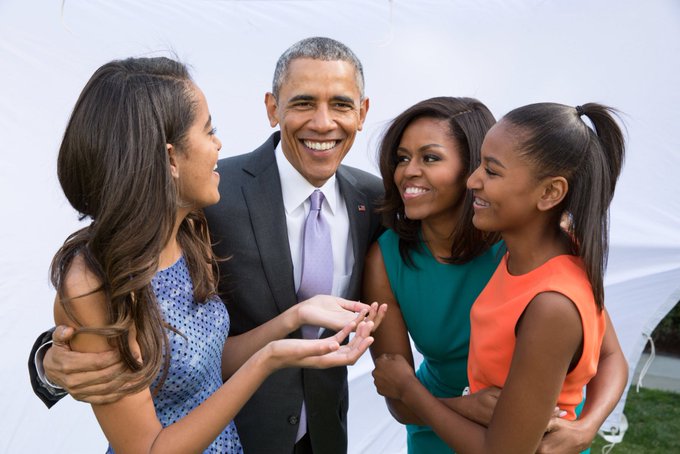
The Obamas may no longer inhabit the White House, but they are still wishing Americans everywhere a happy Thanksgiving “full of joy and gratitude.” Former President Barack Obama tweeted the greetings Thursday morning with a picture of himself with Michelle, Malia and Sasha in a warm family embrace with smiles all around.
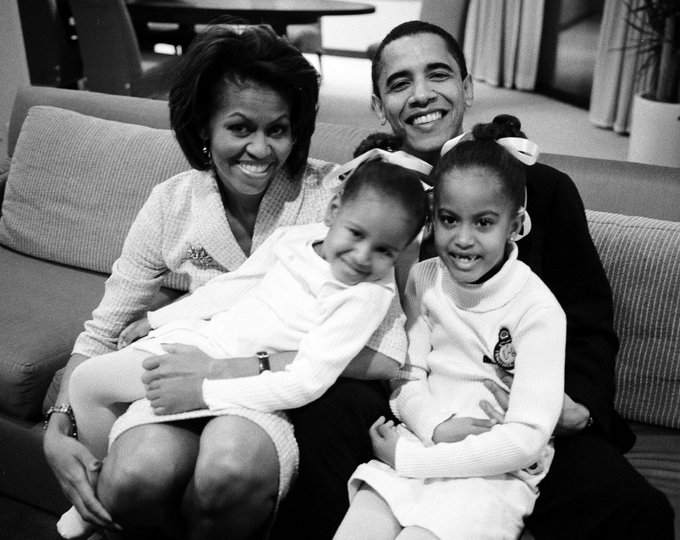
It’s an all-grown-up version of a photograph Obama posted for Thanksgiving five years ago, about two weeks after he was elected for a second term. That image, in black and white, was a throwback to a time when the two first daughters were small enough to sit on their parents’ laps, with bows in their hair and Malia showing off her missing teeth in a wide grin.
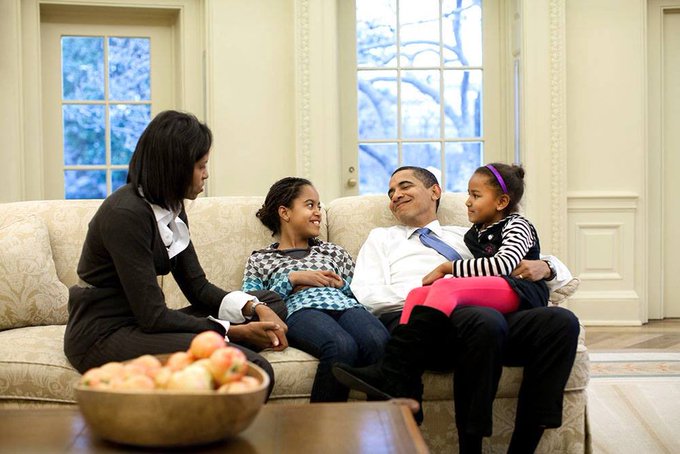
In 2016, shortly after the most recent presidential election that saw Donald Trump chosen as Obama’s successor, the first lady shared another old family photograph for Thanksgiving. “Today and every day we have a lot to be thankful for. From our family to yours - Happy Thanksgiving,” she wrote, according to her archived FLOTUS account.
Today and every day we have a lot to be thankful for. From our family to yours - Happy Thanksgiving.
The 44th president began sharing Thanksgiving wishes from the Obamas' on Twitter during his first year in office. “From my family to yours — Happy Thanksgiving,” he wrote in 2009. The following year, he wrote: “As Americans gather for Thanksgiving, let us rejoice in the abundance that graces our tables and in the loved ones who enrich our lives.”
As Americans gather for Thanksgiving, let us rejoice in the abundance that graces our tables and in the loved ones who enrich our lives.
In 2011, he posed a question: “We've accomplished a lot together over the past three years. This Thanksgiving, what are you most thankful for?” The tweet linked to an Organizing for Action survey that asked for stories of thanks. “From ‘Don't Ask, Don't Tell’ to ending the war in Iraq, what progress from the last three years are you most thankful for?”
Two years later, in 2013, he encouraged parents to talk to take the opportunity to talk to their children about health insurance over Thanksgiving.

View image on Twitter
Today and every day we have a lot to be thankful for. From our family to yours - Happy Thanksgiving.
The 44th president began sharing Thanksgiving wishes from the Obamas' on Twitter during his first year in office. “From my family to yours — Happy Thanksgiving,” he wrote in 2009. The following year, he wrote: “As Americans gather for Thanksgiving, let us rejoice in the abundance that graces our tables and in the loved ones who enrich our lives.”
As Americans gather for Thanksgiving, let us rejoice in the abundance that graces our tables and in the loved ones who enrich our lives.
In 2011, he posed a question: “We've accomplished a lot together over the past three years. This Thanksgiving, what are you most thankful for?” The tweet linked to an Organizing for Action survey that asked for stories of thanks. “From ‘Don't Ask, Don't Tell’ to ending the war in Iraq, what progress from the last three years are you most thankful for?”
Two years later, in 2013, he encouraged parents to talk to take the opportunity to talk to their children about health insurance over Thanksgiving.
Starting that same year, the first lady tweeted about her gratitude to immigration reform advocates and military service members and their families. Her husband followed suit in his 2015 wishes.
As families begin to gather for Thanksgiving, I’m thinking of the brave  immigration reform advocates. We're with you. -mo
This , let's give thanks for all our brave men & women in uniform and their families. We're so grateful for your sacrifice. -mo
As we celebrate , let's give thanks to our men and women in uniform serving our country far from their homes and families. –mo
Happy Thanksgiving, everyone! Today, we give thanks for all of our loved ones and the brave men and women in uniform who serve our country.
In his last Thanksgiving in office, perhaps reflecting on the final days of his presidency, Barack Obama wrote that “this Thanksgiving, we give thanks for our blessings, and work to fulfill the timeless responsibility we have as Americans to serve others.”
The Old Soldiers Home in DC has cared for our nation's veterans for 165 years. I was honored to be a small part of that mission. pic.twitter.com/tDnqOGHgAB
This Thanksgiving, we give thanks for our blessings, and work to fulfill the timeless responsibility we have as Americans to serve others.
There was surely one thing missing from the Obamas' post-White House Thanksgiving: the annual turkey pardon. Though Malia and Sasha may have been grateful for it, one has to wonder if their father missed what is arguably the silliest presidential tradition, one where he could unleash his "corny-copia of dad jokes about turkeys." 
But who knows? Maybe the tradition has continued. As Obama said at last year's ceremony: "What I haven't told them yet is we are going to do this every year from now on. No cameras, just us, every year. No way I'm cutting this habit cold turkey."

Music Video - Zinda - Verna 2017 #LollywoodFilm

Music Video - Afshan Zebi - Koi Rohi Yad Karendi

Music Video - Afshan Zebi - Lokan do do yaar banaye

Report - Afghan President Ghani’s Close Aides Accused Of Links To Terrorists


Some MPs claimed that a number of close aides to President Ashraf Ghani are conducting the activities which are against the national interests.
Some lawmakers in the Wolesi Jirga, the Lower House of Parliament, on Saturday accused a number ofclose aides to President Ashraf Ghani of acting against Afghanistan’s national interests and having links with Daesh militants. “I officially say here that (head of National Directorate of Security) Masoom Stanekzai is behind Daesh project (in Afghanistan) and Akram Khpolwak is a child of ISI (Pakistan’s Inter-Services Intelligence agency) and is responsible for signing the Durand Line,” claimed Lalai Hamidzai, an MP from Kandahar.
The remarks come after the Wolesi Jirga’s first deputy speaker Humayun Humayun in a letter to the National Security Council wrote about the existence of ‘suspicious individuals’ in the NDS chief Massom Stanekzai’s guesthouse.
“Two times, I saw people who walked out of his (Stanekzai’s) guesthouse.” Humayun said. “They are very well-known people and all the media outlets speak out about their activities in deterioration ofsecurity (in the country).”
TOLOnews could not have Presidential Palace’s comments about the MPs’ remarks.
Two weeks ago, government officials searched Humayun’s office over suspicious activities allegations. Humayun however said government wanted to put him under pressure by this move.
Other MPs meanwhile criticized government over searching Humayun’s office.
“Imagine the future of the people if the president (Ashraf Ghani), the NDS chief (Masoom Stanekzai) and the former NDS chief as well as a collective of groups emerge as plotters in such a way,” saidAbdul Latif Pedram, an MP from Badakhshan. “All the MPs have an obligation to know through an investigation by the Attorney General’s Office that why the house of the first deputy speaker of the Wolesi Jirga was searched,” MP Nader Khan Katawazai said.
http://www.tolonews.com/afghanistan/ghani%E2%80%99s-close-aides-accused-links-terrorists

Hafiz Saeed: US warns of ‘repercussions’ for Pakistan over release of alleged Mumbai attack mastermind


By Andrew Buncombe

The US has strongly condemned Pakistan's release of the alleged militant accused of masterminding the 2008 attack on Mumbai - saying it sends a deeply troubling message about its commitment to fighting terrorism.
Hafiz Saeed, accused of plotting the commando operation that left more than 160 people dead, was released from house arrest earlier this week by a three-judge panel in the city of Lahore. His spokesman, Yahya Mujahid, called it a “victory of truth”.
But the White House denounced the move and said it could damage US-Pakistan relations.
“Saeed’s release, after Pakistan’s failure to prosecute or charge him, sends a deeply troubling message about Pakistan's commitment to combatting international terrorism and belies Pakistani claims that it will not provide sanctuary for terrorists on its soil,” said press secretary Sara Huckabee Sanders.
“If Pakistan does not take action to lawfully detain Saeed and charge him for his crimes, its inaction will have repercussions for bilateral relations and for Pakistan’s global reputation.”
Mr Saeed, 68, has always denied being behind the multi-target attack on Mumbai that left close to 170 people dead. In 2010, he told The Independent: “They make me out to be the biggest and most evil terrorist. Do I look like one to you?”

He has insisted that his organisation, Jamaat-ud-Dawa, is involved solely in charitable activities.
Yet both India, the US and other countries, accuse Mr Saeed of being being the attack. They say that while Jamaat-ud-Dawa may indeed perform charitable activities, it is also a front for Lashkar-e-Taiba, the Pakistan militant group which became notorious for strikes on Indian targets, including a 2001 attack on its parliament in Delhi.
In December 2008, UN Secretary Council declared Jamaat-ud-Dawa a terrorist front group. In April 2012, the US announced a bounty of $10m on Mr Saeed.
After the attack on the Indian commercial capital, Pakistan was put under intense pressure to detain and prosecute Mr Saeed. India and the US said there was sufficient evidence, though this was something prosecutors in Pakistan denied.
Instead, Mr Saeed has spent much of the last decade being placed under house arrest and then released. His situation under house arrest is not irksome; Mr Saeed has a large property in Lahore and is protected not only by his own armed guards but by armed police officers.
While some in Pakistan may wish to see Mr Saeed placed on trial, there is widespread suspicion among Indian and US officials that he still retains close links to the country’s Inter-Services Intelligence (ISI), which has been long blamed for sponsoring many of the cross-border attacks on Indian targets.
After his latest release from house arrest, Mr Saeed attacked recently ousted prime minster Nawaz Sharif as a “traitor” for his efforts to seek peace with India.
“Nawaz Sharif asks why he was ousted? I tell him he was ousted, because he committed treason against Pakistan by developing friendship with [Narendra] Modi, killers of thousands of Muslims,” Mr Saeed said, according to Reuters.
The Trump administration has been intensifying pressure on Pakistan to fight extremists and drive them from hideouts in Pakistani territory. 
The campaign appeared to produce some success this year when Pakistani security forces assisted with the release of a Taliban-held US-Canadian family after five years in captivity. However, US officials cautioned that move needed to be followed by additional measures to prove the country's commitment.

    The White House’s comments came as police in Pakistan launched an operation to clear Islamist protesters from an intersection linking the Pakistani capital with the city of Rawalpindi, sparking other demonstrators across the country to take to the streets in solidarity.
     

    Hafiz Saeed's release shows waning US power over Pakistan; India must brace for impact in Kashmir


    Sreemoy Talukdar
    It is tempting to interpret Pakistan's move in releasing Hafiz Saeed from "house arrest" as a hackneyed script trapped within a capsule of time where characters are forced to eternally repeat their actions. The Lashkar-e-Taiba (LeT) founder will be "arrested" and released, "arrested" and released, "arrested" and released in sync with varying degrees of pressure stimuli on the Pakistani State.
    And yet such an interpretation, this time, could be misleading. In the events that led up to Saeed's so-called arrest, his subsequent release and behaviour of the major players, there is an indication that the power equation in South Asia is irrevocably changing, and we must be sensitive to those changes.
    In very broad terms, the Hafiz Saeed episode captures the reality of waning US influence over Pakistan in line with its increasing inability to carry out the role of a global influencer. This—coinciding with the growing clout of China—is creating more space for Islamabad to pivot towards Beijing in defiance of the US. The trend presents both an external and internal challenge for India, whose strategic interests are better served by an US-led regional order in South Asia than a China-led one.
    New Delhi must calibrate its foreign policy to adapt to the post-Cold War era reality and brace for impact in Kashmir where the trouble is more likely to intensify. It shouldn't surprise that in his very first speech following release, Saeed targeted Kashmir and vowed to ramp up jihadist violence.
    This reality, in a rather counterintuitive way, is reflected in the sharp US response against Pakistan's decision to set free the UN designated terrorist just ahead of the ninth anniversary of 26/11 Mumbai terrorist attacks. The State Department release claimed the Donald Trump administration was "deeply concerned that LeT leader Hafiz Saeed has been released from house arrest in Pakistan." Recognising LeT as a "designated Foreign Terrorist Organisation responsible for the death of hundreds of innocent civilians in terrorist attacks, including a number of American citizens," the statement urged Pakistan to "make sure that he is arrested and charged for his crimes."
    Time was when the global superpower ensured favourable outcomes without having to huff and puff over it. Rather than demonstrate resolve, this US statement ends up showcasing its erosion of clout where even openly coercive behaviour isn't bringing desired outcomes. This vocal admonition is more likely aimed at India, to show that Washington is not equivocal in the war on terror.
    It requires a great deal of gullibility to assume that Washington did not conceive of such an eventuality when it decided to delink Coalition Support Funds (CSF) from verifiable action against the LeT while requiring Pakistan to do so only against the Haqqani Network. In the Senate version of the defence bill passed in September, the CSF was tied to demonstrable action from Pakistan on both the LeT (which operates against India) and the Haqqani Network (which is active in Afghanistan). Section 1212 of the defence authorisation bill demanded that Pakistan must validate that "it has taken steps to demonstrate its commitment to prevent the Haqqani Network and Lashkar-e-Tayyiba from using any Pakistan territory as a safe haven and for fundraising and recruiting efforts" and also demanded (albeit indirectly) action against "senior leaders and mid-level operatives of the Haqqani Network and Lashkar-e-Tayyiba".
    However, under pressure from the US Department of Defence, the US Congress modified the key provision to drop the mention of LeT from legislation, ostensibly to maintain exclusive focus on Pakistan's compliance in Afghanistan. The LeT reference was deemed as premature and distracting.
    This indicates that US action against "war on terror" lacks consistency and homogeneity and is subject to prioritisation of interests. It seems to be at odds with Donald Trump's iteration of Afghanistan and South Asia policy where Pakistan's status as a "safe haven" for "terrorist organisations, the Taliban, and other groups" was severely criticised, and specific mention made that Pakistan's actions are posing a "threat to the region and beyond." Trump also demanded that Pakistan must "demonstrate its commitment to civilization, order, and to peace." This led some commentators, such as Chidanand Rajghatta in The Times of India, to point out that "as with all previous US administration, this one too has shown that when it comes to a toss-up between its objectives in Afghanistan (where it has a military presence) and India's interests in Kashmir, its objectives will win."
    The truth is a little more complex. More than US equivocation on terror, the prioritisation indicates that Washington is now dependent more than ever on regional players to achieve its foreign policy objectives. This creates tension in its bilateral ties. Therefore, while it must align with India and "like-minded democracies" to contain the rise of China in South Asia, it equally cannot afford to antagonise China (in so far as the Trump administration is concerned) and complicate further the North Korea situation. Similarly, while backing India on its position in Kashmir, it needs to leave Pakistan with enough lollies to ensure compliance of objectives in Afghanistan.
    These cleavages will become even more pronounced as US power wanes, and its dependence increases on regional players. It is instructive to compare US behaviour with China, which seems to be achieving its foreign policy objectives much more silently, and without much ado, as ORF fellow Abhijnan Rej explains in an essay for Livemint(What China does when it disagrees with you). It is pointless for India to outrage against Pakistan, whose dependence on terrorism as a foreign policy tenet will continue as long as its serves domestic interests and benefits outweigh the costs. It is equally futile to feel betrayed by the US in its policy priorities. India must instead take note of the shifting sands in power balance and calibrate its response.
    A good start will be to understand that Saeed's release is as much triggered by shift in US policy as an attempt by the Pakistan's military-industrial complex to degrade the capabilities of its civilian government in controlling the direction of foreign policy. In fact, Saeed's targeting of Nawaz Sharif for "cosying up with Narendra Modi" is a dead giveaway.
    As Kunwar Khuldune Shahid writes in The Diplomat, "Saeed’s release has both symbolic and actual perils for the political parties gearing up for the 2018 elections. This is as firm a sign as any that anyone eyeing improved relations with India by putting the Kashmir conflict on the back burner will not be allowed to run the country. But, of course, with Saeed himself now free to plan electoral strategies there should be a tangible presence of jihad-mongers in the Parliament: A constant reminder of the fate of civilians that do not toe the lines on security and diplomacy."
    As elections in Pakistan draw near, as an immediate aftermath, violence in Kashmir may increase manifold. So what are the policy lessons for India? Work with the US in areas where there is an alignment of strategic interests (Afghanistan, the Quad) and start delinking the dialogue process with Pakistan from terrorism. Empowering the civilian government in Pakistan is the only way to restrict the influence of Rawalpindi. There are likely to be stiff political challenges domestically, but policy paralysis might extract a greater pound of flesh from us.

    The case of Hafiz Saeed - The ''WANTED'' Terrorist


    So, there we have it. The verdict is in. Hafiz Saeed is a free man. This is what it has come to in today’s democratic Pakistan. We are now a country that can no longer be bothered even with the trouble of sham trials. Our courts simply let a proscribed global terrorist walk.
    The significance of this cannot be overestimated. Not when it was the government that had requested the courts to extend the house arrest of the one-time front man for LeT and JuD, under the country’s anti-terror laws. Yet this latest move simply strengthens the ruling PMLN’s claims that the most powerful in the land are pulling the judiciary’s strings. While also underscoring how the so-called project of mainstreaming of former proxies is in full swing ahead of the elections. It may well be that Saeed leads the MML, the new political reincarnation of the JuD, to the polls next year.
    Pakistan is now hurtling along a very dangerous path. This has already been seen as direct provocation aimed at our eastern neighbour, India. Saeed, after all, has long been linked to the Mumbai terrorist attacks of 2008. Indeed, he has wasted no time in spewing hate. Soon after his release in Lahore, there he was leading a Friday sermon; where he was quick to engage in anti-India rhetoric. He also lambasted Nawaz Sharif as a traitor for having tried to talk peace with New Delhi before he was deposed from the premiership. This is to say nothing of the harm his release will do to the government’s serious endeavours to revisit UNSC resolutions over the Kashmir issue. Then there is the US, which, following Mumbai, slapped a $10 million-bounty on Saeed’s head. And this was before the belligerence of the Trump administration came our way. If Pakistan didn’t splash so much cash on maintaining its security apparatus — a cheeky wag somewhere might venture that the latter was hoping to cash-in on the bounty. Sadly, this is no laughing matter.
    We are taught that democracy means respecting the rule of law. Though this was something that the US found hard to swallow when the Scottish courts released on compassionate grounds the mastermind of the Lockerbie attack. But what has happened this week here in Pakistan is far worse than a case of sour grapes. Just as it proves a far greater risk than finding ourselves embarrassed on the world stage. The move suggests that our democratic pretensions are a lie. Moreover, it also hints that those who are said to run the show here may already have a good idea of just who will come out ahead at the ballot-box.
    Thus the people of Pakistan ought to be afraid, very afraid. For their country’s very survival is at stake. *

    Intolerance, violence on the rise in Pakistan


    Senator Farhatullah Babar on Friday proposed the appointment of a special public prosecutor for dealing with crimes against women and a national register of embarrassment containing details of crimes, status of prosecution and the current status of cases.
    He was speaking at an event organised by the National Commission on Status of Women (NCSW) in Islamabad on combating violence against women.
    “Local governments with women participation can play an effective role in combating violence against women he said and called for the implementation of NCSW recommendations pertaining to reserved seats for women at all levels,” he said.
    He said that intolerance and violence in Pakistan was increasing day by day and identified two areas of violence. “One is security-driven violence as in the case of missing persons, bodies and the reported violence in Guantanamo Bay like internment centres. It is the women and children who suffer most when their men folk disappear mysteriously,” he said.
    “The second category is belief-driven violence in which case the rich and the poor alike are beheaded. This violence goes far beyond as an accused of blasphemy cannot find a lawyer to defend him,” he said
    “The largest variety of violence takes place against women as newer forms of violence against them are invented every year ranging from men’s honour, gang rape and acid-throwing. For women, it is death by the kitchen stove in Punjab, by pesticide in South Punjab, axe in Sindh and guns elsewhere. An unheard of new kind of violence was invented by a holy man when he inserted a red hot iron rod in the abdomen of his wife,” he said.
    “Lack of access to justice, broken criminal justice system, jirga that exclude and degrade women and misapplication of Qisas laws have further compounded violence against women,” he said.
    “Of course pardon can be granted under the Qisas law, but only after conviction. It is a miscarriage of justice and misinterpretation of the law by accepting pardons even before conviction,” he said.
    Later, talking to the media, he said that to fight crimes against women, the society must recognise economic rights, the right to own land, the right to inheritance and equal wages for women. “The draft Constitution of October 1950 contained clear cut provisions for ending all forms of torture and also for equal wages for women. But both the provisions were deleted in the draft Constitution finalised in 1956,” he said.
    Senator Farhatullah Babar on Friday asked the defence minister not to make any commitments in Riyadh without first notifying Senate.
    https://dailytimes.com.pk/147021/intolerance-violence-rise-pakistan-farhatullah-babar/

    #Pakistan - APNS expresses concern over sudden closure of TV channels


    The All Pakistan Newspapers Society (APNS) expressed concern over the sudden closure of television channels and their transmission following police operation against protesters in Islamabad on Saturday. 
    The access to television channels and social media sites was restricted after the arbitrary order of Pakistan Electronic Media Regulatory Authority (PEMRA). 
    In a joint statement,  APNS President Sarmad Ali President and Secretary General Umar Mujib Shami strongly condemned PEMRA for ordering the closure of TV channels and preventing live coverage of police action against the 'Faizabad dharna' [Faizabad protest]. 
    The APNS stated that the objective could have been achieved if the stakeholders were duly consulted. 
    "The sudden and arbitrary action has caused grave confusion and flow of rumours among people exploited by the vested interest which has resulted deterioration of law and order situation all over the country," read the statement. 
    The APNS also stated that any step to curb freedom of press has proven to be counter productive in any democratic dispensation. 
    They urged the federal government to immediately withdraw the PEMRA action and consult the stakeholders for the guiding measures of the coverage of the operation.

    After PEMRA's orders to take all news channels off air, social media access via internet browsers to Facebook, Youtube and Twitter were also blocked Saturday afternoon. 
    The access to services was temporarily restored after 3pm but was blocked again shortly after.
    PEMRA directed news channels to ensure the security of their staff while the situation persisted; in light of which, Geo News as per its tradition of responsible reporting was and continues to abide by the rules.
    Earlier, PEMRA had barred media from live coverage of Islamabad operation under Media Code of Conduct 2015.
    While Facebook, Twitter and Youtube were blocked across Pakistan on internet browsers, Geo.tv had received reports from certain users who are still able to access the services.  

    Countrywide protests 

    The operation to clear Faizabad Interchange from protesters staging a sit-in, which had commenced early morning on Saturday, was put on hold later in the day. According to reports, the operation against protesters was suspended at approximately 2:30 PM.
    The situation remains tense in the federal capital.
    Heavy contingents of police, FC and Rangers were deployed to the interchange, where they used tear gas and water cannons to disperse the protesters, who had paralysed the federal capital for almost three weeks.
    At least 200 people have been injured in the clashes including 90 police and FC personnel. 
    Following the operation, protests were staged in different cities including Lahore, Karachi, Hyderabad, Mandi Bahauddin, Peshawar among others. 

    Important meeting of PPP leadership held at Bilawal House

    An important meeting of Pakistan Peoples Party leadership was held at Bilawal House on Saturday evening.
    President Asif Ali Zardari, Chairman PPP Bilawal Bhutto Zardari, Leader of the Opposition in National Assembly Syed Khursheed Ahmed Shah, Chief Minister Syed Murad Ali Shah, and Senator Sherry Rehman were present in the meeting.
    The meeting discussed the overall political and law and order situation in the country.
    The meeting took stock of the situation in threadbare and pledged to support and stand by democracy and democratic institutions asking the government to fulfil its constitutional obligations.
    Chief Minister Syed Murad Ali Shah briefed the meeting about the law and order position in the province and informed that overall law and situation is under control in Sindh province. He also briefed the leaderdhip about the steps taken by Sindh government to ensure safety of general public and government installations.

    https://mediacellppp.wordpress.com/

    Pakistan launches crackdown on religious protesters, setting off violent clashes


    By Pamela Constable and Shaiq Hussain
    Protests erupted across Pakistan on Saturday after security forces in Islamabad launched an early-morning crackdown on thousands of religious demonstrators seeking to escalate pressure on the government.
    Police fired tear gas and rubber bullets at the crowd, which fought back with clubs and pelted police with stones from slingshots. Hundreds of injuries were reported among both protesters and security forces, with at least two people dead, according to accounts.
    The protests flared over a previous proposed change in election laws — just a few words of text — that weakened the specific oath that all candidates for public office must repeat, swearing they believe that Muhammad was the prophet.
    The government apologized for the “clerical error” several weeks ago, but the protest leaders have continued to push relentlessly for further action, especially the firing of Law Minister Zahid Hamid.
    Some demonstrators Saturday expanded their outcry, calling for the entire government of Prime Minister Shahid Khaqan Abbasi to step down.
    Army officials urged the government to respond to the protests “peacefully,” saying that violent confrontation was “not in the national interest,” but police and civilian officials seemed overwhelmed by the day-long outpouring of unrest.
    Demonstrators closed off highways, shut down sections of metropolitan Rawalpindi, Karachi and Lahore, and filled dozens of public squares and crossroads across Pakistan’s four provinces.
    Officials blocked all television news channels at midafternoon, but information from scattered communities traveled by phone and text messages. Protesters attacked and injured a legislator from the ruling party and vandalized the home of the law minister Hamid.
    In Faizabad, an interchange on the main highway between Islamabad and the nearby garrison city of Rawalpindi, clashes broke out near the site where religious groups had first gathered Nov. 8.
    The original protests were spearheaded by a movement dedicated to defending the honor of Muhammad and the country’s strict laws against religious blasphemy. The group also reveres a man who assassinated a provincial governor in 2011 because the official had defended a Christian peasant woman accused of blaspheming Islam.
    The leader of the protest movement, Maulvi Khadim Allama Hussain Rizvi, remained at the Faizabad site all day, wearing a gas mask and using a wheelchair because of a permanent disability. According to news reports, he chanted slogans praising the “finality of the prophet” and welcoming new protesters who arrived from mosques, shrines and homes to join the besieged rally.
    Rizvi reportedly read out lists of towns and cities where crowds had blocked roads, adding “all praises to Allah.” Emotionally charged protesters chanted, “Long live the finality of the prophet.” The assault at Faizabad had been expected but was delayed for days, as religious leaders refused government orders to disperse and ignored repeated deadlines.
    Despite the presence of thousands of security forces, protesters at Faizabad continued to resist or escape. By nightfall, crowds roamed the streets. Meanwhile, the reports of sympathetic rallies elsewhere spread, creating a growing sense of confrontation and loss of government control in some areas.

    Video Report - 6 Killed in Police-Islamist Clashes in #Pakistan

    Pakistan calls in army to quell protests after 2 people killed, 250+ injured


    By Sophia Saifi and Chieu Luu

    Pakistani officials on Saturday authorized the deployment of soldiers in the capital, Islamabad, to restore order after two weeks of raucous and violent protests.
    At least two people died and more than 250 others have been injured in the street demonstrations, hospital officials said.
    The Interior Ministry called for a "sufficient number" of Pakistan Army troops to help establish "law and order" in the Islamabad Capital Territory, according to the internal order.
      The move, conferred under constitutional powers, was requested by the Islamabad Capital Territory Administration. It was not immediately clear when, or if, the army would take the streets.
      Protesters had been blocking a key road connecting Islamabad and the neighboring city of Rawalpindi since November 8.
      The group is demanding the resignation of the country's law minister for what it considers blasphemy after amended parliamentary bills weakened rules that require lawmakers to reference the Prophet Mohammed when taking their oaths.
      Protesters on Saturday tried to break into the home of Law and Justice Minister Zahid Hamid, police in the Punjabi city of Sialkot said. Hamid and his family weren't home at the time. The gate at the residence was damaged, police said.

      Slingshots and tear gas

      Pakistan Interior Minister Ahsan Iqbal had given protesters around Islamabad until last Thursday to disperse, but they continued their demonstration.
      Video from the scene Saturday showed law enforcement forces carrying sticks and firing tear gas and rubber bullets at protesters. Groups of protesters could be seen throwing rocks with their hands or using slingshots.
      About 100 protesters were arrested Saturday, said Fakhar Sultan, a police officer in Rawalpindi city.
      At least 112 people, including protesters and law enforcement, were being treated at the Pakistani Institute of Medical Services in Islamabad, said Dr. Tahir Nadeem, a physician at the hospital.
      Three smaller protests broke out in Rawalpindi on roads leading to the capital, a journalist there said. The motorway between Rawalpindi and the eastern city of Lahore also was closed, as authorities feared more protesters might try to enter the city to support demonstrators in the capital.
      Protests also broke out in Lahore and the southern port city of Karachi, local media reported.

      Media blackout ordered

      Private television channels in Pakistan were taken off the air by the Pakistan Electronic Media Regulatory Authority, according to a message slate that replaced the channels' programming.
      The agency had ordered local TV channels to refrain from live coverage of the ongoing government operation.
      Only state-run PTV, which has not been reporting on the protest, remained on air.

      Blasphemy accusations leveled

      Demonstrators accuse the government of blasphemy based on a proposed changed that they say would soften electoral laws. The government has apologized and denied making such a change, calling it a clerical mistake.
      Protesters want Hamid to resign over the matter. They support Khadim Hussain Rizvi, the leader of Tehreek-e Labbaik Pakistan, the hardline Islamist movement spearheading demonstrations.
      The movement was formed by followers of Mumtaz Qadri, who was executed last year for shooting and killing Punjab Gov. Salman Taseer in 2011. Qadri allegedly killed Taseer because the governor spoke out against the country's blasphemy law, which makes insulting Islam a crime punishable by death.
      As news of Qadri's death emerged, thousands of the executed man's supporters took to the streets in cities across Pakistan. They praised Qadri as a martyr who died for the cause of the Prophet Mohammed.
      Since then, Tehreek-e-Labaik Pakistan has been attracting political and religious support through the country. A video on the party's Facebook page shows Rizvi reciting religious phrases into a microphone and his supporters repeating the phrases in unison.

      #Pakistan - #Lahore police go missing as religious activists lay siege to Faisal Chowk


      Activists from various religious parties thronged the Faisal Chowk (Charing Cross Chowk) on Mall Road on Saturday afternoon on the call of Tehreek-e-Labbaik Ya Rasool Allah (TLYR) chief Khadim Hussain Rizvi on the social media following the government’s crackdown on the participants of the protest sit-in at Faizabad Interchange in Islamabad on the orders of the Islamabad High Court (IHC).
      Surprisingly, there was no police presence in the most sensitive location in Lahore which houses the Punjab Assembly, headquarters of the Lahore Police, and provincial headquarters of the country’s premier intelligence agency, the Inter-Services Intelligence (ISI).
      Violent protests erupted in most part of the countries, including Lahore, on Rizvi’s call after the Islamabad police and Frontier Constabulary (FC) launched an operation against TLYR supporters who had been occupying the Faizabad Interchange for more than two weeks.
      The protesters in Lahore echoed the same demands as Islamabad protesters which included the sacking of Federal Law Minister Zahid Hamid and Punjab Law Minister Rana Sanaullah Khan, execution of blasphemy convict Asiya Bibi among others.
      Hundreds of protesters, including members of the Lahore Bar Association (LBA), carrying anti-Ahmedi placards and batons thronged the Faisal Chowk to register their protest against the operation in Islamabad.
      Supreme Court Advocate Rafaqat Ali Kahlo told Pakistan Today at the scene of the protest that the government should give into Islamabad protesters’ demands and should make the names of all those involved in amending the election bill public.
      The government has restored the bill to its original form, however, the advocate maintained that the lawmakers should publicise the findings of the enquiry and punish those responsible for “changing the oath regarding the finality of Prophethood” in the elections law.
      “We are protesting for a cause which is greater than any country’s law,” said the lawyer, adding that staging a ‘peaceful’ demonstration is part of democracy.
      Another advocate, Dilshad Ahmed Khan, said that they don’t care about the law when it comes to religion, referring to the Lahore High Court’s verdict which bars protest demonstrations at the Faisal Chowk.
      “Khatm-e-Nabuwwat is more important than anything,” he added.
      One of the protesters told Pakistan Today that they have gathered there in response to Khadim Hussain Rizvi’s call on Facebook, following which Twitter, Facebook and Youtube were shut down in Pakistan.
      Meanwhile, one of the commuters said that he has no problem with the protest as they are protesting for a “sacred” cause, adding that the protest is not just Tehreek-e-Labaik’s protest.
      Another protester, Abdur Rahim Shah, said that they were protesting in the name of the Holy Prophet (PBUH), adding that “the cause is bigger than anything”.
      The protesters were also of the view that Punjab Law Minister Rana Sanaullah and Federal Law Minister Zahid Hamid should resign as the former is “friends with Ahemdis” while the latter “is an Ahmedi”.
      The protesters later cordoned off the Mall Road using police barricades and refused to let citizens pass, causing inconvenience to commuters and residents of the area.
      “The government should immediately get Faisal Chowk vacated from these religious zealots otherwise they will occupy it just like Faizabad Interchange. It seems there is no rule of law and writ of state in Pakistan,” said Muhammad Anwar, a disgruntled commuter who was harassed by the baton-wielding religious activists manning the barricades on Shahray Fatima Jinnah.
      https://www.pakistantoday.com.pk/2017/11/25/lahore-police-go-missing-as-religious-activists-lay-siege-to-faisal-chowk/

      Access to news channels, social media suspended in Pakistan


      After Pakistan Electronic Media Regulatory Authority (PEMRA) ordered to take all news channels off air, social media access via internet browsers to Facebook, Youtube and Twitter were also blocked on Saturday. 
      The access to services was temporarily restored after 3pm but was blocked again shortly after. 
      PEMRA directed news channels to ensure the security of their staff while the situation persisted; in light of which, Geo News as per its tradition of responsible reporting was and continues to abide by the rules. 
      Earlier, PEMRA had barred media from live coverage of Islamabad operation under Media Code of Conduct 2015.
      While Facebook, Twitter and Youtube were blocked across Pakistan on internet browsers, Geo.tv had received reports from certain users who are still able to access the services.  
      Access to the social media platforms was restored after 3pm.