Saturday, September 2, 2017

How young Americans fell in love with socialism


By Chris McGreal


Young Americans blame capitalism for crises in housing, healthcare and falling wages. Once demonised, the word ‘socialism’ is back as a new political movement takes root.

At 18, Olivia Katbi was answering the phones and emails in a Republican state senator’s office in Ohio. Then the legislator threw his weight behind a particularly contentious anti-abortion law. “I realised that the party I’m working for is evil. After that I identified as a Democrat but I wasn’t really happy with their policies either,” said Katbi, now 25.
Back then, she couldn’t articulate her reservations about President Barack Obama. There were the drone strikes, and the limitations of his healthcare reforms. But mostly it was a frustrating sense he wasn’t serving her interests so much as those of a monied elite. So in the 2012 presidential election, Katbi voted for Jill Stein, the Green party candidate. But that didn’t change the world.
It was only last year, when Bernie Sanders made his run under the banner of democratic socialism, that it all started to fall into place.
“My politics were to the left of the Democratic party but I didn’t realise there was an entire ideology, an entire movement that was there. It had never occurred to me,” said Katbi. “Bernie was my introduction to the concept of democratic socialism. It’s not like I associated it with the cold war. It was a new concept to me completely. That was the case for a lot of millennials, which is why the movement has grown so much.”
Katbi, who works at an organization helping to settle immigrants and refugees in Portland, Oregon, became “socialist curious”. She joined the Democratic Socialists of America (DSA), a rapidly growing big-tent movement that has drawn in former communists and fired up millennials. The DSA is now the largest socialist organization in the US as surging membership, which has quadrupled since the election to around 25,000, has breathed new life into a once dormant group. New branches have sprung up, from Montana to Texas and New York. Earlier this month, hundreds of delegates gathered in Chicago for the only DSA convention in years to attract attention.
Part of its membership veers toward Scandavian-style social democracy of universal healthcare and welfare nets. Others embrace more traditional socialism of large-scale public ownership. But the label has been taken up by other millennials who do not identify with any particular political institution. They come at it through protest movements such as Occupy and Black Lives Matter, fueled by frustration at the Democratic party’s failure to take seriously the deepening disillusionment with capitalism, income inequality and the corporate capture of the US government.
With that has come debate not only about pay, housing and proposals for universal basic income, but a reappraisal of the role of the government in people’s lives in favor of greater state intervention.
According to recent polling, a majority of Americans adults under the age of 30 now reject capitalism, although that does not translate into automatic support for socialism. For Katbi, though, the path is clear. Six months after the election, she is leaving Sanders behind. “I really don’t like saying that Bernie was my gateway to socialism, just because I feel like I’m more left than him now, and I also think there’s a very bizarre cult of personality around Bernie,” she said.
Ask what socialism is, and Katbi looks to the campaign by the Labour party leader, Jeremy Corbyn, in this year’s British election.
“I really liked Labour’s succinct tagline: for the many, not the few. That’s a great summary of what socialism is. It’s democratic control of the society we live in. That includes universal healthcare. Universal education. Public housing. Public control of energy resources. State ownership of banks. That’s what I understand socialism to be when I heard Bernie Sanders introduce it,” she said.
Labour’s manifesto caught the attention of young leftwing activists in the US because, in contrast to Hillary Clinton’s presidential campaign platform, it laid out a clear set of ideas they could identify with. Some in the DSA are also finding common cause with Momentum, the leftwing British grassroots organisation formed in 2015 to back Corbyn which in turn has drawn inspiration from Syriza in Greece and Podemos in Spain.
“The people I’m friends with who don’t identify as socialist are definitely supportive of certain socialist policies, like single-payer healthcare,” said Katbi. “Everyone has student loan debt and everyone’s rents are exorbitant and everyone’s paying like $300-a-month premiums for Obamacare. It’s common sense for people my age.”
The alarm created at the prospect of millions of people losing their coverage while millions more see their health insurance premiums surge has pushed the new breed of democratic socialists to embrace universal healthcare as the gateway issue to bring large numbers of Americans, including a lot of Trump voters, around to the idea that government regulation can work for them.
Americans who came of age during the cold war saw socialism being characterized as the close cousin of Soviet communism, and state-run healthcare as a first step to the gulags. There are still those attempting to keep the old scare stories alive. It was the old cold war warriors who helped detoxify socialism for younger Americans when the Tea Party and Fox News painted Obama – a president who recapitalised the banks without saving the homes of families in foreclosure – as a socialist for his relatively modest changes to the healthcare system.
Then came Sanders.
“With the Bernie phenomenon, suddenly you’re able to utter the S-word in public,” said Nick Caleb, 35, a long time leftwing activist who joined the DSA shortly after the election, as membership of its Portland branch surged. Caleb said that even before Sanders ran, the Occupy Wall Street movement had prompted a scrutiny of capitalism. “Occupy Wall Street happened and there was a broader debate about what capitalism was, and we started to highlight the pieces of it that were most awful. So there was an articulation of what capitalism was, and then it meant someone had to define what socialism means, and we sort of left that space open,” he said.
At the heart of the ideas flooding into that space is a debate about the role of the state after decades of conservatives painting government as oppressive and a burden keeping good Americans down.
The campaign over healthcare, the anger sparked by the rapaciousness of big banks bailed out by the taxpayer, and a belief that only the state has the strength to reverse deepening inequality is breathing new life into the old idea that the government is there to control capitalism, rather than capitalism controlling the government.
If that takes hold among a wider group of millennials, it will represent a seismic shift in the way many Americans think about the pre-eminent role of the state and capitalism in their lives.
It would be a fatal mistake not to recognise there's a whole mass of white working-class people who can be won over.
To an older generation of leftwing activists, that sounds a lot like the New Deal – President Franklin Roosevelt’s bold attempt to remake the American economic system and rein in the forces of capitalism in response to the Great Depression of the 1930s. The Works Progress Administration, which provided jobs to millions made unemployed by economic collapse, was at one time the single largest employer in the country. A raft of legislation addressed pay, working conditions and housing. Roosevelt also introduced banking regulation that stayed in place until the 1990s. Roosevelt saw the reforms as laying the foundations for the kind of social democratic society the US helped build in western Europe after the second world war.
“Young people who say that they’re socialists, or look favourably on socialism, they’re thinking about a kind of New Deal government or democracy against markets,” said Frances Fox Piven, coauthor of a widely debated radical plan in the 1960s to alleviate poverty and create a basic income, and more recently the target of a vilification campaign by Fox News.
“What the New Deal represented was government efforts to regulate an unbridled capitalism and to supplement the distribution of income under markets with government programs.”
Piven, a City University of New York professor, sees a shift in thinking among some younger Americans reflecting a time before politicians conflated democracy with the free market and government with private business.
“The New Deal is the clearest and boldest period in the wake of real collapse in capitalist markets. You could just call it economic democracy,” she said. “What they got right was the imperative of regulating the economy. That development was cut short by the second world war and the urgency with which the government turned to big business to cooperate in the war effort and gave a lot of licence to big business. It stopped the New Deal in its tracks.” After that came the red scare, McCarthyism and the rise of global corporations. Still, President Lyndon B Johnson built on the New Deal’s legacy in the 1960s with his “war on poverty” and “great society” programs expanding welfare, greatly reducing the number of people living in poverty, and establishing Medicaid and Medicare – America’s system of public health insurance for the very poor and the elderly.
Then came Reagan revolution and the Democrats’ embrace of neoliberalism.
The New Deal still lingers in the American consciousness. Not so the once bouyant Socialist Party of America, long faded from popular memory. A century ago, socialists were routinely elected to public office in the US and the party’s presidential candidate drew close to a million votes in the 1912 and 1920 elections.
There are few socialists elected to public office in the US today. The most prominent is Kshama Sawant of the Socialist Alternative party, who won a seat on Seattle’s city council in 2013 and drove through an increase in the city’s minimum wage to $15 an hour. She was re-elected two years ago promising a tax on the rich in a state with no income tax. In July, the city council unanimously passed a 2.25% city tax on people earning more than $250,000 a year, although there will be no windfall from the Amazon and Microsoft billionaires who live outside its boundaries.
Sawant has few illusions about why the measure passed. She describes the Democratic party majority on the council as beholden to corporate interests whose hand was forced by the popular mood. Sawant also suspects that other council members are counting on the courts to strike down the new tax. But that the vote happened at all is evidence of the political shift under way. Sawant is a Marxist who wants to see industry taken into public ownership or worker cooperatives. But she recognises that there’s a long way to go before Americans are ready for that. Still, she sees opportunity in what she calls an “amazing change in the consciousness of America”.
“We are in a fundamentally new period. The Occupy movement really took people by surprise. They realized there was something different going on here. The younger generation of America was not going to be another docile generation waiting for their little piece of the American dream, partly because that little piece of the American dream wasn’t going to come to them because of the crisis capitalism is in,” she said.
“I, for one, am elated, actually elated, at the starting point where people are angry at corporate politics, angry at neo-liberalism, angry at austerity. This is a massive cauldron and this is historic.”
One challenge for the new breed of social democrats and socialists is to find the vehicle to electoral success. In the UK, the Labour party is the official opposition, with socialist antecedents Corbyn is attempting to revive. Today’s American socialists are split on whether to revive a New Deal-style Democratic party or forge a new organisation. The DSA has for now decided against becoming a political party.
A recently elected member of Chicago city council, Carlos Ramirez-Rosa, argued that the Democratic party offered a path to single-payer healthcare and $15-an-hour minimum wage because so many people vote for it as a default. But Caleb is sceptical. He thought for a short while that the Democrats might learn the lessons of Sanders’ campaign and Clinton’s defeat to back away from neoliberalism.
“I was somewhat hopeful after the election that the Democrats would get the memo but it’s obvious the party’s not going to change. They’ll make minor concessions but they’re tied to Silicon Valley. They had a chance to make an abrupt change and they haven’t done it,” he said. “They can’t think of anything but a market solution with tax credits and things like that. The Democratic party couldn’t even reconstitute a platform like the New Deal.”
Piven, meanwhile, said the two party system smothered real debate about the issues most people care about. She said protest movements such as Occupy and Black Lives Matter – as well as the Women’s March after Trump’s inauguration and the mass protests over the Muslim ban – forced issues on to the political agenda.
One of the bigger obstacles to broadening support for real socialism in America may not be so much specific policies – although there will be a lot of people doubtful about the DSA’s proposals to abolish police forces and prisons – so much as perceptions of who is now a socialist.
“I want to dispel the reputation of socialism that it’s a bunch of white men talking about theory,” said Katbi. “People are hesitant to join because they’re like, is it a bunch of Bernie bros? The implication is it’s a bunch of white men yelling about Marx. It’s not.” The “brocialist” label has given added impetus to a drive for more diversity. “In DSA we’ve been very intentional about building a movement that is diverse,” said Katbi. “Amplifying the voices of women and people of color and people who have previously been oppressed. Everything we do, we do it with that in mind.” That has created its own tensions amid debate about how much focus should be put on class. “Every day you see debates around what should be emphasized,” said Caleb. “Is it a class discussion? Is it an identity discussion?” Attempts to paint millennials as beholden to identity politics is more than unfair given the Clinton campaign’s assumption that young women like Katbi would automatically vote for a female presidential candidate who claimed she was going to blast through the glass ceiling. Instead, Katbi’s support went to an old white man on the basis of his ideas.
Still, Piven sees lessons in the legacy of the civil rights movement. “There’s a certain amount of discrediting of the identity politics developments that have seemed to dominate the left over the last few decades, but maybe these developments were in a way necessary,” she said. “How could there have been a black civil rights movement without identity politics? Blacks were so disparaged, so dehumanized by American political culture that you had to first have a ‘black is beautiful’ cultural and intellectual and political current. I think the same thing is true of the women’s movement. But if we stay just with identity politics then we can’t grapple with the class forces that are producing the system of stratification and oppression in the United States.”
That means winning over the large numbers of low-income working people who voted for Trump, a task complicated by the sense that the left is dominated by identity politics.
“We won’t be able to build a mass movement for any of the social democratic reforms, let alone for a fundamental shift toward socialism, if we don’t create an opening for those many people who voted for Trump,” said Sawant. “It is extremely important for the left in America to build movements that accomplish a dual task. One is never compromise on the question of oppression – but at the same time reaching the vast majority of working people on a class basis.”
Sawant is not alone in thinking that the entry point is healthcare. She points to packed town hall meetings Sanders has had in West Virginia since the election.
“Who are these people? White people who have been beaten down with entrenched intergenerational poverty and who are desperately looking for a solution. Sanders reached out to them by talking about healthcare, living wages, the need to tax Wall Street and billionaires who have wrought such havoc on their lives. I didn’t see any resistance from those people. I didn’t see anybody saying it was black people or gay people who are responsible for their misery,” she said.
“It would be a fatal mistake not to recognise that there is a whole mass of white working-class people in America who can be won over.”
Katbi recognises that’s a task made even more challenging by Americans’ famed individualism. “There’s a lot of polarisation. I know of people my age who are ardent Trump supporters who are very about individualism, about libertarianism, to an extent. But I think when you really start to think about these things, it’s clear that’s just selfishness and socialism is about the collective good versus hoarding it all for yourself,” she said.

PPP Pashto Song - Bilawal Jaan De

#BenazirBhutto - Zameen Ro Rahi Hai

Killings of Christians in Pakistan and accusation of blasphemy are unbridled


The LEAD got confirmed the killings of three Christians within the month of August 2017. Due to the personal and religious interests, grudges, money matters, or property issues, Islamic state and non-state actors allege Christians those results in confronting massively killing, shamefulness and troubles and threats of victimization by blasphemy laws.

Lahore: A Christian prisoner, Indaryas Ghulam (38 ) a victim of circumstance was sentenced to death by hanging for alleged involvement in the death of two Muslim men who were lynched in the aftermath of the Lahore Twin Church Bomb attack in March 2015. On 13th August, the wife of Indaryas was called by local police and informed that her husband had passed away. When the wife saw his dead body, she was shocked at the number of bruises and cuts on his body - a clear indication of the brutality faced by Indarayas from police and prison staff. Indaryas was also suffering from Tuberculosis a disease he contracted only 3 months prior to his arrest in March 2015, Indarayas was never provided proper health care and carried his poor health with dignity never letting his children know how much pain he was in. To date no reason has been given for his death simply a statement that he died of poor health.

BOREWALA: Sheron Masih, resident of Chak-461/EB, wanted to leave the school during recess for home but his Muslim class fellows Ahmed Raza and other, did not let him go. Then they tortured him severely and kicked and punched Sheron, who collapsed on the school premises and later he was died at the Burewala Tehsil Headquarters Hospital.

It is confirmed that the Police have registered a case against Ahmed and his other accomplices under section 302/34 of the Pakistan Penal Code, the Headmaster expelled from school, while accused escapes. Sheron Masih was pressurized at School by his Muslim class fellows to accept Islam and remained worried on this pressure.

HAFIZABAD: A Christian man namely Sharif Masih, resident of Village Kalianwala of District Hafizabad, on Thursday 31th August, stabbed to death by a Muslim landlord Muhammad Asif after his refusal to work at his fields. The case FIR has been registered against the killer.

LEAD has limited its work only to advocacy as its members are under life threats from Qadri's group and due to the security issues our field work will be passive for a while, because from 4th January 2017, a new wave of threats and harassment has been started against Sardar Mushtaq Gill, HRD Lawyer and his family and other members of LEAD, he was threatened to be killed via face-book by one of members of Mumtaz Hussain Qadri supporters namely Ali Khan whose face-book profile shows he is from Karachi (Bachh...beta ab teri bhi bari ane wali hai....... Mumtaz Qadri hai Ek or yahan) and some other including Babar Ali Qadri and Ghulam Murtaza Qadri are making harassed to file false and baseless complaints against us. 

Extremist Islamic group Fedane Khatm-e-Nubuwwat, Chunian,Kasur along with others religious extremists groups chanted slogans against the execution of Mumtaz Qadri during a rally in Lahore on January. 25, 2016 and after the hanging of the killer Mumtaz Hussain Qadri,the extremists supporters of Qadri threatened Sardar Mushtaq Gill, human rights defender, during a rally in Bhai Pheru early morning on Monday,29 February ,2016.They also used threatening slogans against Mr. Gill who is also critic of blasphemy laws. Qadri was hailed as hero of Islam by all religious Islamic groups.

Blasphemy is a highly controversial issue in Pakistan, and angry mobs have killed many people accused of insulting Islam in the Muslim-majority country. The law does not define blasphemy but stipulates that the penalty is death.Islamic groups also issued a decree (Alamia) that anyone who support blasphemy accused in any way would be considered blasphemer and be punished in the appeal case of Asia Bibi, death convict. The purpose of this Alamia is to terrify victims of human rights violations and their supporters.

On 12 August 2017, a Christian boy Asif Masih (16 years old) was badly beaten by a mob after being accused of burning pages of the Holy Quran outside a shrine in a village near Wazirabad. When the police took the suspect into custody a crowd of 200 gathered outside the police check post demanding he be handed over to them, after which he was moved to another station.

Asif has been charged under Section 295-B of the Pakistan Penal Code that hands life imprisonment for desecrating the Holy Quran. He will face trial under blasphemy law.

In July, a blasphemy case FIR no.273/17 under section 295-C PPC, has been registered at Police Station Dingha,Gujrat against a Christian sweeper Shahzad Masih on the complaint of a member Tehrik-e-Tahafz Islam Raja Nadeem.

In June, a Christian bicycle mechanic namely Ashfaq Masih, in Lahore was arrested over accusations of blasphemy after he became a part of a quarrel in respect to payment for services with a customer.

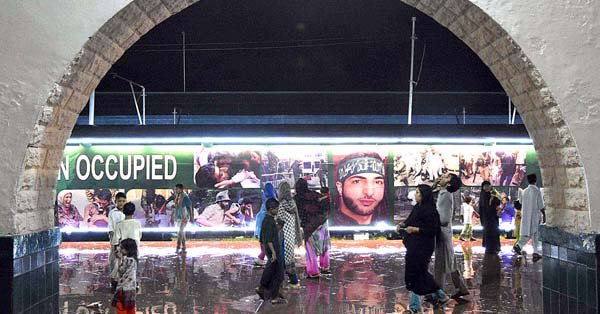
Pakistan puts portrait of U.S. designated terrorist on celebratory train

As part of Independence Day celebrations, Pakistan ran a special ‘Azadi’ train from Islamabad on August 12 which reached the central city of Lahore on August 16th. The ‘Azadi’ or Freedom train had floats and carriages showcasing culture and traditions of the different provinces of the country. The train also had a special carriage dedicated to Hizb-ul-Mujahideen commander Burhan Wani, who was killed last July in a gun battle with Indian forces.
The statement released by the U.S. State Department said:
These designations seek to deny HM the resources it needs to carry out terrorist attacks. Among other consequences, all of HM’s property and interests in property subject to U.S. jurisdiction are blocked, and U.S. persons are generally prohibited from engaging in any transactions with the group.
Formed in 1989, HM is one of the largest and oldest militant groups operating in Kashmir. Hizbul Mujahideen is led by Specially Designated Global Terrorist Mohammad Yusuf Shah, also known as Syed Salahuddin. Hizbul Mujahideen has claimed responsibility for several attacks, including the April 2014, explosives attack in the state of Jammu and Kashmir, which injured 17 people.
Last month, on the first anniversary of Wani’s death, Pakistan Prime Minister Nawaz Sharif paid tributes to the militant commander and said that his death “infused a new spirit in the struggle for freedom” in the Kashmir Valley. Pakistan Army chief General Qamar Javed Bajwa also praised the militant commander in a statement released through his spokesperson he said:
"Kashmiris hv rt of self determination.Sacrifices of & generations agst Indian atrocities are a testimony of their resolve"COAS pic.twitter.com/BP7xU2kL1M

https://www.rabwah.net/pakistan-puts-portrait-u-s-designated-terrorist-celebratory-train/ 

In South Asia, mixing religion with politics has produced a toxic, explosive mess


By Pervez Hoodbhoy


INDIA and Pakistan have more influential holy men per square mile than anyone has ever counted. Some are just rich, others both powerful and rich. Once upon a time their followers were only the poor, superstitious and illiterate. But after the massive resurgence of religion in both countries this base has expanded to include politicians, film and cricket stars, and college-educated people who speak English and drive posh cars.
It is rare for an Indian holy man to bite the dust but one just did. The self-styled messenger of God, Ram Rahim Singh of Dera Sacha Sauda was convicted of two rapes by an Indian court. He is also accused of 52 other rapes, two murders, and storing 400 pairs of testicles in his refrigerators cut from 400 devotees on the promise of getting them nirvana. An avid Modi supporter, Singh travelled in entourages of 100-plus cars and claims 50-60 million followers. Vote-hungry politicians have touched his feet and done deals. After his conviction his crazed followers rioted, convinced of a conspiracy against their God. So far 38 people have died, hundreds injured, cars and public buildings set on fire.

But although Singh is one of India’s bigger holy men he is still small, dispensable fry. The really powerful ones are those who have learned the value of using religion in national politics. Today India is living out the extremist Hindutva ideology of Gowalkar and Savarkar with a head of government who is unabashedly committed to Hindu supremacy. This holy man’s clear and evident role in the communal riots of Gujarat in 2002 had led to his being banned from entering the US in 2005. However, no Indian court could find any wrongdoing committed by the then chief minister, now prime minister. Religion in politics produces a highly toxic, explosive mix.
Pakistan’s holy men also come in two sorts. The pir resembles the Hindu and Sikh spiritual guru in some respects. He hands out amulets, prescriptions, and blessings — usually for a hefty price — to credulous mureeds (followers). Pirs allegedly have magical healing powers. For example, Benazir Bhutto was a mureed of the prescient Pir Pinjar, a man who claimed to cure terminally ill patients by spraying water on them with a garden hose. Her husband, ex-president Asif Ali Zardari, had a black goat sacrificed daily on the advice of his pir. But educated Muslims increasingly spurn such practices and the pir is losing out.
The second kind of Pakistani holy man — the mullah — has had a very different trajectory. Once a poor and largely harmless cleric, he was the butt of many a joke. Sought only for funerals and Friday prayers, he eked out an existence by teaching the Quran to children. Allama Iqbal heaped scorn upon him: Teri namaz main baqi jalal hai na jamal (The prayers you lead are empty of grace and grandeur), Teri azaan main nahin meri sehr ka payam (Your azan is cold and uninspiring).
But the Soviet invasion of Afghanistan in 1979 changed the mullah’s fortunes. Indispensable to the US-Pakistan-Saudi grand jihad alliance, this once pathetic figure could now be seen driven around in a SUV, commanding a militia, or screaming through multiple turbo-charged loudspeakers. Some eventually became successful land-grabbers, wheeler-dealers, and shady entrepreneurs. Few Pakistanis will fail to recognise the identities of Maulana Diesel, Maulana Whiskey, and Mullah Disco.
Serious conflict between mullah and state came after 9/11. Gen Musharraf’s apparent surrender to America enraged the mullah, who resolved to seize control of the Pakistani state. Ensconced in the heart of Pakistan’s capital, armed vigilante groups from Islamabad’s Red Mosque and Jamia Hafsa took over a government building, in January 2007. They kidnapped ordinary citizens and policemen, and repeated the demands of tribal militants fighting the Pakistan Army. From their FM station they broadcast a message: “We have weapons, grenades and we are expert in manufacturing bombs. We are not afraid of death.” Islamabad turned into a war zone and, by the time the insurrection was finally crushed, 150-200 lives had been lost.
Pakistani courts have failed to convict our holy men (as well as women). For example, Maulana Aziz and Umme Hassan (his wife, who headed Jamia Hafsa) were exonerated of any wrongdoing and are today going about their normal business. The court had ruled that possession of heavy weaponry by the accused could not be proven. It dismissed TV footage that showed Aziz’s students with gas masks firing Kalashnikovs. Weapons seized by the army and placed in a police armoury disappeared mysteriously. Although 10 of Pakistan’s crack SSG commandos died in the crackdown, the army — known for quick action in Balochistan — also did not pursue the case.
Why have Indians and Pakistanis become so tolerant — nay, supportive — of holy men, whether of the spiritual or political kind? Why are those who aspire to power so successful in using religion to motivate their electorates? After all, this is the 21st century, not the 12th.
The culprit could be modernity. Technology has created enormous psychological distress by doing away with traditional ways of living and bringing in a new, uncertain and ever-changing world. Older forms of associations such as the extended family and village community, together with their values, are disappearing. Cramped living conditions, pollution, ugliness all around, and job insecurities are a fact of life for most urban dwellers.
There is enormous nostalgia for the time when the world was supposedly perfect. This is why people looking for simple answers to today’s complex questions eagerly buy the wares peddled by holy men. Just as Hindutva encourages Indian Hindus to dream of the ‘authentic’ India, Muslim clerics tell their followers to dream of reclaiming Islam’s ancient glories.
But this is clutching at a straw. It gets far worse when religion is infused into politics. This produces a highly toxic, explosive mix as large masses of people blindly and unquestioningly follow holy men. Instead of dividing people still further, whether inside or outside national boundaries, South Asian states should aspire towards becoming a part of cosmopolitan world society removed from the prejudices of religion, caste and race.

Bilawal Bhutto urges faithful to reach out to the poor on Eidul Azha


Pakistan People's Party (PPP) Chairman Bilawal Bhutto Zardari has felicitated the faithful throughout the world, particularly those in Pakistan, a blessed and peaceful Eidul Azha. "May the bliss and blessings of Eidul Azha remain with you," the PPP chairman said in a message on the occasion.
"Eidul Azha is a reiteration to uphold the value of sacrifice for the good of all. It is a reaffirmation of unity of action in an imperishable bond of brotherhood. It is an occasion to reach out to the deprived, dispossessed and less fortunate ones among us in a spirit of compassion and solidarity." He added, "At a time when our society is faced with challenges of violent extremism, internal displacements and division we need to draw on our common humanity to build a better world for all."

http://dailytimes.com.pk/pakistan/02-Sep-17/bilawal-urges-faithful-to-reach-out-to-the-poor-on-eidul-azha

Pakistan's former military dictator Pervez Musharraf an absconder


A Pakistani anti-terrorism court (ATC) announced the verdict in Benazir Bhutto murder case today, acquitting five Tehreek-i-Taliban Pakistan (TTP) suspects and announcing 17-year imprisonment for two police officials.
The ATC also declared former military dictator Pervez Musharraf an absconder in the case. The ATC had named Musharraf in the case in February 2011. The judgment came nine years after Bhutto, the two-time Oxford-returned Prime Minister was killed in a gun and suicide attack during election campaign in December 2010.
Bhutto's younger daugther Aseefa tweeted after the verdict, "10 years later and we still await justice. Abettors punished but those truly guilty of my mothers murder roam free." In another tweet, she said "there would be no justice until Pervez Musharraf answers for his crimes".
Saud Aziz, who was police chief of Rawalpindi when Bhutto was assassinated in 2007, and Khurram Shahzad, a former Superintendent of Police (SP) were each awarded 17 years in prison. The two, who were out on bail, have already been arrested, English newspaper Dawn reported.
The two former policemen have each been awarded 10 years in prison and seven years each. They have also been fined Rs500,000 each; in case they do not pay the fine, they will have to spend another six months in jail, said the court. The five TTP suspects - Rafaqat Hussain, Husnain Gul, Sher Zaman, Aitzaz Shah and Abdul Rashid - have beean cleared of all charges in the murder trial. Court has directed authorities to seize Musharraf's properties and issue perpetual arrest warrants for the former dictator.
A joint investigation team implicated Musharraf in the case saying that his government did not provide adequate security to the former Prime Minister despite her repeated requests.
Apart from Musharraf, five other men - Baitullah Mehsud, Ahmad Gul, Iqramullah, Abdullah, and Faizullah - have been declared absconders. The TTP chief Mehsud, who was accused by Musharraf regime of masterminding Bhutto's assassination, died several years ago in a US drone strike in tribal Pakistan.
The special prosecutor in the case Chaudhry Zulfiqar Ahmad was killed by unknown assailants in Islamabad in 2013. Doctors said he had been killed with 10 bullets targeting his chest and shoulder. Saud Aziz and Khurram Shahzad, who had been released on bail in 2011, were accused of negligence in security arrangements which subsequently led to the assassination of the ex-Prime Minister.

Why it's unlikely that Benazir Bhutto’s assassination will ever get any closure


VIVEK KATJU


Almost 10 years ago, on 27 December 2007, former Pakistan prime minister Benazir Bhutto was assassinated by a 15-year-old suicide bomber as she addressed an election rally in Rawalpindi.
On 31 August, 10 years later, the five accused in the case, all members of the Tehreek-e-Taliban-e-Pakistan (TTP), have been acquitted by an anti-Terrorist court on the grounds that the evidence presented against them was either unsustainable or fake.

The court, however, sentenced two senior police officers - Saud Aziz, the then city police chief of Rawalpindi, and Khurram Shahzad, who was the SP of Rawal Town area where the terrorist attack occurred - to jail. Both have been held guilty of concealing information regarding the expected attack and for criminal negligence for ignoring threats to Benazir Bhutto’s life, for which they have been sentenced to 10 years in prison.
Both have also got been sentenced to another seven years - to be served concurrently - for virtually destroying all the evidence at the crime scene.

MUSHARRAF'S ROLE

The court went a step further and declared General Pervez Musharraf, who was Pakistan’s president in December 2007 after handing over the army chief’s baton to General Ashfaq Kiyani only a month before, a fugitive and charged him with murder in the case.
As he chose to not present himself before the court, Musharraf has been declared a proclaimed offender. The court ordered that his property to be seized and a perpetual arrest warrant to be issued against him.
This is not the first time that a Pakistani court has declared Musharraf as a proclaimed offender. Musharraf faces a number of cases, including for the murder of Baluchi leader Nawab Akbar Bugti, as also for treason for declaring an emergency and suspending the constitution in 2007.
In fact, in a case relating to the arrest of judges in 2007, when the Islamabad High Court ordered his arrest in April 2013 while he was physically present in court, his army guards whisked him away and later he has put under house arrest.
Will this verdict impact the future of the Peoples Party, Musharraf, besides the politics of Pakistan? Does it shed any light on the Pakistan judicial system?
Before seeking an answer, it would do well to take a peep at the circumstances that prevailed around the time of Benazir’s assassination.

LOOKING BACK

From mid-2006, Musharraf and Benazir Bhutto, who was in exile abroad, were in contact regarding the country’s political future. This was despite Musharraf’s strong personal dislike for her.
As Musharraf’s power waned in 2007 starting with the lawyers agitation because of the dismissal of Pakistan’s Chief Justice Iftikar Chaudhari, the US intervened to hasten an understanding between Benazir and him so that the former could return to contest elections and Musharraf become a civilian president.
Musharraf agreed but was unhappy about her return.
During the Benazir murder trial, US journalist and a Benazir confidant Mark Siegal said that he was with her when she received a call from Musharraf in September 2007 when he threatened her with “dire consequences” if she returned to Pakistan.
When she said that he would be responsible for her security, he told her that would depend on their “mutual understanding”. A few weeks later, when she landed in Pakistan, terrorists attacked her procession from the airport. More than 130 persons died, but she escaped. Despite the attack, her security was not effectively enhanced by Musharraf. After the assassination, this naturally fuelled suspicion of the Musharraf’s negligence if not complicity.

CONDEMNATION

In an extraordinary move, the Pakistan Peoples Party (PPP) government asked the UN to set up a committee to examine the circumstances of the assassination.
It concluded that there were “elements within the establishment” who were her “potential foes” and therefore held that the government was too quick to blame the TTP for the crime. It did not point to any individual or group as sponsors or organisers of the assassination but was scathing in its condemnation at the inadequate security arrangements and at the destruction of evidence of the crime.
Benazir Bhutto's family has criticised the judgment. Bilawal Bhutto tweeted that the release of terrorists is unacceptable and that all abettors should be punished.
Her daughter Aseefa even targeted Musharraf. While the family’s disappointment and the PPP’s anger is justified that none of the conspirators and instigators have paid for their involvement, it is doubtful if the people of provinces other than Sindh will be bothered by this judgement as the PPP’s political fortunes are at a low ebb.

THE END OF A CAREER

Pervez Musharraf is in exile abroad. He shuttles between London and Dubai. He dreams of returning to Pakistan’s political life. That dream will remain just that. The truth is that no one wants him in Pakistan. He has no public following. His real base, the army, is embarrassed by him. He returned to Pakistan in 2013 despite the army’s advice not to do so.
His Napoleonic ambitions to make a comeback soon crumbled. He was left without power or influence. Soon, he was caught in a web of criminal cases and the army had to restrain Nawaz Sharif and discreetly the judiciary from putting him behind bars. It was only three years later that the generals succeeded in convincing him to leave Pakistan and persuaded the courts and Nawaz Sharif to agree to let him do so. That is where he now remains.
The acquittal of the accused also throws a spotlight on the criminal justice administration of Pakistan. During the trial, eight judges were changed. Clearly no judge till the present Ashgar Ali Khan was willing to take it to a conclusion. No wonder in terrorist cases Pakistan has had to go military courts - the Supreme Court itself has approved this system.

NO CLOSURE

It is unlikely that Benazir Bhutto’s assassination will ever get any closure. It will go the way of killing of the country’s first Prime Minister Liaqat Ali Khan in October 1951 on the same grounds where Benazir met her end. The assassin Said Akbar was declared to be from Afghanistan by Pakistan, but the former denied the claim. He had links with the Pakistani police who killed him on the spot. The story behind that assassination was never revealed.
Very few leaders leave behind a legend of enduring potency which becomes a factor in the political life of a country. Benazir Bhutto, charismatic as she may have been, does not fall in that category.

http://www.catchnews.com/international-news/why-it-s-unlikely-that-benazir-bhutto-s-assassination-will-ever-get-any-closure-79711.html

#BenazirBhutto - Benazir Bhutto murdered again after 10 years


By Hamid Mir


Musharraf was allowed to leave Pakistan again in 2016 by the Nawaz Sharif government and the PPP remained silent. The anti-terror court summoned Musharraf many times to appear but he never appeared.
It took almost ten years for a Pakistani anti-terror court to announce its verdict in the Benazir Bhutto murder case. The Rawalpindi judge Muhammad Asghar Khan acquitted five accused Taliban terrorists, awarded 17-years imprisonment each to two senior police officials for abetting the crime and declared former military dictator Pervez Musharraf absconder. There is deep disappointment among the people after this controversial verdict. They believe Benazir Bhutto has been murdered again. It was expected that the court would not be able to convict Musharraf in absentia and the five main accused released. But I didn’t think that the court would imprison Ex-DIG Saud Aziz and SP Khurram Shehzad; I thought they would be saved by some “powerful people.” But the court has rejected Musharraf’s conspiracy theory and actually reversed it by implicating two police officials. Does this mean that Musharraf is part of the crime? Even as the former dictator enjoys life in London, Benazir Bhutto has returned as a bad nightmare for the former dictator.
I still remember my last meeting with Benazir Bhutto just a few days before her assassination in 2007. She invited me for breakfast at her residence in Islamabad. The breakfast table was laid outside her living area in the garage. Having known her since 1987 I was sure she wanted to say something very important to me and was trying to avoid our conversation from being bugged; hence the outdoors breakfast.
She received me with a smile on her face but looked sad and disturbed. She had survived a suicide attack only two months before in Karachi, on October 18th 2007 when she had returned from exile, in a bomb attack which claimed 180 people. I told her I wasn’t carrying my mobile phone with me. She sent hers inside the house as well. She started her conversation by asking me about my family and then said, “I must confess you were right about my dialogue with Musharraf. It was just a trap. Musharraf only wanted to use me for prolonging his power. He was not serious about restoring democracy. Now this dialogue is over.”
She ordered orange juice for me and lemon and honey tea for herself. She began to eat walnuts with lemon and honey tea. She offered some walnuts to me and said “I am trying to reduce my weight with these, knowing that I may not live a long life”. I immediately responded, May God give you a long life. She expressed concerns about my security. She recalled my first kidnapping in 1990 when she was prime minister and I had filed a story saying that president Ghulam Ishaq Khan was planning to dismiss her. She gave me some “security tips.” For example, “never discuss your travel plans on the phone,” or, “don’t go to public places all alone”. I started laughing and said “you need to be more careful than me, you just survived an assassination attempt”. We toyed with the idea of breakfast. Fried eggs or omelette? Benazir didn’t want any, just brown bread with tea, but she ordered some fried eggs for me. When we had finished eating, she sent her staff away, and asked to be left alone. She placed her glasses on her eyes and said, “Let me tell you today, clearly, that they have decided to kill me. They will kill me soon and they will put the responsibility on the Taliban or the Al Qaeda. But you can name Musharraf as my assassin if I am killed”. I was stunned. I asked why “they” wanted to kill her. She said Musharraf had not wanted her to come back Pakistan before the elections. “I never listened to him. He threatened me on the telephone and said your security is based on the state of our relationship. I was conveyed messages by two foreign governments that I should not go to Pakistan, I will be killed there.” Again, she said, “If I am killed, please name Musharraf as my assassin”. By now I was completely shattered. I told her that Musharraf had banned me from appearing on TV, but that I would definitely write what she had told me. Please be careful, I said, don’t give people another chance to attack you.
She got angry. “They want me to go back (to the west), but I wont leave, this is my country. I will die here”. To cut short the details of this last meeting with Benazir Bhutto it was decided that she would write an email or letter to more than two people and mention Musharraf as her possible assassin. Benazir kept her word. She said she had already written one letter in October 2007 before coming to Pakistan in which she nominated some close associates of Musharraf as conspirators, including former DG ISI Hameed Gul. I told Benazir Bhutto that Hameed Gul was no more a close associate of Musharraf, that he started opposing him publically. She agreed and never mentioned his name in the last letter sent to some close friends. The same afternoon she went to Lahore. She met some more journalist friends including my brother Amir Mir and told him the same thing, that he should name Musharraf as her assassin if she was killed. She was sure her days were numbered. She never allowed her husband and children to come back to Pakistan. They were living in Dubai at the time. Her husband Asif Ali Zardari was regularly in touch with me on phone. He was also concerned about his wife’s security.
Zardari once told me that he tried his best to stop her for returning to Pakistan and even begged her by touching her feet not to risk her life, but she never listened. She told him “I looked after the children in Dubai for many years when you were in jail, now its your turn. I am going back to Pakistan”. She even wrote her last will in her own handwriting before returning home. Certainly, Benazir did her homework. She wrote to her trusted friend in the US, Mark Siegel, and told him that Gen. Pervez Musharraf would be her assassin. Mark Siegel was told to share the letter with BBC or CNN in case of another attack on her life. Mark Siegel shared that letter with Wolf Blitzer of CNN on December 27th 2007.Within few minutes of her assassination CNN informed the world that Benazir Bhutto had named Musharraf as her assassin. Musharraf’s government, meanwhile, nominated Taliban terrorist Baitullah Mehsud as the mastermind behind her assassination, but he denied it. In fact, he sent a message to Benazir through a Senator from South Waziristan, Saleh Shah, that he was not planning any attack on her life. The Musharraf government claimed to arrest some boys who facilitated the suicide bomber on December 27th in Rawalpindi but in reality these boys were already in the custody of security agencies before the attack on Benazir Bhutto. The crime scene was washed immediately after the attack on the orders of two police officials. These officials got orders from a close subordinate of Musharraf. They never disclosed his name and faced harsh imprisonment in the end.
I fulfilled my promise too. I wrote about my last conversation with her after her assassination. When the ban was lifted from me and I returned to Geo Television in 2008 I made an investigative documentary on the assassination of Benazir Bhutto which was aired a few days before her first death anniversary. I highlighted Musharraf as the main accused. Unfortunately the People’s Party government never showed any seriousness about her murder investigation till August 2008 when Musharraf was forced to resign. Musharraf quit, but not before he had been felicitated with a guard of honor in President House; meanwhile, the PPP Govt never tried to stop the main accused. Musharraf escaped from Pakistan very easily. The PPP government was left facing the pressure from the public and media to investigate the murder of its late chairperson.
Baitullah Mehsud was killed in a US drone attack in 2009. A UN Inquiry Commission approached me in 2010 for recording my statement, the only journalist to do so. The commission accused Musharraf of failing to provide adequate protection for Benazir Bhutto. It pointed a finger towards former DG military intelligence Nadeem Ejaz who ordered the police to wash the crime scene immediately. Musharraf was included as a suspect in that case in 2010.He was declared an absconder in 2011.He came back to Pakistan in March 2013 to participate in elections. He tried to hijack the MQM but failed. He appeared in court in the Benazir murder case once in April 2013 and the court gave him four days physical remand, but in the meanwhile prosecutor Chaudhry Zulfiqar was mysteriously killed in Islamabad in May 2013 and Musharraf got bail from court. Musharraf was allowed to leave Pakistan again in 2016 by the Nawaz Sharif government and the PPP remained silent. The anti-terror court summoned Musharraf many times to appear but he never appeared. After more than 300 hearings in 10 years the anti terrorist court released five suspects who were arrested by Musharraf government. Four governments and 8 judges have been changed in 10 years, but the truth is that the main accused, Musharraf, was only declared absconder because in Pakistani law courts cannot convict someone in absentia. Two police officials Saud Aziz and Khurram Shehzad have been each awarded 17 years jail because they were declared the main accused along with Musharraf by a Joint Investigation Team headed by Wajid Zia. The same Wajid Zia headed the JIT in the Panama case and wrote a report against Nawaz Sharif. PPP leaders are today criticizing the court verdict but it’s no more a secret that the PPP never tried to prosecute Musharraf because it was more interested in completing its five-year term in power, by pleasing the powerful establishment which never wanted Musharraf’s prosecution. The PPP actually gave a clean chit to many suspects who were named by the UN Commission.
The PPP failed to complete the murder investigation and the people of Pakistan refused to give their vote to the PPP. Today, the PPP is trying to play the victim card by criticizing the court verdict. Benazir Bhutto is definitely a victim who never sought justice even ten years after her assassination, but the PPP leadership is not a victim. They played the role of collaborators by facilitating Musharraf to run away from this murder case again and again. Now the two accused police officers will challenge the verdict in high court and new hearings will start with some new facts.
The PPP will have another chance to follow the main suspect. Will they demand to arrest Musharraf through Interpol and produce him in a court of law. He is also required in a treason case. He may escape a final verdict from the court of law but he cannot escape it from the court of history. He is an assassin. He was not declared assassin by a court of law but Benazir Bhutto named him as his assassin. History will remember him as a killer of Benazir Bhutto and democracy.

http://indianexpress.com/article/opinion/benazir-bhutto-murdered-again-after-10-years-pakistani-anti-terror-court-verdict-on-assassination-pervez-musharraf-4824788/

#BenazirBhuttoMurderCase - Zardari vows to appeal against Benazir murder case verdict


Former president Asif Ali Zardari on Saturday vowed that the Pakistan Peoples Party (PPP) will appeal against the decision in the Benazir Bhutto murder case.
Speaking to reporters after Eid prayers here earlier today, Zardari expressed his dissatisfaction with the verdict in the murder case of his deceased wife.
“We are not satisfied with the verdict, we will appeal against it,” he said.
The former president reached Nawabshah on Friday to celebrate Eid-ul-Azha, accompanied by his daughters Bakhtawar and Aseefa Bhutto Zardari.
He was welcomed by Sindh law minister Zia Lanjar and other PPP leaders.
In his Eid message, Zardari said the occasion symbolises the willingness to sacrifice for a cause, and urged people to pledge to live and strive for a cause larger than one’s own self.
He also felicitated Muslims throughout the world and particularly those in Pakistan. “On this occasion I also call upon my countrymen to remember those who have laid down their lives.. we owe a deep debt of gratitude to them,” he added.
The PPP earlier this week rejected the Anti-Terrorism Court’s (ATC) decision in the Benazir murder case as “disappointing” and said that it will explore legal options to challenge the decision.
A meeting presided by party chairman Zardari held consultations on the verdict and expressed shock and disappointment at the decision.
The party in a statement said that justice was not done in the case, adding that acquittal of Al-Qaeda and Taliban suspects despite evidence is shocking and apparently a victory for the Al-Qaeda militants.
The identity of those who ordered to clean the incident and removal of evidence was not determined, the statement said.
The leadership argued that the government had filed a case without taking the party into confidence and asked it to appeal the decision.

RUNA LAILA - AAP FARMAYEN KEYA

Punjabi Music Video - Akh Lari Baddobadi

Afshan Zebi - Lokan do do yaar banaye

Pashto Music Video - Muneeba Shah - Za Dera Nazaka Yam

Pashto Eid Song - Dus Khushi Ba Manay

MEHDI HASAN - EID KA DIN HAI -

Khabi To Tum Ko Yaad Aaeingi - Ahmed Rushdi (Chakori)

Kiya Hai Jo Pyar To Parday Ga Nibhana - Ahmed Rushdi

Tumhi Ho Mehboob Mayray - Irene Parveen

Wada Karo Sajna - Film Aina - Nadeem & Shabnam