Friday, June 23, 2017

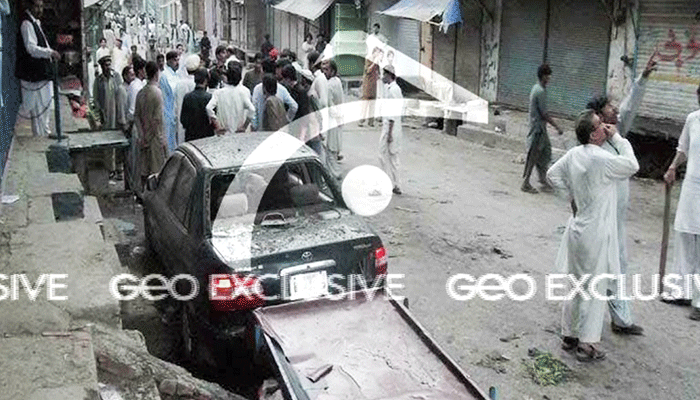
SAUDI REGIME RESPONSIBLE - Pakistan - 35 SHIA MUSLIMS MARTYRED IN TWIN EXPLOSIONS IN PARACHINAR

At least 35 Shia Muslims were martyred and over 100 injured, with fears of casualties rising, after two subsequent explosions hit a densely populated Shia majority area of Kurram Agency's Parachinar city Friday evening. The death toll was confirmed by hospital sources, who warned that the number of casualties may rise. 
Parachinar, with a population of more than 50,000, has been under strict security arrangements for quite some time. Army and paramilitary personnel have set up checkpoints on all routes leading to the town and visitors and vehicles go through extensive search and identification process.
On March 31 this year, the city had suffered a similar tragedy when 23 people were killed in a car bomb blast near an Imam­bargah at midday. More than 70 others were wounded in the attack. Another person had died later after security forces opened fire on a crowd trying to hold a demonstration in front of the political agent’s office in protest against increasing terrorist attacks.
In January this year, 25 people were killed and 87 others suffered injuries when a bomb went off during peak business hours at a crowded vegetable market in the city. In what appeared to be a sign of growing cooperation among extremists, two banned groups had come forward to claim the deadly assault, with one describing the incident as a suicide attack.

This was the second major bomb attack today. Early morning, at least 13 people ─ including seven policeman ─ lost their lives, while 19 others were injured in a suicide blast that shook Shuhada Chowk in Quetta's Gulistan Road area.
Local political administration officials said the twin blasts occurred in the Turi Market near Tal Adda, where a bus terminal is also located. The second explosion targeted rescuers and bystanders who rushed to aid those who had been hurt in the first blast. The nature of the explosions has not been ascertained as yet. But, security officials didn’t rule out the possibility of suicide bombings.
The explosions targeted people shopping in the area and those heading out of the city ahead of Eid-ul-Fitr, administration officials said.
Following the blast, security forces cordoned off the affected site and conducted a search operation in the surrounding areas, with the army dispatching helicopters from Peshawar to Parachinar "for the speedy evacuation of the injured to Peshawar," according to a statement issued by the military's media wing.
Parachinar, with a population of more than 50,000, has been under strict security arrangements for quite some time. Army and paramilitary personnel have set up checkpoints on all routes leading to the town and visitors and vehicles go through extensive search and identification process.
On March 31 this year, the city had suffered a similar tragedy when 23 people were killed in a car bomb blast near an Imam­bargah at midday. More than 70 others were wounded in the attack. Another person had died later after security forces opened fire on a crowd trying to hold a demonstration in front of the political agent’s office in protest against increasing terrorist attacks.
In January this year, 25 people were killed and 87 others suffered injuries when a bomb went off during peak business hours at a crowded vegetable market in the city. In what appeared to be a sign of growing cooperation among extremists, two banned groups had come forward to claim the deadly assault, with one describing the incident as a suicide attack.

http://www.shiitenews.org/index.php/pakistan/item/29194-at-least-35-shia-muslims-martyred-in-twin-explosions-in-parachinar

Qatar Crisis And Pakistan – OpEd

Saudi Arabia, the United Arab Emirates, Bahrain and Egypt released coordinated statements, announcing a diplomatic break ties with the tiny-yet-wealthy peninsular nation of Qatar. They cut air, sea and land links and ordered Qatari officials and nationals stationed in their countries to return home. The move is a reflection of long-running frustrations with the Qataris, who the Saudis and Emiratis claim are supporting terrorist groups as well as being far too cordial with Iran, their regional archrival. Qatar’s Foreign Ministry called the measures “unjustified” in a statement and said the decision to sever ties was a violation of the country’s sovereignty, and “based on claims and allegations that have no basis in fact.”
A complicated and uncertain state of affairs is playing out, with far-reaching stakes — Qatar, after all, is home to a crucial forward base for the U.S. Central Command saw this as a key moment after Trump’s visit to bring Qatar to heel. The crisis of Gulf is a concern for the entire Islamic world but it entails some serious economic political ramifications for Pakistan if deepened. Keeping in mind Pakistan’s strong ties with Saudi Arabia Pakistan has always maintained neutral ties with Gulf States at the time of disputes. Thus Pakistan has to go through a tightrope in the situation like Qatar and Saudi Arabia amid crisis.  The UN human rights chief said Wednesday he was alarmed by the possible impact of the diplomatic isolation of Qatar, warning it could lead to widespread suffering among ordinary people.
Saudi Arabia and its key allies have led to air, sea and land blockade. Cutting ties with Qatar has placed Pakistan in a very difficult situation. Pakistan relations with Gulf States have generally been good and exceptionally good with UAE and Saudi Arabia due to major source for remittances and the trend have shown upward trend. Pakistan appears unlikely to face any immediate and sizable economic impact because of the diplomatic blockade of Qatar by Saudi-led Arab nations.
Pakistan commercial ties with Qatar aren’t that strong as with Other Gulf states the present Government has also hoped that it could send more Pakistani workers to Qatar as it prepared to host the soccer world cup in 2022. Though Pakistan is unlikely to wade Gulf Crisis it could pose challenges to the policy makers. Last year Pakistani government unanimously turned down the request to contribute troops announced that they were suspending air, sea, and land transport with Qatar, while Qatari citizens are required to return home within two weeks. Pakistan’s exports to Qatar have maintained a steady decline over the year from $79m in 2012 to $63m last year, accounting for less than 0.5pc of the country’s total exports. This is a fraction of more than $25bn Qatar spends a year on imports from the world.
There has been no effort to ascertain if the Middle East tussle can open any business or trade opportunity for Pakistan.
This was apparent from a response from the federal ministries. Foreign Office Spokesman Nafees Zakaria was unable to say if the Qatar situation could in any way affect Islamabad or if there was any concern for possible loss of trade and jobs in Qatar, at present, or in case of escalation of tension in the Middle East. At least, the relevant government agencies give an impression as if the situation was a non-issue. There has also been no effort on part of the government agencies or the private sector to ascertain if the Middle East tussle can open any business or trade opportunity for Pakistan — like Turkey and Iran appeared to be doing — as Qatar looks around to meet food requirements arising out of the Saudi blockade of its airspace and trade routes.
But the problem is that Qatar is just too bold, too often. The core issue presently is Qatar’s support of Islamists around the Middle East region, which emerged quite evident during the Arab Spring. This is as much a result of the personalised politics of Qatar’s foreign policy and elite bureaucracy as it is an active decision by Qatar to support Islamists. Moreover, Qatar argues vociferously that it does not support Islamists because the state prefers to, but because such groups like the Islamist Muslim Brotherhood enjoy significant public support.
But what might this mean for Qatar’s economy and people doing business there? With a population of about 2.7 million people, this tiny nation on the north-east coast of the Arabian Peninsula is trying to punch above its weight. Abu Dhabi’s Etihad Airways and Dubai’s Emirates are suspending all flights to and from Doha. Both carriers operate four daily return flights to Doha.
Budget carriers FlyDubai and Air Arabia are also cancelling routes to Doha, with other airlines, including Bahrain’s Gulf Air and Egypt air expected to follow suit.I t comes after Saudi Arabia, the UAE, Bahrain and Egypt all said they would stop flights in and out of Qatar, and close their airspace to the country’s airline, Qatar Airways. And it is Qatar’s flag carrier that risks being the biggest loser. Its flights to places like Dubai, Abu Dhabi, Riyadh and Cairo will stop.Qatar Airways passengers in Abu Dhabi vent frustration
Desert states, by their nature, struggle to grow food. And food security is a particular issue for Qatar given the only way in by land is a single border with Saudi Arabia. Every day hundreds of lorries cross the border, and food is one of the main supplies. About 40% of Qatar’s food is believed to come via this route.Saudi Arabia has said it will close that border and when the lorries stop, Qatar will become reliant on air and sea freight.
A new port, a medical zone, a metro project and eight stadiums for the 2022 World Cup are just some of the major construction projects going on in Qatar right now. Key materials, including concrete and steel come in by ship but also by land from neighbouring Saudi. The closure of that border could, as with food – push up prices and lead to delays. A materials shortage is already a threat that looms over Qatar’s construction industry. This risks making things worse.

اسفندیار ولي: چین باید د پاکستان او افغانستان په منځ کې ضامن شي

دا خبره اسفندیار ولي خان د جمعې په ورځ له مشال راډیو سره د ځانګړې مرکې پر مهال وکړه.
نوموړي وویل ، موږ وړاندې هم ویلي دي چې مسله هغه وخت هوارېدای شي چې چین یوازې د سهولت کار نه بلکې د ضامن په توګه را وړاندې شي.
اسفندیار ولي خان زیاته کړه چې پاکستان پر افغانستان او افغانستان پر پاکستان د وعدو نه پوره کولو تور پورې کوي نو په کار ده چې په منځ کې یې یو زورور دریمګړی کښېني.
د پاکستاني وزیراعظم د بهرنیو چارو سلاکار سرتاج عزیز مشال راډیو ته ویلي وو چې د پاکستان او افغانستان ترمنځ جګړه نه ده روانه چې چین منځګړتوب وکړي بلکې هغه د یوه سهولتکار په توګه راوړاندې شوی دی.
د سفندیار ولي په وینا ، امریکا هم په دې لړ کې مهم رول لوبولای شي خو چین به ځکه زیاتې هڅې کوي چې دلته یې په اربونو ډالر پانګونه کړې ده او که دا ساتل غواړي نو به په سیمه کې د امن راتله باوري کوي.
اسفندیار ولي خان زیاته کړه چې پاکستان له هند سره له لومړۍ ورځې په شخړه کې دی ، له افغانستان سره یې هم اړیکې خرابې دي او اوس یې له ایران سره هم تاوتریخوالی راغلی دی.
نوموړي دا خبره په داسې وخت کې کړې ده چې د پاکستان پوځ د سېشنبې په ورځ اعلان وکړ چې له افغانستان سره پر پوله یې د اغزن تار لګولو کار پیل کړی دی.
د پاکستاني پوځ د عامه اړیکو څانګې په یو خبرپاڼه کې وویل چې په لومړي پړاو کې به دا باړ په باجوړ ایجنسۍ ، مومند ایجنسۍ او خیبر ایجنسۍ کې ولګول شي.
خبرپاڼې دا هم لیکلي چې د دفاع او څارنې زیاتولو لپاره به پر پوله نوي بندرونه او سرحدي چوکۍ هم جوړې شي.
د افغانستان د قبایلو او سرحدونو د چارو سرپرست وزیر غفور لیوال مشال راډیو ته وویل چې افغان حکومت د پاکستان دا ګام نه مني.
بل پلو د پاکستان د بهرنیو چارو دفتر د پنجشنبې په ورځ د دې پخلی وکړ چې د تېرې اونۍ په پای کیې یې د بلوچستان په پنجګور سیمه کې د ایران یو بې پیلوټه الوتکه را غورځولې ده.
اسفندیار ولي خان وویل ، پاکستان باید دا ومني چې له لومړۍ ورځې تر اوسه یې بهرنۍ او کورنۍ دواړې تګلارې ناکامه شوې دي او په کار ده چې جاج یې واخلي او له سره یې جوړې کړي.
د پاکستان پر کورنۍ تګلاره د نیوکې پر وخت هغه وویل ، دا خبره د پاکستان په نشنل ایکشن پلان کې شامله وه چې قبایلي سیمې به په خیبر پښتونخوا ګډوي خو تر اوسه پرې عمل ندی شوی.

https://www.mashaalradio.com/a/28575053.html

Pakistan Still Suffering from the Delusion That It Can Control the Taliban


By Russ Wellen, June 3, 2016.
Pakistan cracks down on its militants to control, not extinguish, their movements.
Nobody deserves to be the victim of a drone strike, even Mullah Akhtar Muhammad Mansour, the leader of the Afghan Taliban. Even if, as John Feffer wrote in Foreign Policy in Focus last week, citizens of FATA (the Federally Administered Tribal Areas), however counterintuitively, actually favor drone strikes. Perhaps that’s because the Pakistani government doesn’t seem up to the task of rolling back the Taliban.
In the New York Times, Mark Lander and Matthew Rosenberg describe how, like most leaders of terrorists groups that states sponsor, trying to control Mullah Mansour was like holding a tiger by the tail. Pakistan had cultivated him for years, and he was widely seen as its choice to lead the Taliban after the 2013 death of Mullah Muhammad Omar, the founder of the insurgency movement, was revealed last year.
But once installed, he resisted Pakistani efforts to put up even the appearance of being willing to take part in a peace process.
Which, of course, was a problem for the United States, as well.
As a result there was growing American pressure on Pakistan to crack down on Taliban leaders who take shelter there — and a growing sense within Pakistan’s security establishment that Mullah Mansour was proving too independent, and thus expendable. A senior American defense official said that another factor in Pakistan’s decision to provide some limited help in tracking down Mullah Mansour may have been that one of his deputies, Sirajuddin Haqqani, has deep and longstanding ties to Pakistan’s main spy service, the Directorate of Inter-Services Intelligence.
Mr. Haqqani, who leads a Taliban faction that is widely seen as one of the most violently effective parts of the insurgency, may prove more willing to take cues from Pakistan’s military leadership and the ISI.
It’s truly distressing that at this late day, Pakistan still believes that the Taliban can be managed. I had thought Pakistan was putting those days behind it.

Bilawal Bhutto strongly condemns terrorist attacks in Parachinar and Quetta

Chairman Pakistan Peoples Party Bilawal Bhutto Zardari has strongly condemned the terrorist attacks in Parachinar and Quetta on the holy Jumatul Vida adding that the ghastly terror attacks have shocked the entire nation.
In a statement issued here, the PPP leader said that destruction of terrorism was the only target that this nation can aim and destroy it for the survival and protection of the current and future generations.
Bilawal Bhutto Zardari said being itself a victim of terrorism, his Party leadership and workers understand the depth of pain which the grieved families are undergoing. He expressed complete solidarity and sympathy with the victims’ families of Parachinar and Quetta blasts.
PPP Chairman stressed for best medical treatment to the injured of the three blasts and prayed for their early recovery.

Pakistan: 11 dead after car bomb near police chief's office in Quetta


A powerful car bombing near the office of the provincial police chief in southwestern Pakistan on Friday has killed 11 people and wounded 20, officials said.
The explosion near the police chief’s office in Quetta, the capital of Baluchistan province, was powerful enough that it was heard across the city, shattering windows of nearby buildings, said police spokesman Shahzada Farhat.
Wasim Beg, a spokesman at a government hospital, said the death toll from the bombing rose to 11. He said some people remained in critical condition.
TV footage showed several badly damaged cars and a road littered with broken glass.
Anwarul Haq Kakar, a spokesman for the provincial government, said the bomb was planted in a moving car, but officers were trying to determine whether it was a suicide attack.
No one claimed responsibility for the attack but Kakar blamed neighboring India for the blast. He offered no evidence. On Thursday, Pakistan said that an Indian naval officer, Kulbhushan Jadhav, who was sentenced to death by a Pakistani military court on charges of espionage and sabotage, had petitioned for mercy.
Jadhav, who Pakistan said had crossed into Baluchistan from neighboring Iran, was arrested in March 2016 and sentenced to death in April.
In New Delhi, the Ministry of External Affairs insisted Jadhav was sentenced on “concocted charges” and expressed doubts about the existence of the petition for mercy. It also reiterated that the proceedings against Jadhav have been shrouded “in opacity.”
Baluchistan has long been the scene of a low-level insurgency by Baluch nationalists and separatists, who want a bigger share of the regional resources or outright independence, but also other attacks, mostly blamed on the Pakistani Taliban.

At Least 35 People Killed in 3 Bomb Attacks in Pakistan


At least 25 people were killed and dozens wounded on Friday when two back-to-back explosions rocked Parachinar in Kurram tribal agency, officials said.
The twin explosions occurred as people were busy shopping for Iftar and Eid in the Turi Bazaar area, close to a crowded bus terminal. 
The second explosion took place as people rushed to provide aid and rescue the wounded from the first explosion. 
Political administration confirmed that 25 people were killed and at least 100 were injured in the explosions. 
Local official Nasrullah Khan said the first blast detonated as the market was crowded with shoppers.
"When people rushed to the site... to rescue the wounded, a second blast took place," he said, adding that officials fear the death toll would increase.
Shahid Turi, a local lawmaker from the area, also confirmed the death toll.
He added that security arrangements were in place at the time of the attack, as paramilitary forces and Army have set up checkpoints in the area.
"The entire area has check posts set-up and the area is declared as a Red Zone. Turi market is a bit outside of the zone," said Turi. 
Hospital officials confirmed that at least 20 of the wounded the were in critical condition. 
The Army has dispatched two helicopters to evacuate the injured to Peshawar, said a statement released from the Inter-Services Public Relations (ISPR).
The military's media wing added that the "rescue operation is in progress".
Pakistan Army contingents and FC personnel also reached the site of the attack to aid in the rescue efforts.
Officials said emergency had been imposed in all hospitals across Parachinar, the capital of Kurram agency.
Rescue services reached the spot of the explosions and started shifting the wounded to hospitals. Hospital sources said 20 bodies were shifted to the local district hospital while five bodies were shifted to the central Imambargah.  
A cordon was placed around the site of the attack and a search operation has been initiated in the area after the bombings. 

'Terrorists attacking soft targets'

Prime Minister Nawaz Sharif strongly condemned the terrorist attack in Parachinar and directed concerned authorities to increase security across the country.
“Terrorists are attacking soft targets and no Muslim can ever imagine to commit such horrific act,” said the prime minister.
He added that such acts of terrorism will be dealt with the full power of the state.
Nawaz also expressed deep grief and sorrow over the loss of precious lives in the attack. 
Pakistan Tehreek-e-Insaf (PTI) Chairman Imran Khan also strongly condemned the twin blasts in Parachinar and termed it as an attack against the nation. 


Pakistan People's Party Chairman Bilawal Bhutto said his thoughts and prayers are for the bereaved families and strongly condemned the blasts in Parachinar and Quetta. 


The attack in Parachinar was the second terrorist attack in the country. Earlier in the day, a suicide car bomb blew up in Quetta and killed at least 13 people, including six policeman. 
Earlier in March, at least 24 people were killed and more than 90 injured in a bombing outside an imambargah located in a busy Parachinar market.

Thursday, June 22, 2017

What is Pakistan doing to combat terror financing? Not much


M Amir Rana
Ramazan is a time of goodwill and giving — a prosperous season for charities, social initiatives and not-for-profit organisations to raise funds. These funds are then used to bankroll operations around the year. But a chunk of the money collected in the holy month ends up, directly or indirectly, in the hands of banned extremist and terrorist outfits.
No properly investigated or researched estimate of the militant economy exists in Pakistan. Yet, there is strong evidence to suggest that the funds collected by radicals, through public donations, significantly contribute to their resources.
So, then what is the government doing to plug terror financing? For now, it is convinced that rolling out a few advertisements on state television would be enough to sensitise the masses on the issue. It is not. And our lack of seriousness could be brought up this month in Spain as the Financial Action Task Force (FATF), an international watchdog of terror financing, meets to update its assessment of high-risk and non-cooperative jurisdictions.

Pakistan could be in trouble

The challenge of terror financing has three aspects. First, Pakistan is under international compulsion to eliminate cash that makes its way into the coffers of terrorists. Second, despite Pakistan’s war on terror, banned organisations still have access to mechanisms to collect funds inside and outside the country. Third, the state has failed to introduce an effective policy to regulate charity and welfare development sectors.
As far as international commitments are concerned, the government has, in the past, taken a few measures to fulfil its obligations. But a recent Associated Press report points out that the FATF expects more. By some accounts, Pakistan’s actions against the Lashkar-e-Taiba and Jamaatud Dawa (JuD), earlier this year, were prompted by an impending report by the Asia-Pacific Group (APG) on money laundering. The report will be submitted to the FATF, and has apparently raised some objections regarding the financial traffic of JuD.
Also, last year the State Bank of Pakistan instructed all banks in the country to freeze the accounts of 2,021 individuals listed in the Fourth Schedule of the Anti-Terrorism Act, 1997. The bank has also issued new guidelines that aim to prevent the use of the banking sector for money laundering, terror financing and illegal transfer of funds. Moreover, President Mamnoon Hussain has issued an ordinance empowering the Securities and Exchange Commission of Pakistan (SECP) to take adequate measures against fraud, money laundering, and terror financing.
According to media reports, the government is also trying to introduce a law that would require a citizen to disclosure his/her money trail.
These are important steps, but not enough to choke off the flow. The real challenge lies elsewhere – terrorists moving money through informal channels. Few militants use banks to conduct their nefarious missions.
The landscape of Islamic charities in Pakistan is quite diverse, ranging from local-level welfare organisations to national — and regional — level relief groups. People find it easier to donate by hand on a first come, first serve basis.
Then there are the donations that flow in from Pakistanis living in the Middle East, which go directly to religious charities. But the money coming from expats in Western countries is earmarked either for non-religious charities or for handing out at religious shrines. Representatives of banned organisations are also known to travel to the Gulf states during this month to collect donations themselves.
Till now, the government’s focus has largely remained on Western non-governmental development organisations. It has been working around the clock to bring them under a strict monitoring framework. In the meantime, funds from Gulf countries are still flowing to religious and militant groups. The government has even failed to chalk up a list and to identify and publicise charity networks in Pakistan that are clean. The ultimate beneficiaries of this lack of vision are the terrorists.

Pakistani - Christian man in Lahore arrested over allegations of blasphemy


A Christian bicycle mechanic in Lahore was arrested on June 15 over allegations of blasphemy after he became involved in a dispute regarding payment for services rendered to a customer, police said Thursday.
Human rights activist Napoleon Qayyum told Dawn that Ashfaq Masih ─ a resident of Mariam Colony in Green Town, Lahore ─ was working at a repair shop in the Bagarhian suburb of the city when Muhammad Ishfaq, a resident of the same area, had his bicycle repaired by him. The two became embroiled in a heated argument when Masih demanded Rs35-40 for his services and Ishfaq requested that Masih reduce the price as he is a poor man, Qayyum said.
The disagreement escalated when Masih refused to lower the fee, reminding the bicycle owner that he was a poor man himself and needed the money as well, according to the rights activist.
After a crowd gathered to witness the incident, unidentified individuals levelled accusations of blasphemy against Masih, prompting further escalation of the already-tense situation, Qayyum claimed. Police, who were called to the scene, arrived and arrested Masih, shifting him to the Green Town police station.
Station House Officer (SHO) of Green Town police station Wasim Akhtar confirmed to Dawn that a blasphemy case had been registered against Masih on June 15 after his arrest.
The Pak Center for Law and Justice is investigating the case.

Has China taken over Pakistan?


It would be no exaggeration to state, that there has been more written on the China Pakistan Economic Corridor (CPEC) in the Pakistani press over the last two years when the project was initiated, than perhaps any other economic or financial relationship which has affected Pakistan. In this short span of time, more words have been written on what is being called a ‘game changer’, a ‘fate changer’, a project which will transform Pakistan permanently making it part of the developed world, than on the IMF (on which Pakistan has had a huge dependence for 30 years), the World Bank or foreign aid to Pakistan over many decades.
Moreover, the nature of the narrative and the discourse around CPEC, compares very differently with any other financial and economic relationship in the past. Although the US has been Pakistan’s largest donor over 70 years, there has been much criticism of the type of this financial, economic, and subsequently diplomatic relationship, where the US has been seen to be the dominating partner, always asking Pakistan to ‘do more’ for all the monies poured into the country.
Similarly, even though the IMF continues to save Pakistan at critical junctures by providing emergency loans and assistance, no structural adjustment package comes through without much debate and criticism from different sections of society. While there have been some questions raised on the Pakistan-China partnership, the tone and content of discussion has been very different, and even sceptics and those who question some of the terms of the new relationship, concede that much, if not all, is more good, than bad.
The China-Pakistan relationship has always been a very special relationship over the last 60 years, ‘higher than the highest Himalayas, deeper than the deepest oceans’, and more recently ‘sweeter than the sweetest honey’. Just to very briefly summarise the historic nature of the China-Pakistan relationship, one can cite a number of important diplomatic and regional developments which have led to where we are today.
Pakistan was the first Muslim state and third non-communist country to recognise the Peoples’ Republic of China after the revolution. Possibly, the India-China war of 1962 may have been an instigator to developing the relationship much further, built on more substantially by Zulfikar Ali Bhutto, first as Ayub Khan’s Foreign Minister in the mid-1960s, but more aggressively and openly after he became President and then Prime Minister in 1972. After the China-India war, relations between China and Pakistan took on a particularly favourable turn, even in the public (as opposed to the diplomatic) domain.
It has been reported that when Chinese Premier Zhou Enlai visited Pakistan in 1964, the welcoming crowd lifted the vehicle carrying him. Prior to Bhutto becoming Pakistan’s first elected head of government and of state, the facilitation provided by the Yahya Khan government to Nixon and to Kissinger to bring China close to the US in 1970 and 1971, was a particularly important episode, to the extent that the US (and China) both turned a blind eye to the Pakistan armies brutal genocide in the then East Pakistan during the war of liberation for Bangladesh throughout 1971.
Most commentators have made comments based on hearsay, leaks to the press, some press statements and little more. There has been very little public disclaimer about CPEC, yet everyone has already formed at least some opinion.
After his election, Bhutto appeared in public wearing Mao caps and Mao jackets making more than a sartorial statement. It is reported that, ‘at least on one occasion, the entire Bhutto cabinet was photographed decked in Mao coats [jackets]’.Bhutto was said to have ‘injected Chinese culture into Pakistani politics. He would talk at length about Mao in his public speeches’.
Between 1966 and 1980, China provided Pakistan military equipment, apparently without charging any money for it, and set up the Heavy Industries Complex in Taxila, which now is a ‘massive armament industry’, building hardware, with an aeronautical factory building the China-Pakistan JF-17 Thunder jet fighter. Importantly, China also helped develop Pakistan’s nuclear facilities, both for power generation and to build Pakistan’s armed nuclear facilities, helping with the development of Pakistan’s nuclear arsenal.
On numerous occasions when Pakistan was desperately short of funds, the Chinese government has been generous in providing low interest loans. Much of this relationship has been based on Pakistan’s diplomatic support for China, and usually, an anti-India diplomatic initiative, although China is, not surprisingly, Pakistan’s main trading partner where trade is around $10 billion, 16 per cent of Pakistan’s total trade including oil imports.
Moreover, China and Pakistan signed a Free Trade Agreement in July 2007, with some expectations that China-Pakistan trade will reach $20 billion by 2020. It is worth pointing out that by 2015, China had utilised 60 per cent of the Free Trade Agreement concessions, and Pakistan only five per cent. Much of the activity in the past, has often been a quiet, often under-the-radar support to Pakistan, but 2015 changed the dynamics, scale, intensity and complete direction of this old relationship.
Chinese President Xi Jinping arrived in Islamabad in April 2015 bearing gifts worth $ 46 billion, which was given the name of the China-Pakistan Economic Corridor. Over the two years, the size of the ‘gift’ has already grown to $55 billion, with more anticipated over the next few years. CPEC is only one small part (for China) of its global One Belt One Road expansionism, but means almost everything to Pakistan. But what exactly is this CPEC?
Although so much has been written on CPEC, by government officials — there are even two web-sites exclusively for CPEC — by supporters and enthusiasts of the project, and even by critics and detractors, the truth is that very little is actually known about the project. Most commentators have made comments based on hearsay, wishful thinking, leaks to the press, some press statements, and little more. There has been very little public disclaimer about CPEC, yet everyone has already formed at least some opinion.
One academic has at least been honest in saying, that ‘Intellectual honesty demands a stance of neutrality on CPEC till the terms and conditions are disclosed, without which one cannot arrive at an objective assessment of whether it could be potentially beneficial for the country. Only then could one move to the next stage of appraisal, knowing that even potentially beneficial projects of this magnitude have their success depend on many other factors’, yet, speculation and opinion abound. Only after two years of the signing of the agreement, was what is called the Long Term Plan, or Master Plan, for CPEC, developed by the China Development Bank in December 2015, acquired by one journalist, summarised in Dawn on 15 May 2017.
The key components of the Long Term Plan of CPEC are summarised as follows: 
What we know (possibly) 
u Thousands of acres of agricultural land will be leased out to Chinese enterprises to set up ‘demonstration projects’ in areas ranging from seed varieties to irrigation technology. Demonstration projects of more than 6,500 acres will be set up for high yield seeds and irrigation, mostly in the Punjab. This engagement will run ‘from one end of the supply chain all the way to the other’. Chinese enterprises will operate their own farms. Enterprises entering Pakistani agriculture ‘will be offered extraordinary levels of assistance from the Chinese government’. They will get ‘free capital and loans’, and will be supported by the China Development Bank. One reason given for such extensive investment in agriculture is to provide food and cash crops to China’s Xinjiang Autonomous Zone. This has been called the ‘Sino-isation of farming sector’, by Pakistan’s leading business daily.
u One fertiliser plant with a capacity of 800,000 tons will be built, as will a meat processing plant with an output of 200,000 tons annually. Vegetable and fruit processing plants will be set up, as will a grain processing plant of 1 million tons, and a cotton processing plant with an output of 100,000 tons annually. Chinese enterprises will establish factories to produce fertilisers, pesticides, vaccines and foodstuffs.
u The Chinese will invest in, and extract, Pakistan’s mineral resources, particularly gold, copper, marble and coal. They are to set up industries in textiles, household appliances and cement. In the textile sector, the emphasis is ‘yarn and coarse cloth’.
u A fiberoptics cable is to be laid between Kashgar and Gwadar to bring better connectivity through the corridor.
u China will help build an ‘electronic monitoring and control system’ and run a ‘safe cities’ project in Pakistan. This project will deploy ‘explosive detectors to cover major roads, case-prone areas and crowded places in urban areas to conduct real-time monitoring and 24-hour video recordings’. Signals gathered from this surveillance system are to be transmitted to a command centre, but who will man this, whether the Chinese or Pakistani officials, is not clear.
u Chinese nationals are to receive visa-free travel access to Pakistan, with no reciprocal arrangement for Pakistanis to visit China.
u Using Pakistani media, China will disseminate ‘Chinese culture’ in Pakistan, to ‘further enhancing mutual understanding between two peoples and traditional friendship between the two countries’.
The reaction to this news report in Dawn by the minister for planning and development, is worth citing. He accused the author of the article of presenting a ‘nightmare scenario’, and that the original plan was ‘redundant’, although no alternative plan has been made public — the existing (or old) Long Term Plan was also not made public by the ministry, but was acquired by the journalist. The minister, on Twitter, no less, is reported to have said, that the Dawn story was ‘factually incorrect’ and ‘half cooked’, having said that this is the ‘most scrutinised project in the history of Pakistan’.
While the Long Term Plan which has just been made public, gives extensive details, some of the broader aspects of CPEC announced much earlier are still worth emphasising. The minister for planning and development who is in charge of some of the CPEC projects, has stated that of the original $46 billion, $35 billion has been allocated for Independent Power Projects to generate electricity, while $11 billion was for infrastructure development, for roads, airports, railways and the Gwadar Port. A road linking Kashgar and Kunjarab in China, to Gwadar in Balochistan, is one of the main road projects of this Corridor. He has stated that, “the process for infrastructure projects is transparent. The government of Pakistan does not choose contractors; it is China which nominates a panel of credible Chinese companies which take part in the bidding process”.
One must emphasise, that the Pakistan Army, on numerous occasions, has stated that it will ‘do all’ to defend and protect CPEC, and the army will ‘actively guarantee security’ and will fight all Pakistan’s enemies who are out to ‘sabotage’ this project. A special military force of 10,000 personnel is to be raised to protect CPEC.
It is worth pointing out a number of aspects to the deal done with the Chinese, which are already in the public domain. The still incomplete Gwadar Port has been handed over to the Chinese on a forty-year agreement, with the Chinese Overseas Port Holding Company reportedly having a ‘91 per cent share in the gross revenue of terminal and marine operations and 85 per cent share in the gross revenue from operations of the [Gwadar] free zone’.
The Independent Power Projects in Pakistan, which China will be building, as per existing rules for all such projects, enjoy a life-time waiver on corporate tax payments! Moreover, numerous fiscal exemptions and tax benefits have been given to Chinese firms, and according to some sources, ‘Islamabad [is] to award contracts for all CPEC projects to Chinese contractors, who may or may not partner with local firms and may or may not procure material from local manufacturers’.
It is clear that as a result of CPEC, some sort of transformation of Pakistan, is underway. It also seems more than certain that this is a Chinese project, rather than a Pakistani one.
Not simply related to CPEC over the last two years, but certainly compounded by it, some interesting statistics help put the Pakistan-China new and developing relationship into some context. While Chinese goods after the FTA have flooded the Pakistani markets in many categories — tyres, motorcycles, electronics, household consumer goods, plastics, ceramics, to name a few — it is their investments and purchases of key sectors which have emerged in recent years. They own a large mobile telephone company, the Pakistan Stock Exchange sold 40 per cent shares to a Chinese consortium consisting of three companies, with the Shanghai Electric Company interested in buying Karachi’s electricity distributing company, K-Electric. They have also been given contracts to collect garbage from some cities in Pakistan, and providing numerous other services.
According to some estimates, there are 10,000 Pakistani students studying medicine, engineering and other subjects in China, more than there are even in the US. There are reported to be 10,000 Chinese people/workers in the province of the Punjab alone, and around 750 small and large Chinese companies are in business across Pakistan, with 650 Pakistani companies with Chinese directors. 
And what we don’t 
Perhaps the most important thing we don’t know, which many analysts and writers have asked is: What will CPEC cost, now, and later?
No one really knows, since so much information has still not been provided, yet estimates abound. They range from Pakistan having to pay $3-3.5 billion annually back to China for the next 30 years for Chinese loans after 2020, to a probable severe balance of payments crisis.
Ambiguity about what level of Pakistani partnerships in projects are permissible, as well as whether certain areas of investment are exclusively for the Chinese, have emerged. For example, numerous Special Economic Zones are to be set up, and public information suggests that these are only going to be for Chinese firms, which has caused a great deal of concern amongst Pakistani investors who feel that they are not getting a level playing field.
A game changer — for whom?
Moreover, many business interests and chambers of commerce groups have complained to the government of Pakistan that while Chinese investors are getting tax breaks and benefits, local industrialists in the same field, are not. They feel that Chinese competition is tough as it is, affecting local industry, but once the Chinese arrive with far better terms, local producers will be completely wiped out. The government and their spokespeople keep reassuring local industrialists that nothing of the sort will happen, but there is great apprehension.
Sovereign guarantees to Chinese power producers have been made, where the Pakistan government will, ‘if the power purchaser defaults on payments, … pick up the liability and pay 22 per cent of the bills of Chinese power producers upfront’.Moreover, ‘no official estimate of the cost of the tax benefits already granted to the contractors and sponsors of the CPEC-related project … are available’.And, this is, in the words of the minister responsible for CPEC, “the most transparent” project in Pakistan’s history. Even the State Bank of Pakistan has raised concerns about the financing of projects around CPEC, and seems to be in the dark about many financial arrangements.
The financial terms of much of the Chinese investments have still not been disclosed. Are these grants, loans, and if so what are the terms of the investments? The Chinese have been given preferential tariffs and terms in electricity generation, but much else is still unclear. There is also a concern amongst local investors that the Chinese will bring in their own labour force — some accounts have said that many will be convicted Chinese prisoners sent to work on Chinese projects in Pakistan. There is also concern that the CPEC roads will mainly be for Chinese goods transported from Gwadar to Kashgar, and nothing else, and Pakistan will merely get some royalty for the use of its Chinese-built infrastructure, but how much this would be is anyone’s guess.
Imperfect information and trying to make sense of CPEC
In light of what we don’t know, and the little that we sometimes do, to have any clear opinion about whether CPEC is a ‘fate changer’, either for the Chinese, or more probably potentially for Pakistan, is not possible. Yet, with what has already been achieved and accomplished and with some trends evident, one can draw some possible scenarios for what may lie ahead. However, any such suggestions could also belong to the realm of either wishful thinking or even wild fantasy, but allow for some reflection.
It is clear that as a result of CPEC, some sort of transformation of Pakistan, is underway. It also seems more than certain that this is a Chinese project, rather than a Pakistani one, and the benefits will be far in the favour of Chinese investments than Pakistani ones, and Pakistanis will be merely externalities to the large project and its investments. Clearly, Pakistan will also benefit, especially once the power production and infrastructure come on line, but most of the benefits are heavily loaded in favour of the Chinese.
Pakistan has been subservient to the Chinese in its appeasement of Chinese interests around CPEC, although, perhaps, this is nothing new in terms of Pakistan’s history and political economy. From the influence of American imperialism for most of its existence, Pakistan gave way to Saudi intrusion in domestic, cultural and social affairs, and now has prostrated itself in front of Chinese imperial designs.
CPEC is a Chinese project, for Chinese interests, and Pakistan just happens to be part of the geographical terrain. Ironic it is, then, that having fought a war against one formally communist regime to stop it gaining access to warm waters, another former communist regime is granted huge easy concessions for the same access.
This is not to deny that Pakistan too, will benefit from Chinese investments, and ‘Estimates from the Pakistan Business Council suggest the projects could account for 20 per cent of the country’s GDP over the next five years and boost growth by about 3 percentage points’.Yet, many observers caution Pakistan after how Chinese terms and investments turned sour in Sri Lanka, Tajikistan and in many parts of Africa.
In both Sri Lanka and Tajikistan, with rising costs and debts incurred by the host countries, large chunks of land were handed over to the Chinese in lieu of unpaid funds. It is estimated that Tajikistan had to cede one per cent of their country to China since they were unable to pay loans — a third of the country’s debt was owed to China — acquired at a time of great fanfare, another ‘game changer’.There are even fears that Pakistan will become just another province of China, or will be reduced to being a ‘vassal state’.
Pakistan’s obsession with China and CPEC, also bodes ill for any sort of rapprochement between India and Pakistan unless, of course, only if the Chinese initiate such moves and if it fits into their grander designs in the region. With China taking over Pakistan, providing it with immeasurable amounts of investments, any arguments of increasing trade and economic cooperation between India and Pakistan, lose all urgency. When you have China, who needs India.
Does the past have a future?
Let me conclude this talk with some quotations without much comment, for they best reflect some concerns that have been raised in the public sphere by many Pakistanis. In fact, Pakistan’s main business daily, the Business Recorder, carried, two, not one, large sections in its Analyses and Comments pages over the last few weeks, invoking a notion which has not been raised in Pakistan since independence seventy years ago.
A businessman, who is the head of a large investment company in Pakistan stated: “We have to be careful if we don’t want this [CPEC] to turn into a repeat of the East India Company”.More importantly, Senator Tahir Mashahdi who is the Chairman of the Senate Standing Committee on Planning and Development said, “Another East India Company is in the offing; national interests are not being protected. We are proud of the friendship between Pakistan and China, but the interests of the state should come first”.
Finally, let me end with a quote from someone who knew this city, Calcutta, very well. Writing in 1765, Robert Clive, looked ahead almost a century, when he said: “We have at last arrived at the critical juncture, which I have long forseen, I mean that Conjuncture which renders it necessary for us to determine, whether we can, or shall take the whole to ourselves … It is scarcely a Hyperbole to say that the whole Mogul Empire is in our hands”.

Pakistan - Shame on Lahore High Court thuggery


Yet again have we witnessed a Pakistani court of law transformed into a virtual wrestling ring by none other than members of the legal fraternity themselves. This latest display of thuggery took place during the hearing of a habeas corpus petition involving a woman reportedly missing for six months. Members of the legal team of petitioner’s counsel Asma Jahangir, former president of the Supreme Court Bar Association and a renowned rights activist, were reportedly manhandled by lawyers associated with a prominent Lahore-based lawyer accused of having orchestrated the abduction of the missing woman.
In 2007, Pakistan bore witness to a remarkable lawyers’ movement for supremacy of the Constitution and rule of law. Back then, mainstream political parties and civil society rightly joined the lawyers’ cause.
However, ever since the success of the movement in securing the restoration of the then chief justice to his office, there has been no dearth of incidents involving the use of highhanded tactics by lawyers who seem to be answerable to no authority. This trend of complete disregard for the law has included incidents whereby judges have been prevented from discharging their duties.
This should be a cause for concern for the bar councils regulating the profession across the country. It is of utmost importance that a code of conduct is developed by these bodies in consultation with bar associations and those found violating the code are stripped of their licences to practice law. This code should apply equally to those occupying offices in bar councils.
Tuesday’s incident has also highlights the unfinished task of making public spaces safe for women. During the courtroom incident, associates of the lawyer accused of abducting the missing woman hurled sexist abuse at a woman lawyer from Ms Jahangir’s legal team. Use of such terms is a tried-and-tested practice in patriarchal social and professional contexts of ‘shaming’ women into silence. Pakistan’s women have come a long way in their struggle for access to the public space, an end to gender-based discrimination and the provision of fundamental rights. That we have laws against workplace harassment and domestic violence is singularly a result of their activism — as part of the broader activism towards the strengthening of democracy. If disdainful patriarchy still comes in the way of women professionals — it is a sign that work is still needed to ensure better implementation of pro-women laws and the expansion of the scope of these laws to ensure the provision of safe and secure work environments.
This is all the more important when it comes to the courts, considering that these are the only fora where citizens in distress can expect to seek remedy due to them under their social contract with the state. Our courts cannot claim to discharge this constitutional duties diligently if women citizens — whether as litigants or as lawyers — are made to feel unsafe and uncomfortable within their premises. 

Pakistan: Investigate Assault on Lawyers


Pakistani authorities need to ensure a prompt, impartial, and effective investigation into a barrage of assaults and threats against lawyers in the premises of the Lahore High Court, the International Commission of Jurists (ICJ), Human Rights Watch, and Amnesty International said today. The Government needs to defend the rule of law and prosecute those responsible for any criminal conduct. On June 20, 2017, during proceedings of a case involving the alleged abduction and subsequent “disappearance” of a 26-year old woman and her two-year old son, supporters of the accused, a prominent lawyer, physically assaulted the complainant’s counsel, Shabbir Hussain and Usama Malik, and made abusive remarks and threats against another member of the complainant’s legal team, Noor Ejaz Chaudhry. The attackers were mostly lawyers and members of the local bar association.
The attackers also made abusive and threatening remarks against Asma Jahangir, a notable human rights lawyer, Honorary Commissioner of the ICJ, and former President of the Supreme Court Bar Association. Asma Jahangir was not present in the court but was represented by her legal team comprising of Shabbir Hussain, Usama Malik, Mian Liaquat Ali, and Noor Ejaz Chaudhry.
“The legal profession is one of the pillars of the administration of justice. It is deeply worrying that instead of discharging their responsibility to uphold the rule of law, certain lawyers would resort to threats and violence in a clear attempt to obstruct justice,” said Ian Seiderman, ICJ’s Legal and Policy Director.
Under international standards, including the UN Basic Principles on the Role of Lawyers, Pakistan has an obligation to ensure that lawyers are able to perform all of their professional functions without intimidation, hindrance, harassment, or improper interference. Where lawyers are threatened as a result of discharging their functions, authorities must ensure they are adequately safeguarded.
“Lawyers must be able to go to court without fearing violent assaults and abuse,” Brad Adams, Asia director at Human Rights Watch said. “That such assaults take place with increasing frequency in Pakistan and without accountability represents a serious failure of the Pakistani authorities to ensure rule of law.”
It is the responsibility of the bar councils and associations to ensure that allegations of professional misconduct against their members are promptly, independently, and impartially investigated, and if lawyers are found in breach of their codes of conduct after a fair hearing, disciplinary action is taken against them. Any disciplinary action must be subject to an independent judicial review.
“Threatening and assaulting opposing counsel is not just against the law, but also in breach of lawyers’ professional code of ethics,” said David Griffiths, Amnesty International’s Senior Adviser on South Asia. “The respective Bar Councils must take notice of the allegations, and use this condemnable incident as an opportunity to tackle the culture of impunity which impacts even the legal profession in Pakistan.”
Background In May 2017, Bilquis Zareena filed a habeas corpus petition in the Lahore High Court for the recovery of her daughter, Ayesha, and grandson, Alyan Ali, who have allegedly been missing since November 2016.
According to Bilquis Zareena, her daughter had secretly been married to Maqsood Buttar, a prominent lawyer and member of the Pakistan Bar Council, the highest regulatory body for lawyers in the country. Bilquis Zareena claims her daughter and grandson’s lives could be in danger as Maqsood Buttar had previously threatened and even attempted to kill Ayesha.
The next hearing in the case is on Friday, June 23, 2017.