Wednesday, May 31, 2017

Kabul blast: 90 killed & 400 wounded in explosion in Afghan capital’s embassy district


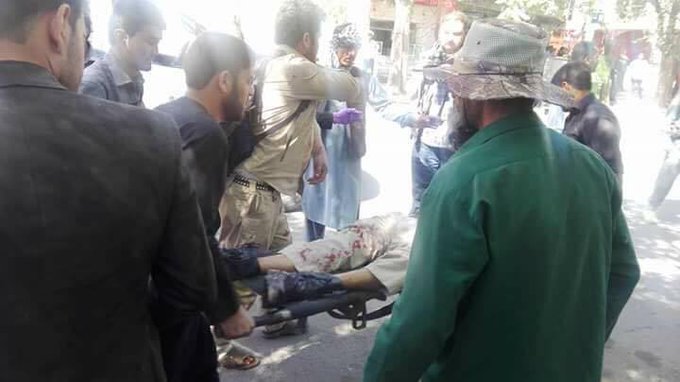
Ninety people have been killed and 400 injured in a powerful car bomb blast that ripped through a diplomatic district in Afghanistan’s capital, Kabul, the government's media center has reported, according to AP.
The Afghan Interior Ministry previously said that 64 people had been killed, according to AFP.
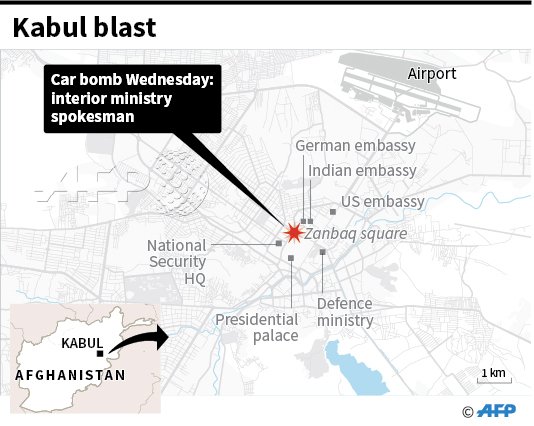
The blast is believed to have come from a car bomb. Reuters reported that the powerful bomb was hidden inside a sewage tank on a truck. The precise target was not immediately clear, but many embassies and government buildings are located in the area.
Afghanistan’s President Ashraf Ghani condemned the devastating attack, which happened just days into the Muslim holy month of Ramadan. In a statement quoted by Reuters, Ghani said “the terrorists, even in the holy month of Ramadan, the month of goodness, blessing and prayer, are not stopping the killing of our innocent people.”
The blast struck at around 8:30am local time Wednesday.
Several hours after the attack, AFP reported that ambulances were still taking the wounded to hospital and rescuers were retrieving bodies from the rubble while firefighters struggle to extinguish flames in adjacent buildings.
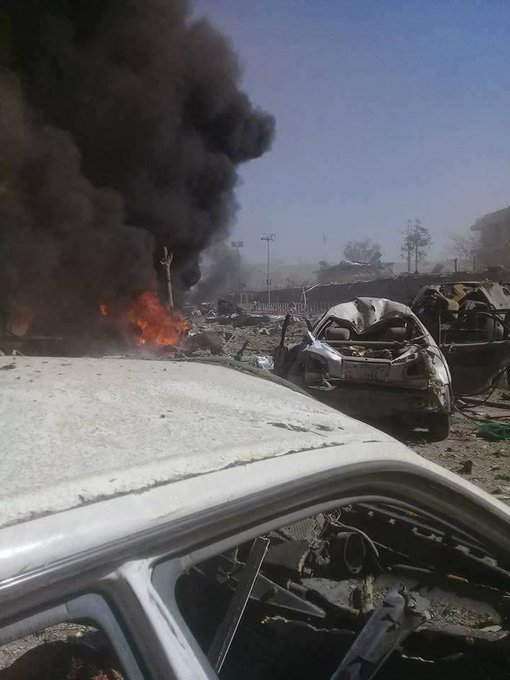
The powerful blast destroyed more than 50 vehicles in the area, Pajhwok News reports.
Photos posted on Twitter showed a thick pillar of smoke rising from the site of the explosion.
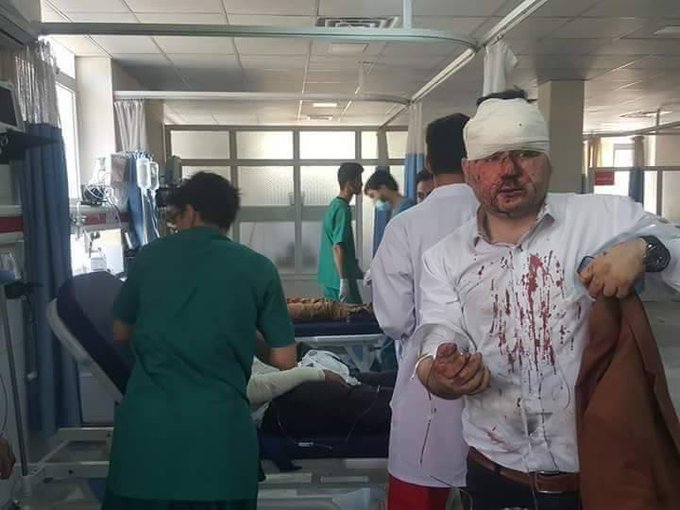
Most victims are thought to be civilians, including employees of a local mobile phone company, Roshan, according to TOLO News.
Eyewitnesses on social media said the blast was so strong it shattered all windows in nearby buildings. 
“At around 8.30am the room was shaken and then we heard a very huge explosion. It was scary, for a moment I thought we were attacked and the explosion was in our office,” Ramzir Bakhtiar, a Kabul resident, told RT. He said the diplomatic quarter where the blast actually took place is situated around 500 meters (1,600ft) away from his office, but the shockwave was so powerful that it still caused damage to the building.

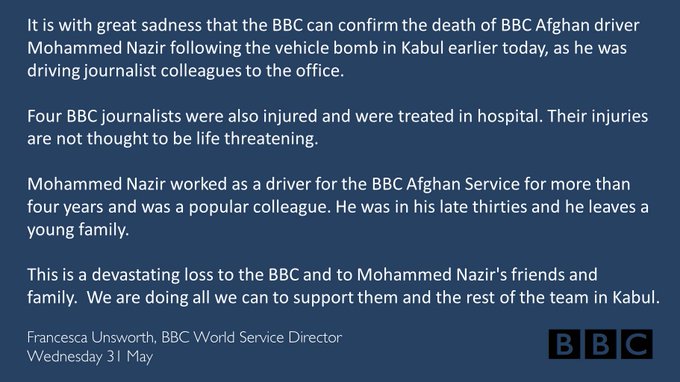
The BBC has confirmed in a statement that Mohammed Nazir, a driver who worked at the corporation’s Afghan office for four years, died in the explosion. Four BBC journalists were injured and taken to hospital.
Despite the high death toll among local residents, the foreign embassies have not reported any fatalities among their staff.
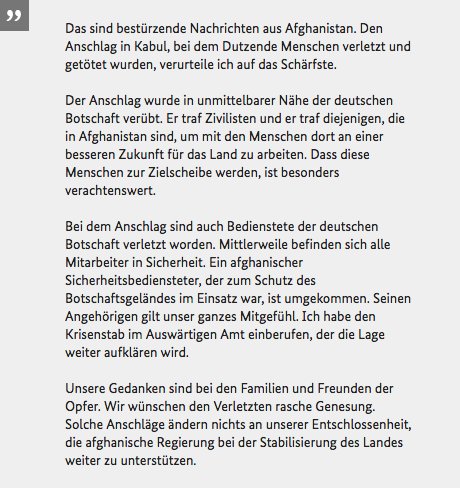
The German Foreign Ministry issued a statement saying that a local security officer guarding the embassy premises has been killed in the blast. Though several embassy workers were injured, all employees are now safe.
The car bomb went off in the close proximity to the diplomatic mission, the ministry said, adding that it targeted people who “worked for the better future of their country.”
German authorities said they would temporarily suspend deportations of failed Afghan asylum seekers or migrants following the blast in Kabul.
"The employees [at the embassy in Kabul] have more important things to do than to prepare the organizational measures needed. Therefore there will be no collective deportations to Afghanistan in the next few days," a German government official told Reuters.
"But it is and remains the case that deportations must be carried out according to our laws. This principle applies to Afghanistan, especially for criminals, and we will continue to go down this path," the official added.
The Indian embassy has said its staff is safe, though the building was damaged in the blast. Two employees of the Japanese embassy were mildly injured, suffering cuts, according to AFP.
In the meantime, France’s foreign minister, Marielle de Sarnez, said the French embassy in Kabul has been damaged, but there are “no signs” at this stage indicating that there were victims among the employees.
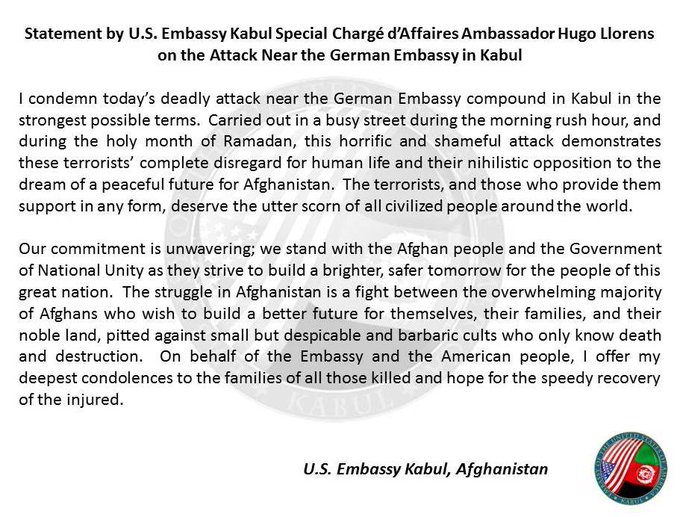
Hugo Llorens, charges d'affaires of the US embassy in Kabul, slammed the "horrific and shameful attack," saying Washington is committed to helping the Afghan government defeat "small but despicable and barbaric cults" that undermine security in the country.
Several journalists tweeted that their offices were damaged in the blast, including Jessica Donati, who writes for the Wall Street Journal, and the BBC’s Kabul bureau manager, Karim Haidari, who said the BBC staff were affected in the blast.
Taliban spokesman Zabihullah Mujahid said the insurgent movement had no involvement in the attack, according to Reuters. Mujahid claimed that the Taliban condemns indiscriminate attacks that cause civilian casualties.

Last month, the Taliban announced the beginning of a “spring offensive,” promising to attack US-trained Afghan forces and foreign troops.
The other possible culprit, Islamic State (IS, formerly ISIS/ISIL), is yet to claim responsibility. In the past, the terrorist group launched several high-profile attacks targeting Afghan and foreign forces in various parts of the country. 
The US has 8,000 troops in Afghanistan to train Afghan forces and render support during counter-insurgency operations.

Bilawal Bhutto strongly condemns suicide terrorist attack in Kabul’s diplomatic enclave

Chairman Pakistan Peoples Party Bilawal Bhutto Zardari has strongly condemned suicide terrorist attack in Kabul’s diplomatic enclave adding that terrorists are striking innocent people everywhere.
In a press statement, he said that human fraternity has to get united to eliminate terrorism from the earth while neighbours have also to fulfill their responsibilities with open heart for peace in the region.
Bilawal Bhutto Zardari expressed sympathy and solidarity with families of the Kabul blast victims and prayed for early recovery of those injured.


https://mediacellppp.wordpress.com/2017/05/31/bilawal-bhutto-strongly-condemns-suicide-terrorist-attack-in-kabuls-diplomatic-enclave/

Tuesday, May 30, 2017

Music Video - Katy Perry - Bon Appétit ft. Migos

Video Report - German interior ministry says its thwarted Berlin suicide attack

Video Report - Illegal Immigrants and Dems Attack Texas Republican after He Calls ICE on Them

Video Report - Pro-Immigration Protest Disrupts TX House

Video Report - Interview with Secretary General of China Development Research Foundation

Video Report - US successfully tests missile interceptor

Video Report - Syria: Syrian army makes major gains on IS territory in Homs region

Video Report - Syrian Army advancing in Deir ez-Zor as fight against ISIS continues

Video Report - Braving bombs, bullets & tear gas – but still not ‘real’ journalists for Macron

Video Report - 'Deceitful propaganda' - Emmanuel Macron on RT and Sputnik

Music Video - Afshan Zaibe - Koe Rohi

Music Video - Lokan do do yaar banaye

BANNED DEOBANDI OUTFITS IN PAKISTAN OPERATE OPENLY ON FACEBOOK

Activity of 41 sectarian, terrorist, anti-state organisations is accessible to every user on the social network. They exist in plain sight, just one search and one click away from any of Pakistan’s 25 million Facebook users. An investigation carried out by Dawn across the month of April 2017 has revealed that 41 of Pakistan’s 64 banned outfits are present on Facebook in the form of hundreds of pages, groups and individual user profiles.

Their network, both interconnected and public, is a mix of sectarian or terror outfits, global terror organisations operating in Pakistan, and separatists in Balochistan and Sindh.
For the purpose of this investigation, the names of all banned outfits – including acronyms and small variations in spelling – were searched on Facebook to find pages, groups, and user profiles that publicly ‘liked’ a banned outfit.
The biggest outfits on the social network, in order of size, are Ahle Sunnat Wal Jamaat (ASWJ) with 200 pages and groups, Jeay Sindh Muttahida Mahaz (JSMM) with 160, Sipah-i-Sahaba (SSP) with 148, Balochistan Students Organisation Azad (BSO-A) with 54.
Other banned outfits which exist on Facebook at a smaller scale include Lashkar-e-Jhangvi (LeJ), Tehreek-e-Taliban Pakistan (TTP), Tehreek-e-Taliban Swat, Tehrik-e-Nifaz-e-Shariat-e-Mohammadi, Jamat-ul-Ahrar, 313 Brigade, multiple Shia outfits and a host of Baloch separatist organisations.

http://www.shiitenews.org/index.php/pakistan/item/28817-banned-deobandi-outfits-in-pakistan-operate-openly-on-facebook

SAUDI WAHHABI MONARCHY DEPORTS 100 MORE PAKISTANIS

As many as 100 Pakistani nationals deported from Saudi Arabia returned home yesterday. Saudi Wahhabi monarchy rendered them jobless and then deported them.

Federal Investigation Agency (FIA) said that 100 Pakistanis who were deported from Saudi Arabia owing to various reasons arrived at Allama Iqbal International Airport Lahore.
The FIA officials, after fulfilling the legal formalities, allowed all of them to go to home.
Saudi Arabia continues to deport Pakistani workers and thousands of Pakistanis have so far been deported but Wahhabis-allied Deobandis don’t raise voice in favour of Pakistanis.

http://www.shiitenews.org/index.php/pakistan/item/28816-saudi-wahhabi-monarchy-deports-100-more-pakistanis

Pakistan's Forced Islamic Conversions - Minorities struggle to save identity


By Emanuel Sarfraz
Two soul stirring news reports have come out in one day about the revelation that forced conversions continue in Pakistan without any check. Member of Kalash community of Chitral, Gul Nazar, speaking in Islamabad the other day gave a desperate SOS call that their culture was being changed and they were being forced to convert to Islam.
Nazar said the media was just showing their dances and not the real challenges faced by the Kalash tribe. Only about 4,000 Kalash people are left. Majority of Kalash people no longer follow their own religion. Some religious groups are active there. She said religious ways of her community are being blocked and names of their places are being replaced with Muslim names such as Qaziabad and Ahmedabad.
The other related story was about the prosecutor who was blamed for asking the under-trial Christian accused of the Youhanabad lynching case to embrace Islam for getting released on bail. He was found guilty of the charge in an inquiry started against him under Punjab Employees Efficiency and Discipline Act. No law of Pakistan could spare them if found guilty but the prosecutor was perhaps trying to give them a chance to change their faith for something that he had in his mind.
Both the stories were disturbing and must have sent shock waves through many people. Till date not a single person has been punished for forcing minorities people to convert. The number of forcefully converted people runs into thousands.
Last year I reported case of a minor girl, Sana Shahid from Sialkot, who was forced to convert by an influential person of the area and was married to his son. The parents of the Christian girl approached the police with documents that their daughter was only 14 years old and could not be forced to convert or marry as she was not an adult. But to no heed. I talked with senior police officers of Sialkot. They all said that justice would be provided, but no arrest was made. The influential people who had converted the girl then got pre-arrest bail from court, which was granted without hearing the other aggrieved party. The girl’s parents are still trying to get justice after the passage of around nine months.
Many cases of forced conversion, usually of women from minority communities, have been reported in KPK, Punjab and Sindh. According to human rights activists many cases are not even reported by the parents of these girls as it all carries a lot of ‘social stigma’ and usually they have other girls and children to take care of. Recently there was a case in Lahore but the father refused to accept publicly that such an incident had even happened. “We got a good proposal for Shazia and it was all done in hurry. She has gone to England with her husband,” said the father.
The stories are endless but the state has not taken any initiative to end this injustice. For Kalash people there have been activists like Maureen Lines who died this April. Her work for saving the culture of Kalash people will never be forgotten. It is hoped her work will be carried on by her followers. I believe it is high time the world take notice of her efforts and declare the Kalash sites under protection of UNESCO. There should be a law that no people from outside the territory can buy Kalash land. The Pakistan government should take practical steps to preserve the Kalash culture and religion. It should legislate to ensure there are no forced conversions and those who are engaged in such activities are punished. Such a step was taken in Sindh but the law could not be made as the religious parties opposed it. The bill against forced conversion was passed by the Sindh Assembly in November but the government later decided to review it. The Sindh governor refused to sign the bill and returned it. The matter has still not been resolved.
Many Pakistanis continue to languish in Immigration Detention Centres of different countries. From Europe to the countries of Pacific Rim these Pakistanis are mostly asylum seekers who want to seek refuge in these countries or are seeking repatriation to some other country. The number of these Pakistanis is in thousands. Though many of them could be in search of greener pastures, but many many complaints are about forced conversion. It is time the government looked into the matter seriously to improve Pakistan’s image in the world and to provide justice to minorities.

Pakistan’s Saudi misadventure


Kunwar Khuldune Shahid 

Following last week’s embarrassment at the ‘Islamic’ summit in Riyadh, where neither Prime Minister Nawaz Sharif nor former Army Chief Gen (R) Raheel Sharif – who militarily spearheads the Saudi-led military coalition – was invited to speak, there are reports that Islamabad might be reconsidering participation in said ‘Islamic’ alliance.
The fact that US President was heading an ‘Islamic’ summit barely six months after winning an election campaign based – in significant part – on anti-Muslim populism should’ve been embarrassment enough for the Muslim world to begin with. What apparently has fueled rumours that Pakistan might be reconsidering participation in the alliance is the fact that both Trump and Saudi King Salman bin Abdul Aziz upped the ante on anti-Iran rhetoric.
This either is a cop out, or reflects Islamabad’s utter lack of basic understanding of international relations and policies of the states it has historically allied itself with. What exactly was it about Trump or King Salman’s speech that came as a surprise for anyone in Nawaz Sharif’s entourage, which had spent hours helping the Prime Minister memorise a speech that he ended up binning?
Do those at the helm of Pakistan’s foreign policy not even have sufficient knowhow to ‘decode’ what the theme of a summit lead by Trump and hosted by King Salman would be themed around before accepting the invitation to join in?
Did the fact that the coalition was first announced in December 2015 – ninth months into Saudi military intervention in Yemen and a month before the execution of Shia cleric Sheikh Nimr al-Nimr – also not give Islamabad an idea who this alliance would be aligned against? One would’ve been prompted to even hint that this belated suggestion of a potential back-peddling, if not complete retraction, is a reaction to the snub at the summit where Trump and King Salman collectively humiliated Pakistan by first not allowing the premier to speak and then by even refusing to include him in any publicised meetings or photo-ops.
But as far as Pakistan’s ties with Saudi Arabia are concerned, disagreement, let alone defiance, has never been on Islamabad’s menu.
So what exactly happened that has, apparently, caused a rethink?
“What we need to understand is that the Terms of Reference (TORs) of the alliance are yet to be finalised. The defence ministers of the participating countries will meet and discuss the modalities of the coalition. We must wait until we have all the information to comment on its outcome. We shouldn’t indulge in speculations,” Foreign office spokesperson Nafees Zakria said at the weekly briefing following the Riyadh summit.
Is the foreign office trying saying that an NOC was issued to Gen (R) Raheel Sharif to spearhead this coalition even before the exact details were finalised with Riyadh?
Or worse, was saying No to the NOC not even an option for the government?
Another government official has also maintained that Pakistan will join this alliance “only to fight terrorism.”
That should clear the confusion then. Because it’s not like the term ‘terrorism’ is loaded, or aligned with state policies.
A Kashmiri freedom fighter who picks up the gun is a terrorist for India. A separatist militant in Balochistan is a terrorist for Pakistan. A mujahid can be a terrorist or strategic asset depending on whether s/he is waging war against the military establishment or against it. So maybe it’s a good idea to modalities of terrorism as well, before we agree to defend Saudi Arabia against terrorists.
A country that has unequivocally upheld that ‘atheists are terrorists’, clearly doesn’t even need an individual to take up arms for them to be lumped into the bin of terrorism. It also underscores that terrorism for the kingdom of Saudi Arabia is primarily based on ideological affiliations. And there are no prizes was guessing the one ideology that Wahabbism is antagonistic to even more than nonbelief.
If the Saudi-led coalition is really about ‘Muslim unity’ and ‘fight against terrorism’, how about Islamabad adds support for the Kashmiri struggle against what it dubs ‘Indian state terrorism’ in the ‘modalities’ of the alliance with Riyadh? There have already been 223 UN resolutions against Israeli occupation of Palestine in the last decade alone, surely the ‘Muslim Ummah’ would also care about ‘Muslim brothers’ in Kashmir?
The only hindrance here is the fact Saudi Arabia has defence agreements with India, supplies 19% of its oil needs and has bilateral trade worth $39 billion.
This diplomatic pickle that Islamabad currently finds itself in is the culmination of decades of Islamist foreign policy where religious affiliation has been peddled as a conclusive determinant not only for bilateral ties between Muslim states, but also to alienate other states – India and Israel being prime examples.
The moment Pakistan abandons its Islamist approach towards relations with neighbouring Afghanistan and Iran – in addition to other Muslim states – and takes up the Kashmir cause without any religious blinkers, it would not only witness a complete revamp of its relations with the world, and in turn the image around the globe, it would also sort out the many contradictions that are forcing Islamabad to pursue duplicitous foreign and security policies.
Till then joining any alliance that claims to be ‘Islamic’ and discriminatory at the same time is masochistic. For any such coalition would define itself with respect to who isn’t Islamic. And we all know what happens when that domino effect kicks in.

Report: Banned Islamist Groups in Pakistan Freely Operate on Social Media


Dozens of banned militant, sectarian, terrorist and anti-state groups in Pakistan reportedly operate freely on social media, particularly on Facebook, spreading hate speech without being confronted by authorities.
In an investigative article published Tuesday, the English-language DAWN newspaper reports 41 of the 64 extremist organizations banned by the government are accessible to social network users in the form of hundreds of pages, groups and individual profiles.
While Pakistan's counter-extremism efforts have long remained under fire for being selective, critics say the reported unchecked extremist activity strengthens widespread opposition fears a recently unleashed government crackdown on social media in the name of "national security" is meant only to stifle political dissent and demands for accountability of state institutions.
Prime Minister Nawaz Sharif’s government has not immediately commented on the newspaper report and has previously rejected allegations its social media crackdown is targeting political opponents.
‘Hate roams free’
The Federal Investigation Agency that is coordinating the anti-social media campaign has mostly detained and probed social media activists linked to Imran Khan’s Pakistan Tehreek-i-Insaf (PTI) and other opposition parties.
Khan has been staging street protests and holding public rallies to pressure Sharif to step down for alleged corruption. His opposition party, analysts note, has effectively used social media to highlight governance issues and mobilize public support in Pakistan.
Critics say that pressuring political opponents and "selectively" moving against extremist forces will fuel religious fanaticism.
“The increasing curbs on freedom of expression in the so-called name of national security will not permit the construction of an intellectual edifice which is needed to for countering terrorism,” observed opposition Senator Farhatullah Babar.
The DAWN story also prompted a flood of criticism of the government on social media for suppressing free speech instead of moving against those promoting violent extremism in the country.
“Hate roams free while the state chases poets, artists and journalists,” read one Twitter comment.

https://www.voanews.com/a/pakistan-banned-islamist-groups-social-media/3877496.html

Heatwave grips many areas of Pakistan amid long power cuts

Pakistan has been hit by a heatwave amid lengthy power cuts in many parts of the country.
The state-run Meteorological Department says daily highs on Monday reached 53 degrees Celsius — about 127 Fahrenheit — in the southwestern town of Turbat, breaking a nearly 10-year-old record.
Its forecast on Tuesday says the hot and dry weather will continue throughout the week across the country, including in the southern Sindh province where 1,233 people died from the heat in 2015. The heat has added to the hardships of many Pakistanis who are facing lengthy power cuts since the beginning of the holy month of Ramadhan, when Muslims fast during daylight hours.
The power cuts have sparked street protests in many areas of energy-starved Pakistan.
https://www.washingtonpost.com/world/asia_pacific/heatwave-grips-many-areas-of-pakistan-amid-long-power-cuts/2017/05/30/64c8fb8a-4523-11e7-8de1-cec59a9bf4b1_story.html?utm_term=.56ee02480409

Bilawal concerned over silence of international community on Kashmiris’ carnage

Chairman Pakistan Peoples Party (PPP) Bilawal Bhutto Zardari termed the Indian terrorism in held Kashmir as attack on humanity expressing distress over the silence of international community on Kashmiris’ carnage by Indian armed forces.
“Barbarism has been let loose on Kashmiri people with the beginning of holy month of Ramadan. Kashmiris are targeted by state terrorism for seeking their inalienable right to self-determination,” he said in a press statement.
BILAWAL BHUTTO ZARDARI SAID PEOPLE OF HELD KASHMIR SHOULD NOT BE CONSIDERED ALONE AND ISOLATED ADDING THAT INDIAN ARMED FORCES WERE TARGETING AND KILLING THE YOUTH MERCILESSLY.
The PPP chairman demanded that international community should take notice of Indian terrorism and stop it.
Bilawal Bhutto Zardari pledged that Pakistani people and the PPP are with our Kashmiri brethren and salute martyrs of Kashmir condemning their slaughter at the hands of Indian forces.
https://arynews.tv/en/bilawal-concerned-silence-international-community-kashmiris-carnage/

Study in Pakistan Finds 40% Women Harassed Online

BY 


The first of its kind, a report by the Digital Rights Foundation has recorded the experiences of online harassment, bullying and fear faced by women in Pakistan.

Pakistani model Qandeel Baloch known for her bold online presence who was killed by her brother, the five young girls who were murdered by their family when a video of them dancing and laughing went viral, the 16-year-old girl who was stabbed by her brother because she was using a mobile phone and hundreds of such incidents that are reported every year are a testament to Pakistan’s growing problem of online harassment. But when it came to quantifying the problem, the data simply did not exist. The lack of official statistics on online victimisation is an issue not only in Pakistan, but also in India and Bangladesh.
That’s what inspired the Digital Rights Foundation to create a dataset that can help shed light on the issues surrounding online harassment and tech-related violence faced by women in Pakistan. The survey, designed and conducted by Hamara Internet, trained and questioned 1,800 women on the use of digital spaces in a safe way. These women were students living in Punjab, Sindh, Khyber Pakhtunkhwa, Balochistan and Gilgit areas of Pakistan. The study paints a picture of women’s experiences and usage patterns on the internet and their digital literacy, as well as awareness about cyber crime laws related to online harassment among women.
The internet in Pakistan: A world of misogyny
In Pakistan, women are a marginalised community online. Around 75-80% Facebook users in the country are men. The report laments the fact that women are not generally seen as owners of online spaces and when they do try to break the norms and assert their rights over the said spaces, they are quickly met with an abusive response, as happened in the case of Baloch. As concluded by the report, 40% of Pakistani women surveyed had been stalked and harassed via messaging apps like WhatsApp and Viber. Twenty-five percent of the women said they had witnessed other women being bullied and harassed by men online. When asked whether they had been victims of online stalking, almost half the sample that was surveyed said they have faced this form of harassment.
Digital illiteracy among women
Respondents were asked whether they were aware of the laws that existed regarding cyber harassment in Pakistan and 81% of them said they were not.
Facebook and WhatsApp are the most commonly used social media apps in the country by women, but when they were asked if they understood its term and conditions, 11% accepted they didn’t understand them at all. The report brought to light the problem that only a fourth of the total sample that was surveyed felt that they knew and understood social media terms and conditions. The respondents largely did not know what they’re signing up for.
Data breach and misuse
The report points out that in Pakistan, the distinction between private and public life can be blurred. Women are often forced to give up their social media passwords by their own family. They are made to share their passwords with men under on the pretext of ‘trust’. Facebook pages in Pakistan like the ‘Gangdageer Khan’ Facebook page resort to extorting women into giving money, providing phone balance, other women’s pictures and more in exchange for having their data removed. The Federal Investigation Authority (FIA) busted the ring that was behind the Facebook page but a lot of information still remains online.
The report found that 23% of the women surveyed had been victims of online pages that leaked sensitive information about women.
Reporting to law enforcement agencies
While the report brings to light the prevalence of online harassment in a patriarchal society like Pakistan, it also raises the issue that reporting online harassment to the FIA or other law enforcement authorities is not a favourable option because of reasons such as family pressure, ‘honour’ or loss of respect. According to the FIA, in 2015, only 5% of cases of harassment were reported and followed by legal action of any kind. Such complaints are often dealt with victim shaming, ‘honour’ killing or loss of family support. The report even found that 21% of the women interviewed stopped using the internet as a reaction to harassment.
The group conducting the research study thought that “the results are worrying as they highlight how easily women take a step back and give up the space they have carved for themselves while the perpetrators walk without a scratch.”  Seventy percent of the women who told the Hamara Internet group that they have faced harassment did not approach the FIA. The FIA has often been credited with lack of action and neglect.
The research argues that “online violence and stalking of women should be seen as an extension of violence against women in other spaces in the society.”
The report, with its findings, challenges the blatant sexism and harassment on display in the digital world. The study makes it clear that safe spaces are needed online and a safer digital experience – though a tall order at this time – is the need of the hour. It also suggests recommendations to the internet service providers, law enforcement agencies and the government.

Monday, May 29, 2017

Video Report - Russian economic resilience despite Western sanctions

Video report - West bears responsibility for chaos & terrorist attacks in MidEast and N. Africa – Lavrov

Video Report - Putin and Macron meet in Versailles on 300th anniversary of Tsar Peter’s visit to France

Video Report - France's Macron holds 'frank exchange' with Putin

Video Report - French President Macron and Russian Leader Putin's Joint Press Conference

Pakistan - EX-COAS RAHEEL SHARIF CONSIDERING RETURN TO PAKISTAN FROM SAUDI ARABIA

Former Army Chief of Pakistan Raheel Sharif is considering returning Pakistan after having been disappointed with the Saudi military alliance where he went to serve.

A private news channel has reported that retired General Raheel Sharif is not happy over the influence of the United States on the Saudi alliance. He thinks that the alliance was not aimed at what he was told earlier. 

He has been disappointed because he was made a security official for limited assigned jobs hence he was pondering upon his options including resigning from his position in the Saudi alliance. He was advised by close friends that he should return Pakistan to serve his motherland where people would welcome and appreciate his services.


http://www.shiitenews.org/index.php/pakistan/item/28810-ex-coas-raheel-sharif-considering-return-to-pakistan-from-saudi-arabia

Two dead, several injured as protest against power outage in Malakand turns violent


By Najeem Khan
Tension gripped the Dargai area of Malakand division, on Monday, as protesters and levies official clashed leaving two dead and 11 others injured.
The military was called to rein-in a protest against persistent power outages in the area that turned violent. At least one person, reportedly from the youth wing of the Pakistan Tehreek-e-Insaf (PTI), was shot dead while 11 others were left injured during the clash.
The protesters set ablaze a levies station, a Water and Power Development Authority (Wapda) and sub-office of the Pakistan Telecommunication Authority (PTA) in Malakand following reports that Javed Khan Tufan – a former PTI student wing president – had been killed. In a bid to control the situation, levies officials fired teargas shells and rubber bullets on the protesters. The protesters from Dobandi, Warter and Qadam Khel Union Councils were demonstrating against unannounced power outages in the area when they stormed Dargai power station and set it on fire, destroying Wapda records and parked vehicles.
Both sides blamed each other for the bloodshed; senior levies officials denied reports of any straight fire causing the death of the PTI official and instead alleged the shot that killed him came from the protesters.
At the time of filing this report, traffic on Mardan-Malakand Road remained suspended as protesters staged a demonstration with the body of the deceased on the road. Despite tall claims of uninterrupted power supply during sehri and iftari by utility providers, the beginning of the holy month Ramazan saw massive load-shedding across the country.
On May 17, hundreds of enraged Pakistan Tehreek-e-Insaf (PTI) activists broke down the gate of the Wapda House in Peshawar and stormed inside during their protest against persistent power outages in Khyber-Pakhtunkhwa (K-P).
The PTI protesters chanted slogans against the federal government, holding it responsible for the power crisis.
Led by Member Provincial Assembly (MPA) Ayesha Gulalai, the protesters demanded that the Pakistan Muslim League-Nawaz-led (PML-N) federal government and Wapda officials stop the hours-long spells of power outages in the province and fulfil their promise of a load-shedding-free Pakistan.
The situation is now on high alert in the area with armed forces being called in to stamp out the possibility of any other untoward incident.
While the protests continue as the body of one of the deceased has been placed on one of the main roads and communications from Malakand to other parts of the country have been disrupted.
Meanwhile, the spokesperson of PESCO stated in a press release that miscreants attacked the office of the SDO1 and SDO2 in the early morning of the day and set ablaze the office records as well as shattering the doors and windows of the office.
The statement also said that the protesters burned down the vehicles present at the premises.
He said Wapda was working on the Palai line and power had been cut off from the area due to the working of Wapda employees on the line.
Whereas, local elders and members of the Jirga were also taken into confidence in this regard.

Pakistan - load shedding - In Darkness


While the government has presented a very optimistic outlook of the energy sector, and asserted via the budget that load shedding will be a thing of the past in just one year’s time, protests have simultaneously erupted in Karachi and KP over drastic power outages. The promises and platitudes that the ruling part has been making since 2013 have been repeated to the point of becoming redundant. Now, even with Chinese investment buoying the energy sector, people are loth to believe in something that has always seemed to good to be true, especially after 18 hour blackouts in KP.
Thus on Saturday, people of Malakand Agency and Peshawar took to the streets and ransacked offices and grid stations of WAPDA. Peshawar Electricity Supply Company (PESCO) in Batkhela was torched and dozens of Pakistan Tehreek-e-Insaf (PTI) workers led by Peshawar MPA Fazal Elahi stormed the Rehman Baba grid station on Saturday. MPA Fazal Elahi alleged that PESCO authorities had been directed by the federal government to punish the people of KP for supporting PTI in the last general elections. While the claim sounds conspiratorial, there is no denying the fact that the long power outage was cruel, and authorities have a lot to answer for in these hot months of summer.
While it was announced by the spokesperson for Ministry of Water and Power on Saturday that no load shedding would occur during Sehar and Iftar timings in Ramzan, it took not even one day for the promise to be broken. Karachi faced power outages at sehri time in the early hours of Sunday, the very first day of Ramazan. The issue had still not been resolved by the afternoon.
Finance Minister Ishaq Dar stated in his budget address that approximately 10,000 MW of electricity will be added to the national grid by summer 2018 and will eliminate load shedding. With just two days passing since this statement, Peshawar and Karachi are up in arms. With so many projects inaugurated in the past four years, it is hard to believe the Finance Minister now. Is this rhetoric just for the upcoming elections, or can the PML-N cure Pakistan of its energy woes?
When the PML-N came to power, there was just one thing it needed to do to ensure the trust and support of the Pakistani people. It was not tall buildings, trains and busses, but just the end of the power shortage. If it had been solved, there would be something very concrete to show to the people- except the party took the word ‘concrete’ in a very literal sense and did not keep its eye on what the people of Pakistan really needed.

Pakistan - Citizens protesting against load shedding start fire in #Lahore


Angry residents of Lahore's Railway Power House Baja Line vicinity started a fire on Mughalpura Road to protest against prolonged electricity load shedding on Monday.
The protesters said they were tired and exhausted of the power outage since the past five days.
Numerous complaints were lodged against a faulty transformer with the area's SDO but to no avail, the protesters said.
The protest affected the flow of traffic on Mughalpura Road. 

Karachi plunges into darkness

Continuing on the trend K-Electric set on the first day of Ramazan, Karachi was plunged into darkness as power outages occurred in various areas on the second Sehri early Monday morning.
Golimar, North Karachi, New Karachi, and surrounding areas experienced an electric breakdown once again, exacerbating public outrage after power breakdowns during Sehri and Iftar times on the first day of fasting.

Pakistan protesters demand electricity as temperatures soar


Violent protests erupted in Pakistan Monday as crippling electricity cuts left hundreds of thousands of people without power in soaring temperatures during the first two days of the holy fasting month of Ramadan.
At least one person was killed and eight wounded in the northwestern province of Khyber Pakhtunkhwa after police opened fire on hundreds of people protesting at the cuts by trying to set a power station ablaze, officials said.
"The protesters first tried to torch the electricity power station and then they attacked a police station," Zafar Ali Shah, a senior government official in Malakand district, told AFP, adding that the demonstrators also attacked government buildings, offices and vehicles.
Protesters later blocked a main highway linking Malakand and the Swat valley to the rest of the country, Shah added, saying that authorities are negotiating with local leaders to defuse the demonstrations.
In the provincial capital Peshawar some 800 protesters took over two power stations, demanding government employees continue the electricity supply without interruption.
Pakistan has for years been struggling to provide enough power for its nearly 200 million citizens. Its chronic energy crisis sees daily power outages which are amplified in the summer heat.
Residents in Peshawar said they face cuts for six to eight hours a day, while rural areas can receive electricity for as little as three to four hours a day.
Prime Minister Nawaz Sharif has vowed to solve the crisis by 2018, when elections must be held.
On Monday he said that "minimum load-shedding" should be carried out during Ramadan, during which millions of devout Pakistanis abstain from food and drink from sunrise to sunset.
Temperatures in Pakistan touched near-record highs over the weekend.
On Sunday angry residents burned tyres in the roads in the sweltering port city of Karachi after a massive power outage in southern Pakistan.
Water distribution -- already unreliable in the megacity of some 25 million people -- is reliant on the electricity supply, leaving thousands unable to drink, cook or wash ahead of the first day of fasting.
Authorities said the power outage extended to more than a dozen districts in the southern province of Sindh of which Karachi is the capital, where temperatures topped 40 degrees Celsius (104 Fahrenheit).

Sunday, May 28, 2017

Video Music - Miley Cyrus - Malibu

’When N. Korea feels threatened, they show military power' – US ex-diplomat on new missile launch

Trump in Brussels - 'The Germans Are Bad, Very Bad'


By 

At a meeting with European Union leaders on Thursday, U.S. President Donald Trump was sharply critical of Germany. DER SPIEGEL spoke with meeting participants.

U.S. President Donald Trump voiced significant displeasure over Germany's trade surplus on Thursday during a meeting with European Union leaders in Brussels. "The Germans are bad, very bad," Trump said, according to meeting participants.
The participants told DER SPIEGEL that Trump went on to say: "See the millions of cars they are selling to the U.S. Terrible. We will stop this."

European Commission President Jean-Claude Juncker showed solidarity with the Germans at the meeting and contradicted Trump's rebuke. Free trade benefits everybody, Juncker said. Participants at the meeting who spoke with DER SPIEGEL said that Juncker tried to maintain a collegial tone, but remained uncompromising on that point.

During the roughly one-hour meeting, Trump met initially with European Council President Donald Tusk and Commission President Jean-Claude Juncker. After about 45 minutes, they were joined by others, including European Parliament President Antonio Tajani and the EU's chief diplomat, Federica Mogherini.

According to a report in the German daily Süddeutsche Zeitung, many EU officials were appalled by how little the Americans appeared to know about trade policy. The guests from Washington seemed not to be aware that EU member states only negotiate trade treaties as a bloc. According to the paper, Trump's chief economic advisor, Gary Cohn, claimed during meetings, for example, that different customs tariffs are in place between the U.S. and Germany than between the U.S. and Belgium.
'Not Gonna Happen'
For years, Germany has exported more than it imports and Trump has criticized the country's trade surplus before - in an interview with the German tabloid Bild prior to his inauguration, for example. In that interview, too, he voiced particular frustration at the number of German cars he sees on the streets of New York. "I would tell BMW if they think they're gonna build a plant in Mexico and sell cars into the U.S. without a 35 percent tax, it's not gonna happen. It's not gonna happen." It was a clear threat to slap punitive tariffs on German automobiles.

The new U.S. president finds Germany's surpluses unfair because they necessarily mean that its trading partners have a trade deficit, the U.S. in this case. But the German government has also been criticized within the EU for its trade surplus. In a recent interview with SPIEGEL, German Finance Minister Wolfgang Schäuble also said that the surplus was too large.
Still, after numerous meetings between European leaders and Trump along with several attempts to explain international trade policy, the EU thought that progress had been made. As Trump made clear on Thursday, however, that hope was in vain.