Sunday, March 26, 2017

To Defeat Terrorism In Afghanistan, Start With Opium Crops in Nangarhar Province


By Anders Corr 


This month, the Islamic State of Iraq and the Levant (ISIL) claimed an attack on a military hospital in Kabul, killing more than 40 civilians and defenseless patients. The attack came two days after the Afghan military announced that its month-long “Shaheen 25” operations had killed 250 Islamic State militants in the terrorist organization’s Afghan stronghold of Nangarhar Province. Two weeks ago, an Islamic State improvised explosive device (IED) injured three U.S. soldiers in Jalalabad, the capital city of Nangarhar. Last week, the U.S. military in Afghanistan vowed to defeat Islamic State in area by the end of 2017. Military strikes and raids against Islamic State and the Taliban are needed, but when militants are captured or killed, these terrorist groups can quickly hire more from their compatriots across the border in Pakistan. To end the cycle of Islamic State, Taliban, and other terrorist violence in Afghanistan requires constriction of terrorist financing, including through both demand and supply interventions against drug revenues that in part finance terrorism.
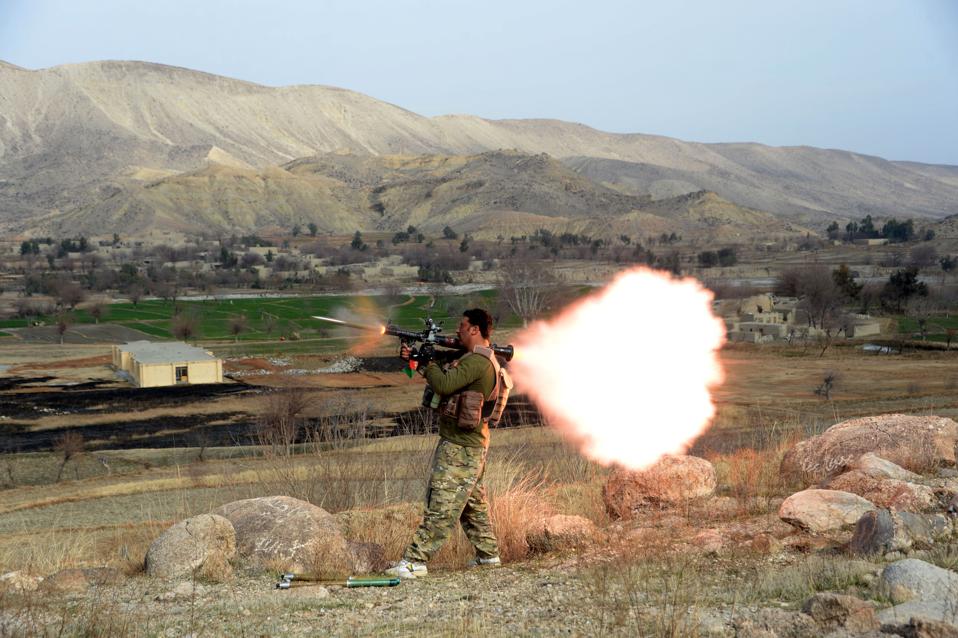
A member of the Afghan security force fires a rocket-propelled grenade (RPG) launcher during an operation against Islamic State (IS) militants in Kot district of Nangarhar province on February 16, 2017. Afghan National Army (ANA) and international air forces, including the U.S., launched a joint military operation against Islamic State (IS) militants, after houses of locals were torched and several people were killed by IS fighters in the area. Credit: NOORULLAH SHIRZADA/AFP/Getty Images
Afghanistan produces 70-80% of the world’s opium, and in 2015, over 127,000 people worldwide died of opium-related deaths. Afghan opium production surged 43% in Afghanistan in 2016, in part due to a new genetically modified poppy seed introduced from China in 2015. Targeting opium production in Afghanistan is timely, and important for two reasons: opium does harm to opiate abusers worldwide, and as an illicit economy, it incentivizes corruption and criminality, and is being used to fund terrorism. In economic terminology, the opium crop in Afghanistan has major international negative externalities, and these externalities can only be fully controlled through better law enforcement.
The farmers and landless laborers in Afghanistan who grow or work on opium crops are some of the world’s poorest people. Their illicit form of livelihood is accepted out of desperation, and so we should be understanding and empathetic towards their plight. Better opportunities should be afforded to opium growers to draw them away from their economic dependence on opium. But the laws of economics will always draw some growers back when prices of opium rise. Therefore disincentives like poppy eradication are necessary. In Afghanistan, drug supply should be decreased through accelerated opium poppy eradication, like aerial herbicide dusting and confiscation of land used for poppy production.
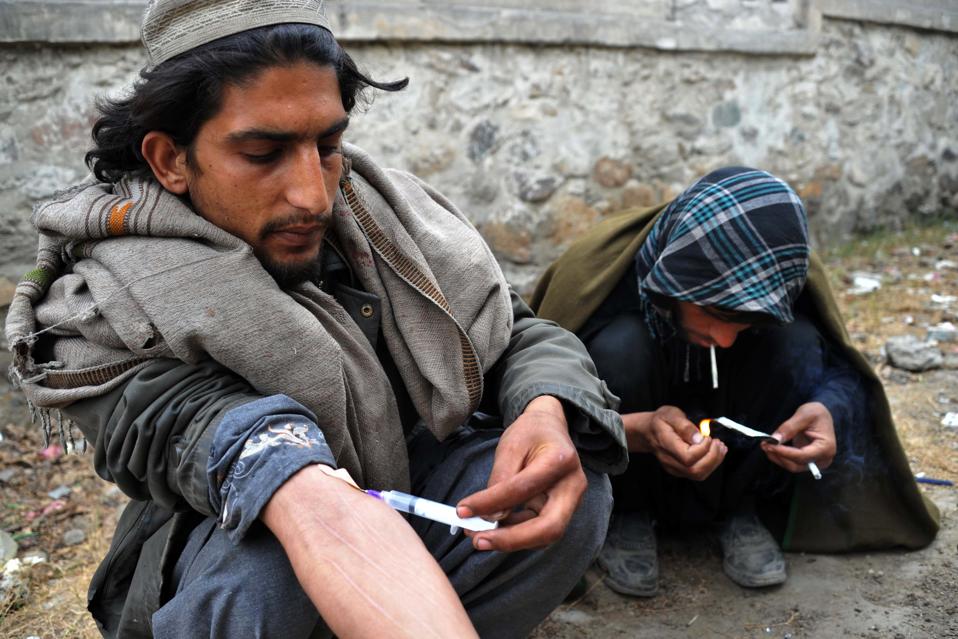
Afghan addicts inject and smoke heroin in Jalalabad on January 31, 2013. Sixteen years after the 2001 U.S.-led invasion to drive the Taliban from power, Afghanistan produces 70-80% percent of the world’s illegal opium, funding much of the militia’s insurgency despite an expensive Western eradication program. Credit: Noorullah Shirzada/AFP/Getty
The policy response to narco-terrorism in Afghanistan has been muted by the risk aversion of politicians, corruption of officials, the niceties of academics, and the timidity of development experts who shy away from imposing disincentives on impoverished opium farmers. Those who are hurt by opium growers, such as Afghan and global victims of terrorism, crime, corruption, and drugs, are not as well organized as opium growers. They are a diffuse interest group, compared to opium growers, who are a concentrated interest group able to influence local and national politicians in Afghanistan. Policies that help decrease the drug supply, and decrease funds to terrorists, need to be implemented despite the Afghan opium cartel’s resistance.
Demand should be decreased through better treatment policies for drug users that reduce users’ harm in exchange for giving them treatment, while targeting dealers with traditional law enforcement techniques. This will decrease demand for opium in Afghanistan, which will facilitate conversion of agricultural land to legitimate crops. The alternative to a tough and holistic strategy against both supply and demand will allow narco-terrorism in Afghanistan, including of the Taliban and Islamic State variety, to continue to make gains at the expense of the elected government, and worldwide communities beset by an epidemic of heroin abuse.
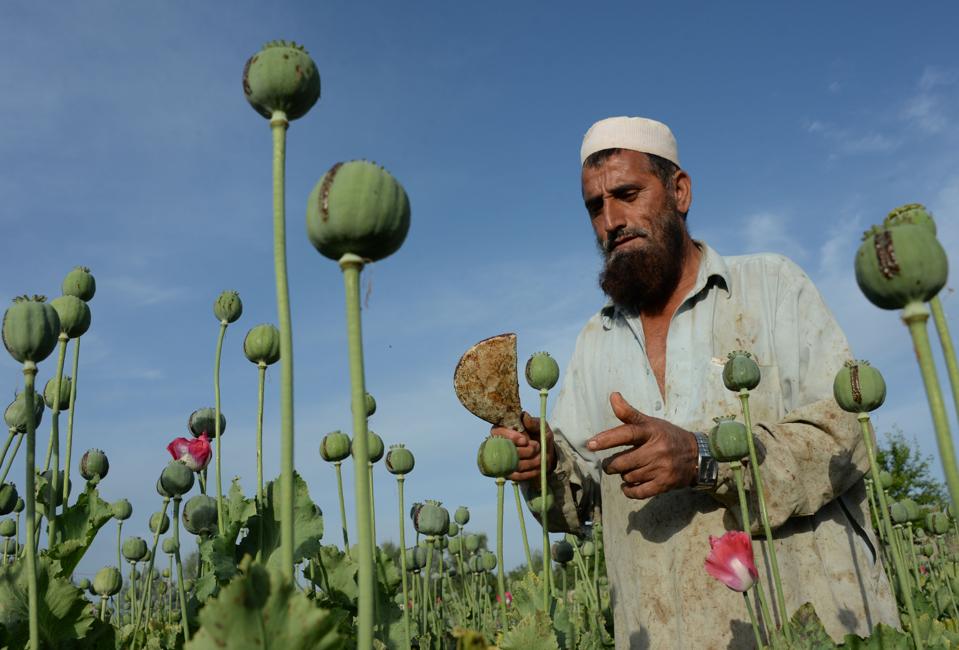
(FILES) In this photograph taken on April 19, 2016, an Afghan farmer harvests opium sap from a poppy field in the Chaparhar district of Nangarhar province. Afghanistan saw a 43 percent jump in opium cultivation this year, a sharp rise owing to favourable weather, growing insecurity, genetically-modified Chinese seeds, and a drop in international support for counter-narcotics operations, the UN said. Credit: NOORULLAH SHIRZADA/AFP/Getty Images.
Nangarhar is the province in which Islamic State is strongest. The Taliban, a more successful terrorist group in Afghanistan, is also active in Nangarhar. If Islamic State can increase its footprint in Nangarhar  it may eventually be able to challenge both the Taliban and elected government of Afghanistan in other regions. So the drug trade in Nangarhar, which is vulnerable to terrorist capture, should be a priority for eradication. This will deny its use for financing to both the Taliban and Islamic State. According to the U.N., the province had 14,344 hectares of poppy fields in 2016, an increase of 43% from the 10,016 hectares in 2015. There is evidence of continued poppy production in 2017, including two heroin factories shut down this month.
There is some uncertainty as to the quantity of revenue that the Taliban and Islamic State obtain from opium in Nangarhar. Field research and aerial imagery analysis from the European Union funded Afghanistan Research and Evaluation Unit (AREU) in the 2015 to 2016 growing season shows that in areas of Nangarhar held by Islamic State, the terrorist organization does not depend on opium for funding, and is eradicating poppy in the province. Islamic State also closed a major drug bazaar in the province. More data is needed on these issues, and that data should be made public. The public has a right and a need to know what the Taliban and Islamic State are doing in Afghanistan, and how best to stop them. NATO should conduct and release more aerial imagery data for analysis by nonprofit groups like AREU. This especially applies in Nangarhar, which could be an outlet for Islamic State fighters that flee Mosul and Raqqa in the Middle East as those cities are retaken by Iraqi, Turkish, or Kurdish soldiers.
Non-profit analysis groups like AREU are doing much-needed longitudinal, imagery, GPS, and fieldwork analysis of agricultural and human societies in opium growing areas of Afghanistan. But they need more regular funding, and in greater quantity. They are currently seeking funds, for example, to do aerial surveillance of agricultural regions in Nangarhar Province, which will prove the extent of poppy eradication by Islamic State in the 2016 to 2017 growing season. This is critical analytical work that will help target a potential funding source of the Islamic State in Afghanistan, if it exists. Such analysis should be supported, and quickly. Compared to the cost of military operations in Afghanistan, the funding required for this analysis is miniscule.
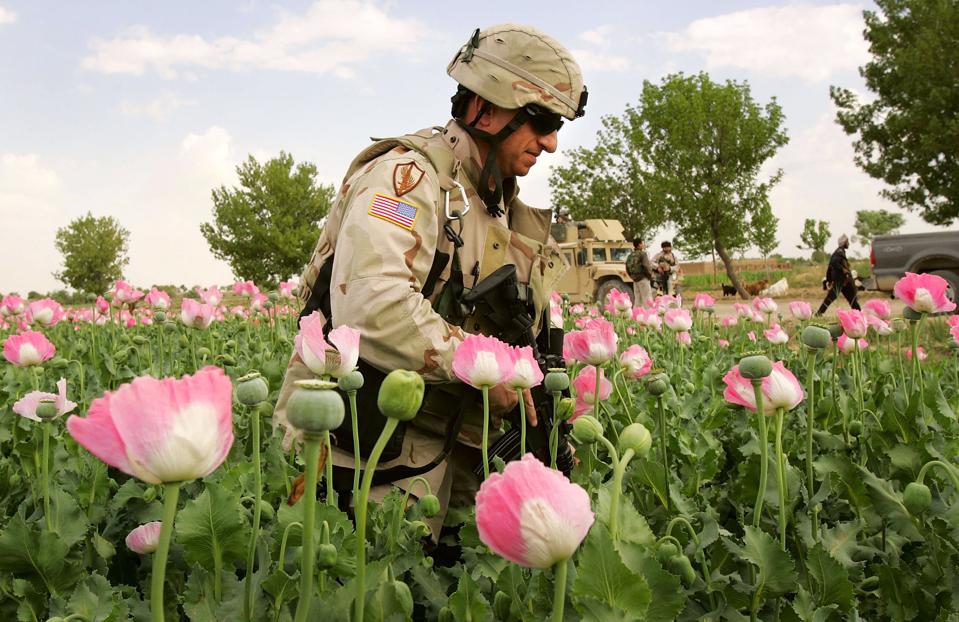
LASHKAR GAH, AFGHANISTAN - APRIL 01: U.S. Army Col. Paul Calbos walks through an opium poppy field on April 1, 2006 near Lashkar Gah in Helmand province in southern Afghanistan. Colonel Calbos survived a suicide car bombing on his three-vehicle convoy outside an American base in Lashkar Gah April 7, 2006. Calbos, who was in the lead vehicle of the convoy, said that one U.S. soldier and one American DynCorp security contractor were injured when an explosives-packed car drove in between the second and third vehicles of the convoy as it approached the entrance to the base. The U.S. military and DynCorp team was training leaders of the Afghan Eradication Force charged with destroying the country's large opium poppy crop. (Photo by John Moore/Getty Images)

Current methods of manual opium poppy eradication, such as use of sticks by local officials to break the stems of poppy flowers, are a complete failure in Afghanistan. They only succeed at making the state appear to be doing something about the problem. But only about 60% of Afghanistan is under the control of the elected government. When the eradication teams venture into rural opium growing areas, the typical stronghold of the Taliban, they are vulnerable to attacks. Regardless of who controls the land, the eradication teams are vulnerable to official Afghan corruption. They lack proper performance metrics, such as measures of second and third order intended effects. Poppy eradication under centralized control, for example aerial herbicide application and land confiscation directed from the capital in Kabul, would evade the Taliban and avoid most of the province- and district-level corruption that has stymied prior poppy eradication efforts in Afghanistan.
Aerial herbicide application has had limited success elsewhere. A 10-year program of aerial spraying of herbicides on coca crops worked to decrease narcotics production by 50% in Colombia.The herbicide glyphosate is widely used in U.S. agriculture, and is seen as relatively safe if not mixed with other herbicides. Its limited use on opium poppy in Afghanistan could be justified to decrease the production of illicit opiates. Glyphosate could be used in a Nangarhar pilot program against a small percentage of poppy fields to raise the risk for poppy farmers just enough to dissuade them from future planting of poppy for the next growing season. If Islamic State is not currently growing poppy, areas of Taliban or government control could be targeted. The spraying should be announced well in advance of the planting season, and phased in slowly over time to give farmers time to choose an alternative mix of crops, and to benefit from government-provided retraining and agricultural extensions. Opium could be replaced, for example, by wheat, onion, green beans, corn, saffron, or horticultural crops. For those on desert lands unsuitable for alternative crops, for example newly-settled areas in Helmand Province under Taliban control, the government and international aid agencies should match limited aerial herbicide application with advance subsidized relocation and retraining for improved access to non-farm jobs. First focusing on Nangarhar for a pilot program will both attenuate terrorist financing from the province, and serve as an example for other provinces in the East and South of Afghanistan.

Poor farmers, and those who take full advantage of crop conversion programs, could be exempted from the threat of herbicides at first in order to avoid major humanitarian issues of previous opium bans, such as reduced food and health expenditures, sale of daughters, sale of capital assets like livestock and land, increased crime, and increased support for the insurgency. Landless laborers hired for poppy cultivation should be given land of their own to decrease the labor supply available to large-scale wealthy poppy farmers. Repayment of opium-denominated debts with family members and capital goods could be forestalled by providing funding or microloans to any farmer in this dire situation.
Only a small percentage of the poppy fields of wealthy farmers who do not pursue conversion programs should be sprayed. Selective herbicide application gradually phased in with sufficient supports would be announced far in advance, and the mere risk of such applications would be enough to incentivize many poppy farmers to convert their fields in the next season. Poppy farmers in Afghanistan are generally attuned to political changes in poppy eradication sentiment and plans. So, advance warning of aerial eradication, which has not yet been used extensively in Afghanistan, would likely lead to immediate decreases in poppy planting if farmers believe in the resolve of authorities. Increases in crime and support for the insurgency may occur, but these would be short-term effects if the government maintains or slowly increases its poppy eradication efforts each year.
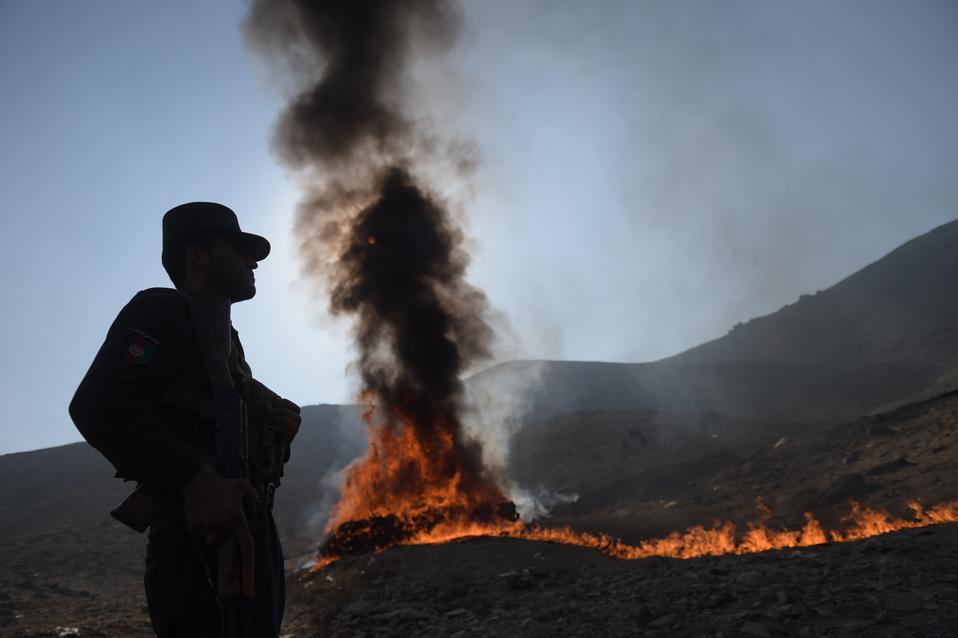
An Afghan policeman watches as a cache of alcohol and drugs burns on the outskirts of Kabul on December 20, 2016. Ninety eight tons of opium, heroin, hashish and alcoholic drinks were set on fire, officials said. Credit: SHAH MARAI/AFP/Getty Images
Another counter-narcotics strategy that should be seriously considered in Afghanistan is the confiscation of land from owners of poppy crops. This land could be redistributed to the landless laborers who work on such crops, creating a political interest group in favor of tough approaches to poppy eradication. The new owners themselves would know they would lose their land if they decided to plant poppy. This would pressure landowners who profit from illicit opium production, not just poor sharecroppers. Land confiscation actually protects poor sharecroppers and the landless by holding landowners responsible for use of their land in poppy farming, rather than imposing costs on the sharecroppers and landless.
Landowners, rather than sharecroppers, are arguably more responsible, and benefit to a greater extent, from sharecropper use of land for illicit but profitable poppy farming. In regions of Afghanistan where poppy farming is common, landowners typically increase rents on land to capture the increased profits yielded by poppy as compared to other crops. According to researchers David Mansfield and Paul Fishstein, who have done years of fieldwork in poppy regions of Afghanistan, including Nangarhar, “in areas where poppy is concentrated, the rentable value of land is inflated to such a point that farmers cultivating legal crops would not be able to meet their rent.” The high rents of poppy regions essentially forces non-owning farmers to plant poppy in order to pay the rent. The landowner, who sets these high rents, is therefore at least partially responsible for the use of his land by sharecroppers or renters for illicit poppy production, and so should bear serious legal consequences. Confiscation of land is one such consequence, and has been effective elsewhere, including against opium growers in China in the early 1900s, and against coca growers in Bolivia in the early 2000s.
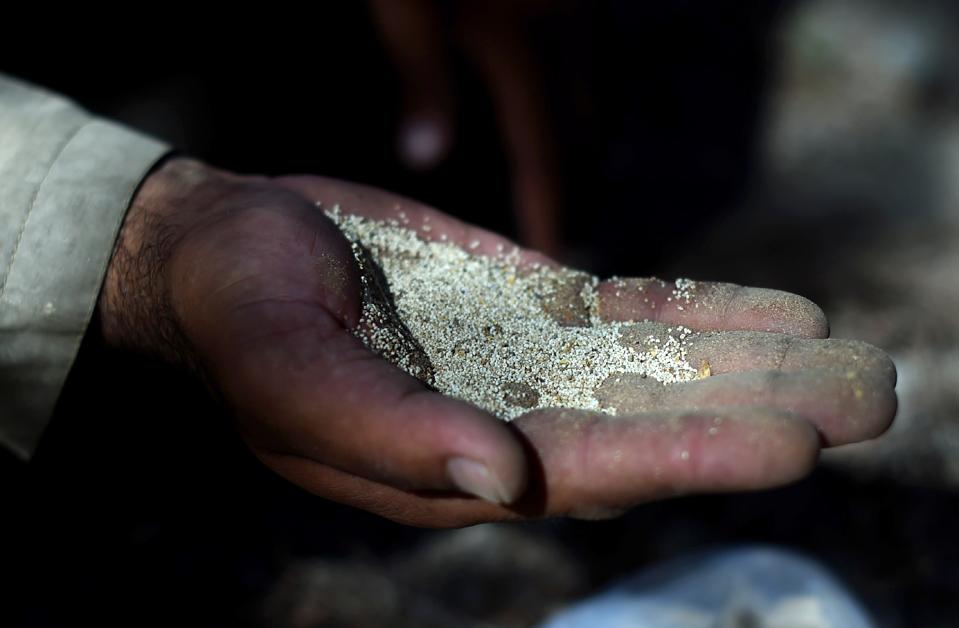
In this photograph taken on October 4, 2016, poppy farmer Nehmatullah, 34, holds poppy seeds on the palm of his hand during an interview with AFP in his home in Lashkar Gah, Helmand province. Afghanistan has all the trappings of a narco-state, with opium production - the lifeblood of the Taliban insurgency - from the traditional spring harvest alone edging towards a record high. Credit: WAKIL KOHSAR/AFP/Getty Images.
War and illegal drugs are two major causes of mortality worldwide. Afghanistan is unfortunately a center of both, and they propel each other in symbiotic fashion, exporting negative externalities of drug dependence and terrorism that make purely positive development strategies untenable. Tougher policies against opium growing in Afghanistan would decrease Taliban and Islamic State sources and potential sources of income, and decrease the supply of global heroin. A pilot program of aerial herbicide application in Nangarhar Province, combined with land confiscation from landowners who allow their land to grow opium poppies, and land redistribution to landless laborers, will be far more effective than current manual eradication programs dependent on corrupt local officials. At the same time, large countries beset by heroin addiction, for example the U.S., Russia, China, India, and Iran, must take more effective measures to decrease their demand for opium. This includes opium user harm reduction strategies, as in Switzerland, combined with traditional law enforcement against heroin dealers. Only by targeting both global demand and Afghan supply of heroin, can we hope to bring that country’s persistent narco-terrorism to an end.

US drone strike kills man behind Marriott Hotel bombing, Pentagon says


By Ryan Browne and Faith Karimi

A US airstrike in southeast Afghanistan killed an al Qaeda leader responsible for the deadly attack on the Marriott Hotel in Pakistan, the Pentagon said.
Qari Yasin was killed in a drone strike in Paktika Province on March 19, the Pentagon said late Saturday.
The September 2008 suicide truck bombing at the Marriott Hotel in Islamabad killed more than 50 people, including two US service members. It sparked a fire that charred the hotel, which is near the diplomatic section of Islamabad.
    Yasin is responsible for other carnage, including an attack on the Sri Lankan cricket team, which was visiting Lahore, Pakistan, in March 2009. In that incident, gunmen sprayed the team's tour bus with bullets as it neared the stadium, killing eight people -- six police officers and two civilians -- and leaving several visiting players wounded.
    The attack was a huge blow for the future of international cricket in Pakistan. In the years that followed, international teams backed out of playing in the country, citing security concerns. In 2015, visiting teams played in Pakistan for the first time since the incident.
    "The death of Qari Yasin is evidence that terrorists who defame Islam and deliberately target innocent people will not escape justice," Defense Secretary Jim Mattis said in a statement.

    Pakistan - Save Punjab University


    Unless Jamaat-e-Islami reins in IJT, its claims as a democratic party would remain suspect

    Enjoying the patronage of Zia-ul-Haq Islami-Jamiat-e-Tulaba (IJT) turned Punjab University campus into a battlefield and its hostels into torture centres. IJT’s main targets at the time were students with left or liberal leanings who demanded end of military rule and holding of elections. In later years IJT’s targets were Shia students organised in ISO who were harassed and beaten. During the last four years students from Balochistan and KP who have their own organisations have been attacked because the IJT does not allow any other student organisation to strike roots in the University, which it considers its fief.

    The IJT has all along tried to impose its narrow code of conduct on the student community by sheer force. Boys seen talking to girls have been given thrashing. Cultural shows have been attacked. Finding itself an unpopular minority, the IJT has illegally settled in the hostels scores of musclemen brought from outside. University teachers with different views have been tortured. In 2014 the Punjab University Academic Staff Association passed a strongly worded resolution against IJT’s lawlessness

    The present incident where Pushtun and Baloch students have been targeted must not be ignored as before by the University administration or Punjab government. Thanks its misguided policies and ill-conceived tactics the Punjab administration is already being accused of ethnic profiling. It has to act decisively to prosecute those who attacked the function instead of injudiciously balancing its action by involving the victims also. Political exigencies must not be allowed to stand in the way of national unity.
    .
    The Punjab University has to set an example by awarding maximum punishment to those who disturbed the event. Stifling dissent and putting an end to free debate on ideas has led to the degeneration of the Punjab University which in a more tolerant and open era produced two Nobel Prize winners, Dr Abdus Salam and Hargobind Khorana. Using force against students with different views, sects or ethnicity is not only atrocious but out of sync with an era which values democratic norms like freedom of opinion, openness and transparency.

    Prices of textbooks to witness 5% to 10% increase


    The retail prices of text books for secondary school will witness a surge up to 5 percent to 10 percent.
    The increase will take place in the garb of using quality cardboard for title covers, including glossy fine paper for text pages.

    Book publishers Oxford University Press, Gaba, FEP International and Paramount have more than 75 percent of market share collectively. More than 80 percent of English medium schools in Karachi prescribed a number of books of these publishers for class I to VIII. Besides they also recommend text books of these publishers for Montessori level (nursery and kindergarten level).
    The publishers usually announce a discount up to 10 percent to buyers on start of every academic year but this offer will off-colour the rebate on pretext of anticipating increase in price.
    In absence of any monitoring authority on government level to monitor the prices of text books, these publishers unilaterally increase the price of books. A senior member of All Pakistan Paper Merchants Association (APPMA) Rauf Ansari said, “Increase in the prices of paper and paperboard has affected the local price of notebooks, copies, textbooks and office stationery.” The leading publishers usually import around 60 percent of all types of paper and paper board for their requirements and rest of the produce need has been acquired from local purchase.
    The commercial importers were paying minimum 25 percent more on imports, now actual cost has been increased to 32 percent, he added. Country imports around 76,000 tonnes paper products of all kinds annually. While under customs tariff, paper is treated as finished goods under section (X) chapter 48 of Pakistan Customs Tariff, at high customs duty slab, at the rate of 20 percent to 25 percent, while in customs policy, raw material is at 10 percent or zero rate duty slab.
    He said the increased sales tax has increased the import cost by around Rs 8 per kg on all kinds of paper. “We import paper and duplex box paper from Indonesia, China, UK and other countries to meet our domestic requirements, while local mills cater around 65 percent of our requirements.” He said around 60 percent imported material is used for making office stationery and high-grade paper products and imported cardboards cater around 35 percent of our needs.
    The import cost on all types of paper and paperboard comes around $750 a metric tonne to $850 a metric tonne. Around 25 percent imported material is used for making notebooks and high quality paperbacks books while more than 50 percent local paper is used in making secondary and higher secondary school books.
    Prices of different standards of paper have also risen by Rs 6,200 per tonne in the local market just before the start of manufacturing and printing season of textbooks and copies. The price of semi-fine paper has increased to around Rs 57,200 from Rs 48,400 per tonne, which is used in the production of textbooks. The price of lower quality and normal paper increased from Rs 49,500 to Rs 54,000 per tonne, which is used in the production of copies and other items.
    The price of fine quality paper used in different value-added products has increased to Rs 66,000 from Rs 56,000 per tonne. Around 75 percent paper merchants buy paper from local paper companies that supply paper to majority of the publishers and manufacturers of various paper products. Pakistan imports different qualities of paper from Japan, Indonesia, China and some other countries but the 60 percent import duty discourages the publishers and printers to use imported paper.
    A senior member of Pakistan Pulp Paper and Board Mills Association (PPPBMA) said, “We are importing wood pulp at around $920 per tonne from Canada, USA, Indonesia and Sweden, besides paying one percent excise duty including regular taxes and sales tax.” Due to rising wood pulp prices in international market and higher customs duty on commercial import, prices of paper and paperboard have increased in the country. Around 100 units of PPPBMA were braving high cost of business, energy crisis and production loss, but still we were selling our products with a minimal increase of around 10 percent.
    Local mills prepare around 3,600 to 4,500 tonnes of paper every month and increase their output by 45 percent during April to July when demand goes up on the back of publishing school books and copies. The manufacturers normally manufacture three qualities of paper, fine paper, semi-fine paper and normal paper. They have already demanded the government to rationalise tax policy and revise duty and sales tax on the paper and board. A book publisher said surge in the basic raw material of books and copies would definitely increase the prices of these items in the coming academic session, which will start in mid-April in Sindh and mid-September in Punjab.
    The provincial textbook boards usually use locally manufactured paper in their products and import only when the local paper suppliers show their inability to provide them required quantity.
    Prices for the end users can be controlled if the government reduces customs duty to a uniform level of 10 percent from 20 to 25 percent on two categories, (uncoated and coated paper and board), representatives of PPPBMA and APPMA said.

    Pakistan - Female polio staff face insults, harassment in Multan


    Female polio workers go through trials and tribulations to work towards a nation free from the scourge of the debilitating disease.
    Multan is the only district in southern Punjab where all frontline polio workers happen to be women. Around 4,000 are currently on duty in the city, which has a population of more than six million, out of which one million are below five years of age.
    A female polio worker in the district, who requested anonymity, said that her job is extremely difficult as staff must confront challenging environments.
    The polio worker said that during campaigns certain residents harass, insult or even abuse them. Notwithstanding, the staff continue to perform their duties diligently keeping in mind the dream of having a polio-free Pakistan.
    Another female polio worker said that to manage her job and raise her children at the same time is a tough job. She added that it would all be worth it to see a polio-free Pakistan one day.
    The polio worker claimed that the feudal lords of Multan create hindrances for the campaign.
    Another polio worker said that certain residents believe the vaccination causes infertility. She added that they say that our campaign is against the tenets of Islam.
    Some residents have even threatened to kill polio staff.
    A seasoned polio worker who has been working for the past 10 years said that even if a single case is detected, staff negligence is blamed for the detection.
    Residents are reluctant to allow us inside their homes now owing to the rise in robberies, she said.
    “Our salaries are released late, even on occasions such as Eid,” she added.
    The polio worker said that even during Ramazan our timings are not changed and the female staff must work in the extreme summers.
    She said that some residents shout at them and admonish them to not visit their residence again. “However, we are steadfast in our work because we know that the eradication of polio is a national cause,” she added.
    Certain residents appreciate and encourage us and offer us hospitality, she said.
    New Vision Foundation President Shahbaz Gurmani said that 52 incidents of harassment, as well as attacks, were reported in the last 10 years.
    These incidents were observed in Multan, Dera ghazi khan, Bahawalpur, Sahiwal and Sargodha divisions. In this regard, 23 FIRs were lodged and 33 persons have been arrested in the cases.
    Community engagement
    The areas religious and political parties support and assist the anti-polio campaign staff. Wafaqul Madaris alArabaia (WMA) General Secretary Mohammad Haneef Jalandhri, who heads the largest grouping of seminaries in the country, claimed that the WMA has been fully cooperating with polio staff.
    Jalandhri added that he has directed seminary staff to guarantee that no child under the age of five is missed.
    In the wake of the recent polio case detection in Lodhran, several parliamentarians have played an active role in the field monitoring of polio workers. Abdul Qadir Gillani, son of former prime minister Yousaf Raza Gillani said that he had personally been overseeing the activities of the anti-polio campaign. Gillani said he had monitored campaigns in Lutfabad, Nehalaywala, Shadi Wali as well as areas of 17 Kassi and 19 Kassi in Multan.
    The former parliamentarian said that female polio workers had been performing their duty diligently.
    Parliamentarian Shaukat Bosan said that to achieve a polio-free Pakistan it is imperative that citizens cooperate with the campaign’s staff.
    Executive District Officer Health Zafar Iqbal said that female workers are playing an indispensable role in eradicating the disease.
    Multan Commissioner Nadir Chatta said that polio workers perform their duty even in the most testing conditions.

    Pakistan - Last time was in shackles, now I am in the field: Zardari

    Pakistan People’s Party Co-chairman Asif Ali Zardari on Sunday said that during the last general elections in 2013, he was ‘in handcuffs’ but now the situation has changed and he is in the field.
    The PPP leader was addressing a press conference in Lahore, where he said that his son, PPP Chairman, Bilawal Bhutto and his daughters are ready for the next elections.
    “The time for the elections has come, now people will know what elections are,” he said.
    The PPP president reiterated that the party lost in the last elections in Punjab, due to ‘RO elections’, making an indirect reference to the elections being rigged.
    For transparent elections, the PPP would consult with all the political parties, said Zardari.
    “When Shaheed Bibi (Benazir Bhutto) used to visit Lahore, the city would close down,” Zardari said, adding “it would happen again, entire Lahore would shut down.”
    He said that by looking at the enthusiasm of the party workers one could safely assume that the PPP is ready to compete. 
    "The PPP is ready for the elections in Punjab," said the former president.

    https://www.geo.tv/latest/135586-Last-time-was-in-shackles-now-I-am-in-the-field-Zardari

    Pakistan - Zardari says border management with Afghanistan critical for peace

    Former President Asif Ali Zardari has said that border management with Afghanistan with mutual consultation is critical for addressing issues in militancy and terrorism and for
    peace in the region.


    Proper securing of borders with mutual consultation will put an end to allegations of cross border incursions of militants that has vitiated the relations between the brotherly neighbors Pakistan and
    Afghanistan, he said.

    The former President said this while commenting on reports today that fencing of border with Afghanistan along the border areas in Bajaur and Momand has started.

    He said it was unfortunate that the relations between the two countries had plunged low in recent times and called for concerted and sincere efforts by both countries to overcome mistrust and suspicions.

    “Border management with mutual consultation has long been delayed” the former President said adding that decision on it should no longer be delayed.

    A decision delayed is not a problem avoided, it is crisis invited, the former President said.

    Asif Ali Zardari expressed the hope that the move to begin border fencing will be welcomed by all those wanting an end to militancy and to the counter- productive allegations of cross border incursions.


    https://mediacellppp.wordpress.com

    Saturday, March 25, 2017

    Video - Beyoncé - If I Were A Boy (GRAMMYs on CBS)

    Video - #Republicans Can't Get Their S**t Together on Health Care: The Daily Show

    Hillary Clinton: 'Today Was a Victory for All Americans'


    As President Donald Trump cast blame on Democrats for not supporting the GOP-crafted effort to repeal and replace President Barack Obama's signature health care law, his former opponent, Hillary Clinton, took to Twitter to hail the bill's defeat as America's victory.
    "Today was a victory for the 24,000,000 people at risk of losing their health insurance, for seniors, for families battling the quiet epidemic of addiction, for new moms and women everywhere," she tweeted. "Most of all, it's a victory for anyone who believes affordable health care is a human right."

    "The fight isn't over yet," her statement continued. "But we are reminded today that there is no substitute for standing up and defending our values."
    She followed her statement with a series of Tweets highlighting stories of people who had been helped by the Affordable Care Act, also known as Obamacare.