Sunday, February 12, 2017

Pakistan - Interview with Hina Rabbani Khar - “It’s a reactive foreign policy”


Interview with Hina Rabbani Khar – politician and former foreign minister
“It’s a reactive foreign policy”
Hina Rabbani Khar.

The News on Sunday (TNS): What does the house arrest of Hafiz Saeed really mean for Pakistan? Has it finally submitted to international pressure, from the US and/or China, to curtail the activities of JuD and various other related outfits?
Hina Rabbani Khar (HRK): We do not want Hafiz Saeed or people like him to be representatives of our country. There is always this unsaid or between-the-lines insinuation that the state of Pakistan has been supporting them. This is all completely against Pakistan’s national interest, internally as well as externally. And, I must say, I’m more concerned about the internal policies – if you sort out your house your international reputation will improve naturally. The image of Pakistan will change. Organisations banned by Pakistan should not be allowed to hold huge rallies in Islamabad. Any state is considered to be weak when it allows something like this to happen.
I’m very happy that this government finally mustered the ability to house arrest Hafiz Saeed, as you know he was arrested during the PPP time, but the courts let him go then. It would be embarrassing to know that the government has acted under international pressure, when it should have done so in the national interest.
TNS: With the arrest of Hafiz Saeed, do you see a shift in Pakistan’s Kashmir policy? Is it moving away from being India-centric?
HRK: I think Pakistan’s policy on dealing with extremists has always been between black and white. Presently, I see us in the grey area but I would like us to get closer to a lighter shade of grey, and ultimately get to white – to show complete unacceptability or complete elimination of space for entities like Hafiz Saeed to function on the soil of Pakistan. These people have not helped the cause of Kashmir, instead they’ve spoilt the moral high ground that should be the mainstay of our Kashmir policy.

TNS: The extent of Chinese involvement in Pakistan is vast. Are Pakistan’s relations with China the only strong point of our foreign policy? Is it really ‘sweeter than honey’?
I’m at a loss. Educate me. Even the foreign office doesn’t know, I think. They do not know who to look to, Sartaj Aziz or Tariq Fatemi. In fact, by not appointing the foreign minister, the government has weakened the foreign office.
HRK: For the PML-N government, China remains the only strong point of their foreign policy. We’re all very proud of the investments China in making in our country. It carries immense value for Pakistan. But should it be the only relationship? During the PPP government, China was one of the focal points; in fact that’s when the foundation of the CPEC was laid by taking the Gwadar Port away from the Singapore Port Authority, enabling China to play a role in it. We called it the regional pivot, not the China pivot. So we were investing in transforming our relations with all our immediate neighbours, Afghanistan, Iran, India and China.
Regional pivot means that you are comfortable with your geography and are accepting of the fact that ‘peace within’ requires ‘peace without’, in the sense that you need to be at peace with your neighbours, invest in good relations and build trust. I believe countries closest to Pakistan are the most important — then as you zoom out, the level of importance decreases. No country has prospered without accepting its regional reality. Traditionally, Pakistan has done the opposite, which is wrong. We first zoom out, the US is our most sought after partner, and then as we zoom in — other than China no other country has seemed important to us. Historically, we’ve tried to manage all our regional relationships via Washington DC.
TNS: So, how do you see the regional scenario evolving with the change of government in the US? What challenges does Pakistan face in the emerging regional politics?
HRK: The US is not willing to invest in this region more than it already has. You see how Afghanistan was not even an issue in the Presidential debate. Afghanistan is not page 1 news anymore. So, the US is rather happy with China playing a strategic role in the region. We do see the US getting into a strategic relationship with India though.
However, a rather interesting development in the region is the developing Russia-Afghanistan-India-Pakistan-China nexus. These regional countries have a greater ability to have a solution-oriented approach to the Afghan issue. Many people will be uncomfortable with India being part of this group but it’s better to have India as part of the solution than part of the problem. In diplomacy we have to engage with countries that threaten you, not ignore them or wage proxy wars with them. I think this region has had enough of proxy wars and therefore all these regional players need to sit around a table and work on co existing peacefully.
A rather interesting development in the region is the developing Russia-Afghanistan-India-Pakistan-China nexus.
TNS: Our relations with Afghanistan have turned for the worse in recent months. We’ve seen frequent war of words and guns too. In an attempt to improve the relations, Gen Bajwa tried to reach out to Ashraf Ghani to initiate talks between Afghanistan and Taliban. Will such friendly gestures help improve the strained relations between the two neighbours? What more needs to be done?
HRK: This government lost a golden opportunity with Ashraf Ghani’s overture when a memorandum of understanding was signed by which Pakistan would help train Afghan intelligence officers, take part in the interrogation of terror suspects and conduct joint operations, alongside many other long standing wish list items for Pakistan. They even offered to stop taking any military support from India. He came all out to cater to our concerns on his first state visit to Pakistan in 2015. This was very significant because we know the anti-Pakistan lobby in Afghanistan is very strong. That was really the time for Pakistan to support him and keep the timelines to various commitments. But sadly we didn’t. What does it show? Clearly lack of will or ability to invest in long-term policy.
During the PPP government, we made it very clear that we have no favourites in Afghanistan and we reached out to all kinds of people, Tajiks, non-Pashtuns, Hazara, etc. That’s what this government needs to do as well. This government has remained embroiled in occurrences; it’s a reactive rather than a proactive foreign policy management.
TNS: Where do you think the relations between Pakistan and Iran are heading? Can we afford to look at Iran through the lens of someone else’s rivalry?
HRK: The Iranian portfolio is being completely ignored. We embarrassed President Hassan Rouhani when he came to Pakistan last year. I don’t think we should view our relations with Iran from the lens of any other nation’s rivalry. Good relations with Iran are in our national interest.
It will be a fatal mistake for Pakistan to align with the Islamic Military Alliance. Why get into a fight that is not ours? Our soldiers are fighting on a daily basis inside Pakistan’s territory so what is our business to become allies in a faraway fight when we have not even sorted our house.
TNS: Who controls the foreign policy?
HRK: I’m at a loss. Educate me. Even the foreign office doesn’t know, I think. They do not know who to look to, Sartaj Aziz or Tariq Fatemi. In fact, by not appointing the foreign minister, the government has weakened the foreign office. Who is to be blamed if the government leaves a vacuum, and someone else comes and fills it?

Music Video - Shabnam and Waheed Murrad - Naheed Akhtar

Video - Film actress Shabnam arrives in Karachi -Feb 10, 2017

Pakistan - Karachi welcomes Shabnam with open arms


Karachi might have changed a lot since Shabnam last saw it in 2012 but the love and appreciation she still receives has not changed at all.
The jam packed session of the yesteryear superstar on the second day of the 8th Karachi Literature Festival was a testimony to that. The determination to see the actress was such that the 30-minute delay in Shabnam reaching the venue hardly deterred any of her fans from attending the session, being moderated by actress Bushra Ansari.

With limited time on her hands, Ansari quickly asked a question that most of the people in the audience wanted to know: does Shabnam want to come back to Pakistan and act. And to the audience’s delight, she responded that given an opportunity, she would love to come back and work.
“The overwhelming love that I receive here makes me want to come back,” she said in Urdu with a tinge of Bengali accent.
Ansari further asked why the Lollywood superstar left her career and move back to Bangladesh. “After having worked in the industry, I thought it was my time to retire,” she said, adding that she wanted to spend more time with her family and believed it was her time to bid acting adieu.
Discussing her marital life, the former actress said that her husband, music composer Robin Ghosh, had shown complete trust in her and let her excel in her career. “It was a time when we did not have cellphones and he would have my entire day’s schedule and we would work accordingly,” she reminisced. Citing an incident on her punctuality, she said that once she had reached a movie set and the only people she found were the sweepers.
Language had initially been a barrier in Shabnam’s film career but her determination and dedication helped her overcome that barricade. “After my first two movies became hits, I was flooded with many offers but I was scared to accept them since I did not understand the language,” she said, adding that she had to spend two years to learn how to read and write Urdu.
In response to another question, Shabnam said that the port city had changed a lot since she visited it last. “It was better when we were poorer and had less cars,” Ansari humorously added.

Pakistan - PML-N, ANP, APML ACTIVISTS JOIN PPP


Pakistan Peoples Party Karachi General Secretary Senator Saeed Ghani on Friday said that key figures of the Muttahida Qaumi Movement would join the PPP soon.
He was addressing a press conference at the PPP Media Cell where local leaders of the Pakistan Muslim League-Nawaz, Awami National Party and All Pakistan Muslim League (APML) announced joining the PPP. He was accompanied by PPP MNA Shahjahan Baloch and Rashid Rabbani. He said that they were in touch with some key MQM personalities and soon they would be part of the PPP. “This is a wrong perception that entire Urdu-speaking community was associated with the MQM,” he said.
Ghani said that they would welcome people from different political parties who had joined PPP ranks. He said that everybody was aware of the role of the PPP for strengthening democracy in the country.
He said that it was the vision of the party that people from different political parties were joining hands with the PPP for a better future.
Responding to a query, Saeed Ghani opposed condition of CNIC of the head of the family for registration from the census team and said that all people should be counted in the census count so that real figures of immigrants could be revealed.
He rubbished aside claims that PPP was involved in giving clean chit to those involved in killing policemen in the city and said that they were not in government during the 1996-2008 tenure.
“We got a demoralised police force in 2008 and then we gave them the courage to fight against the menace of terrorism.”
Earlier on January 8, several activists of the Muttahida Qaumi Movement (MQM), Pak Sarzameen Party (PSP), Majlis Wahdat-e-Muslimeen (MWM), All Pakistan Muslim League (APML) and Awami National Party (ANP) joined the PPP after their meeting with Senator Saeed Ghani.
The announcement was made at a press briefing after the meeting. Those who joined the PPP were Saqib Umar and Kamran Siddiqui of the PSP; Maulana Khair Hussain, Maulana Nusrat Ali and Maulana Sajjad of the MWM; Muhammad Ismail, Zain Raza, Ahmed, Nazish, Kashif and Abdul Majid of the MQM and Zaheer Ahmed and Saddam of the ANP.
Speaking on the occasion, Saeed Ghani said that a large number of people wanted to join the PPP. “Important figures of some political parties will also make announcements about joining the PPP soon,” he said. He said the PPP wanted to take all stakeholders along for progress and prosperity of the city.
Responding to MQM leaders’ call for division of the Sindh province, Ghani said that they should first take control of Nine Zero and then think about division of the province. He said that courts should dispense justice to people in due course of time because delay in justice would tantamount to denial of justice.
Ghani said that many more members of the Pakistan Tehreek-e-Insaf (PTI) would join the PPP soon. He said, “Bogus cases have been lodged against former minister for petroleum Dr Asim Hussain.” He said, “Hundreds of people were pledging their allegiance to the PPP. The PTI will lose many of its members soon.”

https://ppppunjab.wordpress.com/2017/02/11/pml-n-anp-apml-activists-join-ppp/

Pakistan - Rabbani cancels Senate delegates' visit to US over visa delay


Chairman Senate Raza Rabbani Saturday cancelled a visit of Pakistani senators to Washington over unnecessary delay in their visa processing.

A delegation of senators headed by Deputy Chairman Molana Abdul Ghafoor Haideri was scheduled to leave for the United States on February 10. The deputy chairman, in this regard, had submitted a visa request last week.
There had been unnecessary delay in processing of visas by the US embassy, which irked the Senate chairman leading to cancellation of the visit.
The US embassy, however, had issued visa to Senator Salahuddin Tirmizi.
Rabbani said the delegation will not go to New York until an explanation by the United States.

Saturday, February 11, 2017

Hundreds Protest Immigrant Raids in US for Second Day


A second day of demonstrations for immigrant rights saw crowds gather in New York and Washington, DC, to voice anger at a week of raids by US Immigration and Customs Enforcement (ICE) and at new President Donald Trump's immigration policies in general.
Organized under the slogan "Here to Stay," groups like youth immigrant activist groups United We Dream, civic media organization Vote Latino, Human Rights Watch and others gathered to insist that immigrants and refugees remain welcome in the US. Groups like Black Lives Matter and Showing Up for Racial Justice (SURJ), which works to rally white Americans to racial justice causes, also took part.


View image on Twitter
View image on TwitterView image on TwitterView image on Twitter
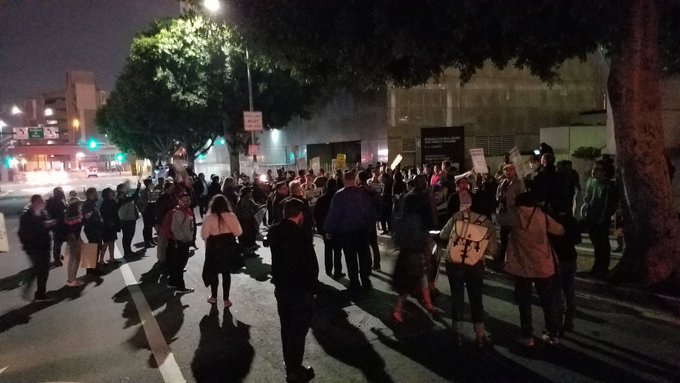
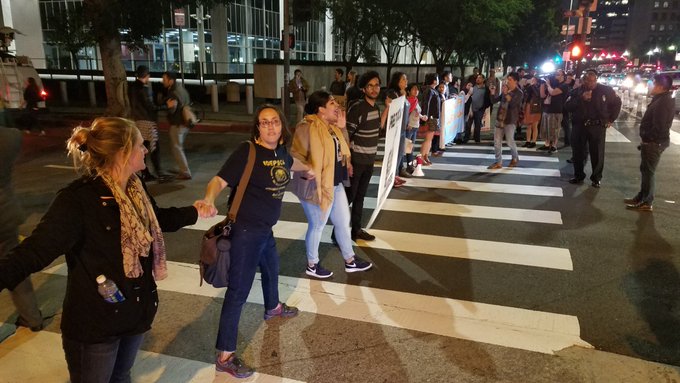
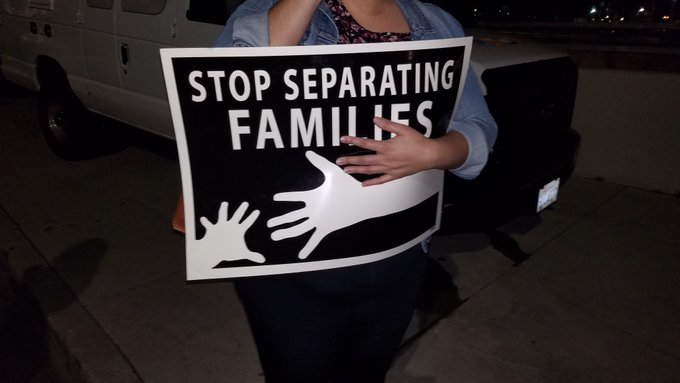
Protestors against deportation and today's ICE raids close off a section of Aliso St in  @KTLA
ICE raids over the past week led to the arrests of hundreds of immigrants, with criminal records and without. Immigration officials called the raids "routine," but immigrant rights groups say they herald a return to pre-Obama policies of casting a wide net for undocumented immigrants in the United States, rather than targeting only dangerous criminals.
Reports say several hundred gathered in front of the White House to protest, with hundreds more in New York, where there were reports of arrests, and in other areas.
The New York community organization Make the Road New York confirmed that ICE raids were taking place in the city in a February 11 statement.
"The Trump administration has now doubled down on its war on our communities," the organization said. "We have confirmed ICE raids that have swept up five immigrant Staten Island residents over the past several days. These raids have the explicit purpose of tearing families apart. Our communities are understandably extremely concerned, but also resilient. We are here to stay, and we will fight back."
Hundreds rallied in New York and Los Angeles yesterday for the same cause.

JOKE OF THE CENTURY - CIA awards Saudi prince medal for anti-terror efforts

Crown Prince Mohammed bin Nayef, Saudi Arabia’s deputy premier and interior minister, has been presented with a CIA award for his work fighting terrorism, prompting raised eyebrows on social media.
CIA Director Mike Pompeo gifted the prince with the George Tenet award in Riyadh on Friday.
Named for the former Director of Central Intelligence under Bill Clinton and George W Bush, the George Tenet award recognized the Saudi royal’s intelligence work against terrorism and his contributions to peace and security.
Tenet served as Director of Central Intelligence from July 1997 to July 2004. In 2015, a CIA report was declassified, slamming Tenet in particular for failing to thwart Osama bin Laden despite years of warnings and threats from al Qaeda, which ultimately resulted in the 9/11 attacks.
“The Kingdom has been keen to combat terrorism based on its conviction that terrorism has no identity and no religion, and from its belief that the terrorists are committing these acts stemming from their deviant ideologies and evil thought,” Arab news quoted bin Nayef as saying Saturday. “All negative religious, political and social ideologies that use religion as a tool throughout human history do not reflect the absolute truth about religion.”
The prince also said the award recognized the Kingdom’s anti-terrorism efforts under King Salman bin Abdulaziz Al Saud, and commended Saudis working in security agencies as well as the Saudi people for their work to combat terrorism.
Bin Nayef highlighted the fact that the Kingdom had successfully prevented several terror plots, including ones against friendly countries, and described the US-Saudi relationship as “strong and historic,” saying nothing would come between them or damage their ties.
“Combatting terrorism requires a joint international effort at all levels; financially, intellectually, militarily and through the media,” he said. “This should be coordinated and conducted in accordance with the UN’s covenants and laws including particularly the principle of sovereign equality.”
The gesture has been viewed as ironic on social media, given the controversy around Saudi Arabia. “Worst joke ever,” a social media user tweeted. “Giving a Saudi prince a medal for combating terrorism is the equivalent of giving McDonald's a medal for combating obesity,” another said.
Of the 19 suspected 9/11 hijackers, 15 of them were from Saudi Arabia, according to the CIA. In 2015, one of the alleged 9/11 hijackers, Zacarias Moussaoui, claimed several members of the Saudi royal family had been listed as al Qaeda donors in the database he worked on under orders of Osama bin Laden, CNN reports.
Families of the victims of 9/11 have brought a lawsuit against the Kingdom. The “Justice Against Sponsors of Terrorism Act” was passed in September, and allows US citizens to sue foreign countries for terrorism.
WikiLeaks cables from the US State Department from 2009 revealed that “donors in Saudi Arabia constitute the most significant source of funding to Sunni terrorist groups worldwide.”
“Saudi Arabia remains a critical financial support base for al-Qa'ida, the Taliban, LeT, and other terrorist groups,” the cable continues.
Saudi Arabia has also been accused of funding extremists in Syria, the Independent reports. In a 2014 email released by WikiLeaks in October, Hillary Clinton allegedly wrote about Saudi Arabia’s funding of Islamic State:
“While this military/paramilitary operation is moving forward, we need to use our diplomatic and more traditional intelligence assets to bring pressure on the governments of Qatar and Saudi Arabia, which are providing clandestine financial and logistic support to ISIL and other radical Sunni groups in the region.”
Accepting the Tenet award, bin Nayef pointed to the dangers the Kingdom faces.
“We are surrounded by areas of conflict, and we were the first affected by terrorism from various sources, but we are equipped to combat terror in any place and under any circumstances,” he said.