Monday, January 9, 2017

#SHAME #PAKISTAN - Patient dying on floor is not strange for me


Aminah Suhail Qureshi
Why does a person with hands bruised while sharpening twines for kites demand same attention which is compulsorily required by the one wounded on neck by those very kite strings?
1996. This year marks the formal inauguration of Punjab’s second largest teaching hospital and the last tertiary care hospital of Lahore to date, that is Jinnah Hospital. With a population increase from 5.4 million in 1998 to 10.4 million in 2016, only 300 beds in two increments have been added to the initial count, making a total of 1250 beds in this hospital. With three patients resting on each bed, should a person lying on floor be a lurid and appalling sight? With only 20 beds available in each emergency ward, would it be fine to admit only 20 patients, 1 for each bed? Would this practice of doctors not be proclaimed as inhumane by flag-bearers of human rights? With three patients lying on one bed and one on the floor, would the death of a patient on bed be less deplorable than the patient who died on cold floor on January 2, 2017? Had the same patient died on a not-so-cosy and actually dirty bed in the hospital, would the chief minister have taken notice of the incident? Against whom has he taken the notice? The doctors who are themselves underpaid employees of the government who just happened to be the front men dealing with the patients? The former governments that failed to add to the system tertiary hospitals in proportion with the increasing population? Or the currently ruling government itself that has been unable to do the aforementioned despite being in power in Punjab since 2008?
Taking notices, dismissing medical superintendents, blaming doctors, blocking roads, and protesting in front of the provincial assembly have been habitually practised in routine on the occurrence of any such incident. Out of all these, damning doctors and paramedical staff is the easiest because they can be easily identified in white coats and uniforms, walking here and there with stethoscopes hung around their necks or trays held in their hands, respectively. I am not denying that several incidents have been reported where patients died or suffered grave losses owing to uncalled for negligence shown by doctors, but the fact that there exists a blind trust between a patient and his doctor is equally undeniable. Regardless of the consequence, the patient there and then does show undaunted faith in the doctor that is allotted to him or he chooses himself. This is obviously realised and acknowledged by both the patient and the doctor. So why would any doctor show any scale of heedlessness and neglect towards his patient despite knowing the dire results he might have to face, including blaming and shaming? No one, exactly no one, on this planet can challenge a doctor if he resolves to harm his patients. What keeps him from doing so is his morality which is now on the verge of being quelled due to unreasonable and unmindful allegations that they have to face every single time. Our media showed a 60-year-old woman dying on the floor, but no cameraman and reporter dared enter one of the wards to show the true picture of the only beds and facilities available in the hospital for the general public.
One general misconception that public has about doctors is factually based on widespread mistrust that exists in our society. Being a part of a nepotistic society, patients widely suspect doctors of giving undue favours to their relatives who come for treatment. They think that these relatives are sent for check-up as well as surgeries before those who come without a reference. The state of mind in which such accusations are made is totally understandable, but all what needs to be done is to roam around the emergency of the hospital and discover the realities. The unfortunate harsh verity is that there exist only two operation theatres for general surgery in the very Jinnah Hospital we are talking about. Yes, only two operation theatres for thousands of patients that daily visit this hospital in pursuit of treatment. What favouritism can possible operate under such circumstances? And why are only the doctors blamed for alleged cold-blooded behaviour? Why patients are not held liable for the height of incorporation they show towards their fellow countrymen? Not a single person willingly shares the bed with others. Why do they forget it is not their personal property but a limited facility that has been provided by the government? Why does a person with hands bruised while sharpening twines for kites demand same attention which is compulsorily required by the one wounded on neck by those very kite strings? Upon witnessing the latter being treated first due to seriousness of injury, why can the former not simply wait for his turn?
Every camera showed the female patient taking her last breaths on the cold floor, but no one dared show the state of patients lying on beds. Instead of highlighting this issue as a failure to provide adequate number of beds and medical facilities resulting from inattention of government since ever, our media portrayed it as a mistake committed by doctors owing to dereliction of duty. Before inculpating doctors one should understand that their sole responsibility is to diagnose and prescribe treatment. Both of these aspects are in turn dependent on the infrastructure and equipment provided by government. If not rendered available, doctors cannot do anything to treat and save lives. This is what we all need to realise; doctors are as much humans as we are. If this incident has moved us, it also has equally, in fact more intensely, affected the doctors. However, they are as helpless as we are. They are as much part of the system as we are. When we cannot assign fault to ourselves, we should not put it on the shoulders of doctors. They are bound to work in the system that has been provided to them. Therefore, if notice has to be taken, it is definitely not against the hospital administration.


http://dailytimes.com.pk/opinion/09-Jan-17/patient-dying-on-floor-is-not-strange-for-me

Pakistan - Child Protection Problems


It is not the least bit surprising that the National Child Protection Policy, despite being enacted as law through the Child Protection Protection System Bill 2014, still lies unimplemented.
An estimated 2.5 million children (the actual number could be much higher) are currently part of the country’s workforce, which goes against the country’s own laws, not counting that it is also against various international conventions on human rights signed by Pakistan.
Children as young as six enter the workforce as undocumented labour, and are doomed to stay there for the rest of their lives. Education, an unalienable right of children everywhere, is denied to a big portion of Pakistan’s adolescent population, which means that the principle of equal opportunity in the job market is an unachievable dream for many.
And although many children working will tell you that this is through their own preference, the internationally established age of maturity is centred on certain principles.
In the case of Pakistan, the age of 18, when one gets their National Identity Card made, is when a child is seen to have grown up enough to make their own decisions. Any point before that, their parents and guardians are supposed to make choices with the child’s best interests at heart. In Pakistani society, not only are parents not always looking to protect their children, but there is also the concept of letting a child believe that they have grown up and can think for themselves long before that is actually the case.
The sad fact is that Tayyaba – the girl that employed by Sessions Judge Raja Khurram’s household – is one case out of countless others where children employed in various fields have been abused at the hands of their employers. The law against employing children has acted more as an impediment than anything else, considering the government has not tried stopping children becoming a part of the workforce.
What this means is that many are driven to work at an early age, and do not even have the legal cover that an adult member of the workforce is to have, which would ideally be concerned with protecting workers’ rights and would protect them from harm due to their employment.
The world sees children as equal to adults in terms of granting rights and liberties, but special conventions include extra protection and care for them alongside these rights for obvious reasons. The Pakistani state is denying its children both, and must rectify this immediately.

Pakistan's 10-year-old child maid - No minor offence


By Waqar Gillani

No minor offence


The case of the 10-year-old child maid allegedly abused in the house of a district sessions judge has created an uproar that must not be allowed to fade.
On December 28, a resident of Street 12 in Islamabad’s Sector I-8/1 called the police to report a case of domestic violence on a minor girl in the house of an additional district and sessions judge. The police, along with a legal team of the government-owned Crisis Centre for Women, reached the neighbourhood but failed to recover the victim. The judge’s wife denied the presence of an under-aged domestic worker in her house.
Next day, the police and members of the Crisis Centre, revisited the judge’s house and succeeded in recovering the 10-year-old maid.
The girl was produced before a local female magistrate, Assistant Commissioner Nisha Ishtiaq, who recorded the girl’s statement and ordered a medical check-up at the Pakistan Institute of Medical Sciences (PIMS).
However, according to an official of the Crisis Centre, a PIMS report, that made no mention of visible marks and bruises on the girl’s body and face, was “manipulated” because the accused person happens to be a serving judge in the city. The female magistrate reordered the girl’s medical check-up but within that period the team of the centre received a threatening phone call from another serving additional sessions judge, directing the centre to produce the girl before him immediately.
The team received the call after the court had adjourned for the day. Yet, the sessions court judge summoned the father of the child and forced a compromise between the girl’s father and the accused judge.
By this time the Islamabad High Court had taken notice of the action, and the news was being aired on tv.
The residents of Street No 12 say the child maid had been living with the judge’s family for over a year. They also indicate presence of more than one under-aged domestic worker in the judge’s house, and suspect the girls were frequently tortured.
According to 2015 Sparc report, there are around 264,000 under-age domestic workers in the country, often left to the mercy of employers who routinely subject them to physical and psychological torture.
According to the Society for the Protection of the Rights of the Child (Sparc), in collaboration with the Child Rights Movement (CRM), an alliance of the civil society groups on child rights issues, the family of the judge refused to cooperate with the activists and fact-finding missions.
In a statement recorded by Registrar IHC, the child maid said she was subjected to physical violence after some valuables were found missing from the house. “They beat me with a big spoon. Then Mano Baji [the judge’s wife] lit the stove and put my hands in the flames”.
The young girl also told the media that her mistress abused her every time something was not kept in its place or was not done in time.
However, the accused judge and his wife deny the charge.
For Anees Jillani, a lawyer and human rights activists with focus on child rights, the only thing surprising in this case is that the accused is a serving judge. “There is need to look at this issue seriously, and make a law to stop domestic child labour. Presently, there is no law to stop domestic child labour — or even domestic labour — and in such cases of violence someone has to prove it is bonded labour. And, there will be hardly any case because there will be no agreement on official stamp paper to prove bonded labour in the court.”
On Jan 4, Justice Saqib Nisar, the newly-appointed Chief Justice of Pakistan’s Supreme Court took suo-motu notice on the compromise between the girl’s father and the accused party.
In the police report, the accused are charged with minor and easily bailable offence of threats and wrongful confinement. The 10-year-old girl was unaware of her salary and details of this bonded labour agreement made by her father.
This is indeed common in big cities where agents supply domestic child labour from rural areas for money pledged in advance. One can get a domestic child labour for Rs20,000 to 50,000, and keep the minor at home as full-time ‘employee’, an agent working in a posh locality in Lahore tells TNS.
Article 37(a) of the United Nations Conventions on the Rights of the Child (UNCRC), ratified and signed by Pakistan, clearly states, “no child shall be subjected to torture or other cruel, inhuman or degrading treatment or punishment”.
According to annual report of 2015 of the Sparc, there are around 264,000 under-age domestic workers in the country, often left to the mercy of employers who routinely subject them to physical and psychological abuse, exploitation and violence.
Meanwhile, the National Commission for Human Rights (NCHR) has started to probe the issue. Justice (retd) Allah Nawaz Chohan, Chairman NCHR says, “The challenge in such cases is the non-existence of laws to prevent child domestic labour.”
He adds, there is need to see whether this agreement between the father and the accused party was done under-pressure, under-influence or through offering some money. “Poverty is the mother of all crimes and this issue of marginalised section of society enslaving their children for domestic labour is linked to the socio-economic situation. There is need for a collective voice and practical steps to discuss these issues and make strong laws,” he says, continuing that his commission has a limited scope, and “we can only suggest such improvements rather than bring any practical change”.
Anees Jillani feels the official bodies working on child rights are not empowered. “Despite commitments, there is no national commission on child rights. We see serious lack of political will in making laws to stop domestic child labour because this is an issue of the majority of upper class and political and administrative elite. This type of child labour serves mutual interest of a class of society — and that is why there are no standards”.
A few years ago, an office bearer of the Lahore Bar Association and an influential lawyer of Lahore was allegedly tortured to death a child domestic worker, Shazia, who belonged to a poor Christian family. The lawyer was acquitted of the charge
A joint statement by civil society groups and members and the CRM states, “The compromise and forgiveness loophole, so expeditiously exploited by the judge and his spouse, is a convenient tool, employed mostly against the poor and downtrodden by the rich and powerful in Pakistan, as in this case.”
They have demanded from the chief justice of Pakistan that “there must be no ‘forgiveness’ and no ‘compromise’ — the State must become the girl child’s guardian and complainant in the case.”


Pakistan - Anti-Taliban Pakistani Activist Is Missing


A Pakistani university professor, poet and rights activist who has been critical of the Taliban and also of the government's efforts against militants, has been missing since last week, his family said Monday.
Salman Haider disappeared on Friday, his brother Faraz Haider said. He said Salman's wife got a text message on her phone to go and collect his car from a roadside on Islamabad's outskirts.
Pakistan's ministry of interior on Monday ordered police to step up efforts to find the missing activist. No militant group has so far claimed that it abducted the activist and no government department or intelligence agency has said it detained or arrested him.
Local media have reported that a number of other activists like Salman Haider — who ran popular social media accounts known for liberal and leftist views — have also gone missing. These social media accounts — some of which are no longer accessible — often highlight what they describe as Pakistan's dual policy of fighting some militants but supporting others.
Pakistan's telecommunication department responsible for blocking social media and controlling the internet in Pakistan did not respond to a request for comment.
Salman Haider has also been participating in rallies and protests against disappearances of nationalists and separatists from Pakistan's southwestern Baluchistan province who are usually detained by intelligence agencies on charges of anti-state activities. The fate of many of these "missing persons" remains unknown.
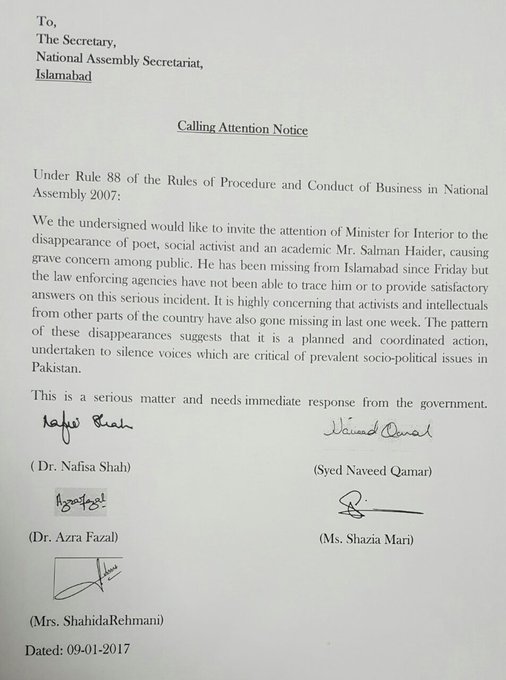
Left-leaning Pakistan's People's Party submitted Monday a request in parliament, seeking an answer from the Interior Ministry on the disappearances, calling them a planned and coordinated crackdown to silence voices critical of state policies.

Pakistan - CONCERN OVER INCREASING DISAPPEARANCES OF ACTIVISTS, SCHOLARS AND BLOGGERS


PPP has put the government on notice for recent and coordinated disappearances of intellectuals, bloggers and activists 

PPP Human Rights Cell Central Coordinator Dr Nafisa Shah has expressed concern on the increasing disappearances of political activists, scholars and bloggers in the last few days in the country. In addition to Salman Haider there are reports of at least 3 other bloggers and activists who are missing besides a number of political activists in Sindh and Balochistan. “The Minister Interior must come clean on this matter and take urgent steps towards recovery of these activists.

The Minister for information technology should also give us answers as it is apparent that their blogs have been removed,” Says PPP Human Rights Coordinator Dr Nafisa Shah. “Unfortunately PMLN government has miserably failed in implementing the National Action Plan or in punishing the terrorists and ironically social activists and intellectuals who are the main challengers of extremism in Pakistan are being kidnapped, tortured and victimised and government is either clueless or unable to protect them,” she added. The ppp human rights cell also voiced concern on the disappearances in Sindh and Balochistan of political activists and nationalist voices. They called upon the Human Rights Committee of the National Assembly to respond to the growing rights violations in the country.

https://ppppunjab.wordpress.com/2017/01/09/dr-nafisa-shah-expresses-concern-over-increasing-disappearances-of-activists-scholars-and-bloggers/

Sunday, January 8, 2017

China - President Putin on South China Sea issue

Video - Chinese fighter jets hone combat maneuvers in drills over South China Sea

China Insight— A military for 21 century 12/17/2016

One-China policy not a capricious request


Taiwan leader Tsai Ing-wen arrived in Houston for a brief transit stop in the US during her trip to four Central American countries, with which Taiwan has diplomatic ties. On her return, she is expected to transit from San Francisco. Such "transit diplomacy" was favored by the Lee Teng-hui and Chen Shui-bian authorities, the significance of which often outweighed the trip to Central America.

Whether Donald Trump will meet Tsai had generated heated discussions. But the Trump team ruled out meeting Tsai this trip. Trump's team and Tsai did not use Tsai's trip as an opportunity to reinforce previous provocations triggered by the phone call between the two. It is hard to say if they are taking a step back. But the mainland does not fear their provocations. The mainland has seized the initiative. The US and Taiwan now should restrain, or be forced to restrain, themselves. 

Tsai had a phone call with Trump, but soon Sao Tome and Principle broke ties with Taiwan. It is certain that more countries will do the same. The US passed bills that allow serving officers to visit Taiwan, while Chinese fighter jets patrolled around Taiwan and China's aircraft carrier passed the island. It is widely expected that the mainland will impose further military pressure. Tsai needs to face the consequences for every provocative step she takes.

Trump is yet to be inaugurated, and there is no need for Beijing to sacrifice bilateral ties for the sake of Taiwan. But in case he tears up the one-China policy after taking office, the mainland is fully prepared. Beijing would rather break ties with the US if necessary. We would like to see whether US voters will support their president to ruin Sino-US relations and destabilize the entire Asia-Pacific region.

Beijing does not need to feel grateful to Trump for not meeting Tsai. The one-China policy is the basic principle reiterated in the three Sino-US joint Communiqués. It is also the foundation of the profound bilateral relationship. Sticking to this principle is not a capricious request by China upon US presidents, but an obligation of US presidents to maintain China-US relations and respect the existing order of the Asia-Pacific. If Trump reneges on the one-China policy after taking office, the Chinese people will demand the government to take revenge. There is no room for bargaining.

The Trump-Tsai call indicates the eruption of the Taiwan independence tendency by Tsai authorities. The mainland should mobilize all possible measures to squeeze Taiwan's diplomacy as well as deal a heavy blow to Taiwan's economy. It should also impose military pressure on Taiwan and push it to the edge of being reunified by force, so as to effectively affect the approval rating of the Tsai administration. 

We should take Tsai's denial of the 1992 Consensus as a turning point and end the disturbance of Taiwan independence on cross-Straits ties. The Democratic Progressive Party should be made to realize that if it continues to engage in Taiwan independence moves, the political costs will be more than it could bear.

New word in political vocabulary? ‘Alt-right’ used for right-wingers now refers to Trump supporters

Bernie Sanders On Obamacare: It’s GOP’s ‘Job To Come Up With Alternative’

Video - The Legacy Of Barack Obama - Fareed Zakaria

Hillary Clinton Receives Ovation at ‘The Color Purple’


By MICHAEL PAULSON and MICHAEL BARBARO

Hillary Clinton, who has kept a relatively low public profile since losing the presidential election two months ago, on Sunday showed up at the final performance of a revival of “The Color Purple” on Broadway.
Mrs. Clinton received a sustained standing ovation from the sold-out crowd, a response far warmer than the scattered booing and clapping that greeted the arrival of Vice President-elect Mike Pence when he attended “Hamilton,” just one block north, on Nov. 18. Mrs. Clinton was accompanied by her husband, Bill Clinton, and their daughter, Chelsea.
Because the Sunday matinee was the last performance for this acclaimed production, which won last year’s Tony for best musical revival, there were other boldfaced names there as well, including Phylicia Rashad (the 2004 Tony winner for best actress in a play, “Raisin in the Sun”) and Debra Messing, who made her Broadway debut in 2014 in “Outside Mullingar.”
Public sightings of Mrs. Clinton in the weeks since the election have still been sufficiently rare that they create a stir on social media. Strangers seek photographs with her at stores and in the woods near her home in Chappaqua, N.Y. But Mrs. Clinton has indicated that she and her husband plan to attend the inauguration of Donald J. Trump as president on Jan. 20.
“The Color Purple” tells the searing story of a young black woman abused by her stepfather and her husband in rural Georgia in the early 20th century. The musical is an adaptation of a best-selling 1982 novel, by Alice Walker, which was awarded the 1983 Pulitzer Prize for fiction.
Steven Spielberg adapted the novel into a film in 1985, and Oprah Winfrey, who was featured in the film, went on to become an important champion, and co-producer, of the musical.

Video Interview - President Obama - ABC - George Stephanopoulos

President Obama says he advised Trump to trust the U.S. intelligence community


President Obama, in an interview that aired Sunday on ABC, said he told President-elect Donald Trump that he must have confidence in the U.S. intelligence community in order to make good decisions.
"When I talked to him about our intelligence agencies, what I've said to him is that there are going to be times where you've got raw intelligence that comes in and, in my experience over eight years, the intelligence community is pretty good about saying, 'Look, we can't say for certain what this means,' " Obama said in an interview with George Stephanopoulos on ABC's This Week.
"But there are going to be times where the only way you can make a good decision is if you have confidence that the process is working," Obama said. "And the people that you put in charge are giving you their very best assessments."
Trump said Friday that he had a "constructive" meeting with intelligence officials, but still had questions about assertions that Russia hacked Democrats during last year's election in order to boost Trump's campaign and defeat Hillary Clinton.
In a report released by the intelligence community Friday, U.S. officials said they "assess Russian President Vladimir Putin ordered an influence campaign in 2016 aimed at the U.S. presidential election."
"I think that what is true is that the Russians intended to meddle and they meddled," Obama said on ABC.
He also warned against letting partisanship undermine faith in U.S. intelligence-gathering.
"One of the things I am concerned about is the degree to which we’ve seen a lot of commentary lately where there are Republicans or pundits or cable commentators who seem to have more confidence in Vladimir Putin than fellow Americans because those fellow Americans are Democrats," Obama said. "That cannot be."
Obama acknowledged that he underestimated Russia's hacking abilities.
"I don't think I underestimated (Vladimir Putin), but I think that I underestimated the degree to which, in this new information age, it is possible for misinformation, for cyber hacking and so forth, to have an impact on our open societies, our open systems, to insinuate themselves into our democratic practices in ways that I think are accelerating," he said.
Obama urged Trump and Congress to strengthen the nation's cybersecurity and prevent any more foreign interference in U.S. elections.
“I think it's important that Congress, on a bipartisan basis, work with the next administration, looking forward to make sure that this kind of (foreign) influence is minimized," the president said. "We have to remind ourselves we’re on the same team. Vladimir Putin’s not on our team."
Obama also said he has talked to Trump about Trump's fondness for using Twitter to communicate with the American people.
"I've said to him, and I think others have said to him, that the day that he is the president of the United States, there are world capitals and financial markets and people all around the world who take really seriously what he says, and in a way that's just not true before you're actually sworn in as president," Obama said.
Obama said he told Trump that running the country is much different than running a business.
"You can't manage it the way you would manage a family business," Obama said. "You have to have a strong team around you. You have to have respect for institutions and the process to make good decisions because you are inherently reliant on other folks."
The president said his private conversations with the incoming commander-in-chief have been "cordial" and that Trump has been open to his advice.
"The main thing that I've tried to transmit is that there's a difference between governing and campaigning, so that what he has to appreciate is as soon as you walk into this office after you've been sworn in, you're now in charge of the largest organization on Earth," Obama said.
Obama said he and Trump are opposite in many ways but that they have one big thing in common — confidence.
"It's probably a prerequisite for the job, or at least you have to have enough craziness to think that you can do the job," Obama said.

Pakistan - Who decides Fata’s fate?


In colonial literature as well as in contemporary analysis, the tribal areas of northern Pakistan have been stereotypically represented. They are depicted as either a populace of permanently armed warriors who sit in jirgas all day or, as nomadic victims trapped in conflict under imperialist attacks and state exploitation awaiting rescue from donors, development workers and Phd documentary makers.
The Fata reform debate is predictably hinged on these two pivots of culture and conflict, as if no other framework may be imagined or voiced by the citizens themselves. In this postcolonial transitionary moment, the government may like to revisit its poor record in nation-building or territorial integrity, to avoid repeating historical mistakes.
Under the government’s proposed Fata reforms, why should the decisions of ‘Elders’ and not the ‘youth’ prevail in the re-structuring of the agencies? Why should women not be consulted and offered the extension of the progressive laws of Pakistan, if they are citizens of the same country?
Who benefits from the continuation of the rule of exceptionalism claimed by a majoritarian religion and military powers?
As spokespersons and gatekeepers of traditions, Elders may be wise in experience but they have also been allies in retaining the privileges of political agents. Such collusion is a legacy of the historical practice that embedded colonial and exploitative economic power in India. Bureaucrats, chieftains, religious leaders and donors only devise means of retaining the status quo and reaping profit. The leadership of the Fata Reforms Committee should not be decided on the basis of age or experience but in fact, for intrepidness. Why do we admire that quality in the young leaders of Kashmir but not for Fata?
Reform means more than just re-forming Fata’s institutional and administrative structures. There is a live debate amongst the people of Fata. It is not valued because it has no formal representative channel of communication. To include the voices of the young, women and multiple minorities in the new social contract for the agencies does not mean holding a referendum under the prevailing unequal political climate. This would only invite a perverse manipulation of ballots. Excluding the views of the displaced and dispossessed simply encourages simmering resentment, disconnection and rebellion in the long run.
Under the proposed reforms, why should the decisions of ‘Elders’ and not the ‘youth’ prevail in the re-structuring of the agencies? Why should women not be consulted and offered the extension of the progressive laws of Pakistan, if they are citizens of the same country? Who benefits from the continuation of the rule of exceptionalism.
It has been overwhelmingly clear for years that the FCR is an unacceptable feature in Fata and must be dismantled completely. This has opened up the important debate of whether the best option is to replace regulation with the proposed Rewaj Act.
Many liberals reject the ideal of a parallel legal system primarily due to the patriarchal nature of informal justice regimes and their bias against women and minorities. However, to align the justice system of Fata with the Constitution requires a better strategy than the unsuccessful attempt to simply outlaw jirgas, as in Sindh.
The significance of the recommendation for replacing the FCR with the Rewaj Act is that it calls for scrutiny of all judgments by the High Courts and Supreme Court, in order to ensure that no judgment can circumvent either human rights or Quranic principles. For some in Fata, this is a practical recommendation while for others it is a stalling strategy. Whichever prevails, the opposing voices must be given fair hearing.
There are also signs that this debate is gendered and generational. It is not urbane Pakistanis but the residents of Fata who are debating the value of tribalism and tradition, too.
Romanticising culture as an ideal becomes a lever of control that justifies the refusal to arithmetically account for citizens’ needs via a regular census. This makes it impossible to prescribe a uniform policy or a fair system of compensation of displaced or vulnerable peoples.
As the government attempts to finalise a political framework for Fata, the economic hitmen are preparing business briefs and loans under the guise of altruism. The favoured mantra is to foster the “resilience of the people”. Recovery, restoration, sustenance, assistance and rebuilding do not define the needs of the affectees but the priority of the specialist bent of the donor in question.
There is broad consensus that Fata should merge with Khyber Pakhtunkhwa and the FCR must be dismantled along with all its proxy political and economic powers and influence. Critically, the Fata Secretariat needs a very focused, professional and sustained strengthening process and not some ad hoc, throw-a-few-dollars triumphant development. If it is to function as the hub of policy and implementation then let the Secretariat be consciously supported by independent economists, intelligentsia, social workers and participatory processes throughout the transition period — but as a collective dialogue and not through individual non-representative consultancies.
Instead of centralised plans and international donor dependency, it is local government that is the most reliable and accountable litmus of efficacy in peoples’ governance. This must be strengthened.
A democratically imagined administrative structure that is invested in accountable and creative reform for the people is possible if there is no pandering and negotiations with some vague thing called traditional buy-in.
It is time to listen to the voices of reason from within Fata. As Sher Rehman from the remote Shawal district in North Waziristan says wisely, “Traditions don’t end just because new laws are passed.” And anyway….who fears rights-based laws? Only those players or practices that benefit from denial of these rights. Reform cannot be led by just men, money, mullahs and the military. Fata deserves better than a repetition of Pakistan’s postcolonial mistakes.

#RECOVERSALMANHAIDER: BILAWAL URGES FOR SAFE AND SOUND RECOVERY OF SALMAN HAIDER

#RecoverSalmanHaider: Bilawal urges for safe and sound recovery of Salman Haider
salman-haider1


Chairman Pakistan Peoples Party Bilawal Bhutto Zardari has expressed deep concern over the reported kidnapping of Human Rights activist Prof. Salman Haider from Islamabad and demanded his immediate recovery.
“Disappearance of a human rights activist from country’s capital has laid bare the harrowing depth of insecurity in Islamabad streets during PML-N’s government and its Interior Ministry,” he added.
PPP Chairman urged for safe and sound recovery of Prof. Salman Haider and action against those involved in his kidnapping.
He said citizens going missing without any clue and government’s lacklustre attitude towards them speak the volume of injustice to the both people and the country.

https://ppppunjab.wordpress.com/2017/01/08/recoversalmanhaider-bilawal-urges-for-safe-and-sound-recovery-of-salman-haider/

China’s Trouble With Pakistan’s Turbulent Democracy

Beijing’s ‘diplomatic cover’ for Masood Azhar is bad for both Pakistan and China


A retired Chinese diplomat, Mao Siwei, in a blog a fortnight ago, critiqued his government’s decision to block attempts to impose a United Nations ban on the Jaish-e-Mohammed leader, Masood Azhar. While Mao served in India, his views on Pakistan’s terrorist networks were influenced by his term as China’s deputy ambassador in Islamabad at a time when militant groups like the Tehreek-e-Taliban were threatening the capital city itself — and, among others, killed several Chinese workers. “Is Azhar a terrorist?” asks Mao, and writes “the answer should be yes.”
The social media views of a retired official are no indication of government policy. In China, where the foreign ministry infamously lacks influence, they probably count for even less. However, the blog has helped underline the increasingly strident and public support by Beijing for any actions, rogue or otherwise, of Islamabad. It also underlines the increasing contradictions this “back Pakistan, wrong or right” policy means for China’s other foreign policy positions.
One contradiction, and the most obvious, is that Beijing has sought global support for its own support against homegrown Islamicist terror groups. Therefore, its provision of diplomatic cover for the most egregious of Pakistan’s terrorism-related activities severely undermines its own policy on that front. India would be well within its rights to say it will “review,” for example, its stance on the Uighur separatist movement in China.
The other is China’s entire stance on how best to help Pakistan. Beijing accepts that its “all weather friend” is a troubled nation. It argues much of what it does, from building economic corridors to becoming Pakistan’s primary supplier of weapons, is designed to help stabilise that country and ensure it does not collapse. India has heard similar arguments — from the United States during its periodic bursts of bonhomie with Pakistan. The Chinese arguments are as short-sighted as the American ones. There is a consensus across the world that the source of that country’s instability is its military’s outsized political role, its demonisation of India to legitimise that role, and the sponsorship of terrorist groups to maintain a state of conflict between the two countries. These militant groups have developed an additional utility for the generals of being used to keep Pakistan’s own democratic parties in line.
Nothing China is doing addresses this core problem in Pakistan. If anything, it only further metastasises the cancer that afflicts that country. Mao’s blog implicitly highlights this issue. The more blatantly Beijing bends over backwards on behalf of Islamabad, the worse that country’s behaviour will become in the long-term. And, in the short-term, whatever little progress is possible on the India-China front is being sacrificed.