Saturday, January 7, 2017

Pakistan - The trap of status quo


By Afrasiab Khattak


Is this a country for Muslims or for Islam? This is the dilemma that Pakistan has faced from day one.
For the majority of Muslim League leaders, Pakistan was to be a country for Muslims where they could live their lives without any fear of domination. The idea of Pakistan as a country for Islam took root later when the feudal and bureaucratic elites ruling the country used the “ideological card” to resist democratic transformation. The dilemma was further compounded by the fact that for the founding fathers the aforementioned question of identity was a mere manifestation of the real issue, which was provincial autonomy. If the All India National Congress had accepted the Cabinet Mission Plan in 1946 presented by the British Raj, that envisaged a confederation in post-colonial India, Muslim League would have given up the demand for partition that took place in August 1947. But the new country took no time in joining the western military pacts of SEATO and CENTO for containing and defeating communism.
It is pertinent to remember that Western ideologues and strategists of the capitalist world had no confusion. For them the vast Muslim population living in the wide arc of Asia and Africa, from Sinkiang (Xinjiang) to Marrakech, was a potential explosive weapon to be used against Soviet communism. The Central Asian belt was regarded as the “soft belly” of the Soviet Union, as there was potential for penetration of religious influence into it from the contiguous Muslim populations. What was missing in the whole Western anti-communist project was an ideological “detonator” that could make the explosion possible. So the West focused on Pakistan to persuade her to play that role. The Pakistani security establishment had jumped on the Western bandwagon from day one. Even Zulfiqar Ali Bhutto’s “New Pakistan”, that apparently distanced herself from the West in foreign policy, could not break out from the old ideological axis internally. It goes without saying that this process was taken to the extreme, almost to the point of no return, by General Zia’s martial law.
It is hardly a coincidence that the decisive battle of the Western powers against the erstwhile Soviet Union in Afghanistan fought through Pakistan, and “Islamisation” of the country, progressed simultaneously. The situation was aggravated to dangerous proportions with the advent of Wahabism, Salfism and Takfirism in Pakistan in the 1980s and 1990s. Pakistan as a state and society became radicalised. The focus of the country’s national security policy isn’t confined to her borders any more. Pakistan involvement in international “jihadism” has turned it into a dangerous country and this adventurism is not confined even to her immediate neighborhood. It has gone as far as Bosnia and to many other places in the world.
After the collapse of the communist bloc the Western powers didn’t require the services of Pakistan, and that brrought Pakistan’s so-called strategic alliance with the West to an end. This relationship has become hostile now as the “mujahideen” of yesterday have become terrorists of today. But religious extremism (and violence and terrorism emanating from it) is putting Pakistan’s own future in question. After living for long years in denial Pakistan has ultimately come around to concede the existence of the problem after the killing of about 60,000 of its citizens at the hands of terrorists. But if the experience of the last two years (after the charting out of the National Action Plan) is anything to go by, Pakistan is still not ready to take on the problem. The stubborn insistence of security circles on providing space to Taliban, LeT, JeM and other terrorists networks closely linked to international terror syndicates proves that the policy of keeping militants as strategic assets for state policy is still intact. In fact, the fresh hobnobbing of Pakistan with Russia indicates that the country is looking for new markets for its militant outfits.
Apart from mere lip service there is no evidence that the Pakistani state regards religious extremism and terrorism as existential threat to the country. Sectarianism is tearing the country apart but the unreformed religious seminaries are producing brainwashed sectarian militants on a very large scale since their syllabus and administration is based on absolute sectarianism. Recently, when the Supreme Court-appointed judicial commission for conducting inquiry into a heinous terrorist attack in Quetta came out with a report criticising ineffective state policy towards extremism and terrorism, the interior minister chose to publicly dismiss the report and launch a verbal attack on the judicial commission. As if that was not enough, Hafiz Saeed, the leader of the proscribed organisation LeT was seen landing in Quetta with pomp and show as if in defiance to the recommendations of the Supreme Court judicial commission. The public demonstration in favor of the murderer of Salmaan Taseer on the death anniversary of the former Punjab Governor has exposed the policy of appeasement of the government towards extremist militancy, particularly in the Punjab.
But the problem is not confined to just state security policy. By ignoring the need for investment in human development for long years the ruling elites are guilty of preparing conditions conducive to the rise of extremism and terrorism. The collapse of the public education system and health services have had dire social consequences. The serious decline of our education system in particular has led to severe distortions and deformations in human material being produced by Pakistani society. Religious seminaries have flourished as the growing number of children remain out of school. Growing population, widening social divide, the deepening environmental crises and failure of judicial system is helping in the growth of extremism and militancy. Ruling elites, both civil and military, are busy in squeezing the dying system. Political squabbles mostly revolve around power games and the slogan of change has become mere rhetoric. There is no reform agenda in sight. There is strong potential for the rise of an Arab Spring like chaotic situation in Pakistan. Interestingly some Turkish political analysts are mourning the “Pakistanisation” of Turkey but Pakistan seems to be adamant in following the beaten path. Is there a way out of this possibly fatal trap of status quo?

Pakistan's military courts: What did they achieve?


Shamil Shams
A Pakistani law allowing military courts to try civilians on terror charges has expired. It's unclear if the government will extend the law, after criticism of the courts' legality and of their failure to curb terrorism.
The controversial tribunals have hanged 12 people and ordered the execution of 149 more since they came into force after the deadly Taliban attack on a Peshawar school in December 2014 that killed more than 150 people, mostly children.
The country's powerful military intensified its crackdown on extremists following the Peshawar massacre, as the civilian government introduced a National Action Plan (NAP) that included the creation of the military courts, which were allowed to try civilians on terror charges.
The South Asian country's parliament and Supreme Court approved the law as an "exceptional" short-term measure, but it was heavily criticized by Pakistan's civil society as "extra-constitutional."
Rights activists also say the courts failed to achieve the target they had set for themselves - the eradication of terror. In addition, they say, no efforts have been made to reform the civilian judicial system to speed up terror trials.
"The lapse of the jurisdiction of military courts over civilians is a step in the right direction, but unsurprisingly, there is no sign of the promised reforms to strengthen the ordinary criminal justice system to effectively handle terrorism-related cases," said Sam Zarifi, Asia Director of the International Commission of Jurists (ICJ).
"The Pakistani government must not re-enact legislation to continue secret military trials of civilians, nor resort to more short-term, short-sighted security measures that are contrary to human rights protection," Zarifi added.
Analyst Imtiaz Gul told the AFP news agency it was unlikely that Prime Minister Nawaz Sharif's government would extend the courts that have been an "embarrassment" for the country.
Citing military sources, the ICJ said the military courts had convicted 274 people since January 2015, of which 161 were sentenced to death, adding that many details about the convictions had not been made public by the military.
A solution or a problem?
Despite the criticism, the military courts enjoyed considerable public support in Pakistan, as the civilian courts have failed to deal with terrorism-related cases.
In a number of instances, the civilian courts' judges were openly threatened by Islamic militant groups such as the Taliban and the Lashkar-e-Taiba. A number of lawyers have been killed for prosecuting the extremists, and many judges have fled the country after receiving death threats. In Pakistan, it is not easy to proceed against Islamists; in the past, liberal politicians were killed for speaking against controversial blasphemy laws and in favor of secular legislation. The perpetrators of these crimes have still not been brought to justice.
But rights activists say that did not justify the military's involvement in civilian judicial matters. The Pakistani military already has more say in domestic and foreign policy matters than the civilian government.
Pakistan Proteste gegen Taliban 5. Januar 2015 (picture-alliance/dpa/AP Photo/K.M. Chaudary)
A consensus to establish anti-terrorism courts was reached after the horrific Taliban attack on a Peshawar school in 2014
The powerful military of the South Asian nation has been receiving billions of dollars from Western nations for more than a decade to eradicate terrorism from Pakistani soil. This includes seven of the nine years of former military dictator Pervez Musharraf's iron-fisted rule from 1999 to 2008. Activists ask why the supporters of the military courts think they could solve the issue if the military could not rein in Islamists back then.
The chairperson of Pakistan's Human Rights Commission (HRCP), Zohra Yusuf, blamed political leaders for not taking advantage of the consensus against Islamist militancy and surrendering their powers to the army. "It is unfortunate that the nationwide resolve against the Taliban and other extremist groups did not translate into political action. It remained a military affair," Yusuf told DW after the Peshawar attack.
In a 2015 report, the International Crisis Group (ICG) criticized Pakistan's counterterrorism measures.
The National Action Plan introduced after the Taliban attack in Peshawar had given the army a dominance in security affairs that in a democratic setup should have belonged to Prime Minister Nawaz Sharif's government, the report said.
"The militarization of counterterrorism policy puts at risk Pakistan's evolution toward greater civilian rule, which is itself a necessary but not sufficient condition to stabilize the democratic transition," the report released on July 22 underlines. "The NAP looks far more like a hastily-conceived wish list devised for public consumption during a moment of crisis than a coherent strategy," it added.
The ICG paper advises Prime Minister Sharif to take matters into his own hands and democratize the anti-terrorism strategy "in order to replace an overly militarized response with a revamped, intelligence-guided counterterrorism strategy, led by civilian law enforcement agencies, particularly the police."

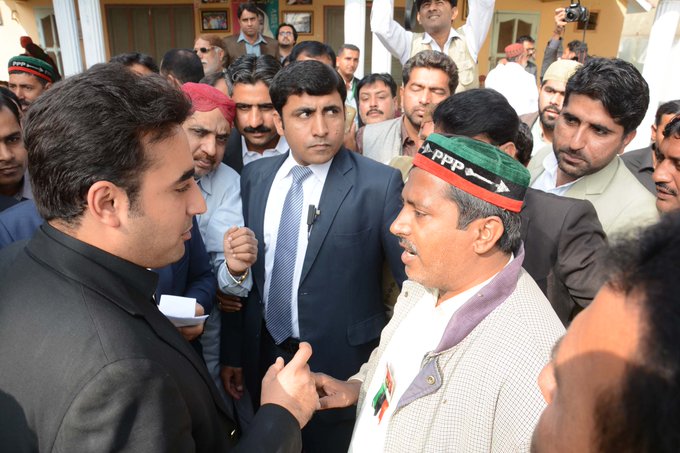
CHAIRMAN BILAWAL GETS WARM WELCOME ON LARKANA VISIT


Chairman of Pakistan Peoples Party (PPP) on Friday paid a visit to Larkana where he was given a warm welcome by the locals. PPP chief Bilawal was given a warm welcome upon his arrival in NA-204 constituency in Larkana where he will be contesting bye elections.NA-204 constituency in Larkana where he will be contesting bye elections.NA-204 constituency in Larkana where he will be contesting bye elections.

People showered flower petals on him when he reached the constituency. He also inaugurated a newly constructed girls college in the constituency.

https://ppppunjab.wordpress.com/2017/01/07/chairman-bilawal-gets-warm-welcome-on-larkana-visit/

Bilawal Bhutto Set To Be Opposition Leader In Pakistan Parliament

Bilawal Bhutto is set to be the Leader of the Opposition in Pakistan’s National Assembly after he is elected to parliament, according to media reports on Thursday. 
The 24-year-old scion of the influential Bhutto family will replace Khursheed Shah, 64, as the Leader of the Opposition, The Express Tribune reported.
Oxford-educated Bilawal is currently chairman of the Pakistan Peoples Party (PPP).
The news of Bilawal’s expected elevation was made public by none other than Shah himself, the paper said.
It came a day after PPP co-chairman Asif Zardari announced that Bilawal would contest a by-election for a parliamentary seat from Larkana, the hometown of the Bhutto family in Sindh province.
“Bilawal Bhutto will be the leader of the opposition and I will assist him as his adviser while his father will also guide him on parliamentary politics,” Shah told journalists in Sukkur, Sindh province, last night.
Bilawal is the son of former President Asif Ali Zardari and the slain prime minister Benazir Bhutto, and the grandson of late prime minister Zulfiqar Ali Bhutto.
A PPP spokesperson, when asked for clarification on Shah’s statements and any change in the PPP’s stance on the matter, said that it is possible that Bilawal may become the Opposition leader.
When asked whether Bilawal would be the new opposition leader or not, the spokesperson told Dawn newspaper that: “It is obvious. He [Bilawal] is the party head. He will become [the opposition leader].”
The PPP insists this decision is not made all of sudden, but after long consultation.
“PPP’s Central Executive Committee and Federal Council had been taken into confidence over by-elections and Bilawal’s nomination for the slot of opposition leader,” PPP Federal Council member Lal Bux Bhutto told The Express Tribune.
“Like his mother, Bilawal has the potential but he lacks exposure in parliamentary politics. But there is no harm in it. Benazir Bhutto was also junior than others when she had taken over as prime minister in 1988,” he said.

https://online.wellsfargo.com/signon?LOB=CONS

Friday, January 6, 2017

Michael Jackson - billie jean live first time moonwalk

Michael Jackson - Thriller

Iraq war veteran accused of killing five at Ft. Lauderdale airport


By Zachary Fagenson
An Iraq war veteran took a gun out of his checked luggage and opened fire in a crowded baggage claim area at Fort Lauderdale's airport on Friday, killing five people, months after he showed up at an FBI office behaving erratically.
Esteban Santiago, 26, who was taken into custody immediately following the shooting and questioned at length, was expected to face federal charges in the shooting rampage, said George Piro, special agent in charge of the Federal Bureau of Investigation's office in Miami.
Piro said investigators had not ruled out terrorism as a possible motive in the rampage and were reviewing the suspect's recent travel.
Santiago, who had served in the U.S. military, had arrived in Ft. Lauderdale shortly before 1 p.m. local time (1800 GMT) on a connecting flight from Alaska, authorities said, when he retrieved a 9mm semi-automatic handgun from his checked luggage and began firing indiscriminately.
Broward County Commissioner Chip LaMarca said on Twitter that the gunman went into a restroom to load his weapon and came out firing. Witnesses told MSNBC television he only stopped after running out of ammunition, at which point he surrendered to police.
Cellphone video posted on social media showed travelers kneeling and treating victims on the floor next to a carousel. At least two victims had pools of blood from apparent head wounds.
The gunman, who wore a "Star Wars" T-shirt, said nothing as he fired, witnesses told MSNBC.
"This is a senseless act of evil," Florida Governor Rick Scott told reporters.
A White House spokesman said President Barack Obama had spoken to Scott and Broward County Mayor Barbara Sharief and had extended his condolences to the loved ones of the victims. n addition to the five killed, eight others were wounded by gunfire and some three dozen were taken to local hospitals with bruises or broken bones suffered in the chaos surrounding the shooting massacre. Piro said that Santiago had turned up at an FBI office in Anchorage in November of last year behaving erratically and was turned over to local police, who took him to a medical facility for a mental evaluation.
A federal law enforcement official told Reuters that Santiago told agents at the Anchorage office in November that his mind was being controlled by a U.S. intelligence agency, which was ordering him to watch Islamic State videos.
Santiago served from 2007 to 2016 in the Puerto Rico National Guard and Alaska National Guard including a deployment to Iraq from 2010 to 2011, according to the Pentagon. A private first class and combat engineer, he received half a dozen medals before being transferred to the inactive ready reserve in August last year.
An aunt said he came back from his deployment "a different person," MSNBC reported.
LEGAL TO FLY WITH GUNS
Flying with firearms is routine and legal in the United States as long as the guns are kept in a locked, hard-sided container as checked baggage only, under TSA rules. Ammunition is prohibited in carry-on bags but is allowed in checked luggage.
The attack was the latest in a series of mass shootings that have plagued the United States in recent years, some inspired by militants with an extreme view of Islam, others carried out by loners or the mentally disturbed.
John Schlicher, who told MSNBC he saw the attack, said the shooter was "directly firing at us" while passengers waited for their bags. His wife gave first aid to a victim who had been shot in the head, and his mother-in-law used her sweater to tend to another victim but it turned out that person was already dead, he said.
Mark Lea, another eyewitness, told MSNBC, "He didn't say anything; he was quiet the whole time."
Fort Lauderdale-Hollywood International Airport is the second largest in South Florida, serving as an intercontinental gateway.
Nearly two months ago a former Southwest Airlines worker killed an employee of the company at Oklahoma City's airport in what police called a premeditated act.
The deadliest mass shooting in modern U.S. history took place last June, when a gunman apparently inspired by Islamic State killed 49 people and wounded 53 at a gay nightclub in Orlando, Florida.

Russia scales down military presence in Syria following ceasefire deal

President Obama 'Heartbroken' Over Fort Lauderdale Airport Shooting


Hours after the tragic attack on Friday in the Fort Lauderdale–Hollywood International Airport that killed five and injured at least eight people, President Barack Obama told George Stephanopoulos “these kinds of tragedies have happened too often during the eight years that I’ve been president.”
Speaking to Stephanopoulos, 55, for ABC’s This Week, Obama said he would not comment on the incident “until I have all the information” but he did want to express “how heartbroken we are for the families who have been affected.”
This Week ✔ @ThisWeekABC
Pres. Obama on airport shooting: "I don’t want to comment on it other than just to say how heartbroken we are for the families." #ThisWeek
6:28 PM - 6 Jan 2017
  150 150 Retweets   274 274 likes

“The pain, the grief, the shock that they must be going through is enormous,” he told Stephanopoulos. Obama, 55, added that his staff has reached out to the mayor of Fort Lauderdale “to make sure that coordination between state and local officials is what it should be.”
“I think we’ll find out over the next 24 hours exactly how this happened and what motivated this individual,” Obama continued.
Gunshots broke out on Friday at the Fort Lauderdale–Hollywood International Airport. The Broward County Sheriff confirmed via Twitter that multiple people have been killed and the suspect is in custody. Broward County Mayor Barbara Sharief told CNN that 13 people were transported to local hospitals.
The suspected shooter used a gun he retrieved from baggage he checked on a Delta flight to the airport, a federal law enforcement official tells PEOPLE.
A federal law enforcement official tells PEOPLE the suspect is Esteban Santiago, 26. He is of Puerto Rican descent. He arrived in Ft. Lauderdale, Friday, on a Delta red-eye flight originating from Anchorage via Minneapolis, with checked baggage containing a firearm.
He picked up the checked firearm at baggage claim, before allegedly going to the bathroom, gathering his weapon and changing into a Star Wars shirt. He then exited the bathroom and allegedly began firing at those around the baggage carousel. Santiago had a military ID on him when he was taken into police custody.
The shooter was discharged from the Army last year on a general discharge, the official says.
Santiago was apprehended by a Broward County sheriff’s deputy and taken into custody, Sheriff Scott Israel said at a Friday press conference. Israel added that the gunman, who wasn’t hit by gunfire, is being interviewed by FBI agents and Broward County sheriff’s deputies.


http://people.com/archive/barack-obama-fort-lauderdale-airport-shooting/

3 Dead, Multiple Injured in Shooting at Fort Lauderdale-Hollywood International Airport

A gunman opened fire at Fort Lauderdale / Hollywood International Airport Friday afternoon, killing at least three people before being taken into custody, law enforcement sources told NBC News. At least nine people in total were shot, sources said earlier.
The shooting occurred at the baggage claim inside Terminal 2. Aerial footage showed a crowd of people gathered outside on the tarmac.
http://www.nbcmiami.com/news/local/Shooting-Reported-Inside-Fort-Lauderdale--Hollywood-International-Airport-409905825.html

Letters to the President: Russ and Linda Dixon from Texas

The Record: President Obama on Health Care in America

Video - The Record: President Obama on Social Progress and Equality

First Lady Michelle Obama Honors the 2017 School Counselor of the Year

Pakistan - The murder of Salmaan Taseer screams of societal ignorance


By Manik Aftab
The brutal murder of Salmaan Taseer, a former governor of the Punjab who was gunned down by his own bodyguard at the Kohsar Market in Islamabad six years ago, screams of societal ignorance at large. Taseer was murdered because he sought reforms in Pakistan's controversial blasphemy laws.
The late PPP stalwart also proved himself to be a champion of minority rights when he announced his open support for Asia Bibi, a Christian woman who is alleged of blasphemy and is awaiting final verdict by the Supreme Court. Her case, which is the first such to be heard under Section 295-C of the Pakistan Penal Code, dates back to 2009.
Fast forward to January 4, 2017 and pro-blasphemy law demonstrators are clashing with security forces as Pakistan walks a line between upholding human rights and appeasing hardliners. Over 150 persons were arrested in Lahore after they attempted to hold demonstrations against the proposed amendments in the blasphemy law. There was no official permission, yet the protesters belonging to the Sunni Tehreek, Tehreek-i-Khatme Nabuwat and Tehreek-i-Labbaik Ya Rasool Allah somehow managed to convey their message.
Call them what you me, but these religious groups are so well-organized that the state has no other option but to bow down to their demands. Despite all their internal differences, these groups feed on the very emotion of human mind that considers hatred above humanity. Any sane person, who knows or practices any religion, is aware of the fact that every major religion in the world promotes humanity and tolerance. The idea of universal brotherhood is greatly stressed upon by major religions of the world. But these religious fanatics make sure that the society at large stick to their twisted interpretation of religion.
Just two days ago, Senate's Functional Committee on Human Rights unanimously approved the Hindu marriage bill. The landmark move set a precedent that the state is willing to deliver if it wants to. It shows that Pakistan is willing to protect its minorities, but we still have a long way to go.
It is a painful truth that the Zia regime destroyed three generations by implementing its twisted version of the religion. And we haven't been able to recover from that. We won't as long as we aren't able to understand the essence of religion, that is humanity. And as long as the state is governed by religious fanatics and hardliners who have forgotten that the Benevolent God indeed exists.

Pakistan, Blasphemy and the Murder of Salman Taseer


Raza Habib Raja 

Right now Pakistan is once again in the news related to its controversial anti-blasphemy law. Shaan Taseer, the son of late Salman Taseer is in hot water after posting a video message in which he condemned Pakistan’s blasphemy laws and tried to show solidarity to its oppressed Christian minority.
After seeing the message the religious community is calling for his arrest. Some have gone even further and have started to incite violence against him. Pakistan over the years has become so bizarre that now even criticism against a man-made law has assumed the status of blasphemy.
Shaan Taseer is now facing similar risks which his father, the late Salman Taseer, had faced after criticizing the blasphemy laws. If these religious zealots are not controlled, I fear that he may end up sharing the same unfortunate fate of his father.
His father, Salman Taseer, a politician and Governor of Pakistan’s most populous province Punjab, was an outspoken man and was murdered by Mumtaz Qadri, his own security guard, for speaking in favor of repealing Pakistan’s controversial blasphemy laws, according to which a person found guilty of blasphemy can be sentenced to death. Salman Taseer had also asked for official pardon of an illiterate woman, Aasia Bibi, who had been sentenced to death by Pakistani courts after being found guilty of blasphemy.
However, even this humane gesture was construed as blasphemy by the religious lobby and they started to agitate against him. The drop scene finally came when Qadri, his own guard, shot him and surrendered himself to police.
Later, in embarrassing scenes which have been permanently ingrained in the memory, he was showered by rose petals. After Qadri’s arrest he went to court where finally he lost his appeal. He was executed on 29th February 2016 and his funeral was attended by millions.
But why did it happen? Why did Qadri shoot Taseer, and why was he subsequently showered with rose petals? Why was his funeral was attended by millions despite the fact that he cowardly murdered a person he was supposed to protect?
And why is Shaan Taseer, son of the late Salman Taseer being threatened so openly and the state is literally helpless to offer protection. In fact, the only thing it has done so far is to register a case of “hate speech” against him rather than against those who are threatening him!
To some extent the murder of Salman Taseer happened due to the extreme reverence attached to religion and the Prophet (Peace Be Upon Him). Outright religious fanaticism is of course responsible and perhaps the only cure in the long run is desensitizing people from religion. I will not dispute this obvious reality.
But this only partially explains the complex situation. Reverence alone does not lead men to commit murders. It is what the society explicitly or implicitly expects with respect to actual demonstration of reverence (particularly when the revered figures and symbols are perceived to be under attack) which often leads to adoption of a particular action.
These expectations are not always spelled out clearly but nevertheless articulated through loaded slogans and narratives which project some real life individuals as heroes and villains.
Extremely pervasive and loaded slogans in Pakistan like “Hurmat-e-Rasool per Jaan be qurban hai” (for the honor of the Prophet (PBUH) we are ready to sacrifice our lives) actually expect that the honor of the Prophet (PBUH) should be protected even if one has to give their life. Slogans such as these become extremely dangerous with respect to their potential impact. I am not saying that they affect every person in the same way, but it merely takes one individual to get affected in “that” way to do the unthinkable.
Moreover, such slogans and the related literature also lowers the threshold of the desired level of “reverence,” as that line where so-called blasphemy starts, becomes blurred, and is eft for the individuals to simply decide what they consider as blasphemy.
I think this is important because such acts are often committed for personal glorification which the society is willing to bestow on such individuals. Yes, Mr. Qadri courted possible death when he fired upon Taseer but he also looked towards widespread hero worship and “immortality’ in the similar vein of Ilm-ud-Din ( a hero for some Muslims) who had killed had stabbed a Hindu in 1929 on publishing a supposedly blasphemous book which had contained derogatory remarks about Prophet (PBUH). He was tried in court and hanged but over time has achieved a legendary status.
His act was subsequently glorified and his legacy has been immortalized in the following words of Iqbal, the national poet of Pakistan: “This uneducated young man has surpassed us, the educated ones”. The narrative around Ilm-ud-Din is that he did the right thing and today he is highly respected. This, in my opinion, is a dangerous narrative as it is projecting the wrong kind of heroes.
In a society where Ilm-ud-Din has been made into a legend and a “Shaheed”, the murder of Salman Taseer is hardly a surprise. Mumtaz Qadri, in his head was going to heaven and on his way to attaining the same legendary status when he fired shots at Salman Taseer, despite the fact that the latter had only asked for a presidential pardon of an illiterate woman accused of blasphemy. And yet Mumtaz Qadri took the decision, a calculated one, and literally got away with it. And the subsequent showering of the rose petals demonstrate that he was not wrong in his calculations.
No society is monolithic, as it is composed of numerous individuals and has so many cultures and sub cultures. It would be totally wrong for me to say that actions of Mumtaz Qadri were supported by all and he is a universal hero. I know that many hated his act. And many of those who did not support his act were devout Muslims. I personally talked to many and found that apparently a large number was utterly shocked by Mumtaz Qadri’s act.
However, those many never came out to protest. Immediately after his act, it was the Islamists chiefly belonging to the Brailvi sect who thronged the streets. And they were celebrating and threatening that any review of the controversial blasphemy law would be met with severe resistance.
The vigil which was organized by those protesting Taseer’s murder barely attracted a few hundred and those who attended look so different from the rest of Pakistan. The size and the appearance of the crowd contrasted so much from the processions of the “other” side. There could be no greater disparity between the two groups.
So-called moderates may be more, but it is the hardliners to whom the street and the weapons belong. And by the word “moderate” too is relative to hardliners only. If we start judging with respect to Western standards then an overwhelming majority is hardliner.
We need to reexamine the narratives here about people like Ilm-ud-Din. Why do we try to narrate the story of men like Ilm-ud-Din in a consecrated manner? By such narrations, we may not be converting the entire population into fanatics but nevertheless a critical mass is getting “motivated,” and all the hardliners need is that critical organized mass which is ready to even adopt violence.
In the end, I would like to make a humble plea to all my Muslim brothers and sisters.
When you kill in the name of Prophet Hazrat Muhammad (PBUH) then you are portraying Islam and his legacy in an extremely wrong way. The world will, and in fact already is, judging Islam by the way Muslims behave in the name of Islam. If we want the world to consider Islam as a peaceful religion then remember to act in such a way. Being violent, endorsing violence, giving apologetic defense to violence and then also demanding that world should not “stereotype” Muslims and consider Islam as a religion of peace won’t work.

Pakistan - The blasphemy business


By Jalees Hazir


Blasphemy fatwas are back in business.
A cleric from Gujrat pronounced one against Imran Khan and our brave tabdeeli warrior who doesn’t tire of quoting Iqbal and Quranic verses, was quick to come up with an apology as demanded. The cleric had threatened the PTI chief that a failure to do so would make him a blasphemer and hence free-game for the ‘aashiq-e-rasool’ assassins.
End of story? I don’t think so.
A few days earlier, the same cleric, who goes by the name and title of Allama Khadim Hussain Rizvi abused Shaan Taseer and his dead father from the pulpit of a mosque.
He hurled death threats at the son for expressing his reservations about the much-abused blasphemy law and the mazar that is being patronised around the grave of the ‘aashiq-e-rasool’ who murdered his father for alleged blasphemy. It’s as if the Supreme Court never wrote that famous judgment. Wasn’t the policeman assassin, who was on duty to guard the Governor when he murdered him, hanged for his crime after the Supreme Court confirmed his death sentence? So now, what does one make of the comfort with which a cleric could hurl death threats at individuals for what he considers blasphemous utterings, and get away with it? Has the landmark Supreme Court judgment landed in the bin? Is the National Action Plan as good as dead?
Why has the government failed to act against a cleric who is clearly inciting people to murder? Who he is and where he lives is no secret. What he said is on record. It’s not as if he said he would take Imran Khan to court.
Clearly, he is on a mission to glorify the now-hanged policeman-assassin Mumtaz Qadri and motivate others to follow his foot-steps. Why doesn’t the government act against those who are building him up as a hero and patronising the mazar around his grave?
Instead, a case was registered in Lahore against Shaan Taseer for wishing merry Christmas to Aasia Bibi and Nabeel Masih who are accused of blasphemy.
In another fatwa, a cleric from Lahore had declared the slain governor’s son as a blasphemer for doing that. It was reported that the Punjab Police, under the National Action Plan, booked him for hate speech on the application of a worker of the sectarian Sunni Tehreek.
So, while the clerics are free to openly incite people to murder and issue self-styled blasphemy fatwas when they wish, the police decided to register an FIR against ‘an unidentified man in the video they found in a USB outside the police station’. Interestingly, Shaan Taseer identifies himself in the first sentence of the video. Surely, the way the PML-N government is going about implementing the National Action Plan says a lot about its priorities. It doesn’t come as a surprise though.
Along with every other mainstream political party, the elitist cults, coteries and cliques fighting for power in the parliamentary circus we call democracy, the PML-N would like to outsource our religion to the clergy; the religious elements promoting sectarianism in our midst. Our political leaders would like us to believe that they are serious about fighting terrorism and extremism but they are clearly not interested in doing any such thing.
We have made serious headway in our fight against terrorism and extremism in the last three years, thanks mainly to the clear-headed and courageous leadership of General Raheel.
Terrorists were sent running, complete with their guns and suicide vests.
Their hideouts were smashed and their accomplices arrested. No-go areas under their control were liberated. The infrastructure of militancy was remarkably downgraded under his command, and the reign of terror that used to hang over Pakistan like a dark cloud was lifted.
Positive developments in other non-military spheres would not have been possible with terrorist-guns still pointed at the head of an entire society.
Terrorists were not only killed in combat, they were captured, convicted and hanged. Their ideological edifice was destroyed by the Supreme Court judgment that confirmed the death sentence for Mumtaz Qadri. Many young voices found some breathing space to broaden the scope of discussion on Islam. Not so our political leaders.
For the sake of political gains, our oh-so-democratic leaders are always happy to co-opt the traditional self-proclaimed custodians of faith, the clerics in our midst wearing turbans of different colours and mouthing ignorance and sectarian venom. They would rather not challenge the hate-filled industry of ignorance they peddle in the name of Islam. They would not reclaim our great religion from the clutches of a sponsored clergy even when the time is so very ripe for doing that. They’d still like to hand to the maulvis and maulanas a monopoly over matters of faith in a platter.
One expected Imran Khan to resist the clerical diktat.
He says Iqbal inspires him, and our national poet was very clear about what he thought of religious elements and their fatwas. On occasions, Imran Khan has also challenged the monopoly of clerics over Islam and felt free to give a more enlightened perspective on religious belief.
But then, we saw him offer prayers behind the likes of Maulana Fazlur Rehman and Tahir-ul Qadri. And now he has tendered this apology on clerical demand.
The sad part is that Imran Khan did not explain his words which were considered blasphemous. He did not explain the plain point that he was trying to make or how his words had been twisted to sound blasphemous. He did not question the authority of the cleric from Gujrat to declare him a blasphemer, a kafir and wajibul qatal. He just gave the man the apology he had demanded.
Most people agree that military success on the counter-terrorism front is not enough to win the war against extremism.
It is not sufficient on its own.
Unless the supreme civilians, whether in government or opposition, put their act together, we cannot win this war. Unfortunately, the supreme civilians seem to be sleeping as extremism claws its way back to terrorise an entire society.

Declassified: How India Tracked Pakistan’s Development of a Nuclear Device


By 
Today, South Asia’s fragile nuclear peace risks insolvency, with both India and Pakistan armed with expansive nuclear arsenals. Moreover, given their mutual rivalry, the prospect of limited nuclear exchange continues to loom large in the region. India’s deterrent strategy accounts for a two-front nuclear exchange with both China and Pakistan. How Pakistan’s nuclear doctrine merges into its strategic identity remains an open question. When Kenneth Waltz wrote of the “spread of nuclear weapons rather than their “proliferation” in 1981, Pakistan was yet to count itself among nuclear weapon states.
Making deterrence work amid nation-state rivalry counts on the ability of the respective intelligence communities of nuclear states to constantly attenuate uncertainty about their rival’s present as well as prospective nuclear arsenal and doctrine. Today, both India and Pakistan continue to deploy considerable intelligence resources to track the other’s nuclear arsenal.
India, for instance, has taken a keen interest in Pakistan’s pursuit of a nuclear device going back to the 1970s and even earlier. Based on newly declassified Indian documentation I was able to access, what follows is an account of what Indian external intelligence knew about Pakistan’s intentions between the 1970s leading up to the 1990s – the decade that would end with both countries coming out as the world’s sixth and seventh declared nuclear powers.
For Indian intelligence in the 1970s, the focus in Pakistan was about its reprocessing capacity and centrifuges. This shifted in the 1980s to focus on the capability to produce an explosive device, and, finally, in the 1990s, focused on the nascent Pakistani missile program routed through China, which was eventually outsourced by China to North Korea.
Soon after the 1998 tests by both countries, Indian intelligence was looking at supply chains for Pakistan’s Shaheen-II ballistic missile, almost four years ahead of its first test in 2004.There was already specific knowledge available with India on Shaheen-I, including on the hardware that was involved in steering the missile. Additionally, New Delhi was not entirely convinced that Pakistan would not use choose to use non-nuclear chemical warheads for its missiles
The trail of documents begins with a Joint Intelligence Committee Report (dated February 24, 1976) titled “Pakistan’s Capability to Produce Nuclear Weapons.” This paper was an update to a JIC Paper from March 1975. It assessed that in absence of assistance for plutonium-239 or uranium-235, “Pakistan could not be in a position to explode a nuclear device at least for four years from now.” Further, the report noted that all was not well with Karachi Nuclear Power Plant. It had developed faults due to “leakage in boiler flow down valve which resulted in reactor poisoning.” It was shut down six times in 1975 with the largest one in mid-1975 when Canadian experts were recruited to repair the leakage of heavy water from the heat exchanger.
Moreover, in 1976, diplomatic cables from the Indian Embassy in Ottawa reveal that India was becoming aware of Chinese scientists’ presence in Pakistan. A Hungarian diplomat informed an Indian diplomat in Ottawa that the Canadian government was aware that Chinese scientists were being given access to facilities with Canadian material in Pakistan, despite the Karachi Nuclear Power Plant (KANUPP-I) coming under IAEA safeguards.
Pakistan was also sharing Canadian technical knowledge with the Chinese in return for military supplies. Henry Kissinger, then-U.S. secretary of state, had visited Pakistan in 1976, where he was attempting to forge Afghan-Pakistan rapprochement following the visit of Prime Minister Bhutto to Kabul. Kissinger’s secondary agenda was to probe the France-Pakistan nuclear agreement. According to briefings received by Indian officials in Washington, Kissinger and Bhutto agreed that on the nuclear issue, “both sides will avoid confrontation.”
By September 1977, India’s external intelligence Research and Analysis Wing (RAW) had begun to report on Pakistan’s plans in detail, issuing a report called “Pakistan — Clandestine Purchase of Nuclear Equipment and Materials.” Pakistan’s Atomic Energy Commission (PAEC) had set up a purchasing channel in Bonn, Germany, and Abdul Waheed, a cousin of General Zia-ul-Haq, oversaw the funds for these clandestine contracts. $11 million was already spent by Pakistan in Western Europe on plutonium technology, including the purchase of a “shearer” for use in its reprocessing facility.
The Pakistan explosive device program was coming together and, in 1981, a “Monthly Report” from the Indian Embassy in Islamabad warned New Delhi that “it is very likely that Pakistan will succeed in exploding a nuclear device, possibly this year.” The embassy also informed that “Zia was extremely keen to explode the nuclear device at the earliest possible.”
In the same year, J. N Dixit, who would go on to become India’s national security advisor (2004-2005), circulated a report entitled “Pakistan race to Nuclear Weapons” to all heads of missions. The note concluded that the question of whether “Pakistan has indeed embarked on a nuclear weapons program” could be answered affirmatively. Dixit assessed that “Kahuta, Islamabad, and Sihala form a sort of protected centrifuge triangle.” Kahuta was protected with Crotale surface-to-air missile systems. Pakistan had also gained the capacity to produce uranium hexafluoride.
India anticipated that Pakistan could conduct an atmospheric or underground test in Sindh, Balochistan, or the Northwest Frontier Province (Khyber Pakhtunkhwa today). Meanwhile, Soviet satellites had revealed information on Pakistani tunneling in the Ras Koh range. Alternately, the Indians anticipated that China could have hosted the first Pakistani test at Lop Nor. As one former official in the office of then-Indian Prime Minister Rajiv Gandhi told me:
…we were following AQ Khan’s movements. A deliberate subterfuge has been created by Pakistan that AQ Khan was running a rogue operation, so called “nuclear Walmart.” A.Q Khan was leading inter-governmental delegations. We knew where he went, whom he talked to i.e. each of his visits to North Korea and then his debriefings in China.
A 1981 brief prepared by the Indian Embassy in Washington also revealed Indian anxieties at U.S. President Ronald Reagan’s upgrading of U.S.-Pakistan relations, fortified by a $3 billion military aid package that included F-16 fighters and airborne warning and control system (AWACS) aircraft. In Zia’s talks with members of the U.S. Congress, “the nuclear question figured prominently,” the brief noted. In this year, Secretary East Eric Gonsalves had led an Indian delegation to Canada wherein India pointed out the Libyan connection to the Pakistan nuclear program. Indian information was that “Pakistan could have a plutonium-based explosion by the end of the year and have enriched uranium by 1983.”
U.S. officials meanwhile assured India that Reagan had conveyed to Zia “quite clearly that Pakistan’s acquisition of nuclear weapons would damage the entire new relationship worked out between the two countries.” Zia had publicly mentioned his proposal for a mutual inspection of nuclear facilities between India and Pakistan. Lawrence Eagleburger, Reagan’s undersecretary of state for political affairs, told Indian officials that “the [U.S.] administration found credibility in Zia’s nuclear disavowal,” but the Indians remained unconvinced.
In conclusion, Indian cold war era intelligence document reveal that Pakistan’s nuclear weapon program has thrived even in an environment of internal and regional uncertainties. Its leadership has historically fielded questionable nuclear peace proposals as a prelude to nuclear escalation. Speculative nuclear brinkmanship remains perhaps the last remaining viable argument available to the Pakistan government and military to influence new patterns of equilibrium taking place in the subcontinental region. The Cold War continuum suggests that China’s dominant voicing within Pakistan’s securitization will fasten Pakistan’s deterrence operationalization and will to re-demonstrate capability. Undoubtedly, Pakistan continues to view itself as the nuclear sword-bearer among the Islamic nation-states.

KAIRA ASKS YOUTH TO GATHER AROUND BILAWAL TO ‘SAVE PAKISTAN FROM SHARIFS’ DEMOCRATIC DICTATORSHIP’