Monday, December 26, 2016

China - Taiwan risks full 'diplomatic' isolation under DPP rule

China and Sao Tome and Principe resumed diplomatic ties on Monday, less than a week since this African island nation broke relations with Taiwan. Gambia, another African country, resumed ties with China three years after cutting off relations with Taiwan. This is a warning Beijing has sent to the administration of Tsai Ing-wen. Within Taiwan, there is also speculation that Beijing and the Vatican are in close touch regarding establishing diplomatic ties.

Tsai will head to four Central American countries with a stopover in the US in January. Taiwan public opinion has been worried about the possibility that a particular country may break ties with Taiwan before Tsai's departure, a huge embarrassment she will suffer. 

If the Tsai administration continues to deviate from the one-China principle, which prompts the Chinese mainland to block Taiwan's diplomacy, the remaining 21 countries with which Taiwan holds diplomatic ties will all follow Sao Tome during the rule of the Democratic Progressive Party (DPP), leaving Taiwan completely isolated.

While the DPP wants to prove that Taiwan is an independent and sovereign country, the mainland should make it realize what Taiwan really is. Taiwan authorities feel degraded about taking part in international events under the banner of "Chinese Taipei," but it may risk losing even that qualification to attend international activities.

Currently, Taiwan can set up representative offices in other countries. But if Taiwan independence forces do not stop, Beijing can lobby these countries not to host Taiwan offices. 

The mainland can resort to military means. In addition, it can consider plans to single out advocators behind Taiwan independence and exert punishment. These two options will wield more deterrence and be more efficient.

Since the DPP refuses to admit the 1992 Consensus and colludes with the US and Japan to break the status quo of cross-Straits relations, they have to take the blame for the end of peaceful exchanges between the two sides and bear the consequences. 

This perhaps is a period of chaos Taiwan and the mainland have to go through before they embark on the path of unification. Although the mainland will suffer some losses as well, it can withstand them. The mainland public is fed up with appeasing Taiwan endlessly and is ready to smash independent forces.

Once the Taiwan Straits runs into trouble, the independence forces will lose ground. DPP authorities should be made to realize that they have no mandate to rule the island with Taiwan-independence thinking.

The mainland, rather than the US, has become the sole force to dominate the situation in the Taiwan Straits. If Taiwan authorities willingly become a pawn of the US and confront the mainland, they will only face a dead end. This is perhaps our last fight to eradicate Taiwan independence forces.

Russian Music - Philipp Kirkorov - Snow

More than half of Russians consider Putin politician of the year — poll

Most Russians view Russian President Vladimir Putin as the most popular politician this year, a recent public opinion poll suggests.

"Vladimir Putin remains the most prominent politician of the year for 64% of Russians. The Russian president has outperformed Russian Foreign Minister Sergey Lavrov (18%), LDPR Leader Vladimir Zhirinovsky (8%), Defense Minister Sergey Shoigu (8%), and Prime Minister Dmitry Medvedev (7%). Putin (77%) also tops the ratings of the country’s elite," the Russian Public Opinion Research Center said on its website on Monday.

Eight percent of respondents named Russia’s two-time Olympic Champion Elena Isinbayeva the best athlete in the outgoing year. Biathlete Anton Shipulin, who topped last year’s ratings, is second with 5%.

Movie stars Danila Kozlovsky (5%) and Sergey Bezrukov (5%) topped the 2016 actors’ ratings. "Russian pop singer Philipp Kirkorov was named musician of the year by 7% of the respondents. Finishing close behind are Grigory Leps (4%), Nikolay Baskov (4%), Sergey Lazarev (4%) and Alla Pugacheva (4%).

Selecting the writer of the year turned out to be a taxing task, as meaningful and coherent answers failed to garner more than 3%. Author Darya Dontsova topped the list with 3%, while Tatyana Ustinova came in second with 2%. That said, the popularity of other writers failed to surpass 1%," the survey revealed.

According to the public opinion research center, Channel One talk show "Pust Govoryat" (Let Them Speak), "Golos" (Voice) and "Novosti" (news) were the most popular programs in 2016 with 11%, 8% and 6%, respectively. The most popular TV series include "Major" (8%), with "Mysteries of Investigation", "Sled" (Trace), and "Univer" all tied with 4%. "Panfilov’s Twenty-Eight Guardsmen" and "The Crew" are considered to be the best films of 2016 according to 5% and 4% of respondents respectively.

"The general observation, which can be made, is that our compatriots do not have obvious favorites among famous athletes or big names in show business, TV and the movies: no film or TV series character could garner more than 10% in the popular ratings," the pollster’s survey said.

The poll carried out by the Russian Public Opinion Research Center took place on December 17-18, 2016 in 130 populated areas in 46 Russian regions with 1,600 participants. The statistical error does not exceed 3.5%.


More:
http://tass.com/politics/922577

Why China Joins Russia in Mourning Loss of Members of the Alexandrov Ensemble


In the early hours of Sunday morning, a Russian Tu-154 aircraft en route to Syria crashed in the Black Sea. All 92 people onboard are feared dead, including 64 musicians of the renowned Alexandrov Ensemble, an official choir of the Russian Army. Speaking to Sputnik China, people explained why they feel Russia's loss as if it were their own.
Russian investigators are continuing their probe into Sunday's deadly crash. December 26 has been declared a day of mourning in Russia and neighboring Belarus.
The Alexandrov Ensemble was en route to Syria from Moscow when it crashed in the Black Sea off the coast of Sochi, shortly after refueling at an airport in the resort city of Adler. Syrian President Bashar Assad, who received news of the plane's loss with "great sadness," said that the Russian musicians were traveling to Syria "to share with us and the people of Aleppo the joy of victory and holidays."
Russia has been greeted with condolences from leaders around the world. China was among them. On Monday, Chinese President Xi Jinping expressed his "deep sympathy in the wake of this tragic event" to Russia and President Vladimir Putin. Speaking to Chinese officials and ordinary people alike, Sputnik China discovered that the Chinese president's words were more than a polite formality. The Alexandrov Ensemble, widely known across Russia and the former Soviet Union, is also known and beloved in China, where it has performed many times over the years. The ensemble specializes in patriotic melodies, and songs about the Great Patriotic War. It is also known for its renditions of popular Chinese folk songs. Wang Guilan, a Beijing resident who attended a performance by the Alexandrov Ensemble during their visit to the Chinese capital, offered her own personal wishes of sympathy over the musicians' deaths. She has a special appreciation of Russian music, she said, and meets with like-minded people to sing Russian songs, including those sung by the famed Russian troupe.
Wang sees the Alexandrov Ensemble not just as a highly professional musical collective in Russia, but as one of the best performance ensembles in the world. "The Alexandrov Ensemble is a kind of state treasure, which could be compared with a pearl on an imperial crown," she said. "Its repertoire includes not only Russian music, but songs of other countries as well," she added. "When the Alexandrov Ensemble visited China, they performed the famous Chinese folk song The East is Red, Jasmine, and others. I watched these Russian artists performing in Beijing's Great Hall of the People."
Recalling Sunday's tragedy, Wang said that "as soon as I learned that part of the Alexandrov Ensemble had been on board, I felt an incredible sense of shock and grief…Although I did not meet them personally, my life is connected with Russia, and the Alexandrov Ensemble is my reference point…These artists have received recognition and affection around the world. I would like to offer their families and friends the very deepest condolences. Their voices and smiles will remain forever in our hearts."
Liu Guiyou, academic and former director of the Confucius Institute at the Russian State University for the Humanities, stressed that for historical reasons, and because of the growing Russian-Chinese friendship in recent years, many of the songs sung by the Alexandrov Ensemble are known by almost everyone in China. "This is a collective that needs no introduction," Liu said. "Most people in China have heard their songs on television or on the radio; many have attended their concerts when they came to China. The Ensemble came to China often, and its performances have always been held before sold out venues."
"This is an outstanding Russian collective – the pride of the country," the academic added. "Our two peoples are bound by strong friendship. Therefore, the death of the artists from the Alexandrov Ensemble has become a great tragedy for many of my fellow countrymen," Liu concluded.
Read more: https://sputniknews.com/asia/201612261049010807-chinese-offer-sympathies-over-alexandrov-ensemble-crash/

Video - Alexandrov Russian Army Ensemble of Song and Dance

Former USSR Unites in Mourning Tu-154 Crash Victims, With One Exception

The crash of a Russian Tu-154 on route to Syria with dozens of musicians, journalists and a famous charity doctor onboard has resulted in a wave of condolences from leaders and ordinary people from around the world. Messages of sympathy have been particularly numerous in the ex-Soviet Union, where appreciation for the Alexandrov Ensemble is strong.

Russia is continuing its search for the wreckage of the Russian military plane off the coast of the Black Sea, where it crashed in the early hours of Sunday morning shortly after refueling outside Sochi. The aircraft, enroute to Syria from Moscow, was carrying 92 people, including 64 musicians of the renowned Alexandrov Ensemble, nine journalists, head of the Fair Aid medical charity Elizaveta Glinka, eight crew and two civil servants. All the passengers and crew are feared dead.

The tragedy has led to a flood of messages of sympathy from around the world, with ordinary people worldwide bringing flowers to Russian embassies and consulates, as world leaders offered messages of condolences to the victims' families, to Russians and the Russian government. Somewhat unexpectedly, the tragedy even brought together nations which have had rocky relations with Moscow in recent years. Polish President Andrzej Duda sent a message to President Putin, conveying his condolences "on behalf of the Polish people" "to the Russian people, primarily the families of the victims." Other officials, from the European Union to the United States, also sent formal and informal messages of support to Moscow. But it was the countries of the former Soviet Union that offered the strongest messages of support. Belarusian President Alexander Lukashenko joined President Putin in declaring Monday a national day of mourning in honor of the plane's passengers and crew. Flags on government buildings were lowered to half-mast, and light entertainment on state radio and television channels was canceled out of respect for the victims.
Elsewhere in the former USSR, similar messages of support could be heard. Speaking to the Russian President at a meeting of the Eurasian Economic Commission in St. Petersburg on Monday, Kazakhstan President Nursultan Nazarbayev said that "we, all the leaders of the countries [of the EEU] express our sincere condolences to the [Russian] people and to all the family members of those who perished." 

Kyrgyzstan President Almazbek Atambayev echoed Nazarbayev's sentiments, stressing that the Kyrgyz nation "mourns with" the "brotherly [Russian] people." Other leaders from almost every other republic of the former Soviet Union also offered condolences, including Armenian President Serzh Sargsyan, Moldovan President Igor Dodon, Azerbaijani President Ilham Aliyev, Uzbekistan President Shavkat Mirziyoyev, and Tajikistan President Emomali Rahmon. Latvian Foreign Minister Edgars Rinkevics tweeted his well-wishes to the families and friends of the victims of the crash. The Estonian Foreign Ministry did the same. Ukraine became the only major exception, with President Poroshenko staying silent, while presidential advisor Yuri Biryukov made crude and tasteless jokes about the crash.  In addition to the diplomatic solidarity given to their partners in Moscow at the official level, unofficially, much of the sympathy flowing in Russia's direction from ordinary people in the former Soviet republics comes down to the Alexandrov Ensemble, 64 members of which are feared dead following Sunday's crash. For many in the former USSR, the military choir's repertoire, which includes many stirring songs about the Great Patriotic War, is not seen as something foreign, but as a part of local identity and a shared history with Russia.

Russians name Syrian war as biggest international event of 2016

The war in Syria, the US presidential elections, and various sports events were the most important happenings of 2016, according to a Russian public opinion poll conducted by the VTSIOM agency.
VTSIOM, a major Russian state-run public opinion research center, said in its Monday release that 33 percent of its respondents named the war in Syria as the most important international event of the year, down from 43 percent in 2015. Meanwhile, 31 percent thought the US presidential poll took precedence, and 13 percent named unspecified sporting events as the most important of 2016 (the doping scandal was a separate entry in the questionnaire, and was named by seven percent of the public).
When researchers asked Russians whom they considered to be the most important political figure of the year, 64 percent named President Vladimir Putin. Foreign Minister Sergey Lavrov was second on the list, with 18 percent, and Defense Minister Sergey Shoigu shared third place with the head of Russia’s Liberal Democratic Party, Vladimir Zhirinovsky – both of whom were named by eight percent of poll participants. Vladimir Putin’s approval rating hit an all-time high in October of 2015, when VTSIOM attributed the president’s record ratings to the Russian Air Force’s successful campaign against Islamic State (IS, formerly ISIS/ISIL) in Syria.
In this year’s poll, Russians told researchers that they thought 2016 had been no better or worse than 2015, but many said they had a much more optimistic outlook now than in any previous year.
The Medialogia think-tank has released the results of a similar poll, which indicates that Donald Trump’s US presidential victory was the most mentioned world event of the year, followed by the attempted military coup d’état in Turkey, and the so-called Brexit referendum. That research was conducted on the basis of media material from 2016. With regards to domestic events, the media reported most on the doping scandal, Russia’s performance in the 2016 Olympics, and September’s State Duma elections.
https://www.rt.com/politics/371850-russians-name-syria-war-main/

PPP Song - ''ZARA SOCHNA'' - Benazir Bhutto

Pakistan - Nation commemorates 9th death anniversary of Benazir Bhutto


Pakistan Peoples` Party (PPP) has finalised arrangements to observe the 9th death anniversary of the assassinated chairperson and former prime minister Benazir Bhutto that falls on Tuesday in Garhi Khuda Bakhsh Bhutto.
A public meeting is scheduled to be addressed by the Chairman PPP Bilawal Bhutto Zardari, former President and Co-Chairman PPP Asif Ali Zardari, Sindh Chief Minister Syed Murad Ali Shah and other central leadership of PPP at Garhi Khuda Bakhsh Bhutto.
A documentary depicting life and achievements of Shaheed Benazir Bhutto will also be shown on the occasion.
Separate camps have been set up to accommodate the leaders and workers from all the four provinces; Gilgit Biltistan, northern areas and Azad Kashmir. Reception camps have also been established. Leaders of the PPP and workers have started reaching at Garhi Khuda Bux Bhutto from Monday afternoon.
A Mushaira has also been scheduled in front of mausoleum of Shaheed Mohtarama Benazir Bhutto on Tuesday afternoon.
President PPP Sindh and Senior Sindh Minister Nisar Ahmed Khuhro said that all arrangements have been completed to observe the death anniversary of assassinated Chairperson. While speaking to newsmen at Larkana Press Club on Monday, he said that a Quran Khawani will also be held for the departed soul at Garhi Khuda Bux Bhutto.
He also said in the Mushaira noted poets across the country will pay homage to the great leader through their poetry.
Khuhro said the workers and leaders of the Pakistan people s party were reaching the city from every nook and corner of the country, and they will participate with the traditional zeal and zest in the death anniversary functions to be held here at Garhi Khuda Bux Bhutto.
He said a public meeting on the occasion will be held at the in front of mausoleum of martyrs of Bhutto family on Tuesday afternoon, further adding that all the provincial presidents of the party and central leaders will also address the public meeting.
He said death anniversary ceremonies will be culminated at Garhi Khuda Bux Bhutto with the showing of documentaries on Late Bhutto to the participants in the evening.
Meanwhile Deputy Commissioner Larkana Kashif Ali Tipu and SSP Larkana Kamran Nawaz told media men that special security and traffic arrangement will be made on the occasion.
They said over 5 thousand police personnel including Women police, traffic police, special police commandos of Sindh Police and three hundred personnel of Shahbaz Rangers will also be deployed to ensure the law and order on the occasion.
The SSP Larkana told that senior rank officers will supervise and monitor the security situation in Garhi Khuda Bux and Naudero vicinities.
An aerial surveillance at the surrounding the Naudero and Garhi Khuda Bux Bhutto will be carried out to monitor the activities, CCTV cameras will be installed at the different locations of Bhutto House Naudero Garhi Khuda Bux and surrounding of Jalsagah and parking areas.
On the occasion, bomb disposal squad bomb detectors, scanning machines, jammers, snapper`s dogs, watchtowers, 50 walk through gates with police vehicles and mobile will be setup for the security purpose. All activities will be monitor by the high officials of Sindh Police and concerned officials.
DC Larkana said various medical and other welcome camps would be established and 60 fire brigades will be deployed at the various locations added that the medical team along with equipped mobile hospitals and ambulance services will serve the public.

Pakistan: Christian Mother Asia Bibi Spends 7th Christmas on Death Row

"It's a case that really kind of encapsulates the abuse of blasphemy laws generally. And it's such high profile that even to bring it up you're inviting controversy. If you're bringing up Asia Bibi in a public area, it's not a wise decision."

Pakistani Christian mother of five Asia Bibi is spending her seventh Christmas in prison after her death sentence appeal was put on hold in October when a judge abruptly recused himself from hearing her case.

Bibi, 45, was sentenced to death in 2010 on allegations of blasphemy after two Muslim co-workers accused her of insulting the Muslim prophet Muhammad, something which she denies.

Bibi's blasphemy allegation stems from an altercation in June 2009 that she had with a group of Muslim women in the town of Sheikhupura in the Punjab province. As the women were picking berries, the Muslim women became enraged when Bibi drank from the same water bowl that they women drank out of.

Since Bibi was a Christian, the women considered her unclean. After an argument between the women ensued, the Muslim women went to the police and accused Bibi of saying something along the lines of "My Christ died for me, what did Muhammad do for you?"

Bibi was supposed to find out in October at a final appeal hearing at Pakistan's Supreme Court whether or not she would be executed, but that decision was delayed indefinitely after one of the senior judges, who was set to preside over her appeal, suddenly resigned.

Local media said that Justice Iqbal Hameed recused himself from the case without giving a specific reason.

William Stark, a regional manager for South Asia for International Christian Concern, which advocates for persecuted Christians around the world, said in a phone interview with The Christian Post that Bibi's struggle is "the premier case for why blasphemy laws are a problem."

Bibi's case, as it now stands, is in what he calls a "wait-and-see" period.

"Hopefully in 2017, the Pakistani Supreme Court will form a new bench and will be able to hear her case," Stark said. "And, frankly, if the case is actually heard on the merits, the Supreme Court has no other option but to find for her and actually let her go."

Stark told CP that he's somewhat optimistic for Bibi's case based on recent court rulings on the rights of religious minorities and conversations he's had with her attorney, Saif Malook, who is a Muslim.

If the court rejects her appeal, however, Bibi would be the first woman in Pakistan to be executed for blasphemy.

"Asia's case is very much a lightning rod within Pakistan itself," Stark said, referencing the 2011 assassination of Punjab Gov. Salman Taseer, a supporter of Bibi who had planned to reform the country's strict blasphemy law.

Taseer had been accused by hardline groups of committing blasphemy himself by criticizing the law, which is supposed to protect Muslim sentiments, but according to human rights groups is often used to settle personal scores and oppress Christians and other religious minorities.

"People who get close to it [Bibi's case] are very scared for their lives," he added. "It's a case that really kind of encapsulates the abuse of blasphemy laws generally. And it's such high profile that even to bring it up you're inviting controversy. If you're bringing up Asia Bibi in a public area, it's not a wise decision."

CP reported in October that Pakistani Christians are worried that justice will not be done.

"Every day that passes I fear that she will either be killed in custody and that her death will be masked as a natural death, or that she will finally fail her Supreme Court hearing — as this would be the most popular decision in a country riven with hate," wrote Wilson Chowdhry, chairman of the British Pakistani Christian Association on his group's website.

"Sadly that position is even held by much of the Judiciary (officials) who have also been blinded by the hate agenda promulgated through media and the education system in Pakistan."

As Bibi has been sitting in prison for over six years, reports have indicated that the health of the 51-year-old mother has been deteriorating. A report from last June indicated that Bibi has had trouble walking and has also vomited up blood inside of her jail cell.

Less than 2 percent of Pakistanis identify as Christians. The country remains among the worst persecutors of Christians, ranking sixth on Open Doors USA's 2015 World Watch List.

http://timesofahmad.blogspot.com/2016/12/pakistan-christian-mother-asia-bibi.html

7 PAKISTANIS AMONG 14 DAESH LOYALISTS KILLED IN EASTERN AFGHANISTAN

At least 14 loyalists of the Daesh (ISIS) terrorist group were killed during the operations in eastern Nangarhar province of Afghanistan. The Afghan Ministry of Defense (MoD) said at least 7 of the militants killed during the operations are hailing from Pakistan.

MoD further added that the operations were conducted with the air support in Haska Mina district.
However, the provincial police commandment officials, said at least 7 militants were killed during the artillery strikes in Haska Mina district. According to the officials, the militants killed during the operations are foreigners but did not provide further information.
The anti-government armed militant groups including ISIS loyalists have not commented regarding the reports so far. Both the Afghan and US forces conducted regular strikes against the loyalists of the terror group in this province.
The increased raids, usually involving drone strikes, by the US forces followed a broader role granted by the Obama administration earlier this year.
The broader role was granted amid concerns that the loyalists of the terror group are attempting to expand foothold in the country and turn the eastern Nangarhar province into a regional operational hub for its fighters.

http://www.shiitenews.org/index.php/pakistan/item/26401-7-pakistanis-among-14-daesh-loyalists-killed-in-eastern-afghanistan

Neglecting female education in Balochistan


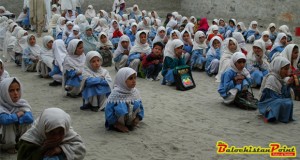
In last few years, the female literacy rate has increased in the country but instead of growing it is opposite in Balochistan. The literacy rate of female in Balochistan has decreased rapidly just due to not getting any attention from government. Balochistan is the most backward province in every regard.
The female are not encouraged to get knowledge by their parents. There are lack of educational institutions for female and the government has not been doing anything special for the improvement of female’s education.
Due to the negligence of government the female’s literacy rate in Balochistan is getting very low. The condition is even is deteriorating in rural areas. It is shockingly estimated only 2 percent. In this 21 century everyone is aware about the importance of education but the rural women in Balochistan are locked at four walls and not getting any opportunity to attend schools. Apart from Quetta none of the other district of the province is having female’s university where women can get higher education.
According to a survey, the total literacy rate of Balochistan is 34 percent against the literacy rate of 52 percent of the nation. The male literacy is 39 percent which is the lowest as compared to other provinces. Not only is the male, the female literacy rate is also the lowest in the country, recorded to be 27 percent standing poorly against the national female literacy of 48 percent.
Furthermore, the female colleges are suffering from lack of female lecturers and without the transport system. It has made compel to the female students either quit the studies or remain absent in entire year. The conditions of urban areas are going in worst conditions. The females are neglected in every field of their life, and the girls belonging to urban or rural areas are facing umpteenth problems.
In Balochistan 69 years of history, the government has not done any remarkable work for educating the both sexes. The schools are suffering from lack of fund as schools are suffering from lack of buildings, electricity and lack of drinking water. As for as non-government organizations (NGOs) are concerned, they highly claim to be working for women rights to education. Unfortunately, they just focusing mainly in Quetta, they hardly go out of the city to look at women’s pitiable education in rural areas. The NGOs are receiving a huge amount of fund and salaries for their work, but they are totally wasting money and time. They should visit entire Balochistan, and ensure that women have rights of education and they are free to seek knowledge.
It is estimated that in Balochistan, around 3408 girls’ school, 22 girls inter college, 13 girls Degree College, and 16693 teachers with the enrollment of 429,784 students. The government has been continuously saying that they are working to bring improvement in all sorts of educational facilities to the students, and they have been appointing teachers in Balochistan’s rural areas where students may be educated in a better way. The government is continuously uttering promises. Day by day the literary rate is decreasing then why government is talking about the improvement of Balochistan?
Without educated women none of the nation can progress. If in reality the government wants the development of Balochistan then the foremost responsibility is to provide quality education to the female because without females, males cannot bring any improvement.

Pakistan - Winter crisis - Gas-Shedding


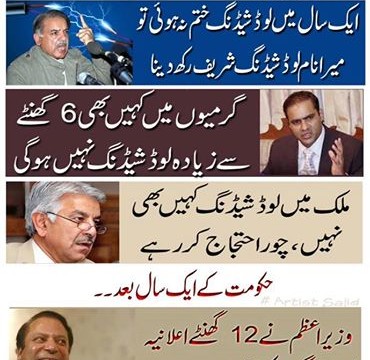
The crisis associated each year with the acute shortage of gas has worsened dramatically as winter has set in the north of the country. According to the Ministry for Petroleum and Natural Resources, the country currently faces a shortage of over 200 million cubic feet a day, notably in Khyber Pakhtunkhwa and Punjab. The shortage is also now beginning to affect the south of the country and Sui Southern Gas Company Ltd has stated the problem could grow. As Sui Northern Gas Pipeline Ltd had warned months ago, this year the problem seems to be more severe than ever before. We have already seen growing protests in various cities of Punjab where gas-shedding of up to 14 hours is being reported in smaller centres. For Lahore, Islamabad, Rawalpindi and other major cities SNGPL had announced shedding from  9pm to 5am. But many consumers report that gas pressure remains low all through the day. The cold spell being experienced in parts of Punjab has exacerbated the low gas pressure and brought more people to a point of panic.
The use of compressors by householders to pull gas out of pipelines at a higher rate has been reported in many places and SNGPL has said strict legal action would be taken against those responsible. However, this does not ease the burden of families who have had to turn to LPG cylinders, kerosene, firewood and coal to meet basic cooking and heating needs. As would be anticipated, the prices of these items have risen sharply by up to 10 percent above set prices. Kerosene, the fuel of the poor, is being sold at over Rs100 for one litre against the set price of Rs43. For many families the burden placed on them by this inflation has created growing unrest within households and communities. In Islamabad where temperatures are now close to the zero degree mark, residents of various areas are threatening to take to the streets. In other towns such as Chakwal they have already done so in an attempt to draw attention to the situation they face. With the winter only just closing in, there is apprehension that the situation could worsen in the coming weeks. The government needs to take a long hard look at the distress people are facing. Given that our reservoirs of natural gas are dwindling rapidly, we need to think about major policy decisions. This would have to include proposed projects such as the Iran-Pakistan pipeline. Steps need to be taken to offer respite to people, and as a preliminary measure at the very least the inflation in the prices of alternative fuels and also stoves used with kerosene or wood need to be checked to prevent further hardship.

https://www.thenews.com.pk/print/174452-Winter-crisis

Pakistan - PPP won’t demand early polls

Pakistan People's Party (PPP) Co-Chairman Asif Zardari said on Sunday The constitutional time for election will be the end of the government's tenure.
He also said that he has ties with Anwar Majeed but avoided to comment on the cases registered against him.
"We have ties with Anwar Majeed, whose is being investigated by law-enforcement agencies there is no denial on it." He, however, refused to comment on Anwar Majeed and directed all queries towards the Sindh interior minister. The former president was talking to media after praying at the mausoleum of Quaid-e-Azam Muhammad Ali Jinnah. He confirmed that any announcement regarding the PPP's four demands would be made on December 27. "Discussion on PPP four demands would be after December 27th," he added.
He said, "My arrival to the country has unset many PPP opponents and now they (opponents) were quite upset."
Zardari said he is in contact with Dr Asim Hussain and his counsel. The former president said Dr Asim's was unwell. He hoped that Dr Asim would get justice.
He said that he would reveal his further course of action and give good news in his address on December 27. To a query about his health, he said he was treated in the United States and London. He took advice from his physicians before travelling, he said.
"As Pakistani we have to follow the golden rules of Quaid-e-Azam," he said. "We have work under the guidelines of Father of the Nation for the development of our country."
Later, on the way to Bilawal House, the former president visited the shrine of Abdullah Shah Ghazi and prayed. He also placed a floral wreath at the shrine. Zardari inspected developmental work going on at the shrine and ordered the chief minister to equip the shrine with modern facilities.
Later, he held a meeting with the chief minister and discussed matters relating to political issues in the province. He also discussed the ongoing developmental work in the province.
Meanwhile, the PPP chairman Bilawal Bhutto Zardari also visited the mausoleum of Quaid-e-Azam and prayed. Bilawal hinted that the PPP co-chairman would give a surprise on December 27. Bilawal also paid tribute to Quaid-e-Azam for fighting for an independent country.
"The dream of Quaid-e-Azam is enlightened and moderate country and we will make our country according to Quaid vision," he said.
To a question about his slain uncle Mir Murtaza Bhutto, he said he had not talked to Fatima and Zulfiqar Junior Bhutto for quite some time. Later, Bilawal visited St Patrick Church to take part in Christmas celebrations. Bilawal was accompanied by Deputy Speaker Shehla Raza and Murad Ali Shah.
Separately, Pakistan Muslim League President Chaudhry Shujaat Hussain called on Zardari at Bilawal House. Both the leaders discussed current political situation and matters of mutual interest.
Bilawal and Murad Ali Shah were also present. Shujaat said Zardari was not afraid of the current political situation as he experienced such a hard time in the past. He was talking to media at Edhi Centre in Kharadar. He said all opposition parties should be united on a joint strategy as the government has failed to deliver and they (PML-N) would not be successful in the next general election. He said, "There is a dire need of grand alliance so that we can make a strong opposition against the PML-N."
"All those forces who wanted to pressurize Asif Ali Zardari never succeed in their evil design because he (Zardari) is never afraid of any situation," he said. Shujaat also paid tributes to Abdul Sattar Edhi for his untiring work for humanity and for the country.

http://dailytimes.com.pk/pakistan/26-Dec-16/ppp-wont-demand-early-polls-zardari

Pakistan - Forced conversions


BINA SHAH 


WHEN the Sindh Assembly passed the law against forced conversion, it was hailed as a landmark piece of legislation for the protection of Sindh’s minorities. In rural Sindh, Hindu girls and women are sometimes forced by local landlords and petty thugs to ‘convert’ to Islam and get married (pretty much a euphemism for kidnapping and rape). Their families complain they have no legal recourse for registering, let alone prosecuting, these crimes.
On the other hand, there are Hindu girls and women who decide to marry a Muslim and convert of their own free choice. Their angry parents will register an FIR and file a case of kidnapping against the groom and his family. Women in these circumstances place advertisements in local newspapers declaring they have converted and married of their own free will.
In both cases, the rights of the girls and women get trampled on by families, by authorities and by criminals. In the first instance, criminals use physical force and intimidation to harm vulnerable minorities and under-aged children; in the second, a woman’s right to choose her religion and her marriage is endangered by her own family. Both cases are egregious violations of the rights of female Pakistani citizens, and there has been no legal way to protect them so far.

Hindu women need a law that gives them extra protection.


The law against forced conversion is a good attempt to halt the first case scenario by criminalising forced conversions, and providing protection to its victims. It declares that people under the age of 18 could not be registered as having converted until they reached the age of majority — this to bring conversions in line with the legal age of marriage in Sindh (also 18).
There are also fines and prison sentences for those who force another person to convert and for those who aid or abet such a marriage. Quick registration of complaints (which would drag on for months if not years previously, with Hindu families often dismissed or discouraged from approaching the authorities because of their second-class status as minorities), and protection of victims in shelters are also included in the bill.
But, as soon as the bill was passed, religious parties protested. How can you restrict the age of someone who wants to convert of their own free will? How can you restrict the age of marriage when religion only requires that people have attained puberty and their guardians or families allow it? Islam doesn’t allow for forced conversion in the first place, so why should there be a law against such conversion?
A forced conversion followed by a prompt marriage may be frowned upon in Islam but was, until now, technically legal in Pakistan. The actors in such cases will intimidate and pressure the woman and her family into saying that the conversion and marriage was ‘free will’ rather than forced. Ironically, these kinds of admissions are made with a gun pointing at your head or the head of your loved ones.
Forced conversions are enacted upon the vulnerable Hindu girls of Sindh so that the criminals who kidnap them can obtain a piece of paper to get another piece of paper — the nikahnama, or marriage certificate. This is then used as ‘evidence’ that they have enacted a legal marriage, not kidnapping and rape.
The Hindu girls and women of Sindh are minorities twice over — Hindus and women — and need a law that gives them extra protection against a legal system and a social system that is heavily weighed against their safety and their rights.
The law can be made clearer to illustrate this circumstance. Anyone can be free to convert at any age, but the conversion would only be registered legally once the convert is 18 years of age. Any marriage to a convert should be precluded by a six-month waiting period in which authorities investigate whether it is of the woman’s free choice, similar to marriages in the West investigated for being genuine, rather than just a piece of paper to obtain a visa or a green card.
There are many things not allowed or discouraged in Islam but they still happen in Pakistan. Forced conversion is one of them. Religious parties should be the first in line to say that they vow to protect the rights of minority converts, and will not support conversions or marriages under duress. They should be the first to want to keep the reputation of Muslims in Pakistan high, rather than wanting to use every legal loophole available to take advantage of vulnerable girls and women.
Pressure from these groups has caused the Sindh government to agree to ‘review’ the bill, but they will probably demand it to be repealed entirely. Yet the Sindh government must stand firm, as the Punjab government stood firm on the Women’s Protection Bill. Muslims we may be, but our consciences are not enough to prevent these crimes.

Pakistan - Protecting minorities


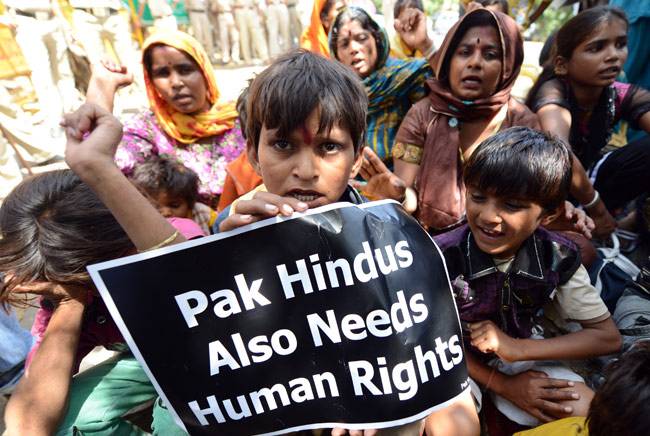
Pakistani Hindus can now register as Indian citizens for as low as Rs100 (PKR 155) following the Indian Home Ministry’s gazette notification amending the Citizenship Rules 2009 last week. To further facilitate the registration of Hindus – and other religious minorities – district magistrates in India have been delegated the power of citizenship permission in Maharashtra, Gujrat, Rajasthan, MP, UP and Chhatisgarh.
This should mean that the number of Pakistani Hindus that register as Indians should significantly spike, with the recent average being around 5,000 per annum. That’s 5,000 of our citizens personifying allegiance to India being a safer country than Pakistan. And even though we’re in a perpetual quest to get one over ‘archenemy’ India – whether it’s sports, geopolitics or nuclear warfare – no one seems particularly worked up over thousands of Pakistanis being forced into holding India’s arm up in the boxing ring of tolerance.
Despite the BJP orchestrated Saffron tide having practically made beef biryani a capital offence for Indian Muslims, it still hasn’t propelled a mass exodus. While the terms of 1972’s Simla Agreement have made Pakistani citizenship for them more complicated, a major factor in Indian Muslims’ reluctance to move is their population strength, which at around 15% makes them the country’s second largest religious community. Incidentally, Pakistani Hindus formed around 15% of the total population at the time of Partition as well. The number has now reduced to 2%, owing to a combination of East Pakistan’s separation and the ongoing evacuation of Hindus. Even so, just like the Indian Muslims, Hindus form the second largest religious community in Pakistan as per the 1998 Census.
Why then do Indian Muslims and Pakistani Hindus react to their respective persecution differently? Why aren’t the former abandoning their land as eagerly as the latter?
As the Indian Home Ministry was revamping its Citizenship Rules, Islamist parties in Pakistan have been challenging the PPP-led Sindh government’s recently passed bill against the forced conversion of non-Muslims. With around 1,000 young non-Muslim women being forced to convert to Islam every year in Pakistan, the Islamist parties touting this as their ‘unalienable right’ is owing to the sovereignty granted to Islam by the Constitution. After all, when the law sanctions supremacy for one religion, and grants many exclusive rights to its adherents, converting others to that religion practically elevates their citizenship.
One of the first things that PPP co-chairman Asif Ali Zardari did following his return to Pakistan, after an 18-month self-imposed exile, was to assure the JI Chief Siraj-ul-Haq that the Sindh government would repeal the law against forced conversions. A law that merely protects individuals against being coerced into abandoning their religion, looks set to be decapitated at the altar of radical homogeneity. For Pakistani Hindus, already under attack on multiple fronts, this move could extinguish the already diminishing hopes of a pluralist Pakistan. While all religious minorities have been suffocated under the Islamist takeover of Pakistan, anti-Hindu bigotry has been institutionalised to being synonymous with ‘Nazariya-e-Pakistan’ (the ideology of Pakistan).
The Hindu massacres and temple destructions orchestrated by the likes of Mahmud Ghaznavi, or the forced conversion of 400,000 Hindus proudly owned by Tipu Sultan, adds to their status as Muslim – and hence Pakistani – heroes.
A Grade 6 Social Studies book in Pakistan reads, “The foundation of Hindu set-up was based on injustice and cruelty”. Another Grade 7 book says ‘Hindu’ organisations have been “working to erase the Muslims’ existence from the region,” and continue to do so.
Last year, PTI’s Lal Malhi called out his fellow MNAs resorting to anti-Hindu rhetoric every time they’re criticising Indian policies. Last month, when the law enforcement agencies used tear gas on Pervez Khattak’s envoy in the lead up to the PTI’s proposed lockdown of Islamabad, the KP Chief Minister said the Punjab Police were ‘acting like Hindus’, in an attempt to equate it with the Indian forces’ attacks on Kashmiris.
Making Hindus synonymous with Indians has resulted in the constant rekindling of the hostage population theory. Every time Hindutva extremists target Muslims, or Indian security agencies use violence against Kashmiris, the Pakistani Hindu community bears the brunt. Whether it’s Islamist mobs torching temples, attacking the elderly for eating in public during Ramzan or coercing young girls to convert in cases of forced marriages. In a bid to highlight the human rights abuses faced by Muslims in India, the Pakistani state has acquiesced to violence against Hindus, if not facilitated it. This has weakened Pakistan’s stance over Kashmir internationally, by reducing it to a Pan-Islamist cause and not genuine support for a people’s freedom.
This is why despite the Indian state’s abuses in Kashmir, and the current Hindutva surge, the average Indian Muslim still embraces their country’s national identity. For them, Hindu supremacism contradicts the ‘idea of India’ – that of a diverse, pluralist, secular society.
Hence, in order to safeguard Hindus and religious minorities in general, we would have to revamp the ‘idea of Pakistan’. Whatever the arguments and ideologies in support of its creation might – and might not – have been in the lead up to Partition, Pakistan going forward cannot tout itself as a ‘homeland for Muslims’.
Pakistan would have to reconcile with its multi-pronged paradoxes, starting with nullifying the idea that Hindus and Muslims cannot coexist. While that idea might have been the rallying cry for Pakistan in 1947, it will be the death knell for its progress in 2017 and beyond. Until we make peace with our past, Pakistan would continue to fail its Hindus and other religious minorities.

Sardar Ali Takkar - د دی مستې شهلاـ مرزاخان انصاري

Sunday, December 25, 2016

Michael Jackson . George Michael - Careless Whisper

#RIP - George Michael LIVE - ENCORE- Earls Court, London 17th October 2012 - Final Show!!!

Elton John Pens Touching Tribute to George Michael

By LILY HARRISON


Elton John has just lost a close, longtime friend.
Just minutes after the news that George Michael had passed away at age 53 was released to the public, the iconic singer and songwriter took to social media to weigh in on the heavy, tragic news.
"I am in deep shock," he began by writing alongside a photo of the two of them together.
"I have lost a beloved friend—the kindest, most generous soul and a brilliant artist. My heart goes out to his family and all of his fans. #RIP."
Earlier today, Michael's publicist released the following statement upon announcing that the former Wham! singer had died.
"It is with great sadness that we can confirm our beloved son, brother and friend George passed away peacefully at home over the Christmas period. The family would ask that their privacy be respected at this difficult and emotional time. There will be no further comment at this stage."
Michael and John were not only friends for several decades, but they collaborated on the hit "Don't Let the Sun Go Down on Me" back in 1991.
The track was originally recorded as a solo for John in 1974, but the live duet picked up the majority of the popularity when it was released.

http://www.eonline.com/news/818029/elton-john-pens-touching-tribute-to-george-michael

George Michael - I Want Your Sex

George Michael - Faith

George Michael - One More Try

George Michael - Wham! - Last Christmas

George Michael - Wham! - Wake Me Up Before You Go-Go

Video Report - George Michael dies - BBC News

Video Report - Russian military plane with 92 on board crashes en route to Syria

Anger in Afghanistan at female pilot's U.S. asylum bid


There was an angry reaction in Afghanistan to news that the first female fixed-wing pilot in the country's air force was requesting asylum in the United States after completing an 18-month training course.
The Afghan defense ministry confirmed on Sunday that Captain Niloofar Rahmani, 25, had sought asylum after the Wall Street Journal quoted her as saying that she feared her life would be in danger if she returned home.
A recipient of the U.S. State Department's "Women of Courage" award in 2015, Capt. Rahmani had been a symbol of efforts to improve the situation of women in her country, more than a decade after the fall of the Taliban regime.
Mohammad Radmanish, a defense ministry spokesman, said the government hoped that her request would be denied by U.S. authorities who have spent billions trying to build up Afghan security forces.
"When an officer complains of insecurity and is afraid of security threats, then what should ordinary people do?" he said. "She has made an excuse for herself, but we have hundreds of educated women and female civil right activists who work and it is safe for them."
Capt. Rahmani, who graduated from flight school in 2012 and qualified to fly C-208 military cargo aircraft, had been in the United States on a training course and had been due to return home on Saturday.
In a conservative country notorious for the restrictions placed on women, Rahmani's story stood out as a rare example of a woman breaking through in areas normally reserved for men.
Her success came at a price, however. The citation for the "Women of Courage" award said she and her family had received direct threats not just from the Taliban but also from some relatives, forcing her family to move house several times.
However, there was little sympathy on Afghanistan's active social media networks, which were replete with comments criticizing Rahmani, accusing her of wasting government money spent on expensive training and avoiding her responsibilities.
"Niloofar Rahmani took a million dollars from the pockets of the people of Afghanistan to pay human traffickers to get to America to seek asylum," one Facebook user wrote in comments typical of others.
Dozens of Afghan troops receiving training in the United States have gone missing over the past two years, and at least one has been detained while trying to cross the border to Canada.

Balochistan’s age of violence: When will it end?


By Shezad Baloch
Quetta walas have become all too familiar with the sound of disaster. As soon as a loud explosion is heard in the valley, people switch on their TVs and start flipping through channels to determine where the blast took place and, more importantly, whether their loved ones are safe.
Three days ago, a suicide bomber struck at a hospital in the heart of the city, wiping off what is being called “an entire generation of lawyers” and media men within a matter of seconds.
The sound was followed by thick smoke, which gradually cleared to reveal horrific scenes: carnage everywhere, bodies lying in pools of blood, their clothes ripped apart; some charred beyond recognition. More reporters, law enforcement agencies, and first responders arrived at the site and soon news about the attack began to emerge. And among the names of victims flashing on TV was Shahzad Khan. My dear friend, Shahzad Khan. A 30-year-old who worked two-three jobs to provide for his family; a father who dropped off his child at school and was murdered in cold blood an hour later in the line of duty. How can that be? Did his daughter, seven-year-old Abeera, know that that morning would be the last time she kissed her father goodbye outside school? Worst yet, did she know her father was working as a cameraman, considered the most dangerous job in this part of the world, and that too for a mere Rs25,000 ($250). Certainly not. Shahzad wasn’t the only journalist who lost his life that day. Twenty-six-year-old Mehmood Hamdarad, a cameraman for Dawn News, was also critically injured and later succumbed to his injuries. Dunya News reporter Freedullah and a camera crew member Amin were wounded. They were among the at least 73 people who lost their lives, and over 140 who were wounded, 26 of them critically, in the attack. For the injured, the “fortunate”, life will now be one of pain and hardship, as is the case for so many victims of bombings. Timeline of deadliest insurgent attacks in Pakistan Monday’s bombing at the hospital was the second time terrorists chose to attack the state-run hospital.
The hospital was crawling with over a 100 lawyers and many journalists, who gathered at the Emergency Gate following the killing of Bilal Anwar Kasi, the former president of the Balochistan Bar Association. Kasi’s body was being shifted to Provincial Sandeman Hospital in the heart of the city, and without a moment of hesitation Shahzad, like many of his colleagues, went off to cover the incident.
‘He wanted to put a smile across everyone’s face’
Reporters, camera crews and other newspaper and new channel staff are a close-knit group. Because of the nature of their job, they often spend more time with each other than they do at home with their families. At the Quetta Press Club, the always-cheerful Shahzad has a strong presence. Just last Thursday, he messaged me, in his characteristically generous and caring way, asking about my health and my future plans. He wanted to put a smile across everyone’s face. “Just have fun Jani (dearest), and enjoy life,” he would say to colleagues. That’s just how he was.
But life was not easy. Shahzad had struggled to get a job at Aaj TV channel. He came from very modest beginnings, born into the family of a health department employee in Kandao, a small town in Mastung, about 25-kilometres from Quetta. All the houses in the town are made of mud, and most people live below the poverty line, barely able to feed their families.
I have known Shahzad since I started my career at a local newspaper over than a decade ago. His first job was as an office boy with the Quetta Daily Kohistan. He moved on to Darti TV where he worked alongside journalist Irshad Mastoi, who was later brutally gunned down at his Online International News Agency office on Quetta’s Jinnah Road. Shahzad’s career rise did not stop there. Being extremely hardworking and proficient at his job, he was soon hired by Dunya News. However, he needed to work two and three jobs to feed his family, since media outlets aren’t known to pay well. After Dunya News, he worked as a copy editor for a local newspaper. Later, he was offered a position at Aaj TV, earning a pay package of Rs25,000 per month. The increase in salary was significant, given that his earlier position had earned him a mere Rs15,000.
This was his final place of work before he life was cut short this Monday. The main breadwinner of his family, Shahzad was laid to rest beside his father in his ancestral home of Mastung. He leaves behind a widow and three young children — two daughters and a son — the eldest only seven years of age. He is also survived by his 26-year-old brother, who works at the health department since the death of his father.
The most dangerous job in the world
Recently, I was fortunate enough to attend a training session in Islamabad with Shahzad. We were among 20 journalists from Balochistan receiving training in reporting from a conflict zone. I can clearly recall Shahzad saying, “Media owners never let us attend trainings in another city. It’s good that I got to see Islamabad and could experience it.” Shahzad was not the first member of the media to fall victim to the violence pervading Quetta. Many journalists have been killed or wounded in similar incidents across the city. The news desk and the employers, however, observe the briefest of pauses after each deadly incident before once again laying pressure on cameramen and reporters to get maximum coverage. This goes against professional ethics of journalism, and so does showing scenes of death and destruction. But few seem to care or are unaware of the ethics and even the dangers of reporting. “We are the poorly paid, and still we risk our lives,” said Quetta’s most senior photographer Banaras Khan who has been working as a journalist for the past 27 years. “I appeal to international organisations and trade unions of journalists to provide training for people who work at TV channel news desks.” Employers aside, government and law enforcement agencies in Quetta have failed to implement appropriate security measures despite the frequency of deadly attacks in the region. Quetta Civil Hospital has now been targeted twice using the same vicious modus operandi—first the attackers target a high profile figure in the city; then they target those the mourners.
Leaving Balochistan lawless
The law community in Balochistan was one that remained at the forefront of protecting human rights and shinning a spotlight on the restive province. The general perception is that terrorists targeted the community perhaps because of its popularity among the masses. What’s certain is that the government’s security plan has miserably failed and it failed to protect the lives of its people, once again. In the past, four similar large-scale attacks have taken place in Quetta, one in the Police Lines, another at the same hospital, the third at the Bolan Medical College Teaching Hospital following an attack on Sardar Bahadur Khan Women University and the fourth at at a snooker club in Marriabad area. Despite this, politicians repeatedly get away with blaming hostile foreign agencies for these massacres. Their primary responsibility is the protection of all citizens. All citizens, not just politicians, security chiefs, and government buildings. Quetta, it seems, is a safe place only for the chief minister, the frontier corps (FC) chief, the police chief and other bigwigs.
No end in sight
We have lost many friends and we will continue to do so because I don’t see any planning, implementation or appropriate measures being taken in the near future. Add to that, it’s unfortunate that not a single government spokesperson or representative has come forward to brief the media with details of the attack. We had to dig for information on our own.
Bloody déjà vu in Quetta
It seems the government cannot be trusted to utilise the huge sum of money—over Rs30 billion — allocated for the maintenance of law and order in an appropriate manner. The current government has increased the law and order budget by 12%, offsetting that with a decrease in the education budget. Despite this, nobody feels remotely secure in Balochistan. Quetta has witnessed the killing of journalists, lawyers, doctors, police, security forces, politicians and citizens. The massacres continue unabated. I’m not a cynic, I’m telling the truth as I see it. People have resorted to adapting to an increasingly perilous environment. They have learned to expect that law enforcers will harass them in the name of security rather than prevent deadly attacks. And have come to accept that all leaders, law enforcers and gatekeepers have to offer are weightless political statements and empty condemnations of terror. Any hope of reclaiming the beautiful city of Quetta is fading, and may soon be lost.