Monday, December 26, 2016

Neglecting female education in Balochistan


In last few years, the female literacy rate has increased in the country but instead of growing it is opposite in Balochistan. The literacy rate of female in Balochistan has decreased rapidly just due to not getting any attention from government. Balochistan is the most backward province in every regard.
The female are not encouraged to get knowledge by their parents. There are lack of educational institutions for female and the government has not been doing anything special for the improvement of female’s education.
Due to the negligence of government the female’s literacy rate in Balochistan is getting very low. The condition is even is deteriorating in rural areas. It is shockingly estimated only 2 percent. In this 21 century everyone is aware about the importance of education but the rural women in Balochistan are locked at four walls and not getting any opportunity to attend schools. Apart from Quetta none of the other district of the province is having female’s university where women can get higher education.
According to a survey, the total literacy rate of Balochistan is 34 percent against the literacy rate of 52 percent of the nation. The male literacy is 39 percent which is the lowest as compared to other provinces. Not only is the male, the female literacy rate is also the lowest in the country, recorded to be 27 percent standing poorly against the national female literacy of 48 percent.
Furthermore, the female colleges are suffering from lack of female lecturers and without the transport system. It has made compel to the female students either quit the studies or remain absent in entire year. The conditions of urban areas are going in worst conditions. The females are neglected in every field of their life, and the girls belonging to urban or rural areas are facing umpteenth problems.
In Balochistan 69 years of history, the government has not done any remarkable work for educating the both sexes. The schools are suffering from lack of fund as schools are suffering from lack of buildings, electricity and lack of drinking water. As for as non-government organizations (NGOs) are concerned, they highly claim to be working for women rights to education. Unfortunately, they just focusing mainly in Quetta, they hardly go out of the city to look at women’s pitiable education in rural areas. The NGOs are receiving a huge amount of fund and salaries for their work, but they are totally wasting money and time. They should visit entire Balochistan, and ensure that women have rights of education and they are free to seek knowledge.
It is estimated that in Balochistan, around 3408 girls’ school, 22 girls inter college, 13 girls Degree College, and 16693 teachers with the enrollment of 429,784 students. The government has been continuously saying that they are working to bring improvement in all sorts of educational facilities to the students, and they have been appointing teachers in Balochistan’s rural areas where students may be educated in a better way. The government is continuously uttering promises. Day by day the literary rate is decreasing then why government is talking about the improvement of Balochistan?
Without educated women none of the nation can progress. If in reality the government wants the development of Balochistan then the foremost responsibility is to provide quality education to the female because without females, males cannot bring any improvement.

Pakistan - Winter crisis - Gas-Shedding


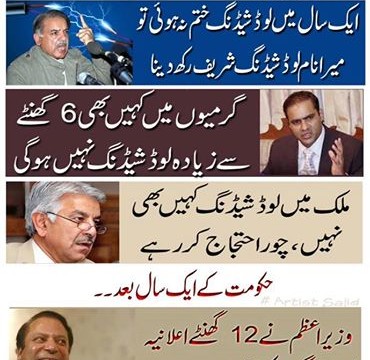
The crisis associated each year with the acute shortage of gas has worsened dramatically as winter has set in the north of the country. According to the Ministry for Petroleum and Natural Resources, the country currently faces a shortage of over 200 million cubic feet a day, notably in Khyber Pakhtunkhwa and Punjab. The shortage is also now beginning to affect the south of the country and Sui Southern Gas Company Ltd has stated the problem could grow. As Sui Northern Gas Pipeline Ltd had warned months ago, this year the problem seems to be more severe than ever before. We have already seen growing protests in various cities of Punjab where gas-shedding of up to 14 hours is being reported in smaller centres. For Lahore, Islamabad, Rawalpindi and other major cities SNGPL had announced shedding from  9pm to 5am. But many consumers report that gas pressure remains low all through the day. The cold spell being experienced in parts of Punjab has exacerbated the low gas pressure and brought more people to a point of panic.
The use of compressors by householders to pull gas out of pipelines at a higher rate has been reported in many places and SNGPL has said strict legal action would be taken against those responsible. However, this does not ease the burden of families who have had to turn to LPG cylinders, kerosene, firewood and coal to meet basic cooking and heating needs. As would be anticipated, the prices of these items have risen sharply by up to 10 percent above set prices. Kerosene, the fuel of the poor, is being sold at over Rs100 for one litre against the set price of Rs43. For many families the burden placed on them by this inflation has created growing unrest within households and communities. In Islamabad where temperatures are now close to the zero degree mark, residents of various areas are threatening to take to the streets. In other towns such as Chakwal they have already done so in an attempt to draw attention to the situation they face. With the winter only just closing in, there is apprehension that the situation could worsen in the coming weeks. The government needs to take a long hard look at the distress people are facing. Given that our reservoirs of natural gas are dwindling rapidly, we need to think about major policy decisions. This would have to include proposed projects such as the Iran-Pakistan pipeline. Steps need to be taken to offer respite to people, and as a preliminary measure at the very least the inflation in the prices of alternative fuels and also stoves used with kerosene or wood need to be checked to prevent further hardship.

https://www.thenews.com.pk/print/174452-Winter-crisis

Pakistan - PPP won’t demand early polls

Pakistan People's Party (PPP) Co-Chairman Asif Zardari said on Sunday The constitutional time for election will be the end of the government's tenure.
He also said that he has ties with Anwar Majeed but avoided to comment on the cases registered against him.
"We have ties with Anwar Majeed, whose is being investigated by law-enforcement agencies there is no denial on it." He, however, refused to comment on Anwar Majeed and directed all queries towards the Sindh interior minister. The former president was talking to media after praying at the mausoleum of Quaid-e-Azam Muhammad Ali Jinnah. He confirmed that any announcement regarding the PPP's four demands would be made on December 27. "Discussion on PPP four demands would be after December 27th," he added.
He said, "My arrival to the country has unset many PPP opponents and now they (opponents) were quite upset."
Zardari said he is in contact with Dr Asim Hussain and his counsel. The former president said Dr Asim's was unwell. He hoped that Dr Asim would get justice.
He said that he would reveal his further course of action and give good news in his address on December 27. To a query about his health, he said he was treated in the United States and London. He took advice from his physicians before travelling, he said.
"As Pakistani we have to follow the golden rules of Quaid-e-Azam," he said. "We have work under the guidelines of Father of the Nation for the development of our country."
Later, on the way to Bilawal House, the former president visited the shrine of Abdullah Shah Ghazi and prayed. He also placed a floral wreath at the shrine. Zardari inspected developmental work going on at the shrine and ordered the chief minister to equip the shrine with modern facilities.
Later, he held a meeting with the chief minister and discussed matters relating to political issues in the province. He also discussed the ongoing developmental work in the province.
Meanwhile, the PPP chairman Bilawal Bhutto Zardari also visited the mausoleum of Quaid-e-Azam and prayed. Bilawal hinted that the PPP co-chairman would give a surprise on December 27. Bilawal also paid tribute to Quaid-e-Azam for fighting for an independent country.
"The dream of Quaid-e-Azam is enlightened and moderate country and we will make our country according to Quaid vision," he said.
To a question about his slain uncle Mir Murtaza Bhutto, he said he had not talked to Fatima and Zulfiqar Junior Bhutto for quite some time. Later, Bilawal visited St Patrick Church to take part in Christmas celebrations. Bilawal was accompanied by Deputy Speaker Shehla Raza and Murad Ali Shah.
Separately, Pakistan Muslim League President Chaudhry Shujaat Hussain called on Zardari at Bilawal House. Both the leaders discussed current political situation and matters of mutual interest.
Bilawal and Murad Ali Shah were also present. Shujaat said Zardari was not afraid of the current political situation as he experienced such a hard time in the past. He was talking to media at Edhi Centre in Kharadar. He said all opposition parties should be united on a joint strategy as the government has failed to deliver and they (PML-N) would not be successful in the next general election. He said, "There is a dire need of grand alliance so that we can make a strong opposition against the PML-N."
"All those forces who wanted to pressurize Asif Ali Zardari never succeed in their evil design because he (Zardari) is never afraid of any situation," he said. Shujaat also paid tributes to Abdul Sattar Edhi for his untiring work for humanity and for the country.

http://dailytimes.com.pk/pakistan/26-Dec-16/ppp-wont-demand-early-polls-zardari

Pakistan - Forced conversions


BINA SHAH 


WHEN the Sindh Assembly passed the law against forced conversion, it was hailed as a landmark piece of legislation for the protection of Sindh’s minorities. In rural Sindh, Hindu girls and women are sometimes forced by local landlords and petty thugs to ‘convert’ to Islam and get married (pretty much a euphemism for kidnapping and rape). Their families complain they have no legal recourse for registering, let alone prosecuting, these crimes.
On the other hand, there are Hindu girls and women who decide to marry a Muslim and convert of their own free choice. Their angry parents will register an FIR and file a case of kidnapping against the groom and his family. Women in these circumstances place advertisements in local newspapers declaring they have converted and married of their own free will.
In both cases, the rights of the girls and women get trampled on by families, by authorities and by criminals. In the first instance, criminals use physical force and intimidation to harm vulnerable minorities and under-aged children; in the second, a woman’s right to choose her religion and her marriage is endangered by her own family. Both cases are egregious violations of the rights of female Pakistani citizens, and there has been no legal way to protect them so far.

Hindu women need a law that gives them extra protection.


The law against forced conversion is a good attempt to halt the first case scenario by criminalising forced conversions, and providing protection to its victims. It declares that people under the age of 18 could not be registered as having converted until they reached the age of majority — this to bring conversions in line with the legal age of marriage in Sindh (also 18).
There are also fines and prison sentences for those who force another person to convert and for those who aid or abet such a marriage. Quick registration of complaints (which would drag on for months if not years previously, with Hindu families often dismissed or discouraged from approaching the authorities because of their second-class status as minorities), and protection of victims in shelters are also included in the bill.
But, as soon as the bill was passed, religious parties protested. How can you restrict the age of someone who wants to convert of their own free will? How can you restrict the age of marriage when religion only requires that people have attained puberty and their guardians or families allow it? Islam doesn’t allow for forced conversion in the first place, so why should there be a law against such conversion?
A forced conversion followed by a prompt marriage may be frowned upon in Islam but was, until now, technically legal in Pakistan. The actors in such cases will intimidate and pressure the woman and her family into saying that the conversion and marriage was ‘free will’ rather than forced. Ironically, these kinds of admissions are made with a gun pointing at your head or the head of your loved ones.
Forced conversions are enacted upon the vulnerable Hindu girls of Sindh so that the criminals who kidnap them can obtain a piece of paper to get another piece of paper — the nikahnama, or marriage certificate. This is then used as ‘evidence’ that they have enacted a legal marriage, not kidnapping and rape.
The Hindu girls and women of Sindh are minorities twice over — Hindus and women — and need a law that gives them extra protection against a legal system and a social system that is heavily weighed against their safety and their rights.
The law can be made clearer to illustrate this circumstance. Anyone can be free to convert at any age, but the conversion would only be registered legally once the convert is 18 years of age. Any marriage to a convert should be precluded by a six-month waiting period in which authorities investigate whether it is of the woman’s free choice, similar to marriages in the West investigated for being genuine, rather than just a piece of paper to obtain a visa or a green card.
There are many things not allowed or discouraged in Islam but they still happen in Pakistan. Forced conversion is one of them. Religious parties should be the first in line to say that they vow to protect the rights of minority converts, and will not support conversions or marriages under duress. They should be the first to want to keep the reputation of Muslims in Pakistan high, rather than wanting to use every legal loophole available to take advantage of vulnerable girls and women.
Pressure from these groups has caused the Sindh government to agree to ‘review’ the bill, but they will probably demand it to be repealed entirely. Yet the Sindh government must stand firm, as the Punjab government stood firm on the Women’s Protection Bill. Muslims we may be, but our consciences are not enough to prevent these crimes.

Pakistan - Protecting minorities


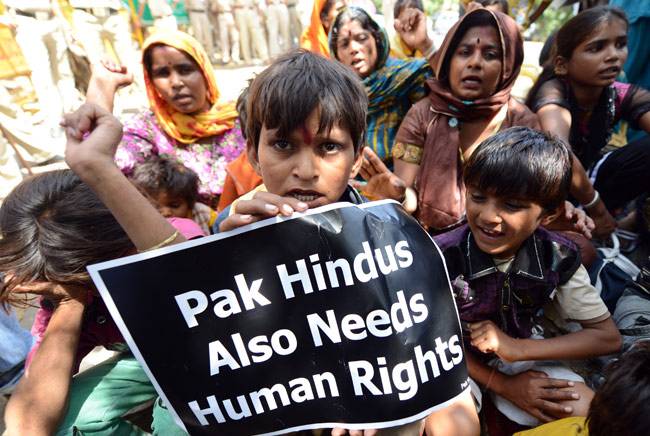
Pakistani Hindus can now register as Indian citizens for as low as Rs100 (PKR 155) following the Indian Home Ministry’s gazette notification amending the Citizenship Rules 2009 last week. To further facilitate the registration of Hindus – and other religious minorities – district magistrates in India have been delegated the power of citizenship permission in Maharashtra, Gujrat, Rajasthan, MP, UP and Chhatisgarh.
This should mean that the number of Pakistani Hindus that register as Indians should significantly spike, with the recent average being around 5,000 per annum. That’s 5,000 of our citizens personifying allegiance to India being a safer country than Pakistan. And even though we’re in a perpetual quest to get one over ‘archenemy’ India – whether it’s sports, geopolitics or nuclear warfare – no one seems particularly worked up over thousands of Pakistanis being forced into holding India’s arm up in the boxing ring of tolerance.
Despite the BJP orchestrated Saffron tide having practically made beef biryani a capital offence for Indian Muslims, it still hasn’t propelled a mass exodus. While the terms of 1972’s Simla Agreement have made Pakistani citizenship for them more complicated, a major factor in Indian Muslims’ reluctance to move is their population strength, which at around 15% makes them the country’s second largest religious community. Incidentally, Pakistani Hindus formed around 15% of the total population at the time of Partition as well. The number has now reduced to 2%, owing to a combination of East Pakistan’s separation and the ongoing evacuation of Hindus. Even so, just like the Indian Muslims, Hindus form the second largest religious community in Pakistan as per the 1998 Census.
Why then do Indian Muslims and Pakistani Hindus react to their respective persecution differently? Why aren’t the former abandoning their land as eagerly as the latter?
As the Indian Home Ministry was revamping its Citizenship Rules, Islamist parties in Pakistan have been challenging the PPP-led Sindh government’s recently passed bill against the forced conversion of non-Muslims. With around 1,000 young non-Muslim women being forced to convert to Islam every year in Pakistan, the Islamist parties touting this as their ‘unalienable right’ is owing to the sovereignty granted to Islam by the Constitution. After all, when the law sanctions supremacy for one religion, and grants many exclusive rights to its adherents, converting others to that religion practically elevates their citizenship.
One of the first things that PPP co-chairman Asif Ali Zardari did following his return to Pakistan, after an 18-month self-imposed exile, was to assure the JI Chief Siraj-ul-Haq that the Sindh government would repeal the law against forced conversions. A law that merely protects individuals against being coerced into abandoning their religion, looks set to be decapitated at the altar of radical homogeneity. For Pakistani Hindus, already under attack on multiple fronts, this move could extinguish the already diminishing hopes of a pluralist Pakistan. While all religious minorities have been suffocated under the Islamist takeover of Pakistan, anti-Hindu bigotry has been institutionalised to being synonymous with ‘Nazariya-e-Pakistan’ (the ideology of Pakistan).
The Hindu massacres and temple destructions orchestrated by the likes of Mahmud Ghaznavi, or the forced conversion of 400,000 Hindus proudly owned by Tipu Sultan, adds to their status as Muslim – and hence Pakistani – heroes.
A Grade 6 Social Studies book in Pakistan reads, “The foundation of Hindu set-up was based on injustice and cruelty”. Another Grade 7 book says ‘Hindu’ organisations have been “working to erase the Muslims’ existence from the region,” and continue to do so.
Last year, PTI’s Lal Malhi called out his fellow MNAs resorting to anti-Hindu rhetoric every time they’re criticising Indian policies. Last month, when the law enforcement agencies used tear gas on Pervez Khattak’s envoy in the lead up to the PTI’s proposed lockdown of Islamabad, the KP Chief Minister said the Punjab Police were ‘acting like Hindus’, in an attempt to equate it with the Indian forces’ attacks on Kashmiris.
Making Hindus synonymous with Indians has resulted in the constant rekindling of the hostage population theory. Every time Hindutva extremists target Muslims, or Indian security agencies use violence against Kashmiris, the Pakistani Hindu community bears the brunt. Whether it’s Islamist mobs torching temples, attacking the elderly for eating in public during Ramzan or coercing young girls to convert in cases of forced marriages. In a bid to highlight the human rights abuses faced by Muslims in India, the Pakistani state has acquiesced to violence against Hindus, if not facilitated it. This has weakened Pakistan’s stance over Kashmir internationally, by reducing it to a Pan-Islamist cause and not genuine support for a people’s freedom.
This is why despite the Indian state’s abuses in Kashmir, and the current Hindutva surge, the average Indian Muslim still embraces their country’s national identity. For them, Hindu supremacism contradicts the ‘idea of India’ – that of a diverse, pluralist, secular society.
Hence, in order to safeguard Hindus and religious minorities in general, we would have to revamp the ‘idea of Pakistan’. Whatever the arguments and ideologies in support of its creation might – and might not – have been in the lead up to Partition, Pakistan going forward cannot tout itself as a ‘homeland for Muslims’.
Pakistan would have to reconcile with its multi-pronged paradoxes, starting with nullifying the idea that Hindus and Muslims cannot coexist. While that idea might have been the rallying cry for Pakistan in 1947, it will be the death knell for its progress in 2017 and beyond. Until we make peace with our past, Pakistan would continue to fail its Hindus and other religious minorities.

Sardar Ali Takkar - د دی مستې شهلاـ مرزاخان انصاري

Sunday, December 25, 2016

Michael Jackson . George Michael - Careless Whisper

#RIP - George Michael LIVE - ENCORE- Earls Court, London 17th October 2012 - Final Show!!!

Elton John Pens Touching Tribute to George Michael

By LILY HARRISON


Elton John has just lost a close, longtime friend.
Just minutes after the news that George Michael had passed away at age 53 was released to the public, the iconic singer and songwriter took to social media to weigh in on the heavy, tragic news.
"I am in deep shock," he began by writing alongside a photo of the two of them together.
"I have lost a beloved friend—the kindest, most generous soul and a brilliant artist. My heart goes out to his family and all of his fans. #RIP."
Earlier today, Michael's publicist released the following statement upon announcing that the former Wham! singer had died.
"It is with great sadness that we can confirm our beloved son, brother and friend George passed away peacefully at home over the Christmas period. The family would ask that their privacy be respected at this difficult and emotional time. There will be no further comment at this stage."
Michael and John were not only friends for several decades, but they collaborated on the hit "Don't Let the Sun Go Down on Me" back in 1991.
The track was originally recorded as a solo for John in 1974, but the live duet picked up the majority of the popularity when it was released.

http://www.eonline.com/news/818029/elton-john-pens-touching-tribute-to-george-michael

George Michael - I Want Your Sex

George Michael - Faith

George Michael - One More Try

George Michael - Wham! - Last Christmas

George Michael - Wham! - Wake Me Up Before You Go-Go

Video Report - George Michael dies - BBC News

Video Report - Russian military plane with 92 on board crashes en route to Syria

Anger in Afghanistan at female pilot's U.S. asylum bid


There was an angry reaction in Afghanistan to news that the first female fixed-wing pilot in the country's air force was requesting asylum in the United States after completing an 18-month training course.
The Afghan defense ministry confirmed on Sunday that Captain Niloofar Rahmani, 25, had sought asylum after the Wall Street Journal quoted her as saying that she feared her life would be in danger if she returned home.
A recipient of the U.S. State Department's "Women of Courage" award in 2015, Capt. Rahmani had been a symbol of efforts to improve the situation of women in her country, more than a decade after the fall of the Taliban regime.
Mohammad Radmanish, a defense ministry spokesman, said the government hoped that her request would be denied by U.S. authorities who have spent billions trying to build up Afghan security forces.
"When an officer complains of insecurity and is afraid of security threats, then what should ordinary people do?" he said. "She has made an excuse for herself, but we have hundreds of educated women and female civil right activists who work and it is safe for them."
Capt. Rahmani, who graduated from flight school in 2012 and qualified to fly C-208 military cargo aircraft, had been in the United States on a training course and had been due to return home on Saturday.
In a conservative country notorious for the restrictions placed on women, Rahmani's story stood out as a rare example of a woman breaking through in areas normally reserved for men.
Her success came at a price, however. The citation for the "Women of Courage" award said she and her family had received direct threats not just from the Taliban but also from some relatives, forcing her family to move house several times.
However, there was little sympathy on Afghanistan's active social media networks, which were replete with comments criticizing Rahmani, accusing her of wasting government money spent on expensive training and avoiding her responsibilities.
"Niloofar Rahmani took a million dollars from the pockets of the people of Afghanistan to pay human traffickers to get to America to seek asylum," one Facebook user wrote in comments typical of others.
Dozens of Afghan troops receiving training in the United States have gone missing over the past two years, and at least one has been detained while trying to cross the border to Canada.

Balochistan’s age of violence: When will it end?


By Shezad Baloch
Quetta walas have become all too familiar with the sound of disaster. As soon as a loud explosion is heard in the valley, people switch on their TVs and start flipping through channels to determine where the blast took place and, more importantly, whether their loved ones are safe.
Three days ago, a suicide bomber struck at a hospital in the heart of the city, wiping off what is being called “an entire generation of lawyers” and media men within a matter of seconds.
The sound was followed by thick smoke, which gradually cleared to reveal horrific scenes: carnage everywhere, bodies lying in pools of blood, their clothes ripped apart; some charred beyond recognition. More reporters, law enforcement agencies, and first responders arrived at the site and soon news about the attack began to emerge. And among the names of victims flashing on TV was Shahzad Khan. My dear friend, Shahzad Khan. A 30-year-old who worked two-three jobs to provide for his family; a father who dropped off his child at school and was murdered in cold blood an hour later in the line of duty. How can that be? Did his daughter, seven-year-old Abeera, know that that morning would be the last time she kissed her father goodbye outside school? Worst yet, did she know her father was working as a cameraman, considered the most dangerous job in this part of the world, and that too for a mere Rs25,000 ($250). Certainly not. Shahzad wasn’t the only journalist who lost his life that day. Twenty-six-year-old Mehmood Hamdarad, a cameraman for Dawn News, was also critically injured and later succumbed to his injuries. Dunya News reporter Freedullah and a camera crew member Amin were wounded. They were among the at least 73 people who lost their lives, and over 140 who were wounded, 26 of them critically, in the attack. For the injured, the “fortunate”, life will now be one of pain and hardship, as is the case for so many victims of bombings. Timeline of deadliest insurgent attacks in Pakistan Monday’s bombing at the hospital was the second time terrorists chose to attack the state-run hospital.
The hospital was crawling with over a 100 lawyers and many journalists, who gathered at the Emergency Gate following the killing of Bilal Anwar Kasi, the former president of the Balochistan Bar Association. Kasi’s body was being shifted to Provincial Sandeman Hospital in the heart of the city, and without a moment of hesitation Shahzad, like many of his colleagues, went off to cover the incident.
‘He wanted to put a smile across everyone’s face’
Reporters, camera crews and other newspaper and new channel staff are a close-knit group. Because of the nature of their job, they often spend more time with each other than they do at home with their families. At the Quetta Press Club, the always-cheerful Shahzad has a strong presence. Just last Thursday, he messaged me, in his characteristically generous and caring way, asking about my health and my future plans. He wanted to put a smile across everyone’s face. “Just have fun Jani (dearest), and enjoy life,” he would say to colleagues. That’s just how he was.
But life was not easy. Shahzad had struggled to get a job at Aaj TV channel. He came from very modest beginnings, born into the family of a health department employee in Kandao, a small town in Mastung, about 25-kilometres from Quetta. All the houses in the town are made of mud, and most people live below the poverty line, barely able to feed their families.
I have known Shahzad since I started my career at a local newspaper over than a decade ago. His first job was as an office boy with the Quetta Daily Kohistan. He moved on to Darti TV where he worked alongside journalist Irshad Mastoi, who was later brutally gunned down at his Online International News Agency office on Quetta’s Jinnah Road. Shahzad’s career rise did not stop there. Being extremely hardworking and proficient at his job, he was soon hired by Dunya News. However, he needed to work two and three jobs to feed his family, since media outlets aren’t known to pay well. After Dunya News, he worked as a copy editor for a local newspaper. Later, he was offered a position at Aaj TV, earning a pay package of Rs25,000 per month. The increase in salary was significant, given that his earlier position had earned him a mere Rs15,000.
This was his final place of work before he life was cut short this Monday. The main breadwinner of his family, Shahzad was laid to rest beside his father in his ancestral home of Mastung. He leaves behind a widow and three young children — two daughters and a son — the eldest only seven years of age. He is also survived by his 26-year-old brother, who works at the health department since the death of his father.
The most dangerous job in the world
Recently, I was fortunate enough to attend a training session in Islamabad with Shahzad. We were among 20 journalists from Balochistan receiving training in reporting from a conflict zone. I can clearly recall Shahzad saying, “Media owners never let us attend trainings in another city. It’s good that I got to see Islamabad and could experience it.” Shahzad was not the first member of the media to fall victim to the violence pervading Quetta. Many journalists have been killed or wounded in similar incidents across the city. The news desk and the employers, however, observe the briefest of pauses after each deadly incident before once again laying pressure on cameramen and reporters to get maximum coverage. This goes against professional ethics of journalism, and so does showing scenes of death and destruction. But few seem to care or are unaware of the ethics and even the dangers of reporting. “We are the poorly paid, and still we risk our lives,” said Quetta’s most senior photographer Banaras Khan who has been working as a journalist for the past 27 years. “I appeal to international organisations and trade unions of journalists to provide training for people who work at TV channel news desks.” Employers aside, government and law enforcement agencies in Quetta have failed to implement appropriate security measures despite the frequency of deadly attacks in the region. Quetta Civil Hospital has now been targeted twice using the same vicious modus operandi—first the attackers target a high profile figure in the city; then they target those the mourners.
Leaving Balochistan lawless
The law community in Balochistan was one that remained at the forefront of protecting human rights and shinning a spotlight on the restive province. The general perception is that terrorists targeted the community perhaps because of its popularity among the masses. What’s certain is that the government’s security plan has miserably failed and it failed to protect the lives of its people, once again. In the past, four similar large-scale attacks have taken place in Quetta, one in the Police Lines, another at the same hospital, the third at the Bolan Medical College Teaching Hospital following an attack on Sardar Bahadur Khan Women University and the fourth at at a snooker club in Marriabad area. Despite this, politicians repeatedly get away with blaming hostile foreign agencies for these massacres. Their primary responsibility is the protection of all citizens. All citizens, not just politicians, security chiefs, and government buildings. Quetta, it seems, is a safe place only for the chief minister, the frontier corps (FC) chief, the police chief and other bigwigs.
No end in sight
We have lost many friends and we will continue to do so because I don’t see any planning, implementation or appropriate measures being taken in the near future. Add to that, it’s unfortunate that not a single government spokesperson or representative has come forward to brief the media with details of the attack. We had to dig for information on our own.
Bloody déjà vu in Quetta
It seems the government cannot be trusted to utilise the huge sum of money—over Rs30 billion — allocated for the maintenance of law and order in an appropriate manner. The current government has increased the law and order budget by 12%, offsetting that with a decrease in the education budget. Despite this, nobody feels remotely secure in Balochistan. Quetta has witnessed the killing of journalists, lawyers, doctors, police, security forces, politicians and citizens. The massacres continue unabated. I’m not a cynic, I’m telling the truth as I see it. People have resorted to adapting to an increasingly perilous environment. They have learned to expect that law enforcers will harass them in the name of security rather than prevent deadly attacks. And have come to accept that all leaders, law enforcers and gatekeepers have to offer are weightless political statements and empty condemnations of terror. Any hope of reclaiming the beautiful city of Quetta is fading, and may soon be lost.

Pakistan - The transition odyssey


Afrasiab Khattak
Democratic transition in Pakistan after every martial law gets prolonged and complicated as duality in the power center exists even after the formal end of the military dictatorship. The deep state brazenly continues its shenanigans as weak civilian dispensation tries to find its feet. The aforementioned phenomenon has been visible after the general elections in February 2008, that have supposedly commenced a transition towards the establishment of a full fledged federal parliamentary democratic system enshrined in the Constitution. The approval of 18th Constitutional Amendment in 2010 for purging the Constitution of the distortions and deformations imposed on it by military dictators was a remarkable achievement. But the diarchy in the state system did not come to an end. Even after getting rid of General Pervez Musharraf, the Asif Ali Zardari led elected government had to work under a long shadow of the security establishment.
A similar situation persisted even after the general elections in 2013 when elected assemblies completed their constitutional term for the first time in the political history of the country and when power was smoothly transferred from one elected government to another one without intervention by non-political forces. But the euphoria generated by the success of democratic transition was short lived as fierce political agitation by myopic and adventurist outfits was used to expand the military’s control over not just forming key state policies and resource allocation but also over day to day governance. By using vast propaganda resources of the Inter Services Public Relations (ISPR) and manipulation by military’s powerful intelligence agencies the security establishment was able to considerably weaken the authority of the elected government. The so-called lock down of Islamabad, the public show of strength by the extremist elements working under the cover of Defense of Pakistan Council and the so called Dawn Leaks were important elements of the final showdown between the elected government and the outgoing leadership of the Army. These moves were also aimed at influencing the decision of the Prime Minister about the appointment of the new head of the GHQ.
The Prime Minister deserves credit for playing his cards well (and he kept his cards close to his chest up till the very end). He was able to foil the designs of elements hell bent on “continuity” in the conduct of the top brass. But Prime Minister Nawaz Sharif has certain advantages over all other political leaders of the country. One, he has a solid political base in the Punjab that is the core area of the present Pakistani state as opposed to the periphery that is politically and economically marginalised. Punjabi civil-military bureaucracy and big business enjoys a decisive domination over Pakistani state and economy. Two, he heads the Muslim League, a political party that traces its political origin to Mohammad Ali Jinnah, the founder of Pakistan. Being an authentic Punjabi leader and having claim to Jinnah’s legacy makes it very difficult for his detractors to label him a traitor, a title that is very generously bestowed upon political leaders from oppressed nationalities such as Baloch, Pashtun, Sindhi and those belonging to Gilgit Baltistan. Three, Nawaz Sharif has rich and long experience in dealing with Army both as its political friend and foe. By appointing General Qamar Javed Bajwa as the COAS he is the only political leader in Pakistan who has to his credit the appointment of six heads of Pakistan Army. All this enabled Nawaz Sharif to withstand the pressure and choose his moves.
The dominos seem to have fallen in Nawaz Sharif’s favor. Imran Khan had to retreat and return to parliament after vanishing off the “script”. The exuberance of “defense analysts” and TV anchors wired to the deep state in doomsday prognosis has mysteriously evaporated. Moving forward towards the general elections in 2018 seems only natural. Despite all this it is difficult to agree with Mariam Nawaz Sharif’s analysis about the “end of the storm”. It is at best a lull in the storm. Nawaz Sharif has a breathing space of about six to eight months. It is because the role of individuals in the clash of the institutions is quite limited. The civil-military institutional imbalance in the state system is very much there and it is bound to resurface in future stand offs between civil and military leaderships.
The ultimate solution to this problem lies in a continuous and consistent process of reforms. But as I have repeatedly said in this space, the reform process can be effective only if the political parties start it from themselves. Introducing genuine democracy within political parties, stopping parliamentarians from using development funds, bringing the culture of patronage to an end and implementing meritocracy can be some meaningful steps in this direction. Standing on high moral ground, the political leaders will have the strength to not only implement the Constitution in letter and spirit but also for bring to book the violators of Constitutional norms.
But it is disappointing to see the ruling PML-N not moving in this direction at all. There is no sign of any reform agenda whatsoever. On the contrary, intoxicated by its recent successes, the ruling party seems to be moving in the opposite direction. For example, for checking the rampant corruption in state and society there is need for bringing in more monitoring, oversight, transparency and the system of checks and balances. But the government has significantly undermined it by bringing regulatory bodies under the control of their concerned ministries. In this way they have ceased to be regulatory bodies. And this has been done without the approval of CCI, which is a constitutional requirement. This is really shocking. One wonders how can people in their right mind do such a stupid thing? I am sure resistance by opposition political parties and judicial intervention will thwart this move but the government is squandering its political capital by defending this stupidity. Similarly, by dithering on the census and a new NFC award the government is undermining its own credibility. For bringing the democratic transition to a logical end it is incumbent upon both the ruling and opposition political parties to focus on reforms.

Video - CHAIRMAN BILAWAL SAYS MERRY CHRISTMAS AND TALKS ABOUT JINNAH’S PROGRESSIVE PAKISTAN

Saturday, December 24, 2016

Tahira syed - Yeh Aalam Shauq ka dekha na jaaye

Bejamin Sisters - kahan tak suno ge

Benjamin Sisters - uddi uddi jawan

Music Video - .:. Benjamin Sisters .:. Gari ko chalana babu zara halke halke .:.

Christmas train aims to show peace and religious harmony in Pakistan

Music Video - Rihanna - Yeah, I Said It

Video - Syria: Jubilant Syrians gather for Christmas celebration in west Aleppo

PCC wishes merry Christmas to Pakistani Christians


The Central Secretariat of Pakistan Christian Congress PCC in a press note here today have wished “Merry Christmas” and prayed that “Lard may bless mankind around globe with Peace, Love and Harmony in this season of happiness because Jesus Christ loved humanity”

In this message, Central Executive Council leaders of Pakistan Christian Congress PCC vowed to expedite their struggle for equal basic democratic rights of poor Christians in Pakistan.

Dr. Nazir S Bhatti, President of Pakistan Christian Congress, Mr. Raymond Wallace Durrani, President of PCC Canadian Chapter, Professor Majid Zia Gill, President of PCC South East Asia, Mr. Pervez Iqbal, President of Holland Chapter of PCC, Mr. Morris Sadiq, Secretary General of PCC, Bishop Dr. FS Bhatti, Vice President of PCC, Mr. Akram Waqar Gill, Chief Organizer of PCC and Mr. Daud Sohatra President of Punjab Council of PCC have congratulated Pakistani Christians on celebrating feast of Christmas.


 - See more at: http://www.pakistanchristianpost.com/detail.php?hnewsid=6240#sthash.kg9m9swV.dpuf

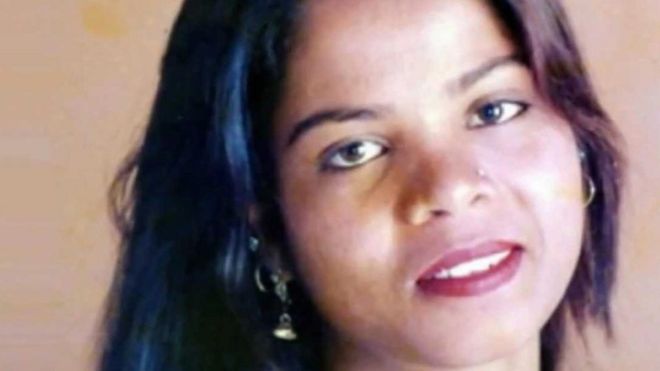
Pakistan - Asia Bibi: Christmas in a prison cell

By Martin Bashir


As churches around the country prepare to celebrate the birth of Christ, with peace and goodwill toward men, spare a thought for those who must live out their faith in a foreign land.
This will be the seventh consecutive Christmas mother-of-five Asia Bibi will spend in solitary confinement within the Islamic Republic of Pakistan - a country that has what the United Nations describes as "one of the worst situations in the world for religious freedom".
A member of the Christian minority, just 1.6% of the population, 45-year-old Asia Bibi was jailed after being found guilty of breaching Pakistan's strict blasphemy laws.
Her case has provoked global protests, with supporters accusing the judiciary of fabricating the charge to persecute a Christian. There have been no fewer than three attempts at appealing against the verdict.
There's also been a direct intervention by Pope Francis, who received a delegation of family and friends at the Vatican. But still she languishes in a small cell as the world awaits a final decision from the Supreme Court in Lahore.
Members of the Pakistan Christian Democratic alliance march during a protest in Lahore on 25 December 2010 in support of Asia BibiImage copyrightARIF ALI/AFP/GETTY IMAGES
Image captionPakistan's Christian Democratic Alliance has called for Asia Bibi's release
"The case of Asia Bibi is precisely the reason why I continue to fight for religious minorities around the world," says crossbench peer Baroness Cox, who recently returned from visiting oppressed Christians in Nigeria.
"Only those of us in open and free societies can be a voice to the voiceless and Christmas is the perfect season for us to renew our appeal for humanity and tolerance."
The original incident, which occurred in June 2009, centred around Asia Bibi sharing a bowl of water with fellow workers in a field, about 30 miles (48km) from Lahore, where they were working as farm labourers.
It's alleged that an argument erupted after some of the women felt it was sacrilegious for Muslims to share the cup with a Christian. Within weeks, the allegations had escalated to the charge of blasphemy, with some fellow workers accusing her of insulting the Prophet Muhammad. She was arrested and imprisoned.
Despite reports of inconsistent witness testimony and fragmentary evidence, she was found guilty in November 2010. Large crowds gathered to celebrate her sentencing, and there soon followed a trail of death and destruction.
Salman TaseerImage copyrightFAROOQ NAEEM/AFP/GETTY IMAGES
Image captionSalman Taseer was killed after saying blasphemy laws had been misapplied in Asia Bibi's case
A month after sentencing, Asia Bibi was visited by the Governor of Punjab, Salman Taseer. He emerged from jail and stated that the blasphemy laws had been misused and wrongly applied in her case. Within days, he was murdered by his bodyguard, Mumtaz Qadri.
Two months later, in March 2011, the Federal Minister for Minorities Affairs, Shahbaz Bhatti - the only Christian in the Pakistan cabinet - criticised the country's blasphemy laws as being open to abuse and manipulation.
After leaving his mother's house, his car was sprayed with bullets: a second assassination in a matter of weeks and both apparently linked to the case of Asia Bibi.
Beyond the application of blasphemy laws, 2016 has also witnessed the continued targeting of Christian minorities by militant groups in Pakistan.
The most severe attack was launched on Easter Sunday in Lahore. A large number of the Christians had chosen to visit a neighbourhood park following morning worship. Spirits were naturally high.
"Things were going well," said the Roman Catholic Archbishop of Lahore, the Most Reverend Sebastian Shaw, "but it was very cautious. A priest called us and told us that we must be alert all the time."
People grieve after the Taliban suicide bomb attack in Lahore on 27 March 2016Image copyrightAFP/GETTY IMAGES
Image captionPeople grieve after the March 2016 Taliban suicide bomb attack in Lahore
As parents pushed their children on swings and enjoyed the company of friends, two suicide bombers entered the park. Within minutes, the hum of children's voices was overwhelmed by the sound of tragedy. More than 340 people were injured and 75 died. The vast majority were women and children.
"It was very difficult," said Archbishop Shaw, who rushed to several medical facilities where the injured had been taken. "Even in the corridors of the hospital, at the entrance [there were] so many people. It was very difficult to console people.
"I visited a lady. She came from Hyderabad. Her husband and two children were killed and another cousin was also killed. So the lady was totally out of her senses and didn't know what had happened."
Within hours a group affiliated to the Pakistan Taliban, Jamaat-ul-Ahrar, said it had carried out the bombing and was reported to have deliberately targeted Christians.
Ban Ki-moon, Secretary General of the United Nations, condemned the attack and urged the Pakistan government "to do its utmost to put in place protective measures to ensure the personal security of all individuals, including religious minority communities living in the country".
But Pakistan is not alone.
Earlier this month, an individual wearing a suicide vest attacked a Coptic Christian church in Cairo, during Sunday morning prayers. There are conflicting reports about whether this was a man or a woman.
But the effect was unequivocal: at least 25 people were killed and a further 45 injured. Orthodox Copts comprise just 10% of Egypt's 90 million people but are the Middle East's largest Christian community.
The latest attack followed complaints by Christians in the town of Minya, about 140 miles (225km) south of Cairo, where several buildings were burned after they were suspected of hosting prayer meetings.
Christian worship in countries such as Pakistan and Egypt remains the most dangerous practice and this year of horrifying attacks could yet end with further bloodshed.
If Asia Bibi's appeal is rejected by the Supreme Court, she will become the first woman in Pakistan to be executed for blasphemy. Christians throughout Pakistan are praying for a miracle this Christmas.

Pakistan - Nine children die as measles epidemic hits Balochistan

At least nine children, including four girls, died as a new wave of measles hit Balochistan’s Zhob district on Saturday.
District Vice Chairman Zhob district Maulvi Jarullah said that the disease broke out in the Tansara Union Council and affected the areas of Bayan Zai, Zakariya Zai and Kakshaim. Immediate measures are required to contain the epidemic, he added.
District Health Officer (DHO) Zhob Dr Muzaffar Shah also confirmed the spread of the disease.
Outbreak: Three children contract measles in Mohmand Agency
Earlier, provincial secretary health Noorul Haq Baloch dispatched teams of experts to the affected district. The department also said that all necessary measures were being taken to overcome the disease as the district administration has been asked for their cooperation to identify the areas affected by the epidemic.
On Friday, doctors initiated preventive measures when the disease also broke out in Awaran area of the province.
In September 6, three children contracted measles in Safi tehsil, Mohmand Agency, Fata. According to the official, another child, identified as Rizwan, was rushed to a hospital in Peshawar in critical condition after he contracted measles. The health official revealed there were no vaccines for measles at basic health units in Safi.
http://tribune.com.pk/story/1273859/nine-children-die-measles-hits-balochistan/

Pakistan - Countdown begins for rulers: Bilawal


Pakistan People’s Party (PPP) Chairman Bilawal Bhutto Zardari on Friday warned that the countdown has begun for ruling party after his father Asif Ali Zardari’s return from self-exile.
Zardari arrived in Karachi to a resounding welcome and vowed to take hold of the power again after the party badly performed in the last general elections.
Sources said that Zardari may not stay in Pakistan for long as he was expected to fly back to Dubai on December 30 but was likely to return soon.
During his week-long stay in Pakistan, Zardari will jointly preside over a meeting of the PPP Central Executive Committee at Naudero with Bilawal.
Bilawal, who accompanied his father from Dubai was confident the government will be under pressure after Zardari’s return. “Aik (one) #Zardari, Sab pay bari (beats all). Countdown for Riawind starts from today. #GoNawazGo,” he tweeted.
Separately he said: “If Zardari is in Pakistan, our four demands will be fulfilled soon”.
Bilawal had earlier announced that if his four demands were not met by December 27, the party would launch an “anti-government drive”. The four demands include the appointment of a full-time foreign minister, implementation of the decision of a multi-party conference chaired by Zardari on the China-Pakistan Economic Corridor, the formation of a parliamentary committee on national security and adoption of a PPP-drafted bill on Panama Leaks probe.
Earlier, Prime Minister Nawaz Sharif welcomed Zardari’s return and advised him to take reign of the PPP – ostensibly pointing to the hostile attitude of Bilawal.
Zardari had been a strong advocate of reconciliation in the past, but, the PPP sources said that he had changed his mind and agreed to follow Bilawal’s aggressive policy, a year before the general elections – to be held in 2018.
Former prime minister Raja Pervez Ashraf told The Nation that the PPP would be much more active in 2017 than the last couple of years. “We are entering the election year, so this is time to mobilise workers. We don’t want to topple the government but they forced us to end the politics of reconciliation,” he said.
Ashraf said a final strategy of the PPP would be finalised on December 27 after the CEC meeting. He said that Zardari and Bilawal were “completely on the same page” over running the party affairs.
On his return, Zardari addressed a welcome rally and criticised the ruling Pakistan Muslim League-Nawaz. “I am confident the PPP will rise to power again,” he said. “The political actors must know I had not fled. We are Bhuttos, we will live here and die here,” he said. Zardari, who is likely to announce the party’s decision to launch Bilawal in the National Assembly through a by-election in the coming weeks, said the PPP would start a “democratic struggle” inside the parliament as the work supporters chanted “Go Nawaz Go” slogans. Bilawal will possibly replace Khurshid Shah as the opposition leader in the National Assembly to give a tough time to the government. PPP leader Senator Rehman Malik told The Nation that Zardari and Bilawal would jointly lead the PPP’s revival in Punjab and other provinces. “Bilawal’s policies are backed by Zardari, there are no differences between them on how to prepare for the elections and how to run the party,” he said. The lawmaker said that Zardari’s return had mobilised the workers. “Our activists and leaders are charged. We will not let that momentum go down,” he said. The sources said the government was trying to convince Zardari to accept an offer where the majority of the PPP demands will be met immediately. But this offer had been on the table for a few weeks and Bilawal had rejected it.

Sixth grader in Pakistan sues President House officials over plagiarism

A sixth grader in Pakistan, through his father, has sued officials at the President House at the Islamabad High Court, accusing them for plagiarising and using his speech without his consent. Eleven-year-old Mohammad Sabeel Haider, a student of Islamabad Model College for Boys, said on Friday that he was chosen to deliver a speech at the President House in Islamabad on December 22, reports the Dawn.
The ceremony was recorded and is supposed to be aired on Pakistan Television on December 25, marking the 141st birth anniversary of Mohammad Ali Jinnah, the founder of Pakistan. However, when Sabeel arrived at the President’s House, he was informed he will no longer be delivering the speech.
He said in his petition that a tenth-grader delivered the speech he had written and prepared, alleging that his intellectual property was stolen. According to Sabeel’s lawyer, as per Section 3 of Intellectual Property and Copyrights Ordinance 1967, a literary piece that the person has produced themselves cannot be used by a third party without their consent.
The court’s judgement in this regard has been reserved.
http://indianexpress.com/article/world/sixth-grader-in-pakistan-sues-president-house-officials-over-plagiarism-4442733/