Saturday, February 20, 2016

Ankara Plays Pivotal Role in Escalation of Violence in Middle East, Europe

Turkey is playing a pivotal role in the escalation of violence both in the Middle East and Europe, Czech-based freelance journalist Martin Berger notes, adding that Ankara is just waiting for a "legal pretext" for the invasion of Syria.


Turkish President Recep Tayyip Erdogan has become the first sectarian leader of the country, Czech-based freelance journalist and analyst Martin Berger notes, referring to the fact that Erdogan's ideas originated from the "New Look" movement and the banned sectarian Virtue Party.
Back in 1999 Erdogan quoted a Turkish poet who said: "Mosques are our barracks, minarets our bayonets, domes our helmets, the believers our soldiers."
Since then the Turkish leader has been harboring a plan to create a neo-Ottoman Empire. To reach the goal he has established close ties with Islamists, including the notorious Muslim Brotherhood, as well as with Turkish ultranationalists and its paramilitary youth group, the Grey Wolves.
To bolster Turkey's influence on European policymakers, Erdogan has flooded the continent with refugees and blackmailed Brussels into providing Ankara with both substantial financial aid and clear prospects of the EU membership.
At the same time, the Turkish President has kicked off a large scale propaganda campaign aimed at discrediting Russia's policies in the Middle East.
"This envy is supposed to allow Erdogan to rally various social groups under the banner of fighting a common enemy, or at least that's what Turkey's President believes," Berger narrates in his article for New Eastern Outlook.

In addition, Ankara launched an all-out war against Kurds in Turkey's southeast region in 2015 and has repeatedly attacked Kurdish People's Protection Units (YPG) in Syria. For several days the Turkish artillery has been shelling the northern parts of Syria.

"The Turkish regime continued on Friday its crimes against the Syrian people, instructing its heavy artillery to attack regions in Aleppo northern countryside in a flagrant violation of international law," SANA wrote on February 19.
On February 18, the Kurdish Hawar news agency ANHA reported that "dozens of Turkish military vehicles advanced 200 meters into Rojava land over the Meydan Ekbise village of Efrin city."
Apparently to expand its Lebensraum in the Middle East, Turkey de facto invaded Iraq regardless of the vocal displeasure of Baghdad, and has pledged to launch a ground operation in Syria, as soon as Washington authorizes the campaign.
It is no secret anymore, that Ankara is involved in illicit oil trade with Daesh, as well as sponsoring the training and arming of radical Islamic fighters together with Saudi Arabia and Qatar. However, Washington and its NATO allies turn a blind eye to Erdogan's criminal actions.


"President Obama expressed concern about recent Syrian regime advances in northwest Syria and urgently called for a halt to actions that heighten tensions with Turkey and with moderate opposition forces in northern Syria, and undermine our collective efforts in northern Syria to degrade and defeat ISIL [Daesh]… He emphasized the unwavering commitment of the United States to Turkey's national security as a NATO Ally," the recent transcript of the US President's Call with President Recep Tayyip Erdogan of Turkey reads.
Some experts believe that the deadly February 17 attack in Ankara was deliberately blamed on YPG by the Turkish leadership to justify a potential ground operation in northern Syria.

​"In this situation an 'unexpected' incident near the Syrian-Turkish carried out by ISIS [Daesh] could become an ideal solution for Turkey, providing it with a 'legal' pretext for the invasion of Syrian territory. But ISIS has no resources to carry out such an attack since it's stuck fighting in Syria and has practically been surrounded near As Sin. Under these conditions, only hosted Turkish secret services could provide Ankara with a pretext that it needs so desperately," Berger stressed.
The journalist notes that Erdogan's ability and willingness to create such pretexts is well-known and documented.
In this light there is the possibility that Ankara will itself create "the last straw" situation that will allow the Turkish leadership to invade Syria.


Read more: http://sputniknews.com/politics/20160220/1035101581/ankara-plays-pivotal-role-escalation-violence-middle-east-europe.html#ixzz40lDOBeXl

Assad Wants to 'Save Syria' in 10 Years

Syrian President Bashar Assad said on Saturday in 10 years he wants to be seen as a person who had saved Syria.

The prospect of a truce in Syria resurfaced on Saturday after a source in the opposition group formed after talks in Moscow and Cairo told RIA Novosti that Russia and the United States had prepared a document on the "cessation of hostilities" to take effect after its approval.

"The most important thing is how I see my country, because I am part of my country. Therefore, in 10 years I want to have been able to save Syria," Assad said in an interview with Spain’s El Pais daily.
Asked to clarify whether he planned to remain in power over the next decade, Assad said "I do not care about my presence in power."

"For me, if the Syrian people want me in power, then I will be; and if not, then I will not. If I cannot help my country, then I must leave immediately."

Russian Foreign Minister Sergei Lavrov and State Secretary John Kerry later explained the "modalities for a cessation of hostilities" have not yet been agreed on.


The latest decision follows a series of meetings among stakeholders to the Syrian conflict, including the February 11 International Syria Support Group (ISSG) that adopted a communique calling for a cessation hostilities and swift humanitarian access to all besieged areas.

Video - Hillary Clinton Gives Victory Speech In Nevada "We're in this together"

Nevada Caucuses: What You Need to Know

Nevada voters caucus on Saturday to choose the Democratic candidate for president. Here is a look at the contest:
Delegates and Rules The caucuses are open, which means that any eligible voter may participate and that voters can register or change their party affiliation on the caucus day. The results of Saturday’s vote are not binding. Twenty-three of the 35 delegates to the county conventions will be chosen on Saturday based on presidential preference in each of the state’s congressional districts.
Results
Nevada caucus precincts open at 11 a.m. Pacific time (2 p.m. Eastern time), and voting will start about noon, with initial results coming within the hour.
Polling
There has been very little public polling, and because Nevada has a caucus system, which means a lower turnout, a surprising outcome is possible.
What to Watch For
Patrick Healy, a national political correspondent for The New York Times, looks at six dynamics that could alter the 2016 race, and Nate Cohn of The Upshot offers some ways to look at the results as they roll in.
http://www.nytimes.com/2016/02/21/us/politics/nevada-caucus.html?action=click&pgtype=Homepage&viewport=desktop-large&module=column-2®ion=top-news&contentIndexValue=0&subIndexValue=4&feedIndexValue=0&groupKick=true&summary=true&_r=0

Video - Clinton Meets With Supporters Before NV Caucus

President Obama's Historic Visit: Cuba and Argentina

President Obama's Weekly Address: A New Chapter with Cuba

Music Video - YEH ALAM SHAUQ KA DEKHA NA JAYE -TAHIRA SYED,AHMAD FARAZ

Optimism is in short supply on Afghanistan these days


Shaukat Qadir

A fresh round of peace talks on Afghanistan are to begin soon. Meanwhile, representatives from Pakistan, China and the US met the Afghan leadership a few weeks ago to settle on the way forward. The fact that no decisions made by the four principal countries involved has been made public might be good news – but only if it means that no stone will be left unturned to find the way forward.
Recently I’ve felt optimistic about a negotiated settlement in Afghanistan, but I must admit that I am beginning to lose my optimism and despite not wanting to hold any single participant to blame, it is becoming increasingly difficult not to centre on America.
In the case of Pakistan it seemed, until early last year, that the US policy was ambivalent because of its desire to keep China encircled. Of late though, it appears that the US is again supportive of Pakistani efforts to improve its security situation.
However, there seems to be no reason for the US not to do everything possible to ensure peace and stability, and yet it has not.
A year ago some of us, while speculating on ISIL infiltrating this region, explained why it was unlikely to be successful in both Afghanistan and Pakistan. After learning of the death of Afghan Taliban leader Mullah Muhammed Omar, I dwelt on the necessity for urgency in dealing with this more insidious threat, but too late, due to splintering Taliban ranks.
Then ISIL captured Kunduz. Admittedly, it was retaken but while attempting to do so American planes bombed a hospital staffed by their own people, killing doctors and patients.
I explained that the logistic route to northern Afghanistan lies through territories where only the Haqqani Network could interdict them and, therefore, it was even more imperative that Haqqanis were included in peace talks.
On Pakistan’s insistence, Haqqani was represented during the meeting in Islamabad. Sensing the reluctance of the invitation to Islamabad, Haqqani sent fairly insignificant representatives. But that too could have been treated as a beginning; to open more doors to them. Apparently that did not suit Kabul and Washington.
Now the Taliban has taken Sangin. Once again Afghan troops are struggling to recapture it. This might be more difficult to recapture merely due to its location and terrain.
I repeat myself again. The Afghan Taliban were splintering but Mullah Omar’s death splintered them further. As a consequence, an ideal opportunity was created. If Afghan security forces could, like the Pakistani forces, conquer the Taliban speedily, then do so. If not, then begin negotiations immediately; while the Taliban are still in a position of weakness. But again nothing happened.
As many of us predicted, inactivity was bound to strengthen ISIL. Continued bad governance, a weakened economy, and widening cracks in Taliban ranks created opportunities which it has filled.
As in Syria, the moment ISIL capture sufficient space, they will create a mini-state. In the politico-economic state which exists in Afghanistan, it will be impossible then to prevent ISIL ranks from swelling further.
It is immaterial that ISIL might reveal its uglier side far sooner than the Taliban did in 1996.
Pakistan is considerably better off economically and in terms of the established capability of its security forces. But if ISIL becomes a force to reckon with in Afghanistan, Pakistan will be the most directly affected neighbour. If that happens, all that has been gained in the last two years could be lost in as many months.
And make no mistake, ISIL leaders are at least as wise as the Taliban, maybe even far wilier.
They timed their operations very well. Spring is upon us to open this year’s campaign season and it begins with Afghan troops attempting to retake Sangin. However insignificant Sangin might be in comparison to Kunduz, but over a hundred British soldiers died unsuccessfully defending it.
Ashraf Ghani has a very tenuous hold over his National Unity government. Far more tenuous than the wilier Hamid Karzai had when he began his first term – only because he was more shrewd. While Mr Karzai strengthened his hold, at least over Kabul and its surroundings, with every passing month, Mr Ghani has been weakened further.
Admittedly, Mr Ghani’s weakening has been partially due to events beyond his control and partially due to efforts of those deliberately undermining his authority. But his failure to demonstrate an attempt to end corruption and deliver good governance is also contributing to his weakening political hold.
By comparison, Pakistan is doing fairly well in its attempt to stage an economic recovery. Good governance might still be out of reach but the decision of security forces to take on corruption along with terrorism has helped improve the domestic scene.
But, only by comparison. We are far from being out of the quicksand we were getting sucked into.

Sexual violence in Pakistan often goes unnoticed: Here are a few resilient voices in the battle for justice


By Kathy Gannon
Kainat Soomro was 13 years old and on her way to buy a toy for her newborn niece when three men kidnapped her, held her for several days and repeatedly raped her. Eight years later, she is still battling for justice. She sits on a steel-framed bed in her parents' three-bedroom home, and holds her blue shawl tight around her body.
When she describes the horror of her captivity her voice is barely a whisper, but it gains strength when she talks of the fight she has been waging: going to Pakistan's courts, holding protests, rejecting the rulings of the traditional Jirga council, taking on the powerful landlord and politician who she says are protecting her attackers.
The Associated Press does not usually identify victims of sexual abuse, but Kainat has gone public with her case.
Her battle for justice has inspired an award-winning 2014 movie, Outlawed in Pakistan. Malala Yousefzai, the Pakistani teenage Nobel Peace Prize winner who was shot by the Taliban, invited Kainat to the Nobel award ceremony, and her fund has given Kainat financial help.
Yet Kainat's family has paid a high price for her bravery. One sister remains unmarried and another was divorced because her in-laws were ashamed to be associated with Kainat.
In 2010, her brother was killed over his sister's refusal to stay silent.
Clutching a gold-framed picture of his son, Ghulam Nabi Soomro spat out words of condemnation. "They know about our troubles thousands of miles away but here in the next street no-one is helping us get justice," he said.
In Pakistan, women are often too fearful to report sexual violence, yet the independent Human Rights Commission of Pakistan recorded 423 rapes and 304 gang rapes in 2015.
It also said that in 2015, at least one woman a day was killed in the name of honour — murdered for allegedly bringing shame on the family.
"Each year a gamut of promises is made for the protection and development of women, but (they) remain unfulfilled by the year-end," the commission wrote in its 2014 annual report.
Attackers are rarely jailed. Human rights workers say the police often refuse to even register a case involving attacks against women, and the powerful and rich are immune.
The groups trying to advance women's rights in Pakistan's deeply traditional patriarchal society suffered a painful blow in January when the national parliament refused to pass laws banning child marriage. The parliament buckled to the dictates of the Islamic Ideology Council, a religiously right-wing advisory group with no legal authority. The same body has also said that taking DNA tests to identify a suspected rapist is against Islam.
"Women's groups have been demanding that the Islamic Ideology Council be disbanded," says Uzma Noorani, an activist who also operates a women's shelter in Pakistan's port city of Karachi.
She says rights advocates are fighting a war for change and occasionally battles are won. Southern Sindh province, of which Karachi is the capital, has passed legislation aimed at protecting women and banning underage marriages. But then the war begins again as they fight to convince police and judges to register cases and implement the laws, and to take authority away from the Islamic Ideology Council and other hard-line groups.
"When you have a law it is like a weapon, when you need it you can use it," says one outspoken member of Sindh's legislature, Mahtab Akbar Rashdi.
She says that the national government is pandering to those who adhere to a narrow and restrictive view of Islam, which mostly targets women. "It's as if women for them are the biggest problem in Islam," she says of the Islamic Ideology Council.
One women's shelter in Karachi, surrounded by two walls and protected by guards, is home to around 40 women. Some have fled abusive husbands, some have been raped, others are being hunted down by families for choosing love.
When Azra was 18, her family sold her for $5000 to an older man who passed her around to strangers. She ran away, and now she is fighting for a divorce and too afraid to leave the shelter's walls. The courts have yet to decide on her case and Azra — who is just 20 — wonders where she will go when the time comes to leave the shelter.
Sidra Kamwal had left her abusive husband and moved back in with her mother when another man proposed to her. The man refused to take no for an answer. He pestered her and harassed her. And then one day he told her that if couldn't have her, no one could, and threw acid on her face.
The months afterward were horrific. Her poverty meant doctors paid her little heed. One sent her home with only burn cream, but the pain and swelling were unbearable. Her nostrils had seared together. She returned to hospital and again, after three days, they sent her home.
Her four-year-old son refused to come to her after her attack. "He didn't recognise me. My face scared him," she says, pulling her headscarf over her twisted mouth and nose.
Nightmares haunt her sleep. Each time she closes her eyes his face appears. Sometimes he is hitting her, throwing more acid, pounding her. If her terror does not waken her, the small tube that runs between her burnt nostrils does. Without it, she struggles to breathe.
It was not until she went to court that Noorani, the women's rights activist, saw her and she received treatment. According to the Human Rights Commission, 55 acid attacks took place in Pakistan in 2015. To date, only 17 arrests have been made.
Unlike Kainat or Azra, Sidra's attacker is in jail, but his family has been embraced by the neighbours. The family jeers at her, and the neighbours applaud. Sidra, with her painfully disfigured face, is the outcast.

New government school blown up in Pakistan's restive northwest

Militants blew up part of a newly constructed government school in Pakistan's South Waziristan region late Friday night, a spokesman for a wing of the Pakistani Taliban said on Saturday, the latest in a string of attacks on educational institutions.
No one was hurt in the blast in Pakistan's restive tribal belt, but 18 laborers working on the site were abducted, said Azam Tariq, a spokesman for an arm of the Pakistani Taliban known as the "Sajna" group, which claimed responsibility for the attack. He said the workers were released a short time later.
"We have blown up the school because it was a government installation," said Tariq, warning the group would continue to attack government targets.
Twenty people were killed and dozens wounded last month when militants launched an attack on Bacha Khan University in Khyber Pakhtunkhwa province, a little more than a year after Taliban gunmen massacred 134 students at a military school in nearby Peshawar.
The Peshawar school attack was seen as having hardened Pakistan's resolve to fight militants along its border with Afghanistan.
Officials in South Waziristan said the girls' wing of the school in the Tehsil Tiarza area was damaged in Friday's blast, as well as some heavy machinery being used for ongoing construction at the site.
In a separate incident in Mohmand tribal area to the north, Pakistani security officials killed five militants during a clash near Mohmand Agency's administrative headquarters on Saturday.
The militants were planning an attack in the area, a security official said, speaking on condition of anonymity.
A generation of Pakistani militants have used the tribal region to launch attacks on the Pakistani state and U.S.-led forces in Afghanistan.

The Pakistani Taliban are fighting to topple the government and install a strict interpretation of Islamic law. They are loosely allied with the Afghan Taliban who ruled most of Afghanistan until they were overthrown by U.S.-backed military action in 2001.

Bilawal Bhutto - Decisions in PPP are made through collective consultations

Bilawal Bhutto Zardari Chairman Pakistan Peoples Party has said that decisions in his Party are made through collective consultations in the greater interests of the masses and the Party leadership will take all the workers and Jiyalas onboard in the decision-making process like in the past.
 In a press statement issued here, Bilawal Bhutto Zardari said that being a huge Party with ground-level roots in all the four provinces, Azad Jammu & Kashmir, Gilgit-Baltistan and FATA, there was no match to the PPP in struggle, sacrifices and performance for restoration and strengthening democracy and protection of the rights of downtrodden and barefoot masses. 
Referring to a recent reports in the media, PPP Chairman said that his father former President Asif Ali Zardari and he himself have been working together, continue to work together and it is only together that we can succeed. He said that we are working like a well-integrated team and history records that former President Asif Ali Zardari has always enjoyed a great respect among the masses and workers for his brave struggle and steadfastness during imprisonments. Wisdom and sagacity displayed by him in the aftermath of martyrdom of Shaheed Mohtarma Benazir Bhutto and the way he put democracy on track and shed his own powers as President to strengthen Parliament have proved him to be a giant asset for the Party and the entire country, PPP Chairman added.Bilawal Bhutto Zardari further said that changes in the organization remain a continuous exercise and all such decisions would be made through mutual consent and consultation within the Party as both the old and young faces would work together for the emancipation of the people from poverty, illiteracy, extremism and terrorism.

https://mediacellppp.wordpress.com/2016/02/20/decisions-in-ppp-are-made-through-collective-consultations-bilawal-bhutto/

Friday, February 19, 2016

Video - Obama Tells Governors to Protect Voting Rights

Post-war Iraq: 'Everybody is corrupt, from top to bottom. Including me'


Martin Chulov


Iraq's anti-corruption chief sat in his office, waving his hands in exasperation. “There is no solution,” he said. “Everybody is corrupt, from the top of society to the bottom. Everyone. Including me.”
Coming at the start of a conversation about Iraq’s ailing governance, and what was being done to turn things around, Mishan al-Jabouri’s admission was jarring. “At least I am honest about it,” he shrugged. “I was offered $5m by someone to stop investigating him. I took it, and continued prosecuting him anyway.”

Jabouri heads one of two anti-graft agencies tasked with protecting public monies in post-war Iraq. Both have more work than they can ever hope to deal with – even if they wanted to.
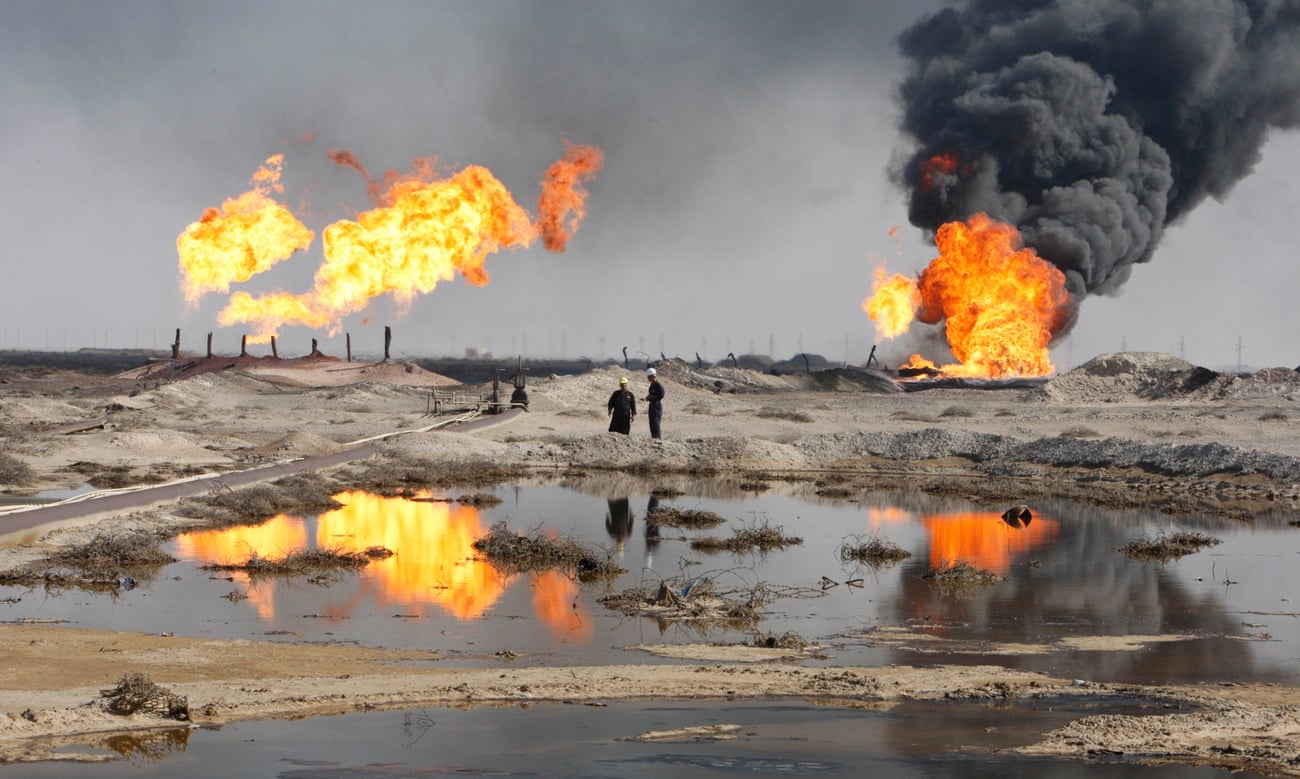
Now, with plunging oil prices leaving Iraq’s revenues in more jeopardy than at any time since the US invasion, attention is shifting to what the custodians of public funds have done over more than a decade with tens of billions of dollars that could otherwise be a buffer from such a budget shock.
If, as projected, global oil prices remain at historic lows, Iraq will be unable to pay some of its civil servants, or honour pledges to build roads and power stations in the next financial year. The gravity of the crisis has created uncomfortable reckonings for Iraq’s political class, military leaders and some senior religious figures, who have led a staggering 13-year pillage that has left Iraq consistently rated as one of the top five least transparent and most corrupt countries in the world.
“Believe me, most of the senior names in the country have been responsible for stealing nearly all its wealth,” said Jabouri. “There are names at the top of the tree who would kill me if I went after them. When people here steal, they steal openly. They brag about it. There is a virus here, like Ebola. It is called corruption. There is no hope, I am sorry to say.”
Across all levels of society, a realisation is sinking in that Iraq is now entering a phase that could prove every bit as destabilising – perhaps even more so – than the war against Islamic State. Jamal al-Bateekh, a senior tribal leader with the ear of the political class, said: “For 12 years we have gone through the process of opening the budget in the parliament. But we have never closed it. There has never been a reckoning. All that time, they have been dividing the carcass into pieces.”
“This is existential,” said former deputy president Ayad Allawi, whose office was abolished late last year in a cost-saving drive. “There are organised corruption syndicates running the country, let alone militias. I tell you very frankly, no Iraqi power can take action on this.”
Over the past four months, some of Iraq’s top office holders, led by prime minister Haider al-Abadi, have tried to do just that. Emboldened by Iraq’s highest religious authority, Ayatollah Ali al-Sistani, Abadi has tried to launch an anti-corruption drive designed to weed out the most guilty and introduce meaningful accountability processes across all levels of business and politics.
Sistani, who has remained taciturn throughout most of his career, had been unusually strident during his Friday sermons, delivered through a spokesman until he stopped them in protest in January. “We spoke so much until our voices were hoarse, yet nobody listened,” he said at the time.
“He was more strong, more fierce and in-depth than he’d ever been,” said Allawi of Sistani’s increasingly forthright interventions. “He knows how serious this is.”
Across Baghdad, the finance minister, Hoshyar Zebari, has been tasked with finding ways around a profound budget shortfall that Sistani, Abadi and others fear could soon lead to civic unrest and even retribution.


“We are 93-95% dependent on oil revenues,” said Zebari. “This year, our situation is far more difficult than in any other year,” he said. “We have exhausted our domestic borrowing. We need to go through a soul-searching process. We need to lose our dependability on oil. We need to prepare the public for change; on things such as VATs and other new measures. It is a question of a change in attitude. Here people are not accustomed to this.”
Iraq’s budget is modelled on an oil price of about $45 per barrel. However, oil had been hovering at $27 per barrel in recent months, before rallying by 14% over the past week. Nevertheless, oil experts across the Middle East believe that the recent fall in prices is structural, not cyclical, with very serious consequences for economies that are largely driven by old energy.
Zebari said that in early February he took Iraq’s full financial accounts to Sistani in the Shia city of Najaf for the 85-year-old ayatollah to inspect. “He is very serious about turning things around,” he said. “But he is frustrated.”
Iraq has one of the biggest per capita public payrolls in the world, roughly 7 million people from a population of just over 21 million, and it is here that Zebari believes much of the systemic corruption is hidden. “Our biggest issue is ghost soldiers,” he said. “There are maybe $500-$600m in salaries being paid to soldiers who don’t exist. There are so many outlets for this money to go without any accountability.”
In such cases, the salaries are instead collected by officers. In other cases, soldiers pay officers half their salaries so they don’t have to show up for duty.
The former chief of staff of Iraq’s army, General Babakir Zebari, who retired last year, conceded that the issue of ghost soldiers had bedevilled the military, along with vastly inflated tenders for weapons. “I warned about this all the time,” he said. “Everybody knew my views.
“The tenders are an issue that needed a lot of focus. It is my understanding that a lot of money went missing there.”
Hoshyar Zebari estimates that there as many as 30,000 ghost soldiers in Iraq’s military and that corrupt officers are pocketing their salaries. The impact is even more significant than the bottom line. The fall of Mosul, Iraq’s second city, in mid-2014 was in part blamed on there being far fewer soldiers in position to defend the city than there were on the books. Generals and other senior officers accused of running the scam have yet to be brought to account.
“They were protected,” said Jabouri. “We only go after the easy targets here. Recently a Christian businessman was jailed for two years for stealing $200,000 to build his house. That is nothing. It doesn’t even register as a crime compared [with] what else is going on.”
“We have paid out $1bn for war planes that never arrived. In Tikrit there have been budgets paid for courthouses that have never been built. It is the same with road projects all over the country, the port at Umm Qasr near Basra. If I had 50 staff to help me, we could barely scratch the surface.
“The problems here are social as much as everything. You are seen as weak if you don’t steal. Everyone wants to claim power, because they know that nobody else is going to share power with them.”
Allawi said he had taken a plan to Abadi to invite forensic auditors to examine Iraq’s books. “I was met by silence and blank stares,” he said. “It was like a bomb went off in the room.”
Abadi has placed much of his political stock on his reform drive, which he sees as essential to holding the country together. Sistani’s full throated sponsorship has given his moves an impetus that they would not otherwise have had. However, so far he has been unable to slow a plunder that has crippled Iraq’s governance.
“He is a good guy,” said Jabouri. “He is cleaner than all people in the parliament. But he cannot do this. Nobody can.”
And what of the self-declared corrupt anti-corruption chief, Jabour? “I did it because I am daring people to come after me,” he said. “No one will dare to. I have files on them all.”

YEMENIS RALLY IN SANA’A TO PROTEST S ARABIA’S ONGOING ATTACKS

Thousands of protesters took to the streets of the capital on Friday, waving flags and chanting slogans against Saudi Arabia and the kingdom's mercenaries and al-Qaeda militants wreaking havoc across the country.
The protesters also chanted anti-US and anti-Israel slogans and called for the downfall of the Saudi monarchy.
Riyadh’s jet fighters bombed al-Mahrah region in Omran Province three times on Friday.
Saudi aircraft also struck Sarvah and Mojzar areas in Ma’rib Province.
Reprisal attacks
In retaliation for the Saudi acts of aggression, Yemeni forces backed by popular committees killed dozens of Saudi mercenaries in Midi desert in Saudi Arabia’s Jizan Province. Yemeni forces also destroyed several Saudi military vehicles in the operations.
Yemen has been under military attacks by Saudi Arabia since late March last year. The Saudi military strikes were launched in a failed effort to undermine the popular Houthi Ansarullah movement and bring the former fugitive president back to power.
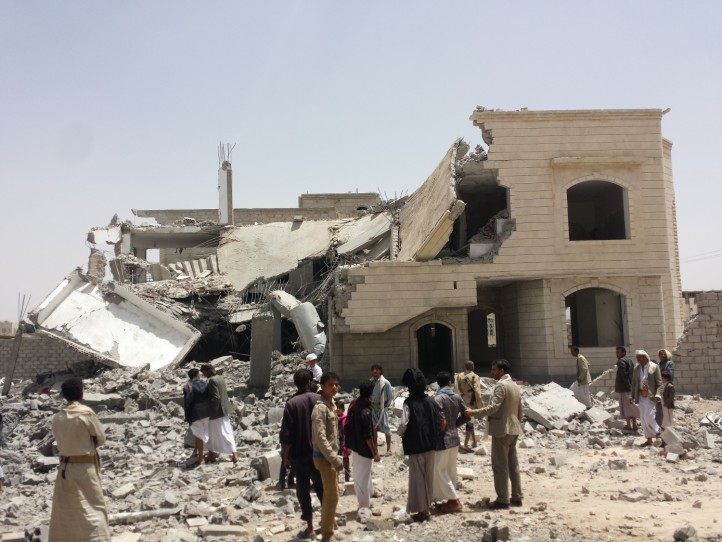
More than 8,300 people, among them 2,236 children, have been killed and 16,015 others injured since the start of the attacks. The strikes have also taken a heavy toll on the impoverished country’s facilities and infrastructure, destroying many hospitals, schools, and factories.

http://shiitenews.org/index.php?option=com_k2&view=item&id=21260:yemenis-rally-in-sana-a-to-protest-s-arabia-s-ongoing-attacks&Itemid=230

The Saudi Slaughter in Yemen


By 

Although the Saudis have promised a high-level committee to investigate civilian deaths from their airstrikes in Yemen, they continue to strike civilian targets with countless deaths and destructions.
For instance, among those recently killed in an airstrike on an abandon cement factory were “people in parked cars, a grocery store owner, a pharmacist and shoppers.” The nationalist insurgents, the Houthis, have also unfortunately contributed to the increased casualties as they try to repel the invaders and defeat the local groups opposed to them.
The civil war in Yemen, compounded by the Saudi invasion, has so far displaced 2.3 million people. It has left 5,700 dead, among them 2,500 civilians. Two thirds of the deaths have resulted from airstrikes. And 82% of the population requires assistance and medical supplies. The United States fears that 14.4 million Yemenis are at risk of “severe hunger.”
To add to the misery of the Yemeni people, the United States just approved the sale of weapons to the Saudis worth $1.3 billion. Among the weaponry are air-to-ground ordinances that included 22,000 bombs. From 2010 to 2014, the United States sold $90 billion worth of weapons to Saudi Arabia. Initially, among the U.S. weapons sold to the Saudis were the internationally banned cluster bombs.
The Saudis have feared Yemen for a long time. They worry that the Houthis and their allies will destabilize the Saudi regime and export revolutionary zeal to the Saudi people. The fear of losing their power is why the Saudi royals, with the help of the majority Sunni regimes in the Gulf, launched an air and ground war against Yemen. Riyadh hopes to reinstate the former government of President Abd-Rabbu Mansoor Hadi and make Yemen a satellite country of Saudi Arabia. Facing an onslaught by the highly equipped Saudi forces with American help, the Houthis were obliged to ally with the unsavory former president, Ali Abdullah Saleh, to defend Yemen. Although calls for talks have gone nowhere, a new effort is underway to hold negotiations in Europe under the auspices of the UN.
The Saudis have made the poorly supported claim that they are fighting a proxy war with Iranin Yemen. Unfortunately, the Obama administration parrots these lies in its official statements, which the major media then repeat. The Saudis and the Gulf States have conjured up Iranian’s involvement in order to justify their war on Yemen. In the meantime, al-Qaeda is deepening its roots and widening its reach in and around the country.
US support for the Saudi regime has continued despite the invasion and the resulting humanitarian disaster. The United States provides the Saudis with intelligence and helps to enforce the current naval blockade. Moreover, in January, Secretary John Kerry said, “We have as solid a relationship, as clear an alliance, and as strong a friendship with the Kingdom of Saudi Arabia as we ever had, and nothing has changed.” Kerry’s level of support for the Saudis contrasts sharply with the U.S. claims of supporting freedom, democracy, and human rights worldwide.
Yemen is one of the poorest countries in the world. The Saudis and the Gulf states are some of the richest countries in the world. And yet the Saudis, the Gulf States, and the United States are destroying Yemen, which had been a potential outpost of democracy in the region. Again, the United States derailed a potential democracy to serve a totalitarian regime, the Saudi Arabia.
The United States bears the moral and legal responsibility for facilitating a potential genocide in Yemen that results from the current war and the population’s lack of food, basic health, and sanitation. The United States keeps wondering why the people of the region continue to harbor the worst terrorists. The reason lies in part because the United States has chosen alliances with dictators for the sake of oil and the stability of corrupt regimes.

Saudi Arabia bombing civilian targets in Yemen is helping grow BAE Systems sales, says Amnesty International


James Cusick 


    UN says Saudi-led raids on schools, medical facilities, mosques and markets have violated international humanitarian laws.
    Saudi Arabia’s potentially illegal bombing of civilian targets in Yemen, currently being investigated by the United Nations, is helping to grow sales of fighter aircraft made by BAE Systems, according to Amnesty International. 
    Amnesty International says that that financial figures from the British-based multi-national defence contractor, reveal that a net gain of close to £1 billion over the last year in the company’s UK division is down to continuing sales and engineering support of its Eurofighter Typhoon jet to the Royal Saudi Air Force. 

    BAE stongly denied that sales to Saudi Arabia were helping fuel the conflict in Yemen, and that their improved sales were related to the bombing campaign.

    Details of fighter jet sales, and UK-manufactured missiles, both licenced by the UK government, are examined in a UN report currently being studied by the Security Council. 

    The Saudi-led coalition of nine Sunni states began its attacks on Houthi-controlled areas of neighbouring Yemen in March last year. The airstrike campaign and naval blockade has so far claimed the lives of over 6,000 civilians. 
    Bombing raids on schools, medical facilities, mosques and markets, according to the UN, have violated international humanitarian laws, with regions of Yemen facing acute levels of famine. 
    Amnesty International alleges that although BAE’s military-related sales contracted in recent years, the Saudi-led campaign in Yemen, alongside plans for further Saudi involvement in bombing in Syria, helped improve operating profits last year from £1.3 billion to £1.5 billion. 
    According to the company’s own figures for 2015, the Saudi military market helped boost its overall performance. Sales increased by £1.3 billion to £17.9 bn. 
    In 2005 the Saudi government placed an order with BAE for 72 Eurofighter Typhoons. The company described 2015 sales as part of an “existing order”. 
    David Cameron recently told the Commons that the Saudis were being encouraged to abide by humanitarian laws. However Amnesty International said the new sales figures should act as warning to BAE’s shareholders. 
    Amnesty’s arms trade director, Oliver Sprague, told The Independent: “They [shareholders] need to realise that a large part of the company’s profits is coming from the sale of weapons to Saudi Arabia at the very time Saudi’s military coalition in Yemen has killed thousands of civilians.”
    Warning the UK government to “stop cheerleading BAE’s lucrative arm sales”  and to suspend export licences for further arms  sales to Saudi Arabia, Mr Sprague added “There is strong evidence that that the present weapons sales to Saudi Arabia are not just ill-advised but actually illegal. 
    The Saudi-led operation claims to have targeted only Houthi military targets. However the UN report documents multiple attacks on civilian populations. 
    The company said:  "Deliveries of aircraft to the Kingdom of Saudi Arabia in 2015 were part of contract signed in 2007 and the delivery schedule is determined years in advance.  
    "We provide defence equipment and support to the Kingdom of Saudi Arabia under a Government to Government agreement. The export of any defence equipment is strictly regulated and the UK operates one of the most stringent arms control regimes in the world."

    China - Commentary: U.S. should bear healthy mindset when developing ties with ASEAN

    The curtain closed on a special meeting between U.S. and ASEAN leaders in California on Tuesday Pacific Time. It was the first such meeting on U.S. soil. Although some had been hyping up the meeting as an “ideal occasion” to provoke China,the following joint statement did not specifically mention China, or the South China Submissiveness the backdrop of China-ASEAN ties, such a result is not unexpected, but the unhealthy mindset of damaging China-ASEAN ties should evoke a cause for alarm. The ASEAN has been growing its vitality and strategic importance in the current global arena, especially after it announced the establishment of the ASEAN Community. In the future international and regional landscape, it will play a more significant role. Meanwhile, it can help deepen regional collaboration and promote the prosperity and stability of East Asia by forging equal and amicable ties which do not target any third party with its partners including the U.S. However, for quite a while, the road map drawn by some for U.S.-ASEAN relations has gone against the right track.

     The Philippines, for example, once tried to persuade other parties to write “South China Sea arbitration” into the agenda and the outcome document as an attempt to let theA SEAN “endorse” the unilaterally-filed arbitration. Washington, at the same time, also shared this motivation.In fact, similar diplomatic games over the South China Sea issue have appeared several times in the past years, but the results repeatedly proved that the ASEAN can properly balance the interests and concerns of all parties and won’t be “abducted” by the unilateral proposition of any one member state. Most ASEAN states are alert enough to acts that could harm its credibility and reputation,or undermine the leading role of cooperation in ASEAN and East Asia at large.

    They are also unwilling to see a community “led” by one single state.As a matter of fact, the active involvement of certain outside countries in the South China Sea is driven by ulterior motives. In the statement after the meeting, so-called “demilitarization” was hyped up again. But it is known to all that as an outside country, the U.S. has been flexing military muscle by frequently sending warships and aircraft into the South China Sea and plotting to conduct so-called joint patrols with other countries. Such behaviors have posed serious threats to the sovereignty and security of regional countries. What the U.S. has done is a major push to the militarization of the South China Sea. Hyping up the South China Sea issue is inconsistent with the interests of the ASEAN. Thecore of the issue lies in territorial and maritime right disputes, which is exclusively between China and some ASEAN members. The communication between China and ASEAN nations regarding the South China Sea issue is effective.

    China supports the dual-track notion proposed by ASEAN members,believing it as the most effective approach for addressing the issue. Derailing from the track will only cause interruption and damage to the efforts. That is why Thai Prime Minister Prayuth Chan-ocha noted in the meeting that all sides should ease the disputes through constructive dialogue.He also stressed that the Declaration on the Conduct of Parties in the South China Sea(DOC) is a useful mechanism to win trust among the concerned parties and bring about peaceful solutions to the conflict. As the ASEAN is striding forward, many countries are striving to boost their ties with it.But only through sincere assistance, instead of self desires, can those attempts betranslated into win-win results.

    Video - Asssad’s adviser: Once Syria & Russia succeed vs terrorists, Turkey & S. Arabia are going crazy

    NATO Warns Turkey It Won’t Support Ankara in Conflict With Russia

    As tensions escalate between Turkey and Russia, NATO has warned Ankara that it will not take part in a war provoked by the Turkish government.

    Last November, Turkey shot down a Russian jet flying through Syrian airspace. While many feared that the incident would plunge both countries into war, conflict was avoided, though relations between Moscow and Ankara have remained chilly.
    As Turkey pushes to deploy ground forces across its border to remove the legitimate government of Syrian President Bashar al-Assad, the Turkish government is, again, threatening the world with war.
    "The armed forces of the two states are both active in fierce fighting on the Turkish-Syrian border, in some cases just a few kilometers from each other," one NATO official told Der Spiegel.
    Ankara’s aggression seems partially based on the assumption that, should conflict erupt, Turkey will be supported by its NATO allies. According to Article 5 of the NATO treaty, the collective defense clause would be invoked if any member state is attacked.

    But European leaders have made it abundantly clear that they have no interest in participating in a war of Turkey’s making.
    "NATO cannot allow itself to be pulled into a military escalation with Russia as a result of the recent tensions between Russia and Turkey," Luxembourg Foreign Minister Jean Asselborn told Der Spiegel.
    Of Article 5, Asselborn stressed that "the guarantee is only valid when a member state is clearly attacked."
    Germany appears to agree.
    "We are not going to pay the price for a war started by the Turks," said a German diplomat, speaking on condition of anonymity.
    NATO leadership made similar warnings soon after Turkey’s downing of the Russian bomber last year.


    "We have to avoid that situations, incidents, accidents spiral out of control," NATO General Secretary Jens Stoltenberg said at the time. "I think I’ve expressed very clearly that we are calling for calm and de-escalation. This is a serious situation."
    On Friday, French President Francois Hollande stressed the need to prevent conflict between Moscow and Ankara.
    "There is a risk of war between Turkey and Russia," he said in an interview with France Inter radio.
    As Turkey calls to escalate the violence in Syria, Russia has called for a meeting of the United Nations Security Council to address its concerns over the rising tensions.
    "The situation is becoming more tense due to increased tensions on the Syrian-Turkish border and Turkey’s stated plans to send troops to northern Syria," reads a statement from the Russian Foreign Ministry.


    Read more: http://sputniknews.com/world/20160220/1035066264/NATO-turkey-russia-syria.html#ixzz40fU5X1WA