Friday, February 19, 2016

Russia open for talks on its UN draft resolution on Syrian sovereignty

Russia is open for talks on its proposed UN Security Council draft resolution in favor of the Syrian sovereignty, Russia’s deputy UN envoy Vladimir Safronkov said.

"I told our partners that the Russian delegation will be ready for talks on the draft resolution and that we welcome all sorts of proposals in the coming days," the Russian diplomat said adding that the Russia-initiated draft resolution on Syria will be "a moment of truth for UN."
The diplomat said he hoped the Russian document would be approved by the UN Security Council as soon as possible.


"Everything stated in the document had been confirmed and reiterated by all members of the UN Security Council throughout the Syrian crisis," Safronkov said. "Thus, it is unimaginable how they would refuse all the principles stated in the Russian document even out of political reasons."

A draft resolution of the United Nations Security Council that was initiated by Russia calls to stop shelling of the Syrian territory, respect its sovereignty and drop all plans and attempts at armed invasion of its territory.

The document reiterates resolute commitment to Syria’s sovereignty, independence and territorial integrity and the principles of the United Nations Charter.

The document contains no mentions of Turkey’s involvement, but condemns "ongoing shelling of the Syrian territory" and the flow of foreign terrorists and illegal arms supplies in violation of the United Nations Security Council resolutions with the connivance of certain states, including Syria’s neighbors.

The one-page draft demands that Syria’s sovereignty be fully respected and urges to immediately stop any trans-border shelling and interference and to drop all attempts or plans of foreign military invasion of the Syrian territory.

Before the draft resolution was submitted with the UN Security Council diplomats from the United States and France, Samantha Power and Francois Delattre respectively, announced that the Russia-initiated draft had no future.

Turkey has been recently shelling positions of Syrian Kurds, who fight against terrorists on the side of Damascus. Earlier in the week, Russia initiated a meeting of the United Nations Security Council over Ankara’s actions. Following their February 16 meeting, the United Nations Security Council members expressed concern over the actions of the Turkish authorities and agreed to urge Ankara to respect international law.

The Financial Times reported on Friday that Turkey was planning to deploy its troops in Syria’s northern provinces, while Saudi Arabia sought deployment of its troops in the south.
The United States, according to the Financial Times, has been trying to keep Ankara and Riyadh from military activities in Syria as NATO is worried over the perspective of deploying Turkish troops in a country, where Russia is waging an Air Force military operation.


More:http://tass.ru/en/politics/858062

Video Report - UK 'unique' Brimstone missiles killed zero ISIS fighter in Syria yet, MoD admits

President Obama and First Lady Michelle Obama Host Black History Month Reception - Feb 18, 2016

Video Report - Sanders & Clinton supportors ready for Nevada caucuses

Video - Clinton nabs key endorsement before Nevada caucuses

Video Report - South Carolina Rep. James Clyburn endorses Hillary Clinton

Video - Obama and first lady Michelle pay respect to Justice Antonin Scalia

Rape victim,Kainat Soomro - The Pakistani women risking it all for their rights


Rape victim, Kainat Soomro, who was kidnapped at the age of 13 by three men who held her for several days and repeatedly raped her, is still fighting for justice eight years later.
Speaking to the Associated Press, Soomro narrated the horror of her captivity and the subsequent fight she has been waging. She has been to courts, held protests, rejected the rulings of the traditional jirga council, even taken on the powerful landlord and politician who she says are protecting her attackers.
Despite all that, she has paid a high price for her standing up for herself. In 2010, her brother was killed because she wouldn’t stay quiet. As for her sister, one was divorced and another is still unmarried because people do not want to be associated with Soomro.
Ghulam Nabi Soomro, father of the rape victim, is outraged at the lack of progress in the case. “They know about our troubles thousands of miles away but here in the next street no-one is helping us get justice,” he said.
Soomro’s battle for justice has inspired an award-winning 2014 movie, “Outlawed in Pakistan.” Malala Yousafzai, the Pakistani teenage Nobel Peace Prize winner who was shot by the Taliban, invited Soomro to the Nobel award ceremony, and her fund has given Kainat financial help.
The independent Human Rights Commission of Pakistan recorded 423 rapes and 304 gang rapes last year. It also said that last year at least one woman a day was killed in the name of honour — murdered for allegedly bringing shame on the family. Attackers are rarely jailed with police often refusing to register a case.
“Each year a gamut of promises is made for the protection and development of women, but (they) remain unfulfilled by the year-end,” the commission wrote in its 2014 annual report.
Last month, the parliament refused to pass a law banning child marriage upon the advice of the Islamic Ideology Council, a religiously right-wing advisory group with no legal authority. The same body has also said that taking DNA tests to identify a suspected rapist is against Islam.
“Women’s groups have been demanding that the Islamic Ideology Council be disbanded,” says Uzma Noorani, an activist who also operates a women’s shelter in Karachi.
She added that the fight for women’s rights has reaped some success, with the Sindh Assembly having passed legislation aimed at protecting women and banning underage marriages. However, she says the war begins anew as victims fight to convince police and judges to register cases and implement laws.
“When you have a law it is like a weapon, when you need it you can use it,” says one outspoken member of Sindh’s legislature, Mahtab Akbar Rashdi.
She said that the national government is pandering to those who adhere to a narrow and restrictive view of Islam, which mostly targets women. “It’s as if women for them are the biggest problem in Islam,” she said of the Islamic Ideology Council.
One women’s shelter in Karachi, surrounded by two walls and protected by guards, is home to around 40 women. Some have fled abusive husbands, some have been raped, others are being hunted down by families for choosing love.
One such woman is Azra who was sold to an older man by her family when she was 18-years-old. She ran away after he began passing her around to strangers and is now fighting for a divorce. Now 20, Azra is waiting for the court to decide her case.
Another such woman is Sidra Kanwal who left an abusive husband and moved back in with her mother. When another man proposed to her, she refused but he wouldn’t take no for an answer. He threw acid on her face so no one could have her.
Since she was so poor, doctors did not pay much attention to her. Her four-year-old son refused to come to her after her attack. “He didn’t recognise me. My face scared him,” she says, pulling her headscarf over her twisted mouth and nose.
When she went to court, Noorani, the women’s rights activist, saw her and she received treatment. Her attacker is in jail now but society still hasn’t accepted her.
According to the Human Rights Commission, 55 acid attacks took place in Pakistan last year. To date, only 17 arrests have been made.

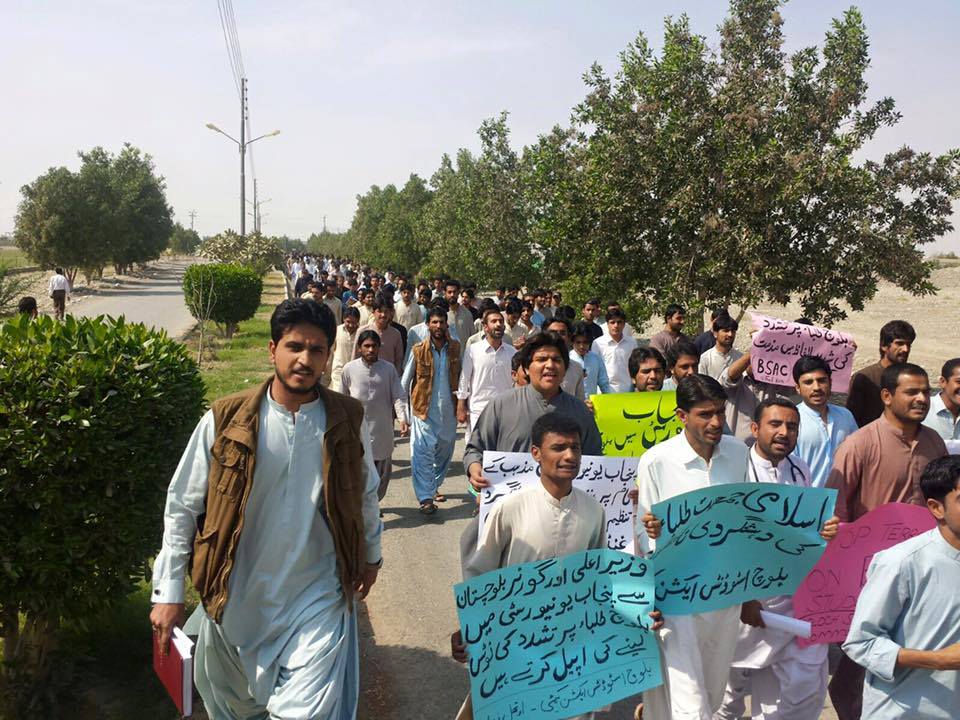
Baloch Students Protest against Attack on Students in Punjab by Islami Jamiat-e-Talaba


Sami Parvez
Quetta: Baloch Students held rallies and processions in Punjab, Quetta and Uthal against the attack and torture of number of Baloch students in Punjab University by Islami Jamiat-e-Talaba, a students’ group of religious organization.
According to the details, Baloch Students protested against a clash between Baloch students and the activists of Islami Jamiat-e-Talaba in which number of Baloch students were injured and their belongings were burnt.
It is worth mentioning, on Wednesday a clash broke out between the Baloch students and  members of Islami Jamiat-e-Taliba (IJT) studying at Punjab University, where a number of Baloch students were injured.  Prior to this incident, on Tuesday night, activists of IJT beat up a Baloch student, Jamil Ahmad Bugti, who was listening songs.  IJT activists attacked his room and set his belongings on fire.
In result the Baloch students blocked the Canal Road for several hours, which created a massive traffic jam. Later on police settled down the matters between both the groups.
On the occasion Baloch students chanted slogans against the IJT and demanded university administration and police to arrest those who attacked the hostel of Baloch student.
Protest  in Lasbela
On Thursday, Baloch Students Action Committee at Lasbela University, Uthal held a protest rally against the attack and torture of number of Baloch students in  Punjab University by Islami Jamiat-e-Talaba.
 Hundreds of students at Lasbela University of Balochistan, Uthal  chanted slogans against incident  and condemned the assault.
Participants raised slogans against student’s wing of religious organization. They were holding placards and banners in the hands and chanted slogans against the violence.
Addressing the participants, the Baloch Students Action Committee leaders said, “Such moves against Baloch Students are unacceptable and   if the issue is not taken seriously we would soon announce the series of protest.”
12745674_1054117457942335_4177592783332473161_n (1)
A rally held by Baloch Students Action Committee at Lasbela University, Uthal
Protests in Quetta
On 17 February, Baloch Students Action Committee held a protest in front of Quetta Press club against the assault on Baloch students in Punjab University.
On 19 February, Baloch Students Organization (Pajar)   and Pashtun Students Organization (PSO) led a protesting rally against the violence and demanded the arrest of involved responsible activists of Islami Jamiat-e-Talaba.
Baloch students say that they have been attacked continuously by the IJT activists in last couple of years but the police have failed to arrest any attacker.

Pakistan - The flying Prime Minister


Making a joke of governance

In two and a half years spread over about a thousand days, Nawaz Sharif spent nearly 200 days away from the country. These do not include his private but regular visits to Saudi Arabia during Ramazan and his private trips to UK. The travels cost the national exchequer a hefty sum of Rs638.276 million. The spending constitutes a drain on national exchequer in Pakistan which faces revenue crunch. The government owes it to people to clarify what Pakistan got out of so many trips by its Prime Minister. With no explanation offered for 17 visits to the United Kingdom, this has given rise to speculations of all sorts.
The frequency of the visits speaks out about Sharif’s priorities at home. He has been criticised for not giving importance to Parliament. He was abroad for about 200 days and attended only 35 sittings of the House which elected him to office. The record of his presence in the Senate which represents the federation is even more dismal. His long absence encouraged Cabinet Members and PML-N MNAs to frequently absent themselves from the House, causing a lack of quorum and leading to inordinate delay in crucial legislation. The Electoral Reforms Committee, headed by an equally busy Ishaq Dar, has yet to come up with its recommendations despite their urgency.
The Prime Minister has failed to fulfill the constitutional requirement of holding the CCI meeting for more than a year while it has to be convened every three months. The excuse was that Nawaz Sharif was too busy. The Prime Minister was required to create a national consensus over disputed issues like CPEC which has not been done. Sharif had no time to visit Jacobabad last year where nearly two dozen people were killed in a terrorist attack. He could not go to Bacha Khan University last month for the same reason. Acts of the sort have led to complaints of neglect from smaller provinces. It’s time the PM concentrates on domestic issues, handing over foreign affairs to someone else.

Pakistan - NAB controversy


For months, the federal government ignored charges made by Pakistan People’s Party’s (PPP) that federal institutions like the National Accountability Bureau (NAB) and Federal Investigation Agency (FIA) were overstepping their bounds and conducting affairs in Sindh in a manner that suggests political partisanship. However, now it appears that the PPP and Pakistan Muslim League-Nawaz (PML-N) are finally converging. On February 16, Prime Minister (PM) Nawaz Sharif, sounding unusually irate, warned NAB against the wrongful persecution of many, including ‘honest’ government employees, stating that the watchdog had been descending on the offices and houses of innocent people, harassing and discrediting them under the guise of ensuring accountability. Instead, he urged them to take up cases after acquiring solid proofs through detailed investigation. For those wondering why the sudden shift in tone of the PM regarding the methodology adapted by NAB and assorted organisations after months of deflection, the answer lies in the fact that finally the eyes of NAB had started to peer into Punjab. NAB is pursuing cases against prominent members of PML-N, including the Punjab Education Minister Rana Mashhood. But perhaps what is truly motivating the PM’s ire is the fact that old cases against the PM and his brother, Punjab’s Chief Minister (CM) Shahbaz Sharif, are about to be rescued from their long standing limbo by NAB. Furthermore, the ‘jewels in the crown’ of CM Shahbaz’s latest tenure, i.e. the Metro Bus and Orange Line Metro Train, are also reported to be in the crosshairs of NAB. Following on from the PM’s remarks, Irfan Siddiqui, special assistant to the PM, stated that the government is mulling the enactment of a new law to keep an eye on NAB’s activities. He dubbed NAB’s performance as “zero” and said the watchdog worked under and was answerable to the government. Given its emboldened activities of late, it is perhaps surprising to note how quickly NAB has folded in response to the PM’s warning, thereby making the quest to clip its wings almost redundant. In a press release, NAB seemed to be praising the government, suggesting that the government’s non-interference had helped strengthen the organisation. Taking a conciliatory tone, the NAB chairman stated the organisation respected the opinion of the PM and that NAB was working on improving its accountability process in line with the criticisms and directions of PM Nawaz Sharif. Moreover, regret was expressed about the investigation process, and blame was laid at the door of “inheritance”, but assurances were given that problems would be rectified.

There are multiple layers to this ‘accountability’ controversy. On a principled level, there is no argument about the need for ‘accountability’ and there is merit in the opinion — most loudly voiced by stalwarts of the Pakistan Tehreek-e-Insaaf (PTI) – that a watchdog should be without political interference and independent in order to do its job effectively. However, a basic problem with the criticism of the PM’s rebuke is that it ignores exactly how accountability drives have panned out in the past. The fact remains, as we witnessed recently in Sindh, these drives are motivated by partisan interests and political opponents are targeted. Furthermore, the scope of accountability is limited only to politicians. For ‘accountability’ to be authentic it should encompass politicians, bureaucrats, judges and generals equally. The last three (in increasing order) mostly escape any scrutiny and it is only the politicians who are caricatured and targeted for being corrupt, which is a prevalent narrative harmful to the prospects of democracy. It is patently apparent that the manner in which NAB (and the FIA) conducts itself is not consistent with criminal investigation ethics and rules of procedure. Nonetheless, accepting this reality does not remove the problems inherent in having the executive branch exercising total control over a watchdog organisation. Indeed, seeing NAB fold so quickly in consequence of the PM’s anger shows the farce at the heart of these accountability drives. To solve this quandary, it is imperative under the given circumstances to have a parliamentary committee overseeing NAB’s affairs. This will go a long way in reducing the partisan nature of NAB and help reduce the perception that accountability drives are fundamentally politically motivated.

Bilawal Bhutto - PM’s statement on NAB mere fallacy


Pakistan Peoples Party (PPP) Chairman Bilawal Bhutto Zardari on Wednesday called Prime Minister (PM) Nawaz Sharif’s statements regarding the National Accountability Bureau (NAB) a mere fallacy. Bilawal has demanded that all parties of the parliament be taken into confidence to rectify the shortcomings in accountability laws.

According to the details, responding to the PM’s statements on NAB, the PPP chairman stated that NAB, the Federal Investigation Agency (FIA) and other departments of the Federal government were only targeting a single Province.

Bilawal further stated that raids were conducted to paralyze Sindh government. He stated that the all authorities of PM Nawaz’s government were violating every regulation.

Lambasting the Federal government, the PPP chairman stated that the subsidiaries of PM Nawaz’s Cabinet had exceeded their limits to conduct actions for paralyzing the government of Sindh while the PM had supported his Federal Ministers’ attacks against Sindh.

Bilawal further added that the PPP demands that every department while working within its jurisdiction should not consider anybody as a holy cow.

He stated that the accountability code had been used as a weapon for targeting PPP in the past whereas not a single hand was laid on PPP’s rivals.

Bilawal further added that no honest and innocent individual should be targeted for vengeance just for their political affiliation.

http://www.pakwatan.com/2016/02/18/pms-statement-on-nab-mere-fallacy-bilawal-bhutto/

Thursday, February 18, 2016

U.S. AIRSTRIKES IN AFGHANISTAN ARE KILLING CIVILIANS AT GREATEST RATE IN SEVEN YEARS


BY 
In what could point to decreased accuracy in targeting or a possible shift in the rules of engagement, the rate at which civilians are being killed by United States airstrikes in Afghanistan is now at its highest point since 2008, an analysis of newly published United Nations data reveals.

On average, one civilian was killed for every four drone or jet strikes in 2015—up from one civilian death for every 11 attacks the year before, and the first time the casualty rate has risen since 2011, according to research by the Bureau of Investigative Journalism. The rate was last at such levels at the height of the Afghanistan War in 2008, when one civilian was killed for every three attacks.
In its latest annual report, published this weekend, UNAMA says there were 103 civilian deaths from U.S. air actions in Afghanistan in 2015. Although these deaths are slightly more than the 101 recorded in 2014, they came from a third as many airstrikes. While there were 1,136 airstrikes in 2014, this number fell to 411 in 2015—the first year after the withdrawal of most U.S. troops.
The sudden increase after so many years of falling casualty rates has raised concerns that military targeting is becoming less accurate or that there might have been an unannounced change in the rules of engagement.
With the mounting pressure on the U.S. to increase the number of air attacks in Afghanistan to push back the Taliban, observers feel these concerns are particularly urgent.
Chris Woods, director of the monitoring group Airwars, says "hard-won" lessons from 2009 onwards, when serious efforts to reduce the civilian casualty rate from international airstrikes began, are being lost.
"What [the U.N. data] indicates to me is that they are not taking the same care…This is not just about accuracy, it's about politics,” he says.
"Bluntly, how many civilians is the U.S. prepared to kill in Afghanistan to achieve its goals?" Woods asked.
In 2009, the U.S. made targeting rules far more stringent, after then-commander U.S. General Stanley McChrystal regarded soaring casualty rates as hugely damaging to the Afghanistan war effort. Apart from a brief spike in 2011, the average number of U.N.-recorded civilian casualties per airstrike has fallen every year since.
A U.S. army spokeswoman in Kabul declined to tell the Bureau whether there had been any change in targeting policies in 2015, citing operational security.
Of the 103 civilian deaths recorded by the U.N. in 2015, the gunship attack on a Doctors Without Borders hospital in the northern Afghan city of Kunduz in October accounted for 42 of the total.
In addition, as a highly detailed four-month investigation published by the Bureau shows, the U.N. has also classified 14 people killed in a counterterrorism strike in Khost province in June as civilian deaths. The U.S. disputes the U.N.'s account of Khost, saying the dead were all insurgents.
Excluding these two single incidents, the casualty total would be 47 dead in 409 attacks—a rate of one civilian dead for every nine strikes.
It is possible that the U.N.'s 2015 figures came from a handful of bloody attacks that indicate a propensity for error in the strikes, but not necessarily a systematic change in targeting procedure or intelligence.
The U.N. report does not specify how many individual incidents produced the 2015 death toll of 103.
Since combat operations were declared over at the end of 2014, the U.S. has been carrying out three types of strikes in Afghanistan: counterterrorism strikes against Al-Qaeda and the Islamic State group (ISIS), actions in defense of U.S. or NATO forces, and, in extremis, air support to Afghan forces. Prior to 2014, the figures provided by the U.S. Air Force for airstrikes included a relatively small number by its coalition allies.
Most U.S. troops were withdrawn from Afghanistan by the start of 2015. Around 6,000 U.S. troops remain there as part of a multinational operation training mission, along with a 3,000-strong counterterrorism force.
In 2015, the Taliban pressed forward, capturing towns and killing large numbers of Afghan security forces. There is now growing pressure on the Pentagon to start offering air support to Afghan forces.
Experts fear the Afghanistan conflict will intensify in 2016.
Sahr Muhammedally from the Center for Civilians in Conflict, a nongovernmental organization, warns that Resolute Support, the NATO mission in Afghanistan, needs to ensure its systems are ready for what lies ahead this year.
"I think it’s going to be a difficult year," she says. "In 2016, the fight's going to be ugly.... RS has to ensure that all policies and guidance have been disseminated and are being adhered to by all troops."

When asked about the shifting civilian casualty rate, Colonel Michael Lawhorn, of Resolute Support's Kabul headquarters, says: "We continue to take all reports of civilian casualties seriously and thoroughly review each one. We remain absolutely committed to doing everything possible to avoid civilian casualties."

Pakistan - Minority rights

In a landmark move, Sindh has become the first province to give those belonging to the Hindu minority the right to formally register their marriages. As per the law passed by the Sindh Assembly, parties to the marriage have to be 18 or above, should be able to give consent, and have at least two witnesses present. The law will be applied retrospectively. Married couples have to register themselves, or risk paying a fine. Sikhs and Zoroastrians will also be able to register their marriages under this law. The passage of the Hindu Marriage Bill 2016 is a significant boon for the beleaguered Hindu community of Sindh (and Pakistan at large). It is shocking to consider that it took almost 70 years after Pakistan came into being for such a bill to be passed. After the 18th Amendment, issues pertaining to minority rights became a provincial subject but Khyber Pakthunkhwa and Balochistan have passed legislation putting the matter back in the basket of the federal government, whereas Punjab still has to pass any bill on the matter. Given these prevailing conditions, it is highly commendable that Sindh government has stepped up and done its duty. Other provinces as well as the federal government cannot follow Sindh’s lead soon enough.

It is no revelation that the status of minorities in Pakistan is a particularly precarious one. The fact that there was no legal recognition of Hindu marriages for so many years reflects the fact that discrimination suffered by the minorities was not simply societal but also institutional. Hindu women are targets of rape and abduction, which frequently result in forced conversions of said women. They are then forced to marry their rapists, even if they are previously married. Previously, since no law recognised their previous marriage, they could not prove their married status and a discriminatory justice system that already disadvantages minorities almost always took the side of the Muslim perpetrators. Due to the absence of such a law Hindu women, again, have also had to face more legal hurdles in matters related to inheritance, as widows could not legally prove their claims on their deceased husbands’ property. Subscribing to governmental services, banks, or any other process that requires official documentation has also been nearly impossible for Hindu individuals. It is hoped that with the passage of this bill, the Hindu community can finally rely on institutional protection from the violence and deprivation suffered by them for decades. As far as the federal government is concerned, a draft bill is being considered. However, a clause of that bill is causing controversy as it holds that the marriage will be voided if one of the spouses converts. This clause is highly unnecessary and leaves the door open for continued abduction and forced conversion. Leaving it in will void the purpose of formalising Hindu marriages. Hence this clause must be removed before the bill is passed. 

Pakistan's 'guns for teachers' drive and the failure of state


Pakistan has allowed teachers to carry guns to protect themselves from Islamic militants. But critics say the move will promote violence in a country which is already volatile due to a protracted Islamist insurgency.
Pakistani security personnel taking position outside the Bacha Khan university following an attack by gunmen in Charsadda, about 50 kilometres from Peshawar, on January 20, 2016
(Photo: A MAJEED/AFP/Getty Images)
The authorities of Pakistan's Bacha Khan University, which was attacked by Islamic militants on June 20, were initially reluctant to reopen the campus for security concerns.
The university, located in the country's northwest, had lost more than 20 of its students and teachers in the assault, and the Taliban insurgents had threatened to target it again. According to the university administration, the government hadn't offered much help to secure the campus, and that there hasn't been a major breakthrough in capturing the attackers.
The concerns of the university officials are not baseless; Taliban militants have vowed to attack schools and colleges throughout the restive northwestern Khyber Pakhtunkhwa province bordering Afghanistan.
A year before the attack on the Bacha Khan University, the Islamists had stormed an army-run schoolin the provincial capital Peshawar and killed over 140 students. The government has arrested several people linked to the assault, but the parents and teachers are not satisfied with the efforts. They demand a judicial inquiry into the attacks and the failure of security forces in protecting the pupils.

The province has been in high alert ever since the Peshawar massacre, more so around educational institutions. So when the Bacha Khan University reopened on Monday, February 15, management decided to take care security into its own hands. Just like in the aftermath of the Peshawar attacks, the university has now allowed its teachers to carry guns to protect both themselves and their students from any possible militant onslaught. Some pupils have even been seen holding weapons in the school across the province.
"After taking the necessary security measures to protect students and faculty members, we re-opened the university for classes," Fazal Rahim Marwat, vice-chancellor of the Bacha Khan University, told media on February 15.
Government failure
The government, too, is encouraging schools to deal with their security issues, which analysts say equates to an admission of failure. While Islamabad's inaction has alarmed some educators and parents, many people in the province see this as a justification of the "self-security" drive.
"It is the responsibility of the government to provide security to educational institutions. But the authorities' response to the threat has been very disappointing," Kamran Khan, a student in Peshawar, told DW. "We became worried when the government asked private schools to look after their own security. Now we don't have a choice: we have to deal with the threat ourselves," he added.
The victims' families say the perpetrators of the two massacres are still at large, and that the authorities have only taken half-hearted steps to eradicate terrorism.
Pakistani relatives and residents look at the picture of a Bacha Khan University attack victim as they gather for a funeral ceremony in Charsadda on January 21, 2016
(Photo: A MAJEED/AFP/Getty Images)
The Bacha Khan University re-opened this week after remaining close for almost a month
Fazal Khan, who heads a committee of the Peshawar victims' families and relatives, says the government still seems to be in two minds about who to hold responsible for the assault, hence the inaction.
Hike in guns sales
In Pakistan's northwest, particularly in the tribal areas, there is an old tradition of bearing firearms. Carrying a gun is considered to be a symbol of bravery and manliness. People also keep weapons for personal security, and to settle scores with their tribal rivals.
But in recent years, the demand for guns and other weapons has increased manifold in the northwestern areas. Arms dealers say that an increasing number of people are buying pistols for their protection.
"Arms sales grew substantially after the attack on the Army Public School in Peshawar, but they rose drastically after the terrorist assault on the Bacha Khan University. There has been a sixty-percent increase in weapons sales," Shahzad Ahmad Khan, a guns dealer in Peshawar, told DW.
Pakistani volunteers carry a student injured in the shootout at a school under attack by Taliban gunmen, at a local hospital in Peshawar, Pakistan,Tuesday, Dec. 16, 2014
(AP Photo/Mohammad Sajjad)
Victims' families are still traumatized a year after Peshawar attacks
"Most of the buyers are educated people, including students. I understand why these people want to arm themselves. They cannot fight the terrorists with these small guns, but they still have a chance to protect themselves if they have a weapon," Khan added.
Experts blame the government for this situation. "Pakistan is already an extremely violent and volatile country. It needs de-weaponization on a national scale. Instead of performing its constitutional duties, the government is encouraging people to deal with violence through violence. It only proves one thing: the state has failed," said Islamabad-based analyst Abdul Agha.

Christian couple sentenced to death for sending 'blasphemous' texts to an Islamic cleric in Pakistan say they were tortured into confessing to the crime


A disabled Christian man and his wife sentenced to death in Pakistan for blasphemy have claimed they were tortured into confessing.Shafqat Emmanuel and Shagufta Kausar, from Gojra, east Pakistan, were found guilty of sending a text message which 'blasphemed' against the Prophet Mohammed to their local imam in 2013. Mr Emmanuel, who is paralysed from the waist down, claims the only reason he confessed to the crime was because he could not stand watching his wife be tortured by police.

'There is no man who can stand to see his wife being tortured by police, so to save my wife, I confessed,' Mr Emmanuel said in an appeal for bail lodged this week. The couple were arrested in July 2013 after their local imam, Maulvi Mohammed Hussain, claimed Mr Emmanuel had used his wife's phone to sent him a text insulting the Prophet Mohammed.
The couple, who have four children, denies ever sending the text, saying the phone had been stolen from them months before the message was supposed to have been sent. “There was no evidence that the text messages came from a phone owned by the couple,' Farukh Saif, an official of World Vision in Progress giving legal aid to the couple, told Christians in Pakistan. In the first place they had lost the phone some months before July 2013 and secondly there was no SIM card in their names. The only evidence police produced was a bill for a SIM card from a shop owner which is unheard of.'
Mr Emmanuel and Ms Kausar were initially sentenced to death for blasphemy, but as with nearly all such convictions, it is most likely they will spend the rest of their lives in jail. Pakistan's blasphemy laws are notoriously harsh, and accusations of blasphemy against Islam is taken very seriously in the country.Being found guilty of desecrating the Koran or blaspheming against the Prophet Mohammed is punishable by death or life imprisonment.
The laws have long been criticised both in Pakistan and internationally as they are often used to settle personal grudges and accusations are made with little to no evidence. They have lodged an appeal at Lahore High Court on the grounds of Mr Emmanuel's deteriorating condition, claiming lack of treatment in jail has left him with bedsores and life-threatening ill health. Pakistan's blasphemy laws are notoriously harsh, and accusations of blasphemy against Islam is taken very seriously in the country.
Being found guilty of desecrating the Koran or blaspheming against the Prophet Mohammed is punishable by death or life imprisonment.The laws have long been criticised both in Pakistan and internationally as they are often used to settle personal grudges and accusations are made with little to no evidence.
Last month, the head of a powerful religious body in the country said he is willing to review Pakistan's harsh blasphemy laws, to decide if they are Islamic. Pakistan's religious and political elites almost universally keep clear of debating blasphemy laws in a country where criticism of Islam is a highly sensitive subject. Even rumours of blasphemy have sparked rampaging mobs and deadly riots.
But Muhammad Khan Sherani, chairman of a body that advises the government on the compatibility of laws with Islam, told Reuters he was willing to reopen the debate and see whether sentences as harsh as the death penalty were fair.
"The government of Pakistan should officially, at the government level, refer the law on committing blasphemy to the Council of Islamic Ideology. There is a lot of difference of opinion among the clergy on this issue," Sherani said in an interview at his office close to Pakistan's parliament. "Then the council can seriously consider things and give its recommendation of whether it needs to stay the same or if it needs to be hardened or if it needs to be softened," Sherani, said.
Read more: http://www.dailymail.co.uk/news/article-3452587/Christian-couple-sentenced-death-sending-blasphemous-texts-Islamic-cleric-Pakistan-say-tortured-confessing-crime.html#ixzz40XjjpjVj Follow us: @MailOnline on Twitter | DailyMail on Facebook

Pashto Music - Sardar Ali Takkar - ما وے په هجر به مې وژني رحمت الله درد

Wednesday, February 17, 2016

Video Report - At least 28 dead, 61 injured, in Ankara car bomb blast

At least 28 dead, 61 injured as blast hits military bus in Turkish capital Ankara


At least 28 people have been killed nad 61 injured in a car explosion in Ankara, Turkey's Deputy Prime Minister said. The blast happened in close proximity to the Turkish parliament building, and reportedly targeted military personnel.
The scene of the explosion is located in close proximity to Turkey's parliament, the Presidency of the General Staff, and Army, Air Force, Navy and Coast Guard commands.
“We are very close to that place and we've heard two explosions,” one of the employees at a nearby hotel told RT by phone.“I went to the rooftop of our hotel and saw smoke… I saw a big fire. There is a military building around there… this was about 1 kilometer from us.”
A Turkish military general staff official has confirmed to Reuters the explosion targeted a bus carrying military personnel.
Social media users in Ankara say they heard a loud noise all across the city, and posted photos of a huge plume of smoke rising over downtown Eskisehir Avenue.
Omer Celik, a spokesperson for Turkey's ruling Justice and Development Party (AKP), said on his Twitter account that the explosion was the result of a “cowardly terrorist attack.”
A Turkish government spokesman has said that the attack was well planned. President Recep Erdogan has postponed his upcoming visit to Azerbaijan in light of the incident.

Twenty ambulances were sent to the scene of the blast, media reported, citing medical officials.
Witnesses reported helicopters circling the area above the blast.
Turkey's state-run Anadolu Agency said that the government has imposed a media gag order banning organizations from broadcasting or printing graphic images of those who were killed or injured in the explosion.
Meanwhile, NTV reported that there had been another explosion as demolitions experts destroyed a suspicious package discovered by police in a different area, near the Interior Ministry building.
There has been no claim of responsibility yet, however Turkish officials said they suspect that this was a Kurdistan Workers' Party (PKK) attack.
Anonymous security sources in Turkey's mainly Kurdish southeast told Reuters they believed Islamic State militants (IS, formerly ISIS/ISIL) were behind the bombing.
Prime Minister Ahmet Davutoglu canceled his trip to Brussels which was due later on Wednesday, an official in his office said.
Deputy Prime Minister Bekir Bozdag has condemned the attack, which he called “terrorist” on his Twitter account.
Last October several explosions at a peace rally in the Turkish capital killed more than 100 people and injured dozens more. The explosions appeared to be the result of suicide bomb attacks.

'We have proof' Turkey backs ISIS & other terrorists – Kurdish commander

Turkey favors Syrian jihadist groups that emerged from Al-Qaeda, a top Kurdish commander has told Russian media. He claims that Ankara, along with Saudi Arabia and Qatar, have been furnishing extremists with weapons and munitions.
The support the terrorist groups have been given by Turkey is confirmed by documentary evidence, Murat Karayılan, co-founder of the Kurdistan Workers’ Party (PKK), told RIA Novosti.
Karayılan has been the acting leader of the PKK, a group considered terrorists by Turkey and the US, since its original leader Abdullah Öcalan was captured in 1999.
Turkey’s ruling Justice and Development Party (AKP) has an “ideological inter-relationship” and joint interests with the radical Islamists, Karayılan said in an interview to RIA given in the Qandil Mountains, an area in Iraqi Kurdistan, next to the Iraq–Iran border.
“Along with Saudi Arabia and Qatar, Turkey has been sponsoring jihadists [in Syria] that emerged from Al-Qaeda… These states backed and armed radical Salafi groups, which base all of their actions on sharia [law],” he said.
“In this regard we fully agree with the statements of the Russian Defense Ministry," the Kurdish commander said. Moscow says Turkey has a mutually beneficial relationship with IS, buying oil from the areas captured by the terrorist group and acting as a supply line for arms and manpower.
The militants of Al-Nusra and IS are penetrating Rojava (in Syrian Kurdistan) from Turkish territory, Murat Karayılan stressed.
The Kurdish leader specifically noted that it was due to the “persistent interference” of Turkey and Saudi Arabia that the Kurds were not invited to Geneva for the Syria peace talks.
“Those very Kurds that have been so actively battling IS and shedding blood,” the Kurdish commander said, adding that it exposed forces that actually do not want a settlement of the Syrian crisis.
The Syrian conflict is multidimensional and involves the interests of many world powers, therefore its resolution to a great extent depends on the political transformation of the whole of the Middle East, Karayılan said, estimating Russia’s air campaign aimed at defeating the terrorist groups in Syria as important and positive.
“The region needs innovation, the formation of a new democratic government control system,” Karayılan said. “Syria will never be the same again. It needs changes.”

Putin: Ukraine does not comply with Minsk agreements

It is pointless to associate lifting sanctions against Russia with the implementation of the Minsk agreements, because Ukraine does not fulfill its commitments, Russian President Vladimir Putin said Wednesday at a press conference after the meeting with Hungarian Prime Minister Viktor Orban.
Putin noted that the Russian sanctions were a response to the sanctions that were unilaterally imposed against Russia by the European Union. "It does not depend on us, when the European Union lifts the sanctions. We have heard and we hear today that it depends on the implementation of the Minsk agreements between the parties of the Ukrainian conflict, which was supported in the Normandy format by Russia, France and Germany. However, it seems to me that any objective observer now sees that the ball is on the side of the Ukrainian authorities. First and foremost, they must fulfill the conditions of the Minsk agreements. I would like to remind you that the key thing is a political settlement, creating political conditions, primarily — introducing amendments to the constitution of Ukraine, which is directly recorded in the Minsk agreements. It clearly says that before the end of 2015, Ukraine must make changes to its constitution — as we can see, this was not done," the president said.
Putin noted there are other unsolved problems that hinder the implementation of the Minsk agreements. "It depends not only on Russia, but, first of all, from our partners in Kiev. We hope that they overcome turbulent political processes, and the political forces in Ukraine that really stand for the settlement of this problem can find strength and supporters to bring this process to the end," Putin said.
"It is pointless to associate lifting the EU sanctions against Russia with the implementation of the Minsk agreements now, because, I repeat, the ball is not on the side of Russia. Nevertheless, we are comfortable with the process as we are confident that sooner or later it will happen — normalization of relations between Russia and the EU," Putin condluded


More:
http://tass.ru/en/politics/857478

Video - Putin, Orban meet in Moscow, discuss sanctions & refugee crisis

Sandra Bland's mother backs Hillary Clinton as she rallies a Chicago crowd