Friday, February 5, 2016

Sen. Nelson asks President Obama to appoint a "Zika Czar"


Comparing the outbreak of the Zika virus to the 2014 Ebola outbreak, Florida U.S. Senator Bill Nelson is asking President Obama to appoint a "Zika Czar".
“One of the things we learned in trying to prevent the spread of that virus is that a highly-coordinated national response is crucial, and the way to manage such an effort is to have a point person in place to oversee the federal government’s response.”, Nelson said in a letter to the president.


Florida has nine reported cases of the Zika virus and Governor Rick Scott has declared a health emergency in four counties (Miami-Dade, Lee, Hillsborough, and Santa Rosa). No cases of the mosquito-borne virus have been reported on the First Coast.
Here is Nelson's letter to the president:
The Honorable Barack Obama
President of the United States
The White House
1600 Pennsylvania Avenue NW
Washington, DC 20500
Dear Mr. President,
                 The ongoing Zika virus outbreak has been detected in at least 20 countries, including the United States, and the number of Zika cases reported here in the U.S. continues to grow daily. 
There is no vaccine, no cure and the World Health Organization has recently declared the spread of the Zika virus an international public health emergency.
The last time we faced an international emergency such as this was in 2014 when the Ebola virus began spreading rapidly throughout West Africa. One of the things we learned in trying to prevent the spread of that disease is that a highly-coordinated national response is crucial, and the way to manage such an effort is to have a point person in place to oversee the federal government’s response.
To help curb the spread of this virus here at home, I strongly urge you to appoint a point person to coordinate the federal government’s comprehensive response. 
                 The Zika virus is an emerging public health crisis. There’s been at least 20 cases of the Zika virus identified in Puerto Rico alone. And the State of Florida announced earlier today that it has declared a state of emergency in four counties where the virus has been found. 
                 If Puerto Rico’s and Florida’s history in dealing with other mosquito-borne illnesses is any indication of the potential for viral spread, these numbers are likely to rise as we head into the summer months.
                 The federal government has the responsibility to respond to this emergency situation and as quickly as it can. And for these reasons, I urge you to quickly identify someone to spearhead a coordinated U.S. response plan and manage all of the communications between both federal and state agencies, as well as other non-governmental organizations, our international counterparts, and the various stakeholders that will all likely be involved. 
Sincerely,

Bill Nelson

Clinton: If race is about records, ‘I’m going to win by a landslide'


By 

Hillary Clinton, a 17.5-percentage point underdog in New Hampshire, will not stop trying to gain ground on Bernie Sanders ahead of Tuesday’s first-in-the-nation primary.
“A lot of political pundits have been opining that I should have just skipped coming to New Hampshire,” Clinton said at a rally in Derry on Wednesday. “Well, their argument is, look, you're behind here — I am — you're in your opponent’s backyard, New Hampshire always favors neighbors, which I think is neighborly. Maybe you should have just moved onto these states…”

That thinking, Clinton said, is bunk.

“I just could not ever skip New Hampshire,” Clinton said. “I cannot even imagine not being here, not being in settings like this and where I was yesterday in Nashua, where I'll be later today and the day after. I'm going to be out here making my case, answering your questions, doing everything I can to persuade you to come out and vote next Tuesday.”
And she wouldn't concede defeat: “I hope we keep it on the issues, because if it’s about our records, hey, I’m going to win by a landslide,” Clinton declared.

The Sanders' campaign balked at Clinton's suggestion that New Hampshire voters were motivated by proximity, rather than ideology.

"Whether it’s equal pay, more secure retirement or affordable health care, the people of New Hampshire will go to the polls Tuesday and vote for the candidate they believe will fight for them," spokesman Michael Briggs said in a statement. "To repeatedly suggest otherwise is an insult to voters in the Granite State."

It was part of a day of back-and-forth sniping between the Clinton and Sanders camps.
Clinton campaign manager Robby Mook earlier accusing Sanders of resorting to negative attacks. In an MSNBC interview Wednesday, Sanders said he didn't like Clinton's high speaking fees after he was asked about them.

"I'm disappointed to see Bernie Sanders making these negative kinds of personal attacks. This is something he pledged not to do," Mook said. "He said he was a different kind of politician so it's disappointing to see that."

Mook also worked to temper expectations, saying Clinton is looking to tighten the gap in New Hampshire.

Clinton was officially declared the winner of the Democratic Iowa caucuses Tuesday, besting Sanders by margin of a 0.3 percentage points, but has struggled in recent weeks to diminish Sanders’ grip, as he has led in every state poll since early January.


Read more: http://www.politico.com/story/2016/02/hillary-clinton-vows-new-hampshire-fight-218682#ixzz3zK849dCe

Video - Fact Check: N.H. Democratic Debate

Millennials have a higher opinion of socialism than of capitalism


In my column today, I mentioned that one reason millennials prefer Bernie Sanders to Hillary Clinton is that they’re not just willing to look past Sanders’s socialism — they actually like his socialism. It’s a feature, not a bug.
Here are some of the data I was referring to.
In a recent YouGov survey, respondents were asked whether they had a “favorable or unfavorable opinion” of socialism and of capitalism. Below are the results of their answers, broken down by various demographic groups.
As you can see, overall, 52 percent expressed a favorable view of capitalism, compared with 29 percent for socialism. Republicans, those in families earning more than $100,000, and people age 65-plus had an especially high regard for capitalism compared with socialism, but respondents in almost every demographic category demonstrated the same preference to some degree.
There were just two exceptions to this pattern: Democrats rated socialism and capitalism equally positively (both at 42 percent favorability). And respondents younger than 30 were the only group that rated socialism morefavorably than capitalism (43 percent vs. 32 percent, respectively).
Additionally, last summer Gallup asked survey respondents about whether they would be willing to vote for a generally well-qualified presidential candidate whom their party had nominated, and who happened to be from a particular background, such as “black,” “Mormon,” “atheist,” “a woman,” “gay or lesbian,” “socialist,” etc.
“Socialist” was at the bottom of the list of 11 characteristics Gallup asked about, with just 47 percent saying they would vote for a socialist. It was also the only category for which a majority of respondents said they’d be unwilling to vote for such a candidate.
Young people proved to be about equally or more open-minded than their elders on all the categories Gallup tested, but the biggest gap between young and old was on “socialist” candidates:
Just 34 percent of respondents age 65 and older said they would be willing to vote for a socialist, compared with about twice that level among respondents younger than 30.
This Gallup question is of course about willingness to vote for a certain kind of candidate, rather than preferences in voting for that kind of candidate vs. another.
Note also that these numbers are from last June, and Sanders’s campaign hasgathered much more enthusiasm and support since then. That suggests that voters’ willingness to vote for a socialist may have increased since Gallup last asked.

Video - FULL MSNBC Democratic Debate: Hillary Clinton VS Bernie Sanders - New Hampshire Feb. 4, 2016

Video - Obama Takes Superbowl Questions 2/5/16

Video - President Obama Honors the Golden State Warriors, 2015 NBA Champions

Video - President Obama Speaks at the Plan Colombia Reception

Pashto Music - Khyal - ( سترګې د مئینو دی ړندې نه شي )

U.S. General: 'Afghanistan is at an inflection point'


The U.S.'s top commander in Afghanistan said Thursday that "Afghanistan is at an inflection point" and that 2016 could be "no better and possibly worse than 2015" if adjustments are not made.

In testimony before the Senate Armed Services Committee, Army Gen. John Campbell said, "Now, more than ever, the United States should not waver in Afghanistan."
President Barack Obama has previously announced that the U.S. will reduce its military footprint from 9,800 troops to 5,500 by the start of next year.
But Campbell warned the committee that "Afghanistan has not achieved an enduring level of security and stability that justifies a reduction of our support in 2016."
Campbell said that building up the Afghan military was "akin to building an airplane while in flight" and said a reduction to 5,500 troops would only allow for a "very limited" training mission.
Currently, the U.S. troops stationed in Afghanistan are split between the NATO-led training and assist mission, Operation Resolute Support, which accounts for 6,800 American troops, and a separate mission tasked with performing counterterrorism operations.
Responsibility for combat operations was transferred to the Afghan National Security Forces in 2014.
It has been a difficult year for the Afghan army, which has suffered heavy casualties in its battle with the Taliban insurgency. The Taliban control or influence as much as 20 percent of Afghanistan, its highest levels of control since 2001.
Experts, including the former commander of U.S. forces in Afghanistan, retired Gen. David Petraeus, have called for increased U.S. airstrikes to bolster the Afghans in their fight against the Taliban. The U.S. has been prevented from providing close air support to the Afghan military due to rules of engagement that were enacted following the end of U.S. combat operations.
The rules only permit coalition airstrikes in situations where coalition troops are directly threatened and as part of counterterrorism missions against transnational groups like al Qaeda. Last month, U.S. forces were granted the authority to strike ISIS in Afghanistan. Campbell said that this authority was granted one year after the coalition became aware of ISIS's presence in Afghanistan.
Campbell acknowledged a steep drop in close air support, noting that in prior years, the U.S. had provided 150 attack helicopters and two Air Force squadrons.
Campbell described the indigenous Afghan air capability as being "extremely limited," with its airstrike capability having dropped to three Indian-supplied attack helicopters.
"Close air support has been the one resource and capability that the Afghans have asked me for every single day," Campbell said.
Campbell said he plans to emphasize the need to fill this air support gap in his final recommendations to the Obama administration, which could include a loosening of restrictions on U.S. airstrikes.
"Those who serve in Afghanistan understand it's worth the investment," Campbell said.

Five including BNM SG murdered as Pakistani military offensives continue across #Balochistan

At least five Baloch including the Secretary General of pro-independence Baloch National Movement (BNM) were murdered during a military offensive in Mastung region of Balochistan Saturday morning.
Local sources reported that Pakistani forces attacked a house in Killi Dattu where BNM leader Dr Mannan Baloch and his companion were staying.
Two brothers Ashraf and Haneef were also killed during the unprovoked attack on their house whereas the other two victims have been named as Sajid Baloh (son of Dr Mannan Baloch) and Babu Nouroz Baloch.
Two days prior to his murder Dr Mannan Baloch had tweeted against the killing of previously abducted Baloch activists in staged encounters by Pakistani forces.
According to BBC Urdu a spokesperson of Pakistani forces claimed to have killed the victims in an encounter with security forces but BSO-Azad’s exiled member Lateef Johar Baloch rejected the Pakistani forces claim and said that all ‘the victims were shot in their heads.’
Previously on 28 January the Pakistan forces abducted a member of Baloch Republican Party, Mr Nazeer Jamaldini from Quetta.
On 29 January Pakistani forces abducted Jalamb s/o Guharam Bugti, Dishad s/o Noor khan, Ali Murad s/o Noor khan, Samreen w/o Noor Khan, Zar khatoon w/o Ali Murad, Salma bibi d/o Ali Murad, Ayaaz Ali s/o Ali Murad, and Sadia bibi d/ o Ali Murad from Uch area of Dera Bugti.
Pakistani military, ISI and others security forces along with their hired criminal gangs and religious extremist groups have been carrying out targeted killings of pro-freedom Baloch leaders and activists since the beginning of the current phase of Baloch freedom struggle in early 2000.
One of the earliest incident of target killing occurred in January 2001 where the Pakistani forces had attacked a house in Kalat Balochistan and murdered three Baloch namely Gul Bahar Pirkani Baloch, Sobdar Marri Baloch and Wahid Bakhsh Marri Baloch.
Other prominent victims of targeted killings of Pakistani state include Nawab Akbar Bugti, Ghulam Mohammad Baloch along with Lala Munir and Sher Mohammad Baloch, professor Sabah Dashtyari, Rasool Bakhsha Mengal, head teacher Nazir Ahmad Marri, aged political leader Malik Noor Ahmad Qambarani, student leader Raza Jahangir Baloch and countless other Baloch activists including women and children.
Meanwhile the Baloch National Movement (BNM) has announced a three days’ shutter down and wheel jam strike across Balochistan and 40 days of mourning against the murder of party’s Secretary General his son and three other companions.
Baloch pro-freedom leaders and parties have long been urging the United Nations, International Human Rights Organisations and the international media to take notice of Pakistan’s war crimes and crimes against humanity in Balochistan.

http://balochwarna.com/2016/01/30/five-including-bnm-sg-murdered-as-pakistani-military-offensives-continue-across-balochistan/

#PIAStrike - A mess made by arrogance


By Ayaz Amir

No one should be surprised. Mian Nawaz Sharif has a well-honed talent for shooting himself in the foot. With the PIA privatisation fiasco he and his closest advisers have done it again, turning a manageable affair into a full-blown crisis.
True, PIA, once a symbol of pride, had become one of the nation’s biggest white elephants. There was not much public sympathy for it – for its declining standards and for being a burden on the public purse. But hand it to this government and its management skills that in the space of a morning it swung public sympathy in favour of the workers.
Its ham-handed tactics have also ensured the success of the PIA strike. To begin with there was unrest only in Karachi with pilots still flying and stations like Lahore and Islamabad unaffected. But when shots were fired and two striking workers lay dead on the pavement, with several more injured, everything changed. The strike spread and flights were grounded as pilots joined the strikers.
There are prizes for idiocy here and they go to two knights: 1) the information minister, Pervaiz Rashid, who with his usual gift for saying the wrong thing at the wrong time declared a day before the strike that those taking part in it would have their wings cut and face the treatment reserved for thieves when they break into a house; and 2) the Rangers pushed by God knows who to take up policing duties outside Karachi airport.
As Ranger jawans were seen on TV screens swinging their sticks over the heads of protesters, much of the gratitude and goodwill earned by the force for restoring peace in Karachi seemed to be going down the drain. The Rangers are now protesting furiously that they were not the ones to fire at the protesters. But the question to ask the DG Rangers, Maj Gen Bilal Akbar, now quite a public figure in Karachi because of his frequent media appearances: what pushed him into this mess?
And if he had to go in why couldn’t his jawans have conducted themselves with greater poise instead of behaving in a manner more suited to the Punjab Police when it is in one of its crazed moods, usually against the weak and defenceless?
Whatever the Maj Gen now says they must be wringing their hands at Ranger HQs. Let no one be surprised if elements at the receiving end of the Karachi operation rejoice at this outcome. The Sindh government has given a further 90-day extension to the Rangers in Karachi. This no longer matters as much as it would have in other circumstances. The Rangers have their powers on paper. But their ability to conduct future operations in Karachi has been seriously undermined by these events.
Does the PML-N realise the soup it has got itself into? Before this affair it stood on top of the political situation with nothing to oppose it. There were those who were already saying that it was on course to win the next elections – in 2018 – and rule Pakistan for another seven years. Sometimes even a day is a long time in politics. On the evening before the strike there was not a cloud on the PML-N’s horizon. By next morning when two people lay dead in Karachi it was a different horizon. The government is here and it is staying and not about to go. But its image has been battered and its competence, never a strong suit, called into question once more.
Opposition parties which had nothing to hold on to are sensing their opportunity and seizing upon the PIA strike as something with which to hit the government. And the government far from being alive to the danger has been slow to react. It seems to be sulking, as if to say…how dare they do this? If Pervaiz Rashid was doing what comes best to him, the gusto for the misjudged statement, the prime minister should have been more accommodating and flexible. At least he should have given this impression. But he has been as intransigent as his information minister.
If the threats, open and veiled, had worked it would have been a different matter. If the charged stick of the Essential Services Act had worked again matters would have stood differently. But these tactics have badly backfired, securing the unity of PIA workers which earlier wasn’t there and giving an opportunity to Imran Khan and others to seize upon this mess and make of it what they can.
It’s all of a piece and fits in neatly with the PML-N’s past. Left to itself the PML-N has not shown much talent for governing, even if there’s no denying the fact that Nawaz Sharif is the luckiest political figure in Pakistan’s history. Bigger and better leaders with more going for them have fallen by the wayside or been destroyed by circumstances. He has prospered and so has his party…but not by ability, which is an important point to note. Call it the alignment of the stars or the power of sheer luck.
Benazir Bhutto had the PML-N on the run in her second turn as prime minister. But then her own nominee, president Farooq Leghari, turned against her and out of sheer spite and vindictiveness dismissed her government, giving Nawaz Sharif the chance, out of the blue, to become prime minister again.
Just when he was running out of ideas and his government looked tired and exhausted Musharaff ousted him. But far from destroying him that coup turned Nawaz Sharif, the foremost protégé of military dictatorship, into Pakistan’s foremost icon of democracy. And then, after Benazir Bhutto’s assassination, he had no one to face except Asif Ali Zardari who did to his party, the PPP, what no military dictator could.
But now the covers are coming off. The PML-N would be slow to recognise it but Zarb-e-Azb was good for it because with the military’s shadow over everything, the PML-N’s propensity to shoot itself in the foot was restricted. Now with Zarb-e-Azb becoming a matter of everyday routine, and Raheel Sharif all prepared to walk into the sunset, the PML-N is in a position to give free rein to its well-honed instincts.
Don’t forget that this was the party, and a ruling clique, which in the course of removing a few traffic barriers from Model Town ended up killing 14 people, including two women, and wounding 80 others, all through bullet wounds. This was a clique which got into a confrontation with the army over Gen Musharraf’s treason trial. It was in the course of that confrontation that the same information minister now threatening PIA workers would make incendiary statements against the army.
We are seeing history being repeated: hubris at its greatest just before the shadows of evening lengthen, just before decline and fall. Ayub celebrated his Decade of Development as discontent against him came into the open. Even as the movement against him was revving up Bhutto slapped his chair and said it was strong. Zia was thinking of resetting the political map when his final hour struck. Musharraf was all gaiety and laughter even as the fates were conspiring to weave a different web for him.
The paladins before us don’t know what has hit them. But their arrogance remains in place.
- See more at: http://www.thenews.com.pk/print/96145-A-mess-made-by-arrogance#sthash.Rmjy07vy.dpuf

‘Pakistani madrasas used money laundering to fund jihadi groups’

Many believe that this is an emerging technique now being used by terrorist groups to finance their violent and oppressive operations, he said.

Radical Pakistani madrasas are enaged in massive trade—based money laundering to fund jihadist groups, eminent experts have told American lawmakers who expressed concerns over terror financing.
Concerned over the practice, Congressman Stephen F Lynch said trade—based money laundering (TBML) involves using trade and products or commodities for value in order to divert and obscure the true nature of the illicit wealth.
“Trade—based money laundering is related to terrorist finance,” John Cassara, former US Intelligence Officer and Treasury Special Agent, told members of the House Financial Services Committee during a Congressional hearing.
He said in one example of TBML and terrorist financing, a Pakistani madrassa was linked to radical jihadist groups and it received large amounts of money from foreign sources.
“It was engaged in a side business dealing in animal hides. In order to justify the large inflow of funds, the madrassa claimed to sell a large number of hides to foreign customers at grossly inflated prices. This ruse allowed the extremists to ‘legitimise’ the inflow of funds which were then passed to terrorists,” Mr. Cassara said.
According to World Bank and IMF estimates, unofficial remittances could be well over $1 trillion as against the World Bank estimates that global remittances through official channels will reach $707 billion by 2016.
Nikos Passas, professor of criminology and criminal justice at Northeastern University’s College of Social Sciences and Humanities, said there are cases of terrorism finance and trade—based money laundering or other money laundering that goes through them.
“In Mumbai, the attacks of Mumbai and the Indian parliament — those cases were solved because of hawala collaboration. In Dubai, the Dubai police and D A made a big money laundering case with trade because of hawala information,” Prof. Passas said in response to a question from Mr. Lynch, who is also a ranking member of the Committee.
In response to another question from Congressman Andy Barr, Mr. Cassara said he believes trade—based money laundering is a major problem.
“But it depends on the part of the world you’re talking about. Certainly, if you’re talking about South Asia, you’re talking about Afghanistan, Pakistan, the Afghan Transit Trade, it’s absolutely huge. Areas in Libya, Somalia, it’s huge. In other areas, perhaps not as important,” he said.
In his remarks, Congressman Michael G Fitzpatrick said trade—based money laundering is the growth industry in terror finance.
Mr. Lynch said trade—based money laundering involves using trade and products or commodities for value in order to divert and obscure the true nature of the illicit wealth.
Currently, there is an ample opportunity for terrorist groups to exploit the international trade system, with low risk of being caught, he said.
Congressman Robert Pittenger, said criminal enterprises have relied on this method of illicit financing for years.
However, many believe that this is an emerging technique now being used by terrorist groups to finance their violent and oppressive operations, he said.
“Congress should prioritise efforts to stop the flow of money and resources to terrorist organisations. We must ensure that organisations like the financial crimes enforcement network receive their resources and intelligence necessary to combat trade—based money laundering and other methods of illicit financing,” he said.
http://www.thehindu.com/news/international/pak-madrasas-used-money-laundering-to-fund-jihadi-groups/article8193198.ece

India concerned over Hafiz Saeed's comments on Pathankot, asks Pakistan to stop his activities

 India on Thursday said that Hafiz Saeed was an internationally designated known terrorist and Pakistan should put a stop to his activities.
"Hafiz Saeed is an internationally designated known terrorist, it is for Pakistan to put a stop to his activities," MEA spokesperson Vikas Swarup said.
He added, "It should be a matter of great concern to everyone that people like Hafiz Saeed continue to enjoy freedom to indulge in their activities," as per ANI.
Swarup`s comments come after Saeed, chief of the banned Jamat-ud-Dawa (JuD), publicly praised the attack on the Indian Air Force base in Pathankot on January 2 that claimed the lives of seven Indian security personnel.
Saeed warned that more such attacks would be carried out in the future.
Swarup said that Saeed'd claims that his various front organisations were carrying out charitable work were 'not even a fig leaf'.
"In this context, I would also like to point out that in October, we had seen reports that the government of Pakistan had banned the coverage of some of these organisations, including the one to which Hafiz Saeed belongs, and that electronic coverage of their allies etc. would not be permitted," the spokesman said, as per IANS.
"But we have seen now Hafiz Saeed making statement after statement and his rallies are being covered, so individuals and organisations concerned need to take their actions," he added.
The UN declared JuD a terror organisation and also individually designated Saeed as a terrorist in December 2008. 
The US has already put 10 million dollar bounty on his head.
However, Saeed, who orchestrated the November, 2008, Mumbai terror attack in which 166 people were killed, roams around freely in Pakistan and continues to make anti-India remarks and speeches.

Why the Military Rules in Pakistan


Stratfor South Asia Analyst Faisel Pervaiz examines the historical and recent reasons for the prominence of Pakistan's military in politics. For more in depth analysis on this topic, read Pakistan's Military-Democracy Complex Video Transcript What explains the military’s dominance in Pakistani politics? The military has ruled Pakistan for 33 of the country’s 68 year history, and two key reasons help explain its dominance: first, upon gaining independence in 1947, Pakistan retained 17% of colonial India’s revenue streams but inherited 33% of the military. This gave the armed forces a proportional advantage in the new government. Second, the immediate disagreement between India and Pakistan over the fate of the Muslim-majority state of Kashmir fueled a belief within some Pakistani circles that “Hindu” India was against “Muslim” Pakistan.

Together, these factors informed two beliefs that profoundly shaped Pakistan's political development — namely, that India is an existential threat, and that the military is Pakistan's greatest guardian against that threat. What is the military’s relationship with Islam? Upon gaining independence, Pakistan was comprised of diverse ethnic groups including the Pashtun, Punjabis, Sindhis, Balochis, and Bengalis. Because the military feared that representative democracy would give each of these groups autonomy and weaken the centralized authority necessary to build the growing state, it opted to construct Pakistan’s national identity upon Islam.

Later, President General Zia-ul-Haq strengthened the link between religion and the state, accepting over $3 billion in American funds to train, arm, and dispatch the mujahideen to fight in the Soviet-Afghan war in Afghanistan during the 1980s. Will Pakistan experience another coup under General Raheel Sharif? As the current Chief of Army Staff, General Raheel Sharif is the most powerful military official in a country that’s already experienced four military coups. However, the emergence of a stronger judiciary, an empowered independent media, and a more democratically-minded electorate have all restricted the space within which a publically-supported coup can occur, even as pressing security challenges and economic interests will ensure a strong role political role for the military. Additionally, Prime Minister Nawaz Sharif and General Raheel have struck a governing balance that helps satisfy the military’s desire for a role in the country’s foreign policy and national security, further reducing the need to pursue a coup.

https://www.stratfor.com/video/why-military-rules-pakistan

More women go to college in Pakistan than men. After attacks


After a horrific and  massive assault on a university in Pakistan, some scholars responded with alarm that the Taliban seem to increasingly be targeting schools, with a dramatic spike in the number of attacks in recent years. 
Shenila Khoja-Moolji, a research fellow at Columbia University’s Teachers College and an education affiliate at the Harvard Divinity School, looks at the most recent news through a particular prism: She is an expert in gender and education with a focus on South Asia and immigrant diasporas. In this commentary, she writes about why girls’ education is such a lightning rod, both for those wanting to help and those wanting to destroy — and how a better understanding of the complexities there could further global education goals. 
By Shenila Khoja-Moolji
Why do groups as different as the Taliban, Boko Haram, the White House’s “Let Girls Learn” and the Nike Foundation’s “Girl Effect” converge on the issue of girls’ education? What makes girls’ education an ideal site of investment, advocacy — or attacks — for them?
Girls’ education has historically been a way in which populations have been marked as civilized/uncivilized and modern/backward. This has especially been the case in relation to Muslims.
For instance, British colonial officers often used the tropes of the ‘uneducated Muslim’ and ‘secluded Muslim woman’ to legitimize their authority and establish the superiority of their cultural values.
Local practices, such as the purdah (veiling) and early marriage were frequently highlighted to signal the degraded condition of Indian Muslims, evidence that worked well within missionary and rescue narratives.
Furthermore, historians of South Asia have argued that British women often employed the plight of Indian women to advance their own social positions in Britain and gain valuable work opportunities in India. All this had the effect of ‘othering’ the Indian Muslim woman – positioning her as silent, victimized, and in need of rescue.
This has continued to the present day, albeit in a different form. Consider how Malala Yousafzai, now a Nobel laureate, is typically seen in the West.
Malala is made to tell a particular story about people in the global South, generally, and Pakistan, specifically.
She is represented as the girl who defied the culture in Pakistan, and who now embodies a transnational, secular modernity exemplified by her emphasis on independence, choice, advocacy for freedom, and arguments for gender equality.
Instead of being a symbol of the courage of Muslims and Pakistanis to stand up against local forms of violence, Malala is presented as an exception.
This narrative of Malala sustains the façade of Islam as an oppressive religion and Muslims as embroiled in pre-modern sensibilities.
Transnational girls’ education campaigns, such as the Nike Foundation’s “Girl Effect” and the White House’s “Let Girls Learn,” similarly paint a picture ofblack and brown populations as pre-modern, and still not educating girls. They call on the feminist sensibilities of benevolent citizens to save their Muslim sisters.
Such formulations, however, not only re-articulate the binary ofvictim/heroine, but also abstract education from a complex web of issues such as state corruption, the hollowed-out welfare system, and lack of access to jobs, among others.
In the case of Pakistan, for instance, research shows that girls are in school; in fact, there are more girls in higher education than boys!
Girls’ education – or, lack thereof – thus, has become a way in which Western institutions have established their own superiority and, simultaneously, the inferiority of Islam and Muslims, deeming interventions necessary and even ethically imperative.
In the context of these deep and emotional attachments to girls and education, girls who advocate for education (like Malala) and the school infrastructure itself have become prominent targets for extremists as a means to express their anti-West, anti-United States and anti-Pakistan sentiments.
It enables them to strike at the heart of what liberal global North deems as its most prized project.
Importantly, the extremists represent their attacks as a continuation of their fight against what they perceive to be colonial and foreign influence – mass schooling in Pakistan being a legacy of the British colonizers who displaced local, indigenous traditions and systems of learning.
This is a serious critique that we must take into account if we hope to curb this war on education.
It is time, therefore, that we scrutinize the loud debate over girls’ education and dislodge the monopoly of Western perspective on it, thereby making it a less potent site for extremists.
A critical way in which we can further both these ends is by recognizing the long traditions of learning that are indigenous to Muslims and Pakistan, attending to the areas and systems of support identified by girls themselves, as well as supporting organizations such as the Aga Khan Development Network, which ground their efforts in their Muslim ethics and seek to improve the quality of life of populations in Pakistan (and beyond).
Doing so will not only allow us to further our efforts for global education, but make space for alternative traditions and recognize humanity’s many histories.

Pakistan - Multiple protests held against Punjab govt

The Punjab Union of Journalist, Awami Workers Party, People’s Democratic Front Pakistan and the National Student Federation Pakistan on Wednesday staged demonstrations against the killings of the Pakistan International Airlines (PIA) workers.
The protesters including employees of several organisations holding placards shouted slogans against the government. They also condemned the poor treatment of media persons at the hands of the security personnel. The multiple protests were held in different parts of the provincial capital.
They said that the journalists were covering the PIA protest, but the law enforcers stopped them forcibly and even tortured them. They demanded the government to take action against the culprits, or prepare to face further protests.
The said that the persons who authorised use of force should be immediately dismissed from service and be tried under relevant laws. They also condemned the imposition of the Essential Services Act and asked the government to immediately revoke the law.
http://www.pakistantoday.com.pk/2016/02/03/city/lahore/multiple-protests-held-against-punjab-govt/

CHAIRMAN BILAWAL ATTENDS NATIONAL PRAYER BREAKFAST IN WASHINGTON

Pakistan Peoples Party (PPP) Chairman Bilawal Bhutto Zardari and Vice president Senator Sherry Rehman attended the US National Prayer Breakfast in Washington on Thursday.
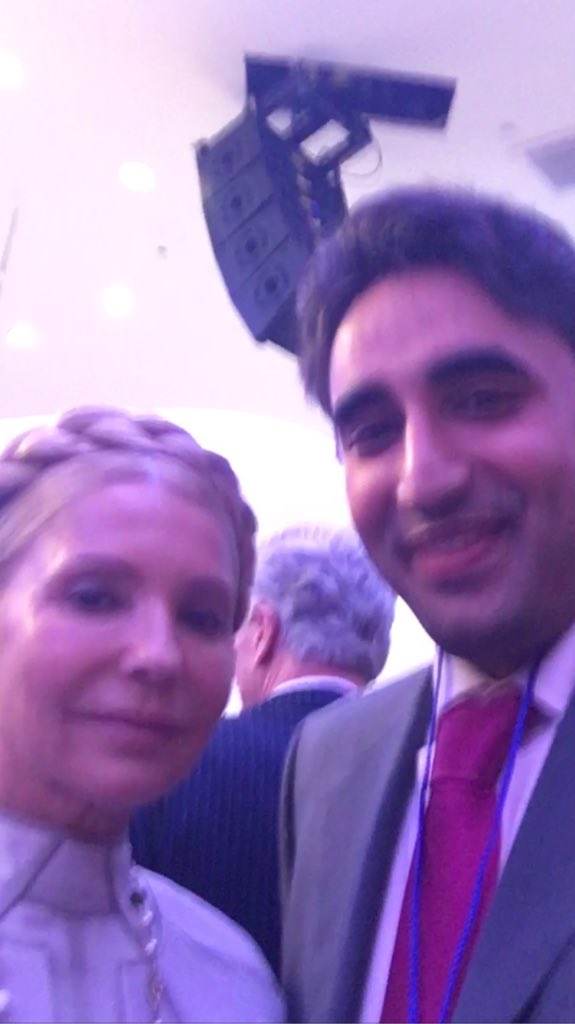
Met the inspirational 1st woman PM of Ukraine. She said Shaheed Benazir Bhutto was her hero.
Embedded image permalink
“Pleasure to attend 64th National Prayer Breakfast. Last address by President Barack Obama,” Chairman Bilawal Bhutto tweeted.
US President Barack Obama was the chief guest and the main speaker at the annual event. Every US president since Dwight D Eisenhower has participated in the prayer breakfast.


During the event Chairman Bilawal Bhutto has met with various international leaders:

Sherry Rehman also tweeted pictures of the event, saying, “With US Congresswoman Shiela Jackson Lee who heads the Pakistan Caucus in DC. Worked with her many years for Pakistan.”


https://ppppunjab.wordpress.com/2016/02/05/chairman-bilawal-attends-national-prayer-breakfast-in-washington/