Thursday, January 14, 2016

Apprentice star tells how she was sexually assaulted in Pakistan by gang of men as she filmed BBC documentary


A former star of The Apprentice has revealed that she was sexually assaulted by a gang of men in Pakistan as she filmed a BBC documentary.

Saira Khan, who was runner up in the first series of the show, was assaulted while filming in a square during a religious holiday in 2007.

The TV presenter, whose parents were raised in Pakistan, claims she was surrounded by men who groped and pressed up against her 'grabbing her boobs, bum and legs' as she tried to shoot scenes for a piece during Prophet Mohammed’s birthday.
Saira Khan, who was runner-up in the first series of The Apprentice, was assaulted while filming for the BBC in a Pakistan square during a religious holiday in 2007
The TV presenter, whose parents were raised in Pakistan, claims she was surrounded by men who groped and pressed up against her 'grabbing her boobs, bum and legs' as she tried to shoot scenes for a piece to camera
She opened up to ITV's Loose Women about the horrifying moment she was assaulted before she was eventually rescued by a member of her crew.
In a column for the Mail On Sunday, she also accused the BBC of ignoring the attack and the issue that 'Asian, Arab and African men grow up in societies where misogyny is the cultural norm'.

She wrote: 'In 2007, I was asked by the BBC to travel to Pakistan and make a documentary.
'One particular shoot was to take place on the day when the Prophet Mohammed’s birthday was celebrated. My all-male British team were nervous because thousands of Pakistani men were to gather in a square and I was to report from the crowd.
'I was determined to do the piece and naively I thought: "Nothing will happen to me, it’s a spiritual day." 


'I was dressed in the native shalwaar kameez – long baggy trousers and a tunic to cover my body. I wore a scarf around my head to show respect. 
'All that was visible were my hands and face. With much persuasion, my director David allowed me to walk by myself near a crowd of men.
'I realised within five minutes what an idiot I had been – I was the only woman in this crowd. I was spotted and within minutes a group of men had circled me and hands were all over me while bodies pressed up against mine. I was rescued by our burly ‘fixer’ who carried me out.
'I was shaking and shocked – and I was angry at myself for being so naive after everything I had grown up with.'
It comes after a spate of sexual attacks in Cologne, Germany where there have been 516 reports of women being attacked by a group of men described as North African.
She said: 'Understanding how African and Asian men view and treat women in their own countries is crucial when dealing with the migrant crisis – because only when we understand their cultural practices can we help them to integrate. They need to understand that women are deemed equal to men in Western societies.
'Here in the West, we need to stop burying our heads in the sand and accept that Asian, Arab and African men grow up in societies where misogyny is the cultural norm. We need to talk about it so we can change it.
'Ignoring it, like the BBC did, is just condoning it. If we are allowing people to come in, we must also make sure that we are not blinded by some truths which are hard to swallow.
'It is a betrayal of the truth, of the majority of decent migrants and – most of all – of women who must not see progress turned back for the sake of accommodating a medieval world view.'


Read more: http://www.dailymail.co.uk/news/article-3395538/Apprentice-star-tells-sexually-assaulted-Pakistan-gang-men-filmed-BBC-documentary.html#ixzz3xFhBz8mv
Follow us: @MailOnline on Twitter | DailyMail on Facebook

Pakistan: Raid on Journalist Latest Act of Intimidation

The raid by a Pakistani paramilitary force on a journalist’s house is just the latest attempt by Pakistan’s security agencies to intimidate journalists who criticize the government and military, Human Rights Watch said today.
On January 12, 2016, soldiers from the paramilitary Pakistan Rangers entered and, without a warrant, searched the house of Salman Masood, a journalist working for the New York Times. In November 2015, the military allegedly pressured the Lahore-based Daily Times to shut down an editorial columnist.
The Interior Ministry issued an apology later that day and ordered an inquiry into the raid on Masood. The government asserted that the action was part of a broader search operation in the neighborhood. However, only one other house was searched, raising serious concerns that the raid’s purpose was to harass and intimidate Masood, Human Rights Watch said. Masood has reported extensively about government policies and the role of the military.
“The Pakistan Rangers’ warrantless search of journalist Salman Masood’s home is an outrage, but only the latest security force outrage against journalists in Pakistan,” said Brad Adams, Asia director at Human Rights Watch. “A raid on a journalist’s home demands not just a government apology, but also a serious Pakistani government investigation of the security forces’ intimidation of journalists.”
The government should rescind official policies that shield the military from criticism and instead ensure that space for public debate and free speech is protected both from extremist groups and the security establishment, Human Rights Watch said.
Masood said that on the morning of January 12, armed men in uniforms of the Pakistan Rangers, a paramilitary organization, demanded to search his house. They refused to show identification or a search warrant. Masood initially refused entry, saying that family members were in the house, and called senior police officials for an explanation. The troops left but returned half an hour later, accompanied by women police constables. Masood said that the security forces claimed to be searching for a terror suspect, but without explanation opened cupboards and drawers and went through his personal belongings.
In May 2013, the Interior Ministry, under pressure from the military, ordered the longtime New York Times bureau chief, Declan Walsh, to be expelled from the country on 72 hours’ notice.
Pakistani journalists have long faced life-threatening obstacles to their work, including harassment, intimidation, assault, kidnapping, and arbitrary arrest and detention. These threats come from the government, security forces, and militant groups. Increasingly, it is security forces who are pressuring editors and media owners to shut down critical voices.
The stifling environment for Pakistani journalists was highlighted by the case of Dr. Mohammed Taqi, a well-known columnist for the Daily Times who was often critical of the security establishment. Taqi reported that on November 27, he received an email from one of his editors that read:
It is with an extremely heavy heart that I regret to inform you that Daily Times will be unable to accommodate your daring and conscientious articles. Due to the climate under which print media operates in these times such pieces are constantly being put under scrutiny and so the newspaper with it.
Taqi later wrote a long article criticizing the role of the military in silencing dissent. Taqi wrote, “A six-year association with the Daily Times thus ended under pressure from Pakistan’s almighty army.”
In August, the Information and Broadcasting Ministry issued a code of conduct for media that seeks to censor any content that “contains aspersions against the judiciary or armed forces.”
Pakistan remains one of the most dangerous countries in the world for journalists. More than 35 journalists and media workers have been killed in Pakistan because of their work since 2010. The Committee to Protect Journalists’ Global Impunity Index placed Pakistan ninth on the list of countries where journalists are murdered without the attackers being prosecuted.
In April 2014, unidentified gunmen attacked Hamid Mir, one of Pakistan’s most prominent television anchors in Karachi. Mir survived the attack, and Jang/Geo – his employer and the country’s largest media conglomerate – accused the director general of the powerful Inter-Service Intelligence (ISI) agency of involvement in the incident. The government formed a judicial commission to investigate the shooting, but its proceedings remain opaque and no findings have been made public.
Freedom of expression and the media in Pakistan are further constrained by vague and overbroad counterterrorism legislation such as the Protection of Pakistan Act (PPA) and the Fair Trial Act, which give the security agencies expansive powers to conduct surveillance and silence dissent. The proposed cybercrimes bill includes provisions that would allow the government to censor online content and criminalize Internet user activity under extremely broad criteria that could be susceptible to abusive application. The bill would also permit the authorities access to the data of Internet users without any form of judicial review to justify that access.
While terrorist attacks are a genuine concern in Pakistan, limitations on fundamental freedoms must adhere to international standards. Any restrictions need to be prescribed by law, necessary in a democratic society, and proportionate to the aim. The military’s censoring of critical voices falls considerably short of these standards, Human Rights Watch said.
“The security forces’ threats and harassment of journalists make a mockery of Pakistan’s claims of being a democratic society,” Adams said. “Soldiers who become censors are an ugly reminder of military rule.”

Printers Censor Another New York Times Article, Shedding Light on Pakistan's Stifled Speech Environment


By Sana Saleem

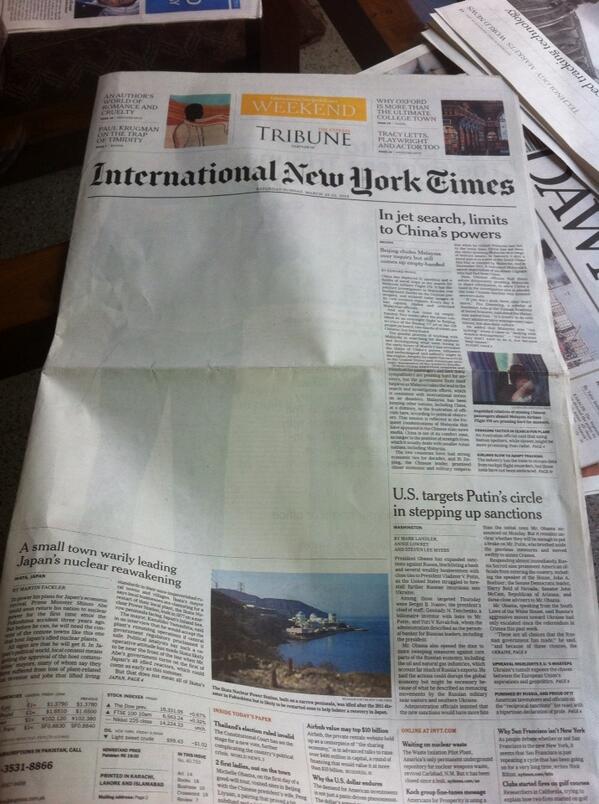
Pakistani printers removed a front-page story titled “Imperiled Bloggers of Bangladesh” from the 2 January 2016 edition of the international version of The New York Times, leaving blank spaces behind.

Salman Masood, the New York Times’ correspondent in Pakistan, tweeted the two different versions of the paper:
The article describes the killings of Bangladeshi bloggers who write about secularism, atheism, human rights and civil liberties. It begins by profiling Asif Mohiuddin, who survived a stabbing attack in 2013 and was soon after imprisoned for his progressive writings. His story is similar to those of numerous other Bangladeshi bloggers who have been targeted and sometimes killed after being singled out and accused of “atheism” by religious hardliners. Atheists have the same rights as all other citizens in Muslim-majority Bangladesh, but the country's secular government has nevertheless done little to discourage the attacks or bring the killers to justice.
The fact that the front-page story was removed in Pakistan by the Express Tribune, the printing partner of The New York Times, created a stir on social media. Many pointed out that this censorship is nothing new in Pakistan.
Some even compared it to authorities’ iron grip on media during the rule of General Muhammad Zia-ul-Haq from 1978 to 1988:
Blank columns of the NYT reminiscent of the Zia era https://twitter.com/salmanmasood/status/684093103251288064 

Pakistan - Quetta bombing

WEDNESDAY’S devastating suicide bombing in Quetta serves as a painful reminder that despite advances, religious militancy remains a major security threat to Balochistan.
Most of the victims of the attack were police personnel deputed to guard polio vaccination teams. An anti-polio vaccination drive was under way in Balochistan on the day of the bombing. To their credit, the authorities resumed the anti-polio campaign soon after the tragedy.
The banned TTP has claimed responsibility for the atrocity. It seems that with the bombing, terrorists have struck two of their ‘favourite’ targets: members of law-enforcement agencies, as well as the anti-polio campaign.
The bombing occurred the day after the new Balochistan cabinet took oath; indeed, the Sanaullah Zehri-led provincial set-up has its work cut out for it on the law and order and counterterrorism fronts.
Over the past several years, the province has suffered from a low-level separatist insurgency along with sectarian terrorism. However, last year, after the formulation of the National Action Plan, like elsewhere in Pakistan there seemed to be perceptible movement on the anti-militancy front. Provincial officials claimed “thousands” of militants had been arrested.
While some observers point out that most of these were quite likely Baloch separatists, it is a fact that religiously motivated and sectarian militants were also apprehended. Moreover, some high-profile sectarian militants were eliminated in Balochistan in 2015; their numbers included Usman Saifullah Kurd, a provincial ‘commander’ of Lashkar-i-Jhangvi.
But while sectarian killings may indeed have come down, especially compared to the situation in 2013 when massive bombings targeting the Hazara Shia community resulted in hundreds of deaths, the infrastructure of religiously motivated militancy very much appears to be intact in Balochistan, as Wednesday’s bombing shows.
The significance of militants targeting security officials guarding polio teams also cannot be overlooked. Last year, significant gains were made in the fight against polio, with far fewer cases reported as compared to 2014.
Hence, the momentum of the anti-polio drive should be maintained and security for the vaccinators beefed up. The civil and military leadership must reassess the threat posed by religiously motivated militants to Balochistan. Intelligence-based operations need to be stepped up to dismantle what remains of the terrorist infrastructure in the province. Balochistan is far from pacified.
The gains made in the realm of security in the recent past should not be squandered, and terrorism and militancy of all shades must be eliminated in the province.

Pakistan - Say no to Saudi


By Kunwar Khuldune Shahid

Around Tuesday evening Foreign Affairs advisor to the PM, Sartaj Aziz, confirmed that Pakistan has said Yes and No to Saudi Arabia – yes, we’re a part of the 34-state ‘counter-terror coalition’ and no, we aren’t sending any troops to the Middle East. Foreign Office sources have suggested that Pakistani support would be limited to intelligence sharing, military personnel training and provision of military hardware.

While political correctness is brimming over at the Foreign Office, with claims that Pakistan would “present important proposals to reduce the Iran-Saudi tension” in an emergency OIC meeting called in Jeddah, the fact that Islamabad has formally said yes to being a part of what conspicuously is a Sunni alliance is problematic on many levels.

For starters all Saudi-led alliances are quintessentially sectarian, not only in terms of their composition, but almost always in their goals as well. Every time high-profile visitors from within the Arabian Peninsula frequent Pakistan in quick succession they arrive with the same demand for Islamabad: troops to fight the Shia.

Five years ago, Saudi Prince Bandar bin Sultan visited Pakistan twice and was followed by Bahraini foreign minister and National Guard commander. The request was for troops to fight Shia rebels in Bahrain, who had caught up with the Arab Spring and were clamouring for political rights. Fauji Foundation advertised Bahrain National Guard positions in Pakistani publications with around 2,500 Sunni men sent to Manama in 2011. Pakistanis make around one-third of the National Guard of Bahrain, a country where the local Shia find it impossible to enroll in the army.

Two years ago the now Saudi King Salman bin Abdul Aziz came to Pakistan and was closely followed by Hamad bin Isa Al Khalifah, the Bahraini King. The task this time was even bigger: in addition to quelling the renewed Shia uprising in Bahrain, Pakistan was asked send troops to fight Bashar al-Assad in Syria whose government began consolidating its gains in early 2014. The combined reward for Islamabad was $2.25 billion, which put the brakes on the Pakistani rupee fall.

In March last year, PM Nawaz Sharif was invited to Riyadh with King Salman bin Abdul Aziz going to the airport to personally receive him. This was the lead-up to the Saudi-led intervention in Yemen, which Riyadh wanted to maintain as its satellite state by reestablishing the government of Abd Rabbuh Mansur Hadi. Following Operation Decisive Storm, Hadi has been restored as the Yemen president, after the Saudi-led Gulf Cooperation Council (GCC) quelled the Shia Houthi rebels.

While Pakistan’s Parliament decided against sending troops to Yemen last year, PM Nawaz, who owes at least the second half of his political career to al-Saud family, reiterated that Pakistan would ‘react strongly to violation of Saudi integrity’. Nawaz had also ensured that Pakistan sent 11,000 to US-led coalition against Iraq in the Gulf War in 1991, during his first term as the premier, when even the then Army Chief Mirza Aslam Beg was vocally against participation in the war.

While Nawaz definitely has grown as a politician in the past quarter of a century, his indebtedness to the Saudi family will always be a stumbling block in Islamabad making decisions completely designed on the basis of national self-interests. And so with Saudi Defence Minister Muhammad Bin Salman and Foreign Minister Adel al-Jubeir visiting Islamabad in the first ten days of the new year, the pressure is mounting on the Nawaz government.

Government sources have revealed off the record that Saudi officials have asked for support in ‘enhanced action’ against Iran, after Riyadh and Tehran came to blows following the execution of Saudi cleric Sheikh al-Nimr on January 2. With Saudi embassies torched in Iran, followed by Bahrain and Sudan joining Saudi Arabia in expelling Iranian ambassadors, the Shia-Sunni fault-lines have been brimming over throughout the Middle East.

The 34-state ‘Islamic coalition’ to counter terrorism will evidently be used to counter the traditional Schiitischer Halbmond – or the Shia Crescent. Saudi has long been paranoid about the crescent evolving into a full moon around the Saudi Kingdom, with Assad’s Syria, the Shia majority Iraq and Bahrain, all joining Iran in a Shia cordon in Saudi north and east. That paranoia has further been fueled by the US-Iran nuclear deal, which threatens to replace Saudi oil barrels with Iranians in the global oil market, in turn giving Tehran the geopolitical leverage in the Middle East that Riyadh currently enjoys.

It’s actually the Shia majority province Ash-Sharqiyyah (Eastern Province) which has long threatened to spark a direct Saudi-Iran conflict, in lieu of the decades-long proxy warfare. It is Ash-Sharqiyyah that geographically links Iran to Yemen, which can potentially complete the ‘Shia encirclement’ around the Saudi kingdom. The Eastern Province, which borders the Shia-majority Bahrain, also holds most of the Saudi oil. The province was the hub of the movement for democracy orchestrated by al-Nimr, whose execution was a clear signal of war from Riyadh.

That countering Iran is higher on the Saudi agenda than ISIS, which Riyadh was long funding before it could self-sustain on occupied oil wells, shows the perilous nature of the ‘counter-terror’ alliance that Pakistan has agreed to be a part of. Saudi might no longer be backing ISIS, now that it has finally realised that Abu Bakr al-Baghdadi’s caliphate-lusting terror group wants to replace it as the global Muslim leader, but it’s evident where Riyadh will dedicate most of its security energy: the Shia in Yemen, Bahrain, Syria and Ash-Sharqiyyah.

Granted the presence of thousands of Pakistanis in Saudi Arabia, and the long-standing Islamabad-Riyadh ties, won’t allow Pakistan to just say no to Saudi, it will have to turn down any action in these regions. Yemen is following Syria in creating a vacuum waiting to be filled by ISIS, owing to Saudi’s erratic bombardment, and Pakistan wouldn’t want to be a part of its aggravation.

That ISIS has penetrated Pakistani borders, local Islamist militants are gravitating towards the Islamic State and over 100 citizens from Punjab have fled to the Middle East to fight alongside it, means that fight against the terror group is no longer a foreign issue for Islamabad. While Pakistan absolutely needs to be a part of the war against ISIS, it should first take on the local militant groups, many of whom are pledging allegiance to al-Baghdadi. Fighting the anti-ISIS war with the state that has long supported the group, and which currently has its interests elsewhere, would inadvertently make Pakistan a part of the problem it has been trying to solve of late.

Pakistan digging out JeM chief Masood Azhar from Bahawalpur signals the right intent and should put the Indo-Pak dialogue back on track. That Islamabad is simultaneously occupied on the Saudi front will be an unneeded distraction at best, with bigger domestic and regional challenges at hand.

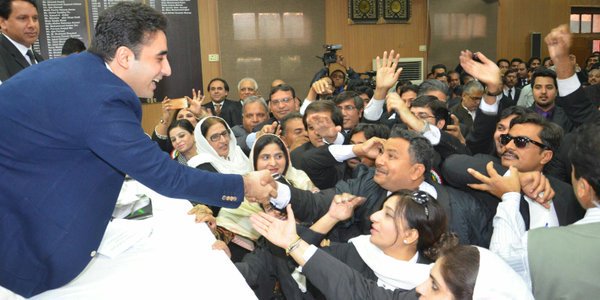
Bilawal Bhutto - PPP STANDS BY THE PEOPLE OF KASHMIR, ALSO WELCOMES DIALOGUE BETWEEN INDIA AND PAKISTAN

Chairman Pakistan People’s Party Bilawal Bhutto Zardari has said that the people of Kashmir are a key to a final settlement of the Kashmir dispute and that the Pakistan Peoples will continue to support them in their just struggle.

He said this while talking to a delegation of the Party leaders from AJK who called n him in Zardari House in Islamabad today.

The delegation included President AJK Sardar Muhammad Yaqub Khan, Prime Minister AJK Chaudhry Abdul Majid, Speaker and deputy Speaker of AJK Assembly, cabinet ministers and PPP AJK office bearers.

Ms Faryal Talpur and were also present on the occasion.

Resolution of the Kashmir dispute in accordance with the aspirations of the people of Kashmir is also central to peace in the region, he said.

The PPP wishes to take South Asia on to the path of peace and prosperity with a peaceful resolution of the Kashmir dispute with respect and honour. This path lies through confidence building, conflict management and creation of a trading bloc of nations to improve the living conditions of all people of South Asia, he said.

He recalled that the Party under the leadership of Shaheed Mohtarma Benazir Bhutto proposed soft borders as far back as 1999. Earlier on, the PPP introduced the South Asian Preferential Tariff Agreement as well as the concept of groups of people, like Parliamentarians and Judges, travelling in the SAARC countries without visas, he said.
However the fundamental rights of the people of Kashmir cannot be sidelined or ignored. There can be no greater fundamental right than the right to franchise of a people, he said.
Bilawal Bhutto Zardari said that the Party welcomed the recent overtures between India and Pakistan to resume the dialogue process and expressed the hope that the process will continue un-interrupted and will not be allowed to be derailed by the recent attack on an airbase in India by militants.

The Party has noted the promise made by the government of Pakistan to investigate and pursue to the logical conclusion any evidence of Pakistanis involvement in the airbase attack. The Party has also noted the claims of the government that the offices of the said banned outfit “are being traced and sealed” and its members detained.

It is surprising that the offices of an organization that was banned over a decade ago are still ‘being traced and sealed’. Regardless of this, however, the Party hopes and demands that the period of ambivalence must be left behind in fighting the terrorists and political ambitions of the terrorists defeated with force and decisiveness.

https://ppppunjab.wordpress.com/2016/01/14/ppp-stands-by-the-people-of-kashmir-also-welcomes-dialogue-between-india-and-pakistan/

Monday, January 11, 2016

#BILAWALFORJUSTICE - Kal Bhi Bhutto Zinda Tha Aaj Bhi Bhutto Zinda Hai

Pakistan - Nawaz Govt reviving politics of revenge, violating CoD

 Nawaz government in centre has once again renewed the 1990’s politics of revenge and is grossly violating the spirit and the joint communiqué of the Charter of democracy, which was also signed by the incumbent Prime Minister Mian Muhammad Nawaz Sharif. The PMLN is now throwing it in political isolation by commencing the politics of revenge. The framing a fake case against a very sane, respectable politician of Sindh and senior PPP leader Mir Munawwar Ali Talpur is not only based on ill-will but is also a manifest of completion of a secret agenda of some institutions, which is the continuation of bogus cases against Sindh Higher Education Commission Chairman Dr Asim Hussain.
PPP Karachi Division President Syed Najmi Alam, General Secretary Nadeem Bhutto, Izhar Ul Haq Hassanzai, Lateef Mughal and Syed Manzoor Abbas expressed these views in a joint statement issued from the PPP Media Cell Sindh Saturday.
While addressing Daniyal Aziz, a self-declared spokesman to his new leader the Prime Minister, they said that he should keep his logic and interpretation to him because the framing Mir Munawwar Ali Talpur in a fake case is only a continuation to the political victimisation.
They said the PPP is the party of the martyrs and dedicated workers (Jialas) that has always challenged the dictators while leader of Daniyal Aziz (Mian Muhammad Nawaz Sharif) had bowed his head to the dictator and tendered apology for sparing his life and left for Saudi Arabia where he lived his days of exile in palace.
They said contrary to Mian Nawaz Sharif, Shaheed Zulfiquar Ali Bhutto embraced martyrdom but refused to bow his head to the then dictator Zia and Shaheed Mohtarma Benazir Bhutto gave her life for the masses despite threats. Likewise, former President Asif Ali Zardari remained jailed for over a decade but did not shake hand with the authoritarian powers.
They said the PPP does not believe in politics of revenge but believes that the democracy is the best revenge.
https://mediacellppp.wordpress.com/2016/01/09/nawaz-govt-reviving-politics-of-revenge-violating-cod-ppp/

#BILAWALFORJUSTICE - Bilawal Bhutto carrying forward the legacy

Judiciary is one of the pillars of the state that acts as an arm of the government. Especially for the trembling governments, it is imperative for the judiciary to be independent and powerful to help the political systems even out. Unfortunately, despite more than sixty years to the creation, the judiciary of Pakistan has been destabilized by the anti-democratic elements ever and anon. But in the fight for the independent judiciary, one party that has been on the forefront to enforce the supremacy of the constitution and the rule of law is Pakistan Peoples Party. This party never hesitated in struggling for the independent judiciary while its rivals sometimes worked against it or sometimes supported the cause having their own ill intentions behind that were pretty much evident during the last governmental tenure when a single individual, mainstream political parties had fought for, almost turned into a vigilante and worked tirelessly with the support of opposition to oust the democratic government which came into existence after an elongated martial law.
PPP is the only political party to have worked as per its manifesto to safeguard the law. In this regard, Shaheed Mohtarma Benazir Bhutto endeavored with the lawyers to ensure strong and impartial judiciary. But exploring the judicial history of Pakistan, one court that holds the major significance in shaping political dynamics of the country is the Lahore High Court. Pakistan Peoples Party stands as the biggest victim that fell prey to the unchallenged atrocities committed in hallowed halls of this court since it awarded death sentence to the populist leader ZA Bhutto. This court being one of the oldest courts in the country has been so powerful that its verdict was upheld by the Supreme Court resulting in the execution of the first democratically elected prime Minister of Pakistan. In the same Lahore High Court, many times political revenge was sought by judiciary on behest of ruling authorities from Benazir Bhutto as well as Asif Ali Zardari through abuse of judicial process. However, connected to this court is its bar association, the professional body of Lahore High Court Lawyers, that has its own glorious chronicles of shielding the democratic values defined in the constitution throughout dictatorial regimes. LHCBA had not only recorded protests against the judicial murder of Zulfiqar Ali Bhutto but also hailed his daughter being the most prominent flag-bearer of democracy, officially declaring 2007 as “Year of Struggle of Benazir for Democracy”.
Today at the time when Pakistan is in urgent need of implementation of actual democratic principles in accordance with the law, the youngest politician Bilawal Bhutto Zardari, during his brief trip to Lahore, chooses to address the Lahore High Court Bar Association that has played great role in the administration of justice. This effort to strengthen ties between the judicial power and national politics by the young vibrant leadership of the PPP is of noteworthiness and manifests his vision. Although the corridors of Lahore High Court are not new for the family that has paid several visits fighting the baseless cases, but following in the footsteps of the mother and the father, Bilawal Bhutto Zardari has shunned any grievances and is taking a step ahead.
It takes strong political will to enhance support for the judiciary that made his family suffer the most, and he has proved to be having the prudence and insight that can steer institutions out of madness and ensure real supremacy of the constitution. The future leader taking interest in the judiciary is a good omen especially when the country is at war against the menace of terrorism as heavy responsibility lies both on the judiciary as well as the political parties. More cooperation between both the pillars would result in effective outcomes.
Moreover, addressing the Lahore High Court Bar Association at the outset of his political career is very substantive especially on the account of its historical worth as ‘The Thinker of Pakistan’ Allama Iqbal had also been its member. The same high court has also had the honor to be braced by the appearance of the founder of Pakistan Mohammad Ali Jinnah on an occasion. Hope other political leaders will follow the suit as such rendezvous with the judicial institutions will be fruitful for the democracy in Pakistan.

#BILAWALFORJUSTICE: BILAWAL BHUTTO PLEADS FOR WIDE RANGING JUDICIAL REFORMS

In a wide ranging address to the Lahore High Court Bar Association covering issues in democracy, constitutionalism and rule of law the Chairman of Pakistan People’s Party Bilawal Bhutto Zardari today called for revisiting the procedure for the appointment of judges, the setting up of a Constitution Court, regulating the use of suo moto powers, provision of speedy and inexpensive justice, legislation to prevent misuse of blasphemy law and ending the culture of sacred cows in fighting corruption. He also addressed issues in the National Action Plan describing it as “Noon League action plan” that had failed in stopping banned outfits from resurrecting under other names.
“I urge you to give a thought whether the independence of judiciary is guaranteed by vesting the power to appoint judges by the judges alone or is it best served when the power to appoint judges is diffused between the Parliament, the President, the Prime Minister and the Bar Council?”, he asked the galaxy of lawyers present at the bar address Monday morning.
He said the restoration of judiciary in March 2009 as a result of public demonstrations created some sort of euphoria that led some to believe that a new era of independent judiciary had dawned but some people thought otherwise, he said.
He said that during 2010-13 the Judicial Commission (JC) made 126 nominations of judges in the Supreme Court and the five high courts while the Parliamentary Committee (PC) disagreed with only 8 appointments. However, the Court overturned all the decisions of the Parliamentary Committee.
He recalled that President Asif Ali Zardari then filed a Constitutional Reference seeking opinion on the roles of the JC, the PC and the President in the appointment of the judges and quoted from the verdict that the role of the President and the Prime Minister was no more than mere post offices.
Chief Justice alone initiating nominations, the JC making its own rules and conducting business in secrecy while neither President nor Prime Minister nor elected representatives had any role in the judges’ appointments.
Judges alone selecting judges was not conducive for the promotion of a bench with judges of divergent world views on issues in jurisprudence. It is not the question of integrity or competence of judges but an issue of diversity of judicial minds that must adorn the bench, he said.
He said that our failures were collective. “The politicians made mistakes, the establishment has made mistakes and the judiciary also has made huge mistakes”, he said recalling past judicial doctrines of “necessity”, or ‘a successful revolution creates its own justification’, the judicial murder of an elected Prime Minister and opposing judicial verdicts in cases involving a prime minister from Larkana and a prime minister from Lahore.
But let us not dwell too much into the past and move on, he said.
About the role of the Parliament he said that the Constitution has clearly laid down the scheme of powers in which lawmaking is the responsibility of the Parliament, the judiciary interprets the laws and the Executive implements the laws and quoted Articles from the Constitution that laid special emphasis on the role of the Parliament in constitution and law making.
It was therefore surprising when it was said that Honorable Chief Justice be consulted in the process of selection of Chairman NAB or in the appointment of Chairman and Members of the Federal Service Tribunal even when the laws made by the elected representatives of the people do not provide for this.
Bilawal Bhutto Zaradri also called for the setting up of Constitution Court with equal representation of all federating unites to decide constitutional issues saying that it was unfinished agenda of the Charter of Democracy signed in May 2006 between his mother Shaheed Mohtarma Benazir Bhutto and MianMuhammad Nawaz Sharif on behalf of their parties.
Bilawal said that the Court’s power to decide alone Constitutional issues was an “awesome power”. If this awesome power if not exercised with great care and humility it can undermine the democratic process itself and easily become what many call a judicial tyranny, he said.
About the use of suo moto powers he said it would be worthwhile to make a comparative study of how many suo moto notices were taken in PPP government and how many after the PPP was no longer in power..
Quoting from the report of the International Commission of Jurists which visited Pakistan in 2011 which said that the use of suo moto led to a corrosion of the rule of law and a blurring of the constitutional separation of powers Bilawal asked the lawyers to give a thought to whether there was need to regulate the suomoto powers. He said that he was happy that the Senate Committee of the Whole has also made some similar recommendations.
Stressing the need for access to speedy and inexpensive justice Bilawal called for a poor-friendly judicial system and vowed that the PPP will provide it to the people.
Those who cannot secure their rights easily through recourse to law are actually oppressed by the law, he said.
In our system of courts, the broadest interface of the citizens with the law occurs in the subordinate courts, he said.
Bilawal said that scant or no attention is paid to the improvement of the process of the civil courts and magisterial forums where these mills grind slow and inflict maximum pain. It will be the ppp mission to introduce reform, transparency, efficiency, expedition and integrity to the legal processes in the subordinate courts of Pakistan, he said.
About corruption he said that it was a serious issue and needed to be tackled but cautioned against using it as a brush to paint black only one section of society. We must challenge the double standard in pursuing corruption cases adding also “we cannot win the fight against corruption unless we do away with sacred cows syndrome”.
It is wrong to have one set of laws for one section of society and another law for another section of the society. The Fight against corruption must be across the board and above the board, he said.
Bilawal also called for addressing issues in intellectual corruption and constitutional subversion. Those who upheld the constitutional deviations, validated military take over and dismantled the democratic structures have also to answer many questions about honesty he said and asked whether we should not pursue those who have subverted the Constitution or validated constitutional subversion through PCOs and court verdicts.
He said that the PPP was deeply concerned and condemned the growing misuse of blasphemy law for silencing dissent and for oppressing minorities and welcomed the recent Supreme Court verdict and its call for looking into this issue.
He expressed the hope that the Parliament will take note of the Supreme Court verdict and make appropriate legislation to prevent the misuse of the blasphemy law.
He questioned whether the government was sincere in implementing the National Action Pan to fight militancy and extremism. He said that the APS martyrs had united the nation which was in disarray as many asked whether the war against militancy was our war or not, the Punjab Chief Minister even asked Taliban to spare his province because he shared their world view and some demanded that Talban be allowed to open offices in Peshawar.
He said ever since the moratorium on death penalty was lifted more than three hundred executions have been carried out and asked how many of those executed were black jet terrorists and how many other ordinary criminals and asked as to why some juveniles and even mentally challenged people were hanged?
He said that the National Action Plan was in fact Noon League Action Plan as it followed the agenda of Noon League and not the national agenda. Banned organizations continue to function under other names he said and quoted from replies given to questions asked in the Parliament to prove his point.
He said that according to the replies in the parliament 61 militant organizations have been banned in the country but it did not know how many of them were working under new names nor whether any action has been taken against the resurrected organizations.
In March 2013 during the PPP government a law was passed under which a banned organization was not allowed to reappear under a different name but the present government is not even aware of it.
He said he called it Noon League Action Plan because no action has been taken against extremist militant organizations in the Punjab.
The National Action Plan called for reforming FATA but no reforms have been introduced in the tribal areas and the Prime Minister has not even acknowledged a personal letter from the former President urging him to expeditiously adopt the Bill passed by the Senate giving them the right to approach superior judiciary for the enforcement of their rights.
He said that the interior minister says that he did not want to coordinate the activities under NAP and accepted to do it unwillingly because the Prime Minister had said so.
Under the law the NACTA Board of Governors is headed by the Prime Minister and it must meet once in three months but had not met for the past one year even once.
He called upon the government to abandon the policy of running with the hare and hunting with the hound in dealing with militants and militant organizations.
After Soviet withdrawal the west disowned militant outfits but we owned them as “assets”. Later we coined words “good” and “bad” Taliban to justify state patronage of some militant outfits. He said that the Defence Minister recently said that the government will talk to Afghan Taliban for security of TAPI gas pipeline and asked whether it was state policy to out-source security of strategic economic projects to non-state militants.
Is this still the state policy?
It seems we have still not abandoned that policy and are still running with the hare and hunting with the hound and asked whether we could expect Afghanistan to believe in our pious protestations?
The survival of our country depends upon democracy he said adding it is the duty of every individual and every institution to play its part in strengthening democracy. The ethos of our people is democratic and that was why dictatorship has not been able to take root in the country, he said and paid tributes to the heroes of democracy for bearing the scars of torture on their bodies.
Bilawal Bhutto Zardari paid glowing tributes to the LHBA, the lawyers, the media and the people for the democratic struggle and ended his speech with a quote from the speech of his mother “I believe and the Pakistan Peoples’ Party believes with me that that greatness lies within our grasp and a dream lies within our grasp, a dream that can best be nurtured in freedom, in law, in respect and in dignity”.

https://ppppunjab.wordpress.com/2016/01/11/bilawalforjustice-bilawal-bhutto-pleads-for-wide-ranging-judicial-reforms/

#BILAWALFORJUSTICE: WATCH BILAWAL BHUTTO COMPLETE SPEECH AT LHCBA


PPP Chairman Bilawal Bhutto Zardari addresses... by arynews

Sunday, January 10, 2016

Music Video - WALK THE MOON - Shut Up and Dance

Video - CES 2016 debuts breakthroughs in drone tech

Video Report - MSF hospital bombed in Yemen: 5 killed, Doctors Without Borders operations director confirms

David Cameron condemned live on TV by Andrew Marr Show band Squeeze as group change lyrics to target Tories


David Cameron had no choice but to sit and listen as a seventies rock band criticised Tory policy to his face live on TV.

The Prime Minister appeared on the Andrew Marr Show on Sunday morning to launch a project that will see more than 100 council house estates torn down and replaced with private properties.

Mr Cameron wrote in the Sunday Times “the mission here is nothing short of social turnaround”, adding the Government will “tear down anything that stands in our way”.

And he told Andrew Marr: “I think it is time with government money - but with massive private sector and perhaps pension sector help - to demolish the worst of these and actually rebuild houses that people feel they can have a real future in.”

With the interview over, Mr Cameron stayed on the sofa with Mr Marr to listen to veteran rockers Squeeze, who played the title single from their new album Cradle to the Grave.


Lead singer Glenn Tilbrook has previously hit out at the Conservative Party for being “seemingly intent on pursuing little people and demonising immigrants”.

And apparently prepared for his Prime Ministerial audience, he changed the third chorus of the rendition of the new song so it went:

“I grew up in council houses

Part of what made Britain great

"There are some here who are hell-bent
On the destruction of the welfare state.”
Squeeze rose to fame in the seventies, and have been fronted by song-writing duo Tilbrook and Chris Difford ever since. 

    A spokesperson for Jeremy Corbyn told Huffington Post the band "gave a remarkably timely voice to what millions of people are thinking about how this government is failing", while the BBC was reportedly not made aware of the protest beforehand.