Saturday, January 2, 2016

People in Saudi Arabia’s Qatif slam Nimr execution

People in the Qatif region of Saudi Arabia’s Eastern Province have taken to the streets to express anger at the execution of prominent Shia cleric Sheikh Nimr al-Nimr.
The rally was held on Saturday with protesters marching from Nimr’s hometown of al-Awamiya to Qatif, chanting, “Down with the Al Saud.”
The regime in Riyadh on Saturday announced the execution of Sheikh Nimr and 46 others in defiance of international calls for the release of the prominent Shia cleric and other jailed political activists in the kingdom.
Meanwhile, mourning ceremonies are being held across Qatif amid media reports that said the region’s residents have called for taking up arms against the Saudi regime in the form of popular resistance.
Saudi security forces are said to have been evacuated from their stations in the region.
The development comes as Lebanon’s Al Ahd news website said hundreds of anti-riot personnel carriers set off for Qatif on Saturday to quell potential protests on the part of its Shia population against the execution.
Security forces have also been alerted in other Shia-populated cities across Saudi Arabia.
Saudi Arabia’s execution of the top Shia cleric has drawn angry reactions from Muslim bodies worldwide.
Iran’s Foreign Ministry Spokesman Hossein Jaberi Ansari said the execution of Sheikh Nimr “who had no means other than speech to pursue his political and religious objectives only shows the depth of imprudence and irresponsibility.”
Lebanon’s resistance movement Hezbollah also condemned the killing as an “assassination,” describing Sheikh Nimr as a spiritual scholar who always sought dialogue and resisted injustice.

A critic of the Riyadh regime, Sheikh Nimr was shot by Saudi police and arrested in Qatif in 2012. He was charged with instigating unrest and undermining the kingdom’s security, making anti-government speeches and defending political prisoners. He had rejected all the charges as baseless.

http://www.presstv.com/Detail/2016/01/02/444213/Nimr-Saudi-Arabia-Qatif-Shia-cleric-/

Fascist #SAUDIARABIA - Riyadh using execution to settle political scores: Amnesty

Human rights group Amnesty International says Saudi Arabia’s execution of prominent Shia cleric Sheikh Nimr al-Nimr shows Riyadh is using death penalty to “settle political scores.”
The London-based rights group made the remarks on Saturday, following the execution of Sheikh Nimr and 46 others, including Shia activists and Sunnis accused of being involved in al-Qaeda-linked attacks.
"What the Saudi Arabian authorities have said so far indicates they regard these executions as taken to preserve security. But the execution of Sheikh Nimr suggests they are using execution to settle political scores," Amnesty’s Middle East and North Africa director Philip Luther said.
He added that Saudi Arabia was actually carrying out executions to clamp down on dissents under the “guise of counter-terrorism” measures.
Luther said that the trials of those executed, including that of the Shia cleric, were politicized and “grossly unfair,” as the “international standards for fair trial were grossly flouted.”
Nimr’s execution has sparked outrage and condemnation across the world, drawing people to the streets in countries including in Iran, Iraq, Pakistan, and Lebanon. People have also taken to the streets in the Saudi Eastern Province’s Qatif region in protest against the cleric’s execution.
German and British officials have also condemned the execution of the Shia figure.
A critic of the Riyadh regime, Sheikh Nimr was arrested by Saudi police in Qatif in 2012. He was charged with instigating unrest and undermining the kingdom’s security, making anti-government speeches and defending political prisoners. He had rejected all the charges as baseless.
Saudi Arabia, which has been under pressure for its human rights violations over the past years, executed more than 150 people in 2015.

http://www.presstv.com/Detail/2016/01/02/444234/Saudi-Arabia-Nimr-Amnesty-International-Qatif-/

Saudi Arabia executes 47, including top Shiite cleric

Saudi Arabia executed 47 prisoners convicted of terrorism Saturday, including al-Qaeda militants and a prominent Shiite cleric who protested for political reform. The move prompted backlash from Muslim nations as well as human rights and advocacy groups.
The execution of cleric Nimr al-Nimr, 56, and a handful of other Shiite activists could incite sectarian unrest in the Middle East, where tensions remain high between Sunni and Shiite Muslims. Saudi Arabia is a predominantly Sunni nation.
The death of the al-Qaeda militants raised the specter of revenge attacks. Al-Qaeda's Yemen affiliate last month threatened violence if their sentences were carried out, the Associated Press reported.
Saudi Arabia's Ministry of the Interior issued a statement that the 47 condemned men "were involved in a score of terrorist attacks which resulted in deaths of innocent lives and destruction of private, public and military properties," according to the Saudi Press Agency.
Amnesty International, a human rights organization, decried the death sentences for al-Nimr and other Shiite activists in November, saying "Saudi Arabian authorities are using the guise of counterterrorism to settle political scores."
In Iraq, Shiite political leader and cleric Moqtada al-Sadr called for demonstrations across the Gulf States to protest the execution of al-Nimr, Reuters reported.
Al-Nimr was a vocal critic of Bahrain’s monarchy, which forcibly suppressed protests in 2011 with the help of Saudi troops. Popular among disgruntled Shiite youth in Bahrain and Saudi Arabia, al-Nimr never denied the political charges against him, but maintained he never carried weapons or called for violence, AP reported.
Al-Nimr's nephew, Ali al-Nimr, a juvenile when he was arrested, is also facing execution but wasn't on the list released Saturday. Amnesty International has complained bitterly about juveniles facing the death penalty in Saudi Arabia.
Jaberi Ansari, foreign ministry spokesman for Iran, a Shiite-majority nation, said the Saudi government "confronts domestic critics with oppression and execution. ... (It) will pay a high price for these policies," according to media reports.
In Lebanon, leading Shiite cleric Abdul-Amir Kabalan condemned al-Nimr’s execution, describing it as “a grave mistake that could have been avoided with a royal amnesty that would have helped reduce sectarian tensions in the region," AP reported.
Kabalan is deputy head of the influential Supreme Shiite Islamic Council that is the main religious body for Lebanon’s 1.2 million Shiites.
The Lebanese Shiite militant group Hezbollah issued a statement calling al-Nimr’s execution an “assassination” and “ugly crime.”
Of the 47 executed, 45 were Saudi nationals, one was from Chad and another from Egypt. Four were Shiites.
One of those executed was a convicted terrorist involved in a 2004 attack on the U.S. Consulate in Jeddah that left nine dead. Another was Faris al-Shuwail, a leading ideologue in al-Qaeda’s Saudi branch who was arrested in August 2004 during a massive crackdown following the series of deadly attacks, AP reported.
The executions — by beheadings or shootings — took place in the capital, Riyadh, and 11 other cities and towns, according to the Saudi Arabian Interior Ministry.
Saudi Arabia carried out 157 executions in 2015, all after King Salman assumed the throne in January. There were 90 executions in 2014.

Video - Bernie Sanders Rally UMass

New York - Let’s Rethink Our Homeless Shelters


By  

MORE than 57,000 New Yorkers will sleep in a shelter tonight. In this city of glistening wealth, they lack a permanent place to call home. Thousands more suffer outside the shelter system; they are on the streets, bracing for the bitter cold ahead.
Many in the system are women and children — families comprise two-thirds of those in shelters. Nine of 10 homeless families are led by women, many of whom have fled domestic violence. Nearly a third of these women are employed. But their low-wage jobs leave them unable to afford the city’s skyrocketing rents.
At Win, the nonprofit I lead, we serve the women and children who are the forgotten face of homelessness in New York. They are mothers and grandmothers and aunts and sisters. They work long hours and make sacrifices few of us can fathom, all to give their children and grandchildren a chance to tap the well of dignity inside each of us and break the cycle of homelessness. They are our neighbors, our fellow New Yorkers. Yet, all too often, we fall short of treating and housing New York’s homeless thoughtfully and with care.
Three weeks ago, Mayor Bill de Blasio announced a 90-day comprehensive review of city services for the homeless, and a laudable new initiative, Home-Stat, to combat street homelessness. This is an important step to address some of the most visible manifestations of our homelessness crisis. But more is needed. New York has a different agency or office that focuses on just about every challenge homeless families face. Yet little is done to coordinate these services toward the goal of providing permanent housing.
Nearly all of those in our shelters are eligible for city-funded housing vouchers. But the agency that oversees cash assistance, which includes vouchers, and job-readiness efforts, the Human Resources Administration, is not the one in charge of shelters. Shelters are instead run by the Department of Homeless Services. We need to combine those two agencies. Until the mid-1990s, services for the homeless were under the purview of the human resources commissioner, and they should be again. This change would be a recognition that homelessness is not an isolated problem; it interacts with, and is a consequence of, a maelstrom of factors — unaffordable rents, insufficient job training, lack of accessible child care, untreated mental illness and substance abuse, and too few stable work opportunities. Our current shelter system is a hodgepodge of repurposed manufacturing sites and rickety apartment buildings. In the past 20 years, only one new shelter in the system — Win’s facility on Glenwood Road in Brooklyn — has been built with families in mind. We need to reimagine our shelters — and, yes, open new ones — so that they can offer the holistic services that are critical to equipping homeless families with the skills and treatment they need.
Shelters should have free on-site G.E.D. preparation classes and exams. They should offer vocational training programs and job placement support, targeting growth industries where well-paying jobs are most likely to be available. The city could further help by partnering with companies and labor unions to create paths to economic security.
Some of these shelters should be built under the same roof as permanent housing and community spaces, to provide a continuum of care and a connection with the neighborhood as well as to leverage existing community resources. Opening new shelters will put thousands of affordable apartments back on the market. For years, the city has rented apartments and even paid for hotel rooms as temporary shelter units. These apartments and hotel rooms are scattered throughout the city, leaving the homeless without on-site access to support services. The city pays landlords more than someone with a rental voucher can pay, which only exacerbates New York’s already severe housing shortage. More than 3,000 homeless families are housed in apartments that could be permanent homes.
Adding quality, integrated shelter capacity and forcing landlords to put up “for rent” signs on these scattered apartments will make more units affordable to working families. This should be a core piece of the mayor’s aggressive housing plan.
Another critical focus area is the aftercare services that help families move from shelters to permanent housing. The city has an effective model in Brooklyn, Home to Stay, which provides customized care that gradually decreases in intensity as families become more independent. It should be scaled citywide.
We need to learn from what works — and eliminate what does not, including a web of rules, regulations and laws that run counter to the interests of the homeless. For example, domestic violence survivors who seek refuge in an emergency shelter should not be uprooted and moved elsewhere after 180 days. This counterproductive policy makes no sense. We should change it. Homelessness is among our city’s most daunting challenges, but it is not intractable. To work with homeless women and children is to be inspired by the grit of mothers who strive daily to improve their kids’ circumstances. They will never accept that better is impossible. Neither can we.

Bill Clinton to stump for Hillary in New Hampshire on Monday: reports

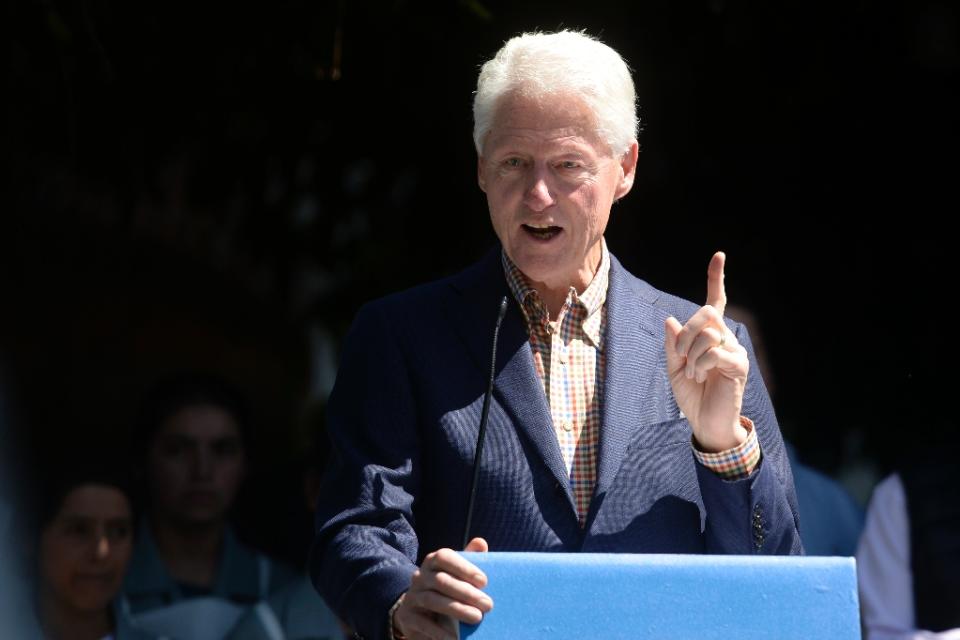
Former President Bill Clinton hits the campaign trail Monday for his wife Hillary -- his first appearance on the stump for the former first lady's White House bid.
US media reported that Bill Clinton will hold a rally at a community college in the city of Nashua and another event later Monday in the city of Exeter.
The former president's visit to New Hampshire in support of his wife comes after Republican presidential frontrunner Donald Trump has sharpened his attacks on both Clintons.
Trump, who leads the Republican field by a large margin in nationwide polls, has turned recently from attacking his fellow Republican candidates to stepping up his criticism of the Clintons.
Last month, he blasted Bill Clinton's "terrible record" with women -- an apparent illusion to rumored past marital infidelities, including while in the White House.
"If Hillary thinks she can unleash her husband, with his terrible record of women abuse, while playing the women's card on me, she's wrong!" Trump recently tweeted.
The billionaire businessman has called Bill Clinton's past reported affairs "fair game" in the 2016 campaign.
Accusations of sexual impropriety dating back to his time as governor of Arkansas have dogged Clinton for years.
Republicans in Congress tried but failed in 1998 to remove him from office for alleged perjury and obstruction during an investigation into an alleged White House affair.
New Hampshire is host to the nation's first presidential primary on February 9.
Voters in the heartland state of Iowa, using the caucus method, will register their presidential preference on February 1.

Clinton Says January Tax Proposals Will 'Go Beyond' Buffett Rule

Democratic presidential front-runner Hillary Clinton will unveil proposals this month that will “go beyond the Buffett Rule” to raise the effective tax rates paid by the wealthiest Americans, she said Saturday.
“As president, I'll do what it takes to make sure the super-wealthy are truly paying their fair share,” Clinton said in a statement responding to the Internal Revenue Service's release of new data on tax rates paid by the 400 wealthiest U.S. households, which averaged 22.89 percent in 2013.
She called billionaire Warren Buffett's plan, which would set the minimum effective tax rate for those earning $1 million per year at 30 percent, “one idea that would help achieve greater fairness in our tax system.”
Since launching her campaign in April, Clinton has bemoaned what she sees as unfair tax policy, arguing it's wrong “when hedge fund managers pay a lower tax rate than truck drivers or nurses.” Vermont Senator Bernie Sanders, her leading rival for the Democratic nomination, uses similar rhetoric, though the accuracy depends on exactly what's being measured. 
Clinton hinted at the coming proposals during a December campaign stop in Omaha, Nebraska, where Buffett endorsed her, saying then that she wanted to “go even further” than his idea.
In the statement, Clinton praised President Barack Obama for taking steps to push the effective tax rate for the wealthiest U.S. households higher in 2013, up from 16.72 percent in 2012.
“It's clear that those at the top are still gaming the system and leaving hard-working American families holding the bag,” she said. “A quarter of the very highest earning taxpayers, those earning more than $250 million per year on average, pay a federal income tax rate of less than 20 percent. That's not fair and it's not good for our economy, placing burdens on middle class families and holding back investments that would help us grow.”
Clinton has already put forward measures aimed at blocking corporate inversions and has vowed not to raise taxes on households making less than $250,000 annually.

Trump featured in terror group's recruitment video: reports

Republican presidential front-runner Donald Trump is featured in a newly released video from terrorist group al-Shabaab, according to multiple reports Friday.
 
Trump's appears in the nearly hourlong video from the Somali al-Qaeda-linked militant group, with a clip shown of him discussing his proposal to temporarily ban Muslims from entering the U.S. during a recent speech.

"The West will eventually turn against its Muslim citizens," al-Qaeda leader Anwar al-Awlaki, who has since been killed by a U.S. drone strike, says in the video after Trump's remarks.
 
"Slowly but surely, your situation is becoming similar to that of the embattled Muslim community of Spain after the fall of Granada," al-Awlaki tells Muslims viewers living in the U.S.
 
Elsewhere in the video, the group urges black youth in America to convert to Islam, invoking racial tension surrounding the police-involved shootings of black men in recent years.
 
Whether Trump was being used in terrorist recruitment videos became the subject of controversy between Trump and Democratic rival Hillary Clinton in December.
 
Trump demanded an apology last month after Clinton claimed in a debate he had been used in recruitment videos from the Islamic State in Iraq and Syria, but her campaign refused.

Music Video - Neele Neele Aasman Pe Kya Hai

Pakistan's First Female Truck Driver

Pakistan's first female truck driver has a message to the women of her country: "Nothing is too difficult." Shamim Akhtar hopes to be a role model after becoming the first Pakistani woman to get a driving license for heavy vehicles. But in a country where men dominate the roads, the journey to gender equality can be a bumpy one. (Produced by Siraj Zaheer and Stuart Greer)

The US in Afghanistan: Withdrawal is Wishful Thinking

By Julia Arciga

In the hours preceding Christmas Eve, Afghan forces were able to fend off Taliban sieges in the Sangin District, killing a “Taliban commander and 50 fighters.” Nonetheless, the district, located in Afghanistan’s strategic Helmand Province, could not have been rid of Taliban presence without US and British airstrikes and air support backing Afghan reinforcements.
Since this incident in the Sangin District, and since the recent deaths of six Americans in an attack just outside of Bagram Air Base, President Obama’s vow to significantly reduce the number of US troops in Afghanistan has again become a prominent component of US foreign policy–with 9,800 slated to stay in the region into most of 2016, and 5,500 to be deployed beyond the president’s departure from office.
U.S. Deputy Representative to the United Nations Michele Sison spoke at the Security Council on December 21st, reiterating the fact that while US forces will still be present, the primary focus is to establish Afghan forces to fight the Taliban.
“Our message to these forces is clear – there is only one path to peace, security, and stability in Afghanistan. And that path is not through military action – but through an Afghan-led reconciliation that builds upon the democratic and human rights gains the country has made since 2001. The Taliban’s attacks harm the Afghan people, destabilize the country, and betray the group’s disregard for the lives of the Afghan people. They must stop.”
Defense Secretary Ash Carter also echoed sentiments of US-Afghan partnership in a December 18 press conference in Jalalabad, despite this being the longest war in American history:
“[…] as groups like ISIL emerge on the battlefield, or al-Qaeda seeks to reestablish a safe haven, we must be prepared to deter their growth and counter the threats they pose. We will be prepared to do that. They can never have a secure base here in Nangarhar or anywhere else in Afghanistan.”
Even with 14 years of United States support and backing for Afghan forces, there are still gaps in areas like intelligence, special forces, logistics, aviation, and “ministerial development.”
Part of the difficulty in regions like Afghanistan is that the battlefields are “dynamic,” in the sense that there are many emerging and reemerging groups in different areas of the country. From a US foreign policy perspective, a dynamic field just makes it more troublesome to pursue a troop withdrawal. Rather than focusing on properly training and equipping Afghan forces to be self-sustaining, we see constant shifts in aid and forces that follow the movements of enemies within the country.
“From al-Qaeda and various different parts of the Taliban movement to groups like the IMU that have been around for a long time, […] these groups are constantly reconstituting themselves, reorganizing themselves, and accordingly, they show different behaviors and different — attention at different times, different parts of the Afghan geography,” said Carter.“Therefore, Minister Stanekzai and I were talking about this today, the Afghan security forces with our help are getting more and more agile.”
Despite the fact that the president promised to end the Afghan war in 2014, it is clear that due to recent events, new developments in terror, and the progress of the Afghan forces, a complete US troop withdrawal in the near future is nothing but wishful thinking.

http://www.conflict-news.com/the-us-in-afghanistan-withdrawal-is-wishful-thinking/

'Pakistan's bureaucracy bloated, grossly inefficient'


Pakistan’s bureaucracy is bloated, over paid and grossly inefficient, said a daily which noted that Indian Prime Minister Narendra Modi cut down his cabinet to streamline decision making. An editorial “When bigger is not better” in The News International said that the inefficiency of the countless ministries running the affairs of Pakistan is no secret, but the sitting government goes a step ahead to set new precedents. “The government has failed to appoint permanent heads to some 12 ministries and divisions.
“How any organization can function without a strong leadership and direction is beyond common sense, but affairs are being run, and targets are being met- such are the official claims. If this is true, that we are doing well without these missing managers; why do we need so many official posts to begin with?” The daily said that Pakistan is perhaps one of the few countries in the world that requires a horde of government officials to carry out a simple task. “Our bureaucracy is bloated, over paid and grossly inefficient...”
It observed that poor governance has caused ministries to become redundant and talents and skills of people go to waste. “The Nawaz Sharif governance style remains colonial at best- the state machinery is run through a group made up of the prime ministers family members and close friends. The cabinet has reportedly met only three times in 2015. If ministerial duty is just a farce then why spend national exchequer on these ministries?”
The editorial went on to say that the Finance Ministry has perfected the art of “concealing the true financial position of the government from the public and yet no one is held accountable for inefficiency or corruption”. It said that the government must prioritise and shake up its government structure to eliminate the unnecessary. “Indian PM Modi cut down his cabinet recently, to streamline decision making. “We have too many ministry portfolios and departments- we do not need this many ministers and secretaries. The international standard is to have a smaller cabinet, but in Pakistan these positions are less about management and more about rewarding party members.”

Appeal for Pakistani Christians caged like Christmas Turkeys in Thailand


A Christian human rights charity has called for help for Pakistani Christian asylum seekers caught up in a crackdown alleged to be linked to controversial claims of Islamic State terror operatives in Thailand.

The British Pakistani Christian Association (BPCA) was appealing for funds to support the families and dependants of those arrested over the past few weeks, and for paying fines to stop some of them being sent to the notoriously brutal Bangkok Central criminal jail for overstaying their visas, after mostly women and children were taken away in crowded mobile cages to an even more crowded Immigrant Detention Centre and criminal jail.


The arrest of these Christian asylum seekers seems to be linked to a massive crackdown that began earlier this month on foreign people who have overstayed their visas. Whilst the crackdown netted a US-Thai boxer and a Russian criminal wanted by Interpol on large-scale fraud and money-laundering charges, by far the greatest number of any nationality arrested were Pakistani’s, and a huge number of these, perhaps the vast majority, were Pakistani Christians seeking asylum.

Some media reports said it came after Russian intelligence warned of a cell of ISIS terrorists who they said had entered Thailand in late October. However, Thai authorities said there was no evidence of such a cell. They did arrest four men, mostly Syrian, but released three of them without charge.

BPCA chairman Wilson Chowhdry advised that Pakistani Christians were targeted in waves in the run up to Christmas, and close to 85% of those arrested were women or minors. He reports that on 17th December 14 were arrested, 6 women and 5 children, on Sunday 20th 17 were arrested, 9 of them children and 7 women, and on 22nd of 7 arrested, 3 were middle-aged women, a teenage boy, one man, and one elderly couple.

He added: ‘Then, the arrests climaxed on Christmas Eve with a series of operations – seven in the morning, including five women, and a further 18 in the afternoon, 8 of them women and 8 of them children ranging from 3 months to 10 years old.

Families have been broken apart. One pregnant mother was arrested with her three and eight year old daughters, but her husband was out working and her other daughter with a neighbour, and weren’t arrested.'

The BPCA has just co-ordinated with other NGO’s and people on the ground, including Thai pastor Tong, Farrukh Saif and Voice of the Persecuted and on Boxing Day we have paid the ‘overstay fines’ of 11 out of 16 who had such fines imposed.

Without these being paid, they would have been incarcerated in the infamous Central jail along with murderers and other criminals, a fate that still awaits the remaining five unless the funds can be raised to spring them from the trap.

However, they will still be in incarcerated in the Immigration Detention Centre (IDC) where conditions are still horrifically bad, with massive overcrowding and very little nutrition. This includes pregnant mothers and children of all ages.

The price for getting them out is much greater, at around £1000 per person, but if it is paid, it means they can’t be arrested again for at least two years.’ Unfortunately for now the bail system has been temporarily revoked while detainees are being investigated for terrorism, since the Erawan Shrine bombing.

When asked about what Pakistani Christians were doing there in the first place, he stated: ‘These are mostly professional people, teachers and the like, who faced blasphemy allegations and other threats to their lives in Pakistan. They will have sold their possessions and homes and often had barely enough to pay for passage out to Thailand. In Thailand, though, they are still in a terrible state, forced to work in low-level jobs illegally. We have set up a school for their children, but these raids have forced us to move it.’

He said that BPCA’s co-workers in VOP summed up the legal situation nicely when they covered the events: ‘Thailand is not a member state of the 1951 Geneva Refugee Convention and the UNHCR has been powerless to protect them from arrest. The Thai government considers these persecuted believers as illegals in spite of the fact they’re documented registrants with the UNHCR as genuine asylum seekers. Asylum status often takes 5-6 years as they wait in fear to be resettled in a welcoming nation. They are unable to legally work and their children unable to attend school. These wait times are unbearably long, inhumane.’ - See more at: http://www.pakistanchristianpost.com/detail.php?hnewsid=5739#sthash.d2Pvnql0.dpuf

PAKISTANI GOVERNMENT SHOULD STOP DECEIVING THE NATION REGARDING THE PRESENCE OF DAESH IN THE COUNTRY

MWM Pakistan’s head Allama Raja Nasir Abbas Jafri asked the government to bravely fight against the menace of terrorism and said that the nation will support the government. He further said “after the media reports regarding Daesh’s presence in the country governmental ministers’ denial of Daesh’s presence is the country is like deceiving the nation. Arrests of Daesh’s terrorists from Lahore, Sialkot and other areas of Punjab and the wall chalking by the terror group proves that these terrorists have been organized and actively working to achieve their objectives”. He also appreciated verdicts given by military courts to some terrorists and said “this act of military court has given hope for justice to families of more than a thousand martyrs of Millat e Tashaii”.
Allama Nasir Abbas also said “these terrorists had brutally killed country’s renowned doctors, engineers, lawyers, businessmen, educationists and ulema. They were given the punishment for their loyalty to their country. We had been struggling for justice since decades but the rulers were not serious in their efforts and supporters of terrorists present among the ruling elite had been protecting them”. He reiterated that it was impossible to get rid of the menace of terrorism without taking action against the political guardians and facilitators of terrorists. Now, heads of terrorists and the group responsible for killing thousands of innocent Pakistanis have been freely visiting offices of religious political parties which proves that they still have the backing.
http://www.shiitenews.org/index.php/pakistan/item/20469-government-should-stop-deceiving-the-nation-regarding-the-presence-of-daesh-in-the-country-allama-raja-nasir-abbas-jafri

(ISIS) - Daesh in Pakistan - The Government continues to turn a blind eye

The influence of Islamic State in Iraq and Syria (Isis) or Daesh is on the rise in Pakistan as the government continues to turn a blind eye. A report in this newspaper confirms that three Lahore-based families, led by women, have moved to Syria to join Daesh. While kidnapping cases for the women have been registered, family members confirmed that they made contact before moving to Syria. Media reports also confirm that a married couple was arrested in Johar Town, Lahore on Thursday for sending people to fight in Syria. It seems this issue has been ignored ti now. But there have been reports of the presence of Isis/Daesh sympathisers and affiliates within educational and religious circles. Three women were arrested in Karachi two weeks ago for spreading Daesh literature and funding raising for the group. Six other women were detained a week later while 13 men were arrested in Daska on Tuesday for suspected involvement with the terror group. This group was reportedly in touch with the Daesh high command.
Along with other factors, the confirmation of the involvement and direct participation of women in terrorist activities via Daesh opens up a whole new front in the war on terrorism. After the woman involved in the San Bernardino attack was reported to have had some links with the Al Huda schools in Pakistan, the world’s attention is now focusing on how the radicalisation of the Musim woman can be prevented. There seem to be no official statistics about the spread of Daesh influence in Pakistan, but reports indicate that members of the banned Lashkar-e-Jhangvi and Jamaatud Dawa are joining the group in significant numbers. The regional presence of the group has been on the rise. The trouble is that Pakistani authorities still seem to be issuing verbal denials. Adviser on Foreign Affairs Sartaj Aziz spoke about Daesh influence in Afghanistan spreading. Moreover, our Foreign Office has taken comfort behind the idea that Isis is not in an organised form in Pakistan. The FO then seems to not even be following what message some state agencies clearly seem to be sending out: Daesh has influence in Pakistan (the extent of it, though, is still unclear). The fact is that a number of segments of society in Pakistan area feeling the group’s influence. This is a strange situation; we claim to be in a war against terrorism in the country but fail to acknowledge the scale and scope of the presence of Isis in the country. There is also the fear that between those joining Daesh, and those who are reportedly going to Syria to join the anti-Daesh efforts, Pakistan will once again be caught up in violent game. That said, we need to understand that no one benefits from issuing repeated denials about the presence of this terror group in Pakistan. The threat the group poses is serious. It is time the government admitted it.

Pakistan - Lahore girl who was gang-raped attempts suicide after 'pressure from prosecution'


A 15-year old rape survivor who was assaulted by at least eight men in a hotel on Mall Road attempted suicide after continuous pressure from police and prosecution, her family said Saturday.
The victim's brother-in-law told Dawn that the family was about to go to sleep at night when she jumped from the terrace. She injured herself and was rushed to the Services Hospital. She is now back at home recovering.
He said she had been under duress from the police interrogations, where officials harassed her with "all kinds of questions".
"She's a child," her brother-in-law said. "You can imagine what kind of questions they ask."
The victim's sister earlier told Dawn that police were pressuring their family to exclude the name of main suspect Adnan from the FIR. She said police started action against the suspects after some TV channels aired the news and appealed to Prime Minister Nawaz Sharif and Punjab Chief Minister Shahbaz Sharif for justice.
The teenage girl, an 8th grade student, had earlier said that PML-N Punjab Youth Wing additional secretary general Adnan and his accomplices kidnapped her from Multan Road and forced her to drink some intoxicated liquid after which she lost consciousness.
This was followed by a text message that was received on the girl's mother's mobile phone around 11pm last Friday. The text said: “Your daughter is lying unconscious in room number 230 of a hotel on The Mall.” She said the family found the girl lying unconscious in the hotel room when they reached there along with police.
Racecourse police recovered the girl from the hotel room and shifted her to Services Hospital where reports of initial medical tests revealed she had been assaulted.
On the complaint of the survivor's mother, the police registered a case against suspects Abdul Majid, Muhammad Umer, Ameer Ahmed, Haris, Bilawal, Zaman and PML-N Additional Secretary General of the youth wing Mian Adnan Sanaullah.
DNA tests of the eight men and the survivor were conducted by the Punjab Forensic Science Agency.
The FIR was initially registered against the suspects under Sections 376 and 506 of the Pakistan Penal Code. Police also added abduction to the list of charges against the eight accused.
All eight suspects were arrested on Saturday and Sunday, along with the hotel manager Imran. The hotel facility has since been sealed.

Pakistan - Federation in controlled democracy

By 


In 2013, despite facing many challenges, Pakistani democrats celebrated the first ever completion of full constitutional term by the elected assemblies in the entire history of the country. They were also taking pride in the smooth transfer of power from the outgoing elected civilian government to the incoming one without intervention of the undemocratic third force. But the movers and shakers of the deep state were not amused by their “redundancy “ in the power politics. The unanimous passage of 18th Constitutional Amendment by the Parliament in 2010 that was regarded to be a glorious victory for both the smaller provinces and the federation turned out to be an affront to the undemocratic forces espousing “strong centre” which was synonymous with a strong control by them. But before it gets too serious let me share a joke to diffuse the tension a little bit. They say that once a tourist from the US was visiting the famous Taj Mahal in India. When the Indian guide had explained the unique history and intricate architectural characteristics of one of the seven wonders of the world he stopped talking to get the response of the tourist. The American tourist, after a brief pause, said that he was just wondering as to how could the Mughals build such a magnificent structure without American aid !

But unfortunately the response of the protagonists in our story was not confined to mere expression of amazement about the aforementioned development of Pakistani democratic system. They decided to do something about it. And then we saw in 2014 the aggressive IK and TUQ led mob physically assaulting the Parliament, the Supreme Court , the Prime Minister House and Pakistan Television in Islamabad under the guise of a “ sit in “ which kept shifting its goal posts from overthrowing the newly elected government to destabilizing it during the siege which continued for months. The public pronouncements by the mobocrat aboutthe intervention of the “ umpire” to send the elected government back to pavilion by raising his finger did not materialize as all the political parties rallied to support the Constitution and Parliament but the pressure exerted in the process was enough to pave the ground for a soft coup. Consequently the military dominated apex committees took charge of the law and order situation in all the four provinces of the country for indefinite time. They have been in the driving seat in FATA for quite some time. The deep state that has been already calling the shots in resource allocation was able to expand its not so implicit control over not only the entire state security policy but also the major portions of the foreign policy. Another important side effect was almost a rupture of the case of high treason against the former military dictator General ( retired) Parvez Mussharaf for abrogating the Constitution . Welcome to yet another era of controlled democracy in Pakistan !

The present crises in Sindh is clearly undermining the very structure of provincial autonomy that supposed to have been achieved under the 18th Constitutional Amendment. Rangers, a force under the command of the federal government and called by the provincial government to provide help in fighting terrorism have taking upon themselves to occupy the driving seat in running the province. Going far beyond their constitutional mandate they have started raiding government offices and arresting government servants and political figures on the charges of corruption without informing the provincial government and without initial involvement of NAB, a federal institution with the sole function of curbing corruption. It is pertinent to mention here that no one has raised objection to NAB’s actions in cases of the alleged corruption. But there are some dangerous aspects to the present stand off between the federation and the Sind government which has the support of the elected provincial assembly. If Rangers are allowed to raid government offices and arrest official without even informing the provincial government , this is a type of mini martial law that may not remain confined to Karachi and may spread to Lahore, Peshawar and even Islamabad .

The federal government, which is an extension of the ruling Punjabi elite, has decided to back the decimation of the provincial government in Sindh at the hands of Rangers. Now this is extremely alarming as allowing the use of state coercion for reversing of provincial autonomy that was achieved through constitutional processes can have dangerous fall out . Apart from deepening sense of alienation among the people of the smaller provinces it will also make the job of the shock forces of authoritarianism easier when they next time come to Islamabad for overthrowing the civilian set up. Then there is the case of a former PPP federal minister Dr. Asim Hussain. He was arrested by Rangers under charges of corruption , financing terrorism and providing treatment to injured terrorists in his hospital. Again it was rightly pointed out by the PPP that investigation of corruption is the domain of NAB and Rangers have overstepped their authority by taking this case into their hands. Terror financing and providing treatment to injured terrorists are serious charges and the courts must look into these charges and proceed according to law. Every single Pakistani will support across the board action not just against terror financing but also action for implementing all the twenty points of NAP to eliminate terrorism. But difficult questions will be inevitably raised if the government will drag its feet on NAP implementation and single out a certain hospital owned by a certain political figure for its anti terror raids. Will the people not speak about a method in the madness? Or will they not ask ask as to how many hospitals have been raided to arrest people responsible for treating OBL or Mulla Mohammad Omar or hordes of Taliban? Last but not the least there will be question regarding IK’s confession about treatment of Taliban in SKMH.

December 16 reminds us of the blunders committed by our ruling establishment ( dominated by Punjabi elites) that led to the disintegration of the country in 1971. Pakistan opted for a federal parliamentary system after that in 1973 Constitution to avoid repeating that tragedy. But under a new bout of controlled democracy similar blunders are being repeated in FATA, Balochistan and Sind. Even PTI which is opposed to PML(n)’s stand on every thing under the sun is not shy of supporting its actions in Sindh. Is the lure of Takht-e-Lahore responsible for this myopia? But will the tyrannical oppression of smaller provinces under controlled democracy not undermine the federation?

PPP leader points out arrests of alleged Islamic State members

Pakistan People’s Party leader Maula Bux Chandio on Saturday said that the Sindh government welcomes accountability process but cannot accept victimisation.

Speaking to journalists after attending a ceremony, he said that it was not acceptable that the 'terrorists' were being arrested in Punjab but action was being conducted in Sindh. He said that the federal government and its prominent ministers had claimed time and again that there was no presence of the Islamic State in Pakistan but how it was possible that the militants and affiliates were being arrested in Punjab and Khyber Pakhtunkhwa.

He criticised the federal government, saying that if the centre want to keep a close watch on Sindh it should also hold itself accountable. He said that PPP does not have any enmity with the ruling Pakistan Muslim League-N. He said that those who had admitted things that others were being forced to admit should also be focused upon under the National Action Plan otherwise it would raise questions on it.

KAMRAN KHAN HIGHLIGHTS IMPORTANCE OF SHAHEED MOHTARMA BENAZIR BHUTTO TRAUMA CENTER


Kamran Khan, iconic news anchor and journalist has highlighted the importance of Shaheed Mohatarma Benazir Bhutto Accident, Emergency and Trauma Centre by describing it a state-of-art emergency and trauma care centre and Sindh​ Govt’s gift to the people of Sindh, on his tv show ‘Dunya Kamran Khan Kay Sath’ on Friday night 01 January​.
Shaheed Mohatarma Benazir Bhutto Accident, Emergency and Trauma Centre was officially inaugurated by Pakistan Peoples Party chairman Bilawal Bhutto-Zardari in the Civil Hospital Karachi (CHK) on Wednesday 23 December 2015.
Shaheed Mohatarma Benazir Bhutto Accident, Emergency and Trauma Centre will provide state-of-art emergency and trauma care facilities to the people. The project is a gift to the people of Sindh and masses will avail best health facilities in it. It will provide trauma care facilities to people under one roof and thousands of patients will avail the healthcare facilities in the trauma center.
The 14-storey ‘state-of-the-art’ trauma centre is first of its kind established by the government where a wide assortment of facilities have been put together to offer one-window operation to the public in emergency situations.
The 14-storey building has been constructed to house the trauma centre along with a helipad on the rooftop in which four storeys have been allocated for parking 500 cars and as many motorcycles.
The existing emergency ward of the CHK, along with neurosurgery, intensive care units, critical care units, cardiovascular and maxillofacial and vascular surgery facilities and eye units would be shifted to the trauma centre.
A total of 18 operating theatres would be part of the gigantic building. It is pertinent to mention here that trauma center comprises 14-storey, and initially, seven-storey building will be made operational in phases. The trauma center has been completed with a cost over Rs 5 billion.

https://ppppunjab.wordpress.com/2016/01/02/kamran-khan-highlights-importance-of-smbb-trauma-center/

India - Want peace, but will give befitting reply to terror attacks: Rajnath

Pathankot terror attack strikes at heart of PM Modi’s Pakistan peacemaking

Exactly a week after Prime Minister Narendra Modi’s dramatic Christmas day visit to Lahore, his high-stakes bid to make peace with Pakistan is facing trial by fire. Today’s pre-dawn attack on the Pathankot air base, raises questions about just how serious Islamabad is, about reining-in anti-India terrorism—the cornerstone of the peace process.
The attack, the second in Punjab in just months, is likely to lead to sharp attacks on Prime Minister’s outreach to Pakistan from the opposition. He will then have to choose between weathering the storm, or calling off the dialogue. Little detail is available about the attack so far, but Indian officials allege the assault was carried out by Pakistani cadre of the Jaish-e-Muhammad.

Should credible evidence of this claim emerge, New Delhi is likely to demand action against the perpetrators. The chances Islamabad will do so, though, are low. Today’s attack bear the marks of past Jaish operations: like, the December 2001 attack on Parliament House, where the attackers hijacked an official car, hoping it would be allowed into the complex.
Indian intelligence officers believe the group, entered India along the banks of the Beas, which cuts across the fencing on the Pakistan border, on January 31- just hours after Pakistani Prime Minister Nawaz Sharif said the two countries “cannot live as enemies”.
Maulana Masood Azhar, the head of the Jaish-e-Muhammad, has close links to Pakistan’s intelligence services. Even though the organisation is proscribed by the United Nations, as well Australia, Canada, India, the United Arab Emirates, the UK, the US and the UN, Azhar operates openly, from a sprawling seminary in Bahawalpur. He has never been prosecuted for the hijacking of Indian Airlines flight 814 to Kandahar, carried out to ensure his release from jail. New Delhi has been hopeful that the terrorism-focussed dialogue between National Security Advisor Ajit Doval and his Pakistani counterpart, Lieutenant-General Nasir Janjua, has the army’s backing.

The attack, though, raises the question of whether Pakistan’s armed forces in fact support the dialogue process, or are seeking to subvert it. Pakistan’s Generals, the scholar C Christine Fair has pithily noted, see India as an ideological, not solely military, problem: “to acquiesce [to India] is tantamount not only to defeating the Pakistan Army, but also, fundamentally, to eroding the legitimacy of the Pakistani state”.

From an Indian optic, two steps would make clear Pakistan’s military has, indeed committed to a new strategic vision. The first would be legal action against the perpetrators of violence against India and the second, the dismantling of the military infrastructure of terrorist groups like the Lashkar-e-Taiba and Jaish-e-Muhammad.

There’s some evidence that Pakistan has, indeed acted prodded along by the United States. Ever since 2003, the violence in Kashmir has declined steadily-and, notwithstanding commentary in the media, official statistics demonstrate it stayed in line with the low levels seen in recent years through 2015.

Even violence levels, which showed an uptick through 2013 and 2014, showed a marginal decline. Moreover, since 26/11, there hasn’t been a single major terrorist attack outside Jammu and Kashmir that has traced back to Pakistan and interrogations of arrested terrorists has shown the ISI is keeping a tight leash on some jihadist groups acting against India.

There is evidence to just the contrary, too, though: the Lashkar’s attack in Gurdaspur could, for example, have claimed hundreds of lives had landmines been planted on a railway line.
In discussions with Indian interlocutors, Pakistan has said it hopes, in the long term, to defang organisations like the Lashkar-e-Taiba and Jaish-e-Muhammad by bringing them into political life. Prime Minister Modi has decided to take the chance on this post-dated cheque—and now has to decide if it’s actually worth more than the paper it is written on.
- See more at: http://indianexpress.com/article/explained/pathankot-terror-attack-strikes-at-heart-of-pms-pakistan-peacemaking/#sthash.4aQgn2fa.dpuf