Saturday, December 5, 2015

#IStandWithAhmadis - Pakistan - Manufacturing intolerance


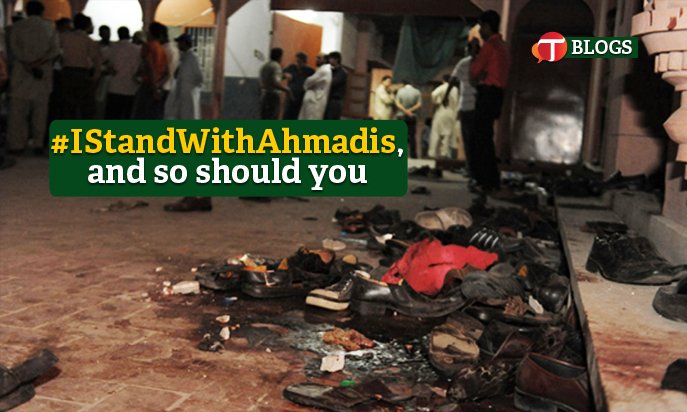
Five days after the torching down of the chipboard factory and looting of workers’ houses and offices, about four kilometres from Jhelum on G.T. Road, by a violent mob, the smoke was still billowing from its warehouse and fire-fighting vehicles were still at work.
On November 20, some workers of the chipboard factory, owned by a local from the Ahmadi community, alleged that the factory’s security officer Qamar Ahmad Tahir (also an Ahmadi) had burnt copies of the Holy Quran in the furnace.
According to the First Information Report (FIR), complainant Basharat Husain, a driver with the factory for almost four years, saw that paper trash packed in sacks came on a vehicle and the security in-charge ordered two workers to burn it in the furnace. While it was being thrown in the furnace, the workers noticed Quranic pages in it. The situation led to an argument and the police had to be called in. Following which the FIR was lodged.
By evening, announcements were made from local mosques that the owner and the workers had burnt the Quran. Soon, outrage spread in the nearby villages. Following this, people not only from the vicinity but nearby villages gathered as a mob and set ablaze the chipboard factory. The houses and the offices of the factory were destroyed, looted and burnt.
The government managed to block the news on national television channels. The factory is under the control of administration ever since and the media has not been allowed to visit the area, thus blocking any kind of coverage that could expose the horrifying scenes of loot, plunder and burning of the factory.
“We saw people looting the offices and residences. They were igniting fire with air freshener sprays and taking away valuables including laptops along with them,” says a local administrator who was injured while stopping the mob. “It was an awful scene but our priority was to save people stuck inside. An Ahmadi young man was injured while snatching a child from the mob’s custody and escaped from the rear side.”
A day later, the situation became volatile again after another angry mob in Kala Gojran, a nearby town about a kilometre from the factory, attacked the Ahmadi worship place (the law of the land forbids the Ahmadis from calling their place of worship as ‘Masjid’) and set ablaze the valuables there.
A video available with TNS shows people setting things on fire in the worship place with a policeman standing quietly and watching rather than taking any action. Almost 24 hours after the whole episode, the Punjab Chief Minister ordered to take action against the culprits.
“Police received a call on Rescue 15 around 4.30pm about the alleged blasphemy. We quickly took the material in custody and arrested the accused. Later, by 7.30 pm we heard around 1,500 people from nearby villages had gathered at the main road and were planning to attack the factory with batons in their hands,” District Police Officer Mujahid Akbar tellsTNS.
“I did not know the factory was owned by an Ahmadi. After receiving information about the protest, I went with some policemen to the spot but the situation was violent and our first priority was to save people present in the factory,” he says, adding, “We rescued around 15 people from the factory including women and children from the rear side and then started dealing with the protestors.”
681A3826
The DPO says announcements were made in the nearby villages urging people to gather outside the factory and possibility of any mischief cannot be ignored. He says the police have identified around 70 people involved in the attack and many of them have been arrested. “A case of terrorism has been lodged against them.”
The police also called Pakistan Army from the nearby Jhelum Cantt on the evening of November 20. Interestingly, Jhelum, one of the smallest districts of Punjab, has only 450 operational force for its 11 police stations, says the DPO. “Of these, on that particular day, 150 police personnel were on another assignment in Chakwal district.” He didn’t say that the next day the chief minister Punjab was supposed to be in Chakwal.
The situation in the three villages, from where the police says the mob came, has remained tense the whole week. In Kala Gojran, three vehicles of Pakistan Rangers were guarding the damaged worship place.
The locals in the villages declined to talk on the issue. “It is very unjust and unfair. A few Ahmadi families have been living in this area for many decades and there has never been any issue before,” says Dilawar Hussain, a 60-year-old man who lives in the same street. “The protesters were in huge number and the police did not take any action.”
In the village Raathian, adjacent to the factory where a sizeable number of workers from this factory live, was total empty. Many houses were locked while the others were reluctant to open the doors despite repeated knocks. “People have fled away as the police are raiding the houses for the past three days,” an old woman tells TNS from a rooftop.
Salimuddin, spokesperson of Ahmadiyya community, says, “It was an attempt to burn innocent Ahmadis alive over the vicious allegation of blasphemy of the Holy Quran. No Ahmadi can ever contemplate the slightest disrespect to the Holy Quran.” He suspects mischief behind this incident to persecute the community.
“Thereafter, without any further enquiry, announcements were made on loudspeakers in mosques and a violent mob was formed to attack the factory. The fire has destroyed 70 per cent of the factory while eight vehicles parked inside were also set on fire,” says Salimuddin.
He demands fair investigations into both the incidents — the allegation of blasphemy and the attack on the factory. He says the person accused of blasphemy is arrested and now the police should apprehend all people and mullahs involved in the attacks and make sure they are also sentenced rather than freed.
_MG_9716
Members of the Ahmadiyya community suspect that the incident was ‘systemically run’ in term of sequence of incidents. Last year in July, during Ramzan, three Ahmadi females were burnt alive by an enraged mob over baseless allegation of blasphemy of the Holy Ka’aba in Gujranwala. Subsequent investigations proved the allegation entirely false and a result of personal animosity.
Mob violence after provocative announcements from local mosques on mere allegations of blasphemy has become a dangerous trend amid cowardly and delayed actions by the law enforcement agencies. This vandalism intensifies when allegations are levelled against people belonging to religious minorities in particular.
I.A. Rehman, Secretary General Human Rights Commission of Pakistan, sees a set pattern in these incidents for the past many years. “People use these allegations to settle personal scores, persecute marginalised sections and for certain vested interests,” he says. “The state seems to have failed in stopping this vandalism. And now the police have failed to an extent that they have had to call the army or paramilitary troops to control such situations.”
Rehman says with the passage of time an environment has been created and people can react to such allegations even on hearsay. “Until and unless the state changes its policies to improve the level of tolerance and change its orientation regarding religion, things will not start turning better.”

California shooting puts focus on radicalisation in Pakistan

The deadly mass in this week carried out by a Pakistani-origin couple has put the focus on radicalisation in and its madrasas.

Pakistani national Tashfeen Malik, 27, and her Pakistani-American husband Rizwan Farook, 28, had links with Maulana Abdul Aziz, the cleric of Pakistan's notorious of Lal Masjid, according to media reports.

The information about the links has been shared by US officials in London with Shahbaz Sharif, the brother of the Pakistani Prime Minister Nawaz Sharif.

Malik had returned to Pakistan in 2010 to study pharmacy at the Bahauddin Zakariyah University in Multan after having spent most of her years in Saudi Arabia. She was born in Pakistan.

Pakistani media also reported about the links between the suspected shooter and the radical Islamic cleric of Red Mosque.

"Tashfeen was in contact with Islamabad's Lal Masjid," a US official was quoted as saying by ARY News to an unnamed Pakistani official familiar with the investigation.

"Investigation officials have found Malik's pictures in which she can be seen with Lal Masjid cleric Maulana Abdul Aziz," it said.

In a statement, the Pakistani embassy here hoped that the investigations would lead the authorities to bring the perpetrators of this act to justice sooner.

However, it made no mention of any links between the suspected shooter and the radical Islamic cleric.

The Los Angeles Times reported that authorities in Pakistan are investigating whether Tashfeen had ties to Islamic militant organisations.

She had pledged allegiance to an Islamic State leader on Facebook, officals had said.

"Intelligence agents have questioned members of Malik's extended family in the province of Punjab, an area that is considered as one of the nurseries of militant organisations, according to Pakistani intelligence agents," the daily reported.

According to the report, Tashfeen belonged to an educated, politically influential family from Karor Lal Esan in Layyah district. Malik Ahmad Ali Aulakh, one of her father's cousins was a provincial minister from 2008-13.

"The family has some extremist credentials, and some members of Malik's family in Karor are also involved in sectarian activities," Zahid Gishkori, a local resident who knows the family well told the US daily.

Tashfeen's family was said to follow the Barelvi version of Sunni Islam, which is considered more into spiritualism than militancy.

"But sources said it was likely that she had converted to the Salafi/Wahabi version of Islam after spending most of her life in Saudi Arabia," the daily reported.

For the past several years, Congressman Ed Royce, who is now Chairman of the powerful House Foreign Affairs Committee, has been demanding that Pakistan shut down the 600 madrasas that preached radical Islam.

Pakistani female Terrorist in California shooting became hardline in Saudi Arabia: relatives

KAROR LAL ESAN


The estranged relatives of Tashfeen Malik, a Pakistani woman accused of shooting dead 14 people in California, say she and her father seem to have abandoned the family's moderate Islam and became more radicalized during years they spent in Saudi Arabia. 
Malik, with her husband Syed Rizwan Farook, 28, is accused of storming a gathering in San Bernardino, California, on Wednesday and opening fire in America's worst mass shooting in three years. 
Investigators are treating Wednesday's attack as an "act of terrorism." On Saturday, the Islamic State (IS) group claimed the couple as their followers. There is no evidence yet that IS directed the attack or even knew the attackers.
Malik's killing spree has horrified her Pakistani relatives. Her father cut off contact with his family after a feud over inheritance, they told Reuters, and moved to Saudi Arabia when his daughter was a toddler. There, it seems, he turned to a stricter form of Islam. 
"From what we heard, they lived differently, their mindset is different. We are from a land of Sufi saints ... this is very shocking for us," said school teacher Hifza Bibi, the step-sister of Malik's father, who lives in Karor Lal Esan town in central Punjab province.  
Sufism, a strain of Islam popular in parts of Pakistan, emphasizes a mystical, personal religious connection. Devotees often play music and dance at shrines, and their practices are looked on with suspicion by orthodox Muslims. 
"Our brother ... went to Saudi and since then he doesn't care about anyone here," Bibi said. "A man who didn't come to attend his own mother's funeral, what can you expect from him?" 
Tashfeen Malik returned to Pakistan and studied pharmacy at Bahauddin Zakaria university in Multan from 2007 to 2012. She lived in a university hostel. An identity card said she was 29 years old at the time of the shootings. 
"She was known to be good student with no religious extremist tendencies," an intelligence official based in the nearby town of Layyah told Reuters. 
Malik's uncle Javed Rabbani, a clerk in the town's education department, said he has not seen his brother in 30 years. 
"We feel a lot of sadness but we also feel ashamed that someone from our family has done this," he said. "We can't even imagine doing something like this. This is a mindset that is alien to us."
Malik visited Pakistan in 2013 and 2014, security officials told Reuters, but it's unclear who she met or where she visited. 

Pakistani media reported she had links to the radical Red Mosque in the capital of Islamabad, but a cleric and a spokesman at the mosque said they had never heard of her before. 

Friday, December 4, 2015

Spanish Music - Plan B - Mi Vecinita

Video - Monkey spa! 90 monkeys relax in hot bath, Japan

What needs to be done for China to tackle climate change

Turkey’s Present Turmoil is All Erdogan’s Fault


All of the problems presently wracking the Turkish Republic are directly attributable to Erdogan in one way or another. Turkey used to be known as a pillar of secularism and stability in the Middle East,but those times seem to be behind it nowadays. The steady Islamization of society that's been undertaken since the AKP first rose to power in 2002 is transforming the very essence of the secular Kemalist state, and the multisided identity conflicts that have lately reemerged are threatening to undermine the harmonic fundamentals that the country depends on. Furthermore, the economy is floundering and human rights are being violated with disturbing frequency, thus weakening the country's social fabric. 


If one thinks about it, a very ironic change is taking place in the region right now. Syria, stereotypically painted by the Western mainstream media as the most volatile country in the Mideast for the past couple of years, is becoming more stabilized, secure, and strong as a result of the organic synergy of purpose between the people and their government, buttressed by Russia's anti-terrorist intervention. On the other hand there's Turkey, long lauded by the West as a model for Syria and the rest of the region to emulate, which is now becoming more unbalanced, dangerous, and weak, and the reason for this is none other than the massive miscalculations made by Erdogan.

A Slippery Slope

Let's take a look at everything that's gone wrong in Turkey lately and how Erdogan is directly at fault for it:

Civil War:

The ongoing civil war that's raging in the southeast was completely avoidable, especially considering that both sides were earlier engaged in a constructive ceasefire with one another. Erdogan restarted the conflict precisely as an electioneering tool in order to win over more nationalist votes from the MHP in the second-round elections. A back-to-back comparison of June and November's ballots suggest that he was successful in stealing some of their voters, but the cost was that he returned the country back to civil war and has lost full control of the dynamic. This has unnecessarily spread the military thin and inhibited their ability to protect the hinterland from terrorist threats.

Terror Threat:

Turkey has lately fallen victim to horrific incidents of ISIL/Daesh terrorism (if one is to follow the government's official narrative that the group is to blame), and the entire country is at risk of repeat attacks due to how deeply embedded the terrorists are throughout its territory. Erdogan refused to shut down the porous border and secure its unprotected portions, all out of his feverish pursuit to militantly overthrow President Bashar Assad via hard-core Islamic terrorists.


There's also a personal factor involved as well because reports state that his son Bilal is profiting quite handsomely from trading oil with Daesh. This familial factor might explain why the Turkish strongman is illegally neglecting his constitutional responsibilities in keeping his countrymen safe from terrorism, and it might also be the reason why he's still keeping Turkey's border with Daesh-occupied Syria totally open to this very day.

Identity Tension:

What's not commonly reported in the Western mainstream media but is a factor that all Turks are aware of is that the country is facing an existential identity crisis. The Kemalist secularism that constitutionally defines the Turkish Republic is being de-facto replaced by Erdogan's Islamism, and the growing divide that this is creating between the cities and the rural areas explains the widening geo-electoral rift that's evident in the country.
Erdogan's sympathy towards the Muslim Brotherhood and desire to implement their ideology across all strata of Turkish life is well-documented, but interestingly, this very same organization is officially designated as a terrorist group by Syria, Russia, and Saudi Arabia (one of the very few instances of political agreement that Damascus and Moscow have in common with Riyadh). Now Erdogan wants to change the constitution to give more power to the presidency (his current position), but many of his critics believe that this is a ploy to eliminate the legal foundation for secularism and slyly enshrine the Muslim Brotherhood's teachings as the supreme law of the land.

Human Rights Deterioration:

Erdogan's leadership (be it as Prime Minister or President) has seen a marked backtracking on fundamental human rights such as the freedoms of speech (the periodic blocking of social media), press (the jailing of opposition journalists), and assembly (the Gezi Park crackdown). These aren't mere fits of rage on the part of an unpredictable psyche, but premeditated actions designed to crush dissent, intimidate critics, and advance the one-party Islamist rule that he's envisioned for Turkey ever since he first came to power in 2002.

Economic Challenges:

The Turkish economy was naturally slowing in tune with the rest of the world amidst the Great Recession, but the country's structural challenges will undoubtedly be made more acute by the Russian restrictions that were recently implemented in response to Turkey's aggression. If the economy continues to decline, then it might be the final spark that's needed to generate a renewed anti-government movement modeled off of the tactics and organization of the historic Gezi Park protests.

The Dilemma

As Erdogan sees it, his increasingly authoritarian and Islamist rule could be reversed by either a pro-democratic uprising or a military coup, and he has no idea how to deal with these two factors simultaneously. He's proven himself adept at handling them individually before, but never in combination, and herein lies the Turkish strongman's dilemma.

The degenerating economy and rising social tensions are giving birth to emboldened grassroots opposition to his rule, and Erdogan is afraid that this could one day turn into a nationwide version of the earlier Gezi Park movement. Concurrent with this, the military is spread ridiculously thin between fighting the Kurds and trying to intimidate the Syrians, and this has opened up too many vulnerable blind spots in the heartland that are now vulnerable to terrorist attacks.

Logic would dictate that Erdogan should redeploy some of the military from these fronts in order to secure the cities, but the Turkish strongman is afraid that this would make it all the easier for the armed forces to stage a secular coup against his Islamist government (such a move wouldn't be unprecedented). As regards a Gezi Park 2.0, if Erdogan were rational, he would backtrack on his imposed Islamism and abandon the Muslim Brotherhood project, but he's gone so far already that he can't retreat without betraying the influential base that he's nurtured for over a decade and possibly producing violent pro-Islamist protests.

Turbulent Times Ahead

The societal divisions that he's created might eventually lead to a large disruptive movement in one shape or another (be it secular/pro-democracy or Islamist/pro-autocracy), and in the end, he might be urgently compelled to call the military into the streets and inadvertently facilitate the very same coup scenario that he's trying so desperately to avoid.

No matter what form it takes, it's very likely that the myriad of opposing identities actively organizing within the Turkish state will find a pretext to clash with one another and take the country down a very turbulent path in the near future. The civil war against the Kurds is a major destabilizing factor, but one shouldn't overlook the other less known but equally impactful conflicts that could predictably pop up sometime soon.

Secular and Islamist protesters (politically represented by the CHP and AKP, respectively) could come to blows as social tension reaches an all-time high, and the MHP-affiliated "Grey Wolves" (a hyper-nationalist organization that Russia is mulling to ban as a terrorist group) are the ultimate wildcard in this scenario. Extreme left-wing organizations like the Revolutionary People's Liberation Party-Front (designated as a terrorist group by Turkey, the EU, and the US) could also more assertively rear their head amidst any unfolding pandemonium, and the shadowy supporters of Fethullah Gulen (presently in self-imposed exile in the US) might make their presence known and engender an intra-Islamist split within the AKP. Finally, the 2 million Syrian refugees in the country might finally get fed up enough with their living conditions that they riot and trigger even more unrest.
If Erdogan is a Sultan like some have justifiably likened him, then he looks to be following more in the footsteps of Mehmed VI, the last Ottoman ruler, than those of Suleiman the Magnificent when the Empire was at its strongest.


Read more: http://sputniknews.com/columnists/20151202/1031108048/erdogan-dilemma-turkey-turmoil.html#ixzz3tPQiWOs3

#CaliforniaShooting - Female Terrorist Tashfeen Malik's journey from Pakistan to mass murder

Tashfeen Malik's path to accused mass killer in California began in a small city on the Indus River in Pakistan's Punjab province.

It was from here, when she was a toddler, that she moved with her father Gulzar 25 years ago to Saudi Arabia, where he became more deeply religious, more conservative and more hardline, according to a family member.

A picture slowly emerged on Friday of the role and possible motivations of 27-year-old Malik in this week's killing of 14 people in California, including her apparent pledge of allegiance to the leader of the Islamic State militant group, according to U.S. officials.

Malik, with her husband Syed Rizwan Farook, 28, is accused of storming a holiday party on Wednesday in San Bernardino, California, and opening fire in America's worst mass shooting in three years.

The intensive search for clues, extending to Pakistan and Saudi Arabia, could help U.S. investigators piece together what drove Malik and her husband to leave their infant daughter with his mother, don assault-style clothing and carry out the shooting.

Malik, who entered the United States on a fiancée visa, and Farook, the son of immigrant parents from Pakistan who had worked as a health inspector, were killed in a shootout with police just hours after the attack.
U.S. investigators were evaluating evidence that Malik, a Pakistani native who had been living in Saudi Arabia when she married Farook, had pledged allegiance to Islamic State leader Abu Bakr al-Baghdadi, two U.S. government sources said. They said the finding, if confirmed, could be a "game changer" in the probe.
CNN reported that one U.S. official said Malik had made the pledge to al-Baghdadi in a posting on Facebook on Wednesday, the day of the attack, under an account that used a different name.
Though large information gaps remain, it appeared to be the strongest evidence so far that the attack may have been inspired by Islamic State. But U.S. government sources said there was no sign that it had been directed by the militant group, which has seized swathes of Syria and Iraq and claimed the deadly Nov. 13 attacks in Paris.
FATHER BECAME "CONSERVATIVE AND HARDLINE"
Two Pakistani officials said Malik was from Karor Lal Esan, a city on the west coast of the Indus River in southern Punjab province. She moved to Saudi Arabia with her father, an engineer, 25 years ago, they said.
She returned home five or six years ago to study at Bahauddin Zakariya University in Multan to become a pharmacist, they said.
The area in Punjab where she spent her early years and later went to university is a "recruitment ground" and stronghold of Islamist groups with ties to al Qaeda, said Husain Haqqani, a former Pakistani ambassador to the United States. Among the militant groups with a presence there is Lashkar-e-Taiba, which has been blamed for the November 2008 killing spree in the Indian financial capital of Mumbai.
"Our brother changed a lot since he went to Saudi," Malik's uncle, Javed Rabbani, said of Malik's father. "When relatives visited him, they would come back and tell us how conservative and hardline he had become," he said in an interview with Reuters.
A source close to the Saudi government said that during Malik's time in Saudi Arabia nothing came to authorities' attention there that suggested she was involved with radical Islamic groups. Malik was not on any Saudi law enforcement or intelligence watchlist, the source said.
Malik's father, Gulzar, had built a house in Multan, where he stays when he visits Pakistan, according to another uncle, Malik Anwaar.
He said Gulzar had a falling-out long ago with the rest of the family, citing a dispute over a house among other matters. "We are completely estranged," Anwaar said.
Rabbani said he had been contacted by Pakistani intelligence as part of the investigation into the San Bernardino shooting.
Malik had two brothers and two sisters and was related to Ahmed Ali Aulak, a former provincial minister, the Pakistani officials said.
The exact circumstances of how Farook and Malik met remained unclear but they had apparently been married for two years. The Federal Bureau of Investigation said Malik was in the United States on a visa under a Pakistani passport.
While Farook had an active presence online, Malik's digital footprint is harder to trace. A Facebook profile established under an alias by Malik was removed by the company for violating its community standards, which prohibit praise or promotion of "acts of terror," a spokesman said on Friday.
But her name was attached to a gift registry for their baby hosted by the website TheBump.com. According to the registry, Malik's baby had been due on May 17.
Just hours before the couple opened fire on Farook's co-workers in a government building in San Bernardino, they had dropped off their daughter at his mother's house, telling her they had a doctor's appointment.

Hundreds rally in Saudi Arabia for death row Shiites: Witness

Hundreds of Saudi Shiites rallied in the east of the kingdom on Friday to support activists whose execution they fear could be imminent, a witness said.

It was the second Friday in a row that a mass gathering had been held in solidarity with Shiite cleric Nimr al-Nimr and other death row detainees.

Activists say three of them were minors at the time of their arrest after protests that began in 2011 in eastern Saudi Arabia, where most of the country's Shiite minority live.

Nimr was a driving force behind the protests that developed into a call for equality in the Sunni-ruled kingdom, where many Shiites have complained of marginalization.

Friday's prayer gathering in an open area of Shiite-majority Qatif, on the Gulf coast, aimed "to show solidarity with Sheikh Nimr and the rest of the detainees," said Hussein al-Nemr, who is no relation.

He estimated the crowd at 600 or 700 and said they carried pictures of the detained cleric.

"It was a big one," he said of the rally, which followed a similar gathering in the Eastern Province town of Awamiya last week.

Amnesty International said in late November that Nimr al-Nimr and five other Shiite activists were at imminent risk of execution and were "clearly convicted in unfair trials".


The London-based human rights group said the six were among more than 50 people who could soon be put to death in a single day.
Media "close to the Saudi Arabian authorities" had reported on the execution plans and said Al-Qaeda "terrorists" would also be among those put to death, Amnesty said.


Shiites accuse authorities of issuing such reports in an effort to gauge public reaction.


So they have turned out in public to show they are siding with the "innocent" detainees, Nemr said.

SAUDI-LED ATTACKS ON YEMEN CLINIC: MSF

The Saudi-led coalition has bombed a clinic related to MSF in southwest Yemen, wounding nine people, Aid agency Doctors without Borders (MSF) on Thursday has announced.
Two MSF staff were among those wounded when the clinic in Taez, Yemen's third-largest city, was struck by coalition jets on Wednesday, it said.
The agency said it had repeatedly shared coordinates of the clinic with Riyadh in the days before the strike.
“There is no way that the Saudi-led coalition could have been unaware of the presence of MSF activities in this location,” said Jerome Alin, MSF mission head in Yemen.
"The bombing of civilians and hospitals is a violation of international humanitarian law. Civilians seeking health care and medical facilities must be respected," Alin said in a statement.
The United Nations says more than 5,700 people have been killed in Yemen since then, nearly half of them civilians.

Two Yemen tribesmen Killed by ISIS Terrorists

Terrorists have killed two members of an influential tribe in southeastern Yemen, tribal sources said Thursday, accusing the terrorists of carrying out the executions.
"Supporters of Daesh on Wednesday executed members of the Awlaki tribe after kidnapping them," a senior tribesman told AFP.
Another tribal source said Hashem and Ahmed Maklam al-Tunssi were killed in Seiyun, the second largest town in Hadramawt province, where Al-Qaeda in the Arabian Peninsula (AQAP) has a significant presence.
The announcement comes a day after AQAP fighters drove pro-government forces out of a town in southern Yemen that could potentially open up a supply route between their stronghold of Mukalla, in Hadramawt, and second city Aden.
At least 15 people were killed when AQAP fighters swept into Jaar, in Abyan province, before appearing to withdraw from the town. AFP reported.
http://www.shiitenews.org/index.php/saudi-arab/item/19892-saudi-led-attacks-on-yemen-clinic-msf

Video - Turks say Erdogan won’t go despite promise, media crackdown to resume

Video - RT talks to both sides of Turkish media for reaction to crackdown

‘Only I and my paper were prosecuted’ – journalist who exposed Turkey’s hospitality for jihadists

There were numerous reports of Islamist fighters injured in Syria finding shelter and treatment in Turkish hospitals. Dogu Eroglu, a journalist who broke one such story, told RT it resulted in only him and his newspaper being prosecuted.
Eroglu is an investigative journalist working for the opposition BirGun (One Day) newspaper. In September last year he wrote an expose on a medical facility in Gaziantep, a town in southeastern Turkey about an hour’s drive from the Syrian border. The hospital treated fighters who had been injured in the neighboring country with the tacit approval of the Turkish authorities.
“I was told by the hospital administration that they are jihadist fighters and do not have any other profession,” he told RT, adding that after recovering the fighters went back to Syria to fight more battles.
“They also said that the food and sanitation services are provided by the city of Gaziantep, and without the government help it wouldn’t be possible to bring all these injured fighters from Syria to Turkey,” he said.
The Turkish journalist found evidence that fighters from the Islamic Front group were treated at the clinic. The Sunni umbrella group adheres to radical Islamist ideology and is seeking to turn Syria into a state ruled by Sharia law, not a secular constitution. The goal is shared by the notorious Islamic State group, but the two are hostile toward each other, competing for territory, resources and recruits. Some of the militant groups comprising Islamic Front are reported to ally themselves with Nusra Front, the Syrian branch of Al-Qaeda, which also clashed occasionally with ISIS.
are protected by military of entire nation[Turkey]. That is why they are acting so boldly & blatantly – Putin http://on.rt.com/6xfi 
After the expose was published, the facility relocated and various parties involved gave conflicting denials, Eroglu told RT.
“The immediate response from the authorities to our report was to close [the facility] down and transferring patients to other locations. The city of Gaziantep immediately denied our report and told the press that this facility doesn’t exist. The medical organization responsible for running the hospital then confessed that there was such a hospital, but it didn’t serve to cure the jihadists.” he said.
What the Turkish authorities didn’t do is try to prosecute anyone involved in assisting jihadists. Instead, BirGun was accused of false reporting and a Turkish court ordered that the newspaper retract the report.
“I and my newspaper were the only ones who faced prosecution,” Eroglu said. “Under the court decision, we were ordered to put the city’s denial under the story, which made it look like the whole story was false,” Eroglu said.
Eroglu’s story is far from the only example of extremist fighters from various groups reported as being sheltered in Turkey. An Islamic State commander, Emrah Cakan, was confirmed to have received medical attention in a hospital in Denizli. The news triggered a nationwide scandal as opposition MPs demanded that the government explained how a known terrorist leader could get a hospital bed in Turkey.
Hospitals treating militants were identified all across Turkey’s border Hatay Province, Mehmet Ali Ediboglu, who represents the area in the Turkish parliament, told RT.
“There are more than 50 state, university and private hospitals in border cities and jihadists have been treated in these hospitals for five years,” he said. “Wounded Nusra Front and Islamic Front militants are brought there.”
“They are fighters, not civilians. Two or three months ago two militants were brought to Hatay hospitals and there were bombs on them,” Ediboglu said, adding that ambulances taking fighters to hospitals are often escorted by armed jihadists.
Apparently, not all fighters injured in Syria are equal in Turkey. Members of the Kurdish YPG militia injured during the fight for the city of Kobani, when ISIS besieged it last year, told RT they had to be smuggled into Turkey for treatment, because traveling openly there could lead to their arrest.
Turkey, a NATO member, is part of a US-led coalition that is pledged to destroying Islamic State in Syria and Iraq. In practice, however, Turkish warplanes have been targeting Kurdish forces, including those fighting against ISIS, rather than the Islamists.
Russia believes that elements of the Turkish government, including President Recep Tayyip Erdogan, are profiting from the plundering of Syria and Iraq by terrorist groups and provide material support to them.
Two prominent journalists were arrested in Turkey last week on espionage allegations after exposing an alleged Turkish special service operation to smuggle arms to Syrian militants. RT


President Obama defends his strategy against ISIS

The U.S. is intensifying its fight against ISIS as President Obama ordered the deployment of about 200 Special Operations forces to Iraq and Syria.
Speaking to "CBS This Morning" co-host Norah O'Donnell Wednesday in the White House Cabinet Room, Mr. Obama said that while he sticks to his promise of no "Iraq-style invasion," military intervention is necessary to defeat the terror group.
"What I've been very clear about is that we are going to systematically squeeze and ultimately destroy ISIL and that requires us having a military component to that," Mr. Obama said.
The president also defended the United States' current strategies, including its membership in a 65-country coalition against ISIS and local partnerships within Iraq and Syria.
"We have been able to push back ISIL from territory that we had taken, but in Iraq and Syria and we are developing partnerships - although they are not as strong as we want yet - with local tribes and Sunnis who are willing to fight ISIL," Mr. Obama said. "And what I've said is we're going to continually modify and adjust our strategy based on those things that work and those things that may not work."
The president expressed confidence that the U.S. Special Forces would add to these measures. While he admitted they could not "single-handedly destroy ISIL," he said the additional forces would offer "greater situational awareness on the ground, generate additional intelligence, work with local forces to develop smarter strategies, (and) help direct where airstrikes are going to make the most difference,"
"We're going to continue to push hard and the good news is, coming out of Paris, we're seeing countries like Germany and Great Britain that had been hesitant about getting too actively involved in Syria, realizing that they have to be part of the solution here," Mr. Obama said.
With the FBI conducting active investigations into ISIS sympathizers in all 50 states and more terrorism-related arrests than in any in one year since 9/11, President Obama said there's "no doubt" that Americans have some fear that attacks like th"What I try to do is to make sure that people understand the threat is real, we have to vigilant, but we also can't panic and we can't respond out of fear. We have to make sure that we keep a clear-eyed view about what needs to be done," Mr. Obama said. "ISIL is not going to pose an existential threat to us, they are a dangerous organization like al Qaeda was, but we have hardened our defenses, our homeland has never been more protected by more effective intelligence and law enforcement professionals at every level than they are now. The coordination is much better than it is now. If you look at the number of successful terrorist attacks that have occurred, you know, we have disrupted a lot of them, but the dangers are still there and so we just have to keep things in perspective"
The president said the American people should feel confident about the country's defense and go about their lives.
"I said this repeatedly overseas, ISIL only wins if we react out of fear and start changing how we live, violating our values, they can't win on the battlefield. They can kill some innocent people, but that's not a victory for them if we respond appropriately," Mr. Obama said.e recent ones in Paris could happen in the U.S.
http://www.cbsnews.com/news/president-obama-isis-threat-paris-style-terror-attack-us/

Video - FBI: San Bernardino Mass Shooting Now a Terrorism Investigation