Friday, November 27, 2015

Putin Right to Accuse Erdogan of Duplicity – British Historian

Turkey only pretends to be fighting against ISIL, British historian Michael Burleigh wrote, stressing that the country’s president Erdogan acts like if wanted to weaken the forces that actually combat Islamists.

It may seem only at first sight that the Turkish leader Recep Tayyip Erdogan is involved in the fight against ISIL militants, Michael Burleigh claimed in his article written for Daily Mail.

In reality, Turkish forces are conducting airstrikes mainly on positions of only “one army which poses a real threat to ISIS, and has won countless battlefield victories against them,” and it is the Kurdish PKK forces in Syria. In fact, ISIL could be destroyed in a relatively short period of time, if Kurds acted freely without being attacked by the Turkish Air Force.

“[W]hile Turkey may be a member of NATO — and of the alliance taking on the jihadists — Erdogan seems to be doing almost everything he can to cripple the forces actually fighting ISIS[ISIL],” Burleigh argued.

Burleigh went on by explaining that Erdogan treats Kurds as a threat of greater proportions than ISIL due to their objective of founding their own state. Kurds account for roughly one fifth of the population in Turkey and there are also big communities in Iraq and Syria.


Moreover, the Turkish leader “loathes” Syrian president Bashar al-Assad, whose positions would strengthen should ISIL military might decrease.  So Erdogan turned a blind eye on ISIL militants infiltrating into small Turkish towns with a further goal of transfering foreign militants through those settlements to Syria. He also “ignored” that Turkish smugglers were purchasing oil from ISIL, Burleigh pointed out.

The historian also mentioned what he called the “worrying aspect of Erdogan’s consolidation of power,” meaning the continuing transformation of Turkey from a secular to Islamist state. Sitting in the Istanbul mayor’s chair, Erdogan was imprisoned in 1997 for his links to radical circles. And as Burleigh pointed out, he never forgot that experience. While serving as the country’s Prime Minister, Erdogan got his “revenge” in 2012, putting in jail 324 officers. He has also cut funding to the only force that could get in the way of spreading Islamization across Turkey – the army – by 30 percent.

The alarming fact, according to Burleigh, is that a younger generation of Turks, including members of Erdogan’s party, tends to be more sympathetic with ISIL. And there are some fresh instances of this turnaround: in the aftermath of the Paris attacks, Turkish football fans during the match between Turkey and Greece disturbed the minute of silence devoted to the extremists’ victims, chanting “Allahu Akbar.” Statistical data shows that seven percent of Turks don’t think that ISIL militants are terrorists and some 15 percent claim that the radical group doesn’t pose a threat to Turkey.

“That’s why, too, Vladimir Putin is at least partly right to accuse him [president Erdogan] of duplicity in his fight against ISIS [ISIL]. Erdogan may want to join the EU, but he’s only a fair-weather friend of the West,” Burleigh concluded.

Syria FM says US should study rumors Erdogan’s son is involved in oil trade with IS

 US Secretary of State John Kerry should check out reports on the involvement of Turkish President Recep Tayyip Erdogan’s son in illegal oil trade with the Islamic State (IS) terrorist group, Syrian Foreign Minister Walid Muallem said on Friday.
"I’d like to mention rumors that Erdogan’s son could be involved in illegal oil trade with the IS, although there are no proofs. If I was in Kerry’s place, I’d make an attempt to shed light on these reports," Muallem said commenting on Kerry’s statements that Damascus was buying oil from terrorists.
Muallem repeated that Kerry had no proofs that Syria bought oil from the IS. "We are still waiting to see them," the minister said.
Russian Foreign Minister Sergey Lavrov also touched upon the topic.
According to the Russian minister, the United States could not have been unaware of the scale of the Islamic States’ oil industry but preferred to spare it.
"Everything is a matter of practice. Let us operate with facts. There have been many reports that god knows who is living off the oil wells illegally seized by the Islamic State," Lavrov said.
"When our aviation started flying in the Syrian airspace at the request of (Syrian president) Bashar al-Assad, we saw the whole picture of that illegal business from above. Russian President Vladimir Putin spoke about that on several occasions, including yesterday’s news conference and the G20 summit in Antalya where he had shown space and aerial images - very eloquent and very convincing - to his colleagues," the Russian foreign minister went on to say.
"The US-led coalition started flying over Iraq and Syria, without the Syrian government’s consent by the way, more than a year before the Russian military operation. I am convinced that they saw all that but did not do anything for some unknown reason. Russian warplanes started bombing that criminal industry when they began operation in that area," Lavrov said.
"Of course, it’s certainly not a coincidence that our Turkish neighbours grew more and more nervous after that," the Russian foreign minister said.
According to Lavrov, the arrest of two Russian journalists for a story about illegal arms supplies from the Turkish territory to the Islamic State speaks of how carefully they (Turkey) protect information about their underground oil deals.
"So my answer is very simple: if the United States is so much concerned with the fact that god knows who is benefiting from the illegal oil business, the illegal oil field should stop functioning.
Lavrov believes that the US-led coalition ought to have started destroying that business straight from start.
"The US coalition and the Americans themselves started doing that after Russia had actively intervened with air strikes. I would say that then the US partners were forced to do that, so to speak, in order not to lag behind us in the struggle against terrorist infrastructure," Lavrov said.
He noted that the United Nations Security Council passed resolution 2199 that bans any trade with oil from terrorist-seized territories at Moscow’s request.
"Now we have submitted a concrete proposal to the United Nations Security Council to ask the United Nations Secretary General to prepare a report in the next two weeks to sum up all the existing information on who is supporting the IS illegal oil industry. We hope the UN Security Council members will have a chance to see this information. We constantly include this theme in the agenda. It is we who need full clarity," Lavrov said.
"I hope that the United States, given that US Secretary of State John Kerry is so much concerned with various aspects of this problem, is going to support us and this information will be presented to the world public," the Russian foreign minister concluded.
http://tass.ru/en/world/840009

Video - Hong Kong film-makers aim to be first in 3D porn

Video - The 2015 White House Christmas Tree Arrival

Police arrest gunman who opened fire in Colorado abortion clinic


Police arrested a gunman who stormed a Planned Parenthood abortion clinic in Colorado Springs on Friday and opened fire with a rifle in a burst of violence that left at least 11 people injured, including five officers, authorities said.
Five hours after the siege began, the suspect was taken into custody, the city of Colorado Springs confirmed in a message posted on the municipal Twitter account.
A Reuters photographer at the scene saw a man in a white T-shirt, with his hands cuffed behind his back, being taken out of an armored police vehicle and placed in an unmarked squad car.

An hour earlier, police said that progress in securing the building was slowed by the fact that the gunman brought "some bags" with him into the clinic and left several items outside, all of which needed to be checked for possible boobytraps or explosives.
No fatalities were reported by authorities. Five police officers were among those injured in the gunfire, said police spokeswoman Lieutenant Catherine Buckley.
There was no information provided on the nature of the injuries, or the condition of any of the victims.
Police swarmed the area around the building after an emergency call reporting shots fired at about 11:30 a.m. Mountain Time (1830 GMT), and officers ultimately confronted the suspect inside the building, Buckley said.
(Reporting by Daniel Wallis in Denver; Additional reporting by Dan Wallis in Denver, Dan Whitcomb in Los Angeles, Eric M. Johnson in Chicago, Laila Kearney in New York, Eric M. Johnson in Seattle and Andy Sullivan in Washington.; Writing by Steve Gorman; Editing by Steve Orlofsky and Tom Brown)

#Fightfor15: Walmart workers protest, fast for living wage on Black Friday

On the most notorious retail shopping day of the year, Black Friday, Walmart workers and allied groups have been calling on the retail giant to raise pay to $15 per hour and offer more full-time work to millions of its employees.
For the fourth year running, thousands of Walmart employees and others are attending demonstrations at more than a dozen Walmart stores across the nation, including in New York City, Los Angeles, Oakland, and Detroit. Prior to Black Friday, the beginning of the Christmas shopping season in the US, more than 1,000 people, including hundreds of Walmart workers, fasted for more than two weeks.
The demonstrations are led by the Organization United for Respect (OUR) at Walmart, an organization made up of employees at Walmart, the second-largest retailer in the world. Dozens of allied groups, including the United Food and Commercial Workers (UFCW), are joining OUR Walmart in their appeal for higher wages and less erratic work schedules.
"We, the hourly Associates, are the life-blood of Walmart," OUR Walmart said. "Our company is stronger because of the values we embrace – a strong work ethic, compassion for one another and honesty. Yet we are not treated with the respect we deserve. The fundamental desire to be shown respect is what led us to join together as OUR Walmart."
The group is calling for Walmart to boost salaries to $15 per hour for full-time employees (known as "associates"), more full-time opportunities for workers, "more predictable and dependable" schedules, an expansion of employee health care coverage, a less-hostile environment when employees speak out about issues at work, a clearer protocol for enforcement of employee policies, better work standards within Walmart's global operations, and equal treatment for all employees"regardless of gender identity, race, disability, sexual orientation, or age."
"Far too many of us have to rely on government assistance for our basic needs," the group added. "Walmart should publicly commit to providing  wages and benefits that ensure that no Associate has to rely on government assistance."
Part of treating employees with respect, the group said, means curbing employee intimidation, especially when a grievance is aired or when employees attempt at organizing.
"Associates who assert their freedom of association frequently face retribution from the company," OUR Walmart said."Walmart should allow Associates to freely join OUR Walmart without fear of negative company action."
Some Walmart employees are taking the Fight for 15 to the home of Walmart heiress Alice Walton's condo in New York City.
For its part, UFCW, through its Making Change at Walmart campaign, is holding as many as 1,000 food drives this week in an attempt to "feed 100,000 Walmart workers and families this holiday season."
“This Black Friday, the message we are broadcasting through our TV ads and food drives is that Walmart employees are struggling,” said Jess Levin, communications director at Making Change at Walmart.
“They work for one of the richest companies in the country and so many of them have to rely on assistance from food banks and food stamps to avoid going hungry. We are setting the goal of feeding 100,000 Walmart workers but that is not a long term solution to that problem. The only solution is for Walmart to change.”
UFCW operates one of two OUR Walmart groups after some members of the coalition split from UFCW in September. The splinter group has the support of several activist groups, including the National People’s Action, Demos, and the National Domestic Workers Alliance.
OUR Walmart and UFCW said they aim to help Walmart employees "in their dealings with Walmart over labor rights and standards and their efforts to have Walmart publicly commit to adhere to labor rights and standards" but "have no intent to have Walmart recognize or bargain with UFCW or OUR Walmart as the representative of its employees."
In April, Walmart bumped up its base employee pay to $9 per hour and has pledged to raise that amount to $10 per hour by February 2016.
Walmart spokesman Brian Nick defended the company's actions, claiming the average full-time Walmart employee makes more than $13 an hour, and has opportunities for quarterly bonuses, a matching 401K program, and health care benefits.
“We know it takes quality [employees] to give our customers a great shopping experience,” he told Fortune. "We’re proud of the wages and benefits package we offer.”
The biggest private employer in the world, with 2.2 million workers, Walmart is the global leader in revenue, according to the 2014 Fortune Global 500.

Video - Walmart workers protest outside heiress Walton's New York penthouse

Ghazal - ABI TU MEIN JAWAN HOON - MALIKA PUKHRAJ,TAHIRA SYED

Bangladesh - Pakistan's War Crimes - Turning the leaves of history

Nizamuddin Ahmed


In the light of the hullabaloo, albeit ludicrous, raised last week by the Pakistan government, here's a sampling of what this column has been saying for the last two decades. 
May 30, 1995: Perhaps each trait of the Bangalee has its good and bad sides. But the one peculiarity amongst some of us that is unpardonable is the short-lived memory, particularly with reference to politics. While the emblematic Bangalee will be envious of the Jews hunting down Nazi war criminals and profusely acknowledging their nationalism, the same Bangalee this far has tried to brush under the carpet any suggestions of bringing to book the culprits opposing our liberation at home and abroad.
December 16, 1996: On December 16, 1971 despite our grief and agony, we celebrated as a nation. From Teknaf to Tetulia; in the refugee camps strewn along the border; in the torture camps of Pakistan; from this corner of the earth to another, we rejoiced the victory of Bangalees. All for one and one for all. Twenty-five years later, everything seems to be spinning in a realm of confusion. There is mistrust everywhere. Each of us has our own version of history, distorted immeasurably over the years. One man's belief is another's object of ridicule. The one nation of Bangalees has been shred to pieces. The nokshi kantha has fallen off at the seams.
August 17, 1996: But, perhaps we are no less a Razakar than the gun-toting enemies of the Bengali people; for to this day we have failed to bring to justice the self-proclaimed killers of the symbol of our independence, our liberation struggle, our very existence. Yes, we are but sinners in our own domain!
October 13, 1997: Whereas newspapers in West Pakistan (not in the East) carried pictorial advertisements of their night club dancers; whereas sex, violence and vulgarity were the hallmarks of West Pakistani movies (not of the East), the West Pakistani Muslims had the audacity to call us in the East 'non Muslims' as an excuse to let loose their barbaric armed assailants on our innocent civilians. And, did we not give them a befitting reply? Our glorious War of Liberation was a jihad, yes a holy war, against their blasphemy and non-Islamic demeanour.
April 23, 1997: As the Northern line train of the London Underground disappeared into the tunnel, I opened the book on our Liberation War that I had picked up on Oxford Circus. In it were pictures of Pakistani atrocities, death, fleeing refugees, hunger, triumphant freedom fighters, joy... I was accompanying a relative to meet one of his distant (Bangladeshi) cousins, Keshtu. On introduction Keshtu looked like a decent guy; clean shaven, neatly dressed, etc. As a matter of conversation, I offered Keshtu the book on Liberation. He would not even touch it, saying “There was no liberation war”. What about the millions of martyrs? The women who were raped in their thousands? 14th December? Did none of these happen? Do pictures lie? These are pictures taken by the foreign media. Keshtu was unmoved and summed up his nationalism with the terse comment, "That was all a propaganda by western journalists".
August 26, 1997: In our War of Liberation we had come across many brutes among the Pakistani officers whose actions would have made Dyer* tremble in fear. Yes, many of them today lead a cosy life in havens far from the anguish of the dear ones of their victims for whom every new day is to live yet another in pain. Have we not heard of Bangalee children being flung into the air only to test the sharpness of Pakistani bayonets? Have we not been shamed by the rape of our mothers and sisters? Have we not seen the murder of innocent Bangalees, streets and alleyways littered with our soul and body? Yet, have we ever made a concerted effort to seek an apology from Pakistan?
(*Colonel Reginald Dyer of the British Army, on whose orders 379 unarmed satyagrahis were killed at Jallianwalabagh, April 13, 1919)
February 13, 1998: Md. Siddiq Khan Kanjoo, the Pakistan deputy foreign minister, said that there was no question of asking for forgiveness for the mass killings during the 1971 war. Well, if he has admitted that mass killings took place, it's a big start because, “Deen kaal ja porche”, some Bangladeshis who seem to have lost their memory now sincerely believe that nothing happened in 1971. A Pakistani official also said, “We now need to develop more friendly relations. Bringing up the past will only reflect adversely on the relations.” Do we sniff a veiled threat? At whose cost will relations be spoilt? Perhaps the Pakistanis need reminding that whereas a full-fledged military operation of the savagest brutality could not silence unarmed Bangalees, such hollow attempts of frail intimidation could not even tickle us.

Pakistan - Sialkot: Family of a 13-year-old Christian girl forcefully given in marriage to a Muslim

Dejected family of a 13-year-old, Christian girl victim of gender-based religious persecution implore the authorities to help them in setting the Christian teen free.

In keeping with details, a Christian teen resident of Haji Pura, near Silakot; was allegedly kidnapped by a 21-year-old, Muslim namely Waheed Akhtar who reportedly married her forcefully in order to convert her to Islam. Waheed Akhtar is adamant that she converted to Islam before marrying him.

On the other hand, Shahid John father of the victimized Christian teen, says, “I was shocked to hear the news. My legs were trembling when I heard what had happened. Hina (te victim’s sister) was accompanying her on her way back from school. Waheed Akhtar forcibly took her away. Hina came back to home and informed the family.

We went to Waheed Akhtar’s house, which is also in the vicinity. Waheed and his father are butchers by profession. They kept saying that Waheed will be back soon but when he did not turn up I went to police station and registered my complaint.”

In his statement to Fides, Shahid John said, “In Pakistan there is no justice for the poor and, above all, no one cares for Christians, no one has heard my cry. The police do not pursue the culprits; no one is doing anything for us.”
Since so many days have passed and no substantial progress has been made by police in recovering the girl from the custody of Waheed Akhtar, a Pakistani NGO “Life for All” in a note to sent to Fides stated that it has initiated an appeal in order to save the girl and make sure that she is returned to her family. The girl’s has been missing since the morning of 9 November, after she had left home for school.

Through “Life for All”, the girl’s family has launched an appeal to the authorities for justice. The NGO “Life for All” in an official statement regarding this case said, “These are frequent cases: influential people use their power in order not to get punished. Thousands of underage girls are abducted and forcibly converted each year. Cases are reported, but the courts and authorities turn a blind eye and the marginalized suffer. How long will we have to tolerate this injustice?”

- See more at: http://www.christiansinpakistan.com/sialkot-family-of-a-13-year-old-christian-girl-forcefully-given-in-marriage-to-a-muslim-implores-authorities-for-help/#sthash.7hY0SIJr.dpuf

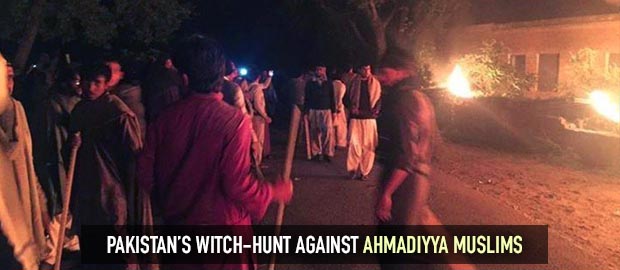
Pakistan’s witch-hunt against Ahmadiyya Muslims


By Rabia Mehmood


It was pitch dark at 2:30am in the morning. The only sounds that Imran* could hear were coming from the factory that was set ablaze a kilometer away, and the slogans against Imran and the rest of the Ahmadi community in Jehlum. I was almost whispering, convincing my fellow Ahmadis to come out of hiding and show themselves to me, so that I could take them to a safe distance but there was no response, Imran told me over phone. However after repeated assurances, Ahmadi families hiding nearby revealed themselves to him. Out of fear that I could be one of the mob who were hunting down Ahmadis in the area near Jehlum factory that every time I tried to call out to them, they would further hide downwards into the shrubs.
A few of the families who escaped from the factory during the mob attack had their toddlers hidden in their jackets. Ahmadi women can be identified by the distinct cut of their burqa, so they were asked to remove them and only cover heads with dupattas. Imran is one of the Ahmadis who worked at the old chipboard factory, more than 4 decades old and owned by an Ahmadi businessman in Jehlum, Punjab. There are about 300 employees at the factory out of which Ahmadis are just ten percent, Imran claims. At 5pm on November 21st, Imran was sitting in his office at the factory getting ready to leave for his living quarter across the road from the factory compound, when police personnel on motorbikes and a vehicle entered the factory. The policemen arrested the security in-charge of the factory who had an office at the entrance of the compound. Qamar Tahir, the head security officer at the factory, an Ahmadi by faith, was arrested on blasphemy charges, allegedly on a complaint from a factory staffer. Imran: I am only telling you what I saw. That was the first time we had heard of any such thing as a blasphemy allegation against one of our own at the factory—it was a shock for us. The environment in the area surrounding the factory was not actively hostile towards Ahmadis. In recent years, there was a seminary built nearby which was a cause for some concern but nothing severe had happened to us, just regular everyday bigotry, which we’re used to as Ahmadis.
Police came with their minds made up that Qamar Tahir had burnt pages of the Holy Qur’an and thrown them in one the factory boilers. God forbid, why would he commit such a heinous act? We are practicing people, but the police pointed at Qamar Sahib saying that he had committed that act. On Tahir’s arrest, his sons questioned the police, so police arrested them also. One of the boys is still a young teenager, less than 18-years-old. I saw that they were manhandling the boys, slapping them and pulling their hair, says Imran. After the arrests, police personnel arrived again at the factory twice, within a span of 30 to 45 minutes. On the last trip, the District Police Officer arrived and went to the boiler where the religious scripture was allegedly thrown. The factory staffer who is allegedly behind the blasphemy charges was the one with the police, Imran says. I did not see the DPO consulting any senior managers of our office. Instead, he went straight to the boiler with the complainant and then left. Qamar’s boys were later released.
That is when factory staffers saw men gathering outside the factory on motorbikes, and began to be alarmed. Imran and his Ahmadi colleagues quickly gathered and decided to leave the area. Within 45 minutes, Imran and a few families from the colony nearby which holds about eight homes of Ahmadi residents, had begun to organize an escape. Because Imran and some of the others did not have families, it was easy for them to leave the residential area. However, the youth were told by their elders to return to the area near the factory. The mob was at the brink of breaking down the factory gate, and loudspeakers had begun calls of protest and violent actions against Ahmadis. The young Ahmadi youth were needed to assist those hiding out and get them to safety. It was a miracle how families inside the factory compound and those outside managed to gain some distance, as the hunt had started by the mob then. The night had grown darker. The mob began to loot, and then, to set the factory on fire. When the angry men moved towards our quarters, they were told by some non-Ahmadis to only target the living quarters of Ahmadis, I was told by my contact. They stole from our residences and then set them on fire. They had also started running in the direction of Ahmadis who had managed to flee with batons and torches.
Ahmadis hid in the fields behind small hills, in deep nallahs (canals), and in thorny shrubs, hungry and scared for hours. The subsequent rescue operation by the volunteers of the community – without any help from the law enforcement personnel – went on till 6am. By 3am, I took some of the families, and through alternate routes, and once with the help security guards from another colony, I managed to take them to our cars on the main road, after which I had to help with ensuring that Ahmadi residents of Jehlum city leave the town also. The police told Ahmadi volunteers guarding the community’s worship places that leaving the premises was the only way of saving Ahmadi lives. The Ahmadi volunteer at our mosques in Jehlum city were advised by the police to leave. They told our men that they could not guarantee safety of Ahmadis inside the mosque from the enraged mob, and assured them that mosques would be protected. The arson attack at the factory, the incitement of violence against the community, the looting of valuables and a roadblock on the Grand Trunk road went till early hours of the morning too. Within 24 hours of the arson attack on the factory, an area near Jehlum city, Kala Gujran, saw another wave of violent attack on Ahmadis. An active anti-Ahmadi hate campaign had been going on in that area for a while, the community says. But despite the presence of heavy contingent of law enforcement personnel, one of the places of worship could not be protected. When the enraged mob reached the said worship place, the police had to intervene and in a rare incident of fairness rescued three Ahmadi youth from inside the worship place. The 25-year old-Imran is friends with those men, My friend told me that the mob wanted to lynch them, so police told them that they are arresting us – the Ahmadis, and this is how they took us out. Now, almost 40 displaced Ahmadi families from the burnt factory, and Jehlum city and Kala Gujran are stranded and unsure of their return despite the start of a police investigation into the incident. Internal displacement is not rare for Ahmadis of Pakistan. Many from Balochistan, Sindh, Khyber-Paskhtunkhwa and parts of Punjab have moved due to threats to their lives or due to the increasing vulnerability they feel living outside the town of Rabwah—the town with highest number of Pakistani Ahmadis living in an area.

Gujranwala Mob Attack of 2014

Muhammad Boota and his fellow Ahmadis from Gujranwala still do not have a stable life, more than a year after the murders of his mother, two daughters and the unborn baby of his sister at the hands of a similarly violent mob in Gujranwala in July 2014. A violent mob wanted to burn the women and children alive inside their homes in the Arfat Colony area of Gujranwala as penance for alleged blasphemy by an Ahmadi youth. About 120 Ahmadi residents of Gujranwala fled their homes for safer locations after murders of innocent unarmed woman and children. Those who dared to come back and restart their lives are failing. Boota: Some of my extended family have tried to resettle, but their previously smooth running businesses are not enough to get by now. Nobody is giving our boys jobs. When anyone enters into our stores for services, people in the area tell them to avoid doing business with Ahmadis. In fact, nobody is willing to buy my property, which is on a prime location.
Boota and his family are homeless. For them, living in Gujranwala is impossible but he cannot be so far away that he cannot follow up on the murder cases of his loved ones. There is also a constant pressure from the cohorts and families of the five men who are in prison for the murder of Boota’s mother and daughters. After losing his children and his mother, Boota wanted due procedure to be carried out by the police and the courts. But the investigation for the murder cases was not initiated until well into 2015 — after the young man accused of blasphemy was acquitted. The message government officials were sending was clear: they would consider the murders of Boota’s family justified if the young Ahmadi man had been found guilty of blasphemy. The police would call us, take the side of the attackers and murderers, tell us we are small in number and those men could target us again, so the best solution was to forgive them the murders. Even now, the man Sadam, whose Facebook post and false allegation led to the arrest of the Ahmadi youth and murders of my family is out on bail. Boota tells me that on November 22nd, a congregation at a banquet hall called Bhatti Marriage Hall in Gujranwala sang praises for Mumtaz Qadri, the killer of Punjab governor over a blasphemy allegation, and complimented the men arrested for the murder of his loved ones’; those arrested and charged with murder include Shia and Deobandi men. I keep getting these messages that if we did not take our case back, our community will be targeted again in a more violent attack. Now Muhammad Boota looks at the Jehlum attacks and his hopes diminish further because he sees persecution thriving in Punjab. As for Imran, he never thought that the situation in Jehlum would escalate to the point where Ahmadis would have to flee. While there are no deaths or injuries from the Jehlum incidents so far, the trauma and fear is immense. A few years ago, Imran had witnessed a hate crime against an Ahmadi acquaintance in Punjab and had to take the bleeding man to the hospital after he was shot. That physical violence was nothing compared to the utter fear of Jehlum. There is no comparison. After the unveiling of the National Action Plan in the country, there have been efforts to curb hate speech and arrests have been made. But the government has itself also demonized the Ahmadi community. Aside from anti-Ahmadi laws on the books, government officials recently banned religious literature of the community by categorizing it as hate literature. Many Ahmadis continue to languish in jails on blasphemy and other faith-based allegations with little attention paid to their legal rights. While Ahmadis cannot assemble for religious purposes and are still forced by law to deny their religious identity, groups like Aalmi Majlis-e-Khatm-e-Nabuwat are free to incite violence against Ahmadis. The government does appear to be cracking down and arresting people over the factory fire and the mosque attacks in Jehlum, but for affected Ahmadis, life will never be the same. *Names have been changed where indicated to protect the identity of interviewees.
Read more at: https://www.rabwah.net/pakistans-witch-hunt-against-ahmadiyya-muslims/

Pakistan's Ahmadi Muslims under attack by Sunnis - Fires of hatred

Sunday mornings in Jhelum are usually slow, but today an uneasy quiet pervades. For the Pakistan Chipboard Factory, located by the Grand Trunk (GT) Road, doomsday already occurred on Friday (Nov 20).

The decades-old facility has been turned into a vast heap of ashes and charred structures by an arson attack launched by a crazed mob. The crowd gathered in the wake of announcements made from mosques’ loudspeakers, calling on people to burn the facility down after one of its employees was arrested over allegations of blasphemy. What they didn’t burn down, they looted.

The main gate has been pulled down and the guard-post is burnt. The path leading into the premises is partially blocked by the melted and overturned hulks of two cars. At the reception, the computer monitors have been hacked into pieces, fragments of them strewn all over the floor.

Chipboard sheets manufactured just before the attack have been reduced to a smouldering mound in the main production area, still emitting smoke, which rescue staff are trying to douse with sprays of water. In the main factory building, too, machines are broken and half burnt.

The compound also contained the residences of the factory owner, senior staff and servants’ quarters. These have all been ransacked and destroyed, their walls broken down, the cars parked in the porches now ash.

In a veranda, flower pots are shattered and shards of glass cover every surface. A sofa-swing is still hanging, badly blackened. In the drawing rooms, carpets and furniture have been destroyed and in kitchens, meals — half-cooked and half-eaten — are laid out. Fine china crockery sets have been smashed to pieces and the refrigerators are burnt-out wrecks. Floors, walls and ceilings — all are damaged and the pungent smell of incinerated materials hangs over everything.

The boiler, which used to keep the factory running through burning material such as scrap and old books, has itself been burnt. The material being used as fuel at the time of the attack is still there: paper, newspapers, magazines, books in Arabic, which rescue workers are collecting.

Some yards away, in front of the factory’s hall, a building had been furnished with soft carpets to serve as a place of worship for the Ahmadi owners and the factory employees. The windows of this building have been broken also, and the carpets are now covered with glass shards. Three books are still lying on a reading table, though, and a bookshelf still hangs on the wall.

As the rescue workers go about their work to quell the embers, a convoy of police vehicles arrives. From a glittering black car disembarks the Rawalpindi Regional Police Officer (RPO), Muhammad Wisal Fakhar Sultan Raja — clearly upset and even frightened. Moments later, Inspector General of the Police, Punjab, Mushtaq Sukhera, arrives in another convoy. The RPO and rescue officials give him a tour of the factory premises and the damaged houses.

As he leaves, a patrol contingent of the army takes over at the main gate. There, a few men and women are huddled in the corner, confused and worried, the women with tears in their eyes.

“We work and live here in this factory,” says Muhammad Kaswar, adding that his wife worked in the house of the factory owner. “We have come here to take our belongings; we left everything and ran for our lives when the attack took place. We were trapped inside the factory when the mob gathered and were rescued by the police.” Shamun Masih and his wife Samina Shamun, who also worked in the owner’s house, nod in agreement.

A few kilometres east of the torched factory, in the congested Kala Gujran area of Jhelum city, dozens of armed soldiers and policemen stand guard in front of an Ahmadi place of worship. But the place has now been inscribed with the title of ‘Masjid Allah Wali’ and displays the slogan ‘Khatm-e-Nabuwat Zindabad’.

“These were written by the protesters who briefly took over this place yesterday and offered their prayers here,” says Malik Basharat Jameel, a native of the area. “They took three motorcycles, two generators, some furniture and files out from this building and set it all on fire.”

The authorities promise to act against the culprits.

“Those responsible for this arson will face the music,” says Zulfiqar Ahmad Ghumman, the Jhelum District Coordination Officer.

But Nasir Butt, a local journalist, believes the police were responsible for the chaos.

“The police failed to apply a strategy to counter religious unrest,” he says. “Surprisingly, the second attack occurred after the RPO himself had arrived here to control the situation. The police simply vanished when the crowd arrived.”

Sami Zuberi, a senior journalist in Islamabad, believes that the government machinery has been proved incapable of being able to handle such sensitive issues.

“We have been facing blasphemy cases and retaliatory protests and ransacking for decades now, but the authorities have been unable to tackle them. They need to be sensitised about it,” he says.

http://ahmadiyyatimes.blogspot.com/2015/11/pakistan-fires-of-hatred-mirza-khurram.html

Pakistan - THREAT OF TERRORISM, QUAID’S MAUSOLEUM CLOSED FOR PUBLIC

Due to possible threat of terror attack Quaid e Azam’s mausoleum had been closed down for public and security was beefed up.
According to sources, Federal Interior Ministry had sent a letter to Sindh government in which Sindh government was directed to enhance the security measures at Quaid’s mausoleum due to possible terror attack. Sindh government conducted a meeting with the management board of Quaid e Azam’s mausoleum, after the warning, stopped public entry and increased the security. 
http://www.shiitenews.org/index.php/pakistan/item/19796-threat-of-terrorism-quaid-s-mausoleum-closed-for-public

Pakistan’s most un-Pakistani institution


The Sindh Institute of Urology and Transplantation is an aberration that doesn’t fit into the national landscape. The creed animating its work is pure craziness: that the sick are entitled to not just free treatment, from start to finish, but the best treatment, the fancy phrase being state-of-the-art treatment.

Now in a land otherwise dedicated to greed and plunder, where cutting corners is the true faith, if this is not craziness what other name do we give it?

SIUT has not only upheld the creed of free treatment as a verbal proposition for the past 40 years, it has against the odds made it come true. From the moment you enter, as a sick person, the urology department of the Dow Medical College in Karachi, for that is what it is, till the time you leave after completing your treatment, you pay not a penny.

The most elaborate tests may have been carried out on you. You may have had a kidney transplant and received the most expensive medicines. But you pay not a penny. Throughout the vast expanse of SIUT, for over the years from its small beginnings it has grown into a mighty oak, there is no paying counter, not even for an entrance slip. This would be anyone’s definition of craziness.

In the old Soviet Union the same thing was in vogue. You entered a hospital and came out, whether the same day or after a month, and you were required to pay nothing. It was all free, taken care of by the state. No wonder, smart economists called it an unworkable system. The same thing prevails to this day in Cuba which has one of the best healthcare systems on the planet, all free. No wonder, American capitalists so hated the Cuban revolution. It set a bad example for the rest of the continent.

SIUT’s Fidel Castro is Dr Adeebul Hasan Rizvi – a onetime leftist. There you have it, the secret is out. It had to be a leftist, of the fraternity dubbed as subversives, closet commies, in the first decades of our glorious republic.

SIUT now has a huge budget, some coming from the Sindh government but the bulk of it from private donations. Tycoons otherwise careful about their money have given generously to SIUT over the years because they know their money will not be pilfered or stolen. Lesser mortals too give what they can, Prof Rizvi telling me once that he was most proud of such donations – 100 or 200 rupees being sent from a remote part of the country by a school teacher or someone like that.

So the sums of money involved in the running of SUIT are huge. But figure this out: the last time I visited the place a few years back with Ava, Ardeshir Cowasjee’s daughter, she showed me the Prof’s car parked outside: a Suzuki Swift which you could see had done its bit of running around. 

Judge for yourselves: the first order of priority for anyone else in his place would have been swanky transport. I would have done it and besides would have done up my office, leather sofas and stuff, and put two staff nurses – not male, you can bet your life – in the outer office. That would have been the right thing to do. Every boss, however lowly, does it: SUV and staff nurses. And here was this battle-scarred Swift.

Ah well, I said to myself, this may be austerity on parade, so to speak. Let’s go inside and I went looking for dirt, slovenliness and inefficiency, the standard Pakistani combination which sets us apart from other nations and other peoples. Travel the world and when you come at last to a Pakistani airport you know you have arrived: the slovenliness of the FIA official, the general air of lassitude, the hyena-like look in the eyes of the customs official, you’ll find these traits hard to match anywhere else.

So I went looking for the same when in Ava’s company I stepped inside the building. This was my first surprise and still over the years I have not been able to get over it: the corridors, the wards, the labs…everything was spotless. The wards were painted not in the drab whitewash which is the signature tune of all government-constructed buildings here but in bright and friendly colours, especially the children’s wards. On the windows were bright curtains.

There was no VIP ward, no private rooms, not for love or money. Even a middling Pakistani VIP would consider this outright communism. And to my amazement there were no separate wards for men and women, male and female patients laid out in the same wards, without the heavens falling. There was Maulana Abdus Sattar Edhi – that other un-Pakistani Pakistani – on a bed. He had come for dialysis, and there were women on other beds. Boys and girls were together in the children’s wards. What would the Office for the Promotion of Virtue and Prevention of Vice say about this?

As we rounded a staircase I saw a man praying in a corner. Was there no mosque, I asked. No, there was none; if you felt like it, you prayed wherever you wanted to.

The true revelation, however, was the treatment procedure. There is a central hall where patients first arrive. Round it are consulting rooms and labs. You sit in the hall and when your turn comes you walk just a few paces to your doctor. If tests are to be carried out the labs are right there. And if you have to be hospitalised, up to the wards you go, no questions asked. 

The central dialysis room has a hundred machines, working day and night, donated by the Dawoods. Procedures are in place to ensure that the equipment used on a patient stays reserved for him and is not passed around. There is a separate dialysis room, with about a dozen machines, for patients infected with Hepatitis C. These machines were donated by the Cowasjees. There is a laser room where kidney stones are treated by laser…these machines also from the Cowasjees. The Dewans have given crores – I don’t have the exact figures – for the new building. There was a room dedicated to the memory of a Saigol lady. There must be other donors as well but these names stick in my mind. 

And the Prof, like a ghost, prowls the corridors at all hours – seeing to this and that. And the team he has built up…all workaholics like him. (Here I can’t help mentioning another work-besotted individual – Maj Gen Azhar Mahmood Kayani, who headed the Armed Forces Institute of Cardiology and now heads the Rawalpindi Institute of Cardiology. I saw him working first hand when I had an angiography done at the AFIC. He would begin working at 6.30 in the mornings, six days a week. On Sundays he would go to his village in Jhelum to attend to patients there.

And he had a droll sense of humour, always a smile playing on his lips. I suppose Pakistan has its share of such people. After the angiography he said I must cut down on the good stuff. What was acceptable, I asked. Thrice a week, he said, with a twinkle in his eyes, confirming me in my opinion about his sound judgement.)

After a blood test at SIUT – this was in the Zia era – I was given such a fright that I wrote a column titled ‘Valedictory’, by token of farewell to the golden mead. As Mark Twain said of smoking, “Giving up smoking is the easiest thing in the world…I’ve done it hundreds of times”, similarly my farewell to arms then was the first in a long series. 

The Prof has a ruddy complexion which one can only envy. Comes from all his prowling, I guess. Here’s to him and may he be around for a long time. And his baby which he has nurtured all these years and seen grow to such stunning heights is soon commemorating its 40th anniversary. Here’s to SIUT and long may its healing hand reach out to the sick, the homeless and the deprived. There is so much talk of Islam in this country and so little actual Islam in practice.

Being labelled anti-Pakistan

By Zeeba T. Hashmi

Liberalism has become a taboo word in Pakistan, and secularism has become almost criminal. However, the good news is that, in logical terms, the right-wing narrative, with endorsements of fabricated national history, seems to be losing ground.
The rightist and nationalist ideologies have been entrenched so effectively in public discourse that any voice countering or opposing them, no matter how rational the dialogue may seem, gets easily intimidated by threats and humiliation. It is, in fact, easier to be termed a traitor than be considered one having common sense and empathy. In the face of intolerance and actual violence meted out for speaking one’s mind, freedom of expression has become a far cry for many here. And this is a sad predicament for those who get conveniently labelled as anti-Pakistan just for expressing their criticism of certain acts of the state that have caused great harm to the people here in the name of national interest.

So, who are these people who are homogenising the national mindset by condemning free minds? One must recall how Malala was targeted on social media and the whole episode of her getting shot played as a ‘CIA drama’. No matter how ridiculous this idea is, it holds sway with the irrational reasoning of the Jamaat-e-Islami (JI) and the like. They criticise her and consider her to be an agent of the CIA, who got herself shot by the CIA and went abroad to malign Pakistan and the army. They became insecure because the Malala episode had in fact exposed the fissures in our country whereby schoolchildren are targeted, directly or indirectly, by the militants and the state remains unable to give protection to schools and the children within them.

The question that needs to be asked is: why is ridiculous logic being allowed to be presented by fundamentalists in the mainstream? And, most importantly, who is encouraging them and using them to steer public opinion in their favour? Liberalism has become a taboo word in Pakistan, and secularism has become almost criminal. However, the good news is that, in logical terms, the right-wing narrative, with endorsements of fabricated national history, seems to be losing ground. Because of Nawaz Sharif’s speech in which he indicated that he would steer his country on a liberal and democratic path, he was severely criticised by the right-wing parties and their media affiliates. Nawaz Sharif had a previous beef with the military establishment about which he is now quiet since coming to power has also subjected him to much ridicule, media trials and, perhaps, a threat to his political ambitions.

Nawaz Sharif may feel pressurised to aid Saudi Arabia in its aggression towards Yemen. He can feel the flickering of right-wing operatives under the umbrella of the Pakistan Defence Council (PDC) to protest parliament’s decision to refrain from sending troops into Saudi Arabia’s war, unless the country faces a direct threat to its sovereignty. The plausible reason behind this was the apprehension that this act that represented the will of the people could affect military contracts and relations with Saudi Arabia. A profitable venture that the establishment feared losing, it attempted to create a public discourse in this regard. Thankfully, this did not work as people are becoming more aware of what their national interests should actually be versus the national interests that are working against them. It is indeed only through the democratic principle that the voice of the will of the people is respected.

What we suffer at the hands of fundamentalists is the paranoia of the state, which has a tendency to disown the people’s resentment towards certain policies. There is a vicious cycle of how the nexus of the state with right-wing parties, fundamentalists and even with militants at times results in emboldening religious parties to pressurise the government into meeting their political demands. This politicisation of religious groups is a living example of creating ideological chaos in the country. They come out in full force to dictate societal trends through their unchecked propaganda machine, which is the reason why we see intolerance and violence against minorities. The present government is finally realising the dangers of such radical inculcation in society. We should be worried about the fundamentalists taking over political and public space because they form their opinions on a limited knowledge of Islam and vigilantly persecute those who challenge their unwritten dictates.

The hardened blasphemy, anti-Ahmedi and Hudood laws, for instance, were issued by a military dictator, General Ziaul Haq, to appease the clergy who held the reins of society and its institutions. It was done during an Islamisation process, a fallout of the Cold War that propelled Pakistan to side with the US, which financed the jihadist organisations to fight off Soviet forces based in Afghanistan. It was more than a token of thanks to the fundamentalists for fighting the 'infidels' in another country.

The institutions in Pakistan are weak and they usually fail to deliver to the people. There are more pressing issues that need to be addressed by the state than investing in religious institutions that have damaged our collective ability to tolerate and appreciate diversity. It is time to do away with nationalist and religious indoctrinations, and adopt policies that are pro-people’s development in every democratic and liberal term. Being critical does not mean one is anti-Pakistan or anti-Islam; in fact, it should have more to do with keeping in view the best interests and prosperity of the people of Pakistan.