Thursday, November 26, 2015

For today’s GOP, Thanksgiving is the ultimate hypocrisy

By Harold Meyerson

Thanksgiving is our holiday of refugee commemoration. We have no holiday to commemorate the first successful English settlement, Jamestown, which was a commercial and political venture, or the first French and Spanish settlements, which were also commercial and political. We celebrate only the arrival and survival of a band of Pilgrims seeking not only opportunity but also refuge. Of the many and varied American creation epics, this is the one we have chosen to celebrate.
We have never been a land, of course, where refuge has gone uncontested. The Germans, the Irish, the Italians, the Jews, the Slavs, the Chinese, the Japanese, the Mexicans, the Muslims — every group of newcomers has been reviled and labeled a peril to our way of life. Each group, to be sure, contained a dangerous few, just as the non-immigrant population did. At the turn of the 20th century, a handful of native and immigrant anarchists preached a gospel of violence and assassination. A Jewish immigrant shot and wounded industrialist Henry Clay Frick; a Slavic American shot and killed President William McKinley; two Italian immigrants probably (the verdict of history is still out on this one) killed a Massachusetts bank guard. The number of murders committed during the same period by native old-stock Americans gripped by racial and religious hatred exceeds that committed by the new-stock anarchists by thousands, but to the nativist mind, all murders are not created, or considered, equal.
In 1924, by an act of Congress, virtually all immigration from Asia and Southern and Eastern Europe was halted. (The law was not to be repealed until 1965.) Fortunately, immigration from those lands had not been banned earlier. Had Americans always excluded millions due to their fear of a few, this would be a very different country. Where have you gone, Joe DiMaggio (and Frank Sinatra, and Enrico Fermi) indeed?
Today, we may marvel at many of our forebears’ conflation of “anarchist” with “Italian,” but the same nativist and racist phobias now dominate the discourse of one of our two major political parties. Arabs are jihadists; Mexicans are rapists; a little more than 80 percent of murdered whites are killed by blacks — whoops, it turns out that a little more than 80 percent of murdered whites are killed by whites, but to the neo-Nazi who concocted this Big Lie, and to the Republican presidential front-runner who publicized it, spreading that lie and similar sewage is apparently how they intend to win adherents and, for Donald Trump, take power.
We’ve had presidential candidates whose campaigns were rooted in appeals to racism and even racist violence: That was the very essence of George Wallace’s political appeal. But it’s been a long time since a front-runner of a major party’s presidential contest has based his appeal on raw racism, much less dropped hints that roughing up his critics was fine by him. To find Trump’s antecedents, you have to go back to the Southern segregationist demagogues who whooped up their crowds by affirming the rightness and necessity not merely of their racism but of racist violence as well.
In Trump, the Republicans’ Southern Strategy — pioneered by Barry Goldwater and perfected by Ronald Reagan — has hit bottom. Just as the Southern economic elites found they could count on the electoral support of the region’s largely impoverished white working class by steering those workers’ resentment at their lot toward even more impoverished African Americans, so today’s Republicans look at their own (no longer just Southern) white working-class supporters — whose jobs have been offshored and whose paychecks have been shrunk by indifferent financiers and corporate executives — and steer their resentment toward immigrants and minorities.
Trump’s distinctive contribution to this decades-long process has been the rawness of his racism, the thuggish tone of his speech and the huge growth of anti-minority police powers that he has championed. In proposing to deport 11 million undocumented immigrants and their U.S. citizen children, in suggesting that the government monitor mosques , he has positioned the Republican Party much closer to fascism than to the libertarianism toward which some mistakenly believed the GOP was headed. (The broad appeal that Trump’s proposals have among right-wingers makes you wonder whether their nonsensical phobias about the Democrats’ seizing their guns and throwing them into camps isn’t just a psychological projection of what they’d like to do to their opponents.)
It’s all a far cry from the spirit of the holiday we celebrate today. For today’s Republicans — including Trump’s rival candidates afraid to call him out for what he is — celebrating Thanksgiving is an act of high hypocrisy.

Bernie Sanders Gets Immigration Policy Right


Senator Bernie Sanders released his immigration plan on Tuesday. To read it — and every citizen should — is to be yanked back in time, to an America that not so long ago was having a reasonable immigration discussion and a time when major reform had strong bipartisan support and a shot at becoming law.
But since the immigration reform bill was killed, in 2013, the party that killed it — the Republicans — has dragged the immigration debate to grotesque depths that go well beyond the usual nativist bigotry. Republican presidential candidates are arguing, in all seriousness, about sealing the border with fantastical 2,000-mile fences and weaponized drones; merging state, local and federal authorities and private prisons into one all-seeing immigration police state; forcibly registering American Muslims; mass-deporting 11 million Mexicans and others in a 21st century Trail of Tears; and turning away thousands of refugees fleeing war and terrorism in the Middle East.
Mr. Sanders, the Vermont senator seeking the Democratic presidential nomination, turns away from the insanity. His plan starts with the right premise: that immigrants should be welcomed and assimilated, not criminalized and exploited. His proposals seek to uphold American values, bolster the rule of law, bolster the economy and protect and honor families.
Recognizing Congress’s chronic inaction on immigration, Mr. Sanders promises to use executive authority well beyond what President Obama has done. He would protect young immigrants and their parents from deportation, and give “broad administrative relief” to young immigrants, to the parents of citizens and legal permanent residents and to others who would have been allowed to stay under the 2013 Senate bill. This affirms the humane and sensible principle behind that legislation — that 11 million unauthorized immigrants should stay and contribute, not be isolated and expelled.
The Sanders plan tackles an ugly truth — that racial profiling and the nation’s vast deportation and detention machinery have made suspected criminals of millions of people who don’t fit the definition. His promise to “decouple” federal immigration enforcement from local policing would be a sharp break from dragnet policies that expanded under President Obama. Mr. Sanders rightly defends “sanctuary city” policies that protect public safety by building trust between immigrant communities and local law enforcement.
Mr. Sanders’s promise to increase immigrants’ access to the justice system, with more funding for courts and lawyers, stands in sharp contrast to the Republican view of unauthorized immigrants as a shadow society of criminals who haven’t been deported yet. Mr. Sanders instead sees them as parents, breadwinners, taxpayers, bulwarks of the economy and of the communities they live in, aspiring Americans trapped by unjust laws and oppressive policing.
Is that so radical? It may sound that way, in today’s climate. But it is a vision that lawmakers of both parties once embraced without question. Ronald Reagan and both Presidents Bush spoke movingly of immigrants as assets to the country to be welcomed through assimilation and citizenship.
Mr. Sanders has done more than most of the other candidates to seed the campaign with good ideas. But he is still trailing Hillary Rodham Clinton, whose own immigration agenda delivers a similar list of worthy proposals, but with fewer specifics and less breadth than that of Mr. Sanders. We hope she is inspired to match his boldness.
In this bizarre campaign season, Republican candidates are playing reality-TV versions of themselves, filling the air with lies and irrational promises, while the Democrats — Mr. Sanders especially — are depicted by TV comics as cranks and loons. Mr. Sanders’s immigration plan is a powerful counterpoint to that stereotype. It is reality-based, moderate, practical and hopeful.

Poll: Clinton maintains her lead in Iowa

By 

Iowa Democrats still prefer Hillary Clinton, but Bernie Sanders gets higher marks on economic policy, according to the latest Quinnipiac University poll of likely caucus participants out Wednesday.

Clinton received 51 percent support in the latest survey, unchanged from the October poll, while Vermont Sen. Bernie Sanders took 42 percent, a slight increase of 2 points, though well within the margin of error. Former Maryland Gov. Martin O'Malley earned just 4 percent, with 3 percent saying they are undecided with a little more than two months until the caucuses.


About 63 percent of likely caucus-goers said they have made up their mind about their candidate, while 36 percent said they have not. Among Clinton backers, the results are statistically the same. Among Sanders supporters, 64 percent have their minds set on the self-described democratic socialist candidate, while 34 percent indicated that they might change their minds.

Sanders earned a slightly higher net approval rating than Clinton, with 81 percent expressing a favorable view of him and just 7 percent having an unfavorable opinion. About 11 percent said they have not heard enough about him to decide. Clinton also earned 81 percent favorability, though the share of unfavorable opinion is at 15 percent. Just 2 percent said they have not heard enough about Clinton to decide.

On an issue-level basis, regardless of whom they said they were voting for, participants preferred Clinton in every category except for the economy, where Sanders led 47 percent to 42 percent. A strong plurality of 36 percent selected the economy as the most important issue out of a list including climate change (15 percent), foreign policy (12 percent) and health care (11 percent), among others.

In the days following the Paris terrorist attacks, just 5 percent ranked terrorism as the most important issue. About 80 percent of Iowa Democrats said they would accept taking Syrian refugees into the state, though Republican Gov. Terry Branstad has sought to block their resettlement. Nearly six in 10 — 58 percent — opposed sending ground troops to fight Islamic State terrorists in Iraq and Syria, while just 33 percent supported it.
The poll was conducted Nov. 16-22, surveying 543 likely Iowa Democratic voters via landlines and cellphones. The margin of error is plus or minus 4.2 percentage points.


Read more: http://www.politico.com/story/2015/11/poll-iowa-democrats-hillary-clinton-216201#ixzz3sdsCUoBU

Video - NYC Thanksgiving parade held without incident

Video - U.S. troops in Afghanistan celebrate the annual holiday of Thanksgiving

President Obama, First Lady Michelle Obama, Malia, and Sasha volunteer at Friendship place & Serves Thanksgiving Dinner 2015

President Obama's Weekly Address: This Thanksgiving, Recognizing the Greatness of American Generosity

Video - Macy's Thanksgiving Day parade balloons ..

Watch a few of the famous Macy's Thanksgiving Day parade balloons inflate in 60 seconds. SHOW MORE

A Turning Point in Afghanistan-India Relations?


Ever since a U.S.-brokered agreement resolved Afghanistan’s electoral dispute last year, forming an experimental National Unity Government, strategic relations between Afghanistan and India have effectively been stuck in limbo. The primary cause for this was Afghan President Ashraf Ghani’s pollyannaish attempt to forge a modus vivendi with Pakistan – a break from his predecessor Hamid Karzai who, despite his mistrust of the United States in his final years at the helm, approached India with ease.
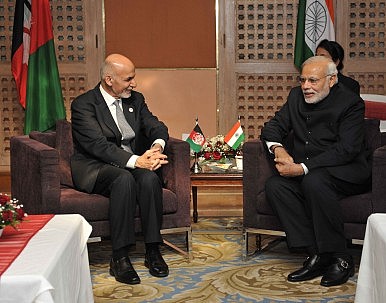
Prime Minister Narendra Modi of India meets President Ashraf Ghani of Afghanistan on the sidelines of 18th SAARC Summit at Kathmandu (November 26, 2014).

Afghanistan’s rapprochement with Pakistan was short-lived, confirming the expectations of many who suspected that Ghani would be unable to keep at bay the interests in Pakistan that have historically sought to sow instability and violence in Afghanistan. The first troubling signs were that Pakistani Prime Minister Nawaz Sharif and Ghani managed to agree to a formal counter-terrorism cooperation mechanism that would see Afghanistan’s National Directorate of Security liaise with Pakistan’s Inter-Services Intelligence.
Ghani’s first mistake was trusting Pakistan’s civilian leadership to speak on behalf of the country’s military-intelligence apparatus. As has been the case throughout most of Pakistan’s history, foreign and security assurances delivered by civilian leaders are subject to the fickle whims of the country’s military establishment.
To credit Ghani, the arrangement with Pakistan was never entirely comfortable. Critical voices in Afghanistan cried foul when the arrangement for counter-terrorism cooperation was announced, but it was an attempt by the new government in Afghanistan to seek peace. After all, peace talks with the Taliban would be dead-on-arrival without Pakistan’s support.
Tragically, three months after announcing that the ISI and NDS would cooperate, in August 2015, Ghani found himself mourning the victims of devastating attacks in Kabul which claimed nearly 60 lives. The president, who had months earlier reached out to Islamabad, minced few words in response, accusing Pakistan of sending “messages of war.” He continued that the events in Kabul showed “that suicide bomber training camps and bomb-producing factories which are killing our people are as active as before in Pakistan.”
To make matters worse, the August attacks came weeks after the Taliban publicly revealed that Mullah Mohammed Omar, the group’s supreme leader and Amir al-Mumineen (Commander of the Faithful), had been dead for two years. The news sparked a short-lived succession crisis, which temporarily raised the question of whether Omar’s successor was beholden to Pakistan’s intelligence apparatus in the same way that Omar had been.
Ultimately, Mullah Mohammed Akhtar Mansoor, Omar’s erstwhile second-in-command, prevailed. Mansoor had been pulling the strings and issuing orders in Omar’s name for two years and carried forward the Taliban’s cooperation with Pakistan.
Following these developments, the Pakistan-backed peace talks with the Taliban, which were sponsored by both China and the United States, have stalled. Additionally, the fall of Kunduz, Afghanistan’s fifth largest city, in late-September emphasized the Taliban’s reversion to bold and ambitious insurgency, determined to seize territorial control of strategic nodes of Afghan territory.
The fall of Kunduz was perhaps the final straw for Ghani, causing him to fundamentally reevaluate his approach to regional diplomacy with Afghanistan’s South Asian neighbors. Incidentally, Kunduz fell to the Taliban nearly exactly a year after the formation of the national unity government and the signing of the Bilateral Security Agreement (BSA) with the United States. (Another significant development during these months is the arrival of the Islamic State in Afghanistan, which announced itself in April 2015 with a deadly bombing in Jalalabad.)
Ghani’s misguided attempt to forge a workable relationship with Pakistan cost India and Afghanistan a “lost year” that could have otherwise seen real strategic progress. In May 2014, Narendra Modi was elected with a bold vision for India’s neighborhood diplomacy. While economic and cultural interactions between Kabul and New Delhi continued, Afghanistan lost interest in acquiring Indian arms.
After all, any serious attempt at engagement with Pakistan would necessitate a freeze in strategic and military rapprochement with India. For Pakistan, Afghanistan is a zero-sum game with India.
Earlier this month, Ghani delivered the clearest signal yet that his brief and ill-fated experiment with Pakistan was over. In early November, reports suggested that Kabul would formally request four attack helicopters from India to bolster the capabilities of the Afghan National Army against Taliban militants.
Afghan National Security Adviser Mohammad Hanif Atmar and Afghan Deputy Foreign Minister Hekmat Khalil Karzai arrived in New Delhi shortly thereafter to finalize the deal. Over the weekend, Indian reports confirmed that four Russian Mi-25 attack helicopters will be transfered from the Indian Air Force to Afghanistan. The delivery will come as soon as January 2016. Karzai, the former Afghan president’s cousin, said that the visit had the overarching objective of “operationalizing” the 2011 India-Afghanistan Strategic Partnership Agreement.
Beyond the Limits
For Indian Prime Minister Narendra Modi’s government, the deal demonstrates a willingness to take India’s policy toward Afghanistan beyond the limits that had prevailed during the previous government’s era. Under the United Progressive Alliance-led coalition government, India had approved support and training activities for the Afghan army and security forces, but had stopped short of providing lethal support.
The closest it got was a May 2014 deal with Russia to finance military equipment, including artillery, tanks, and armored vehicles, that would be delivered to Afghanistan. In late April 2015, just before Kabul announced its counter-terrorism cooperation arrangement with Pakistan, India transfered three light utility, multi-role helicopters.
The transfer of three Mi-25 attack helicopters won’t be a game-changer by any means, either for Afghanistan’s fight against the Taliban or for its relationship with India in the short-term. What it does suggest is the Ghani government is close to picking up the Karzai approach to Afghanistan’s bilateral relationship with India.
Before exiting the national stage, Karzai, on multiple occasions, presented a frank wish list of military hardware to his interlocutors in New Delhi. As one high-ranking foreign ministry source in India told The Diplomat in 2013, “Kabul’s wish list keeps on growing every time and before committing to anything we have to keep the larger regional interest and peace in mind.”
The latter part of the statement, parsed in the context of India’s restrained approach toward Pakistan, applies less to the current government in New Delhi. As I’ve noted elsewhere, Modi’s own attempt at pursuing constructive dialogue with Nawaz Sharif has fallen flat, taking South Asia’s most important and bitter bilateral back to square one.
For India and Afghanistan, for the first time in recent memory – and certainly for the first time since both Modi and Ghani have been in charge – there is a sense that the door for expanded strategic and military cooperation is open. What is still unknown is if New Delhi and Kabul are willing to expand their cooperation independent of their respective relationships with Islamabad.
These developments have consequences for the United States as well. After the fall of Kunduz, Washington has reconsidered its timetable for complete withdrawal from Afghanistan. If the transfer of lethal equipment from India to Afghanistan becomes a habit, the United States should be supportive.
Additionally, though the United States’ track record is shaky on this front, Washington can seek to keep Pakistan’s military in line with deftly structured incentives. For instance, the U.S. Department of Defense has somewhat realigned the Pakistani military’s domestic counterinsurgency efforts with a credible threat to withhold certification that it has adequately focused its efforts on the Haqqani network, thereby threatening a $300 million Coalition Support Fund (CSF) reimbursement tranche.
Pakistan’s chief of army staff, General Raheel Sharif, arguably the most influential man in the country when it comes to driving its foreign and security, spent the past week in the United States, discussing Afghanistan and other issues with U.S. officials. With reports just weeks before his arrival in Washington that India would transfer attack helicopters to Afghanistan, it is not unlikely that the issue came up during his meetings with U.S. officials ranging from Secretary of State John Kerry, Secretary of Defense Ashton Carter, Vice President Joe Biden, CIA Director John Brennan, Army Chief of Staff General Mark Milley, and his effective counterpart in the U.S. military, General Joseph Dunford, the chairman of the joint chiefs of staff.
After the brief fall of Kunduz, the future of Afghan security, particularly in the country’s hinterlands, has come under question. India can no doubt play a much greater role as a net provider of security in the country, but both countries will need to seize the opportunity that exists today.
A sensible move for the Indian government now, to demonstrate that it is serious about maintaining momentum in the bilateral, would be for the prime minister to visit Kabul. Fortunately, this appears to be in the works. The India-Afghanistan bilateral will be one to watch in 2016.

Video Report - Displaced In Pakistan Protest End Of Food Aid

A Christian Television Station set on fire in Pakistan


A Pakistani Christian Television Channel named “Gawahi” was set on fire by some masked men destroying studios, computers, Bibles, cable network equipment and furniture on night of November 24, 2015.

The Gawahi Television was broadcasting Bible teachings, Hymns, Sermons and Christian youth evangelism attracting millions of viewers on which it was under constant threat by Muslim radicals which were brought in notice of Karachi administration.

The Gawahi TV Channel building was located in South District of Karachi in an area where Christians are living in large number surrounded by Muslim majority.

To enter in populous Christian locality and burnt down building of Gawahi TV Station points out that culprits were trained who picked their target in middle of night on 2;30 am on November 24, 2015, and destroyed it.

As military operation is going on in Karachi and in presence of Pakistan Rangers and police in city setting on fire Christian Television building proves that Christian life and property ‘No Matters” for any law enforcement agency.

As PCP is filing this story, not any officer from Pakistan Rangers or Police have visited burnt down Gawahi TV building nor any culprit is arrested involved in incident.

Dr. Nazir S Bhatti, President of Pakistan Christian Congress PCC have strongly condemned setting on fire the building of Gawahi TV Channel and demanded arrest of culprits involved in sad incident.

“It is surprising that Pakistani Electronic media owned by Muslims have again not bothered to cover setting on fire incident of Gawahi TV when minor issues are taken as breaking news by it” said Nazir Bhatti - See more at: http://www.pakistanchristianpost.com/detail.php?hnewsid=5708#sthash.zjATUBA3.dpuf

Pakistan - Violence against Ahmadis flares up in Jhelum

By Dr I Malik 

It is unfortunate that once again minorities are being targeted in Punjab, Pakistan.
On Friday 20th November, after an alleged blasphemy, an inflamed angry mob attacked and set fire to a long established chipboard factory in Jhelum. The complex which included residences was owned by Ahmadis and the assault put their lives at risk.
The allegation of blasphemy, which the Ahmadi community strenuously deny, was used to incite hate by the local religious leaders. The frenzied mob was then instructed by mosque loud speakers to seek revenge and attack the complex. Fortunately no lives were lost on this occasion.
The following day the violence spread to nearby Kala Gujran, where an angry crowd ransacked and burnt furniture from an Ahmadi place of worship, before taking over the property.
This pattern of targeting minorities has become the modus operandi of religious extremists in Pakistan.
In Jhelum the authorities had to call in the Army to control the tensions.
The Ahmadiyya community has suffered decades of religious discrimination and persecution in Pakistan. Last year in Guranjwala, an Ahmadi lady and two children were murdered after their homes were set alight by an enraged mob. In May 2010, 94 Ahmadi worshippers were murdered by terrorists in two Lahore places of worship.
In the past these atrocious acts of violence went unnoticed. However with Twitter, Facebook and Youtube these deplorable acts are shown worldwide within minutes.
I appeal to the Punjab and Pakistan Government to investigate these acts of terrorism and stamp out the hate filled speeches by religious clerics which incite people to violence and take the law into their own hands.
Islam is a religion of peace, it does not allow the killing of innocent people. The religious extremists do not portray the true image of Islam, whether they be ISIS in Syria or a mob from Jhelum.
This comes at a time when Muslims are facing challenging circumstances throughout the world eg. in India, Burma and Israel. Together with rising Islamophobia in North America and Europe. If in Islamic countries like Pakistan we don’t protect the rights of minorities, how can we as Muslims expect to be treated any better in other countries abroad?
If we don’t stand up and speak out against the persecution and murder of the minorities in Pakistan, who knows who these angry mobs will target next?
Quaid-e-Azam Mohammad Ali Jinnah said ‘You are free; you are free to go to your temples. You are free to go to your mosques or to any other places of worship in this State of Pakistan. You may belong to any religion, caste or creed- that has nothing to do with the business of the State’.
All we can do is pray to Allah Almighty for peace and freedom in Pakistan for all citizens. Ameen.
Love for all, hatred for none.


http://blogs.arynews.tv/violence-against-ahmadis-flares-up-in-jhelum/

Meeting Malala: Teen's wish comes true in Birmingham


A teenage boy from Pakistan, with a life-limiting illness, has been flown to Birmingham to fulfil his wish to meet the Nobel Peace Prize winner Malala Yousafzai.
Anwar Ullah, 17, suffers from a rare form of lung cancer. His meeting with Malala was arranged by the Make A Wish Foundation.
The pair spent an afternoon chatting and playing board games.
In 2012, Miss Yousafzai was shot in the head by a Taliban gunman for demanding that girls be allowed to receive an education.
After the visit, Anwar Ullah said, "My dream has come true."

Baluchistan - Educational Emergency: Surab Needs Attention

Adil Nazeer Hassni

Surab, a town of Kalat district, is facing severe educational problems, learnt Balochistan Point.
Surab town is located in central Balochistan with a population of over 90,000 people.
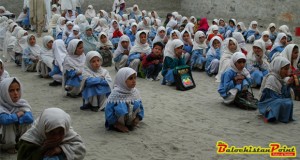
There are only 5 Boys High Schools and Only one Girls high School in Surab Town.
“Literacy rate of Surab is very low due to Lake of facilities in Schools,” Hashim Ali, a resident of Surab told Balochistan Point. He added, “One School is not enough to fulfill the educational needs of girls.”
Students of Surab town also express their disappointment with education facilities provided by the government.
“We are being deprived of our right to receive education due to lack of availability of proper educational infrastructure in Surab,” Khair Baksh, a student told Balochistan Point.
In a period where government of Balochistan has imposed educational emergency, Surab does not seem to be beneficiary in anyway.
Dropout ratio of students from schools in Surab is very high claims a government teacher who requested not to be named. He said that there is no data available but the dropout rate is increasing rapidly.
This claim can be backed up by the fact that large number of school Boys can be seen working at Tea Stalls, Tailoring Shop, Carpenters, workshops and welding shops.
“Lack of access to education has caused an increase in Child Labor activity in Surab,” claimed the government teacher.
Another major complaint by the students is that there is not a single library in Surab to fulfill the needs of students.
Article 25-A of constitution of Pakistan bounds the state to provide free and compulsory education to the citizens under 18 years old.
“Apparently Article 25-A doesn’t apply in Surab or most parts of Balochistan for that matter,” said Nadeem Khan an educationist based in Quetta.
Students, teachers and civil society of Surab have urged government of Balochistan to take urgent measures to improve education by providing necessary facilities.

“Educational emergency would be deemed a farce if government still did not so anything to improve education in Surab,” lamented Khair Baksh.

Pakistan - The arc of climate justice


It is a painful irony of climate change that those least responsible for the problem are often the most exposed to its ravages. And if any country can claim to be the victim of this climate injustice, it is Pakistan. As world leaders prepare to meet at the United Nations Climate Change Conference in Paris, the country is reeling from the after-effects of devastating floods that damaged buildings, destroyed crops, swept away bridges, and killed 238 people.

Such weather-related tragedies are not new to Pakistan; what’s different is their frequency and ferocity. Deadly floods have become a yearly occurrence; in 2010, record-breaking rains killed nearly 2,000 people and drove millions from their homes. Even as Pakistan fights one of the world’s most pitched battles against terrorism, increasingly violent weather is pushing up the cost of food and clean water, threatening energy supplies, undermining the economy, and posing a potent and costly security threat.

There is little doubt that the country’s climatic woes are caused, at least in part, by the greenhouse-gas emissions that industrialised countries have pumped into the air since the beginning of the Industrial Revolution. Even today, Pakistan produces less than one percent of the world’s emissions. Meanwhile, Pakistan is consistently ranked among the countries that are most vulnerable to the harmful effects of climate change, owing to its demographics, geography, and natural climatic conditions. 

From 1994 to 2013, climate change cost Pakistan an average of $4 billion a year. By comparison, in 2012, terrorism in Pakistan resulted in losses of roughly $1 billion. When the country isn’t suffering from floods, it is subject to water shortages, ranking as one of the most water-stressed in the world, according to the Asian Development Bank. And climate change is compounding both problems, wearing away at the glaciers and snowpack that serve as natural regulators of water flow, even as increased erosion caused by flooding contributes to the siltation of major reservoirs.

Meanwhile, rising temperatures are increasing the likelihood of pests and crop diseases, jeopardising agricultural productivity and subjecting the population to increasingly frequent heatwaves. Rising sea levels are increasing the salinity of coastal areas, damaging mangroves, and threatening fish species’ breeding grounds. And higher ocean temperatures are leading to more frequent and dangerous cyclones, endangering the country’s coast.

The outlook for the future is no less alarming: worsening water stress, increased flash flooding, and the depletion of the country’s water reservoirs. By 2040, projections indicate that an average rise in temperatures of 0.5 Celsius could destroy 8-10 percent of Pakistan’s crops.

This burden must not be left for Pakistan to carry alone. Thus far, progress at international climate-change talks has been incremental at best. Fossil-fuel lobbies, reluctant governments in industrialized countries, and disengaged electorates have delayed and obstructed the emergence of a robust agreement to reduce global greenhouse-gas emissions. But while expectations of a breakthrough in the fight against climate change in Paris are optimistic, a push for equitable distribution of the costs of global warming must be made.

Despite an increase in funding for climate adaptation and mitigation in the developing world, Pakistan’s share has remained tiny, relative to the disasters it has suffered in the last five years alone. By 2050, the average annual cost of climate-change adaptation in Pakistan will be $6-14 billion, according to the UN Framework Convention on Climate Change. Mitigation will run another $17 billion per year.

As climate change continues to take its terrible toll, Pakistan cannot allow the billions of dollars in damages it suffers at the hands of the world’s largest polluters to go uncompensated. Whatever the ultimate agreement in Paris, climate negotiators must ensure that the accrued losses resulting from global emissions are borne fairly and do not remain the sole burden of those suffering the greatest harm.

As one of the world’s smaller polluters, Pakistan is well within its rights in seeking resources and funds to cope with the impact of problems for which it is not responsible. So are many other countries. Our demand for a binding international mechanism to distribute the burden of climate change – a mechanism to ensure climate justice – must not go unheeded in Paris. 

Pakistani jihadists are filling the ranks of IS - Pie in the sky

By Dr Mohammad Taqi 


Many of the Pakistani jihadists are filling the ranks of IS, which is making its presence increasingly felt in eastern Afghanistan.
Pakistan’s Chief of Army Staff (COAS), General Raheel Sharif, recently completed a tour of Washington, DC. Meetings with the vice president, Joe Biden, and deputy national security advisor of a lame duck administration were then dubbed as the high-water mark of the visit. Despite the ritual welcome that the Pakistani entourage received, one area they still may have managed to promise the US some pie in the sky is the Afghanistan issue and talks with the Afghan Taliban. The director of the Inter-Services Public Relations (ISPR) said on social media that the COAS had emphasised to US officials the “requirement of a conducive environment for re-initiating the Afghan peace process”. The ISPR director also brushed aside concerns about Islamic State (IS) in Iraq and Syria aka Daesh (Arabic acronym) getting a toehold in Pakistan, saying, “There is zero tolerance for Daesh in Pakistan. Even Daesh’s shadow will not be allowed in Pakistan.” Both comments are, prima facie, heartening, unless one looks closely at what is happening on the ground.

Just as the Pakistani delegation was leaving Washington DC, dozens of corpses were being brought into the Lower Dir region of Khyber Pakhtunkhwa from Afghanistan. At least 22 bodies were buried in Timargarah in a funeral attended by hundreds if not thousands, including some elected officials from Dir. A nazim (mayor), Sahibzada Fasihullah, from Upper Dir confirmed his participation in the funeral to Voice of America’s (VOA’s) Pashto service, Deewa radio. Video clips from the funeral available on social media show that the coffins were wrapped in the flags of a jihadist outfit called al Badr and bore its name. The assembled crowd chanted “sabeelona, sabeelona al-jihad, al-jihad” (our path is jihad). Several Pakistani and local media outlets confirmed that the militants had been killed in a US and/or Afghan security forces strike inside Afghanistan and were then brought to their home area for burial. Al Badr is said to be associated with both the Kashmir-oriented jihadist outfit Hizbul Mujahideen as well as Gulbuddin Hekmatyar’s Hizb-e-Islami Afghanistan. Afghan officials have put the number of Pakistani jihadists killed at upwards of 50.

The Pakistani government and military officials have remained mum over the incident so far but this certainly cannot be the ‘conducive environment’ that is supposed to expedite talks, let alone peace in Afghanistan. Whether or not there is official patronage for such large infiltration of Pakistani jihadists into Afghanistan, it is worrisome for both the countries on multiple counts. Pakistan has generally been patted on the back for the Zarb-e-Azb Operation but that does not mean it should get a free pass for dispersing the hornets into the neighbour’s yard after eliminating their nest at home. A more stringent view is that such dispersal has been taking place by design. In either case, the involvement of Pakistani jihadists first in Kunduz and now in Khost will further sour an already tenuous relationship between the two countries. An even more alarming issue is that many of the Pakistani jihadists are filling the ranks of IS, which is making its presence increasingly felt in eastern Afghanistan. After all, the notoriously brutal thugs from the Tehreek-e-Taliban Pakistan (TTP), Abu Omar Maqbool Khurasani aka Shahidullah Shahid, Hafiz Saeed Orakzai, Hafiz Daulat Khan, Maulana Gul Zaman, Mufti Hassan and Khalid Mansoor Khurasani pledged allegiance to IS a little over a year ago. Shahidullah Shahid and Gul Zaman were killed in US drone strikes but others like Commander Gul Bali, Abu Bakr and Huzaifa have joined more recently.

It is irresponsible in the extreme to look the other way when these assorted terrorists who had previously operated in Kurram, Orakzai, Bajaur and Khyber tribal agencies, and settled areas like Dir and Peshawar, cross over into Afghanistan and when their corpses are brought back and buried amidst jihadist fanfare. Pakistan should be worried for its own sake if not for Afghanistan’s. The TTP after all was executing people in IS style six years before there was an IS. The fact is that there is enough ideological substrate and abundant manpower for IS to recruit from. IS might not be able to launch a full fledged insurgency in Pakistan or Afghanistan yet but it could certainly unleash havoc if both countries let their guard down. And if not checked in time, IS could replicate the deadly success of its predecessor and now competitor, al Qaeda. The blowback from letting al Qaeda figures like Osama bin Laden and Abu Masab al-Zarqawi have a thoroughfare via Pakistan a couple of decades ago was horrible but letting IS types through would be much worse. Doctrinal differences between the Salafist al Qaeda and predominantly Deobandi local Taliban did not keep them from making a deadly common cause and they sure will not prevent IS Salafists from doing so too. And that is not counting the mega Salafi project of Jamatud Dawa (JuD) and Lashkar-e-Tayyaba (LeT), who actually share antecedents with IS and have been making their own incursions into Afghanistan.

A political solution in Afghanistan would help Pakistan as much as it would help Kabul. With the decades of radicalisation manifesting itself such as in the mob burning down Ahmedi property and a place of worship in Jhelum last week, Pakistan can ill afford transnational jihadists jumping into the fray again. Also evident in Jhelum was the Pakistani state’s abject lack of will and capacity to stop the brutal battering of a minority community. The failure of the Pakistani state to enforce its writ against just a horde was as unmistakable as the misery of the Ahmedis. Pakistan’s National Action Plan (NAP) against terrorism lay in tatters in Jhelum and Timargarah. The ideological tinderbox of jihadism clearly remains as brimming as ever and it would be suicidal to allow various militants to consort together and regroup along the Durand Line. It is fine to talk about helping Afghanistan negotiate with the Taliban but unless there is a crackdown on the influx of the slew of jihadists making their way into that hapless country, it is all just pie in the sky.

Chairman PPP Bilawal Bhutto telephoned Col (R) Mukhtiar Ahmed, father of Pakistan’s First Shaheed Female Flying Officer Marium Mukhtiar Shaikh

Chairman Pakistan Peoples Party Bilawal Bhutto Zardari telephoned Col (R) Mukhtiar Ahmed, father of Pakistan’s First Shaheed Female Flying Officer Marium Mukhtiar Shaikh who embraced martyrdom on a mission when a PAF trainer jet crashed near Kundian, Mianwali.
Bilawal Bhutto Zardari condoled with Col (R) Mukhtiar Ahmed Shaikh and expressed his sympathies with him and all family his members.
Pakistan Peoples Party Chairman said that not only the family of martyred Marium Mukhtiar Shaikh but whole nation is proud of your brave daughter.
Bilawal Bhutto Zardari told him that he knows the grief and pain of you and your family members but Shaheed never dies, they always remain alive.

https://mediacellppp.wordpress.com/2015/11/26/chairman-ppp-telephoned-col-r-mukhtiar-ahmed-father-of-pakistans-first-shaheed-female-flying-officer-marium-mukhtiar-shaikh/

Miss Pakistan USA on a mission to change image of Pakistani women


It takes more than just tiaras, gowns and stilettos to win hearts and Sarish Khan tells us exactly how she does it.
The 26-year-old American beauty of Pakistani origin is the current title holder of Miss Pakistan USA. A student at George Mason Law School in DC, she not only represents the refined class of Pakistani beauties, but also their intellect on a global platform.
But it comes as a surprise to know that this mélange of beauty and brains was a complete stranger to the word ‘pageant’ some time back.
Speaking to The Express Tribune, Sarish revealed what inspired her to compete for the title. “I hadn’t watched a pageant in my life until I heard all the chatter about Nina Davuluri, the first Miss America of Indian descent to win the title,” she said.
That led her to think, “if a pre-med student can put India on a global platform then what’s stopping a Pakistani law student from following suit?”
The desire to place her community’s women in a positive light, transcending the domains of law, entertainment and philanthropy, led her to look for possible options. That’s when she was first introduced to the title of Miss Pakistan USA.

PHOTO: PUBLICITY
Sarish had been an active member of the South Asian community in DC and was aware of the fact that winning the coveted title would bring her more responsibilities. “The moment they announced my name, I knew my world was about to change as my responsibilities would escalate tremendously,” she said.
And that made her stand even taller. “I am not just a beauty queen without a purpose,” said Sarish while sharing, “I aim to bring to light the diversity and adversity in the Pakistani community — particularly for women — in America and across the globe.”
She currently serves as a Women Empowerment Ambassador for a non-profit organisation, Comprehensive Disaster Response Services. Previously, she worked for USAID on an Education Crisis project in Karachi for almost a year that involved some eye-opening experiences in critical areas of Lyari and Korangi.
Sarish’s family and friends were supportive of her decision to participate in the pageant. Although she was met with a few reservations, she managed to convince them through her aims. “I was able to overcome their doubts by representing myself positively during the pageant,” she said.
Winning the title as a Muslim and a Pakistani in an American society hasn’t limited her abilities as she has received an overwhelming response from people. “I’ve always known that I’m different. I’m Pakistani, I’m American, I’m Muslim, and I’m a woman. With each title, comes its own responsibility,” she said.
“My diversity is the strength to promote equality through each title I hold,” she added.
One wouldn’t doubt Sarish’s talent as she belongs to the family of legendary actors Sabiha Khanum and Santosh Kumar, her maternal grandparents. The pageant winner aspires to follow in their footsteps.
“I didn’t grow up dreaming to be an actor because my mother wanted education to be my primary focus,” said Sarish.
“Now, that I am about to finish law school, I have started taking acting classes here [US] and plan to break into the Pakistani entertainment industry once I gain some experience,” she added.
But that does not mean she will give up on her law career. She believes that even as an actor one “has to deal with entertainment contracts and copyright issues.” She has plans to practice as a litigation attorney.
Besides her services in the American community, Sarish hopes “to be an agent of change for gender equality in Pakistan.”
She believes that the role of a man, rather than a woman, needs to change in our society. “We live in a world where women aren’t just homemakers, but also breadwinners. It is about time their male counterparts share responsibilities at home as well,” said Sarish.