Saturday, November 21, 2015

Military Reviews U.S. Response to ISIS Rise

By MATT APUZZO, MARK MAZZETTI and MICHAEL S. SCHMIDT
When Islamic State fighters overran a string of Iraqi cities last year, analysts at United States Central Command wrote classified assessments for military intelligence officials and policy makers that documented the humiliating retreat of the Iraqi Army. But before the assessments were final, former intelligence officials said, the analysts’ superiors made significant changes.
In the revised documents, the Iraqi Army had not retreated at all. The soldiers had simply “redeployed.”
Such changes are at the heart of an expanding internal Pentagon investigation of Centcom, as Central Command is known, where analysts say that supervisors revised conclusions to mask some of the American military’s failures in training Iraqi troops and beating back the Islamic State. The analysts say supervisors were particularly eager to paint a more optimistic picture of America’s role in the conflict than was warranted.
In recent weeks, the Pentagon inspector general seized a large trove of emails and documents from military servers as it examines the claims, and has added more investigators to the inquiry. The attacks in Paris last week were a deadly demonstration that the Islamic State, once a group of militants focused on seizing territory in Iraq and Syria, has broadened its focus to attack the West. The electronic files seized in the Pentagon investigation tell the story of the group’s rise, as seen through the eyes of Centcom, which oversees military operations across the Middle East.
The exact content of those documents is unclear and may not become public because so much of the information is classified. But military officials have told Congress that some of those emails and documents may have been deleted before they had to be turned over to investigators, according to a senior congressional official, who requested anonymity to speak about the ongoing inquiry. Current and former officials have separately made similar claims, on condition of anonymity, to The New York Times. Although lawmakers are demanding answers about those claims, it is not clear that the inspector general has been able to verify them. A spokeswoman for the inspector general declined to comment.
Staff members at the House Permanent Select Committee on Intelligence are also poring over years of Centcom intelligence reports and comparing them to assessments from the Central Intelligence Agency, the Defense Intelligence Agency and others. The committee is not just examining reports about Iraq, Syria and the Islamic State, but also about Afghanistan and other areas under Centcom’s purview. The insurrection inside Centcom is an important chapter in the story of how the United States responded to the growing threat from the Islamic State. This past summer, a group of Centcom analysts took concerns about their superiors to the inspector general, saying they had evidence that senior officials had changed intelligence assessments to overstate the progress of American airstrikes against the Islamic State, also known as ISIS.
The analysts said problems in Iraq were rooted in deep political and religious divides that could not easily be solved with a military campaign, current and former officials have said. Yet Centcom’s official posture remained generally upbeat.
It is not clear whether the Centcom assessments significantly changed the Obama administration’s views about ISIS. While Centcom was largely positive about American gains, other agencies have been more pessimistic. The White House has generally been measured in its assessments.
But President Obama and senior intelligence officials have acknowledged that the Islamic State’s rapid emergence caught them by surprise. At the least, the prospect that senior officials intentionally skewed intelligence conclusions has raised questions about how much Mr. Obama, Congress and the public can believe the military’s assessments.
Those questions have taken on a new urgency since the terror attacks in Paris, which signaled a new determination by ISIS to carry out terror attacks beyond the territory in Iraq and Syria it has declared its “caliphate.” Pressure has grown on the White House to articulate a more muscular strategy for dismantling the group, and a chorus of Republican lawmakers and presidential candidates are calling for an American ground campaign in Syria.
Senior lawmakers have begun their own inquiries into the military’s intelligence apparatus. Representative Mac Thornberry, the Republican from Texas who is chairman of the House Armed Services Committee, said in an interview that his committee was examining intelligence assessments from Centcom and other military commands to see if there was a systemic problem of dissenting voices being muffled by senior military commanders.
“Any time there is an allegation that intelligence is being shaved in a certain way, or distorted in a certain way, that’s a cause for serious concern,” he said.
Mr. Thornberry said that Congress has to be careful not to impede the progress of the inspector general’s investigators, but that lawmakers “also have a job to do.” On Thursday, Foreign Policy reported that a group of Republican lawmakers will be focusing on whether Centcom also skewed intelligence assessments about Afghanistan. Representative Devin Nunes of California, the Republican chairman of the House Permanent Select Committee on Intelligence, has been eager to expand his panel’s inquiry into the Centcom assessments. Mr. Nunes is planning to send a letter to the inspector general on Monday asking if emails and documents relevant to the investigation have indeed been deleted. He is also asking for copies of any deleted materials that investigators might be able to retrieve from Centcom servers.
For the moment, Mr. Nunes is making the request without the support of his Democratic counterpart, Representative Adam B. Schiff of California. Mr. Schiff said questions about skewed intelligence needed to be taken “very seriously,” but that the inspector general should be allowed to finish the inquiry before the House intelligence committee considered expanding its own investigation. The committee has asked the Pentagon for permission to interview officials, including the two most senior intelligence officers at Centcom, Maj. Gen. Steven Grove and his civilian deputy, Gregory Ryckman. The request was denied by Pentagon officials, citing the ongoing internal investigation.
That investigation was prompted by complaints this past summer from Centcom’s longtime Iraq experts, led by Gregory Hooker, the senior Iraq analyst. In some ways, the team’s criticisms mirror those of a decade ago, when Mr. Hooker wrote a research paper saying the Bush administration, over many analysts’ objections, advocated a small force in Iraq and spent little time planning for what would follow the invasion.
Lawmakers originally said that the Centcom investigation would be completed in weeks. But Pentagon investigators have found the work painstaking and it could span months. In addition to determining whether changes were made to intelligence reports — and if so, who ordered them — the investigators, like the staff members of the House intelligence committee, are studying reports from other intelligence agencies produced at the time to determine what was actually occurring in Iraq and Syria when the reports were written.
Col. Patrick Ryder, a Centcom spokesman, said that the command welcomed the inspector general’s oversight and would respond to requests from Congress for information, and that Gen. Lloyd J. Austin III, the Centcom commander, would “take appropriate action once the investigation results have been received and reviewed.”

Video - Hillary Clinton Rally at Fisk University Nashville TN. 11/20/15

Refugees Must Not Be Turned Away, Obama Says


By MICHAEL D. SHEAR

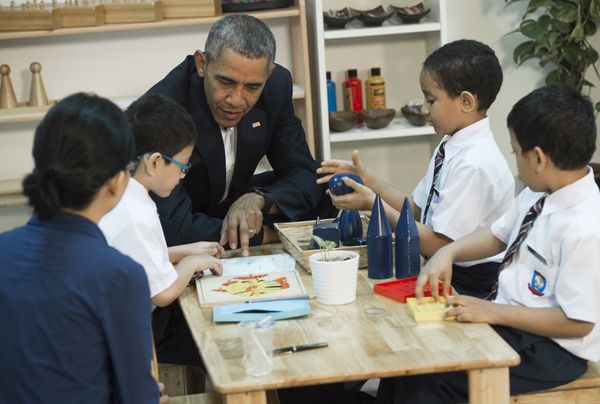
President Obama vowed on Saturday to keep America’s borders open to the world’s refugees “as long as I’m president,” even as he met with child migrants and refugees here and his administration refused to yield in a long-distance feud with his critics over the issue.
Mr. Obama chatted with elementary-school-age children, all sharply dressed in navy-and-white uniforms, at a humanitarian center that serves young people who have fled violence in Myanmar, Pakistan, Syria, Iran and elsewhere.

They were representative of the faces of all the world’s persecuted minorities, the president said, adding that such children must not be turned away by countries like the United States because of what he insisted was an unfounded fear of a terrorist threat from their presence.
“They were indistinguishable from any child in America,” Mr. Obama said after kneeling to look at their drawings and math homework. “And the notion that somehow we would be fearful of them, that our politics would somehow leave us to turn our sights away from their plight, is not representative of the best of who we are.” A 10-day trip by the president to Turkey and Asia has been overshadowed by a relentless clash with governors, lawmakers and Republican presidential candidates about whether to block the entry of Syrian refugees into the United States.
In the wake of the terror attacks in Paris, House lawmakers this week passed bipartisan legislation to drastically tighten screening for refugees seeking to enter the United States from Syria. Calls for restrictions on Syrian refugees have echoed across the political landscape, from Republican presidential hopefuls and governors to many lawmakers from the president’s own party. The president and his aides have condemned what he called on Thursday a “spasm of rhetoric” among politicians. He accused Republicans in the United States of cowardice for seeking to block Syrian children and families who are fleeing the violent civil war in their country. “Apparently, they’re scared of widows and orphans coming into the United States of America as part of our tradition of compassion,” Mr. Obama said on Wednesday, adding a moment later: “That doesn’t sound very tough to me.”
As Mr. Obama has participated in a series of economic summit meetings on this trip, White House officials have repeatedly sought to emphasize what they say is a comprehensive screening process for Syrian refugees that takes up to two years and includes interviews and biometric data to ensure that terror suspects do not enter the United States. In the president’s weekly radio address, taped by Vice President Joseph R. Biden Jr. and released on Saturday morning, Mr. Biden insisted that refugees from Syria face “the most rigorous screening” of anybody entering the United States. “First they are fingerprinted, then they undergo a thorough background check, then they are interviewed by the Department of Homeland Security,” Mr. Biden said. “And after that, the F.B.I., the National Counterterrorism Center, the Department of Defense and the Department of State, they all have to sign off on access.”
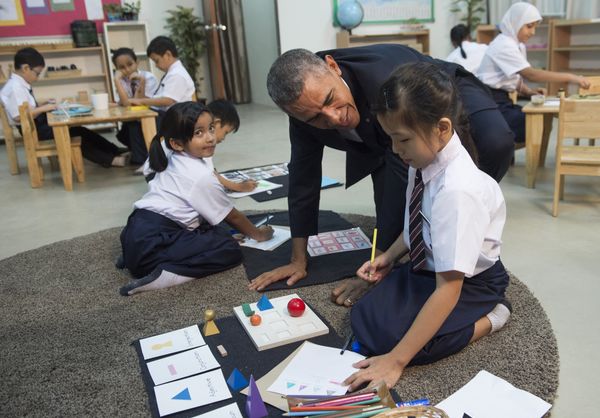
Administration officials have also sought to change the subject, telling reporters during the president’s flight from the Philippines to Malaysia on Friday that the White House was open to discussions with lawmakers about tightening security for a separate program that reduces visa requirements for millions of people visiting the United States from certain countries. But the White House efforts have done little to quell the anxiety back home. The House bill increasing security for the refugee program passed by a vote of 289 to 137, with nearly 50 Democrats supporting it. That is a margin that might allow lawmakers to override Mr. Obama’s promised veto if the bill also passes in the Senate. At the Dignity for Children Foundation in Kuala Lumpur on Saturday, Mr. Obama knelt to talk to several children as photographers and television cameras captured the broad smiles on their faces.
“What’s your favorite subject?” he asked, squatting beside a girl seated on a gray shag rug. “Do you know what you want to be when you grow up?” The girl said she liked math and wanted to be an engineer when she grew up, prompting Mr. Obama to say, “You’re going to be an excellent engineer.” Most of the children at the center were members of the Rohingya minority who have fled persecution, discrimination and ethnic violence in Myanmar, officials said. White House aides said the United Nations had documented more than 153,000 refugees and asylum seekers in Malaysia, but they said the images of Mr. Obama in the center were designed to highlight the plight of refugees across the globe. In his remarks, the president said he hoped the recent elections in Myanmar, where Daw Aung San Suu Kyi’s National League for Democracy won in a landslide, would help ease the humanitarian crisis in that country. In the meantime, he said, “The refugees from Myanmar — again, mostly Rohingya, mostly Muslim — those young children up there, they’re deserving of the world’s protection and the world’s support.”
More broadly, he said, the United States should not turn its back on children from all over the world. He said America’s role as a global leader was defined by its willingness to help people who have been discriminated against, tortured or subjected to violence. “That’s American leadership,” Mr. Obama said. “That’s when we’re the shining light on the hill. Not when we respond on the basis of fear.” Mr. Obama is scheduled to return to the United States on Monday, when he is likely to face more debate about the refugee issue. He is also scheduled to meet on Tuesday with President François Hollande of France to discuss the terror attacks in Paris. Before leaving Asia, Mr. Obama spent some time on Saturday telling business leaders that the Trans-Pacific Partnership trade deal negotiated by 12 nations, including the United States, will improve the economy and security of Southeast Asia.
Speaking to a business group before heading to the humanitarian center, Mr. Obama said he remained confident that Congress would approve the deal. And he said that nations in Asia should quickly do the same. “T.P.P. is more than just a trade pact; it also has important strategic and geopolitical benefits,” he said. “T.P.P. is a long-term investment in our shared security and in universal human rights.” “With T.P.P., we’re not only writing the rules for trade in the Asia Pacific, we also have an historic opportunity to shape the future of the global economy,” he said, adding: “It says that America’s foreign policy rebalance to the Asia Pacific will continue on every front.”

Video - President Obama Speaks at the ASEAN Business and Investment Summit

President Obama says Mali attack stiffens resolve against terrorism


Michael A. Memoli


President Obama said the hostage standoff that claimed at least one American life in Mali on Friday “only stiffens our resolve” to combat the scourge of terrorism.
Before planned remarks on trade Saturday at an economic summit in Malaysia, the president hailed the work of American diplomatic security forces and other American troops who worked with French and United Nations personnel to prevent even further bloodshed after Islamist gunmen stormed a Western hotel in Bamako, the Malian capital.
“Like the heinous attacks we saw in Paris, and the attacks we see all too often elsewhere, this is another awful reminder of the scourge of terrorism that threatens so many of our nations,” Obama said. “Once again this barbarity only stiffens our resolve to meet this challenge. We will stand with the people of Mali as they work to rid their country of terrorists and strengthen their democracy.”
The president arrived in Kuala Lumpur on Friday as he nears the end of a 10-day foreign trip that also included stops in Turkey and the Philippines. The attacks in Paris on Nov. 13 and in Mali have competed for his attention as he has also sought to promote his trade agenda and highlight deepened ties he’s sought to build in southeast Asia.
But Obama signaled in his remarks Saturday morning how his rebalance strategy also serves America’s security interests in the fight against terrorism.
“I’ve seen throughout my trip this week nations around the world, including countries represented here today, are united in our determination to protect our people, push back on the hateful ideologies that fuel this terrorism, and stand up for the universal values of tolerance and respect for human dignity that united us and makes us stronger than any terrorist,” he said. “This is the work that we must do together.”

U.S. Vice President's Weekly Address: In the Face of Terror, We Stand As One

Afghan Music Video - Laili - Az Tu

Afghanistan and Pakistan: The Poisoned Legacy of the Durand Line


By  


Historically, Afghanistan has lain astride the invasion route from central Asia into the Indian subcontinent. It was also the shortest route from central Asia to the Indian Ocean. This was the route that the Persian conqueror Darius I took in 516 BC. Alexander the Great followed suit in 326 BC. In turn they were followed by, among others, Muslim armies under Qutaybs ibn Muslim in 705, by Mahmoud Ghazni of the Afghan Ghaznavid Empire in 1001, Muhammad Ghori of the Ghurid Empire in 1175, and the Mongol, Genghis Khan in 1219.
2015-11-18-1447859099-8510007-Durand_Line_Border_Between_Afghanistan_And_Pakistan.jpgTimur (Tamerlane), during his conquest of northwest India in 1383, took the same route and his descendent Babur, whose grave is in Kabul, also passed through the Khyber Pass on his way to creating the Mogul empire in India in 1526. Ahmad Shah Durrani of the Afghan Durrani Empire followed suit when he attempted to conquer the Punjab in 1748. The last invasion of Afghanistan from central Asia was the Soviet one in 1979. The invasion route ran both ways. The Sikh Empire invaded Afghanistan from the southeast in 1813, and the British fought three wars with the Afghans (1838, 1878, and 1919).
The Himalayas block access from central Asia to the Indian subcontinent and to the Indian Ocean. Their western most extension, the Hindu Kush, is penetrated by the Salang Pass, which separates northern Afghanistan (and Central Asia) from the rest of Afghanistan, and the Khyber Pass through the Spin Ghar Mountains between Afghanistan and Pakistan, in turn an extension of the Hindu Kush. The two passes are the traditional trade and invasion route from central Asia to the Arabian Sea or into the Punjab of north India and from there the rest of the Indian subcontinent. For millennium, Afghanistan has been fought over by would be conquerors, both for its mineral wealth and also for its strategic position at the crossroads of central and south Asia. Even in the technologically driven world of the twenty-first century, geography still matters.
In the nineteenth century, Afghanistan became a pawn in "the Great Game" between the Russian Empire and Great Britain for control of central Asia. As Russia gobbled up one central Asians khanate after another, the steadily expanding Russian Empire began to encroach, in British eyes, dangerously close to British India. In an attempt to preclude any further Russian expansion south, Great Britain twice invaded Afghanistan only to be defeated by a guerilla army drawn primarily from the Pashtun tribes that inhabited the region.
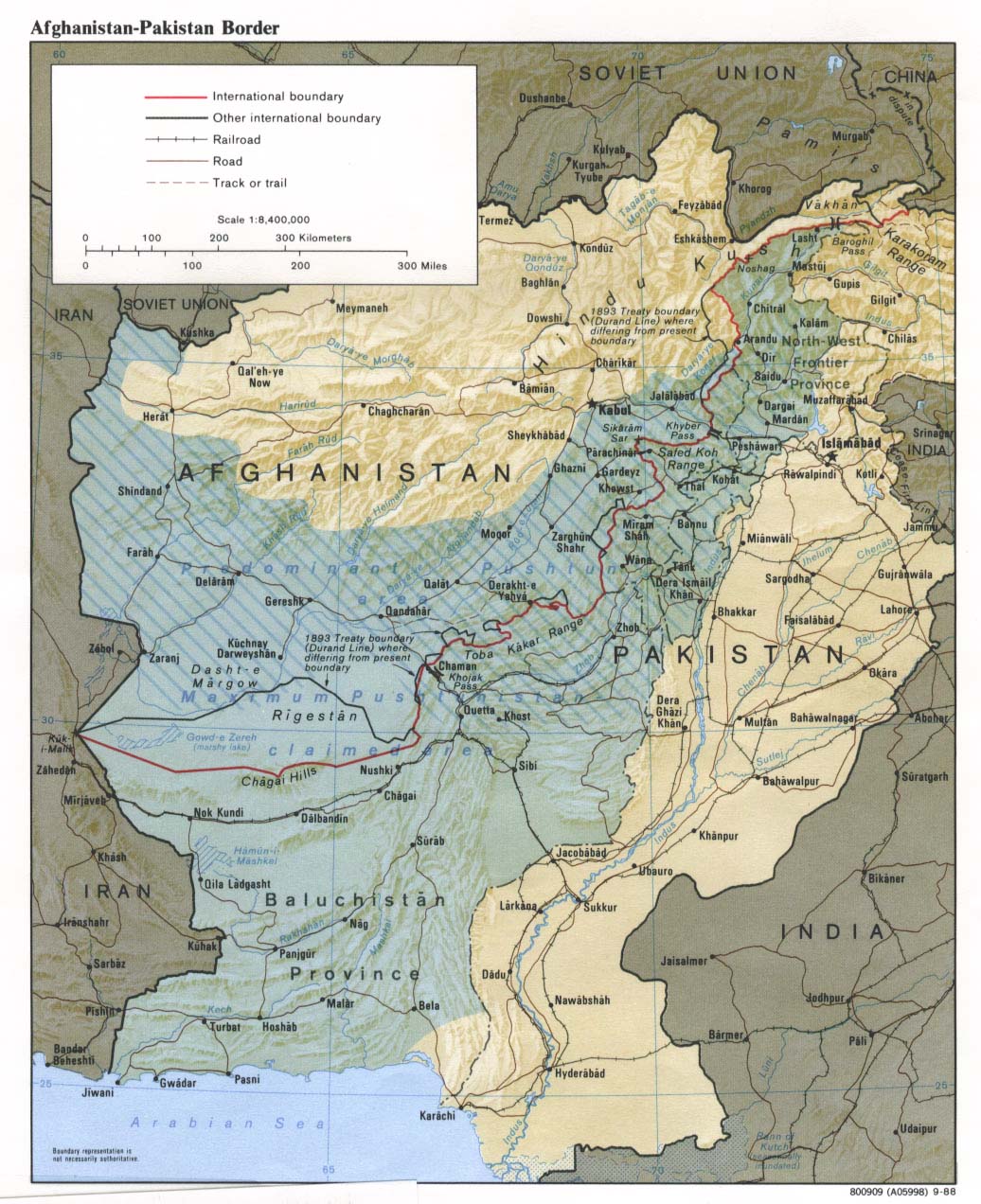
In an effort to secure control of the strategic Khyber Pass, in 1893, Great Britain dispatched a British diplomat, Mortimer Durand, to negotiate an agreement to delineate the border between the Emirate of Afghanistan and British India. The resulting agreement resulted in a frontier that ran from the Karakoram Range in the northeast running south through the Spin Ghar mountains (Safed Koh and Toba Kakar Ranges) before turning west along the Chagai Hills to the border with Iran.
The new border, dubbed the Durand Line, divided the Pashtun tribal lands, a region informally referred to as Pasthunistan in two, with half of the Pashtun tribal region now part of British India and the balance remaining part of Afghanistan. The line also resulted in the loss of the province of Baluchistan to British India, depriving Afghanistan of its historic access to the Arabian Sea. The Durand Line also ensured that there would be a thin strip of Afghanistan running to the Chinese border, thus separating the Russian empire from British India. The Durand Line would become one of the principal issue of Afghanistan's foreign policy for the next century and even now remains at the heart of Afghanistan's relations with Pakistan.
The original agreement was only a page long. The treaty was written in English with copies in Dari and Pashto. The English copy, a language that the Afghan Amir Abdur Rahman Khan could neither read nor understand, Durand insisted, was to be the definitive copy. The 1,584-mile boundary was subsequently delimited between March 1894 and May 1986. The Durand Line precipitated a long-running dispute between the governments of Afghanistan and Great Britain and prompted a third Anglo-Afghan war in 1919. Under British pressure, subsequent Afghan governments reaffirmed the boundary line in additional treaties and agreements in 1905, 1919, 1921, and 1930.

Blue areas indicate historic "Pashtunistan", red line the Durand line border.
The newly formed state of Pakistan inherited the boundary line delineated by the 1893 Durand agreement and upheld by the subsequent treaty of Rawalapindi (1919) that ended the Third Anglo-Afghan war. The government of Afghanistan however has, subsequently, refused to acknowledge that the frontiers represented by the Durand Line were legally binding. In 1947, when Pakistan joined the United Nations, Afghanistan was the only member to vote against its membership. On July 26, 1948, followed two years of steadily deteriorating relations between the two countries, the government of Afghanistan declared that it did not recognize "the imaginary Durand nor any similar line." It also declared that all previous Durand Line agreements, including the subsequent Anglo-Afghan treaties upholding it, were void because they had been imposed on Afghanistan by British coercion.
Moreover, it is widely held in Afghanistan that the original agreement with Great Britain was only for 100 years after which the lands in question would revert back to Afghanistan. The official treaty, however, makes no reference to a specific term. Past Afghan governments have implied that the Dari and Pashto copies of the original agreement specified the 100 year term (1893-1993) and that this provision was deliberately left out by Mortimer Durand in the "official," English language version, of the treaty. No evidence of this contention has ever been produced, however, and it is not clear whether the Dari and Pashto language versions of the original agreement still exist.
The question of the legitimacy of the Durand Line borders has poisoned Afghan-Pakistani relations for the better part of a century. For Afghanistan, the loss of half of the traditional Pashtun territories divided its largest tribal grouping. Moreover, the loss of Baluchistan left it landlocked, without any access to the Arabian Sea and Indian Ocean except through Pakistani territory. For Pakistan, the issue of the Durand Line is an existential one. The territory in question amounts to some 60% of its present sovereign territory.
During the cold war the Afghan-Pakistani dispute was subsumed to the larger Soviet-American rivalry. Pakistan aligned itself with the United States, becoming as founding member of CENTO (Central Treaty Organization), while Afghanistan refused to settle its differences with Pakistan as a precondition of joining CENTO and instead sought diplomatic and military support from India and the Soviet Union. Afghanistan was one of the few "holes" in the ring of containment with which the United States surrounded the Soviet Union. The emergence of Pakistan and Afghanistan as Soviet and American proxies meant that, other for ongoing border skirmishes and covert operations, the larger issue of the Durand Line was left unsettled.
2015-11-18-1447858663-665014-Durrand_First_stage_in_the_Soviet_troop_withdrawal_from_Afghanistan.jpg
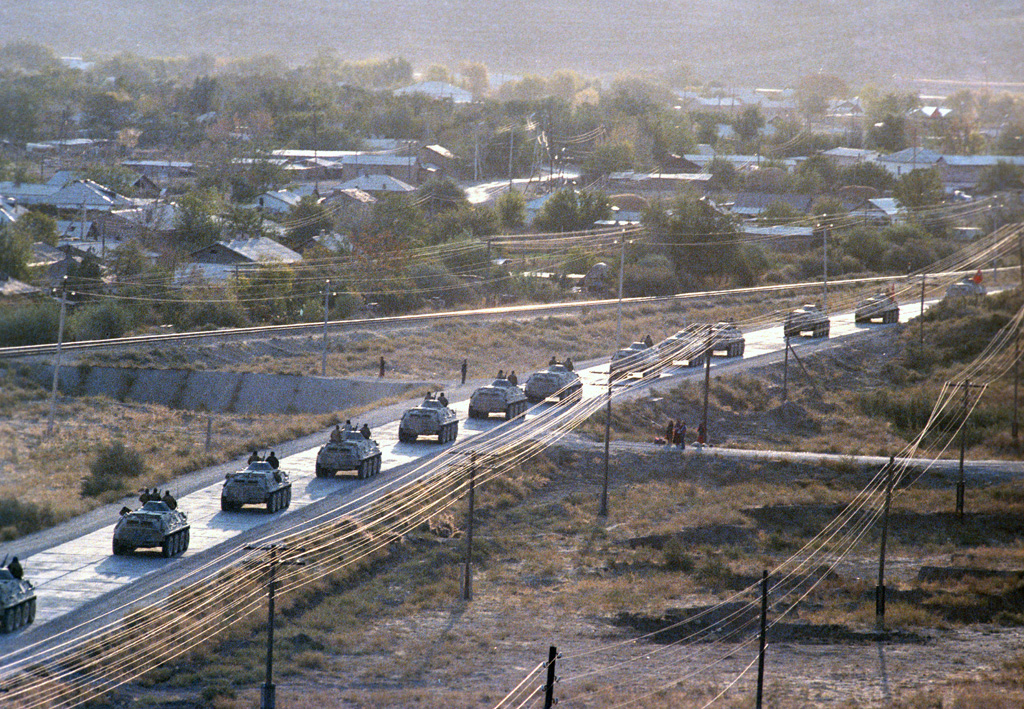
Soviet troops withdrawing from Afghanistan, 1989
The Soviet invasion of Afghanistan in 1979 ushered in a new phase in Afghan-Pakistani relations and laid the foundation for a vastly expanded Pakistani role in Afghanistan's internal affairs. Under the guise of Operation Cyclone, a program funded by the Central Intelligence Agency, Pakistan's Inter-Services Intelligence Agency (ISI) organized large numbers of mujahidin militant groups that it recruited mainly from the Pashtun tribes on its side of the Durand Line. At the time, the government of General Muhammad Zia-ul-Haq had started a program of aggressive Islamization, so the ISI favored militant jihadist groups as Pakistan's (and the United States') proxies in Afghanistan.
American covert funding for the mujahidin began in response to the communist People's Democratic Party of Afghanistan seizure of power in the Saur Revolution and predated the Soviet invasion by six months. The original program was relatively modest and only amounted to about 20 million dollars a year. By 1989, the year the Soviet Union withdrew from Afghanistan, it had increased to over 630 million dollars a year. The U.S. program continued through 1992, but after the Soviet withdrawal financial support quickly declined. Moreover, in October 1990, the Bush Administration refused to certify that Pakistan did not possess nuclear explosive devices, triggering the imposition of sanctions and a suspension of economic assistance and military sales.
Over the course of the program the ISI trained over 100,000 militants to fight the Soviets and Afghanistan's communist government. The CIA funded some 20 billion dollars of expenditures, although some of those funds may have come from contributions of Saudi Arabia and the other Gulf states that were funneled directly to the CIA.
Operation Cyclone has two lasting consequences. First in contributing to the subsequent collapse of the Soviet Union it deprived Afghanistan of its principal patron and supporter. Secondly, it presented to Pakistan and the ISI a model for how it could intervene in Afghanistan's internal affairs. The fall of the Najibullah government in 1992, and the subsequent four years of chaos, would set the stage for the rise of the Taliban in 1996 and create an opportunity for Pakistan's ISI to emerge as both the Taliban's financer, organizer and principal patron. The Taliban, in turn, would give Pakistan's ISI an unprecedented opportunity to exert its control over Afghanistan and its government. An opportunity that Pakistan's government has pursued for the last 20 years.
Ironically, even the Taliban, which is dependent on Pakistani military and financial support for its survival, has refused to accept the legitimacy of the Durand Line. Despite Pakistani pressure, the Taliban, both when it was in power and to the present day, has sided with previous Afghan governments in maintaining that the Durand Line was void.
The result of the ongoing dispute over the legitimacy of the Durand Line has meant that Pakistan has a vested interest in ensuring that the Afghan government never gets strong enough to unilaterally change the current frontier with Pakistan. Given that Pakistan has six times the population of Afghanistan and a formidable military, the only practical scenario under which Afghanistan would regain its disputed territories would only be as a consequence of a complete collapse of the Pakistani government. Most likely as a result of a fourth Indo-Pakistani war, a Pakistani civil war, domestic revolution, or all of the above.
To avoid that possibility, Pakistan continues to rely on an external patron, bouncing back and forth between either China or the United States, as the ultimate guarantor of its security vis-à-vis India. The byzantine complexity of Afghan-Pakistani-Indian relations and the subsequent interest of Russia, China, and the United States in any changes in the status quo means that barring a negotiated settlement for some kind of division of the disputed territories or an Afghan acceptance of the Durand Line in exchange for the end of Pakistani support for the Taliban, either of which are highly unlikely events at the moment, there is no immediate solution to the Afghan-Pakistani dispute over the Durand Line and this issue will continue to complicate the relationship between Afghanistan and Pakistan.
Given that the United States has a vested interest in the establishment of a secure and stable Afghan government and that Pakistan seems determined to use the Taliban and possibly other jihadist groups to ensure that doesn't happen, the issues that surround the Durand Line will continue to have an impact on the formulation of U.S. policy in the region as well as complicate U.S.-Pakistani relations.
The most enduring and destructive legacy of five centuries of European colonialism are borders that were drawn for the sake of political and military expediency but which, given the region's underlying history, culture, and ethnicity, make no sense today. The dispute over the Durand Line is just one more example of an ill-conceived frontier that continues to inflame the long running dispute between Afghanistan and Pakistan and which will shape the region's politics well into the twenty-first century.

Persecution of Christians in Pakistan needs to be recognized

In the wake of rising persecution of Christians in Pakistan, a need to recognize the substantial fact that Christians are being persecuted urged in the British Parliament.

A UK based NGO namely Global Minorities Alliance, GMA as been endeavouring to raise the issues of persecuted Christians in Pakistan. It is necessary to identify the persecution of religious minorities in Pakistan, Global Minorities Alliance said in an appeal note sent to Fides.

About 20 various organizations joined in an effort, to monitor the situation of religious minorities in Pakistan. In a recent hearing of this cause, Global Minorities Alliance presented various cases of persecution of Christians, Hindus, Sikhs and Ahmadis in Pakistan. This hearing was held in British Parliament which was attended by various British leaders also.

Also Read: Pakistani Christians seeking asylum are hopeful of better asylum policy from UK
In the appeal note which Global Minorities Alliance, sent to Fides, it mentioned two terms “discrimination” and “persecution” related to current situation of Christians in Pakistan. The note also mentioned the stance maintained by the Supreme Court of Pakistan in 2014, in which the Apex Court issued directives to the government of Pakistan to take effective steps to protect the religious minorities in Pakistan.

Furthermore, the vice President of Global Minorities Alliance, Shahid Khan urged the European countries to grant asylum to the persecuted Pakistani religious minorities’ members, if they request for it. He urged the European countries to consider the Geneva Convention on Refugees of 1951, which obligates the signatory states grant asylum to those escaping conflict and persecution.
Shahid Khan, condemned the renowned blasphemy law in Pakistan, also mentioned the high profile case of blasphemy accused Pakistani Christian woman, Asia Bibi who is on death row.
Global Minorities Alliance urged the Government of Britain and the governments of other western countries to review their economic relations with Pakistan, urging them to pressurize Pakistan to improve the observance of human rights in the country.

- See more at: http://www.christiansinpakistan.com/persecution-of-christians-in-pakistan-needs-to-be-recognized-a-uk-based-ngo-states/#sthash.d4C1ihxs.dpuf

Pakistan - Globalised terror

By  Afrasiab Khattak


Social scientists are good at studying the anatomy of the past historic events as most of the factors, if not all of them that shaped events, are in their knowledge. But it isn’t possible to predict the shape of things to come as new factors are an unknown commodity until the time of occurrence of fresh events. So after end of the Cold War in the 1990s there was a general hope (or maybe wishful thinking ) for a comparatively more stable and peaceful world where human energy and resources were expected to go into mitigating social and economic  problems faced by mankind. But that was not to be.
To use a Marxist term, new contradictions surfaced almost from the ashes of the old world, leading to the rise of new (or not so new) conflicts. Extremist violence, emerging from the ravages of war in Afghanistan and Middle East, turned into dreadful terrorism on global scale. Terrorism or asymmetrical war is a very old phenomena but the new thing about its recent manifestation is its global character. Like every thing else in a globalizing world it has refused to recognize geographic or state frontiers. It first devastated countries of its origin (but not necessarily having the entire responsibility for its birth) like Afghanistan, Pakistan, Iraq and the latest one Syria. But subsequently the terrorist cancer could penetrate in to countries considered to be immune to such a menace in the past. The 9/11 terrorist attacks in the US and the earth shaking response of the then sole super power in a unipolar world changed the world for ever. As if that was not enough other countries also faced similar spectacular terrorist attacks that came to be known as their 9/11s (UK had 07/07 and India’s was 26/11).
The most recent one is the devastating terrorist attack in Paris on November 13 that led to a heart wrenching blood bath. Unfortunately, the first two decades of the 21st century are mainly defined by the dates of horrible terrorist attacks taking place in one country after another.
Complex socio-historical factors have gone into the making of the present phenomenon of globalized terrorism and it is not easy to explain it in all its manifestations. It is also obvious that any effort at analyzing its causes would be almost impossible without getting into the blame game. But despite these odds such an effort is indispensable for eliminating the root causes of this scourge to avoid its occurrence in the future. Socio-economic development in the world has unfortunately been uneven and in many cases even unfair. Economic deprivation coupled with political oppression lead to serious depression, hopelessness and alienation paving ground to abnormal behavior. Ghettoisation of entire ethnic or religious communities along with identity crises creates conducive conditions for the rise of extremist violence. But radicalization on religious lines has become one of the most prominent reasons behind recent global terrorism. Here again the problem is not confined to any one religions as followers of Islam, Christianity, Judaism, Buddhism, Hinduism and other religions have resorted to some kind of violence on the basis of religious extremism. But Muslim community has come under spotlight in connection with extremist violence and terrorism in recent years for obvious reasons.
Religion as faith does not create any problem. But when it is politicized for grabbing power and achieving domination it becomes problematic. It is a matter of record that first UK and subsequently US, as colonial and imperial powers, used communal politics first for divide and rule to perpetuate their empires and subsequently unleashed Islamism for  subverting  communism. The aforementioned policy culminated in the Afghan war where billions of dollars were invested into the propagation of religious extremism that was aimed at Soviet Central Asia through Afghanistan. Most of the dollars and Petro-dollars went into the hands of the most rabid obscurantists.   Wahhabi, Salfi and Takfiri fanaticism found space to expand out of KSA into other parts of the world. This is not to suggest that Muslim states and leaders can absolve themselves from the responsibility of lending their shoulders to western powers for use in the war that created the present mess. Muslim collaborators can in no way justify the barbaric acts of terrorism that have killed numerous innocent women, children and men. The perpetrators of these heinous crimes must be brought to justice and measures must be put in place to stop such tragedies in the future.
But critical analysis of the past policies and corrective measure for future are indispensable for a long term solution of the problem, The gravity of the situation becomes evident when we see the western powers repeating the same blunders in Iraq, Syria, Libya and Somalia, paving ground for the birth of the ultimate monster, IS. Not only that. Publicly declared and executed plans for regime change in different countries of the Middle East and even declaring an intent to create a “new Middle East” could not have been without consequences, as there is a clear implication that the people of these countries are to remain objects of history and that their efforts to graduate as subjects of history will be thwarted. Then there are home grown terrorists in Europe that have made a beeline to Middle Eastern battlefields and will remain a threat as they go back home. The rise of racism and Islamophobia can further aggravate the situation.
Be that as it may, there are a number of lessons for Pakistan. It is particularly vulnerable to religious extremism as the only Muslim country createda on the basis of religion. The consequences of using the “Jihadi” outfits as foreign policy instruments in the post Zia era have been devastating but the country is still not able to jettison them. Unfortunately Pakistan has the dubious distinction of being a country with largest number of banned terrorist organizations still active under new names. Suspected individual terrorists with head money on them lead public processions and put pressure on state to adopt certain policies. Sanctuaries of Afghan Taliban are an open secret. The crackdown on these extremist/terrorist networks cracks up before it cracks down. The country has stated anti-terror policy but it is not implemented. We should make no mistake. Implementation of National Action Plan to curb extremism and terrorism is going to decide the future of Pakistan.

Pakistan- Ahmadi Muslim Place of worship set ablaze by Sunni fanatics in Jhelum, riots erupt after blasphemy allegations

An enraged mob set a Ahmadi place of worship on fire in Punjab's Jhelum district on Saturday, following Friday night's arson attack on a factory.
The place of worship was located in the Kala Gujran area of Jhelum, which was under guard of local police forces.
The mob managed to break through the police cordon which was established to safeguard the Ahmadi places of worship, following Friday night's unrest.
Police had to resort to baton charging and tear gassing the protesters in order to bring the situation under control, but were unable to do so. The protesters resorted to pelting stones at the police personnel.
The incidents were a result of rumours circulated earlier in Jhelum district which levelled blasphemy allegations on the owner and workers of the factory.

Army contingent called in

As tensions rose, a contingent of the Pakistan Army was called in to assist the local police forces.
After the arrival of the army contingent, the situation calmed down, with the protesters chanting slogans in favour of the army.
Lieutenant Colonel Khurram of the Pakistan Army negotiated with the protesters.

Factory set on fire

Earlier, an enraged mob set a factory on fire in Jhelum district late on Friday after rumours circulated in the area and announcements were made from mosques levelling blasphemy allegations on the factory owner and workers. No casualties were reported from the arson attack.
Hundreds of people surrounded the chipboard factory in Jhelum and set the facility ablaze after reports surfaced that one employee had allegedly desecrated the Holy Quran.
“The incident took place after we arrested the head of security at the factory, Qamar Ahmed Tahir, for complaints that he ordered burning of the copies of the Holy Quran,” Adnan Malik, a senior police official in the area, told AFP.
According to police, another employee at the factory had reported that Tahir was overseeing the burning in the facility's boiler and intervened to stop the act.
“We registered a blasphemy case against Tahir, who is Ahmadi by faith, and arrested him after confiscating the burnt material, which also included copies of the Holy Quran,” Malik said.
Four other men who were previously arrested on suspicion of blasphemy were reportedly released by the police, DawnNews reported.
After this, certain people in the area approached local mosques to make announcements through loudspeakers against the release following which people not only from the immediate vicinity but even from nearby villages gathered as a mob and set ablaze the chipboard factory.
The owner’s residence, adjoining the factory, was also set on fire.
The mob later moved to the Grand Trunk Road, blocked the route and chanted slogans against the police. Members of the mob also clashed with police personnel as the latter tried to disperse the crowd.
Police fired rubber bullets and fired tear gas shells at the mob, members of which resorted to aerial firing. Three men were reportedly injured in this unrest. However, there were few policemen on the scene who thereby failed to control the situation.
District Police Officer (DPO) Mujhaid Akbar Khan reached the location and tried talking to members of the mob but that did not yield any results.
Subsequently, armed forces’ personnel were called in and GT Road was opened for traffic some six hours after the disturbance.
A spokesman for the local Ahmadi community said three of their members were arrested in the wake of the fire.
“Three members of our community have been arrested by police under the charges of blasphemy,” Saleemuddin told AFP

Sensitive issue

Blasphemy is a hugely sensitive issue in Pakistan, with even unproven allegations often prompting mob violence and killings.
Ahmadis were declared non-Muslims by the Pakistani government in 1974.
Eleven members of the sect were murdered for their faith in 2014 and authorities failed to apprehend any of the killers, a report said in April, highlighting growing intolerance toward the community.

Pakistan's Ahmadi Muslims under attack: Ahmadi-owned factory burnt; Punjab govt and media biases on display

"The front part of factory is burnt. As per information received most of people inside are Alhamdullilah [thank God] safe. Mob is still there"; these are the latest reports from Jehlum, Punjab, where an enraged mob attacked and set an Ahmadi-owned wood products factory on fire late last evening, local time, on false accusations of blasphemy against one of the manager.

News of the attack first broke in social media around 10:00 PM and the first confirmation of the commotion going on in Jehlum was posted by the Ahmadiyya Muslim Community about 30 minutes later.

"There is ongoing security situation at Jehlum chip board factory," wrote Saleem-ud Din, national spokesperson of Sadr Anjuman Ahmadiyya Pakistan. 

Reports of the factory set ablaze and workers forced-held inside the factory compound kept family members and countless Ahmadis around the world on edge and praying.

"This is repeat of Gujranwalla situation all over again," wrote a BBC reporter, Tahir Imran, referring to the Ahmadī houses set ablaze and resulting fatalities in July 2014. “Hope this time we don't lose precious human lives.”

As the fire raged in the factory several in social media questioned the Pakistani media’s biases when it comes to persecution of Ahmadis. “#Ahmadi owned factory under attack in #Jhelum. Why is the media silent? #Pakistan,” wrote Farahnaz Ispahani, a former lawmaker from Pakistan and a public policy scholar at Woodrow Wilson Center.

A Pakistani journalist and documentary filmmaker, Rabia Mehmood, challenged the government, asking, “First high intensity attack on #Ahmadis since #NAP implementation. Huge test of #Punjab govt's resolve towards battling violent extremism” in her social media post.

Meanwhile, on the scene of fire in Jehlum, no rescue services were allowed in and 100’s from violent mob were seen enforcing a blockade of the burning premises while raising slogan of ‘Allah-o Akbar” and shouting anti-Ahmadis slurs.

However, as per the information released last by the community spokesperson most of the people inside were confirmed safe. 

In Pakistan, where minority lives have not been safe in general, Ahmadī have particularly fared worse because they face persecution not just from the fanatic segment of the Pakistani society, but they are systematically persecuted also by the country’s institutions.

Imran Jattala, cheif editor of Ahmadiyya Times says there is a consistent stream of Ahmadi-bating and continuous enticement of hatred against members of the Ahmadiyya Jama'at and its elders by some self -proclaimed 'moderate' clerics on Pakistani social media scene.

"The chairman of Pakistan's so called 'clerics council' is one such culprit," said Jattala while pointing to a barrage of disparaging anti-Ahmadi tweets Hafiz Tahir Ashrafi, chairman Pakistan Ulema [Clerics] Council, has posted in Twitter time line. "He abuses Ahmadis, their beliefs and revered personalities all day long, but Pakistan's liberal pundits still call and promote him as a 'moderate'."

Jattala demanded Ashrafi and his brother Hassan Muawia --known for advancing agitation against Ahmadis-- should be investigated for a possible hand in last night's fire at wood factory in Jehlum.

'P.U.C., Tahir Ashrafi and his brother Hasan Muawia should be included among the suspects being investigated for their hand in instigating Jehlum fire,' Jattala wrote in his twitter post.

Sana Saleem, a freelance writer and director of Bolo Bhi, an advocacy group for gender rights, government transparency, internet access, digital security and privacy, reacted to the event and Ahmadis entrapped by factory fire saying, "They will hopefully survive but so will the persecution against them."

http://ahmadiyyatimes.blogspot.com/2015/11/pakistan-ahmadi-owned-factory-burnt.html

Pakistani Terrorist Mullah - The need to revisit Lal Masjid

  • By Zeeba T Hashmi


There is a reason behind why the Lal Masjid gets so bold and has easy ground upon which to hold its activities: it has been provided it by the state's intermediaries.
In the aftermath of the Army Public School (APS) attack in December last year, which killed scores of children, a 20-point National Action Plan (NAP) was incepted haphazardly to counter terrorism. Immediately after the attack, Maulana Abdul Aziz, the cleric of Lal Masjid, defended the attack on APS, which prompted protests from civil society demanding his immediate arrest. However, he was never arrested. The cowardly maulana, also notoriously known as the burka maulvi, went to his village to avoid arrest but he was soon reinstated as the cleric of Lal Masjid.
Upon questioning the government’s inability to arrest him, Interior Minister Chaudhry Nisar brushed responsibility off by saying that Maulana Abdul Aziz had offered a written apology and that arresting him would have taken focus away from the government’s resolve to end terrorism in the country. The remarks by the interior minister were absurd, as it has shown the level of seriousness and the government’s intent to counter extremism in the country. It has also exposed the government’s lack of consensus on identifying the abettors of terrorism as terrorists.Lal Masjid clearly stands in violation of point five of NAP, which relates to strict action to be taken against intolerance, sectarianism and extremism, and point 11, which stipulates a ban on the glorification of acts of terrorism. The Lal Masjid’s cleric, Maulana Abdul Aziz, seems to be immune to NAP for peculiar reasons and continues to glorify horrific acts of terrorism through his powerful media campaign and mobilisations of the mosque’s students. On November 14, after the Friday sermon, Maulana Abdul Aziz vowed to take out a rally from Lal Masjid to demand the imposition of sharia law in Pakistan, about which he has been issued a warning letter from the magistrate’s office stating that such an act would be in violation of section 11 EE of the Anti Terrorism Act (ATA) and would be arrested for doing so. It has to be seen how the police will tackle him should he take out this promised rally. There is a reason behind why the Lal Masjid gets so bold and has easy ground upon which to hold its activities: it has been provided it by the state’s intermediaries, with no exception of the honourable interior minister.
It should not be forgotten that this is the same institution that threatened to use suicide bombings if the authorities tried to stop its vigilantism, which had started to plague Islamabad back in 2007. Suicide jackets and stocked weapons were found from the vicinity after the authorities took action against the mosque. In September this year, nephews of Maulana Abdul Aziz, Haris and Haroon, were apprehended by the police after they were caught with illegal weapons and army uniforms. What is more disturbing is that recently the Jamia Hafsa school of Lal Masjid invited Chief of Islamic State (IS) Abu Bakr al-Baghdadi. Showing the connections the Lal Masjid brigade has with IS operatives, it is a dangerous precedent the government is setting by not taking any action against this institution over its terrorist affiliations.
It should be noted here that the security forces, in a report titled, ‘Activities of Maulana Abdul Aziz’, forwarded to the interior ministry, said that the Lal Masjid has links with various terrorist organisations and land mafia. Furthermore, the maulana has a hand in organising the Ghazi Force, a militant group facilitated by the followers of Lal Masjid. The report, which has been shared with a mainstream newsgroup, also mentions the sympathies of the land mafia. Among the sympathisers and even assistors of Lal Masjid is property tycoon Malik Riaz and an MNA, Shah Abdul Aziz, of Karak, who was arrested in 2009 for his alleged links with the Taliban. The Lal Masjid administration also has strong relations with land grabbers who steal land from others to make spaces for religious seminaries. Recently, the village of Malpur filed a complaint with the police about the Lal Masjid administration destroying their peaceful environment because of a mosque it had tried to grab. In the complaint, 181 villagers stated that the Lal Masjid was trying to introduce in sectarian rift between Shias and Sunnis in the area, who had been living together peacefully for centuries. The report concluded that if the activities of the Lal Masjid were not checked or countered, there would be another serious law and order situation in the capital. There are serious repercussions of remaining aloof to the administration of the Lal Masjid, which has serious implications on the government’s assertion of its writ. With IS beginning to show signs of its existence in Afghanistan and Pakistan, the government needs to get serious about the issue.
The horrific terrorist attacks in Paris last week sent chills across the world, particularly for Muslims based in western countries fearing blame and a xenophobic backlash for an act they consider has nothing to do with Islam. Indeed, such acts of terrorism may have nothing to do with religion but we cannot ignore the fact that the terrorists, with their enmity against the west, ‘infidels’ and also Muslim governments, (like we are reminded of our own terrorists attacks in Pakistan) prescribe to the ideology of Islamic militancy. We have our share of linking Islam with terrorism, if we are to look into the terrorist and extremist ideologies that have been infused with general religiosity here.
For the sake of catering to their demands for the imposition of sharia laws, most ‘moderate’ religious parties do not, in general, condemn any act of terrorism done so in the name of Islam. We openly host such Islamist groups and institutions that celebrate and appreciate any attack carried out in the name of Islam. They ideologically and even materialistically align themselves with political and militant Islam; Lal Masjid’s case represents the state deliberately turning a blind eye to its illegal moves. It is time Lal Masjid is revisited by the authorities to check up on its militant connections.

Pakistan - Makhdoom Amin Faheem’s funeral prayer offered in Hala

Funeral prayers of senior Pakistan Peoples Party (PPP) leader Makhdoom Amin Fahim were offered today, in his native town Hala.

Makhdoom Amin Fahim passed away at a private hospital in Karachi early today. The funeral prayers were attended by senior leadership of the PPP, including party Chairman Bilawal Bhutto Zardari and former prime minister Raja Parvaiz Ashraf as well as the leader of the opposition in the national assembly Syed Khursheed Shah, Manzoor Wassan and others.


https://ppppunjab.wordpress.com/2015/11/21/makhdoom-amin-faheems-funeral-prayer-offered-in-hala/

Bilawal Bhutto expresses deep grief over death of Makhdoom Amin Fahim

Bilawal Bhutto Zardari Chairman Pakistan Peoples Party has expressed deep grief and sorrow over the death of President PPPP and former Federal Minister Makhdoom Amin Fahim who passed away early morning in Karachi after protracted illness.

In his condolence message, Bilawal Bhutto Zardari said that Makhdoom Sahib was an icon of loyalty to the Party, its workers and people. His commitment to three generations of PPP leadership, illuminating political career and political foresightedness made him an unmatched shining character in Pakistan’s history. “From Shaheed Zulfikar Ali Bhutto, Shaheed Mohtarma Benazir Bhutto and myself, Makhdoom Mohammad Amin Fahim was like a right-hand. I had thought to learn a lot from him and his guidance but Almighty God snatched him from all of us,” he added.

PPP Chairman paid rich tributes Party’s heavyweight leader who always fought against three dictatorships by remaining in the forefront of PPP’s struggle for restoration of democracy and never looked back. Today, we are undergoing a heartfelt mourning for the loss of our Party leader and reiterate that this mutual commitment and loyalty shall continue for future generations also, he said.

He further said the death of Makhdoom Mohammad Amin Fahim was not only a loss of Makhdoom family, PPP but entire country and its people including Party workers, supporters, Sarwari Jamaat and well-wishers is feeling the pain upon his death.

Bilawal Bhutto Zardari prayed to Almight Allah to grant courage and fortitude to Makhdoom family, Party workers, Sarwari Jamaat, supporters and all those in grief. He also prayed for heavenly abode and peace to the great departed soul.

PPP Chairman also announced Day of Mourning on Party level tomorrow all over the country.

https://ppppunjab.wordpress.com/2015/11/21/bilawal-bhutto-expresses-deep-grief-over-death-of-makhdoom-amin-fahim/

Pakistan - Asif Ali Zardari pays glowing tributes to Makhdoom Amin Fahim

Former President Asif Ali Zardari has paid glowing tributes to the late Makhdoom Amin Fahim president of the PPP Parliamentarian and senior party leader as ‘a great pillar of strength of the party, a steadfast political loyalist and a person of great dignity and grace whom adversities failed to shake”.


The death of Makhdoom Amin Fahim has created a void that will be hard to fill for a long time, he said.
Gifted with innumerable qualities of head and heart and possessing pleasing mannerism late Makhdoom Amin Fahim commanded the respect of people not only in his home town in Hala and his followers in the Sawari jamat but also throughout the country among people of all shades of political persuasion, the former President said.

Ever since Makhdoom Talibul Mola, the late father of Makhdoom Amin Fahim hosted the first PPP convention in Sindh at his home in Hala in the seventies Makhdoom Amin Fahim has remained loyal to the party through thick and thin, he said.

The passing away of Makhdoom Amin Fahim is a great loss to the members of bereaved family no doubt but it is also a loss of the party and indeed of everyone who came in contact with him, the former President said.
Zardari said that death is the greatest reality of life and every one must face it one day. In his last days Makhdoom Amin Fahim appeared fully prepared to face this reality with equanimity and courage that will inspire many.

When the prophets of gloom and doom thrived on predicting his imminent exit from the Party Makhsoom Amin silenced them with a cryptic one liner: “Amin Fahim and PPP are inseparable”.

May his soul rest in eternal peace and may Allah grant patience to the members of the bereaved family, the former President prayed.

https://ppppunjab.wordpress.com/2015/11/21/asif-ali-zardari-pays-glowing-tributes-to-makhdoom-amin-fahim/