Sunday, November 8, 2015

The Pakistan Nuclear Nightmare


With as many as 120 warheads, Pakistan could in a decade become the world’s third-ranked nuclear power, behind the United States and Russia, but ahead of China, France and Britain. Its arsenal is growing faster than any other country’s, and it has become even more lethal in recent years with the addition of small tactical nuclear weapons that can hit India and longer-range nuclear missiles that can reach farther.
These are unsettling truths. The fact that Pakistan is also home to a slew of extremist groups, some of which are backed by a paranoid security establishment obsessed with India, only adds to the dangers it presents for South Asia and, indeed, the entire world.
Persuading Pakistan to rein in its nuclear weapons program should be an international priority. The major world powers spent two years negotiating an agreement to restrain the nuclear ambitions of Iran, which doesn’t have a single nuclear weapon. Yet there has been no comparable investment of effort in Pakistan, which, along with India, has so far refused to consider any limits at all.
The Obama administration has begun to address this complicated issue with greater urgency and imagination, even though the odds of success seem small. The recent meeting at the White House on Oct. 22 between President Obama and Prime Minister Nawaz Sharif of Pakistan appears to have gone nowhere. Yet it would be wrong not to keep trying, especially at a time of heightened tensions between Pakistan and India over Kashmir and terrorism.
What’s new about the administration’s approach is that instead of treating the situation as essentially hopeless, it is now casting about for the elements of a possible deal in which each side would get something it wants. For the West, that means restraint by Pakistan and greater compliance with international rules for halting the spread of nuclear technology. For Pakistan, that means some acceptance in the family of nuclear powers and access to technology.
At the moment, Pakistan is a pariah in the nuclear sphere to all but China; it has been punished internationally ever since it followed India’s example and tested a weapon in 1998. Pakistan has done itself no favors by refusing to join the Nuclear Nonproliferation Treaty and by giving nuclear know-how to bad actors like North Korea. Yet, it is seeking treatment equal to that given to India by the West.
For decades, India was also penalized for developing nuclear weapons. But attitudes shifted in 2008 when the United States, seeking better relations with one of the world’s fastest-growing economies as a counterweight to China, gave India a pass and signed a generous nuclear cooperation deal that allowed New Delhi to buy American nuclear energy technology.
American officials say they are not offering Pakistan an India-like deal, which would face stiff opposition in Congress, but are discussing what Pakistan needs to do to justify American support for its membership in the 48-nation Nuclear Supplier Group, which governs trade in nuclear fuel and technology.
As a first step, one American official said, Pakistan would have to stop pursuing tactical nuclear weapons, which are more likely to be used in a conflict with India and could more easily fall into the hands of terrorists, and halt development of long-range missiles. Pakistan should also sign the treaty banning nuclear weapons tests.
Such moves would undoubtedly be in Pakistan’s long-term interest. It cannot provide adequate services for its citizens because it spends about 25 percent of its budget on defense. Pakistan’s army, whose chief of staff is due to visit Washington this month, says it needs still more nuclear weapons to counter India’s conventional arsenal.
The competition with India, which is adding to its own nuclear arsenal, is a losing game, and countries like China, a Pakistan ally, should be pushing Pakistan to accept that. Meanwhile, Narendra Modi, India’s prime minister, has done nothing to engage Islamabad on security issues, and he also bears responsibility for current tensions. The nuclear arms race in South Asia, which is growing more intense, demands far greater international attention.

Interview: - Pervez Hoodbhoy - Who are Pakistan’s liberals, really?

4 Pakistani militants held in Dhaka

They were among seven arrested for allegedly planning violent acts

Seven Islamist militants, including four Pakistani nationals, have been arrested in Bangladesh for allegedly planning violent acts in the Muslim-majority country grappling with a series of murders claimed by the Islamic State terror group.
The seven members of the banned Jamaat-ul-Mujahideen Bangladesh (JMB) were arrested last night in the capital, bdnews quoted police as saying.
Several jihadi books, CDs, seven Pakistani and Bangladeshi passports, seven mobile phones and about Rs. 27,000 were seized from them.
“They have admitted to have met to revive the JMB and plot sabotage in Bangladesh,” Dhaka Metropolitan Police spokesperson Monirul Islam said, adding that they were involved in forging currencies and funding religious extremism.
About the Pakistani passports, Mr. Islam said they were valid. “But their frequent visits are mysterious.”
Bangladesh has in the past three months witnessed murders of an Italian aid worker, a Japanese farmer, attack on a Shia rally, killing of two policemen, and assassination of a book publisher.
http://www.thehindu.com/news/international/4-pakistani-militants-held-in-dhaka/article7855987.ece

Pakistan: trials for ‘blasphemy’ fundamentally unfair – ICJ new report

People accused of violating Pakistan’s draconian “blasphemy laws” face proceedings that are glaringly flawed, said the ICJ in a new report published today.
“Pakistan’s blasphemy laws fly in the face of Pakistan’s international legal obligations, including the duties to respect the rights of freedom of expression and freedom of religion and belief,” said Sam Zarifi, ICJ’s Asia Director. “But even worse, those facing accusations of blasphemy suffer through trials that are often fundamentally unfair.”
In the 60-page report On Trial: the Implementation of Pakistan’s Blasphemy Laws, the ICJ has documented in detail systematic and widespread fair trial violations in proceedings related to blasphemy offences in Pakistan, particularly in trial courts.
Some of the problems documented in the report include:
  • Intimidation and harassment of judges and lawyers that impede on the independence of the judiciary and the right to a defense;
  • Demonstrable bias and prejudice against defendants by judges during the course of blasphemy proceedings and in judgments;
  • Violations of the right to effective assistance of counsel;
  • Rejection of bail and prolonged pre-trial detention;
  • Incompetent investigation and prosecution that do not meet due diligence requirements under the law;
  • The prosecution and detention of people living with mental disabilities;
  • Inhumane conditions of detention and imprisonment, including prolonged solitary confinement.
Pakistan’s laws on “offences related to religion” – sections 295-298-C of the Penal Code that are commonly known as “blasphemy laws” – include a variety of crimes including misusing religious epithets, “defiling” the Holy Quran, deliberately outraging religious sentiment, and using derogatory remarks in respect of the Prophet Muhammad.
Sentences for these offences range from fines to long terms of imprisonment, and in the case of defamation of the Prophet Muhammad (section 295-C), a mandatory death sentence.
“Section 295 is a relic of the British colonial system that lends itself to human rights violations, including in Pakistan, India, Myanmar, and elsewhere,” Zarifi said. “In Pakistan, General Zia-ul-Haq made additions to the laws that made them truly draconian.”
Based on the analysis of over 100 judgments of the high courts and courts of first instance from 1986-2015 as well as interviews with defendants in blasphemy cases, their families, and defense counsel; judges, lawyers and police officials; and human rights activists, the report found:
  • In 19 out of 25 cases under section 295-C (defamation of the Prophet Muhammad) studied by the ICJ, high courts have acquitted individuals convicted for blasphemy by trial courts. Glaring procedural irregularities and mala fide complaints are the grounds for acquittal on appeal in over 80 per cent of cases;
  • Even in cases that ultimately result in acquittal, blasphemy proceedings suffer from undue delay – proceedings in trial courts can take on average three years, and appeals can take even longer, more than five years on average;
  • Individuals accused of blasphemy under section 295-C are frequently denied bail even though they meet requirements under the law;
  • Individuals detained pending trial or convicted for blasphemy are often kept in prolonged solitary confinement, at times, over a number of years.
The report also confirms concerns recently raised by the Supreme Court of Pakistan that individuals accused of blasphemy ‘suffer beyond proportion or repair’, in the absence of adequate safeguards against misapplication or misuse of such blasphemy laws, the Geneva-based organization says.
The ICJ has also made a number of recommendations to the Pakistani executive, legislative and judicial branches to address the defects in the framing of the blasphemy laws as well as of the shortcomings at the investigative, prosecutorial, procedural, administrative and judicial levels highlighted in the report to minimize the misuse of the blasphemy laws and ensure that those accused of blasphemy have a fair chance at defending themselves.
“It’s time Pakistan and other countries got rid of these noxious laws, which continue to stifle freedom of expression and freedom of religion or belief, and instead promote extremism and intolerance,” Zarifi added.

Deception in the Name of ‘Education Emergency’ Continues in Balochistan

Adnan Aamir
The incumbent Balochistan government imposed education emergency in the province from January 2014. The educational budget was increased to Rs 42 billion in the last budget. However, different actions taken by government in the name of the educational emergency prove it to be nothing more than a political gimmick. Approval of Private Educational Institution Registration and Regulation Authority Act, 2015 is the latest example.
Earlier this month, Balochistan government tabled the aforementioned bill in the Balochistan Assembly. As usual, the majority of the members, ruling and opposition parties included, voted for the approval of the bill without even reading it. This act is supposed to regulate the private education sector in Balochistan, but in reality it has more to it in the form of mischievous hidden designs.
Article 3 of this act states that Balochistan Education Foundation (BEF) would be the regulatory authority for the private sector. BEF was set up in 1994 as a semi-government institute to promote education in Balochistan. Since then it has been working on some educational projects funded by international donors. How can such a body be given the status of a regulatory body? This raises eyebrows and proves the hidden designs behind this act.
BEF is controlled by a lobby affiliated with a political party, which is a part of incumbent Balochistan government. Majority of the key office bearers of BEF are politically affiliated. Under the guise of the aforementioned bill, BEF has been transformed as a full-fledge government department to benefit the political workers of the said political party. Never before in history has a piece of legislation been drafted to benefit few workers of a political party, as is the case with Private Educational Institution Registration and Regulation Authority Act, 2015.
Apart from political patronage, other question marks with BEF are with regards to its ability and competence to regulate private educational sector. BEF has worked more or less like a typical educational based Non-governmental Organization (NGO). It has no expertise and capacity to regulate private educational sector, which requires technical competence. As a result, BEF would create bureaucratic problems for private education sector but it will fail to regulate it effectively.
That’s not the only problem with the proposed regulatory mechanism for private schools. The proposed setup would be a huge burden on the provincial exchequer for no reason. As per the aforementioned legislation, government of Balochistan would provide annual grants and separate budget allocations to BEF. Scores of employees working on contract would be regularized and their salaries would be drawn from provincial exchequer. Existing educational department apparatus could have been used to regulate private schools and colleges. However, that would not have served the vested interests of one of the ruling parties and hence this evil design was concocted at the expense of the provincial exchequer.
Moreover, one of the major problems faced by Balochistan government is establishment of multiple parallel organizations that have similar tasks. Rather than using resources for educational department, parallel organizations are being created for tasks for which the directorate of education already exists. So, in the name of educational emergency self-serving decisions are being made that are against the interest of people of Balochistan.
This episode also reveals the flawed priorities of Balochistan government in the field of education. In the education sector, the most urgent need is to establish more secondary and intermediate boards. At the moment there is only one such board in Balochistan which has miserably failed to cater to the needs of schools and colleges in 32 districts of the province. An example of this failure was the Intermediate result this year, which compelled over 3,000 students to protest against the Balochistan Board outside its main office in Quetta.
In addition to that, the proposed regulatory mechanism has created loads of problems for small private schools. Large private schools which are part of country wide school chains will not be, in any way, affected by this mechanism due to their powerful lobbies. However, small private schools have had to bear a great deal of inconvenience. All private schools have been asked to re-register with BEF within 90 days. Even those schools that were registered by the education department a week before the establishment of this body will have to re-register. Apart from that, private schools are being asked to ensure different arrangements in their schools such as large playgrounds and computer labs which are not even available in certain government schools. There is absolutely no logic behind these flawed decisions. As a reaction, associations of private schools in Balochistan have started their protests against the new system all over the province.
The new regulatory mechanism would increase the expenses of the private schools. As a result they would be compelled to increase the fees, and justifiably so, and ultimately the students and their parents would have to pay the price. So, technically BEF as a regulatory body would result in making it difficult for people of lower-income backgrounds to admit their children in private schools.
Flawed decisions based on political interest, such as declaring BEF as regulatory body, is tantamount to playing with the future of people of Balochistan. The irony is that all of that is being done in the name of education emergency. After experiencing the attitude of incumbent Balochistan government for two and half years, it’s futile to hope that they would reverse this decision. Perhaps the only way left is that civil society of Balochistan openly protests against this regulatory mechanism.

Pakistan - Lahore factory tragedy: Collapse of system


The incident is a clear case of negligence on the part of the Punjab government in monitoring and implementing building bylaws. 


The factory roof collapse in the Sundar Industrial Estate (SIE), which resulted in over a hundred casualties, has left many a question in its wake.
Lahore saw a dreadful incident Wednesday last, as a four-storey polythene bag factory came crashing down in the Sundar Industrial Estate (SIE), raising many a question in its wake.
As the death toll at the Rajput Polyester Industries roof collapse rises — it’s well over two dozen — the incident is a clear case of negligence on the part of the Punjab government in monitoring and implementing building bylaws and regulations.
The incident occurred at dusk when the factory workers were winding up their morning shift. Rescue teams have recovered more than two dozen bodies and evacuated over a 100 casualties from the wreckage in the first three days since the disaster. The owner of the factory, the officials say, also died in the accident.
“We were working on stitching machines on the ground floor when suddenly the building caved in,” said Muhammad Arshad, an injured laborer who was rescued hours later, before being shifted to the Sharif Medical Complex. “There was darkness all around.
“The [factory] building had visibly developed cracks in its pillars, after the recent earthquake,” Arshad continued. “Many workers were concerned but they could do nothing about it. The factory owner wouldn’t pay heed [to them]; he kept on with the construction work, moving the machinery to the third floor despite the fact that the building was damaged.”
Massive operation work, involving rescue units of Punjab’s official Rescue 1122, the Pakistan Army and a troop of Capital Development Authority (CDA), is still under way. Trapped workers are being evacuated, and dead bodies recovered from the debris. An army surgeon, along with his team, made a tunnel in the rubble and crawled up to 60 yards to save the life of a worker. The latter’s legs were entangled in heavy machinery and had to be surgically removed.
Violation of rules and regulations in building constructions, getting cheap (often child) labour, and ignoring health and safety occupational tools is all in a day’s work in large industries and factories.
“We wanted to save lives. That’s why, we had to dig tunnels and holes in the collapsed structure,” said Arshad Zia, Director General Rescue 1122.
The factory, built on a large piece of land specified for industries, was constructed in 2012. According to its old workers, two new floors were added a year ago.
The SIE area comprises 1,750 acres of land that was inaugurated in February 2007. As per the official figures, more than 400 factories are operational here.
TNS spoke to some of the survivors — the laborers — who had horrible tales to tell of official and administrative negligence. The factory building was of poor standard, they said, but the owner was not heedful and he continued to add floors to it.
“We often tried to identify the damaged parts of the building to the managers but nobody seemed to care,” 18-year-old Abdul Salam said.
Salam revealed that the building’s pillars had developed cracks after the recent earthquake and many workers were reluctant to install new machinery on the third floor. Most of the labourers were from far-flung districts and had families to tend. The factory also had shelter rooms for them.
Another injured Muhammad Imran said a majority of the labourers were aged 15-20. The total number of labour and staff was 300 to 400.
Punjab’s Chief Minister Mian Shahbaz Sharif has set up a high level committee to look into the disaster. Violation of rules and regulations in building constructions, getting cheap (often child) labour, and ignoring health and safety occupational tools is all in a day’s work in large industries and factories. But action is seldom taken by the government, often not until such a disaster happens.
“We only help in acquiring land for industries and factories, and after that the owner is supposed to obtain the certificate of obeying the rules and regulations from the concerned departments and submit its copy to us,” said Chief Executive Officer, Punjab Industrial Estate Development and Management Company (PIEDMC).
The CEO said that after the incident, the PIEDMC was writing to all factory owners, exhorting them to ensure the certification and inspection of their buildings.
He also said that a former manager of the collapsed factory had resigned from his job a month ago because of differences with the owner on certain issues, apparently regarding the wages and the poorly constructed building extension.
Pakistan Institute of Labour Education and Research (PILER), an organisation working on labour rights, puts it down to a lack of essential health and safety facilities at the factory premises. “Improper labour inspection by concerned provincial departments often results in such disasters,” said PILER Executive Director Karamat Ali. “The provincial governments have never taken it seriously, thereby giving the factory owners a free hand to violate any relevant laws. The greed and callousness of the owners makes the lives of the workers miserable.”
Sadly, the provincial capital has a huge track record of incidents where a building collapsed or caught fire that resulted in several deaths. In September 2012, at least 25 workers lost their lives when fire erupted inside a shoe factory in a congested residential area. Last year, a three-storey small commercial building caught fire that took 13 lives.
“Such incidents continue to happen but the authorities are least bothered,” said labour rights activist Khalid Mahmood. “We can avoid these only if we are sincere towards the cause!”

Afzal Khan Lala: ' Profile of valour '


Mohammad Afzal Khan was an idealistic politician and an author with big ideas. He didn’t achieve most of his goals, but he never stopped struggling and saying things that he considered right. 
An unforgettable moment: Afzal Khan Lala and Malala together at Swat Museum.
Photo courtesy Ziauddin Yousafzai
His name was Mohammad Afzal Khan, but he was commonly known as Khan Lala.
Being a prominent landlord from a family with the right pedigree, he was certainly a Khan. However, it was the title of Lala that he rightly earned and deserved as someone older and wiser. Khan Lala was like an elder brother to everyone. One didn’t feel like calling him Afzal Khan as Khan Lala sounded and felt better.
Khan Lala was 89 years old when he passed away on November 1, but his appearance as a white-bearded old man hadn’t changed all these years. His face was forever friendly and his talk was always familiar. The thought that he is no more is both strange and painful.
At his picturesque village Bara Drushkhela in Swat’s orchards-laden Matta tehsil, one saw a steady stream of mourners arriving to offer Fateha for the man who despite his old age stood his ground at this very place when the Taliban were rampant and feared. Though he had lived all his life in Swat, the last decade or so was the toughest and most dangerous because he had challenged the Swati Taliban in their stronghold at a time when most other politicians and notables were leaving their ancestral land and moving to relatively safe places such as Peshawar and Islamabad. Survival was the name of the game, but not for Khan Lala as he had already survived attempts on his life and attack on his house.
The term chivalry aptly applied to this veteran Pakhtun nationalist who lived by the code of honour of Pakhtunwali. He was both humble and fierce depending on the circumstances. For years he championed the cause of the Pakhtuns and advocated unity among the “lar and bar Afghans” living in Afghanistan and Pakistan.
However, he wasn’t anti-Pakistan and had, in fact, joined hands with the state to fight against the anti-state elements when Swat almost slipped out of control of the government in 2007-2009. His close relationship with the military also underscored his love for Pakistan even though some nationalists found it uncomfortable and intriguing. However, the precarious security situation in Swat at the time left no other option for Khan Lala, but to come close to the only organised force that mattered in the face of the onslaught by the Maulana Fazlullah-led Taliban.
The Pakistan Army also gave the highest regard to Khan Lala as long as he lived and even after his death. It flew him from the Saidu Sharif airport, which after years of disuse was made operational in the wake of the recent earthquake, to Rawalpindi and got him admitted at the Combined Military Hospital for treatment of liver cirrhosis. And when he died the next day, his body was flown home to Swat for burial. Corps Commander Peshawar Lt Gen Hidayat Ur Rahman and General Officer Commanding Swat, Maj Gen Nadir Khan led the army officers who attended his funeral.
The term chivalry aptly applied to this veteran Pakhtun nationalist who lived by the code of honour of Pakhtunwali. He was both humble and fierce depending on the circumstances.
It is obvious the military would have played a role when the government in 2009 awarded Khan Lala the Hilal-i-Jurat (crescent of courage) medal, the second highest civil gallantry award in Pakistan. He was honoured by the army by inviting him to events organised by it and generals, brigadiers and colonels operating in Swat sought his advice. Soldiers were deployed at his village to reinforce his armed volunteers when the threat by Taliban fighters to Khan Lala and his family peaked. It helped that his son and nephew had served in the army.
During his long political career, Khan Lala mostly remained on the opposition benches. He briefly remained part of the government in the 1970s and 1990s, but one never heard any scandal or corruption attached to his name. His politics was spotlessly clean, just like the white shalwar-kameez that he preferred to wear.
After winning election as member of the provincial assembly from Swat in the 1970 general election, Khan Lala became a minister when there were only three ministers in the coalition government of Khan Abdul Wali Khan’s National Awami National Party (NAP) and Maulana Mufti Mahmud’s Jamiat Ulema-i-Islam (JUI). This explained his seniority and importance in the NAP, which he also led as the provincial president in 1978.
He also served as a federal minister, but then he wasn’t part of the original NAP (and its successor ANP), as he had quit after developing differences with the leadership over the direction of its policies, including its decision to form an alliance with the conservative Islami Jamhoori Ittehad. He and some of the progressive elements had broken away and formed the Qaumi Inquilabi Party to eventually join hands with the Pakistan People’s Party (PPP) and contest from the platform of the PDP in the 1993 general election. The polls brought him victory as the MNA from Swat and he was made federal minister in Prime Minister Benazir Bhutto’s government from 1993-1996.
It was during this period that he referred to the North-West Frontier Province (NWFP) as Pakhtunkhwa in the National Assembly to trigger a storm of protest from scores of lawmakers. This was the first time that a lawmaker, and one serving as federal minister, had used this term for his native province in the parliament. Khan Lala had the courage to utter Pakhtunkhwa in the face of fierce criticism without backing down. He was vindicated after the 2008 general election when the ANP persuaded both the PPP and PML-N to back the constitutional amendment for renaming the NWFP as Khyber Pakhtunkhwa and giving identity to the Pakhtuns.
Political considerations became a hurdle when a proposal was floated to make him the governor of Khyber Pakhtunkhwa. The military would have backed his candidature if his own party, ANP, had pushed it. Though Khan Lala had returned to the ANP after their brief separation earlier, he was no longer in the inner circle of the party leader, Asfandyar Wali Khan. He had even complained that he wasn’t consulted when the ANP was in power in the coalition government with the PPP in the province and had negotiated despite his opposition the failed peace agreements first with Maulana Fazlullah and then with his father-in-law Maulana Sufi Mohammad.
Khan Lala also suffered on account of his political views as he faced imprisonment and persecution. He and the top NAP leaders ranging from Wali Khan to Ghous Bakhsh Bizenjo, Nawab Khair Bakhsh Marri and Sardar Attaullah Mengal were jailed in Hyderabad for three years and their party was banned by Prime Minister Zulfikar Ai Bhutto’s government. The next ruler, General Ziaul Haq, dropped the treason case and freed them in 1978.
Later in life, Khan Lala had stopped contesting elections and for a while aligned with the shortlived Pakistan Oppressed Nations Movement, which advocated giving maximum provincial autonomy to the provinces and the different ethnic groups.
Khan Lala was an idealistic politician and an author with big ideas. He didn’t achieve most of his goals, but he never stopped struggling and saying things that he considered right.

FATA’s bleeding wound


By - 

News of bloodshed continuously keeps pouring in from the Federally Administered Tribal Area (FATA). Pashtuns from tribal areas are still in the eye of storm in the so called war on terror. They are still dying and they are still IDPs. There is no let up for them although the situation has some what changed for the better in the rest of Pakistan. On Tuesday  November 3 two known tribal leaders were killed in cold blood by terrorists in Bajaur Agency. Both were killed in explosions caused by improvised explosive device (IED) in different parts of Bajour.
Tribal leader Malik Mohammad Younis was going to Raghgam from Tali. When his car reached Gulo Shah area it was targeted by a bomb explosion. Malik Mohammad Younis died on the spot and his  two sons Ijaz and Hazrat Noor who were accompanying him in the car got severely injured. Ijaz’s condition is stated to be critical. The body of the deceased and injured persons were taken to the Agency headquarter hospital in Khar. Another tribal leader Malik Munsif Khan was also killed in an explosion caused by IED when he was on his way back from a mosque in Galey village in Bajour. On the same day a known tribal journalist Zaman Masood was target killed in Tank bazar which borders South Waziristan. TTP accepted responsibility for his death. He had received death threats from terrorists who were demanding coverage of their statements in his reports. From time to time we also see or read press releases about casualties in ground operations or aerial bombardments. But these are mainly statistics without names or identities. Collateral damage has not been mentioned even once. The war in FATA has been by and large remained as faceless up till now as it has been through out the Cold War.
Tribal elders have been killed for siding with the state for the last decade and a half but the state didn’t protect them or didn’t even provide the type of support to tribal leaders that could have galvanized their fight against Taliban and Al Qaida who occupied their area. The terrorists started their attacks invariably against tribal leaders in every tribal agency to create terror in the region  and establish their writ.
Military operations were launched against terrorists from time to time (in some cases two, three and even four operations in one tribal agency), but the menace could not be wiped out because space for Afghan Taliban (or the good Taliban) was always maintained and they obviously required some local support. Hence the agreements with local militants signed in 2006 and 2007 that survived up till recently in which the militant would pledge to not launch attacks on this side of the Durand Line (implying that they will focus their fight in Afghanistan).
Even after the launching of Operation Zarb-e-Azb some Punjabi Taliban and Masood Taliban were able to switch over from “bad Taliban” into “good Taliban” by declaring their intent to shift their focus from fighting in Pakistan to fighting in Afghanistan.  It is a matter of record that General (R) Musharraf publicly welcomed their decision  as a good omen for Pakistan. So the Taliban networks have survived and the death of tribal elders continued. Their deaths went unnoticed and unmourned as the state authorities practically disowned them.  Many of tribal leaders raised local self defense forces against Taliban but most of them died in suicide attacks launched by Taliban and others were forced to  became IDPs.
The President of Pakistan and Governor Khyber Pakhtunkhwa, who are supposed to be administering FATA, do not send even simple condolence messages to the bereaved families and clans. That is exactly what has happened this week also. The families of Malik Mohammad Younis, Malik Munsif Khan or journalist Zaman Masood did not receive a phone call, a condolence letter or any other kind of state recognition. It is obviously difficult to decide as to weather these Pashtun casualties are part of collateral damage or a mere cannon fodder in the so-called ‘war on terror’. For all practical purposes FATA is expected to bleed as long as Afghan Taliban are allowed to use the area for continuing their war in Afghanistan.
Operation Zarb-e-Azb started in June 2014. It was supported by all and sundry and its genuine successes were recognized. There can’t be any complaint about the lack of political ownership for it. The first and the last briefing to political parties was given about it in August 2014.
Initially it was expected to be a matter of a few months. It was also extended to parts of the Khyber Agency and some other pockets in FATA. But after a year and a half there is still no end in sight. It can go on for the next few years. Most probably it is linked with plans for fighting in Afghanistan. It is linked with on the ground changes in Afghan policy and not the high rhetoric emerging from Islamabad now and then. Cleansing Shawal and Datta Khel in North Waziristan has taken ages with out any tangible explanation. Pashtun IDPs from FATA, particularly North Waziristan, who were promised to be sent back to their homes and hearths “very soon” are still waiting. We hear about the number of families who will go back. They are living human beings and not abstract statistics. They are the most disempowered and miserable people in Pakistan. They do not figure on the radar of “ free media” that deserves full marks for self-censoring.
Is there any roadmap for an end to war in FATA and the rehabilitation of the IDPs? The Human Rights bodies should not only raise their voice against the continuing death, destruction and agonies faced by the tribal Pashtuns but they should also support the demand for establishment of a Truth and Reconciliation Commission to apportion responsibility for the crimes committed against the people of FATA.
Any reform without such exercise would not bring the matter to a close as the scars in the people’s minds are too deep to be heeled by mere administrative measures. Even colonial subjects do not accept half backed superficial measures as an ultimate solution to their pains from long sufferings and oppression. They insist on justice.

Bolshevik Revolution: 98 years on


By Lal Khan


It was proved that it was possible to run society without capitalists, feudal landlords, bankers and moneylenders...
As the crisis of capitalism unravels with a harrowing ferocity, society in Pakistan descends into the blind abyss of poverty, misery, disease, filth, terrorism, mayhem and crime. It is not just in Pakistan but also on a world scale; we are passing through one of the most turbulent and pulverising periods ever in history. It is not just the economy and dominant politics that are devouring the oppressed masses but the fact that art, culture, human relations, social behaviour, ethics and morality are also in decay. The working classes, students, youth and women have struggled time and again to liberate themselves from this exploitation and socioeconomic coercion but without a party, a programme and a scientific perspective of class struggle they failed to achieve salvation. However, in the last analysis, the only road that can lead to their emancipation still lies in the path pioneered and carved by the Bolshevik Revolution of 1917. It is as much relevant today as it was almost a century ago.
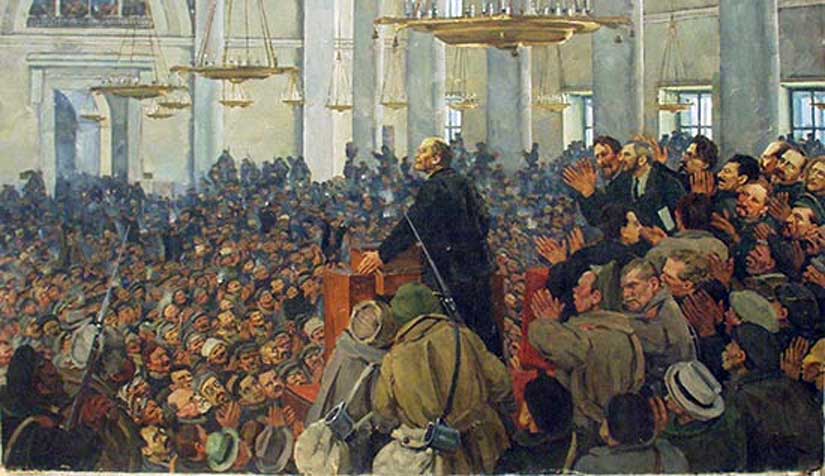
Of all the parodies of popular representation in which history is so rich, Pakistan’s political elite is perhaps the most absurd. On the one hand, they reverberate the cliché that ‘socialism is dead’ while at the same time mostly the right wing politicians often frighteningly warn about a bloody revolution. If one dares to mention the Bolshevik Revolution the abrupt reply of the political elite and their subservient intelligentsia is, “Oh! The one that failed in Russia.” The relative weight of slander in a political struggle in society still awaits its sociologist.The Bolshevik, or the Russian Revolution, triumphed on November 7 (October 26 according to the orthodox Byzantine calendar), 1917. Apart from the heroic episode of the Paris Commune, millions of downtrodden workers and peasants seized political power in their own hands, sweeping aside rotten capitalists and landlords, and embarked upon creating a socialist world order. John Reed, the iconic American writer, described it in the following words: “No matter what one thinks of Bolshevism, it is undeniable that the Russian Revolution is one of the greatest events in human history, and the rule of the Bolsheviki a phenomenon of worldwide importance” (Ten Days that Shook the World, page 130).
In a gigantic and unprecedented experiment it was proved that it was possible to run society without capitalists, feudal landlords, bankers and moneylenders. Despite the extreme primitiveness, reactionary religiosity, fierce aggression of 21 imperialist armies and tremendous objective difficulties and obstacles, the abolition of market mechanisms and the introduction of the planned economy revolutionised the productive forces and laid the basis for a modern and rapidly developing economy. The process of the overthrow of the bourgeois state and capture of power by the leading party of the proletariat had a massive conscious involvement and participation of the vast majority of toilers. It is the only revolution hitherto that took place on classic Marxist lines. Lenin explained what real change this revolution ought to bring. He wrote in December 1917, “One of the most important tasks of today is to develop (the) independent initiative of the workers, and of all the working and the exploited people generally, develop it as widely as possible in creative organisational work. At all costs we must break the old, absurd, savage and despicable prejudice that only the so-called upper classes, only the rich and those who have gone through the school of the rich are capable of administering the state and directing the organisational development of socialist society.”
In the 50 years, from 1913 (the height of the pre-war production) to 1963, the total industrial output of the USSR rose by more than 52 times. The corresponding figure for the US was less than six times. In a few decades, a backward agricultural economy was transformed into the second most powerful country in the world. It developed a mighty industrial base, a high cultural level and more scientists than the US and Japan combined. Life expectancy more than doubled and child mortality fell by nine times. Such economic advance, in such a short time, has no parallel in the world. Rents were fixed at about six percent of the monthly income. A small flat in Moscow, up until the early1980s, cost $ 17 per month, which included gas, electricity, telephone and unlimited hot water.
However, due to the defeat of revolutions in Germany (1918-1923), China (1925-1927), the UK (1926) and several other countries, the isolation of the revolution and primitiveness of technology led to the beginning of the degeneration of the revolution. Under frightful conditions of economic, social and cultural backwardness, the workers’ democracy was replaced by a monstrously deformed caricature.
After the death of Lenin we saw the rise of a bureaucratic clique that began to monopolise power. The four conditions laid down by Lenin were swept away. As the economy expanded and technology became more advanced and complex, it became more and more difficult to run the system efficiently for the privileged bureaucracy that had usurped power. Unlike the development of capitalism, which relies on the market for allocation of resources, a nationalised economy requires conscious planning and direction. Workers’ democracy is the same for the planned economy as is oxygen for the human body.
In his epic work, Revolution Betrayed, Trotsky wrote in 1936: “The fall of the present bureaucratic dictatorship, if it were not replaced by a new socialist power, would thus mean a return to capitalism with a catastrophic decline of industry and culture.”
How the post-1991 scenario has vindicated that! And yet the apologists of capitalism, the reformists and ex-leftists try to maintain that the collapse of the USSR signified the demise of socialism. What failed in Russia was not socialism, but a caricature of socialism. The demagogic attacks on socialism/Marxism/communism have an increasingly hollow ring because they are made against a background of the deepening crisis of capitalism that is devastating society.
Social malaise and mayhem have set in due to the raging terminal crisis of capitalism aggravating mass agony and misery. In her famous book, Waiting for Allah, Christina Lamb wrote in the early 1990s: “Nothing less than a revolution can save Pakistan.” With the unravelling capitalist crisis, society is faced with the stark choice predicted by the great Marxist teacher Frederick Engels more that a century ago: socialism or barbarism? The revolution that can ensure an end to this misery, overthrow this rotten system and achieve the victory of the toiling masses is only possible on the ideas, methods and strategy of Bolshevism. The ruling classes will tremble in stormy events when the masses enter the arena of history to transform their destiny.