Wednesday, November 4, 2015

Is corruption the cause of all that ails Afghanistan?

Why Central Asia is increasingly worried about Afghanistan

As foreign militants join the Taliban's fight against government forces in Afghanistan, Central Asian countries are more and more worried about the danger of Islamic fighters infiltrating the region. DW examines.
S Secretary of State John Kerry recently concluded a five-nation tour of Central Asia, reassuring the countries' leaders - increasingly concerned about the threat of Islamic extremism - that Washington remains committed to the region's security, even though the US has scaled down its military presence in Afghanistan.
In fact, during a meeting with Tajikistan's President Imomali Rakhmon, Kerry reaffirmed Washington's intentions of helping that country secure its border with Afghanistan, and explained that the US decision to slow the drawdown from the war-torn country also served that purpose.
Afghanistan has been a source of concern in recent years for the former Soviet states which fear the fighting in the war-torn country could spill over into their territory, particularly after reports emerged that a large number of Central Asian militants - Uzbeks, Chechens, Tajiks and Kazakhs - fought alongside the Taliban during the insurgents' brief capture of the northern Afghan city of Kunduz in late September.
"Terrorists of different stripes are gaining more influence and do not hide their plans for further expansion," Russian President Vladimir Putin said last month at a summit of the Commonwealth of Independent States (CIS) in Kazakhstan.
There is also a growing concern about the spread of extremist ideas in the region. For instance, Tajikistan's authoritarian government - which has been in power since 1992 - faced embarrassment earlier this year when the commander of the country's Special Forces declared himself a member of "Islamic State" (IS). There have also been reports of attacks on police staged by militants allegedly sharing IS views.
Assessing the threat
Any signs of instability in Tajikistan are a source of concern to Washington, but especially to Moscow upon which Dushanbe relies through the Collective Security Treaty Organization (CSTO) for external security. For instance, Moscow has military bases in both Kyrgyzstan and Tajikistan.
But just how serious is the threat emerging from Afghanistan? According to President Putin, the situation is "genuinely close to critical." But analysts say there has been limited evidence of that so far. So in order to fully understand the issue, it's important to take a broader look at ties between Afghanistan and Central Asia.
Afghanistan's immediate neighbors - Turkmenistan, Uzbekistan and Tajikistan - still share a common cultural and social heritage with their Afghan neighbors despite their isolation during the Soviet rule.
Tajikistan, for instance, is both an important trade partner - especially for energy - and a comfortable fall-back "base" for many Afghan politicians and commanders of Tajik ethnicity, said Alexey Yusupov, director of the Afghanistan office of the German foundation Friedrich-Ebert-Stiftung (FES), explains.
But although generally stable, Kabul's relations with its neighbors to its north are not necessarily tension-free. There is a long legacy of cross-border crime and violence, much of it fueled by the drug trade, and such unrest has sometimes ratcheted up tensions.
'The wake-up call'
Central Asian states are particularly concerned about the trajectory of the Taliban insurgency, because in recent years it has become so much stronger in northern Afghanistan than it had been before.
"I think we can assume that the Taliban's brief takeover of Kunduz was a wake-up call for some of the more naïve officials in Central Asia who may have believed that the violence was restricted to areas further away from Central Asian borders," Michael Kugelman, Afghanistan expert at the Washington-based Woodrow Wilson Center for Scholars, told DW.
"My sense is that Central Asian states worry greatly about increased fighting in northern Afghanistan, not just because of the violence but also because of the refugee flows and drug trafficking that could intensify," Kugelman added.
Although the Taliban have repeatedly stated they have no ambitions beyond reclaiming control over Afghanistan, it is known that foreign Islamist groups operating in Afghanistan such as IS or the Islamic Movement of Uzbekistan (IMU) have a much broader agenda.
Returning jihadists and Pakistan
Nevertheless, analysts argue that security threats to Central Asia don't come mainly from Afghanistan, but are rather posed by returning homegrown jihadists and groups based in countries such as Pakistan who have infiltrated Afghanistan.
"For Central Asia, the primary concern is descendants from the region who fight in Syria in the al-Nusra Front or IS-affiliated brigades," said Yusupov. Moscow says some 5,000 to 7,000 people from former Soviet states, including Russia, are fighting alongside IS jihadists in the Middle East.
"Their eventual return would mean an influx of experienced and radicalized militants thereby constituting a serious threat to the ruling regimes and societies of Central Asia. This is why preventing this scenario is one of the motivational rationales behind the recent Russian campaign in Syria," the FES expert added.
But that's not all. Tamim Asey, a research fellow at the Kabul-based Afghan Institute for Strategic Studies (AISS), points to a host of Pakistani groups such as Lashkar-e-Jhangvi, Lashkar-e-Taiba, and Sipah-e-Sahaba as contributing to the overall security threat in the region. It is believed that many of these militant outfits crossed into neighboring Afghanistan when the Pakistani army decided to launch a military offensive against them in 2014.
"Right now - their aim is to either return to North Waziristan or find an alternative sanctuary. Once resettled, they want to step up their operations in Pakistan, Afghanistan and Central Asia," said Asey.
IS gaining a following
As for IS in Afghanistan, experts indicate that the group's factual weight and importance is currently significantly lower in comparison to the public perception.
"Their territorial control is so far limited to a couple of districts in Nangarhar Province, with some incidents also reported in Kunar Province," said Yusupov. Afghanistan expert Kugelman agrees: "Despite all the hype and threats, IS remains a big threat in the Middle East, and not beyond that region - at least not yet."
The more pressing issue for Central Asia and Afghanistan is that many radicalized and unaligned militants are galvanized by the IS brand and wish to associate themselves with it, even if they have no formal institutional linkages.
This means, in effect, that many militants in the region are carrying out attacks and giving IS the credit, especially after the confirmed death of Taliban leader Mullah Omar.
"Though there's no indication of formal allegiances between these disaffected militants and IS, the group is starting to gain, at least rhetorically, a following that is more than negligible," said Kugelman. On top of that is the fact that the Central Asian IMU, described by some as one of the most vicious militant groups in the world, recently announced its loyalty to IS.
"The IMU has been close to al-Qaeda and has fought very closely alongside the Taliban. It's staged countless attacks in Afghanistan and Pakistan, and the fact that it's now tied to IS is nothing but bad news," Kugelman added.
This means that IS militants in Afghanistan could indeed become a significant threat if the country and especially its economy continue to deteriorate. What's surprising in this context, despite their proximity to Afghanistan, the Central Asian states do not have extensive legitimate economic relations with Afghanistan.
Main objective: Afghanistan
This is in part testament to the fractured nature of the larger region but also to the sheer profitability of the illegal drug trade, which links elites in Afghanistan and the Central Asian states, Deirdre Tynan, Central Asia Project Director at the International Crisis Group in Kyrgyzstan, explained.
"Efforts to stem the drugs trade in Central Asia have failed largely because there has not been the political will at the highest levels to do so. At the same time, there has not been the wherewithal to open the economic space between Afghanistan and Central Asia to legitimate cross border trade."
In the meantime, it seems the militants' main objective remains Afghanistan, especially since most of the fighters involved seem to share the Taliban's ideology of establishing a hard-line Islamist Afghan state and, perhaps more importantly, already enjoy de facto control of large swaths of the country.
By comparison, the situation to the north is very different. "In Central Asian states you have these large crackdowns against militant groups, which curtail their freedom of movement and make it harder for them to operate. In an ideal world, the militants would redirect their attention back to Central Asia and perhaps Russia, but they simply don't see a very easy environment to work in back in those areas at the moment," said Kugelman.
This, however, doesn't exclude a scenario of increased terrorist attacks in the area - probably the reason why Moscow recently decided to beef up its 7,000-strong military presence in Tajikistan with attack and military-transport helicopters.
A failed strategy?
Although both Russia and Central Asian republics have had their experience with combating domestic Islamism, they have concentrated thus far on instruments of law enforcement and intelligence control. But as FES analyst Yusupov explains, this strategy does not address the social issues and the economic factors underlying the recruitment dynamics.
"Most of the Central Asian combatants in Syria left their countries as migrant workers to Russia trying to support their families through remittances. The economic crisis in Russia took them then to the paying 'jobs' inside the IS, thus intertwining economic and ideological motivations," he said.


Pakistan - Ahmadiyya Apartheid and the Quest for Tolerance


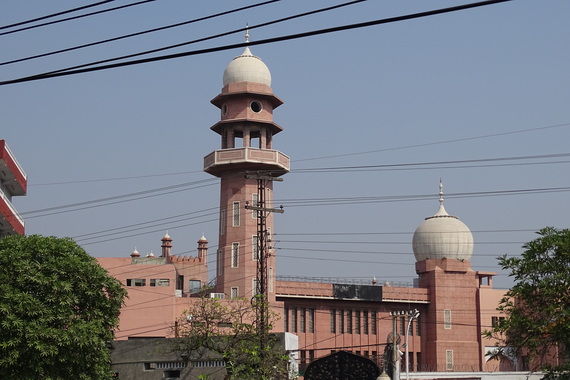
I took this picture last month in Lahore, Pakistan. I knew of this place, I knew what happened there on May 28, 2010. But actually standing before it and seeing the undeniable reality of it sucked the life out of me for a few seconds. This is a place of worship; five times a day people come here to perform Salaat- the Muslim prayer- behind an Imam. Just like any mosque in Pakistan. But this place is not called a mosque. It goes by the name of "Darul Zikr" which means "The abode of the remembrance of God".
Bear with me, I will return to Darul Zikr.
Pakistan, 1953: Ahmadis are a salient facet of Pakistani society. They have the highest literacy rate of any community, are prominent in the civil service and excel as teachers, scientists and Military Officers. The Foreign Minister of Pakistan is Sir Zafarullah Khan, an Ahmadi who drafted the Pakistan resolution-the famous 1940 declaration by the All India Muslim League calling for the creation of a Muslim State.
Not all, however, are pleased with the accomplishments of the Ahmadiyya.
Fee, Fi, Fo, Fum.
The Mullah strokes his beard thoughtfully.
The rise of the educated Ahmadis who profess a pluralistic, peaceful version of Islam is problematic. The power of the Mullah rests on getting people riled up, ready to give their lives for their faith. A version of faith adapted to require Mullahs as sentinels of the "correct" form of Islam is preferable. For then, when people are ready to die for Islam, they are ready to die for the Mullah.
The Mullah writes a book, sort of a Pakistani "Mein Kampf". The Ahmadis are a problem; they are perverting the faith and are more loyal to the British than to non-Ahmadi Muslims. They consider all non-Ahmadi Muslims heretics. They have social and political ambitions that will do no less than destroy the practice of true Islam in Pakistan. The only solution to all this is excommunicating them from Islam.
The Mullah gathers a cabal of demagogues who demand the Government declare Ahmadis non-Muslims and remove all Ahmadis including Sir Zafarullah Khan from important government posts. The Government refuses and the Mullah tells his followers to take to the streets. Hundreds of Ahmadis are killed and shops, houses and places of worship burnt to the ground. The Mullah is arrested and sentenced to death. Two months later this is changed to a life-sentence. Two years later the Mullah is pardoned-despite his never requesting a pardon or accepting any wrongdoing. His adoring followers see this is a vindication and his popularity grows like never before.
The Mullah bides his time.
Fee, Fi, Fo, Fum.
Pakistan, 1974: On the pretext of an attack on members of the Mullah's political party in Rabwah (the headquarters of the Ahmadis) the Mullah launches street protests again. The demand remains the same-declare Ahmadis non-Muslims. The Government offers little resistance and the houses of Parliament pass the bill that makes the Second Amendment part of the constitution of Pakistan. The Mullah has triumphed, Ahmadis have been declared non-Muslims.
Pakistan 1979: A huge crowd gathers for the Mullah's funeral in Lahore. He is remembered as a true soldier of the faith and the ultimate authority on Jihad. A nation weeps.
But neither Mullahs nor the state is done with Ahmadis yet.
Pakistan 1984: General Zia-ul-Haq promulgates Legal Ordinance 20. No longer can Ahmadis even refer to themselves as Muslims. They cannot say Muslim greetings, cannot cite the Quran or Ahadith and their places of worship will no longer be known as Mosques. The ex-communication is complete.
Pakistan 2010: Two Ahmadi places of worship are attacked. Ninety-four people are killed and a hundred and twenty injured. The Pakistani Taliban claim responsibility. One of these places is Darul Zikr.
So we return to Darul Zikr.
Pakistan 2012: Two years after it was attacked and its occupants butchered the administration of Darul Zikr was ordered by a judge to remove the "Kalma"-the bearing of witness that there is one God and Mohammad is the Prophet of God upon reciting which one becomes a Muslim-from the front of the building. Here are seen the ugly strokes of black hiding the Kalma written on Darul Zikr.
As if black paint could hide the faith of the Ahmadiyya from the light of God's sun.
Here is the world of intolerance in a grain of sand. Not even cold-blooded mass murder can suffice for those who seek to affirm their faith by denying it to others. It is time to put an end to this callous persecution that finds no justification in the Koran or in the example of Prophet Mohammad.
It is time for Darul Zikr to become Masjid Darul Zikr and for Ahmadiyya to become Ahmadiyya Muslim.
The monopoly of the Mullah must end and our great faith must belong to all who profess it. The Holy Quran says in Surah Ahzab:
Those who have been driven from their homes unjustly only because they said: Our Lord is Allah - For had it not been for Allah's repelling some men by means of others, cloisters and churches and oratories and mosques, wherein the name of Allah is oft mentioned, would assuredly have been pulled down. (22:40)
Let us all strive to become the means by which Allah repels those who would tear down the houses of God in His name.
The Pakistani state can lay no rightful claim to tolerance or justice till the right of Ahmadiyyas to identify as Muslims is unconditionally accepted.

Pakistan must pursue killers of Zaman Mehsud and bring them to justice

The Committee to Protect Journalists calls on Pakistan to investigate the killing of local journalist Zaman Mehsud who, according to reports, was shot dead in the Tank district of Pakistan's Khyber Pakhtunkhwa province today.
Unidentified gunmen opened fire on Mehsud while he was on his motorbike, police told local media. The 40-year-old journalist was the president and secretary-general of the Tribal Union of Journalists' South Waziristan chapter and worked for the Urdu-language Daily Ummat. He was also the district coordinator of the Human Rights Commission of Pakistan in Tank, an independent group critical of all sides in the ongoing conflict in Pakistan.
The Taliban claimed responsibility for the attack, with its commander Qari Saif Ullah Saif telling Reuters: "We killed him because he was writing against us ... we have some other journalists on our hit list in the region, soon we will target them." It is difficult to verify such claims independently.
"Whether it was related to his work as a journalist or for the Human Rights Commission of Pakistan or some other reason, the murder of such a widely respected figure as Zaman Mehsud deserves the full attention of investigative authorities," said Bob Dietz, CPJ's Asia program coordinator. "Pakistan can ill afford to add to its history of impunity for murderers, no matter who claims responsibility."
As a journalist, Mehsud reported mainly from South Waziristan in Pakistan's Federally Administered Tribal Areas, along the border with Afghanistan. Home to many militant groups, the region is notoriously lawless despite government efforts to bring it under control. The Tank district borders South Waziristan and violence, including targeted killings, is commonplace, according to reports.
Pakistan ranks ninth on CPJ's global Impunity Index, which analyzes countries where journalists are murdered and their killers go free. CPJ data shows that 22 journalists have been murdered with impunity in the past decade. Impunity remains the norm not only in these murders but also in a slew of non-fatal attacks, such as the shooting that gravely injured news anchor Hamid Mir in 2014. Threats to journalists come from military and intelligence agencies, political parties, criminal groups and militants, and corrupt local leaders, CPJ has found.

Bilawal Bhutto condemns killing of journalist in Tank


Bilawal Bhutto Zardari Chairman Pakistan Peoples Party has condemned the brutal murder of journalist Zaman Mehsud who was gunned down in Tank in Khyber-Pakhtunkhwa yesterday.

In a press statement, PPP Chairman said attacks and killing of journalists were threats to the freedom of press, which the journalist community and the PPP had won through great struggle and sacrifices.

Bilawal Bhutto Zardari asked Khyber-Pakhtunkhwa government to catch the culprits without any delay for severe punishment. He also demanded that the family of slain journalist should be provided protection and fair compensation.

He said PPP had always stood for the protection of journalist fraternity and won’t remain silent on atrocities against them.

Pakistan - Insulting a journalist proves IK a product of dictatorship

Pakistan People’s Party (PPP) Media Cell in-charge and Senator Saeed Ghani, members Habibuddin Junaidi, Zulfiquar Kaimkhani and Manzoor Abbas have condemned Pakistan Tehreek-e Insaf (PTI) chairman Imran Kahn for insulting a working journalist during his press conference in Lahore.

In a statement issued for the PPP Media cell Sindh, they said Imran Khan is one such political character, who is the product of dictatorship and has through his acts and deeds always proved he is void of established norms and values of politics, which are politeness, respect for the media and journalists.

They said the question, which the affected journalist had asked did not mean to interfere in Imran Khan’s personal life and in case the journalist had put a personal question, Imran Khan should show serenity and could have avoided the response to that question. However, the journalist did not ask any personal question.
They said Imran Khan had already publicized his marriage during his sit-in protest at D Chowk in Islamabad and was very excited about his marriage. He had tweeted his personal matter quite often. However, when he could not continue with his marriage, which has ended in divorce should not be taken as personal, because Imran Khan has also shared the same information on twitter.

They advised Imran Kahn to relinquish the charge as chairman of his party and should hand over to some sane politician within his party and should focus on training and education of his children.

https://ppppunjab.wordpress.com/2015/11/04/insulting-a-journalist-proves-ik-a-product-of-dictatorship-sen-saeed-ghani/

Pakistan - A politician’s actions are never personal: Khursheed Shah

Opposition leader in National Assembly and leader of Pakistan People’s Party (PPP) Khursheed Shah on Wednesday said a politician is ‘a public property’, thus, none of his/her actions are personal.
Talking to media persons here, Khursheed Shah advised Pakistan Tehreek-e-Insaf (PTI) leader Imran Khan that instead of getting involved in a media battle, he should go out on a foreign trip.
He claimed that popularity graph for PTI and Pakistan Muslim League-N has been on a steady decline.
Ruling out any ‘minus-one’ formula in PPP, he said Bilawal Bhutto Zardari will be part of the new parliament.
“Asif Zardari has been in contact while Bilawal Bhutto is running the affairs of the party,” he said, adding ‘from now onwards we elders will guide while the kids will work’.
He said between the independent candidates and popular parties in the Local Government elections the electorate chose the former. He predicted that the results of the first phase of LG polls will impact the second.
Khursheed Shah said the incumbent government does have its influence on the LG polls.

He said due to the ‘public perception’ a number of PPP candidates contested the LG polls in Punjab as independents.

Tuesday, November 3, 2015

Video - #UK - "We need rent control" - 100,000 children homeless this Christmas

Saudi Arabia Is Set to Crucify Pro-democracy Teenage Protester


Ali Mohammed Baqir al-Nimr, a 17 year old Saudi Arabian, was arrested in February 2012, and is slated to be executed by crucifixion at the hands of the Saudi Arabian government, who disregarded any form of due process whatsoever to prosecute al-Nimr under the charge of "encouraging pro-democracy protests using a Blackberry."
For this alleged crime, al-Nimr will be taken to a public square and have his head chopped off as onlookers watch, leaving his corpse hung there for people to see as a warning. Al-Nimr was tortured into giving a false confession, never had a lawyer, had his appeal done in secret without his knowledge. A criminal justice system as medieval and gruesome as this should not exist in the world today.
"Saudi Arabia may so far this year have executed at least 134 people, which already represents 44 more than the total for the whole of last year," United Nations Human Rights Experts wrote in a press release. "Such a surge in executions in the country makes Saudi Arabia a sad exception in a world where States are increasingly moving away from the death penalty."
To allow this crucifixion to occur is an inexcusable injustice and contradicts International Law as well as the law of the Saudi Arabian government. Saudi Arabia's recent appointment to the UN's Human Rights Council is a farce when they perpetuate egregious human rights violations and enact barbaric methods of punishment themselves.
The European parliament recently passed a resolution urging Saudi Arabia to stop the execution and issue a moratorium on the death penalty. The Prime Minister of France, Francois Hollande, has also spoken out to Saudi Arabia on behalf of Al-Nimr. The leader of the Labour Party in the UK, Jeremy Corbyn, has called upon the UK Prime Minister David Cameron to put pressure on the Saudis as well. As a global leader, the United States cannot be silent when such stark human rights violations occur at the hands of our presumed allies. The Obama administration
Al-Nimr's family is extremely worried that his execution can come at any moment. The last time they spoke with him, he reported being kept in solitary confinement. The boy's fate lies in the hands of 79 year old King Salman, who has already been under intense scrutiny over Saudi Arabian led bombings in Yemen that have killed thousands of civilians, and two tragic incidents in September, a crane collapsing and a stampede, that killed hundreds of people in Mecca.
The alleged reason for Al-Nimr's arrest and sentence is surmised to be his relation to his uncle, Nimr al-Nimr, a well-known Shiite cleric. His uncle was a leader of protests against the Saudi government, demanding they treat Shiites, a minority in Saudi Arabia, as equals. The uncle died in the back of a police car in 2012 from gunshot wounds, and the political need to make an example out of the uprising fell on Ali Mohammed Baqir al-Nimr. As subsequent protests increased, so did the charges filed against the boy.
Saudi Arabia is abusing its power to dissuade any forms of dissent, and has one of the highest execution rates in the World. The country has dismissed criticism as protecting the rights of the killer. The United Nations and global leaders need to put more pressure on Saudi Arabia to curb their human rights violations. Instead, Saudi Arabia was selected as one of the nations to oversee a United Nations panel on human rights. In September, Saudi Arabia's ambassador in Geneva was elected chair of the UN Human Rights Council that appoints independent experts to investigate violation claims. The legitimacy of the council is completely undermined by having a leader presiding over it that perpetuates human rights violations within their own borders on a regular basis. The United Nations should be holding the perpetrators of human rights violations accountable, not rewarding them. Calling on Saudi Arabia to release Ali Mohammed Baqir al-Nimr is an opportunity to reverse lax policies that accept such cruel forms of capital punishment to go without any sort of repercussions. The Death Penalty has no place in the 21st century," said UN Secretary General Ban Ki-Moon in a press release. The words and policies of the United Nations are completely pointless if they refuse to capitalize on the opportunity to call out Saudi Arabia to change their practices.

8 Months Into Its Bloody Offensive, Saudi Victory Remains Elusive in Yemen

What was originally intended as a brief intervention has now extended into a lengthy and much-maligned military campaign, leaving Saudi Arabia and its backers with little to show for the thousands left dead.

When Riyadh first began aggressive military action in Yemen, it was sold as a "quick intervention," a necessary move to defend against alleged "Iranian influence."
Eight months later, Saudi officials are still defending the decision.


"The military option was the last one for Saudi Arabia and came via a request from the legitimate government and to protect Saudi citizens from ballistic missiles," Saudi Foreign Minister Adel al-Jubeir said last week, according to Reuters.

But prolonged involvement is taking a toll on the kingdom. Military action is costing billions, and stagnating oil prices mean that the Saudi government is losing one of its principal sources of income. Allies in the conflict – including the United States, United Kingdom, and France – are growing impatient with the lack of results.
Not mention the humanitarian devastation. Shriveling funds means that Riyadh has failed to deploy any of the $274 million in aid it had promised.

The United Nations estimates that as many as 2,400 Yemeni civilians have been killed by coalition bombing. The Saudi naval blockade has left approximately 1 million people internally displaced, and as many as 20 million people in need of food, water, and medical supplies.


And while Saudi officials have repeatedly – and incorrectly – predicted the conflict’s approaching conclusion, the worst may be yet to come. According to Reuters, the Saudi coalition has struggled to secure Yemeni territory, even when it has support from the locals. In addition, Riyadh has not even begun to press into the highlands, where Houthi fighters have the strongest presence.

Last week, reports surfaced that political infighting within the Saudi royal family was at least partially to blame for the kingdom’s recent foreign policy decisions. Fearing for his own security after his father’s eventual death, King Salman’s son, Deputy Crown Prince Mohammed bin Salman, has been using his position as head of the Saudi Defense Ministry to improve his own reputation.


"You could argue this whole Yemen operation was in part calculated to shore up the defense minister’s profile," said Frederic Wehrey of the Middle East Programme at the Carnegie Endowment for International Peace, according to Agence France-Presse.

With the Deputy Crown Prince’s future at stake, the conflict could become a never-ending campaign, grasping at an unachievable success.

A military victory for Saudi Arabia would bring an end to the conflict. But experts tell Reuters that success could also reinvigorate the kingdom into launching aggressive military campaigns elsewhere, chasing its phantom Iranian aggression across the region.


Read more: http://sputniknews.com/middleeast/20151103/1029556358/eight-month-syrian-yemen-conflict.html#ixzz3qTqJ1xIe

Crash victims' injuries show midair explosion likely caused A321 crash - investigator

The nature of passengers’ injuries from the Russian jet that crashed in Egypt’s Sinai on Saturday may indicate that an explosion took place aboard before the plane hit the ground, an Egyptian doctor who examined the bodies said, Sputnik news agency reported.
"A large number of body parts may indicate that a powerful explosion took place aboard the plane before it hit the ground,"an Egyptian forensic expert told the agency.
A DNA analysis would be required to identify the victims of the Russian A321 airliner crash in Egypt, the expert added.
Earlier, Russian tabloid LifeNews claimed to have obtained the results of a forensic medical examination that allegedly stated that the passengers “in the tail section of the liner died because of so-called blast injuries.”

According to the broadcaster, they were diagnosed with burns of over 90 percent, with experts noting particles of metal and aircraft covering piercing the bodies of the deceased.

The people in the front part of the plane died from different causes, including blood loss, shock, open head injuries and multiple fractures, it added.

However TASS news agency cited Russian and Egyptian experts as saying that they failed to find any blast-related trauma during their preliminary examination of the bodies of the victims.

“There were no signs of an explosion impact found during the preliminary examination,” the source said.

One of the Egyptian experts also told TASS that “there were no signs of external impact” found on the bodies.

There have been no official announcements made so far on the results of forensic medical examination of the crash victims.

An unnamed US official said on Tuesday that before the Russian passenger airliner crashed in Sinai, an American infrared satellite had detected a heat flash in the same vicinity, indicating that an explosion may have occurred onboard.

“The flash, which was observed by the satellite, that’s a piece of evidence, but against it’s inconclusive. It can also occur if there was a missile attack, a fire onboard or an explosion onboard,” retired flight commander, Sultan Mahmoud Hali, told RT.

Dr. Anil Padhra, a senior lecturer in aviation studies at London’s Kingston University, told RT that examining the passengers’ injuries might not be the most precise way to learn about the reason for the crash.
“It’s too early to say categorically whether or not the plane broke up in the air. It’s difficult to tell what the injuries would have been if there was an explosion onboard. And I think it’s difficult to tell how it would be different to injuries sustained when the bodies impacted the ground,” Padhra said.
The explosion of the engine could have caused the Russian plane crash as it went down right after finishing the climbing stage, when “the engines are under the most stress.”
Dr. Padhra also mentioned another theory, which has been discussed as widely as others, saying that a midair collision could have interrupted the Airbus A321’s flight.
There is a “possibility that the aircraft could have collided with some other object – I’m thinking, in particular, unmanned aerial vehicles or drones may have been operated in that area to gather intelligence by different authorities… We know it was a conflict area. We know that drones can achieve that kind of altitude,” he said.
All 224 people aboard were killed, making it the deadliest civilian aircraft disaster in Russian and Soviet history.
Since the crash on October 31, several possible causes of the Sinai tragedy were discussed by experts.

Islamic State

Islamic State (formerly ISIS/ISIL) attempted to claim responsibility for the incident, saying that it brought the plane down as retaliation for Russian air operation against the terrorists in Syria.
However, many experts rejected the claim, saying that the jihadists only possessed man portable air defense systems with no capability to reach the high-flying Airbus.

Bomb on board

An explosion of a bomb aboard the plane was mentioned as another possible cause of the crash.
US global intelligence company Stratfor said that Egyptian security personnel often take bribes for allowing passengers to avoid checks, with cargo security screenings in the country also not being strict enough.

Mechanical damage

There was also speculation that corrosion of parts of the plane could have caused the crash, backed by claims that the Russian airliner broke up in the air.

However, Egypt’s civil aviation ministry said on Tuesday there are no facts to substantiate assertions that the plane really fell apart in the sky.  
The journalist also found out that the Airbus A321 struck its tail on a runaway during an unsuccessful landing in 2001. It was later repaired, but some experts believe the lasting damage could have causing the crash in Egypt.
Russian first class pilot Andrei Litvinov shared his belief with Kommersant newspaper that the Sinai tragedy happened due to "old metal parts, an old aircraft that was already damaged.”
Human error was also mentioned among the early explanations for the incident, but this was quickly rejected.
Ex-flight commander Hali stressed that “it’ll probably not be possible to make any serious comment on the cause of the accident until the black box has been examined.”
“It normally takes four to five weeks to examine the contents of the black boxes because it’s a technical process,” he added.

Hillary Clinton calls for minimum wage increase to $12 per hour

U.S. Democratic presidential candidate Hillary Clinton said on Tuesday she would like to raise the federal minimum wage to $12 per hour from the current $7.25.
"I want to raise the federal minimum wage to $12, and encourage other communities to go even higher," Clinton said at a campaign event in Coralville, Iowa.
Many U.S. cities and municipalities have established a higher minimum wage than the current federal minimum. Bernie Sanders, who is challenging Clinton to become the Democratic presidential nominee, has said the federal minimum wage should be raised to $15 per hour.

Video - Burning meteor? Green fireball streaks across the sky in Thailand

Video Report - Teens use media 9 hours a day, report says

Poll Shows Gains for Hillary Clinton in New Hampshire


In the topsy-turvy Democratic race in New Hampshire, Hillary Rodham Clinton took a small lead over Senator Bernie Sanders on Tuesday in a Monmouth University poll, reversing a deficit of eight percentage points from September.
Mrs. Clinton’s three-percentage-point lead was within the poll’s 4.9 percent margin of error. Still, it was the latest survey since the Democratic debate last month showing Mrs. Clinton and Mr. Sanders trading off the lead, after the Vermont senator led solidly by double digits two months ago.
Mrs. Clinton notably reversed a deficit among women in the poll, following a week in which she and her allies strongly implied that Mr. Sanders was sexist for accusing her of “shouting” about gun violence. With Clinton surrogates pressing hard on the accusations — in one case calling Mr. Sanders “misogynistic’’ — he has been on the defensive, pointing to his congressional record of fighting for women’s rights.
But he appears to be on the losing end of the attack. In the Monmouth poll, Mrs. Clinton led Mr. Sanders 56 percent to 37 percent among women, a reversal of a five-percentage-point deficit among women in September.
The poll also found Mrs. Clinton with a big lead among registered Democrats, 57 percent to 35 percent. Mr. Sanders was the preference of registered independents and people who have not voted before. Independents can vote in either party’s primary in New Hampshire and new voters can register the same day.
“Past results show that registered Democrats are likely to make up a majority of the primary electorate,’’ Patrick Murray, director of the poll, said. “Sanders either has to convince more of these voters to support him or he has to turn out an unprecedented number of independents and brand-new voters.’’

http://www.nytimes.com/politics/first-draft/2015/11/03/poll-shows-gains-for-hillary-clinton-in-new-hampshire/