Friday, October 30, 2015

US 'Advisers' En Route to Syria: Washington’s Next War?

Following indications from US Defense Secretary Ash Carter earlier this week, President Barack Obama confirmed on Friday that the Pentagon would deploy between 20 and 50 "advisers" to combat the self-proclaimed Islamic State terror group in Syria. It’s a song we’ve heard before, and one that may not even change the situation on the ground.

Despite a pledge to keep US ground forces out of further conflicts in the Middle East, President Obama now plans to send dozens of special operations forces into Syria. According to a senior administration official, those forces will include less than 50 individuals, and they will serve in an advisory capacity, coordinating air strikes and supply drops.

But in the past, the term "adviser" has been used to disguise the fact that US ground forces are conducting combat operations. Most recently: In Iraq.

While US combat operations in Iraq officially ended in 2011, the Obama administration was forced to deploy Special Forces advisers back in 2014. Similarly, the Obama administration denied that this action could be considered "boots on the ground."

"American forces will not be returning to combat in Iraq," President Obama said last summer.
This week, Pentagon officials made that denial a little more difficult.

"We’re in combat," Pentagon spokesman Army Col. Steve Warren told reporters on Wednesday. "I mean, of course this is a combat zone. There’s a war going on in Iraq, if folks haven’t noticed. And we’re here and it’s all around us."


The proclamation came in response to the death of Master Sgt. Joshua Wheeler, who was killed last week while conducting an anti-terror raid in northern Iraq.

Wheeler’s death also forced US Defense Secretary Ashton Carter to come clean about the realities of US ground operations.

"Of course he died in combat. That’s what happened," Carter told reporters on Wednesday, adding that "there are American troops in combat every day" in Iraq.

But Wheeler’s death was just the tip of the iceberg. According to reports from the Washington Post and the Daily Beast, the Pentagon has been conducting covert ground operations in Iraq for months, with as many as six US service members wounded in action since last year.

Bloomberg has also reported that US task forces operating out of Irbil have been participating in missions to identify and locate members of the Islamic State for months.

"We have very good and close cooperation with the United States on military operations, whether that is coordinating airstrikes or the professional forces operation like the one we had last week in Hawija," Bayan Sami Abdul Rahman, US representative of the Kurdistan Regional Government, told Bloomberg.


Given these operations conducted by forces labeled as mere “advisers,” it’s hard to imagine that a US presence in Syria will play out any differently.

Of course, for some, Obama’s announcement is simply a public admission of what the Pentagon has already been doing secretly in Syria.

"The Pentagon, together with NATO, Turkey, and Israel, et al, have routinely dispatched their military advisers, special forces and intelligence operatives to the Syrian war theater," Professor Michel Chossudovsky, of the University of Ottawa, writes for the Global Research Center.

"These foreign forces have operated within rebel ranks from the outset of the war on Syria in March 2011."
Chossudovsky also points out that such operations would be illegal under international law.

"In other words, [the US-NATO led coalition] is largely responsible for coordinating countless ISIS and Al Nusrah terrorist operations against civilians inside Syria on behalf of the US led coalition," he writes.

"Needless to say, they are also supported by the US led air campaign, which theoretically is targeting (rather than ‘protecting’) the terrorists.


Read more: http://sputniknews.com/middleeast/20151030/1029364590/us-advisers-to-syria.html#ixzz3q5cIMI2n

Will the US double down or recalibrate its Syria policy? Crosstalk

Video Report - 'To advise and assist': US to deploy special forces in Syria to fight against ISIS

‘Not surprised by Musharraf’s admission on support to LeT’

The link between the 26/11 attackers and some elements in the Pakistani government cannot be credibly denied, says U.S. Senator Tim Kaine.

A top U.S. Senator has said that former Pakistan president Pervez Musharraf’s admission that Pakistan aided and trained terror groups like LeT is “not surprising” and the link between the 26/11 attackers and some elements in the Pakistani government cannot be credibly denied.
“I am not surprised...I think that the evidence about ties between some aspects of the Pakistani government with LeT in connection with the attack in Mumbai in 2008 is pretty hard to deny,” said Senator Tim Kaine, an influential Democratic Senator in the two power Senate committees of foreign relations and armed service.
“When you get into the intel (intelligence information) and explore, you get the questions how high the ties were and how officially they were sanctioned. But there were definitely ties (between Pakistani government and LeT),” said Kaine who visited the 26/11 terror attack sites in Mumbai last October.
“The connection between those attackers and at least some elements in the Pakistani government, I do not think they can be credibly denied,” Kaine told Defense Writers Group when asked about Musharraf’s remarks that Pakistan supported and helped terrorist organisations like LeT.
Last week Kaine met Pakistan Prime Minister Nawaz Sharif when the latter visited the US Capitol and met members of the powerful Senate Foreign Relations Committee.
War against terrorism, continued presence of terrorist safe havens was one of the major topics of discussion with the visiting Pakistani leader, he said, but noted that Pakistan under Sharif is moving in a different direction as far as war against terrorism is concerned.
“My sense from that visit (of Sharif) and from a trip to Pakistan (in October 2014) is that it has been a very very hard (US-Pak) relationship after the death of (Osama) bin Laden. But I think the arch of it is going in a better direction,” the Senator from Virginia said.
“My sense is that Pakistan is now really going after enclaves of terrorists in North Waziristan and other areas.
They are sincerely doing it. Those (terrorist) organisations are feeling tough pressure. They are fighting back on the Pakistani Government because they are feeling that the Pakistani government is cracking down on them,” he said.
Kaine said that there needs to have better relationship between India and Pakistan. “Pakistan-India relationship is the one we still care deeply about,” he said and expressed concern over the increase in cross border fire on the LoC.
“I think Prime Minister (Narendra) Modi’s invitation to Sharif as part of the ceremony surrounding his inauguration was a good start to the relationship. But, I haven’t really seen those early promising sign. I do not think those have been followed up sufficiently on either side by India or Pakistan,” he said hoping that there would be more efforts to improve relationship on both sides.

http://www.thehindu.com/news/international/not-surprised-by-musharrafs-admission-on-support-to-let-us-senator/article7823113.ece

Urdu Music Video - Awarapan Banjarapan

Pakistan - A Christian girl forcefully converted to Islam after being kidnapped from her house

A Christian girl betrothed to marry a Christian man forcefully converted to Islam after being abducted from her own house.
In keeping with details, a Christian girl identified as Nabila Bibi is yet another victim of forced conversion in Pakistan’s densely populated province Punjab. A Muslim man Allah Rakha kidnapped her from her father’s house in Changa Manga on October 16. Nabila Bibi was already engaged to Sajid Masih and was set to marry him this November.
Soon after the abduction of Nabila; her father Bashir Masih and fiancé Sajid Masih launched a complaint regarding Nabila Bibi’s abduction in the Changa Manga police station.
Shortly after the FIR was filed, a group of Muslim men arrived at Bashir Masih’s house. They told Bashir Masih that Nabila had converted to Islam after marrying a Muslim man. Moreover, Bashir Masih was shown some documents as proof of Nabila’s conversion and marriage. They told him that she was living happily in Allah Rakha’s house.
Nonetheless, after learning this, Bashir Masih, Sajid Masih and his cousins went to Allah Rakha’s house and asked him to bring Nabila out to meet them. However, Allah Rakha refused to let them meet Nabila Bibi, while a gang of about 15-20 Muslim men began threatening them in case they insisted meeting her or did not leave immediately. Despite, threatening from the Muslim men, Nabila’s family was reluctant to leave and kept insisting that Nabila be brought out to meet them. Seeing this, the Muslim men held them these Christian men captive at Allah Rakha’s house for a night.
However, the following day, the Christian men managed to flee from Allah Rakha’s house by some means. Yet their quandary was far from over, as the very next day the Muslim men went to Bashir Masih’s house and started inquiring about Sajid Masih’s whereabouts. After knowing where Nabila’s fiancé lived they left for Sajid Masih’s house. However, before they arrived at Sajid’s house, he fled from there and is still in hiding.
This is not an only case of its kind. According to a report by Aurat Foudation, every year about 1000 girls hailing from religious minorities are forcefully converted to Islam after forcibly given in marriage to Muslim men. Out of these 1000, about 700 are Christian women who fall victims to the gender based religious persecution.
- See more at: http://www.christiansinpakistan.com/kasur-a-christian-girl-forcefully-converted-to-islam-after-being-kidnapped-from-her-house/#sthash.8Bi6LU0e.dpuf

Pakistan: Intellectuals denounce 'Lahore top technical university' for anti-Ahmadi declaration requirement

A Pakistani university recently got an earful from a US academic in response to an assessment request of a professorship candidate whose 'religious declaration' was also included in the review package sent for evaluation.

Addressed to one Dr. Asif, reportedly 'the Registrar of a top technical university in Lahore,' the US professor, whose name has been redacted, expressed an immense disgust for the institution's practice of requiring such a declaration from faculty candidates. "While I take no position on the status of the members of the Qadiani Group or the Lahori Group or the Ahmadi congregation a Muslim or non-Muslims, I deplore the fact that an institution of higher learning requires such a declaration from faculty candidates."

"A university is a laboratory of ideas where any religious-membership test must be regarded as anathema," the professor further wrote to the Registrar.

The professor went on to reject the Pakistani university's request saying he/she would not want to be associated "with any religion-based exclusionary practice and therefore will not submit my assessment."

Several intellectuals of Pakistani origin with international standings took note with concern of the faith-based selections requirement in Pakistani elite education institutions and sought clarifications.

Islamabad based physicist, Dr. Isa Daudpota, addressing the Higher Education Commission of Pakistan (HEC) in his semi-public communique, demanded that the HEC clarify its position publicly about the faith declaration requirement for promotions such as the one exemplified by 'the Registrar of the top technical university in Lahore.'

"Would this become a requirement for becoming a faculty member too?  Would PhD students be asked to sign the same statement and will undergraduates need it pasted in their project theses?  If these appear ridiculous, so does the requirement for promotion," Dr. Daudpota wrote to the HEC Chairperson, Prof. Dr. Mukhtar Ahmed.

"Will the HEC clarify its position publicly?" demanded Dr Daudpota adding that "This can hardly enhance the tarred reputation of Pk universities internationally."

Another noted intellectual, a geologist and research scientist from Pakistan, Dr J, whose full name is being withheld, joined Dr Isa Daudpota "in condemning the policy of discrimination on the grounds of faith."

"Pakistan higher education needs your benign intervention if the university is discriminating on the basis of belief," Dr J asked the HEC chief.

Dr J asked the HEC to inquire whether the applicant voluntarily provided the declaration or it is a requirement by the university. "If it is the latter, it is terrible indeed."

"The universities should be open to the best faculty, irrespective of their belief," Dr J added.

In his opinion, Dr J says, "diversity of social, cultural and academic backgrounds contributes to the strength of a society and an institution."

"Once people are hired, only performance should be used as the yardstick for promotion," Dr J further asserted.

"I wonder how can our highly educated "intellectuals" assume that 1) the non-Muslim citizens of Pakistan are not equal to the Muslims, and 2) Muslims in Pakistan are better human beings or more patriotic than non-Muslims?"

"What kind of message of intolerance are we giving to the outside world?" Dr. J forcefully questioned.

http://ahmadiyyatimes.blogspot.com/2015/10/pakistan-intellectuals-denounce-lahore.html

In Pakistan, a divorce underscores society’s chauvinism

Pakistani media are revelling in the details of a high-profile celebrity divorce. But their coverage of the incident is highlighting questionable attitudes to women in the country.
The recent media spotlight in Pakistan on a crucial local government election and earthquake relief efforts has suddenly shifted its focus. There is something bigger and juicer to obsess about: a picture-perfect couple, made up of the loved (and loathed) cricketer-turned-politician Imran Khan and television journalist Reham Khan (photo above), has fallen apart, with the pair ending their short, tumultuous marriage accompanied by the now mandatory announcements on Twitter. And no one is talking about anything else on or off air.
It is no surprise that the Khans' unfortunate split has met with rabid fascination. Imran Khan's marriage earlier this year to the new face in broadcast journalism elicited a similar reaction. Anchors reported meticulous details of the embroidered shoes he selected for his big day; there were live interviews with the bride's make-up crew; and media pundits indulged in much speculation about how the romance may have blossomed during Khan's indefatigable Islamabad siege last year.
Khan is wildly popular, both as a sportsman and for being the outspoken underdog in government, and the exceptional attention he gets when he does anything even mildly unusual is simply a natural manifestation of Pakistani society's voracious appetite for chatter.
But although one could forgive the media for their overzealous coverage of the happy occasion of Khan's marriage, their treatment of a tragic episode in the lives of two public figures has highlighted a dangerous attitude that is often evident in Pakistan both in everyday life and in popular culture.
Blame it on the woman
Reham Khan, who was widely criticized in the early days of the marriage for being too "broadminded," is today being faulted for being "ambitious" and "outspoken."
"She is only good for doing salsa."
"She is a gold digger."
“She has always been liberal.”
"She just refused to sit at home."
Other than Shakespeare's Julius Caesar, when was the last time a man was blamed for being "too ambitious"? The examples listed above are an illustration of the loaded phrases employed to criticize Reham Khan online. While Imran Khan has also come in for flak over the divorce on social media (mostly by supporters of rival parties), that disapproval is limited to calling him "immature" or "indecisive" – words devoid of overtly sexist undertones.
Local model and actress Hira Tareen took to Facebook to denounce this woman-hating attitude. "[There is] so much male chauvinism and one-sidedness being displayed right now on the news channels regarding a divorce," she writes. "Is a woman being ambitious and wanting to be involved [in politics] a bad thing?"
Karachi-based lawyer and writer Abira Ashfaque says that while she did not support Reham Khan's publicly over-deferential comportment and change of persona, the criticism that Reham has a mind of her own is unfortunate. “What I am hearing is that she was 'too ambitious' but not that he was controlling. The language is not just biased: it's hostile to women,” says Ashfaque.
Role of TV
The same idea is reinforced through widely-watched television dramas, where a female character is placed in the "good" or "bad" drawer depending on her clothing and degree of submissiveness.
Ashfaque continues: "If popular culture is any indication, a man's right to unilateral divorce is celebrated and reinforced in people's minds, whereas a woman's rights within marriage are limited."
A ray of hope?
It is heartening that in this environment of hate and unabashed sexism, Imran Khan has chosen to avoid a mudslinging match with this tweet: “I have the greatest respect for Reham's moral character and her passion for working for and helping the underprivileged.”
Ironically, however, the defense is once again limited to praising her "moral character" – not her independence.
The expectation that Reham Khan should fulfill the role of a meek, obedient wife follows an ugly pattern of outrageous criticism flung at her during the early days of her marriage. Back then, she was described as a "modern" woman, and photos of her wearing smart skirts and dresses from her days as a BBC reporter were splashed on the Internet. Today, despite her demure, dutiful public appearances as the silent sidekick Mrs. Khan, she is still not docile enough.

Video - د زلزلې پر وړاندې خوندي دانۍ جوړول

Bilawal welcomed from Mohenjo-daro to Naudero

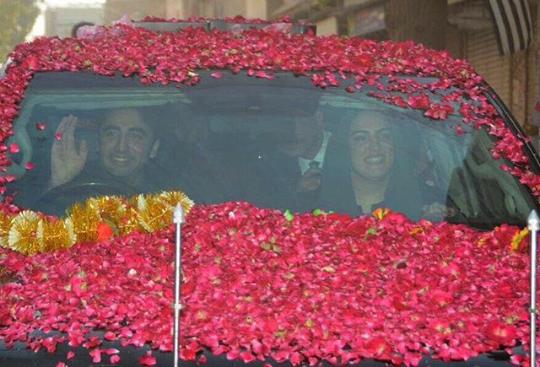
 Co-chairman Pakistan People’s Party (PPP) Bilawal Bhutto Zardari on Friday was given warm welcome everywhere from Mohenjo-daro to Naudero just one day before the election. Bilawal arrived at Mohenjo-daro Airport along with his sister Bakhtawar Bhutto Zardari and was accompanied by thousands of workers, protocol cars, police mobiles and official cars to home in Naudero, reported Dunya News.

Bilawal will cast his vote in Ward No. 4 tomorrow in Naudero.


http://dunyanews.tv/en/Pakistan/306360-Bilawal-welcomed-from-Mohenjodaro-to-Naudero-just

Pakistan Slowly Becoming Less Bellicose

By ,

Second only to North Korea — a distant second — Pakistan has long been regarded as the loose cannon of the nuclear-weapons club. Among other things:
  1. It developed nuclear weapons without signing the nuclear Non-Proliferation Treaty.
  2. It failed to prevent one of its leading scientists, Abdul Qadeer Khan, from creating a nuclear black market to sell nuclear know-how and equipment.
  3. It refuses to renounce a policy of possible first use, as almost all the other nuclear powers have.
  4. It continues to build up its arsenal.
  5. It’s developing tactical nuclear weapons (smaller, for actual battlefield use) to compensate for the greater numbers of India’s conventional forces.
  6. There’s an undercurrent of dread about the thought that Pakistan military can be infiltrated by Islamist extremists who might stage a takeover of one of its nuclear-weapons facilities.
Lately, though, Pakistan has provided hints of a more responsible (or marginally less irresponsible) nuclear-weapons policy. In Abu Dhabi’s the National, Tom Hussain writes: “Subtly, that situation has begun to change.”
In June, a US-Pakistan working group issued a statement about their shared desire to ensure the security of Pakistan’s nuclear arsenal and steps Pakistan had taken to prevent even unintentional proliferation of its technology. Then, in August, the Carnegie Endowment for International Peace and the Stimson Centre proposed that Pakistan’s strategic programme should be accepted and brought into the global non-proliferation scheme, in exchange for its commitment to a ceiling on the number of warheads it would produce and the range of its ballistic missile delivery platforms. This month, Washington Post columnist David Ignatius disclosed that Carnegie’s proposals had, in fact, been adopted by the Obama administration and offered to Islamabad.
However
…a deal is not imminent. Indeed, Pakistan’s leadership had appeared to turn down the offer outright. It said it would continue to work towards the development of a full-spectrum nuclear arsenal – one with the ability to launch weapons from the air, land and sea.
But on October 25
… 4 hours before prime minister Nawaz Sharif’s meeting with Barack Obama, Pakistan’s press, quoting the same unnamed official sources, reported the government’s position was markedly different to the long-perceived policy of zero compromise. It would not accept limits on the number of tactical battlefield warheads, it was reported. No mention was made of other types of devices, the strong hint being that a compromise could be reached on those, eventually, if India were prepared to make a matching commitment.
I know it doesn’t sound like much, but it
… is, by far, the biggest shift in – and disclosure of – Pakistan’s nuclear doctrine since the 1998 tests. Indeed, the US offer is a significant development in as far as it underlines its belief that Pakistan’s nuclear programme is not the leaky sieve it had been.
Hussain summarizes:
Nobody is suggesting a breakthrough will happen soon, but in a world increasingly characterised by regional conflicts, Pakistan’s willingness to negotiate is an encouraging sign that responsible attitudes are being adopted.
In fact, Pakistan is generally becoming less bellicose. In the National Interest Sameer Lalwaniwrote in August:
Pakistan is often characterized as a belligerent, unyielding, and destabilizing force in international affairs. But despite longstanding and widespread negativeperceptions, Pakistani behavior and strategic culture is changing for the better in important respects, as recently exemplified by anti-Taliban operations in the country’s North Waziristan region and thawing relations with the United States and Afghanistan.
The reorientation of Pakistan’s national security policies remains little noticed because media coverage of Pakistan is crisis-driven and narrowly focused, often overlooking longer-term trends.

PPP shares earthquake victims' grief: Bilawal Bhutto Zardari

Co-chairman Pakistan People’s Party (PPP) Bilawal Bhutto Zardari has on Thursday said that PPP shares the grief of earthquake victims. He said that everyone should do whatever they can to help the earthquake victims. “It is my first visit to Peshawar”, said Bilawal, reported Dunya News.
Talking to media at the residence of PPP’s provincial secretary general Humayun Khan, Bilawal said that PPP is with the victims of the earthquake in this hour of trial. He was accompanied by Chief Minister (CM) Sindh Syed Qaim Ali Shah and Sherry Rehman on this occasion. Bilawal said that PPP always stood at the forefront whenever the nation was hit by a calamity.
Bilawal met senior PPP leaders and workers of People’s Students Federation (PSF) on this occasion and also listened to their grievances.
CM Sindh, while talking to media, said on this occasion that the PPP leaders have visited the place to show solidarity with the earthquake victims. He said that it was a serious earthquake. He said that the federal government’s aid for coping with the problems created by the earthquake is almost nothing.
Earlier, Bilawal also visited Lady Reading Hospital to visit the injured there. 
Co-chairman PPP prayed for the earthquake victims.

Bilawal Bhutto restricts leaders & workers from making adverse comments on anybody’s private matters


Bilawal Bhutto Zardari has directed all the Party leaders and workers not to make any adverse comments on anybody’s personal matters.
The PPP Chairman passed these directives today following noticing some comments on personal matters regarding marriage and divorce of a politician. “We are harbingers of our rich traditions and dignity. We represent every segment of society. We respect individual’s privacy. Hence we should not indulge in things, which don’t suit our morals and ethics,” he exhorted Party leaders and workers.
https://mediacellppp.wordpress.com/2015/10/30/ppp-chairman-restricts-leaders-workers-from-making-adverse-comments-on-anybodys-private-matters/

Thursday, October 29, 2015

Urdu Music - RUNA LAILA - TUJ JAISA DAGHABAZ MEIN NEY - MERAY HUMSAFAR

Video - Earthquake aftermath: Fatal landslide caught on camera in Pakistan

Pakistan - Due share in CPEC, not meagre packages, to solve issues: ANP


Awami National Party leader and MNA Ghulam Ahmed Bilour has said that the federal government should give due share to the militancy-hit Khyber Pakhtunkhwa in $46 billion China-Pakistan Economic Corridor (CPEC) project instead of announcing meagre packages after a disaster hits the province.
He said that China wanted this corridor to develop those parts of the country where it was facing religious extremism. The federal government here should do the same as sheer force can’t end militancy and extremism, he said.
“Development is the only way to end extremism in provinces like Khyber Pakhtunkhwa and Balochistan,” said the senior ANP leader, who himself had narrowly escaped a suicide blast, but his younger brother and former senior minister Bashir Ahmed Bilour was killed in a suicide attack in Dec 2012.
Speaking at a press conference at his home in Peshawar on Wednesday, he said that if these provinces were not given equal importance like Punjab than joblessness and poverty would force the people to side with extremism in one form or the other. Federal minister for planning and development and focal person of the CPEC projects, Ahsan Iqbal, thinks more like a Punjabi than a Pakistani, Mr Bilour claimed and advised him to think for the rest of Pakistan too.

Bilour says development only way to end extremism in KP, Balochistan


The ANP leader said that unlike other political parties having financial and donation resources his party had no such resource so they could not help the quake-hit people much financially, but their party would raise voice for their rights.
“The relief package has been announced for the quake-stricken people. Let’s see if the federal government implements it too. It would be good if it does so,” said Mr Bilour. He lamented that often such promises were easily forgotten as it had been witnessed in the case of CPEC.
“The road that has been promised is like a lollipop. The people of KP and Balochistan should be given share to develop these militancy hit-provinces,” he said.
The ANP leader said that he respected people’s wish who voted Pakistan Tehreek-i-Insaf to power in the province, but he called on the ‘Banigala resident’ to also raise voice for the rights of this province. “A person dreaming of becoming prime minister would never raise voice for the people of Khyber Pakhtunkhwa,” Mr Bilour taunted the PTI leader for not giving priority to issues of KP.
“Pakhtuns have always been promised things which were never fulfilled,” he said, adding that they were not considered Pakistanis if they raised voice for their rights.
Later, he called on the government to ensure that schools and mosques damaged by the recent earthquake were rebuilt on priority. He said that the local government representatives should help in relief activities.

EXCLUSIVE INTERVIEW WITH AFGHANISTAN RECONSTRUCTION WATCHDOG

An ineffective $8 billion counternarcotics effort, $500 million worth of cargo planes that had to be turned into scrap metal and a $30 million program to grow crops that nobody wants — those are just some of the examples of how US funds have been wasted in Afghanistan.
While taxpayers have every right to be upset about how their money has been squandered, they might feel even more strongly about the lack of consequences for those who spend it so unwisely.
“We don’t hold people accountable for losing and wasting taxpayer money,” John Sopko, the Special Inspector General for Afghanistan Reconstruction (SIGAR), toldWhoWhatWhy in an exclusive interview.
“People have got to be fired, people have got to lose promotions, people have got to be demoted. And only when that happens will we start to see really significant changes with protecting the taxpayer’s dollar.”
The special inspector general says his team is doing all it can in a difficult environment. Its criminal investigators have recovered nearly $1 billion in fines and restitution. Although dozens of people have been indicted when crimes were committed, Sopko noted that most of the problems he and his team encounter are not related to theft.
“It isn’t criminality,” he said “It’s just waste and abuse.”
And in those cases, despite the vast sums involved, not much is happening with regard to personal responsibility.

MORE EXPENSIVE THAN THE MARSHALL PLAN

The sheer size of the undertaking magnifies the problems. At currently about $110 billion, more US taxpayer funds have now been appropriated for Afghanistan’s reconstruction than for rebuilding all of Europe after World War II — even after taking inflation into account.
And the entire program is run without any attention to what in the private sector would be called the bottom line.
“I can’t find anybody … who can tell me … what the costs are and what are the benefits from doing something,” Sopko said. “The problem in the government is that the bottom line is the appropriations. Did we meet the appropriations, did we spend all the money? And that is the unfortunate approach to government as a whole.”
He also describes the current personnel system as “very poor.”
“We can’t hire the right people, we rotate them in and out of Afghanistan too quickly, we reward them for basically spending the money and not for actually accomplishing anything,” Sopko noted.

COUNTERNARCOTICS EFFORT IS THE BIGGEST WASTE

The biggest waste of all, according to the special inspector general, has been the $8 billion spent on counternarcotics, which “hasn’t really accomplished much of anything.”
“And again,” Sopko pointed out, “nobody has been held accountable and nobody has lost their job.”
Another “horror story of waste and fraud and abuse,” as the special inspector general described it, was the purchase of about 20 cargo planes for the Afghan air force that cost approximately $500 million.
“They were the wrong planes for Afghanistan, for the terrain and the weather and altitude,” Sopko explained. “We were basically told by pilots who flew the planes over [to Afghanistan] that they were death traps. They were poorly maintained, poorly rehabbed and basically they didn’t fly.”
In the end, they had to be turned into $30,000 worth of scrap metal — at an additional cost of about $50,000.
“It even cost us money to scrap them,” Sopko said, adding that some of the wastes of money would be “primetime comedy except for the fact that it’s the taxpayer’s dollar and the fact that there are people’s lives at stake.”

A NEW GOVERNMENT BRINGS NEW HOPE

Still, he is hopeful that the new unity government in Afghanistan, which is “really taking fraud, waste and abuse seriously,” and the new US ambassador can help turn things around.
“I would not have said that I’m optimistic a year ago,” Sopko said. “The current regime really understands the problem and is trying to address it.”
The special inspector general said he was told by the United States Agency for International Development (USAID) people that he shouldn’t reveal some of the problems he and his staff have uncovered because the Afghans would get upset. This is a notion he rejects.
“The Afghans know when the road isn’t built, they know when the bridge falls down, they know when the school isn’t constructed the right way,” Sopko said. “The Afghans know what the problems are, it’s the US taxpayers and the Congress who don’t know.”

IT’S ALL ABOUT SECURITY

In the end, as with most things in Afghanistan, it is all about security. And that is why more than half of the appropriated money, about $60 billion, has been spent on improving the Afghan military and police force. If the Afghans can’t secure their own country, all that has been gained can quickly be lost.
“If the security situation were a lot better, then I would feel more comfortable about the potential success and, more importantly, the sustainability of all of the other programs — the schools, the clinics, the roads, the airports, all of the other stuff,” Sopko said.
“The big threat is if the Afghan government and the military loses control, the Taliban are going to come in like a whirlwind and punish the poor Afghan civil servants, the teachers, the women, the girls, who have been trying to change the reality in Afghanistan,” he added. “That is what is concerning me most. If we can’t sustain the gains we have made, then it’s the dirtiest trick we have played on the Afghans.”

“GOD BLESS WHISTLEBLOWERS”

Even though a lot of money has been wasted, things would be far worse if it weren’t for contractors and whistleblowers.
“The contractors come in and say: ‘You can’t believe what they are asking us to do. This is crazy but we gotta abide by the contract’,” Sopko said, adding that the majority of contractors “have been extremely responsible in responding to our request for information and then voluntarily coming forward with information.”
As for whistleblowers, Sopko is even more complimentary and the situation would be dire without them.
“God bless whistleblowers,” Sopko said. “If we didn’t have whistleblowers, the government would be 100 times worse than what it is right now.”

Pakistan supported, trained terror groups: Musharraf

Former Pakistan President Pervez Musharraf has admitted that Pakistan supported and trained groups like Lashkar-e-Taiba (LeT) in 1990s to carry out militancy in Kashmir.
“In the 1990s, the freedom struggle began in Kashmir. At that time Lashkar-e-Taiba and 11 or 12 other organisations were formed. We supported them and trained them as they were fighting in Kashmir at the cost of their lives,” Mr. Musharraf said in an interview to Dunya News on Sunday.
The former army chief was responding to a question about action against LeT’s Hafiz Saeed and Zakiur Rehman Lakhvi.
He said people like Saeed and Lakhvi enjoyed the status of heroes at that time.
“The Kashmiri freedom fighters including Hafiz Saeed and Lakhvi were our heroes at that time. Later on, the religious militancy turned into terrorism. Now they (referring to militants in Pakistan) are killing their own people here and this should be controlled and stopped,” he said.
To a question whether Saeed and Lakhvi should also be “controlled and stopped”, Mr. Musharraf said, “No comments.”
He said that “religious militancy” was started by Pakistan which brought militants from all over the world to fight against Soviet forces.
He said in 1979 Pakistan was in favour of religious militancy.
“We trained Taliban and sent them to fight against Russia. Taliban, Haqqani, Osama Bin Laden and Zawahiri were our heroes then. Later they became villains,” he said, adding that people need to understand the whole environment at that time.

http://www.thehindu.com/news/international/south-asia/pakistan-supported-trained-terror-groups-like-lashkaretaiba-pervez-musharraf/article7813284.ece?ref=sliderNews

Christian Woman Burned Over 50% of Her Body in Pakistan After Refusing Marriage Proposal

According to details, a Pakistani Christian woman identified as Sonia Bibi was purportedly burnt by Latif Ahmed in Multan. 20-year-old victim, Sonia was set on fire when Latif Ahmed purposed her. Sonia refused his proposal and as a consequence, Latif Ahmed burnt her.

After the incident, Sonia was rushed to Nishtar Hospital in the city, while a doctor treating her told media that despite the fact that she is severely burnt, she is expected to survive.

As narrated by Sonia Bibi herself, that the culprit Latif Ahmed was her ex-boyfriend, who had set her ablaze as a consequence of her rejection of his marriage proposal. Moreover, Jamshaid Hayat- a local police official told the media that Latif Ahmed has been hooked by police while a first round of investigation has been conducted.

“Police arrested the man after recording the statement of Sonia Bibi in the presence of her parents. The girl told us that she was in love with Latif, whom she accused of dousing her in gasoline and setting her alight,” he said.

In addition to this, another police official Mukhtar Cheema stated that Sonia Bibi had earlier told him that she had rejected Latif Ahmed’s proposal. 

- See more at: http://www.pakistanchristianpost.com/detail.php?hnewsid=5669#sthash.9iDX33wV.dpuf

Pakistan - Righting a colossal wrong

Finally, a judgment on blasphemy law

Necessary amendments were not introduced in the defective blasphemy law because of the spinelessness of successive administrations. Despite repeated demands by human rights groups, the elected governments would not do the job fearing that religious parties would use this to stir up a hornet’s nest. Musharraf, who called himself a moderate and wanted to be considered a liberal, was best suited to bring the necessary changes as being a usurper he was accountable to none. He also enjoyed the full support of the army and the ISI. Exigencies of power politics, however, led him to seek allies in the religious parties who were deadly opposed to any modification in the law. The failing on the part of the civil and military governments has caused a lot of suffering to hundreds of innocent people who were wrongly indicted, and their families.
The critics of the law who maintained that it was used to settle scores with enemies, grab other people’s properties and has promoted religious intolerance and lawlessness are vindicated by the Supreme Court judgment. The court has further maintained that allowing individuals to pass judgments on others and then implement these judgments themselves is tantamount to promoting vigilantism. The rule of law requires lodging complaints with the police and allowing the courts to judge the case on the basis of evidence. The court ordered the Inspector General of Police, Punjab, to ensure that cases registered under the blasphemy law are entrusted to a team of at least two gazzetted Investigating Officers (IOs), preferably those conversant with the Islamic jurisprudence. They should seek the help of a scholar of known reputation and integrity if needed.
The government has to pick up courage to introduce the necessary amendments in blasphemy law. It has to take firm action against those who instigate people to indulge in lawlessness. The government should also review all constitutional amendments which militate against the basic rights of the citizens.

Pakistan - Blasphemy reform


The detailed judgement of the landmark Mumtaz Qadri case has been issued by the Supreme Court (SC) three weeks after the verdict upholding Qadri’s conviction for murder and reinstating terrorism charges for assassinating Governor Salmaan Taseer was announced. The 39-page judgement, penned by Justice Asif Saeed Khosa, is a significant document and in more ways than one reinforces the widespread impression in the aftermath of the verdict that this case can be a harbinger of positive change and a fitting legacy for Governer Taseer, who gave his life for the cause being spearheaded in this judgement. While the short order made it clear that the SC had ruled that raising objections about the misuse and flaws of the existing blasphemy law, as Governer Taseer had done, was not an act of blasphemy itself, the detailed judgement goes further and shows Justice Khosa and his fellow judges taking a proactive stance in calling for said reform in a striking show of principled bravery. The honourable justices recognise the extreme potential for abuse inherent in the way this law has been framed and note the various instances where false accusations were employed to realise nefarious personal vendettas. 

The judgement holds that a false accusation of blasphemy is as abhorrent as actual blasphemy and has called for procedural safeguards to be introduced that improve investigations of such cases and ensure innocent people are not arrested, tried and put at risk of mob violence. The judgement recognises that laws need to be evolved with the changing times and emerging challenges and the blasphemy law is no different in needing improvements to its definitions, amendments and safeguards. The judgement also takes note of woefully incompetent police investigations in these matters and has called for a change in the protocols used and retraining of Investigating Officers (IO) in matters pertaining to blasphemy. Noting the scourge of extra-judicial murders of those accused of blasphemy, the judgement thoroughly condemns actors like Qadri who take the law into their own hands instead of letting the law run its course.

This is a thoroughly welcome and bold judgement that has taken the cause of blasphemy reform forward by leaps and bounds. After the brutal silencing of Governer Taseer and the hero worship of his killer, many opponents of the law and champions of its reform were wary of making their stances public and a climate of fear and foreboding was prevalent. There is bound to be strenuous opposition to the reform of this law by the forces of religious intolerance and this makes the firm stance of the SC even more commendable. With this declaration by the highest court in the land, the advocates of tolerance and rationality will be emboldened in the struggle for the country’s soul and to ensure that the reforms demanded in this judgement are followed through.

چیئرمین پیپلز پارٹی بلاول بھٹو کی جانب سے زلزلہ متاثرین کیلئے امدادی سامان روانہ

پاکستان پیپلز پارٹی کے چیئرمین بلاول بھٹو زرداری کی جانب سے زلزلہ متاثرین کی امداد کیلئے امدادی سامان جس میں خیمے، کمبل اور سردی سے بچاؤ کیلئے اشیاء شامل ہیں جمعرات کودو ٹرکوں کے ذریعے بلاول چورنگی کراچی سے روانہ کر دیا گیا ہے۔ امدادی سامان کی روانگی کے موقعے پر پی پی کراچی ڈویژن کے صدر نجمی عالم ، پی پی سندھ کے سیکریٹری اطلاعات وقار مہدی ، وزیر اعلیٰ سندھ کے معاون خصوصی راشد ربانی ، وزیر اعلیٰ سندھ کے کوآرڈینٹر صدیق ابو بھائی، خالد لطیف ، تیمور سیال ، مشتاق مٹو، قادر کھوکھر، شوکت گلگتی اور دیگر شامل تھے۔ درین اثنا زلزلہ متاثرین کی امداد کیلئے امدادی کمپ کراچی اور اندرون سندھ کے تمام اضلاع میں قائم کردیے گئے ہیں جہاں عوام بڑی تعداد میں پہنچ کر متاثرین کیلئے امدادی اشیاء جمع کر رہے ہیں،جوکہ جلد زلزلے سے متاثرہ علاقوں کو روانہ کردی جائیں

#BBZVisitsEarthquakeVictims: Bilawal Bhutto visits Peshawar’s LRH, meets quake victims

Pakistan Peoples Party (PPP) Chairman Bilawal Bhutto Zardari has visited Peshawar’s Lady Reading Hospital on today (Thursday) afternoon amid loud political cheering by party workers.
The chairman has arrived in Peshawar and visit Lady Reading Hospital to meet quake sufferers. He will also monitor rescue activities.
According to details, Chief Minister Sindh Qaim Ali Shah, vice president PPP Senator Sherry Rehman and other prominent political leaders have also accompanied him.
Moreover, the PPP chairman has also held a press conference at the residence of the party’s provincial General Secretary Humayun Khan.