A job vacancies advertisement of a hospital which runs by Ministry of Health of Government of Punjab Province spreads anger among millions of Christians in this province of Pakistan which invites application for “Sweepers” only from non-Muslims while other job opportunities in this advertisement are left open for general public.
As term non-Muslim is being used for Christians, Hindus, Sikhs and other religious minorities in 18th Amendment in Constitution of Pakistan.
In Punjab province of Pakistan, the Christians are second biggest population after Muslims counted in millions while Hindus, Sikhs and other religious minorities are only up to hundreds only. It is generally points towards Christians when called non-Muslims in Punjab province of Pakistan.
A Christian nominated from ruling Pakistan Muslim League PML (N) in Punjab Assembly as Member of Provincial Assembly is Minister for Health and he not launches any enquiry on this controversial job advertisement.
Last year the PTI government in KPK province also publically announced that for Christians the jobs of Sanitary Workers will be allocated only which received condemnation from all schools of thought in Pakistan but in Punjab province it happens where a Christian leads Ministry of Health.
The “Sanitary Workers” are called as “Churras” (a hate words) in all over Pakistan when majority of Christians are forced to perform duties of sanitary workers, the Muslims call Christians who are even educated with hate word “Churra” in their absence.
The sources close to parliamentarians told Pakistan Christian Post that Muslim Members of National Assembly and of Provincial Assemblies enjoy drinking parties in Assemblies Hostels but not take dinners with non-Muslim members and call them “Churra or Bangi” when they are not present in their private gatherings.
Dr. Nazir S Bhatti, President of Pakistan Christian Congress PCC have strongly condemned health department advertisement of job opportunities allocating sanitary workers jobs for non-Muslims.
PCC Chief have demanded resignation of Punjab Health Minister and an open apology from Mian Shahbaz Sharif, Chief Minister of Punjab and keep 5% quota for jobs for non-Muslims from grade 4 to grade 17 Pay Scale jobs.
Meanwhile, an advocacy group LEAD in a press release have said “According to details, an advertisement was publicized by the Institute of Cardiology in Lahore explaining that only non-Muslims will be eligible to apply for the job of male and female sweeper. The advertisement has been deemed as a humiliation of the non-Muslims; generally the word non-Muslim here is assumed to be for Christians. These advertisements were widely circulated throughout the country and have sparked great anger among the Pakistani Christians. It has been assumed that low-ranking jobs have been specifically assigned to the Christians.
Sardar Mushtaq Gill, Human Rights Defender who heads LEAD, an organization working for minorities’ rights, has taken strongly condemned this advertisement and decided to challenge it in High Courts.
“It seems that Government authorities deliberately misleading to cover 5% quota by pointing only Christians on these menial jobs and systematically humiliate Christians in the eyes of the society that they have been limited to specific types of work" told Mr. Gill.
This is not first incident of such religious discriminatory advertisement for jobs vacancies, this has been pointed out that earlier too when two other hospitals namely Lady Wellington Hospital and Sir Ganga Ram Hospital, also had publicized advertisements for job vacancies for janitor calling in for a non-Muslim or Christian, as requirements for the vacancy.
"The government has very sharp mind about minority 5% job quota, they cover it by pointing Christian on janitor jobs and filled all other jobs by Muslims and if someone try to challenge it through 5% quota system in courts then authority takes plea that reserved 5% jobs for minorities had already filled with janitor jobs" added Mr. Gill. - See more at: http://www.pakistanchristianpost.com/detail.php?hnewsid=5615#sthash.iDCP15Y9.dpuf
M WAQAR..... "A man's ethical behavior should be based effectually on sympathy, education, and social ties; no religious basis is necessary.Man would indeed be in a poor way if he had to be restrained by fear of punishment and hope of reward after death." --Albert Einstein !!! NEWS,ARTICLES,EDITORIALS,MUSIC... Ze chi pe mayeen yum da agha pukhtunistan de.....(Liberal,Progressive,Secular World.)''Secularism is not against religion; it is the message of humanity.'' تل ده وی پثتونستآن
Saturday, September 26, 2015
Pakistani Gov't Refuses to Punish Violent Mob Who Set Christian Family's Home on Fire to Burn Them Alive
By Leah Marieann Klett
An angry mob in Pakistan torched the home of a Christian family and attempted to burn them alive by locking them inside before setting it ablaze, a Christian advocacy group has reported. However, the local police department is refusing to hold the violent perpetrators accountable.
The British Pakistani Christian Association reports that earlier this month, a mob of radicals in the city of Islamabad surrounded the home of 38-year-old Christian Boota Masih and began banging on the door, demanding he come outside.
When Masih answered the door, the mob's leader ordered him to take his family and abandon their home, including all of their belongings, or face severe consequences.
The mob claimed Masih and his family were trespassers in their own home; however, Masih told the advocacy group that he paid a million Pakistani rupees (about $9,500) in an oral agreement to purchase the house from a man named Ghulam Ali.
Because he was the legitimate owner of the house, Masih refused to comply with the demands of the mob, which was reportedly led by Ali's wife.
"I was terror stricken, the mob was threatening to kill me and my family. They had weapons in their hands and started to brandish them before me. I thought they would kill all of us," Masih explained. "I refused to leave my home - I had paid for it fairly and they had no right to ask me to leave."
In response, the angry mob began to beat him with metal rods and sticks, and locked Masih and his family inside a room before setting the house on fire.
Although the house was destroyed in the fire, Masih was able to rescue his family, which consists of his wife and six children.
"I broke the door down using all my strength, desperate to live and to save my family," Masih explained. "Soon other local Christians came to rescue us. They put out the flames and called the fire brigade."
The report notes that local authorities are still refusing to register a First Incident Report (FIR), even though witnesses to the attack and a written report having been submitted to the local police station.
Instead, Masih was arrested after Ali filed a FIR against him for allegedly attacking a woman who came to collect rent.
The BPCA explains that a donation campaign has been started to help support the Masih family. The group notes that local Christians have said that the family has a good reputation in the eyes of the public: Boota earns his living in the fruit market, while his wife works in a school.
Pakistan is notorious for its oppression of Christians, which make up a mere 2% of the country's population. Persecution watchdog group Open Doors ranked Pakistan in 8th place on its 2015 World Watch List of countries where Christians face the most severe persecution for their faith.
"Pakistan's Christians are caught in the crossfire between Islamic militant organizations and mobs that violently target Christians, and an Islamizing culture on the other hand that results in Christians being isolated from the rest of the population," notes the group.
Under Pakistan's harsh blasphemy laws, anyone accused of insulting Islam or the Prophet Muhammad risks a violent and bloody death at the hands of vigilantes. The laws are often used to target religious minorities and are frequently manipulated to seek personal disputes.
In light of these shocking abuses, the U.S. Commission on International Religious Freedom has called on the administration to designate Pakistan a "country of particular concern," a step that would make it eligible for sanctions or other measures intended to prod governments to stop violating religious freedom.
http://www.gospelherald.com/articles/58068/20150923/pakistani-government-refuses-to-punish-violent-mob-who-set-christian-familys-home-on-fire-to-burn-them-alive.htm
An angry mob in Pakistan torched the home of a Christian family and attempted to burn them alive by locking them inside before setting it ablaze, a Christian advocacy group has reported. However, the local police department is refusing to hold the violent perpetrators accountable.
The British Pakistani Christian Association reports that earlier this month, a mob of radicals in the city of Islamabad surrounded the home of 38-year-old Christian Boota Masih and began banging on the door, demanding he come outside.
When Masih answered the door, the mob's leader ordered him to take his family and abandon their home, including all of their belongings, or face severe consequences.
The mob claimed Masih and his family were trespassers in their own home; however, Masih told the advocacy group that he paid a million Pakistani rupees (about $9,500) in an oral agreement to purchase the house from a man named Ghulam Ali.
Because he was the legitimate owner of the house, Masih refused to comply with the demands of the mob, which was reportedly led by Ali's wife.
"I was terror stricken, the mob was threatening to kill me and my family. They had weapons in their hands and started to brandish them before me. I thought they would kill all of us," Masih explained. "I refused to leave my home - I had paid for it fairly and they had no right to ask me to leave."
In response, the angry mob began to beat him with metal rods and sticks, and locked Masih and his family inside a room before setting the house on fire.
Although the house was destroyed in the fire, Masih was able to rescue his family, which consists of his wife and six children.
"I broke the door down using all my strength, desperate to live and to save my family," Masih explained. "Soon other local Christians came to rescue us. They put out the flames and called the fire brigade."
The report notes that local authorities are still refusing to register a First Incident Report (FIR), even though witnesses to the attack and a written report having been submitted to the local police station.
Instead, Masih was arrested after Ali filed a FIR against him for allegedly attacking a woman who came to collect rent.
The BPCA explains that a donation campaign has been started to help support the Masih family. The group notes that local Christians have said that the family has a good reputation in the eyes of the public: Boota earns his living in the fruit market, while his wife works in a school.
Pakistan is notorious for its oppression of Christians, which make up a mere 2% of the country's population. Persecution watchdog group Open Doors ranked Pakistan in 8th place on its 2015 World Watch List of countries where Christians face the most severe persecution for their faith.
"Pakistan's Christians are caught in the crossfire between Islamic militant organizations and mobs that violently target Christians, and an Islamizing culture on the other hand that results in Christians being isolated from the rest of the population," notes the group.
Under Pakistan's harsh blasphemy laws, anyone accused of insulting Islam or the Prophet Muhammad risks a violent and bloody death at the hands of vigilantes. The laws are often used to target religious minorities and are frequently manipulated to seek personal disputes.
In light of these shocking abuses, the U.S. Commission on International Religious Freedom has called on the administration to designate Pakistan a "country of particular concern," a step that would make it eligible for sanctions or other measures intended to prod governments to stop violating religious freedom.
http://www.gospelherald.com/articles/58068/20150923/pakistani-government-refuses-to-punish-violent-mob-who-set-christian-familys-home-on-fire-to-burn-them-alive.htm
Malala Says Syrian Toddler's Drowning Shows World Has 'Lost Humanity'
Teenage Nobel laureate Malala Yousafzai called on world leaders to do more about the Syrian crisis, saying that the drowning of a toddler showed the world had "lost humanity."
Appearing at the opening of the United Nations General Assembly on September 25, the 18-year-old Pakistani, who was shot by the Taliban for defiantly going to school, said she was haunted by the picture of Aylan Kurdi, the Syrian toddler whose body washed up on a Turkish beach earlier this month.
The shocking image of the toddler face down on the beach in newspapers and online drove home the tragedy of the Syrian migrant crisis to a stunned world audience.
"We lost humanity on that day when...nowhere a child is welcomed," she said. "It is important that people open their hearts and people open their lands to people who are now needing more support and who need the right to live."
Malala appealed to world leaders to imagine their own children suffering the abuses meted out by the Islamic State militant group, which has taken over large parts of Syria and massacred and enslaved thousands.
Pakistan’s Legends:Salmaan Taseer (1944 - 2011)
*In view of Defence Day, we will highlight some legends and eminent martyrs of the country, who laid down their lives for the motherland. Our seventh and last Pakistan's Legends feature is on the brave and mighty governor of Punjab, Shaheed Salmaan Taseer, who was assassinated for his humanitarian advocacy.
“Tell me about your father," I said to Shehryar Taseer. We both lapsed into memories of our childhood.When I was a child, I was taught martyrs do not die because the sacrifices they made for the protection of innocent people enables them to live forever in our hearts and history.It is for that reason I will write about Salmaan Taseer in the present tense.
Capturing the vibrant talents and enthusiastic personality of Salmaan Taseer is about as easy as sweeping the ocean into a bottle. The magnitude of his work, the scope and scale of his accomplishments - in business, in politics, in media and more- and that too, spanning decades, has led him to mean different things to many people. Close friends and family say that to this day, new tales of his wit and accomplishments come to light from all corners of the globe.
His own tale begins in Simla in 1944, the city of his birth, and he was raised in Lahore, the city of his heart and home. Born to Muhammad Din Taseer, popularly known as MD Taseer, a national poet and leader of the Partition-era progressive writers' movement, and Bilqis Christobel George, the sister of Alys Faiz, herself the wife of beloved Urdu poet Faiz Ahmad Faiz, the fates of his family and Pakistan were readily intertwined before Salmaan Taseer was even born; the nikahnama of his parents was officiated by no one other than Allama Iqbal.Salmaan Taseer's sharp mind and overflowing charisma earned him a respected reputation early on, and made him a natural supporter of the populist socialism of Zulfikar Ali Bhutto and his Pakistan People's Party (PPP). He authored the first biography Bhutto: A Political Biography of his icon, chronicling the political landscape Bhutto hoped to change with a progressive vision for Pakistan.
The fervour would never abate.
After Bhutto's devastating hanging, orchestrated by the vile dictatorship of General Ziaul Haq, Salmaan Taseer endured jailing and torture by a regime that did not take kindly to his pamphleteering for the restoration of democracy.
For months, Zia's thugs kept him in solitary confinement in a dungeon in the old Lahore Fort, allowing him half a plate of lentils a day. His new bride, Aamna Taseer, imbued with a natural grace and strength of spirit, went each day to ask after her husband, only to be told by sneering guards he had been killed. Meant to break her indomitable spirit, these lies only fuelled her search and she managed to relay a note to her young husband by befriending a cell sweeper. Salmaan Taseer wrote back one of his iconic lines: "I'm not made from a wood that burns easily." He withstood constant jailing, at one point kept in shackles for six months, yet remained undeterred activist and defender of democracy.
In time, and with Benazir Bhutto's rise to prominence and the resurgence of the PPP, Salmaan Taseer was back centre stage in politics as the prime minister's aide. He won the election to become a member of the Punjab Assembly from Lahore in 1988, forging close ties with a democratic government in a time where everything must have seemed upward-bound and anything must have seemed possible.
"You live life once, you live it by your principles and you live it courageously. That's what it's about"
All along, he pursued his passion for business. His skill and acumen, coupled with his keen enterprising instincts, led him to establish First Capital Securities Corporation, a full service brokerage house with equity participation by Smith Barney, Inc, US and HG Asia Hong Kong and Worldcall, a telecommunications network. His forays into media included Pakistan's only business channel, Business Plus channel as well as his successful leading English newspaper Daily Times.
For this son of the soil, it was only right to take these successes and return them back to Pakistan, leading by example and respecting men and women of all faiths, backgrounds, religions in his dealings and generating livelihoods - not just jobs - for tens of thousands of employees.
His mighty voice speaks for a gentle heart.
He said as much himself; newly appointed as the Governor of Punjab by a PPP-led coalition government in 2008, he stated on the show 'Meena Bazar' with Ayesha Sana that he had no intention of being a ceremonial Governor. In fact, he continued, the doors would be opened and the Governor's House and gardens would be made accessible to the public, just as his offices would be to their grievances. Political friend and rivals alike acknowledge this was done with masterful care and compassion, in a country where this is the exception and not the rule.
His conscience guides his public service. When floods ravaged parts of Punjab, the Governor rallied the province, leveraged his business contacts and expertise, to respond to the crisis, making several trips himself to follow up on relief and rehabilitation efforts for the affectees as well as the resurrection of their destroyed crops. In the wake of a brutal sectarian attack against followers of the Ahmedi sect that left 86 people dead, the governor went to condole with the families of the slain and to support the injured survivors. When rioting mobs torched house and after house in Joseph Colony, a Christian neighbourhood, the Lion of Punjab, as he had come to be known, was among the first to show up to the scene and demand justice.
Perhaps because he believed in a more progressive Pakistan, perhaps because he lived in a time where there had been such promise and possibility, Salmaan Taseer is braver than many of our generation. When Aasia Noreen, a poor, illiterate Christian mother of five was sentenced to death under Zia's outrageous blasphemy laws, the case became a national lightning rod. Salmaan Taseer went immediately to visit Aasia Noreen, holding a press conference the morning after Christmas 2010 to champion her cause, believing that this might be the case that would finally allow the misuse of these laws to be stopped once and for all.
Upon learning the details of this case, he understood the allegations were fabricated, based on a ploy for a land grab if Aasia Noreen and her family were forced to relocate. While the case of Aasia Noreen attracted global attention, with Pope Benedict XVI appealing for her life, the Lion of Punjab was one of a select few willing to discuss it in Pakistan.
These laws, he said in interviews and town halls, are unfairly used to convict minority Pakistanis for insulting Islam, and in this case especially, there was no evidence that Aasia Noreen had committed blasphemy, which carries the penalty of death. A logical mind can never accept hearsay as admissible in a civilised court of law, knowing that countless people languish in prisons, sure to live in fear for their lives if they ever are freed.
This strong stance invited a tidal wave of fury from the religious right-wing of Pakistan. Fatwas were issued condemning the Governor and those who supported Aasia and other minorities; in some cases even read on air by representatives of a newly-free and sensationalist media. Mosques and madrassas whipped worshippers into a frenzy based on misinformation and outright lies, pulling them into forceful demonstrations across the country to protest the actions of Salmaan Taseer. As they burned him in effigy, he took to his Twitter and said, "Religious right trying 2 pressurise from the street their support of blasphemy laws. Point is it must be decided in Parliament not on the road (sic)," he wrote on December 26, 2010.
"I was under huge pressure sure 2 cow down b4 rightest pressure on blasphemy. Refused. Even if I'm the last man standing (sic)" he posted on December 31.
Just weeks after his public stance, he was assassinated on January 4, 2011, his son Shehryar's 25th birthday.
Perhaps he did not know - how could anyone have? - that deeply pervasive religious extremism was lurking nearby. His death came at the hands of his own bodyguard, a man who gleefully takes pride in his actions. Salmaan Taseer had said, "Covered in the cloak of religion even a puny dwarf imagines himself a monster." This devastating assassination in the heart of the capital ruled by his party shook Pakistan to the core, further cementing the deep polarisation and instability of the country. The country's progressives were left stunned speechless, or otherwise grappling with a totally changed political landscape. Other national leaders, who had been following in the confidence and benevolent tradition of the governor, withdrew into a shocked silence. On the streets, supporters of Salmaan Taseer carried signs asking, "Who will protect us now?"
Then Senator John Kerry issued a statement declaring, "The best way to honour his legacy is to continue resisting violent extremism and supporting the core principles on, which Pakistan was founded." Here at home, PPP Chairman Bilawal Bhutto Zardari declared his pride that "Salmaan Taseer and other brave leaders like him were the part of Pakistan People's Party and its leaders and workers who cared little for their lives but gave sense of security to the toiling and innocent people of the country."
It was said that a light had gone out in our country, that this was perhaps the final nail in the coffin for a progressive Pakistan. For many people, and for a long time, this seemed to be true. A sympathetic public oscillated between grief and despair. Yet, as time pulls us, our eyes adjusted to this darkness and that stubborn voice of justice calling beckons in the hearts of many. I often find myself wondering what the governor would have thought about this issue, or that Middle East political tangle, or the trends in the national economy.
We don't have him anymore, but as his daughter Shehrbano Taseer wrote, "But we buried a heroic man, not the courage he inspired in others." It has been hard to summon that sort of bravery but I have learned one thing about courage: it is contagious.
As we talk, Shehryar Taseer, transported by time, comes back to the present and catches my eye. "A self made man, who always did things, when people said they can't be done. He would hope when there wasn't any left. He would stand up when standing wasn't the easy option. He was Pakistan's brave heart."
"Martyrs never die," I remind him.
Friday, September 25, 2015
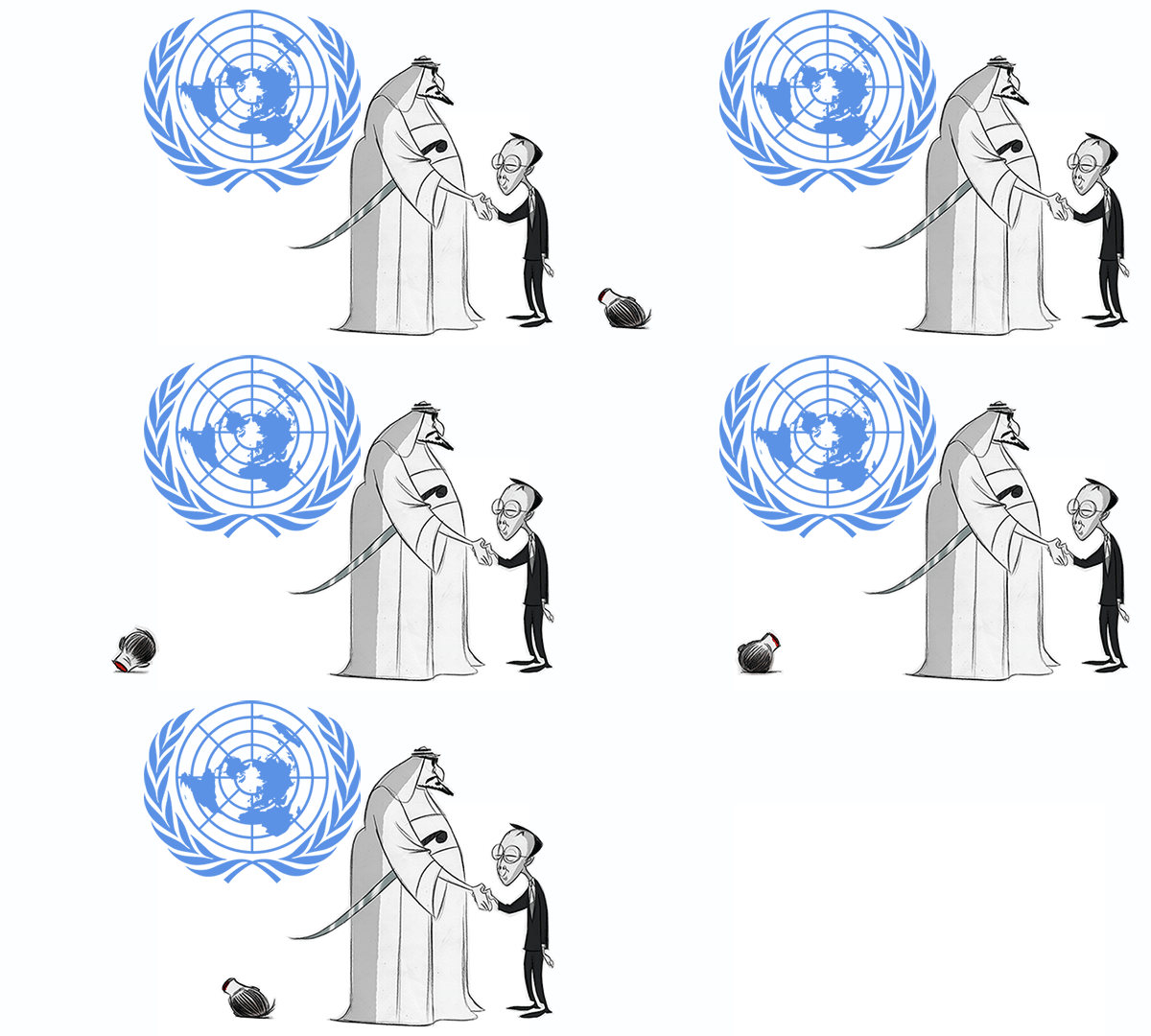
The United Nations thinks Saudi Arabia is a defender of human rights
By Ann Telnaes
The United Nations has named an official from Saudi Arabia to head a UN Human Rights Council panel. The appointment, which was made in June but not reported until recently, comes after multiple beheadings by the Saudi kingdom and the continued imprisonment of Raif Badawi, a blogger who has to date received 50 of his 1000 lashes sentence. This isn’t the first time the UN has made a tone-deaf human rights appointment. In 2001 Sudan, whose government backed militias which took slaves during the Sudanese civil war, was named to a UN human rights commission as well.
The United Nations has named an official from Saudi Arabia to head a UN Human Rights Council panel. The appointment, which was made in June but not reported until recently, comes after multiple beheadings by the Saudi kingdom and the continued imprisonment of Raif Badawi, a blogger who has to date received 50 of his 1000 lashes sentence. This isn’t the first time the UN has made a tone-deaf human rights appointment. In 2001 Sudan, whose government backed militias which took slaves during the Sudanese civil war, was named to a UN human rights commission as well.Video - Israel PM Netanyahu's Eid Al Adha Greeting to the Muslim Community
Prime Minister Benjamin Netanyahu recorded a special holiday greeting to Muslims on Friday, insisting that claims Israel was upsetting the delicate interfaith balance on Temple Mount were false.
"Muslim citizens of Israel and members of the Islamic faith around the world, I would like to wish you all an 'Eid mubrak'," Netanyahu said, marking the occasion of Id al-Adha. "I hope that this year will be one of peace between the religions."
"I would like you to know that Israel is maintaining the status quo on the Temple Mount," the premier said, posting the message on his Facebook page. "Israel safeguards the holy places of all faiths. Don't be led astray by incitement, wild incitement that is without foundation. We respect all religions."
The emphasis Netanyahu placed on Temple Mount could be interpreted as a message directed at Jordan, which is reportedly furious with the Israeli government over its handling of events at the Islamic holy places there.
The Prime Minister’s Office refused comment Thursday on a spate of reports that Jordan’s King Abdullah II is refusing to take phone calls or meet secretly with Netanyahu because of the tension around the Temple Mount.
According to the reports, Abdullah does not want to create a “business as usual” atmosphere with Netanyahu while the situation around the Temple Mount remains tense.
Nevertheless, the prime minister did not back off from stressing that Israel will preserve the status quo and law and order at the site.
Following Thursday’s security cabinet meeting on stiffening penalties for rock-throwers, Netanyahu said that Israel has told its neighbors that it will preserve law and order on the Temple Mount, and is calling on the Palestinian Authority to “stop its wild incitement.”
“We are preserving the status quo,” he said. “We are not violating it and all comments that we intend to harm Muslim holy sites are completely baseless.”
Netanyahu added that those who were bringing explosive devices in the mosques are the ones altering the status quo.
The Kuwaiti daily Al-Jarida reported on Thursday that Abdullah refused Netanyahu’s request to hold a secret meeting in the Red Sea resort town of Aqaba, just over the border near Eilat.
The reports said that not only has the Jordanian government refused to accept any back-channel messages from the Prime Minister’s Office, but it is considering a recall of its ambassador from Tel Aviv as a means to express its displeasure with Jerusalem’s policies.
Some 10-days ago Abdullah, in a meeting in Amman with British Prime Minister David Cameron, said that Jordan has been “very concerned and angered with the recent escalations in Jerusalem, specifically in Al-Aksa Mosque.”
He said that if the situation continues, it “will affect the relationship between Jordan and Israel; and Jordan will have no choice, but to take action, unfortunately.”
Following Abdullah criticism, Israel - according to Channel 2 - sent messages to Jordan that it should not be shirking its own responsibility at the Temple Mount and that it was in fact the Jordanian Wakf Islamic Trust that has allowed the rioters who were armed with stones to sleep in Al-Aksa Mosque.
Father of young Saudi protester facing crucifixion fears imminent execution
By Rori Donaghy
- See more at: http://www.middleeasteye.net/news/father-young-saudi-protester-facing-crucifixion-fears-imminent-execution-1278235287#sthash.3JWvzsEe.dpuf
The only thing stopping Ali al-Nimr being publicly beheaded and crucified in Saudi Arabia is the signature of King Salman bin Abdulaziz
The father of a young Saudi man sentenced to death by beheading and crucifixion has told Middle East Eye that he fears the king may imminently sign off on his son's execution.
Twenty-year-old Ali Mohammed Baqir al-Nimr was convicted of sedition and rioting – among other charges – in 2014 and sentenced to death.
He was arrested in 2012 after having taken part in Arab Spring inspired protests the previous year in eastern Saudi Arabia, where the country’s Shia minority are concentrated and complain of long-established government discrimination.
Nimr has hit the headlines in recent days, after controversial American comedian Bill Maher referenced his case on Twitter.
Maher, who is well known for his animosity to Islam, suggested people should direct their anger toward Nimr’s potential execution rather than at police in Texas who arrested a 14-year-old Muslim boy after his teacher mistook his homemade clock for a bomb.
The upsurge in international support for Nimr’s case, which has seen his name mentioned over 15,000 times in English on Twitter this week, has not reassured the 20-year-old’s family, who fear he may be crucified and his body left to rot in public by local authorities.
“King [Salman] must sign off on the sentence for it to go ahead,” Mohamed al-Nimr told MEE on Friday. “I fear that there are negative influences around the king, including in the Interior Ministry, people with a Salafi mind-set that will convince the king to sign.”
The king’s signature is the last remaining hurdle to the execution being carried out. The high court has approved the death sentence, which means 13 judges have signed off on it. There are no avenues of appeal left and the family will not be informed if or when the execution is done.
“If the sentence is carried out, we don’t know when it will be,” Nimr said. “Nobody is informed of these things. The usual thing is to hear on the television or radio of a statement that the death sentence has been done against such and such a person.”
Saudi Arabia has executed 133 locals and foreigners this year, according to an AFP tally, compared with 87 last year.
Authorities may be put off by executing Ali, however, because of the reaction on the streets of the Eastern Province, which would explode with anger according to the young man’s father.
“[If Ali is executed] there will be an uncontrollable reaction on the streets,” Nimr said. “We don’t hope for this reaction, and we don’t want it, and nor do we support or encourage it, but we won’t be able to stop it. There will be a wave of rage.”
“The government has to be prepared to deal with it.”
The Shia community of Saudi Arabia – which makes up around 10 to 15 percent of the country’s 29 million people – have long complained of government discrimination, particularly in areas of employment and education.
Private television channels have hosted speakers who express hatred of the country’s Shia community.
“We’ll come to your areas and eat you alive,” Khaled al-Ghamidi, a local journalist, said on Wesal TV in January 2013. Wesal TV has since had its offices shut down after accusations it was spreading sectarianism.
Mohamed al-Nimr told MEE that he believes that “there are people [in Saudi Arabia] who benefit from the schism that has been created between the Shia and their government. The Shia in Saudi want to solve their problems using peaceful means. But there are people, extremists, who oppose this.”
Protests have largely petered out in the Eastern Province since 2011, although from time-to-time confrontations happen between local residents and security forces. The Arab Spring inspired uprising saw around 1,000 people arrested, hundreds of whom remain behind bars.
Authorities have repeatedly said they will not tolerate sectarianism in the country. They have also defended their actions in dealing with the Eastern Province protests – in which dozens of protesters and security forces have been killed – by arguing that they have faced an armed uprising.
The leader of the protest movement, firebrand cleric Sheikh Nimr a-Nimr – Ali’s uncle – has also been sentenced to death for his role in the demonstrations and his brother Mohamed said he believes his son was arrested “to shame” the family.
On Friday Mohamed and his wife were granted permission to visit Ali in prison for the religious holiday of Eid al-Adha. His father said Ali was “overcome by happiness” at seeing his family.
It was a rare visit for the family, who last saw Ali nearly two months ago, although he is granted a weekly telephone call by prison authorities.
Mohamed said prison has been hard on his son, who has been detained for over three years, since February 2012.
“Ali has been deprived of his family, deprived of his childhood and his youth, deprived of years of study,” he said.
He is kept in one room, 24 hours a day, with between four and six other prisoners. He is not allowed out for exercise, except during Ramadan, when prison authorities gave him permission to take part in sports matches between prisoners.
The United States, a close ally of Saudi Arabia, has expressed “deep concern” over the impending death sentence and his father has said international pressure could be the only thing that saves his son’s life.
“The Western world says it cares a lot about human rights,” he said. “This is a human rights case, there is no doubt about that. Ali was a child on the day he was arrested. The charges brought against him are incorrect. Even if they weren’t, he was a child! How can he receive the death penalty?”
“The US government could explain [to the Saudi government] the danger of carrying out this sentence, that this would further heighten tension and add to a deteriorating security situation.”
The United Nations has called for Saudi Arabia to cancel Ali’s execution order and grant the young man a retrial. The original trial was carried out in secret and the conviction was based on a forced confession given by Ali under torture, his father alleged.
Despite problems with the original trial, Mohamed said he believed there is a chance for fair trial standards to be met in Saudi Arabia.
“I’m sure that if the proper procedures were followed it would be possible to have a fair trial in Saudi Arabia,” he said. “If the trial is open and public it could be fair.”
Saudi authorities have not commented specifically on the case.
U.S. - Speaker John Boehner Quits the Arena
Mr. Boehner sparked fury from his right flank in his unsuccessful attempt to work out a budget compromise with President Obama. His leadership was marked by endless votes against Obamacare even as it became a national success. The 2013 shutdown of government, engineered by conservative Republicans, was a low point in what seems to have become an increasingly impossible job for Mr. Boehner.The latest challenge — a threatened government shutdown over demands by conservatives to defund Planned Parenthood — is exactly the kind of absurd and dangerous move that the right wing has made its signature tactic. It appears that Mr. Boehner, like most of the nation, finally decided he had had enough. With his decision to retreat, some Republicans seem to think the right wing, claiming victory over Mr. Boehner’s ouster, might drop the Planned Parenthood fight and approve a budget extension bill this month in order to concentrate on the looming leadership fight. This, of course, would be the height of hypocrisy since they’ve been howling that defunding Planned Parenthood was a matter of life and death. Now it seems they might welcome a way out of the cliff-hanging scenario they created, since opinion polls show voters would blame the Republicans for any government shutdown. If nothing else, this intramural brawl makes it ever clearer that congressional Republicans are incapable of governing themselves, much less the government and the nation. The current Republican candidates for president might find an object lesson here. Far from a moderate in any normal sense of the word, Mr. Boehner departs as a figure thrown out by party zealots enthralled by Ronald Reagan’s woeful dictum that “Government is not the solution to our problems; government is the problem.”
Malala To Open UN Summit With Appeal For Free Education
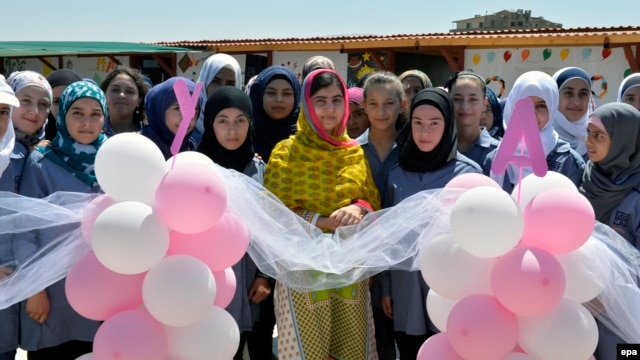
The address by Malala, who was shot on a school bus in Pakistan in 2012 by the Taliban for advocating girls' rights to education, will immediately follow an opening address by Pope Francis on September 25.
"The dreams [the leaders] have for their own children, I'm hopeful they will have the same dreams for the rest of the world's children," Malala said in an interview with Reuters.
"If you want our future to be more powerful, to be enlightened, to be bright, we need to invest in education," she said, noting it "does not require as much money as we think -- just $39 billion, which we spend just in eight days on [the] military."
Malala, who celebrated her 18th birthday in July in Lebanon by opening a school for Syrian refugee girls, said she would also highlight the plight of refugee children as Europe faces the largest wave of refugees and migrants since World War II.
Pakistan - Nisar’s follies
In the fallout of the Bababer base attack, Interior Minister Chaudhry Nisar continues his perplexing trend of making counterproductive grandstanding statements. Talking to a group of reporters, he repeated his claim that other than the five attackers identified as Pakistanis, the ones who could not be identified were indeed “foreign”. He further insisted that the investigations had confirmed that the attack originated from Afghan soil and that since the Tehreek-e-Taliban Pakistan (TTP) had admitted responsibility for the attack, this clearly revealed that the TTP was based in Afghanistan. While he did promise that the Pakistan government would share proof of the attackers’ identity, associates and modus operandi as gleaned from the investigation with the Afghanistan government, he tampered the message of coordination by launching yet another salvo towards Kabul. In his bid to appear tough and uncompromising to the audience at home, Nisar boldly made a highly dubious claim that Pakistan’s military operation in North Waziristan has ensured that infiltration of militants from Pakistani soil into Afghan territory had nearly stopped but the reverse was not true, and, according to him, this was the result of Kabul’s inaction. Even if one accepts that the ongoing military operation has managed to effectively reign in the infamously porous Pakistan-Afghanistan border in the North Waziristan region, the absurdity of Nisar’s declaration is obvious to anyone who looks at a map between the two countries because the border between the two countries runs for thousands of kilometres and remains equally porous and unmanageable in the other areas, for example in Balochistan where the Afghan Taliban’s Quetta Shura is sitting. The bizarre statements on the border do not end there, as Nisar pushes for a self-evidently unworkable idea: fencing the thousands of kilometres long border to curb the crossings. The cost of such an endeavour and the impossibility of keeping it under watch at all times in all areas seem to be lost on the Interior Minister.
Nisar seems to be pushing the responsibility of dealing with the TTP primarily onto the shoulders of Afghanistan’s embattled government in a language that paints Pakistan as a victim with no responsibility in the creation of the TTP. Chaudhry Nisar did, however, rule out the possibility of Pakistan launching an operation or airstrikes inside Afghan territory to the relief of many observers, as such a foolhardy endeavour that violated Afghanistan’s sovereignty and territorial integrity would have permanently damaged any chance of rebuilding trust and coordination between the countries, and would have exposed Pakistan to a new military front. While it is a relief to see Pakistan back down from this contemplated bout of adventurism, the barbed rhetoric of one of the government’s premier ministers is only serving to exacerbate the gulf between the two countries at a time when the most sensible course of action to fight terrorism is for the two countries to converge to bridge the gaps in their surveillance apparatus and get rid of the discord readily exploited by the TTP to carry out its operations. It is difficult to foresee such an eventuality if Nisar persists with undercutting every statement he makes on the war against terrorism with veiled comments about Kabul being in bed with India, thereby playing to the conspiracy-hungry gallery in Pakistan, which is all too eager to pin the blame for all of Pakistan’s ailments on the elusive 'foreign hand'. The Pakistan government’s paranoia about an Afghanistan partnering up with India to the detriment of Pakistan reveals that they are still stuck in the recent past when Hamid Karzai was the Afghan president. As soon as Karzai’s successor, Ashraf Ghani, was elected he extended an olive branch to Pakistan and every political action he took until July of this year indicated that he was sincerely committed to establishing good ties with Pakistan and reducing the trust deficit between the two countries. Pakistan should recognize this, even at this belated stage, and seek ways to repair the damage. Lambasting Afghanistan at every opportunity is a questionable strategy, especially since Pakistan repeatedly complains about Afghanistan doing the same. Pakistan’s continual game of playing victim also rings hollow, since its decades-long interference in Afghanistan has played a huge role in Kabul’s current reduced status and the ailments of Afghanistan. By refusing to acknowledge this responsibility and by doubling down on a rhetorical assault, Pakistan is not doing its fair share to resuscitate the relationship. Allowing this dispute to persist is harmful to the security of both countries.
Pakistan - Peshawar attacked again
Why is it so hard to admit that the enemy, no matter how insane and ignorant, has outsmarted us?
Like an expert predator, the terrorists swooped down on Badaber airbase in Peshawar last week, killing 30 people, including an army officer, and wounding many more. Without counting the numerous smaller attacks that afflict two to three individuals every time, the jihadists have carried out their third successful major strike in the last one month. Put another way, we have lost three times against the extremists within a month.
A few days ago, on August 16, Lashkar-e-Jhangvi (LeJ) sent two suicide bombers in retaliation for the killing of its leader, Malik Ishaq, in police custody. Their target was the interior minister of Punjab, Shuja Khanzada, a vocal critic of banned sectarian organisations. According to reports, the suspects entered the facility without going through any security check points and zoomed in on the victim in the meeting place, moving closer, stealthily, avoiding attention. Once they had ascertained the former military officer stood in their range, they detonated the explosives. The ensuing blast was huge, causing the entire building to collapse. The roof gave way, entrapping dozens of people, most of whom died under the rubble, their bodies still buried.
What makes the situation worse is that the minister was warned before the assault to take appropriate precautions. I am not sure if he beefed up his security to prevent such a tragedy or not but, even if he did, those measures failed as he went to meet his maker in the attack.
After targeting Attock, the northern district of Punjab that borders Khyber Pakhtunkhwa, the terrorists jumped over to Multan, a southern district, slaughtering more than 30 people in a bomb explosion. We were still recovering from its shock when they pounced on Peshawar again, like a master planner who pays attention to every detail and ties all the loose ends before the event. The question is if we, in response, are tackling this war as skillfully as it should be tackled. Or we are playing ‘the Hulk’ who gets angry and starts destroying everything that comes in front of him, shoots indiscreetly and bombs the area in jet planes without a specific target? I am not sure. What I am sure about is that the enemy eludes us and stays way below the radar, underground, well connected and well organised yet we fly thousands of feet above the ground in the air, aloof and oblivious. For us to win though we have to change that culture. We need to penetrate its organisation from within before we can destroy them through an overt military operation, a strategy that they are already working on and we may have ignored.
Our strategy till now has been to belittle jihadi groups and consider them imbeciles, lunatics with no agenda, criminals without any moral conviction. That policy of course has not yielded good outcomes. Sometimes, trivialising the enemy to boost the morale of the people and to ward off fear from their minds works, I agree. On the downside though, underestimating the enemy can induce laziness and inculcate overconfidence, an attitude that we come across everywhere. All over Pakistan people believe it is a matter of days — not even weeks — to uproot every terrorist hideout once the establishment has made up its mind. And since no one knows what the establishment in fact wants, the failure that mocks us through these killings is either attributed to the involuntary complicity of the agencies or is because of the involvement of ‘foreign hands’. In other words, we refuse to consider these attacks as our genuine inability to handle the situation, a capacity issue more than an issue of intent. Why is it so hard to admit that the enemy, no matter how insane and ignorant, has outsmarted us?
Do you not think it is time that we recognise the strengths of our adversary, which keeps on orchestrating such assaults, the resilience of its network that stays unscathed after a year of nationwide military operations, its determination to fight back even in the most unfavourable circumstances and its outreach from one corner of the country to another? We must focus on the pluckiness of these gangs, rather than deriding their weaknesses and appreciate their commitment rather than scoffing at their beards and outfits. That, in turn, can help us launch a better, smarter and more vigorous counterinsurgency campaign and prepare us for a war that will be stretched over years, not days or months as we expected. It may also pull us out of a looming defeat while we dream of a victory in our oblivion.
Remember, last year too, after the Peshawar school massacre, we thought the capital of Khyber Pakhtunkhwa would be converted into a castle, a fortress that could not be penetrated, heavily guarded and religiously protected. We were committed to change it from being one of the most vulnerable cities in the world to the safest, united to send a message to the world that we know how to defend ourselves. To show that we are a country with a large professional army consisting of brave soldiers and talented officers. That we have the most powerful spy agency in the world, its significance recognised internationally, and that the time to show patience is over. Even though it took us a long time to conclude how to respond to these offences we are now determined to fight back and we will do whatever it takes to eradicate violence in the name of religion. Anyone from that day, it must be known to every organisation that plans or tries to attack the city, will be dealt with with an ‘iron fist’. Both the military and the civilian administration seemed to be on one page in their resolve. Then, how come a year later, more than a dozen people disguised as soldiers in paramilitary uniforms stormed a mosque located within the airbase and mowed down tens of worshippers? Where is our iron fist? Has it softened up after targeting the wrong spots for so long?
Women in remote Pakistan ostracized for medical condition
Ever since she endured a complicated pregnancy years ago, Bibi Razia has been ostracized by her family, barred from even sitting with her husband other members of her family.
She suffers from a little-known but devastating disease known as obstetric fistula. The condition, according to the Fistula Foundation, is the result of a hole between the vagina and rectum or bladder caused by prolonged labor and often affects women in the developing world due to the poor state of maternal care there.
"I was abandoned in a separate room with my child, and food was served me there," Razia said. "I was not allowed to cook food because of the smell that continuously came from me."
In Pakistan, there are said to be as many as 8,000 fistula cases. The large number of cases is blamed on women in places like Balochistan province having babies delivered at home by traditional birth attendants because they cannot afford to go to the hospital. Botched hysterectomies are responsible for causing fistula.
"This is a disease of poor, where poor women grapple with it during the delivery," said Sajjad Siqqui, the Pakistan country director for the U.N. Population Fund, adding that among every 100,000 delivery cases, 726 women die each year in Pakistan, and the ones who survive suffer complications of fistula."
Siqqui said that there are only 56 doctors in the entire country available to treat fistula patients, partly because it is not a lucrative business.
"In Balochistan, only four doctors have expertise to treat patients, all based in Quetta," Siqqui added.
Ahsan Tabusum, the U.N. agency's provincial coordinator, told News Lens Pakistan that the agency, in collaboration with the Pakistan National Forum for Women Health, has opened three centers for fistula treatment in Quetta. They have treated over 500 patients since 2006, he said, with a 90 percent success rate. But he said so far there has been little interest from the government in expanding or taking over the program. Making matters worse, doctors at government facilities often fail to refer patients or inform the women of the centers.
"Once we roll back our program, then what will be the fate of patients suffering from fistula?" Tabusum wondered.
Adding to the women's woes is the fact that many are given little support and wait years and even decades to have the condition addressed. Most do not even know there is a relatively routine treatment available, and are often abandoned by their families before they get the treatment.
"We do not have recorded data as to how many women have been divorced in Balochistan or abandoned so far, but I do have idea that they are beaten, abandoned and even divorced after developing fistula," said Tasneem Ashraf, president of Pakistan Association of Gynecologists.
The obstetric fistula can be closed with intravaginal surgery, according to the Fistula Foundation. If a skilled surgeon performs the surgery, the foundation said a fistula patient has a good chance of returning to a normal life.
Women who do not know about the treatment are forced to endure a life of misery.
One of those women, Bibi Sursan, has been suffering with the condition for 25 years. Living in the remote district of Harnai, Sursan only learned about the condition when she visited a doctor in Quetta.
"I informed my husband, but he did not know that the disease would linger on for the next three decades," said Sursan, who is in the process of getting treatment.
Razia, too, has come to Quetta for treatment.
Hailing from Nasirabad district, 125 miles from the Quetta, Razia could not afford to get the treatment for much of her life because her husband is a poor farmer. After finally making the travel arrangements to Quetta, however, she was found to have developed an infection in her bladder.
"I was abandoned and ostracized," she said. But with the treatment, Razia said she is hopeful her life can change for the better.
"I hope to reunite with my family and children," she said.
Subscribe to:
Posts (Atom)