Sunday, September 13, 2015

Iran Criticizes Saudi Arabia for Yemen Attacks in Times of Muslim Haj


Iran criticized Iran to Saudi Arabia Sunday, for intensifying the bombing in Yemen before the Muslim Hajj pilgrimage, and said that this aggression "is a symbol of their lack of wisdom"
The Iranian deputy minister Foreign Minister for Arab and African Affairs Hossein Amir Abdollahian, urged the Saudi kingdom to stop armed attacks, far from weakening the insurgency Ansar Allah, kill hundreds of innocent civilians, he said.

"To keep aggression on the eve Hajj, the largest religious procession in the world will begin on September 21, it is also an indication of disrespect from Riyadh to constructive diplomacy and peace," said the deputy foreign minister was quoted by the official IRNA news agency.

Amir Abdollahian said there is no military solution to the Yemeni crisis and recalled that the Islamic Republic has already submitted appropriate to help the Wahhabi kingdom to "get rid of the dilemma of Yemen" political mechanisms, but efforts have been ignored.

Iran supports national dialogue among all the political groups and opposing forces in Yemen, recalled the official, who also praised the efforts of the UN special envoy to the Arab country in favor of a negotiated solution to the dispute.

The Deputy Foreign Minister regretted that all efforts UN to send humanitarian aid to Yemen, raising the human blockade to stop the war and bloodbath "have fallen on deaf ears because of the Saudi refusal to help, as the ambiguous silence of some Arab and Western countries." 

Abdollahian Amir's statements came after news that the Yemeni President Abdo Rabbou Mansour Hadi, conditioned its participation in any negotiations with the Shiite militia Ansar Allah and loyal army sector exmandatario Ali Abdullah Saleh.

Hadi, who was exiled to Ryad, days into Saudi bombing campaign against his country on March 26, declined to attend the talks scheduled for this week in Oman, unless the rebels recognize and abide by the resolution 2216 Security Council of the UN.

During a meeting on Saturday night in the capital of the Wahhabi kingdom, Hadi, Vice President and Prime Minister Khaled Bahah, and several advisers demanded the insurgents to accept "unconditionally "the implementation of the UN text.

In that sense, the ousted president refused to set a date and venue for a dialogue with supporters of Saleh and Shiite rebels" to declare their recognition of the decision and begin to implement it ".

Analysts said the Iranian Press TV that such a stance reflects Saudi pressure just as a dangerous concentration of troops from countries in the Arab-Islamic coalition on the border with Yemen in what appears to be an imminent ground invasion is reported .

http://www.plenglish.com/index.php?option=com_content&task=view&id=4154451&Itemid=1

SAUDI GOVERNMENT RESPONSIBLE FOR THE CRANE INCIDENT IN THE HOLY KA’BA: AN IMPORTANT REVELATION

Saudi government is responsible for the incident that took place in the Holy Ka’ba. According to proofs and statements of engineers, they asked the government to remove those huge cranes that were installed for expansion of the Holy Ka’ba. They told that they asked the government, a week earlier, to remove those cranes and to stop the construction work in order to avoid any abominable incident during Hajj but the government did not hear them and told to continue the work.

It should be keep in mind that millions of people goes to the Holy Ka’ba every year, to perform Hajj. The incident that took place yesterday killed 108 pilgrims whereas more than 200 people were injured, including Pakistanis as well.
According to the administration of Makkah, the incident took place due to the severe storm and cyclone. Pictures on social media shows the lightning falling from the sky.
http://www.shiitenews.org/index.php/saudi-arab/item/18389-saudi-government-responsible-for-the-crane-incident-in-the-holy-ka-ba-an-important-revelation

Saudi Arabia Takes Zero Refugees Despite Having 100,000 Tents Able To House 3 Million People

While Europe takes the burden of the migrant crisis
While European countries are being lectured about their failure to take in enough refugees, Saudi Arabia – which has taken in precisely zero migrants – has 100,000 air conditioned tents that can house over 3 million people sitting empty.
The sprawling network of high quality tents are located in the city of Mina, spreading across a 20 square km valley, and are only used for 5 days of the year by Hajj pilgrims. As the website Amusing Planet reports, “For the rest of the year, Mina remains pretty much deserted.”
The tents, which measure 8 meters by 8 meters, were permanently constructed by the Saudi government in the 1990’s and were upgraded in 1997 to be fire proof. They are divided into camps which include kitchen and bathroom facilities.
The tents could provide shelter for almost all of the 4 million Syrian refugees that have been displaced by the country’s civil war, which was partly exacerbated by Saudi Arabia’s role in funding and arming jihadist groups.

However, as the Washington Post reports, wealthy Gulf Arab nations like Saudi Arabia, Qatar, Kuwait and others have taken in precisely zero Syrian refugees. Although Saudi Arabia claims it has taken in 500,000 Syrians since 2011, rights groups point out that these people are not allowed to register as migrants. Many of them are also legal immigrants who moved there for work. In comparison, Lebanon has accepted 1.3 million refugees – more than a quarter of its population.
While it refuses to take in any more refugees, Saudi Arabia has offered to build 200 mosques for the 500,000 migrants a year expected to pour into Germany.
Saudis argue that the tents in Mina are needed to host the annual Islamic pilgrimage to Mecca, but given that the Arabic concept of Ummah is supposed to offer protection to all Muslims under one brotherhood, surely an alternative location could be found so that Mina can be repurposed to house desperate families fleeing war and ISIS persecution?
While Europe is being burdened by potentially millions of people who don’t share the same culture or religion as the host population, Gulf Arab states refuse to pull their weight, resolving only to throw money at the problem.
The likelihood of the Saudis inviting Syrian refugees to stay in Mina is virtually zero, but the thousands of empty tents serve as a physical representation of the hypocrisy shared by wealthy Gulf Arab states when it comes to helping with the crisis.

Video Report - Hungary: Inside Röszke Detention Centers

Video Report - Why Hillary is Supporting the Iran Deal | Hillary Clinton

Video Report - State Department: Radical Islam is Losing, But Also Growing

Video Report - Killing not just pain: Strong painkillers make people drug addicted

Video Report - The Stream - Should buying and selling sex be a crime?

Urdu Music - NAYYARA NOOR - ROTHE HO TUM KO

Another Unneeded, Unnecessary Building in Afghanistan You Helped Fund


By 


The United States military shelled out millions before deciding the project was unnecessary, bringing the total for unused buildings spotted by the Inspector General for Afghanistan to nearly $42 million.
The beat goes on. For the third time in four months, the watchdog for spending on the war in Afghanistan has released a report that shows the United States military commissioned a multimillion-dollar building in Afghanistan it didn’t need.
This time around, it’s a headquarters for a Special Forces base in Kandahar that was canceled halfway through at a cost of $2.2 million.
The latest disclosure raises the total for surplus buildings uncovered by the Special Inspector General for Afghanistan Reconstruction to nearly $42 million. There was the $25 million headquarters in Helmand that three generals said was not needed but was built anyway and never used. Then there was a warehouse in Kandahar for $14.7 million that was also never used, because the unit for which it was intended ended its mission in Afghanistan before the building was completed.

The U.S. Army Corps of Engineers, which was responsible for the contract, told SIGAR that it was still negotiating a final settlement with the contractor.

In the latest report released last Tuesday, SIGAR detailed how the military decided in July 2012 that it wanted a new, single headquarters on Camp Brown in Kandahar. The camp was home to troops with the Combined Joint Special Operations Task Force. (SIGAR also sent the Pentagon a more detailed, classified letter about its findings on the building.)
The military hired an Afghan company to build a $5 million, two-story building with administrative space and a secure communications room for logistics, maintenance, personnel, and operations management, according to the report. The building was scheduled to be completed in July 2013—just as the U.S. greatly reduced its military presence in the country and only 18 months before the combat mission was scheduled to end.
The contractor, Road and Roof Construction Company, fell almost a year behind schedule, and, in October 2013, the commanders whose troops had been assigned to occupy the building decided it was no longer needed, SIGAR said.
Six months later, the military canceled the project.
By this time, $2.2 million had already been spent. The building remains half constructed, with no stairs to the second floor, electrical wiring, or plumbing, SIGAR said. It has never been used.
Military officials told SIGAR that they halted construction because the operations planned for the region had changed, making Camp Brown’s existing facilities sufficient. The inspectors said this decision was reasonable, but suggested that the military should consider completing the building for the Afghan government’s use.
The U.S. Army Corps of Engineers, which was responsible for the contract, told SIGAR that it was still negotiating a final settlement with the contractor. Because negligence was not involved in the cancellation, it’s possible that the company could demand the rest of the contract be paid.
http://www.psmag.com/politics-and-law/another-unneeded-unnecessary-building-in-afghanistan-you-helped-fund

In Pakistan, U.S. Aid Agency’s Efforts Produce Dubious Results

By 
The ads are a staple of Pakistani television: footage of water gushing through dams, farmers standing in green fields, a girl using a computer. At the end, the red, white and blue logo of an aid organization flashes on the screen with its slogan, “from the American people.”
The organization behind the Urdu-language ads, the United States Agency for International Development, or U.S.A.I.D., has been operating in Pakistan for more than a decade, disbursing billions of dollars. But critics say the aid has had minimal impact on the ground.
Critics accuse the agency of taking on projects with little consideration for local priorities and being over-reliant on American contractors with little development experience. At the same time, they say, much of the aid money goes toward administrative costs, and large amounts have been siphoned off by Pakistani subcontractors who fail to complete work or return raw material.
A recent lawsuit against the agency highlighted the challenges and image problem it faces in a country where American aid is often viewed with suspicion, and countries like China have been making inroads with their own programs. The case, filed in Peshawar, in northern Pakistan, by three lawyers seeking the payment of legal fees from the aid agency, accused it of abandoning the recovery of United States taxpayer money from a former contractor.
Documents and correspondence filed by the lawyers lay bare the money and equipment that went to waste in a project in Pakistan’s insurgency-hit tribal areas. One subcontractor finished only two of 12 irrigation channels he was supposed to build. Another did not return more than $27,000 worth of construction material to U.S.A.I.D., and demanded nearly $30,000 in rental charges for equipment, though there was no proof of any machinery on site.
Nadeem UL Haque, the former deputy chairman of the Planning Commission, a government agency that oversees development projects, said U.S.A.I.D. had become an “aid-outsourcing agency” and that funds largely flowed back to American contractors instead of to communities.
Despite the widespread criticism about its effectiveness, some experts also acknowledge that the agency has been the victim of anti-Americanism in Pakistan and has failed to promote some of its successes.
“I would not say it’s been a failure — they’ve invested money in energy and education — but because of anti-Americanism and their own inability to effectively communicate, this hasn’t been seen,” said Raza Rumi, a fellow at the National Endowment for Democracy in Washington, who has worked in Pakistan’s development sector. “They’ve spent so much money in F.A.T.A.,” he added, referring to the Federally Administered Tribal Areas of northwest Pakistan. “The reality is no one actually knows the result.”
Officials with the United States Agency for International Development declined repeated requests for comment.
The agency’s recent troubles are just the latest in a series of high-profile missteps for American aid efforts in Pakistan.
An Islamist group that received funding from the State Department to hold an anti-Taliban demonstration also went on to lead rallies in support of a man who assassinated the governor of Punjab Province in 2011.
In 2012, the agency cut funding to a Pakistani theater group producing a local version of “Sesame Street” over irregularities in procurements and asked it to return $1.6 million it had been paid. The theater group did not repay the funds or return equipment worth approximately $900,000, according to a report by the agency’s Office of Inspector General.
And in March 2015, an internal audit by the agency of a $102.7 million municipal services program in the province of Khyber Pakhtunkhwa found that the provincial government had worked in only one city of the three districts for which it was granted funds, and had only carried out a handful of activities there.
The report noted that while funds had been issued to contractors, “The lack of significant progress indicates that the capacity-building efforts may not be sufficient in quality, quantity, or discipline to accomplish the goals set forth by the program.”
Development aid, which is dwarfed by the military aid that the United States provides Pakistan, has long been a contentious issue between the two countries but has been growing in recent years.
In 2009, Congress authorized $7.5 billion in nonmilitary aid to Pakistan over five years. But stipulations related to civilian control over the military infuriated the Pakistani military, which said the legislation interfered with national security. Many Pakistanis view any aid initiatives of the United States with suspicion.
“There is also this deep-seated suspicion that this aid — whatever the objectives — are kind of subject to the U.S. foreign policy’s short-term goals,” said Mr. Rumi of the National Endowment of Democracy.
But, he said, the development agency could also be faulted for its bureaucratic inefficiency and for not having prioritized assistance effectively, as well as its emphasis on hiring contractors from the United States. “A lot of money which is allocated or spent goes back to the contractors,” he said, adding that other international aid agencies worked more directly with provincial governments.
Another challenge for the United States is that its aid programs are often overshadowed by those of other donors like China, which disburses funds without many of the conditions demanded by Western agencies like U.S.A.I.D.
“The Chinese do not get into the whole idea of improving a country’s systems and governance and how it functions,” Mr. Rumi said. “They are very clear: ‘Do whatever you want — we’ll build this road, highway or nuclear plant.’” Western governments, he said, instead appear to feel that it is their “moral responsibility” to improve governance and accountability.
Critics like Mr. Haque say the American aid agency and other foreign donors are themselves not transparent about their own work.
“When I was at the Planning Commission I asked them to present their programs to us and they resented it,” Mr. Haque said. “If I’m planning, I need to know what they’re doing.”
China also sets itself apart by building high-visibility infrastructure projects such as a recently announced $46 billion investment in Pakistan for energy and infrastructure projects, unlike U.S.A.I.D., which often focuses on less-prominent programs like training and expanding the capacity of government institutions.
The development agency’s project at the center of the lawsuit in Peshawar was a $300 million initiative to create jobs and build roads in insurgency-torn districts in the tribal areas. One of the contractors on the project, Academy for Educational Development, a now-defunct American nonprofit organization, was accused in 2009 of submitting false claims and failing to inform U.S.A.I.D. that it was aware that its subcontractors were overcharging U.S.A.I.D., potentially by millions of dollars. U.S.A.I.D. suspended Academy for Educational Development from United States government contracts and reached a settlement that involved the repayment of more than $5 million.
Academy for Educational Development was also awarded at least $300,000 after a drawn-out arbitration process with its Pakistani subcontractors — money that should have been returned to U.S.A.I.D. The Pakistani lawyers who filed the suit said that the aid agency had made no attempt to recover the money.
The agency’s reluctance to pursue the subcontractors for the money may stem from a desire to avoid the Pakistani legal system, where cases are often plagued with delays and allegations of corruption. But for many Pakistanis, the case is another puzzling instance of wastefulness. “This is U.S. taxpayer money,” Sanaullah Khan, one of the lawyers, said. “Why is U.S.A.I.D. walking away from an ongoing legal process?”

Constitution of Pakistan guarantees religious freedom to minorities says Hindu leader

Patron-in-chief of Pakistan Hindu Council, Dr. Ramesh Kumar Vankwani has said that the constitution of Pakistan guarantees to provide religious freedom to the minorities, adding that Quaid-e-Azam in his address to the Constitutional Assembly also ensured the minorities to live according to their religious beliefs. While delivering his keynote speech, on the occasion of first-ever Dharmik Quiz Competition organized for the Hindu Children in the history of Pakistan, Dr. Ramesh Vankwani said that providing religious education to the minorities, according to their beliefs, must be included in the curriculum of schools. He urged that the teachings of all religions ask their followers to respect other religions, which is essential for a peaceful society.

"Today, the passion of Hindu Children participants prove that the future of Pakistan is bright," Dr. Ramesh said, while urging that all segments of society must join hands for promoting the interfaith harmony. He also ensured the participants that Pakistan Hindu Council would continue the struggle for the protection of minorities rights, as per the detailed decision of the Supreme Court on June 19, 2014.

The Dharmik Quiz, Speech and Tableau competition, was organized by the Pakistan Hindu Council, for children of Hindu community for awareness of Hindu dharam , at Swami Narayan Temple. On the occasion, cash prizes and appreciation shields were also distributed among the participants, belonging to more than 1,500 Hindu families, where thousand of people have gathered to support the noble cause. 

- See more at: http://www.pakistanchristianpost.com/detail.php?hnewsid=5597#sthash.bdw01OWU.dpuf

Hundreds of Pak-Christian asylum seekers detained in crackdown

In a major police crackdown in Bangkok, Thailand hundreds of asylum seekers were arrested for overstaying there tourists visas. The majority of those arrested were the ignored Pak-Christian asylum seeker community, two Somali families and one Afghan family. 


At 10 am on 10th September 2015, immigration officers visited Delight Condos in Pracha Uthit, Soi 75 accompanied by a mass of police officers and the military forces of Thailand. Security forces have been clamping down on illegal immigration since the recent bomb blast in Bangkok's centre at the Erawan Hindu shrine, one of Thailand’s most famous and popular tourist locations. 

Over 100 asylum seekers from many nations were questioned by the police and 91 were taken to the infamous and brutal Immigration Detention Centre, in the capital. The Thailand United Nations Commission for Human Rights (UNHCR) negotiated the release of 27 of those captured under the terms of asylum seekers with 'special concerns', none of whom were Pak-Christians. The special terms included vulnerable women who were pregnant and their children, and the elderly. This current negotiation is quite a precedent by the UNHCR and follows the submission of a report on the scandal of the UNHCR with Pak-Christians that was delivered in by our Chairman Wilson Chowdhry in person to Senior Protection Officer at the UNHCR Peter Trotter, in Bangkok on Tuesday 9th September 2015. The report commissioned by the BPCA, and co-authored by two genocide scholars Professor Rainer Rothfuss and former Senior lecturer at De Montford University Desmond Fernandes, contained details of the insouciance towards asylum seekers in Thailand by the UNHCR and highlighted that although the Thai Government had not signed UN Conventions on Asylum - nether the 1951 or 1967 versions - they had signed the following conventions, which meant the UN had a significant responsibility to ensure adherence to: 

- Universal Declaration of Human Rights (UDHR) (December 10, 1948) 

- International Covenant on Civil and Political Rights (ICCPR) (October 29, 1996)priam 

- Convention against Torture and Other Cruel Inhuman or Degrading Treatment or Punishment (October 2, 2007) 

- Convention for the Protection of All Persons from Enforced Disappearance (January 9, 2012) 

- Convention on the Rights of the Child (March 27, 1992). 

The report primarily focuses on the rights of Pak-Christian asylum seekers who make up the largest body of asylum seekers in Thailand, reported to be around 4600 by the UN but German NGO International Society for Human Rights placed the figure much higher at 8000. The report highlights the delay in Resettlement Status Determinations (RSD) for which an interview can take up to 4 years, leaving victims easily deportable, from here refugees status can take a further 4 years and resettlement a similar period. The UN documents have no worth in Thailand and arrest are indiscriminate of those with or without them. The report describes the scandalous overcrowding in Thailand's Detention centre; the disturbing failure to process asylum applications with many delayed until 2018; poor levels of resources and personnel for the UNHCR; failure to provide or permit legal representation for detainees; failure to protect women and children; inadequate and flawed translation provision often by Muslims to Christians who believe they have a biased agenda; the denial of education for children and young people; meagre health care, leading to deteriorating conditions and deaths of refugees while detained and soon after release; and dismissal of evidence detailing an escalation in violence against the tiny Christian minority and the well-founded fear of lethal persecution. 

Despite the report the UNHCR believes the main failing is with the Thai Government, a spokesperson said: "in my view, a primary focus of advocacy efforts should be the main source of the challenge, namely the RTG (Royal Thai Government) and the absence of a legal framework for addressing the needs of persons of seeking international protection. 

The BPCA is calling for the UNHCR to pursue better rights for Pak-Christian asylum seekers by calling for a reassessment of the current risk profiling. The UNHCR cites Britain’s Home Office policy statement (Feb 2013) that Pakistani Christians don't suffer persecution. In which Theresa May summarizes the policy as such “Christians in Pakistan are a religious minority who, in general, suffer discrimination but this is not sufficient to amount to a real risk of persecution."

The UNHCR does not need to follow any particular country for their assessments and we call on them to review the positions of countries such as Holland and Canada who have both adopted "High Risk" status for Pak-Christians. The BPCA is also launching a campaign to improve the current misinformed position held by Britain. Lord Alton at a meeting with Wilson Chowdhry in Bangkok on Tuesday said: 

"The exodus from Pakistan is driven by visceral hatred and a fanatical disregard for the rights of minorities. In a country where the brave Minister for Minorities, Shahbaz Bhatti, can be murdered in broad daylight, where churches are bombed, where an illiterate woman can be sentenced to death of alleged blasphemy charges, where a husband and wife can be burnt alive in front of their young children, and where there is a culture of impunity which rarely leads to those responsible being brought to justice, it is little wonder that many Christians are fleeing for their lives. It doubly compounds their suffering when the international community fails to step up to the plate in defence of those who have to endure such pitiless suffering and hardship.” 

BPCA has set up a fund for the release of Pak-Christians asylum seekers, for whom it will cost 50,000 baht (£1000) to release on bail. Once released on bail families have a two year protection from re-arrest and we hope and pray that many of you will help us to deliver them from the awful conditions in the IDC. Lord Alton visited the Thailand Immigration Detention Centre following a conversation with Chairman of the BPCA in June. During his visit to Thailand he noticed the despicable conditions of asylum seekers caged within the undersized and over capacitated cells in which refugees numbering in their hundreds are forced to sleep crouching, standing up, laying over one another and have to organise themselves into sleeping shifts. Food consists of boiled cucumber and rice in small proportions and all inmates look presentably emaciated. Toilets are flooded and overflowing, are too few for the number of detainees and create a rancid stench that is overpowering. We also hope to be able to support these families by providing rent and subsidence grants. 

Wilson Chowdhry of the BPCA said: "Pakistani Christians are the most ignored persecuted minority globally, despite the copious amount of evidence pertaining to the ever-present danger of persecution they face. Britain and America hold disingenuous positions with regards to asylum for Christians form Pakistan, based on protection of their existing economic ties through trade agreement and their desire to continue ally status in the war against terror. This is unhealthy and limits the desire for change in the corrupt nation of Pakistan, which has become a birthing ground for extremists and has now resulted in UNCHR misinformation, allowing millions to continue suffering and thousands who escaped violence to become repersecuted. Unchallenged the existing protocols will mean many will continue to live in terror or die in despicable circumstances. The UNHCR must simply undertake more research on the quality of life for Pakistani Christians, perhaps in the form of an officer living with a Christian family to understand the real implications of religious intolerance in Pakistan." 

- See more at: http://www.pakistanchristianpost.com/detail.php?hnewsid=5595#sthash.wnwAGrvZ.dpuf

It’s my ambition to work even harder in Pakistan and India, says Malala Yousufzai

Malala Yousafzai to visit India along with her family soon.
According to media reports, Malala Yousufzai an activist for education for girls and Nobel Prize winner will be visiting India soon. She also expressed an earnest desire to work for promotion of education of girls in India.
Malala Yousaufzai as invited to India by Indian actor Jacky Bhangani who met the Nobel laureate in London. The Indian actor met Malala Yousafzai accompanied by her father Ziauddin Yousafzai and her mother Toor Pekai over coffee. He also invited her family to visit India and asked Malala to work for education of girls in India.
During the meeting Jacky Bhagnani invited Malala Yousufzai to visit India which was gladly accepted by Malala Yousafzai. Malala who shared Nobel Prize with Indian social activist, said that “It’s my ambition to work even harder in Pakistan and India, to ensure that girls’ voices are heard and they get empowered and contribute to their society. So I am looking forward to coming to India, Inshallah.”

- See more at: http://www.christiansinpakistan.com/its-my-ambition-to-work-even-harder-in-pakistan-and-india-says-malala-yousufzai/#sthash.HHHqa6MW.dpuf

Pakistan - MILLAT E JA’AFARIA’S BLOOD SPILLING IN IMRAN KHAN’S NEW KPK

Five Momineen have been killed in Peshawar, Charsadah and Dera Ismail Khan during the last ten days by the terrorists of banned Sipah e Sahaba (Ahl e Sunnat wal Jama’at) but KPK’s Raisani Pervaiz Khatak has not yet taken any notice.

According to details, 5 Shia have been killed in KPK province within 10 days, terrorists have been freely roaming around but the government that claims to be the provider of justice is silent over the issue.
The recent wave of Shia target killing in KPK started from the martyrdom of Riaz Alvi who was converted to Shia religion from Sunni and was busy in preaching Shiite. After that, two Shia men Zeeshan Haider and Nazakat Ali were martyred in Dera Ismail Khan but the government has neither taken any notice of these incidents nor taken any action against the terrorists and this encouraged the terrorists to kill two more Shias named Qaiser Abbas and Khizar Abbas.
It should be kept in mind that many areas of KPK have become centers of takfiri terrorists and banned organizations and they have been silently hiring tribal people for the international terrorist organization Daesh. The union of Lashkar e Jhangvi, Sipah e Sahaba and Taliban in Charsadah, Khyber Agency and in other surrounding areas has been preparing force for the international terrorist organization whereas the silence of Tehreek e Insaaf and Jama’at e Islami’s coalition government over this issue is alarming and disturbing.
http://www.shiitenews.org/index.php/pakistan/item/18390-millat-e-ja-afaria-s-blood-spilling-in-imran-khan-s-new-kpk

Pakistan - Bleak Future of Balochistan Educational Sector


By Akhtar Baloch
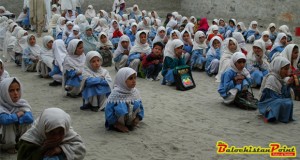
The overall educational sector of Balochistan has failed to provide quality education because it lacks qualified human resources and sufficient schools and infrastructure. According to Policy planning and Implementation Unit (PPIU) there is only one middle school for approximately 9 primary schools. Total there are 10,585 primary schools and 1,165 middle schools; most of which lack basic facilities like furniture and sanitation facilities.  Half of schools in Balochistan are single teacher schools the average teacher and pupil ratio is 1:38 it means that there is 1 teacher for 38 students which clarifies that all students may not be able to receive equal attention in learning environment and causing quality of education to suffer. According to another report 2.3 million children are out of school in Balochistan province. Literacy in province remains 39%.

There is only one middle school for approximately 9 primary schools.

In these conditions, where students have no facility for quality education, most rich people send their children to other provinces for Quality Education but poor people have limited resource that’s why their children become deprived of quality education. Balochistan Government has recently started a new Drama with the name of “Educational emergency” and results of this emergency can easily be seen in intermediate result 2015 where most students failed. So before implementing Educational Emergency one must review situation of schools and colleges in the province. How can you expect good marks from the student who never has seen his school and even he doesn’t know that what are his subjects?
Why do students cheat in exams?
The reason is the poor quality of education that they are receiving. In most of the schools there are not enough teachers. Where there are teachers they have poor quality of teaching. Here I would like to give example of my own district Bolan. The population of district Bolan is 450,000. According to 2008-09 survey there are only 409 schools, 2 inter colleges and no degree college. This district has 27 Union councils but still it has no degree college. After intermediate most of the students are unable to continue their education because they can’t afford to go to Quetta or Sibi for higher education.


Balochistan Government has recently started a new Drama with the name of Educational emergency.

So before implementing Educational Emergency we have to provide Quality education. Recently 2015 intermediate result has destroyed academic careers of many talented students. 71% of candidate failed in intermediate exams and those who passed the exams have scored very low marks on average. This result has effectively disabled students to secure admissions in well-reputed institutes of the country.
If Balochistan government is really interested in improving quality of education, than firstly they have to get rid of all corrupt officers in education department.
Secondly, they must take action against illegal appointments in colleges and universities.
Thirdly, it must provide basic facilities to every school and only then the Educational Emergency can be meaningful.

Why Pakistan's army is targeting the MQM party

Expert Arif Jamal talks to DW about a paramilitary operation against the MQM, a liberal political party in southern Pakistan, and how the army is allowing an Islamist takeover of Pakistan's economic hub, Karachi.
"Thank you, General Raheel Sharif," reads a gigantic poster on a street in Karachi, Pakistan's southern port city and economic hub. Supporters of Pakistan's army chief, Raheel Sharif, have set up large billboards in the city, heaping lavish praise on the military general for "liberating the city from terrorists and criminals."
By terrorists the army fans do not mean the Islamist groups like al Qaeda and the Tehreek-i-Taliban Pakistan (TTP), but the Muttahida Qaumi Movement (MQM), a liberal political party supported in the urban areas of the southern Sindh province. Despite being a largely secular party, the MQM has been allegedly involved in using violence as a political means to control Karachi and its economy. The MQM leadership, which represents the "muhajirs" or the people who had migrated from India to Pakistan in 1947, denies these claims.
MQM officials say the army, through its paramilitary force, the Rangers, has been targeting its members and activists on the pretext of combating terrorism. While the Islamist parties continue to receive the military's patronage, the MQM and the Pakistan People's Party of former president Asif Ali Zardari, are being "victimized," some rights groups and experts say.
Arif Jamal, a US-based journalist and author of several books on Islamic terrorism and Pakistan, says in a DW interview that one of the key objectives of the Pakistani military is to weaken mainstream political parties to increase their control on government and civilian institutions. He also says that Raheel Sharif, who is being systematically projected by the pro-army media as a "messiah," is paving the way for an Islamist takeover of Karachi by weakening the MQM.
DW: Do you agree with claims by the MQM leadership that the Pakistan Army is selectively targeting its activists and members?
Arif Jamal: There is ample evidence that the Pakistani military is selectively targeting the MQM. It is now also targeting the Pakistan Peoples Party or PPP. The current army-led campaign is nationwide and in reality aimed at weakening all the major political parties in the country.
As the political parties remain divided and fail to put up united resistance, the army is leading them by the nose to support their actions. We see General Raheel Sharif sitting side by side with Prime Minister Nawaz Sharif in every decision-making meeting. In all the photos and videos in the Pakistani media, General Sharif appears to be running the show. He is never seen wearing his military cap, which means he is not required to salute his civilian bosses.
It looks abundantly clear that Pakistan's Rangers, the police, and other security agencies are taking direct orders from the army. The country's media is totally co-opted or gagged, so much so that some TV anchors and journalists were seen wearing military fatigue jackets on September 6 and 7 when the Pakistan celebrated "Defense Day" against India. This further blurred the difference between the military's public relations department and the media.
This is not the first time that the army has acted against the MQM. There was a somewhat similar operation against the party in the early 1990s. Why is the state, particularly the country's ubiquitous military, against the MQM?
In or out of power, the Pakistani army continues to make and break political parties. In the second half of the 1980s, it encouraged and supported the formation and rise of the MQM in order to damage the PPP in Sindh. In the 1990s, the army generals felt the MQM had become too big to handle, so they created divisions in it.
The MQM is not the only political party which continuously faces such wrath of the army; other political parties, too, face similar kind of treatment from the generals. The army uses different ways to create divisions in different political parties at different times. The reason is that strong political parties are a direct threat to the supremacy of the military in politics.
Critics say that despite being a liberal party, the MQM uses terror to maintain its grip on Karachi, and that therefore the military operations against it are justified. Do you agree?
Like other countries in the region, Pakistan is also a violent society, with political parties frequently resorting to violence. However, it is unfair to describe political violence as terrorism. However, there are religious parties such as the Jamat-i-Islami (JI) and Jamiat-e-Ulama-e-Islam which sponsor terrorism.
If terrorism were the reason, the army should have gone after the JI whose armed wing, Hizbul Mujahideen, remains a major terrorist group in the region, or other terrorist organizations such as the Jamatud Dawa (formerly Lashkar-e-Taiba). But the unfortunate fact is that the Pakistani army itself funds Hizbul Mujahideen and Jamatud Dawa.
How do you analyze the Lahore High Court's recent decision of banning MQM's leader Altaf Hussain's speeches in the media?
The Lahore High Court's order to register a treason case against Hussain and ban his speeches and images in the Pakistani media is unprecedented even by Pakistani standards. It violated all legal and democratic norms. The decision seems to be part of the ongoing army-run campaign against the political parties, particularly the MQM.
History shows that there has always been an "unholy nexus" between the Pakistani army and the Pakistani judiciary. The ties are still strong and the decision is the result of that nexus.
What could be the repercussions of weakening the MQM on Pakistan's national politics?
The weakening of the MQM and other political parties is creating a lot of space for jihadist groups in Pakistan. Because of the active military interference in political matters and conspiracies, no civilian government has been able to perform and show results since 1988.
People have lost whatever faith they had in democracy and civilian rule. The irony is that terrorist organizations such as Jamatud Dawa are openly recruiting and fundraising in Pakistan while the army is accusing politicians of funding terrorism.
We now discover that Zarb-e-Azb (the military operation in northern Pakistan) was aimed at weakening political parties and not eliminating terrorists. Some of the top global terrorists such as Hafiz Saeed and Hizbul Mujahideen's Yusuf Shah are openly leading public rallies, recruiting jihadists, and fundraising.
In about two weeks, terrorist organizations like Dawa will fundraise millions of dollars on the occasions of Eidul Azha while political parties such as the MQM will not be allowed to fundraise for genuine charity reasons. In fact, this year the jihadists may fundraise hundreds of thousands of dollars more than last year.
Some analysts say that the weakening of the MQM could result in the rise of Islamist groups like "Islamic State," al Qaeda and the Taliban in Pakistan's urban centers. Why would the Pakistani generals want that?
Because the Pakistani generals have not abandoned their policy of using jihad as an instrument of its defense policy. The Pakistan Army still supports "good jihadists," which include the Jamatud Dawa - a Salafist group, that follows the same ideology as the "Islamic State" (IS) and Boko Haram.
IS has been winning over the extremist factions of Islamist terrorist groups in the Afghanistan-Pakistan region since its rise in June 2014 in the Middle East. Jamatud Dawa seems to be in alliance with the IS in Afghanistan. So the Pakistai army's strategy seems to be creating an alliance of "good jihadists" like Jamatud Dawa under the umbrella of the IS.

Pakistan: Factory fire kills 11, burns dozens

By Umar Shahid


 ''The factory’s owner is also the leader and Information secretary of the ruling PML(N) Party in the district. ''


On Saturday 5 September, whilst the Pakistani ruling class celebrated a war and praised its general, the  workers in the Badar 313 factory near Gujranwala were suffering the hellish conditions of capitalism.
An outdated compressor containing flammable chemicals exploded causing the roof to collapse on more than 80 workers. So far, 11 have been killed and many are in a critical condition. Many more suffered partial burns. Workers from nearby factories and comrades from PTUDC  were quick to offer help while the  factory owners stayed away  to keep their clean hands clean . The factory’s owner is also the leader and Information secretary of the ruling PML(N) Party in the district. His influence and wealth will protect him from an impotent judicial system; his punishment will be the payment of paltry compensation to his victims. This tragedy, and the reaction of the authorities, will come as no surprise to those familiar with Pakistan where these incidents have become routine.  For example, three years ago more than 300 workers were burnt alive and many more injured in a fire in a garments factory in Baldia, Karachi. No one has been held responsible or punished.
Pakistani capitalists, in pursuit of higher profits, face pressure to  cut costs and one of the first targets for savings is often the safety of the factory.  Workers are therefore forced to work with the constant worry of death or injury whilst they make a living. Moreover, if workers dare to complain, they are often severely beaten by factory owners or their hired goons.
This incident also shows the complete impotency of the Pakistani State, which is unable to implement its own labor laws, thereby exposing the complete absence of any regulations for workers. Despite the fact that many have been working in the factories for years, these workers are not permanent labor, which means they are subject to extreme exploitation at the hands of capitalists. If they don’t like their working conditions, the bosses can threaten them with replacement due to the high unemployment rate.
Baddar 313 is situated at GT road Gakhhar. The factory produces feed for chicken and cooking oils for human consumption. In the absence of a union, workers are subjected to extreme exploitation, with wages often far below the Government’s announced minimum wage. Whilst the Government claims a minimum wage of $130 (PKR 13000) per month for an eight hour day,  workers are being paid $75 (PKR 7500) per month for a twelve hour day. The Government’s ‘minimum’ wage is already too low for a worker to afford a normal diet but if you include other expenses, such as feeding their family or paying health and utility bills, the Government’s minimum is far from being enough to live on. A proper diet, with three meals a day for one adult, costs more than this minimum wage. PTUDC has already started a campaign to, not only  increase the minimum wage to the price of  10 grams of gold, but have also demanded that this  be strictly implemented in all workplaces.
Social security benefits, additional pay for overtime, transport and safety arrangements may be compulsory by law but in this factory, along with others, factory owners implement their own laws. It is worth remembering that one of the owners, Shoaib Altaf Cheema, is also an office bearer of the ruling PML N Party, which means that this factory, like all others, can violate labor laws easily. Chemicals such as Acid, Caustic soda and slaked lime are frequently used  with no safety measures protecting workers thereby causing breathing, eye and skin problems. Much of the infrastructure  is old and in disrepair and is therefore prone to accidents. However,  labour is cheap in Pakistan and so, for the factory owners, it is much cheaper to just replace their workers than to update their infrastructure. In the months before the incident, workers had tried to complain to the owners about the crumbling building but nobody paid attention. It is in this context that these workers face 12-14 hour days without any overtime, the concept of paid leave is non-existent and medical expenses are covered  by workers themselves.
The morning of 5 September started as a normal working day but, as the workers began to work, a compressor of dryer exploded. A natural gas pipe was connected to this  compressor, which caused an explosion so big that the roof of the factory fell and its effects could be felt in nearby factories.  Seven workers died at the scene and dozens more were injured and taken to D.H.Q. Hospital Gujranwala, around 22 kilometres from the factory. However, D.H.Q does not have a  burn unit facility hence, which meant that many injured workers were referred to Lahore, thereby having to travel for an additional two hours. The survivors have been subjected to  chemical hazards, which may result in long term health complications.
After the incident, there were angry scenes as many workers gathered near the factory, which caused the District Administration to rush to the factory in an attempt to calm down the situation. This attempt culminated in the  arrest of the owner of the factory, Major (retd) Altaf Cheema and his son Shoaib Altaf Cheema. The D.C.O (district administrator) Gujranwala Aamir Jaan said “there were no safety measures taken by [the] factory and chemicals are spilled on floor, [which] is creating problems for [the] rescue operation”. Nonetheless, it was under  this very District Administration that the poor state of the factory  and the labour law violations were allowed to continue
Aashir Khokhar told the PTUDC delegation that he  “was at some distance from the incident”, which is what saved him. However, he also called the factory owners “big rascals” because “nine years ago [the] same kind of accident happened but they didn’t pay any attention. I was admitted to hospital at that time and after a long treatment I recovered.” When workers tried to point out the fact that the factory was in disrepair, the factory owner “always ignored”. The workers attitude was aggressive and they chanted slogans against administration.
At D.H.Q hospital, the situation was even worse. PTUDC Comrade, Sibghat Wyne and Muhammad Ibne Sana, visited the hospital and tried to resolve the problems of the injured. However,  hospital management was not interested helping workers but were more concerened with their preparations for the visit of various important people from the city to have photographs with injured. When some MPs entered hospital to have some photo sessions with the injured patients, hospital administration was eager to help them but were unable to even  tell the injured worker’s relatives where those who had been referred to  Lahore were. The hospital was full of bodies and the injured kept coming.
In this situation PTUDC is in contact with Badar factory workers and has launched a struggle against the brutal owners and callous government. To this end,  meetings have been arranged to get justice for the workers. However, thehe factory owners have a direct relationship with Chief Minister Punjab Mian Shahbaz Sharif, the younger brother of Prime Minister Nawaz Sharif, so it will be difficult to achieve  justice for these workers. We appeal to the workers of the world to express solidarity with the victims of this factory fire. If we can get justice for workers in this incident and punish other factory owners for their crimes many more accidents will be  avoided.
After discussions, the following demands were put forward by workers:
  1. Each family of deceased workers to be paid 5 Million PKR and injured workers to be paid 2.5 million as compensation.
  2. Major (retd.) Altaf Cheema and his son Shoaib Altaf Cheema to be to be trialed for murder of workers and punished accordingly.
  3. Strict action to be taken against all those officials of the district administration and Labor department for their negligence.
  4. All workers to be given  permanent contracts, with their wages increased according to inflation.
  5. Minimum wage in the country to be equal to the price of 10 grams of gold.

Pakistan - TTP Threats Continue

Shuja Khanzada, a staunch advocate for the anti-terrorism movement, was recently assassinated when a suicide bomber blew himself up at his house in Attock. The minister and a DSP were among the 12 people killed. The Tehreek-i-Taliban Pakistan (TTP) was not kidding when it said that they would strike back. They will not stop, until the message that they want to portray is loud and clear. Information gathered through communication intercepts and intelligence suggests that the life of many a high-ranking political figure is in danger. Heads of seven parties and a dozen senior politicians are under threat of attack by the TTP. The TTP is up to its old tricks and the threats will mount pressure on the government to abort the ongoing operation against terrorism across the country. However, the TTP should have realised by now that there is going to be no backing down now by the army or the civilian government. We are too far in. Additionally, TTP apologists and sympathisers have drastically decreased in the general population after the December massacre in Peshawar and the success of Zarb-e-Azb. Either the TTP will either die a slow death, choked by military operations and a lack of civilian support, or it will morph into something even more monstrous like ISIS.
The TTP is insistent on creating a sectarian strife in Punjab, as many members of the possible targets belonged to two specific sects. They have threatened to attack shines for this purpose. This group also has Red Mosque sympathisers, who want revenge from some high-ranking political figures, ones that were part of the Musharraf government.
We made real headway as late as 2009, with ‘Operation Rah-e-Rast’, when the Pakistan Army reclaimed the area of Swat. On a larger scale, Operation Zarb-e-Azb in 2014 destroyed the communication lines of terrorists. It has been claimed that for the first time in over a decade, relative peace prevails in the country. Maybe, this is not enough to tackle the problem. Lives are still being lost as the TTP eliminating everyone who tries to fight with them. The list of suspected targets include Imran Khan, Pervez Musharraf, Asfandyar Wali, Sheikh Rashid, Fazlur Rehman, Aftab Sherpao and Sahibzada Hamid Raz. Moreover, noted figures including Hamza Shahbaz Sharif, Shah Mehmood Qureshi and Abdul Rehman Kanju have also been warned. Today, Pakistan is fighting a war for its very survival against this faceless enemy. With politicians the new target, maybe a different strategy to tackle terrorism is necessary.