Wednesday, August 26, 2015

U.S. soldiers killed in Afghanistan, Taliban grab district

Taliban fighters seized a district headquarters in Afghanistan's Helmand province on Monday despite repeated U.S. air strikes to repel them, adding to the insurgents' recent advances in a heavily fought over region of opium farms and trade routes.
Elsewhere in Helmand, a man in Afghan uniform opened fire in the former British base of Camp Bastion, killing two U.S. service personnel, before being shot and wounded. Another man in Afghan uniform was wounded in the return fire.
It was the second incident this year involving Afghan troops, or people wearing Afghan uniforms, shooting at foreign soldiers. No group has claimed the attack.
Pentagon spokesman Captain Jeff Davis said the attacker opened fire on the vehicle in which the Americans were traveling. He gave no more details.
    An Afghan regional official said the incident involved Afghan special forces firing on allies at the former Camp Bastion, which was handed over to Afghan forces last year.
Helmand's Musa Qala district fell after the Taliban overran police and army posts to retake a district straddling smuggling routes that was wrenched from them by British and Afghan troops eight years ago.
U.S. warplanes have been bombarding Musa Qala since the weekend, killing up to 40 militants, with two new air strikes on Tuesday. But they regrouped, chasing the district government out of town and confiscating weapons in what a spokesman for Afghanistan's 215th Maiwand Corps called a "tactical retreat" to protect civilians.
Coalition military advisors have recently been working with the 215th Corps, which based in Helmand capital Lashkar Gah.
"Afghan special forces, police and commandos have been deployed to Helmand in order to retake Musa Qala district. Foreign air strikes are backing our forces," said Dawlat Waziri, a spokesman for the defense ministry.
In Afghanistan's first summer fighting season since foreign troops stepped back from combat roles, the Taliban have pushed into several districts in the North and South but have mostly struggled to keep hold of them.
Last week, Afghan forces pulled out of the town of Nawzad, the headquarters of a neighboring district that was also fiercely fought over when British and U.S. forces were stationed in Helmand, the country's main opium production center.
That means the Taliban currently control three districts in northern Helmand and have partial control of several others, including Kajaki, where they frequently disrupt supplies from a large U.S.-built hydroelectric dam powering the province.
"We left the district early in the morning because the Taliban were attacking from all sides," Musa Qala district Governor Mohammad Sharif told Reuters by telephone.
"We had asked for reinforcements for days but none arrived and this was what happened," he said.
In the years following the 2001 U.S. invasion that toppled the Taliban government, more than 400 British soldiers died in Helmand, several while defending Musa Qala. More than 350 U.S. Marines also lost their lives in the province.
Nearly 14 years later and after foreign forces formally ended their combat mission, the Taliban is still fighting a guerrilla war aimed at restoring their hardline regime.

Violence has increased sharply across Afghanistan since the coalition mostly withdrew in December, leaving a small contingent of about 12,000 NATO troops to train Afghan forces.

Music Video - Naheed Akhtar - Yeh Ranginiye Nau Bahar

Pakistan - ‘NAB fails to probe PM, Punjab CM corruption’


The Supreme Court (SC) on Tuesday said that the National Accountability Bureau (NAB) has failed to complete investigation into corruption cases of billion of rupees against Prime Minister (PM) Nawaz Sharif, Punjab Chief Minister Shahbaz Sharif, former PM Chaudhry Shujaat Hussain and Pervez Elahi even after 15 years.

In a report filed by NAB in SC, it has been disclosed that an enquiry into financial irregularities of Rs 126 million against PM Sharif and Punjab CM in the construction of Raiwind Road was started in 2000.

Another enquiry against Sharif was launched in 1999 concerning his alleged involvement in illegal appointments in Federal Investigation Agency (FIA). So far, none of the enquiries have been concluded.

Previously, Maj Gen (r) MH Ansari had filed an application with NAB, stating that several officers who were appointed have now retired.

The report also reveals that investigations against Hussain and Elahi for corruption of Rs 2.5 billion and accumulation of illegal assets started in 2000 but are still incomplete.

A three-member SC commission is reviewing NAB’s report.

http://www.pakistantoday.com.pk/2015/08/26/national/nab-fails-to-probe-pm-punjab-cm-corruption/

Pakistan - Pro-Saudi-wahabi Govt of Punjab arrests 22 SHIA LEADERS

Punjab government has once again proved its Shia enmity and arrested Shia leaders without any reason. According to reports, 22 Shia leaders have been arrested last night from different cities of Punjab including Bhakar, Sialkot, Gujrat, Wahari, Dera Ismail Khan and Nankana Sahab. They have been arrested by counter terrorism department and include leaders and members of Majlis e Wahdat e Muslimeen and Shia Ulema Council, Ulema and Zaakireen.
It should be clear that National Action Plan was formulated against terrorists but Punjab government has proved its Shia enmity by using it against Shia Muslims according to balance policy. However, they do not have any proofs against Shia Muslims. This action by Punjab government is in fact a way to provide relief to their Deoband and Wahhabi extremists and terrorists by painting the ongoing terrorism as a sectarian conflict, whereas everyone is aware of the fact that sectarian problems do not exist in Pakistan and it is engulfed in Deoband and Wahhabi terrorism.
On the other hand, the leader of Majlis e Wahdat e Muslimeen Allama Raja Nasir Abbas Jafri severely condemned the arrest of members of Shia organizations and demanded their immediate release, while talking to a news conference in Islamabad. 
http://www.shiitenews.org/index.php/pakistan/item/18021-22-shia-leaders-arrested-by-punjab-government-in-name-of-national-action-plan

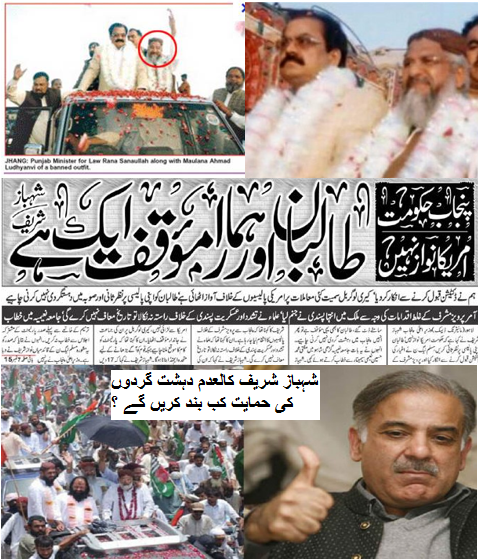
Pakistan - #PMLN Pro-Punjabi Taliban Law Minister Rana Sanaullah’s sense of success

Rana Sanaullah’s sense of success


And political correctness
Strange that Rana Sanaullah brought up the threat to the Punjab Assembly and tried to play down the danger of terrorism in the province at the same time. His observations regarding seminaries are particularly interesting. Not a single madrassa in Punjab has any links with terrorists, he said, speaking no doubt after thorough investigation by relevant agencies. Why, then, should Punjab differ so seriously from other parts? The Sindh home department, for example, has just ordered action against 49 seminaries with alleged links with terrorist organisations. And just the day before Ch Nisar spoke of the centre’s concern about movement on suspect madrassas.
Why would Sanaullah want to give his province a clean chit on the madrassa question? Naturally his position will not be taken too seriously when many in the ruling party – including the late Col Shuja Khanzada – openly disagreed with it. By issuing such statements, the Punjab law minister not only weakens his party’s position, but also gives weight to accusations about his links with suspect organisations. If anything, militancy in Punjab is expected to provide one of the stiffest tests yet to Zarb-e-Azb as it becomes more complicated and intel-intensive. Many consider action here, where radical militants have long been housed, as the true litmus test for the operation.
As the Punjab government finds its feet after its home minister’s assassination, it must ensure NAP is, finally, properly implemented. Sidestepping crucial processes in the Plan – like madrassa funding, etc – will not only allow the enemy to strike more boldly, but also harm politically as people demand action. The ruling party is advised, therefore, to concentrate its energies on building on the momentum that is being generated. True, violence overall has come down since the operation began. Yet it is equally clear that much more needs to be done to eradicate terrorism and terrorists completely. Political correctness of the Rana Sanaullah mould will no longer successfully divert public opinion. The government will have to walk the talk, for itself and the people.

http://www.pakistantoday.com.pk/2015/08/26/comment/rana-sanaullahs-sense-of-success/

Pakistan - Madressah clean-up?

IT appears that the Punjab government has been busy cleaning up the seminaries — but away from public view. Rana Sanaullah, the provincial law minister, says the madressahs in Punjab have somehow been purged of militant elements. He did, as a prelude to his claim, ‘admit’ to the presence earlier of 20 such seminaries whose students or faculty had been involved in terrorism, even if ‘only’ as facilitators. What magic wand the administration waved to get such surprising results has yet to be disclosed. For the moment, those informed of the figures, intended to be reassuring no doubt, must deal with the mini-surprise of learning that, long identified as a hotbed of extremism, Punjab only had 20 seminaries that, presumably, required a little bit of fixing here and there. The minister did come up with figures: 532 seminaries raided; 1,100 suspects taken into custody from them; 13,787 madressahs geo-tagged. But then, according to his remarks, the record of each and every student on the roll of these 13,000-odd tagged seminaries was being looked into. So how is he so sure that the militant element has been uprooted?
There may be some credible evidence that shows the Shahbaz Sharif government’s commitment to targeting the nurseries of militancy, a commitment dictated by the National Action Plan. But unfortunately, the absence of substance in Mr Sanaullah’s claim does not make it part of the clinching evidence that would put Punjab ahead of the other provinces. On the same day the claim was made, in Sindh surfaced a list of 49 madressahs against which action had been ordered for their links to militancy. Just as it was unclear as to what the action in Sindh would be, it was difficult to assess whether Sindh had been sufficiently inspired by the big brother in the federation, or if both these bigger provinces were equally guilty of many airy-fairy boasts with little achieved on the ground. Sindh has repeatedly been criticised for lethargy and lack of purpose in recent years. In this case, it could justifiably look for some appreciation for having been able to identify 49 suspect madressahs whereas the much larger and, by many estimates, far more suspicious Punjab stopped at 20. Much more significantly, both these provinces — in fact, the whole country — need to come up with a transparent system where they are actually seen to be cleansing their respective territories of the dangers that are nurtured inside seminaries.
http://www.dawn.com/news/1203015/madressah-clean-up

Pakistan - Education, extremism and the elite


Why shouldn’t young minds turn towards extremist ideologies — I’m not talking of terrorism — if they are marginalised, their basic rights grossly violated, or if they are under-paid or unemployed? What role are many private educational institutions playing in promoting extremist tendencies among young academics? Is the state attentive to this? Is education a market economy product determined by the demand and supply principle, or is it a government responsibility (as promised underArticle 25-A of the Constitution)? The state is the guarantor of the right to education, bound to provide decent livelihoods as well as protect the youth from exploitation. These are some of the questions that must be posed to the Sharifs, the Zardaris, the Shahs, the Khans and all those political luminaries who tirelessly speak of turning Pakistan around. Not to forget those members of mainstream political parties who are running educational institutions. These include the Kasuris, the Chaudhrys, the Syeds and the Niazis.
Under-paying highly educated young people employed by high-flying institutions affiliated with Oxbridge and other leading systems, is a perennial issue. Exploitation of the educated youth — both as teachers and students — is prevalent even in Islamabad, the capital, but this curse is omnipresent in its most oppressive forms in under-developed regions and those where the ruling elite control education boards or sit in parliaments. Although Khyber-Pakhtunkhwa (K-P) has seen a proliferation of private universities and colleges, there has been little check on their fee and salary structures. The Abbottabad, Peshawar and Mardan boards seem to be hubs of corruption that are under the control of the political elite and their henchmen. Many of them are involved in issuing fake degrees and under-paying teachers, often invoking the demand-and-supply principle as if teaching were a commodity obtainable at a negotiable price.
Some of Imran Khan’s colleagues in K-P are among those running private education institutions, a practice that has turned into an unchecked money-minting enterprise in the absence of a regulatory framework. The PTI has made a strong point about the accountability of the electoral system. Now, it must also embark on an accountability of those running educational institutions, especially its own members appointed to important positions in the K-P government. Of course they are not the only ones. Scores of private educators are exploiting students, often in collusion with officials of education boards and higher education departments. Why shouldn’t the highly educated young slip into confusion and extremist thought streams if, after a 17-year education, they either remain unemployed or extremely under-paid — earning paltry sums between $40-150 a month? This way, many private institutions are disincentivising education among those who come from poor families.
Another alarming issue is of fake degrees being issued by many private institutions and government education boards. Ironically, the business of fake degrees in Pakistan is nothing new, but really came to the fore only recently because of the activities of Axact. Many universities running under the charter of some London-based institutions have been doing the same thing. Even official education boards have been involved in this as illustrated through the disqualification of a PML-N legislator, Chaudhry Arif Hussain, for holding a fake degree issued by the Lahore Board of Intermediate and Secondary Education. Before Hussain, several other legislators also lost their seats for possessing fake degrees.
It is correctly believed that the government should not interfere in private education; however, it carries the responsibility to prevent fraudulent practices and preempt exploitation of students and teachers. Private educators have the right to determine fee structures, but they are also bound to pay teachers fairly and ensure quality education. They cannot, must not, be allowed to equate market economy principles with exploitation of young academics. Shouldn’t the government ask private institutions if there is a balance between the fees they charge and the salaries they pay to their teachers who hold master’s degrees?
The Sharifs and Imran Khan can turn Pakistan around only if they handle education on a war-footing and start meaningful reform of the sector. When will they crack down on the moth that is eating away the vitals of the education sector, stunting real intellectual development?

Pakistan’s poor handling brings UAE, India closer

A recent defence agreement between the United Arab Emirates (UAE) and India has arisen many questions regarding foreign policy of Pakistan as the proximity of the two is result of a ‘poor handling’ of affairs by the Foreign Office if not a complete failure vis-a-viz Arab world.


Looking at the history of Pakistan-UAE relations, it come to light that the Middle Eastern nation is a major investor in Pakistan's key sectors like oil and gas, telecommunications, real estate, aviation, banking and energy. A report by UAE's Ministry of Foreign Trade tells that its public and private sectors invested about $3.74 billion in Pakistan from in the early years of this century and the Dirham – UAE currency – continued pouring in Pakistan’s economy till now.

The main investments were made in different sector by the Emirates National Oil Company (ENOC), the International Petroleum Investment Company (IPIC), the Emirates Telecommunications Corporation (Etisalat), Dana Gas; Al Ghurai; Emaar, DP World, Abraaj Capital, Thani, Danata, Atharihra Agricultural Company; Gulf Pharmaceutical Industries (Julfar), the Emirates Investment Group, the Arab Company for Packaging and Al Nasser Holdings.

– Pakistan’s contributions –

The love is not one sided as Pakistan has significantly cooperated with the UAE in the establishment of its major institutions like armed force, police, health and education. Besides 1.25-1.50 million skilled and semi-skilled Pakistani expatriates are living in the UAE, contributing significantly to the progress of both the countries. According to an estimate, 20 percent of the Pakistani expatriates are working white-collar jobs, whereas 80 per cent are working blue-collar jobs.

It is a fact that the road of relationship to the ‘Trucial States’ passes through Kingdom of Saudi Arabia (KSA) that was in difficult situation due to Yemen-based Houthi tribes. The Saudis were facing difficult time because of the attacks by the insurgents from Yemen. They were advancing inside Saudi Arabia. The Saudis expected the Pakistan Army to reach there and defend their soil. It was perhaps the first time when Pakistan authorities refused to send its troops to the kingdom. Pakistan received a ‘message of displeasure’ from the UAE at that time too. It is obvious that the nearness between the two countries – UAE and India – is not without the blessings of Saudi Arabia.

What gets India from its Prime Minister Narendra Modi’s two-day visit to the UAE is narrated by Poonam Mahajan, India’s Bharatiya Janata Party (BJP) lawmaker from Mumbai: “For the first time, UAE and India are on the same wavelength with respect to terrorism. The prime minister in his speech has categorically mentioned that both countries will not tolerate the terror wreaked in the name of religion. Those who were responsible for horrendous terror attacks in the country like the 1993 Mumbai blasts and the 26/11 attacks and are still being ‘harboured’ by Pakistan ought to be punished.”

She also narrated that in order to combat terrorism, a joint statement has been made by India and UAE wherein both the countries condemn efforts, including by states, to use religion to justify, support and sponsor terrorism against other countries. “They have called for international cooperation and intelligence sharing in counter-terrorism operations. They have also proposed to work together for the adoption of India's proposed Comprehensive Convention on International Terrorism in the United Nations.”

The biggest achievement for prime Minister Modi is that the UAE announced support for India’s permanent berth in the UN Security Council. Indian investment in UAE and defence pact between the two is an added advantage. Former Foreign Affairs minister Khurshid Mahmud Kasuri is of the view that Pakistan had failed in dealing with the Saudi-Yemen issue in a proper way. “Saudi Arabia is a tried and tested friend of Pakistan and always supported it at all level and all forums,” he said.

He said that Iran was also a good neighbour. In Pakistan, both Saudi Arabia and Iran have following as Sunni people have soft corner for the Saudi kingdom while the Islamic Republic of Iran was dear to Shia people, he pointed out. “When there is an issue between the Saudi kingdom and Iran, it is needed to be dealt with care and wisely as we must know that these two countries are important to us,” he said. He commented that the Yemen issue should be dealt carefully and the two should be taken into confidence on it.

But the Foreign Office dealt the matter in a poor manner, Kasuri said. He was of the view that Pakistan is lacking a full time foreign affairs minister as the office is being held with the worthy prime minister himself who always has other engagements. At present, he said that the Foreign Office has two bosses which is also creating hurdle in smooth sailing of the affairs. The former minister is of the view that Pakistan should have talked to the Saudi kingdom and also go to Iran on the issue that could help keep the two nations near to Pakistan.

Another point of view is that the recent emergence of new alliance of four nations – Pakistan, China, Iran and Russia – has rang alarm bells for the United States and its allies. Israel and India always enjoy good relations and in these days Israel and Saudi Arabia are near to each other and the recent kind of ties between the UAE and India is to send some signals to quarters concerned. It is time for Pakistan to take a more conciliatory stance with the UAE in an attempt to counter India’s new found status.

Pakistan - #PTI - Flogging A Dead Horse

Pakistan Tehreek-i-Insaaf (PTI) is considering filing a reference in the Supreme Judicial Council (SJC) for the removal of four members of Election Commission of Pakistan (ECP) for the ‘irregularities’ revealed by the Judicial Commission report and the recent annulment of the NA-122 election. The proposal claims that “lapses (by the ECP) made the entire election 2013 non-transparent and unlawful”, furthermore, Imran Khan promises that if the ECP does not respond to his call for resignation, he will stage a sit-in outside its premises. Unlawful elections, sit-ins, judicial commissions – it feels like we have been here before.
Imran Khan needs to stop clinging to the 2013 election results, plain and simple. If PTI ever wants to be a party that seriously contends for the leadership of this nation then it must address nationwide issues. The Chairman must confront a harsh truth; he tried every trick in the book to topple the government, and he failed. Now he must get back up, and try to achieve political power like the rest of us mortals; by actually working towards solving Pakistan’s myriad of problems. He has a vast following, and if he utilises it to become an effective opposition in the parliament, he can bring change. People will applaud him if he proposes police reforms in the parliament. They will salute him if he hounds the government on holding Local Body elections. Energy, tax collection, seminary reform, water management – there are so many issues that he could lend his voice to, yet he chooses to drag the dead issue of the 2013 election out of its grave once more. The demand for resignation only serves to nurse the pride of the PTI and its chairman, whose “ironclad” evidence of rigging was found wanting.
Of course, Imran khan is well within his rights to demand the resignations of ECP members for not properly managing the elections; in fact he is well within his rights to demand the resignation of a errant traffic warden for a mismanaged road junction, but that does not entitle him to a response – nor does allow him paralyse the system until his demands are met. Even if they were met, it would change nothing; it won’t make the ECP more accountable, it won’t make it more competent, nor would it change its structure in the slightest way. Khan just wants to see heads roll. If he wanted real reform, he would be in the Parliament canvassing support, not planning the logistics of another sit-in.
The PTI must prove it is not a one trick pony, it must prove that it cares for other issues, it must show that it has the magnanimity to move beyond a personal defeat to help serve the nation. Imran Khan must remember, determination is an important quality, but it is a few thin strokes away from foolish stubbornness.

Pakistan Is Not Stopping Terrorists Who Threaten the U.S.


BY 
The U.S. is reportedly set to block a military aid tranche to Pakistan because of its failure to crack down on the Haqqani network, a designated terrorist organization with ties to the Taliban that attacks U.S. and Afghan forces on a regular basis.
It’s about time.
According to Pakistani media, U.S. officials have told their Pakistani counterparts that they will not certify to the U.S. Congress that Pakistani counterterrorism operations in the tribal areas bordering Afghanistan have damaged the Haqqani network.
Pakistan launched an offensive against the bases of Tehrik-e-Taliban Pakistan (TTP or Pakistani Taliban is an organization that has ties to Al-Qaeda and the Afghan Taliban, but which focuses mainly on attacking Pakistani targets) in North Waziristan over a year ago after they attacked Karachi airport. Pakistani efforts against the TTP intensified following the group’s a horrific massacre at a military school in Peshawar last December that killed over 130 children.
But the decision not to certify a new tranche of Coalition Support Funds (CSF) aimed at reimbursing Pakistan for its counterterrorism operations in the region signals U.S. patience with escalating violence in Afghanistan is wearing thin.
The U.S. has provided around $13 billion in CSF funding to Pakistan since 2001, in addition to the nearly $14 billion in other economic and security aid the U.S. has transferred to the country. The U.S. has long conditioned its aid to Pakistan on the country meeting certain benchmarks, including “demonstrating a sustained commitment to combating terrorist groups on Pakistani soil.”
However, over the last few years, the U.S. secretary of state has waived these conditions on grounds that it was in the U.S. national security interest to transfer the funding even though the legislative conditions had not been met.
Last year Congress added a new requirement to the CSF program that the U.S. defense secretary certify that military operations in North Waziristan have significantly disrupted the safe haven and freedom of movement of the Haqqani network. If the defense secretary is unable to make this certification, funds in the amount of $300 million will not be available for Pakistan, even if the administration chooses to exercise its waiver authority.
Despite Pakistani proclamations that they no longer distinguished between “good” and “bad” Taliban, most observers assessed that Haqqani camps were spared during the military operation dubbed “Zarb-e-Azb” (sharp strike).
In a Heritage backgrounder published last month, I argued that the U.S. must stop using national security waiver authority to provide security-related assistance to Pakistan, given its failure to crack down on the Haqqani network and Lashkar-e-Tayyiba, another terrorist group.
I argued that unless the U.S. follows through on withholding military aid to Pakistan on the basis of its support to terrorist groups, Pakistan will continue to serve as a base of operations for groups that both threaten regional stability and are responsible for attacks against the U.S.

While Pakistan has suffered massively from terrorist attacks over the last eight years and the U.S. should partner with Pakistan in its fight against terrorism, Washington can no longer skirt around the fact that Pakistan has failed to crack down on certain terrorist groups that continue to conduct attacks and undermine critical U.S. national security interests in the region.

PPP Chairman Bilawal Bhutto calls for streamlining and strengthening the social media wing


Bilawal Bhutto Zardari has called for streamlining and strengthening the social media wing of the party to package the party’s message and spread it far and wide.
He said this while hosting a dinner for the over 100 PPP social media team members from throughout the country in Zardari House in Islamabad Wednesday.
Social media has revolutionized communication strategies and a revolutionary party like PPP has to play lead role. The meeting also attended by Bakhtwar Bhutto Zardari, Faryal Talpur and raja Pervez Ashraf, Sherry Rehman and Qamar Kaira.
https://mediacellppp.wordpress.com/2015/08/26/ppp-chairman-calls-for-streamlining-and-strengthening-the-social-media-wing/

Tuesday, August 25, 2015

African Music Video - Charly Black - Nicest

Video Report - 3,000 refugees a day to enter Former Yugoslav Republic of Macedonia

Raif Badawi: Wife of Saudi blogger launches campaign to free African writer on death row for criticising prophet Mohamed

The wife of Raif Badawi, the Saudi blogger sentenced to ten years in jail and 1,000 lashes for insulting Islam, has launched a campaign to free an African writer who is on death row in Mauritania for criticising the prophet Mohamed.

In an article for The Independent, Ensaf Haider said that while “millions of people around the world” had campaigned for her husband’s release, the case of Mohamed Cheikh Ould Mkhaitir risked being forgotten by the international community.

The 30-year-old journalist was arrested in January last year after publishing an article on the website of the newspaper Aqlame. In it, he criticised the Mauritanian caste system and said that certain social groups were being marginalised because of their religion.

Mr Mkhaitir later “repented” during a pre-trial hearing at a military police station and again during his trial in December last year, telling a court in the city of Nouadhibou he had not meant to insult Islam but intended to denounce those who used religion to belittle others.


Despite Mauritanian law stating that leniency must be shown if a defendant repents, the judge convicted him of having “lack of respect for the prophet” and handed down a death sentence – the first imposed in Mauritania for apostasy since the country gained independence in 1960.
Ms Haider, who has led the international campaign for her husband’s release, said Mr Mkhaitir “could be executed at any time” if pressure was not placed on the Mauritanian government to reconsider his sentence.
“Millions of people around the world rallied to the support of Raif Badawi; who will care for a poor young man in Mauritania?” she wrote. “He will be executed for blasphemy – by those who insist that Isis does not represent Islam.”
Dozens of human rights organisations signed a joint statement in March calling for Mr Mkhaitir to be freed, describing him as “a prisoner of conscience who has not committed any crime but was merely peacefully exercising his right to freedom of thought, conscience, expression and religion”.
However, there have since been no updates on his case. His lawyer told Mauritanian television earlier this year that his condition in prison was “miserable” and that he had been tortured and placed in solitary confinement, Ms Haider said.
Gaetan Mootoo, Amnesty International’s West Africa researcher, said: “The use of the death penalty is always abhorrent, but it raises additional concerns in cases like that of Mohamed Cheikh Ould Mkhaitir where a dubious law is being used to stifle free speech.
“Mohamed Cheikh’s trial was blatantly flawed and his repentance – which should have entitled him to leniency – was twice ignored by the authorities. We continue to call for his immediate and unconditional release.”
The writer’s case has numerous parallels with that of Mr Badawi, who was arrested in June 2012 over material published on his Saudi Arabian Liberals website. While he has been in prison, the 31-year-old activist has received a number of awards for promoting freedom of expression and has been nominated for the Nobel Peace Prize.
Mr Badawi has so far only received one round of 50 lashes, which are supposed to be carried out weekly. Earlier this month his family learned that the kingdom’s Supreme Court is reviewing his case, raising the possibility that his draconian sentence may be reduced – but Ms Haider says “the flogging could still happen at any time”.

http://www.independent.co.uk/news/world/africa/raif-badawi-wife-of-saudi-blogger-launches-campaign-to-free-african-writer-on-death-row-for-criticising-prophet-muhammad-10465844.html

Fascist #SAUDI, ALKHALIFA, EMIRATI REGIMES ESCALATE REPRESSION, DETAINING & TORTURING CITIZENS

The Saudi authorities arrested 27 Christians in the Eastern Province for holding prayers for Virgin Mary. They could face religious persecution and deportation. Non-Wahhabis are generally not allowed to practice their faith in the Saudi kingdom. On Tuesday 18th August The United Arab Emirates arrested a prominent Emirati economist who has previously supported calls for democratic reform in the oil-rich Gulf state. State security arrested Nasser bin Ghaith at his work in Abu Dhabi and took him to Dubai where security service agents searched his home for over four and a half hours. He was then taken to an unknown location. Ghaith is an Emirati economist who has lectured at the Abu Dhabi campus of the Paris-based Sorbonne University. He also works as an economic and legal consultant to the UAE army.
In the week 10-16th August at least 29 native Bahrainis were arrested by the Alkhalifa regime, mostly for taking part in peaceful protests. Yesterday, Tuesday 18th August, a leading AlWefaq figure, Sheikh HassanIsa was arrested at the airport and is likely to be charged with opposing the hereditary dictatorship. On 17th August Mahmood Hassan Al Hamar, 20, was arrested in a raid on his home at Dair Town. He had previously been detained and tortured and is in bad physical health. On 17th August, Salman Ali Salman,from Dair Town, was also detained. On 13th August, Ayman Salam was detained at the airport and taken to one of the torture houses operated by the regime outside official prisons. On 11th August, Mohammad Yousuf was detained while trying to cross the causeway to Saudi Arabia.
Basket Ball player, Hussain Taqi, has been detained for his alleged role in a recent bombing at Sitra. But he was at his work when the incident happened. On 13th August Ali Mohsin Baddaw, a grandfather from Duraz, was arrested and taken to the torture chambers for unspecified reasons. All his children are in detention. With his arrest only his wife and a disabled child are left behind. Sayed Adnan AlKhabbaz has been sentenced to five years jail. This means he won’t be able to continue his secondary education. Denial of the right to education has become a tool against the native Baharna citizens. Abbas MalAllah who has been in prison for some time has been on hunger strike for two weeks in protest against ill-treatment and regular beating. For the seventh time, Taiba Dawish has been remanded in custody for two more weeks. Repeated detention without trial amounts to harassment and human rights violation.
This year the Independence Day has been marked by Bahrainis with great enthusiasm inside the country and outside. While the people organised large protests and attempted to reach the Pearl Roundabout to mark 14th August, there have been several activities outside. In London, a Press Conference was held by Lord Avebury on Wednesday 12th August. On Thursday, 13 August, the Bahrain Institute for Rights and Democracy and Human Rights Watch held a roundtable discussion regarding concerns regarding human rights in Bahrain and UK policy towards the country. Chaired by Nicholas McGeehan, Gulf researcher at Human Rights Watch (HRW), the discussion also included speakers Shane Enright, Global Trade Union Adviser at Amnesty UK, Kevin Laue, Legal officer at Redress and Isa Al-Aali, a Bahraini torture survivor recently granted asylum by UK court. The discussion was attended by representatives from a number of organisations including Amnesty International, Index on Censorship, Reprieve, NASUWT, English Pen and Chatham House amongst others. On 7th August, Nine-year-old boy, Mohammed Mahmood Ali Habib, was shot in the eye. While he was walking from his grandfather’s house to his house in the Bani Jamra area Mohammed was shot in his left eye by the occupants of an armoured vehicle operated by regime’s Death Squads. He was wounded with one pellet in the left eye. A number of cars parked in the same area were also damaged. There were no reports of any protests in the area.
Under the title “When Bahrain Says You’re Not Bahraini Anymore” Natasha Bowler wrote an article yesterday on Foreign Policy website. She said: “The Bahraini government began revoking citizenship shortly after the Arab Spring engulfed large sections of the Middle East, Bahrain included, in 2011. On Feb. 14 of that year, both Shiite and Sunni Bahrainis took to the streets to demand the same rights and political freedoms for the majority Shiite population as for their Sunni compatriots. The regime of the ruling Al-Khalifa family, who are Sunnis, sent in troops to put down the movement. But four years later, demonstrators still protest every night on the streets of the country’s Shiite villages. “The regime is running out of options. It has tortured people, starved thousands to death, openly killed hundreds of people in the street, and yet Bahrainis are still adamant on achieving change,” says doctor and activist Saeed Al-Shehabi, who was made stateless in 2012. “Revoking citizenship is just yet another tool to scarepeople and deter them from asking for their rights.”
http://www.shiitenews.org/index.php/saudi-arab/item/17877-saudi-alkhalifa-emirati-regimes-escalate-repression-detaining-torturing-citizens

Human Rights Watch urges Bahrain to release opposition leader

Human Rights Watch (HRW) has described the trial of Bahrain’s prominent opposition leader Sheikh Ali Salman as unfair and politically motivated, urging the ruling Al Khalifa regime to release him immediately.
The high-profile rights body said Tuesday that a review of documents in Salman’s most recent court shows that he was convicted on charges that violate the right to freedom of expression.
“The authorities should vacate Sheikh Ali Salman’s conviction on charges that violate the right to freedom of expression and release him without delay,” said a statement on the HRW’s website.
Sheikh Ali Salman is the leader of Bahrain’s main opposition bloc, the al-Wefaq Islamic Society. He was arrested last year and sentenced to four years in jail in July for what the regime calls inciting hatred. Prosecutors in Bahrain say Salman’s detention is related to a series of speeches and sermons in which the senior cleric offended the regime.
The HRW noted, however, that the presiding judge in Salman’s case refused to let his lawyers present crucial evidence to prove his innocence.
“The court’s refusal to consider crucial defense evidence confirms the political nature of Sheikh Ali Salman’s prosecution,” said Sarah Leah Whitson, the Middle East director of the HRW, adding, “The manifest unfairness of the trial means the authorities should release Salman immediately.”
The HRW also criticized the court for relying on testimony from Bahrain’s Interior Minister Khalid al-Sa’idi instead of reviewing actual content of Salman’s speeches. The statement said that Sa’idi’s written description of Salman’s speeches may have “misrepresented” their content.
The Bahraini court has already acquitted Salman of one of his major charges, namely advocating the overthrow of the regime.
However, the revered cleric was sentenced to four years in prison over three speech-related charges on June 16.
The HRW said the court has based its ruling on “wrong” testimony by Sa’idi, which had claimed that during a sermon on October 10, 2014, Salman said, “The people have bigger and bigger force in them. All that you need to do is call forth this force. I’m talking now about military force.”
The rights body said a recording of the actual speech, which can be easily found on the Internet, shows that Salman actually said “I am not talking about military force.”
Bahrain has scheduled Salman’s appeal for September 16. His four-year ruling is based on three two-year convictions, two of which will be implemented concurrently. Salman was also sentenced to two years in prison for insulting the Bahraini Interior Ministry, a maximum penalty for such cases in the Persian Gulf kingdom.
Opposition figures and rights activists have criticized Manama for handing down such harsh sentences, saying the rulings run counter to the Bahraini government’s ratification of the International Covenant on Civil and Political Rights (ICCPR), which stipulates that “states parties should not prohibit criticism of institutions, such as the army or the administration.”
“The behavior of the court in Sheikh Ali Salman’s case shows again that Bahrain’s justice system has been incapable of delivering justice,” Whitson stated.

Fascist Saudis committing war crimes in Yemen

Press TV has conducted an interview with Fatik al-Rodaini, a journalist and human rights activist in Sana’a, to discuss the ongoing Saudi military aggression against Yemen.

Following is a rough transcription of the interview.

Press TV: First of all, apart from just the civilian deaths that are taking place, there are many who point out that Saudi Arabia is ensuring that even aid does not get to the civilian population of Yemen.  What do you make of that?
Rodaini: I think Saudi Arabia has committed lots of war crimes in Ta’izz every day. We are hearing every day about war crimes committed everywhere not only in Ta’izz but also in many places all over Yemen.
I was shocked because I heard yesterday that Saudi airstrikes killed 54 people, most of them children and women. It is not that it only happened for the first time. It happens every day, every single day. It happens in Hudaydah, in Mocha, and also in Sa’ada, where many people were killed and wounded because Saudi Arabia wanted that.
Also there is another point. I am talking about the humanitarian aid. I think nothing has arrived yet, or people in Yemen cannot have a lot of things, because the KSA targeted the Hudaydah sea port. 
Press TV: Tell us a bit more about the position of those forces who are loyal to the fugitive former president Abd Rabbuh Mansur Hadi?
Rodaini: The fighting in Ta’izz … maybe there is some resistance, but there are also radical groups who are fighting with the resistance. We have seen the picture published in social media about people who were fighting with the Yemeni army, most of them slaughtered, first arrested and then they were slaughtered. I am sure there is a little bit resistance in Ta’izz but not all of them are resistance. I think radical groups like AQAP and ISIS are fighting also together with the resistance in Ta’izz.

http://www.presstv.ir/Detail/2015/08/21/425734/Yemen-Saudi-Arabia-Taizz-war-crimes

UN: 1,000-PLUS CHILDREN KILLED OR INJURED IN ‘BRUTAL’ YEMEN WAR

At least 398 children have been killed and more than 605 maimed since the “brutal armed conflict” in Yemen escalated on March 26, reported the United Nations children’s agency UNICEF on Wednesday.

That means that on average, nearly three children are being killed daily, and another five injured—“more than four times the number killed in 2014 and three times the number injured,” noted the report, tilted Yemen: Childhood Under Threat, adding that “the actual number of children killed or maimed could be higher.”
Among the casualties are a growing number of children who are being recruited by armed forces and other groups.
At least 377 children “have been recruited and used by parties to the conflict up to the end of July —more than double the total of 156 children in 2014,” UNICEF confirmed in the report, which was released Wednesday.
“All warring sides in Yemen are increasingly using teenage boys — who see fighting as a way to support their families financially — to swell their ranks,” indicated UNICEF, according to Reuters.
A Sunni Arab coalition led by Saudi Arabia has been targeting Iranian-allied Houthi rebels in Yemen with airstrikes and ground operations since late March in an effort to restore exiled President Abd-Rabbu Mansour Hadi, who has fled to Riyadh and has been recognized by the international community as Yemen’s legitimate leader.
More than 4,300 people have been killed in the war, most of them civilians. Disease and hunger continues to spread across the country.
“Yemen is one of the most terrifying places in the world to be a child. Children are bearing the brunt of a brutal armed conflict that escalated in March this year and shows no sign of a resolution. Scores of children are dying every month, while those who survive live in constant fear of being killed,” reports UNICEF.
“Since the escalation of fighting basic services that children depend on have been decimated. Food, medicine and water are all in short supply,” it adds. “Nearly 10 million children – 80 per cent of the country’s under-18 population — need urgent humanitarian assistance. More than 1.3 million people have been forced to flee their homes.”
Although many children are fatally falling victim to bullets and bombs, “Countless more” are at risk of death from otherwise preventable diseases and lack of proper nutrition, the U.N. report pointed out.
“As the conflict escalates, malnutrition — long endemic in Yemen – is posing an even more insidious threat to Yemen’s children,” proclaimed the U.N. agency. “Overall, around 1.8 million children are likely to suffer from some form of malnutrition in Yemen in this year alone — a total increase of almost one million children from 2014.”
“A projected 537,000 of these children will be at risk of severe acute malnutrition in 2015, which is over three times the 160,000 reported in 2014,” it continued.
The health system in Yemen is falling apart due to shortages of medicines and medical supplies, a situation that is fueling the rapid spread of communicable diseases such as malaria and dengue.
“An already fragile health system is crumbling in Yemen, leaving over 15 million people in need of basic health care. Shortages of medicines and medical supplies are severely constraining the functioning of health facilities that remain open,” reported UNICEF.
A quarter of Yemen’s 3,652 medical facilities (about 900) are no longer administering much needed routine vaccinations.
Moreover, nearly 2 million children in Yemen have no access to education.
“At least 3,600 schools have closed over the past two months, leaving 1.8 million children deprived of education,” reports UNICEF.
“This conflict is a particular tragedy for Yemeni children,” said UNICEF Representative in Yemen, Julien Harneis, adding,“Children are being killed by bombs or bullets and those that survive face the growing threat of disease and malnutrition. This cannot be allowed to continue.”