Monday, May 11, 2015

White House calls Seymour Hersh story about Osama bin Laden raid ‘baseless’


By 


Famed investigative journalist Seymour Hersh is standing byhis controversial account of the 2011 killing of Osama bin Laden despite a growing chorus of critics, including the White House, who say his version is flat-out wrong.
“This is not a wager,” Hersh told CNN’s “New Day” Monday. “This is a story that has to be dealt with by this government very seriously.”
“The White House’s story might have been written by Lewis Carroll,” Hersh wrote in a 10,356-word report published in the London Review of Books Sunday. “Would bin Laden, target of a massive international manhunt, really decide that a resort town 40 miles from Islamabad would be the safest place to live and command al-Qaida’s operations? He was hiding in the open. So America said.”
The White House refuted Hersh’s account Monday, calling his report “baseless.”
“There are too many inaccuracies and baseless assertions in this piece to fact-check each one,” White House National Security spokesman Ned Price said in a statement.
Citing an anonymous “major U.S. source” described as “a retired senior intelligence official who was knowledgeable about the initial intelligence about bin Laden’s presence in Abbottabad,” Hersh alleges that the White House engaged in what amounts to a massive conspiracy. He writes that:
• The U.S. was tipped off to bin Laden’s whereabouts by a former senior Pakistani intelligence officer, who was paid nearly $25 million for that information. The Obama administration has said repeatedly it located the terror leader by tracking his couriers.
• Two senior Pakistani military officials knew about the raid in advance, Hersh writes, contrary to the White House’s insistence that no one outside a small group of senior U.S. officials was informed of the operation.
• There was no firefight during the nighttime raid on the Abbottabad compound, because bin Laden was being held there as a prisoner by the Pakistani military; the only shots fired, Hersh writes, were the ones that the Navy SEALs used to kill bin Laden.
• The Obama administration had initially agreed with Pakistani officials to say bin Laden had been killed by a U.S. drone strike in the mountains a week after the raid but that President Obama decided to go public that night.
Former CIA Deputy Director Michael Morrell calls the report nonsense.
“It’s all wrong. I started reading the article last night. I got a third of the way through and I stopped, because every sentence I was reading was wrong,” Morrell said on “CBS This Morning.” “The source that Hersh talked to has no idea what he’s talking about.
“The person obviously was not close to what happened. The Pakistanis did not know,” Morrell continued. “The president made a decision not to tell the Pakistanis. The Pakistanis were furious with us. The president sent me to Pakistan after the raids to try to start smoothing things over.”
“The notion that the operation that killed [bin Laden] was anything but a unilateral U.S. mission is patently false,” Price said. “As we said at the time, knowledge of this operation was confined to a very small circle of senior U.S. officials. The president decided early on not to inform any other government, including the Pakistani government, which was not notified until after the raid had occurred. We had been and continue to be partners with Pakistan in our joint effort to destroy al-Qaida, but this was a U.S. operation through and through.”
CNN National Security analyst Peter Bergen called Hersh’s account of the bin Laden raid “a farrago of nonsense that is contravened by a multitude of eyewitness accounts, inconvenient facts and simple common sense.”
According to Bergen, who wrote “Manhunt: The Ten-Year Search for bin Laden — From 9/11 to Abbottabad,” Hersh’s story “reads like Frank Underwood from ‘House of Cards’ has made an unholy alliance with Carrie Mathison from ‘Homeland’ to produce a Pakistani version of Watergate.”
Other critics wondered why Hersh’s explosive story was not published in the New Yorker, where he has been a regular contributor since 1993.  According to Vox.com, the magazine “had rejected it repeatedly, to the point of creating bad blood between Hersh and [New Yorker] editor in chief David Remnick.”
In 2013, Hersh told the Guardian newspaper that the Obama administration’s account of the bin Laden killing is “one big lie, not one word of it is true,” and that he was devoting a chapter of an upcoming book — “an alternative history of the war on terror” — to the raid.
On CNN, Hersh, who won a Pulitzer Prize in 1970, defended his use of an anonymous retired source.
“It’s very tough for guys still inside to get quoted extensively,” he said. “There are other people who have retired with great information, so it’s much easier to quote some of them than somebody on active duty.”
Hersh did admit he may have gotten one detail wrong: that the U.S. Navy SEALs practiced for the bin Laden raid in Nevada — not in Utah, as his piece suggests.
“If I’m wrong about Utah, that’s just a mistake, because I know exactly where they were in Nevada,” he said. “Sometimes my geography gets lousy.”
https://www.yahoo.com/politics/white-house-calls-seymour-hersh-story-about-osama-118704190246.html

Jeb Bush’s Revisionist History of the Iraq War


Last week, a spokesman for Jeb Bush, who used to be governor of Florida and is now vacuuming up as much dark money as he can without actually announcing a run for president, tried to unspin a comment Mr. Bush made in a private gathering that suggested he was taking advice about the Middle East from his brother, former President George W. Bush.
Since it’s hard to think of a foreign-policy success by George Bush in that region, it was alarming that the would-be president would take his brother as his role model. Turns out it’s much worse. Jeb Bush doesn’t seem to have learned anything from his brother’s failures and he is blithely parroting the worst propaganda about the war in Iraq.
Asked on Fox News (in an interview to be aired tonight) if he would have authorized the invasion of Iraq, knowing what the world now knows, Jeb Bush replied: “I would have and so would have Hillary Clinton, just to remind everybody. And so would almost everybody that was confronted with the intelligence they got.”
Let’s leave aside for a moment that Mr. Bush has no clue what Mrs. Clinton would have done given her knowledge now about the lack of a security threat to the United States from weapons of mass destruction or anything else in Iraq. What he appears to be referring to is the fact that Mrs. Clinton, like most of the Senate, voted in favor of a war resolution after George W. Bush presented Congress with a National Intelligence Estimate that said Saddam Hussein had active programs in nuclear, chemical and biological warfare.
The former president likes to say Congress had the “same intelligence” he had when they voted to authorize the war, which sounds good, but is not exactly true. George Bush decided to invade Iraq long before the National Intelligence Estimate was ever even drafted. Its purpose was not to inform policymaking, but to fool Congress, the United Nations, the American people and the rest of the world into supporting the war.
The world now knows that the document was reverse-engineered to suit a policy that had already been created. The assessments of Saddam Hussein’s weapons programs were wrong, and hotly disputed within the intelligence community at the time; the Bush administration just conveniently forgot to mention that to Congress.
Mr. Bush said in his interview: “Once we invaded and took out Saddam Hussein we didn’t focus on security first,” a stunning understatement of the incompetent way Defense Secretary Donald Rumsfeld planned the invasion. Jeb Bush added that his brother “thinks those mistakes took place as well.”
That may set a new standard for passive shifting of responsibility — even worse than the classic dodge, “mistakes were made.”

Music - Prince Releases A New Song ‘Baltimore’

Urdu Music - Komal Rizvi - Tu Beh Gaya

Pashto Music - Sardar Ali Takkar(ګل ګل ماشومانےدی) Song For School going girls, Poetry BEHROZ KHAN

Indian Village Moves Against Female Feticide

The dwindling number of girls in India due to gender-driven, illegal abortions has fueled deep social problems, including a lack of women for young men to marry. Anjana Pasricha visited Bibipur village in the country's worst-affected state, Haryana, where in an unusual initiative, the local council is battling to change the country's deep seated preference for sons.

Pakistan - Sherry Rehman - Karachi’s Pashtun community is a key component of peace-making and development

https://mediacellppp.wordpress.com


Vice President PPP Sherry Rehman said that Karachi’s Pashtun community is a key component of peace-making and development for the mega-city. She was addressing a gathering of Pashtun elders at former PPPP MPA, Akhtar Jadoon’s residence on Monday to congratulate him on appointment as Special Assistant to Chief Minister Sindh. At the occasion, Rehman also reaffirmed her party’s continued and equal support for all citizens of Karachi. She said that the PPP is committed to serve the underprivileged communities of the city and will continue to pursue progressive policies for the underprivileged. She called for higher community involvement in the campaign leading upto the local bodies poll this summer, and promised to return soon for a longer listening tour of their problems. She said the party is re-organizing at many levels, and pledged commitment to Chairman Bilawal and Co-Chair President Zardari’s leadership.

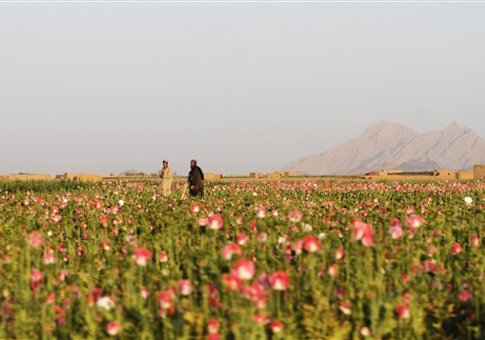
Afghanistan Housing 400,000 Football Fields Worth of Opium


BY: 

Afghanistan is housing the equivalent of 400,000 football fields worth of opium fields, despite the United States having spent billions in taxpayer funds to combat the growth of illicit narcotics, according to the Special Inspector General for Afghan Reconstruction (SIGAR).
While the United States has spent $8.4 billion on counter-narcotics programs in Afghanistan over the years, the country is estimated by the United Nations to have “roughly 500,000 acres, or about 780 square miles, devoted to growing opium poppy,” according to SIGAR head John Sopko, who criticized the billions in taxpayer money spent on these programs during a speech last week in New York City.
“As of this March, the United States has provided $8.4 billion-I repeat, billion-for counternarcotics programs in Afghanistan,” Sopko said, according to text of his remarks. The Pentagon “and State [Department] give information to SIGAR every quarter on their successes such as drug-treatment centers built, rehab workers trained, tractors donated (31 last year), alternative-livelihood programs executed, drug seizures, and so on. Yet, despite all this, we see record and rising levels of opium production.”
Despite these taxpayer-funded efforts, “The United Nations reports that Afghanistan produces 90 percent of the world’s illicit opiates,” Sopko said.
“That’s equivalent to more than 400,000 U.S. football fields, including the end zones,” he added. “This enormous acreage devoted to opium feeds a huge tragedy-fostering heroin addiction and crime around the world, including here-as well as a strategic threat. Taxes on opium are a major revenue source for Afghan insurgents, and a powerful prod to corruption among Afghan officials.”
The billions the United States spends on counter-narcotics programs reduced Afghanistan’s opium fields by just more than 1 percent in the last year.
“The bottom line—record opium cultivation and production—clearly shows we are not winning the war on drugs in Afghanistan,” Sopko said.
Since 2002, Congress has appropriated nearly $110 billion for various Afghanistan reconstruction projects. The money continues to flow despite many instances of fraud and waste identified by SIGAR in recent years.
Security in Afghanistan also continues to deteriorate, making it more difficult for inspectors to provide oversight on the projects receiving U.S. funding.

Farewell Kabul: From Afghanistan to a More Dangerous World review – a lucid account of the longest war


War reporter Christina Lamb illuminates Nato’s failures in Afghanistan in this captivating memoir of her years on the frontline
 In November 2008, an Estonian minister by the name of Harri Tiido was being given a tour of Helmand province. Estonians were stationed in Nawzad, which had once been a town of 30,000 people, but was now deserted, “with the two sides dug into first world war-type trenches with their lines 300 yards apart”. After receiving the usual PowerPoint briefing, Tiido was asked by his British hosts if he had any questions: “I have only one,” he said. “What the fuck are we doing here?”

The minister at least knew what he was talking about. During the previous Afghan war, Tiido had been a conscript in the Soviet 40th Army. The Soviets had gone the same way as the Brits in the 19th century, beating a hasty retreat from a land often invaded but never subdued – a land, according to Christina Lamb, “of pomegranates and war”. This was the longest war in British living memory, and the longest in American history, one that has seen hundreds of soldiers come home in body bags, tens of thousands of civilians dead, and to what end?

This is a journey through more than a decade of hell and futility, written vividly
Lamb spent 13 years on and off in a country that she came to love. Arriving straight after 9/11 at the start of what George Bush claimed would be a swift incursion to snuff out Osama bin Laden’s terrorist cell and, as an optional extra, to remove the Taliban. Operation Enduring Freedom turned out to be none of the above.

This is a journey through more than a decade of hell and futility, written vividly, with emotion but mercifully shorn of polemic. The author gets to know a number of the main characters well. One of her first sources was Hamid Karzai, well before the Americans identified him as the man they could do business with. Over the years, Karzai becomes a prisoner in his own fortified compound, increasingly furious with the erstwhile “liberators” and mired in corruption. The author has much sympathy for the squaddies and their commanders, who are charged with an impossible mission. She describes in vivid detail going on foot patrol in Helmand. The British commander concedes that they have no interpreter, adding: “We don’t know if people are friend or foe until they fire.”

Little America: The War Within the War for Afghanistan by Rajiv Chandrasekaran – review
This account of America's decade-long adventure in Afghanistan makes for essential reading, writes Jason Burke

 Read more
The war becomes an industry. The number of arrivals and departures at the airfield at Camp Bastion, from jumbo jets to unmanned Reaper drones, turns it into the fifth busiest UK-operated airstrip. The Americans spend more on Afghanistan than they did on the Marshall plan to rebuild Europe after the second world war. Warlords who would relish torturing their opponents are given palaces, reinforced cars, trips to Dubai for R&R and to Germany to get their teeth fixed.

The hapless number crunchers back home dispense with any of the checks they would normally make. Of the many vignettes about waste and corruption, this one is my favourite: more than $3m is spent on patrol boats that end up languishing unused in a Virginia warehouse. “Somehow each of the eight boats had cost $375,000 – far more than the usual £50,000 usual price tag – before anyone realised that Afghanistan had no coastline.” At one point, the British sent grey-suited customs officers to Kabul airport; incoming passengers, groaning under the purchases they had made abroad, would simply walk around them.


In the post-“victory” period of the early 00s, Kabul became a pocket party town for westerners and a clique of westernised Afghans. Those living in the “Kabubble” enjoyed a raucous social life fuelled by illicit alcohol, cheap hash and the adrenaline of fear. Among the many expat ventures were a sea-green-and-chrome “lounge bar” serving margaritas and club steaks, a Deutsche Hof Bierhaus offering pork chops and sauerkraut and a French restaurant replete with swimming pool, which the foreigners dubbed Latmo.

The author scarcely disguises her contempt for the political masters back home. Of the many absurd utterances, the hubris of Labour’s defence secretary John Reid is hard to beat: “We would be perfectly happy to leave in three years, and without firing a single shot.” At every step of the way, the strategy changed and the strategy failed. The initial invasion was a rapid success (just as Iraq was). By 2003, the attention of George W Bush and Tony Blair was focused on the newly invented ogre, Saddam Hussein. Afghanistan became an afterthought. “Nation-building”, such as there was, stopped. The warlords and the Taliban regrouped. Repeated attempts, dating back to 1999, to snatch Bin Laden failed.

The initial casus belli – rooting out terrorism – got nowhere. That was followed by the need to destroy the opium crop. That morphed into cementing democracy and the rule of law, finally the vague and desperate aspiration to improve infrastructure and “quality of life”. The hubris was accompanied by self-delusion that Pakistan was part of the solution, rather than the problem, its security service, the ISI, being one of the chief sponsors of al-Qaida and disrupter of attempts to bring a modicum of stability to Afghanistan.

In the introduction to this most captivating of war journals, Lamb poses the following rhetorical question: “How on earth had the might of Nato, 48 countries with satellites in the skies, 140,000 troops dropping missiles the price of a Porsche, not managed to defeat a group of ragtag religious students led by a one-eyed mullah his own colleagues described as ‘dumb in the mouth’?”

Pakistani intelligence officer disclosed terrorist Osama’s hideout - Seymour M. Hersh

U.S. journalist Seymour M. Hersh calls Obama administration’s narrative on Osama killing ‘a lie’

A former Pakistani intelligence officer disclosed the hideout of Osama bin Laden to CIA in exchange for $25 million bounty on the head of the al-Qaeda chief, who was living as prisoner under ISI protection in the garrison town of Abbottabad, according to a report.
“In August 2010 a former senior Pakistani intelligence officer approached Jonathan Bank, then the CIA’s station chief at the U.S. embassy in Islamabad. He offered to tell the CIA where to find bin Laden in return for the reward that Washington had offered in 2001,” the Dawn reported, citing American investigative journalist and author Seymour M. Hersh.
The intelligence official, Mr. Hersh said, was a military man who is now living in Washington and working for the CIA as a consultant.
U.S. informed ISI

The U.S. confirmed the information provided by the official and put the compound under satellite surveillance. Americans later informed the ISI which set up a cell in Ghazi, Tarbela, where “one man from the SEALs and two communicators” practised the raid before executing the operation, Mr. Hersh said, adding that it was difficult decision but Pakistan was ultimately taken on board and told about the script to kill Osama.
Mr. Hersh said that whatever the Obama administration told about the operation to kill Osama was part of fiction and the real story was totally different.
“The most blatant lie was that Pakistan’s two most senior military leaders — Gen Ashfaq Parvez Kayani [the then Army chief] and Gen. Ahmed Shuja Pasha [the then ISI chief] — were never informed of the U.S. mission,” he told Dawn.
Mr. Hersh said the Saudi government also knew about Osama’s presence in Abbottabad and had advised the Pakistanis to keep him as a prisoner.
He said President Barack Obama did not consult Gen. Kayani and Gen. Pasha before releasing the cover story that he shared with his nation in a live broadcast.
Mr. Hersh also said that Dr. Shakil Afridi, the physician now jailed in Peshawar for helping CIA trace down Osama’s hideout, was a CIA asset but he did not know about the operation.
http://www.thehindu.com/news/international/pakistan-ntelligence-officer-disclosed-osamas-hideout/article7194571.ece

Pakistan - Kayani, Shuja Pasha knew of Terrorist Osama raid in advance: author

US forces killed Osama bin Laden with the full cooperation of Pakistani military and intelligence agencies, who had kept the 9/11 mastermind prisoner inside his infamous Abbottabad compound for years before the fatal raid, according to a controversial article in the London Review of Books by veteran investigative journalist Seymour M Hersh.
According to the 10,000-word expose published on the London Review of Books website, Bin Laden was a prisoner of the Pakistan military, who not only knew of his location, but were keeping him under house arrest and accepting funds from Saudi Arabia for his upkeep.
Another official US account Hersh contradicts is the idea that water-boarding and other “harsh interrogation” produced the intelligence that led to Bin Laden (as in the fictionalised movie Zero Dark Thirty). In his article, Hersh claims a “walk-in” tipster told US officials about Bin Laden’s whereabouts in exchange for $25 million.
The article widely contradicts multiple elements of the original account of the May 2011 raid by US forces provided by the Obama administration. Hersh’s primary source for most of the revelations was a “a retired senior intelligence official who was knowledgeable about the initial intelligence about Bin Laden’s presence in Abbottabad.”
“The most blatant lie was that Pakistan’s two most senior military leaders — General Ashfaq Parvez Kayani, chief of the army staff, and General Ahmed Shuja Pasha, director general of the ISI — were never informed of the US mission.
This remains the White House position despite an array of reports that have raised questions,” Hersh wrote, adding that he had unearthed the following new pieces of information:
“(B)in Laden had been a prisoner of the ISI at the Abbottabad compound since 2006 … Kayani and Pasha knew of the raid in advance and had made sure that the two helicopters delivering the Seals to Abbottabad could cross Pakistani airspace without triggering any alarms … that the CIA did not learn of bin Laden’s whereabouts by tracking his couriers, as the White House has claimed since May 2011, but from a former senior Pakistani intelligence officer who betrayed the secret in return for much of the $25 million reward offered by the US, and that, while Obama did order the raid and the Seal team did carry it out, many other aspects of the administration’s account were false.”
US officials, including President Obama, have repeatedly maintained that the Navy SEALS operation to take out bin Laden in 2011 was conducted without the help of Pakistan’s Special Forces and without notifying the Pakistani government beforehand.
Throughout his account, Hersh maintains that it “just made no sense that bin Laden was living in Abbottabad,” a military stronghold that is home to the nation’s equivalent of the West Point military academy in the US.
Obama, Hersh wrote, doubted that Special Forces could carry out any kind of assault on the terrorist’s purported compound without help from Pakistan. “The only way to accomplish both things, the retired official said, ‘was to get the Pakistanis on board,’” Hersh wrote.
US intelligence services gradually collected information about the compound, until they were able to eventually prove that Bin Laden had lived there with help from ISI.
“The compound was not an armed enclave — no machine guns around, because it was under ISI control,” Hersh wrote.
Bin Laden had lived undetected in the Hindu Kush mountains that straddle northern Pakistan and southern Afghanistan from 2001 to 2006, until the ISI “got to him by paying some of the local tribal people to betray him,” Hersh wrote. ISI then hid Bin Laden in the Abbottabad compound for years, keeping his presence a secret, but using him to “keep tabs on al Qaeda and the Taliban,” a source told Hersh.
“The ISI was using bin Laden as leverage against Taliban and al Qaeda activities inside Afghanistan and Pakistan,” Hersh wrote.
But in 2010, the US began learning of bin Laden’s whereabouts, and months later, CIA officials began bringing a small number of Pakistani officials into the planning of the potential operation.
“It didn’t take long to get the co-operation we needed, because the Pakistanis wanted to ensure the continued release of American military aid, a good percentage of which was anti-terrorism funding that finances personal security,” a source told Hersh.
American and Pakistani officials bargained for weeks over how the mission would be carried out, and the Pakistanis proved instrumental in providing intelligence, in the final agreement, that allowed the raid to occur successfully.
“At the Abbottabad compound ISI guards were posted around the clock to keep watch over bin Laden and his wives and children. They were under orders to leave as soon as they heard the rotors of the US helicopters,” Hersh wrote.
“An ISI liaison officer flying with the Seals guided them into the darkened house and up a staircase to bin Laden’s quarters. The Seals had been warned by the Pakistanis that heavy steel doors blocked the stairwell on the first and second-floor landings; bin Laden’s rooms were on the third floor,” Hersh alleged, citing his sources.
After bin Laden was shot and killed during the raid, White House officials contended that his body was brought to the USS Carl Vinson, possibly in the Indian Ocean, for a burial at sea that was conducted in accordance with Muslim law.
Again, Hersh claims that the administration lied. “Within weeks of the raid, I had been told by two longtime consultants to Special Operations Command, who have access to current intelligence, that the funeral aboard the Carl Vinson didn’t take place,” he wrote.
“One consultant told me that bin Laden’s remains were photographed and identified after being flown back to Afghanistan. The consultant added: ‘At that point, the CIA took control of the body’,” Hersh wrote.
http://tribune.com.pk/story/884342/kayani-shuja-pasha-knew-of-obl-raid-in-advance-author/

Smitten by its own monster, Pakistan rushes to blame all terror acts on RAW

By Rajeev Sharma  


Is India's external intelligence agency RAW (Research and Analysis Wing) becoming a powerful tool than ever before in the dispensation of Prime Minister Narendra Modi and National Security Adviser Ajit Doval in dealing with Pakistan?
Pakistan definitely believes so. In fact, Pakistan’s top civil and military leaders as well as non-state actors have accused RAW of choreographing terror acts in Pakistan.
None other than their Defence Minister Khawaja Asif claimed that RAW had been created to destroy Pakistan and its activities could not be taken lightly. Asif went on record as telling Pakistan’s Geo News channel that the interests of the Taliban and RAW were the same and also that separatist leaders from Pakistan’s Balochistan province possessed Indian passports. He was also quoted as saying that "RAW has been formed to wipe Pakistan off the map of the world".
Asif's reported remarks came after a meeting of Pakistan’s top military commanders in Rawalpindi on 5 May. The meeting of corps commanders was chaired by Pakistan Army chief General Raheel Sharif. It was convened to discuss situation in Pakistan's restive province of Balochistan and RAW was the elephant in the room during this meeting. "The conference (of Corps Commanders) also took serious notice of RAW's involvement in whipping up terrorism in Pakistan," said a statement from the military’s media arm ISPR.
While it is a known fact that Pakistan Army controls the levers of Pakistan’s foreign policy and all strategic decisions, particularly with regard to India, it does so through its corps commanders. This should put in perspective the huge importance of corps commanders in the Pakistan set up.
All who are familiar with Pakistan know that the real power vests with the army chief and the political leadership is directed by the army on the talking points for the civilian government. It is against this backdrop that one needs to consider the ISPR statement that RAW is "whipping up terrorism in Pakistan".
Pakistan’s civil and military leaderships have been blaming RAW for instigating terrorism in Pakistan but it is unusual for a corps commanders’ conference to blame the Indian intelligence agency directly.
In December 2014, former Pakistan dictator General Pervez Musharraf had told CNN-IBN that Maulana Fazlullah, the Tehrik-e-Taliban Pakistan commander, was trained by RAW and supported by former Karzai government for carrying out the terror attacks in Peshawar's Army Public School.
Notorious Pakistani non-state actor Jamaat-ud-Dawa (JuD) chief Hafiz Saeed had also alleged that India was behind the Peshawar attack. In fact, after the gruesome terror attack, Hafiz Saeed had gone to the extent of exhorting the jihadist elements to target India in retaliation.
An interesting thing here is that tables have been turned in the blame game being played in India-Pakistan context. Decades ago when terrorism in Punjab was at its peak it was common for Indian officials and ministers to blame Pakistan Inter Services Intelligence (ISI) for all terror acts perpetrated against India. Indian government continued to blame the ISI when insurgency started in Jammu and Kashmir in 1989 and soon turned into a bloody proxy war.
Those days hardly a day passed without a terror incident in India while Pakistan remained peaceful. Today, it is the other way round. Terror incidents have become a routine in Pakistan while India is comparatively far more peaceful in terms of terror strikes of the jihadist brand.
Pakistan today is reaping what it sowed for India. Those very terrorists whom it created, nurtured, indoctrinated and armed for spreading mayhem in India have now turned their guns towards their own erstwhile masters.
Evidently, Pakistani military establishment has upped its ante vis-a-vis India. It connotes hardening of stand by Rawalpindi, the high seat of military power.
While it shows Rawalpindi's growing exasperation over its inability to curb terror activities in Pakistan it also conveys a tinge of helplessness of the Pakistani military establishment. Pakistan military leaders’ rant against RAW shows that they are unable to go beyond the optics and do not have hard evidence against RAW to haul India before the international community.
After all, a country like Pakistan which has dragged India before various international platforms — be it water issues or downing of a Pakistani aircraft — won't have waited for a day for going to the international community if it had hard evidence against RAW.
This may provoke Pakistan Army to resort to some hard actions in near future. India will have to be on its guard.

Pakistani Christians Demand Rights To Visit Israel

God’s Peoples Fellowship of Pakistan (GPFP), a Karachi-based Christian organization, which seeks diplomatic ties with Israel, staged a protest on Sunday outside the Karachi press club to demand the lifting of the travel ban on Christian Pakistanis to Israel.
There are no formal diplomatic ties between the two countries and Pakistan forbids its citizens from going to the Holy Land. All Pakistani passports state, “This passport is valid for all countries of the world except Israel”.
“People of different religions particularly Sikhs of India come to Pakistan every year to perform their religious obligations despite the fact the two countries have fought three wars,” Ashraf P Butt, Secretary-General of the GPFP, said.
“Since Pakistan doesn’t recognize the state of Israel and does not maintain any diplomatic ties, the Christian community in Pakistan has been deprived of their legitimate religious rights,” he told ucanews.com.
“We deem Bethlehem, Jerusalem, the holy city of King David, the Skull place where Jesus Christ was crucified, Nazareth, Galilee and other such places sacred,” Butt said.
Pervaiz Khan, a pastor, said Christians are only asking for the rights to visit holy places in Israel.
“When Muslims can freely go to Mecca and Medina for pilgrimage, why can’t we exercise our religious obligations guaranteed by the constitution of Pakistan,” he said
- See more at: http://www.christiansinpakistan.com/pakistani-christians-demand-rights-to-visit-israel/#sthash.OF4LmXEK.dpuf

Pakistan - ‘State of Human Rights' - A damning verdict

The Human Rights Commission of Pakistan has released its annual report on the ‘State of Human Rights 2014’. As expected, the bulk of the report is a damning indictment of the Pakistani state’s failure to protect its citizens. The year started with a series of attacks on religious minorities and ended with the attack on the Army Public School in Peshawar. At least 1,723 Pakistanis lost their lives while 3,147 were injured in 1,206 terrorist attacks over the year. Pakistan witnessed a surge in sectarian violence, attacks on religious minorities and media-censorship. Moreover, Pakistan remained the world’s most polio-affected country. At least 45 polio workers were target-killed, there were at least 144 sectarian terrorist attacks, 11 attacks on Hindu temples and Christian churches while Shia pilgrims passing through Balochistan were consistently targeted. A Christian couple was lynched and burnt in Kot Radha Kishan while 11 Ahmadis were murdered in targeted attacks. The HRCP also documented that 37 new cases were registered under the controversial Article 295-C for offences relating to religion. The abject failure of the judicial system documented that over 1.8 million cases remain pending in courts, an astonishing figure no doubt.

The report also points to some good: an increase in women’s participation in politics, a law against child marriage, and an increase in minimum wage. But the good news is limited. Parliament enacted 10 laws, down from 22 the year before. The report notes that most of these laws were promulgated for state security at the expense of civil rights and liberties. Three important laws for the rights of people remain in the pipeline: the Hindu Marriage Act, Christian Divorce Act and the Domestic Violence Bill. The trouble is that this dire picture is nothing new. We latch onto minor improvements as markers of improvement, but the reality is that violence has crept into every part of public and private life in the country. The increasing attacks on polio workers as the country faces a polio epidemic is a key indicator. The HRCP report has become an annual affair which is talked about for a few days before being forgotten. If anything, the year 2015 looks set to be worse, with the advent of military courts, lifting of the moratorium on the death penalty and the clampdown on academic freedom in mainstream universities. Slowly, but surely, the government is complicit in making even talking about human rights into a crime against the state. The recent draft of the cyber crimes law is another such tool. With 2015 heralding a terrorist attack on churches in Youhanabad and the murder of activist Sabeen Mahmud in Karachi, the picture is not going to get rosy anytime soon. 

Pakistan - Women apartheid


It appears duplicity and politics were born twins in Pakistan. They happily coexist as an essential condition to obtain a vibrant democratic order in the country. But how do they do that, two happenings this past Thursday, one in Islamabad and the other in the highlands of tribal areas, offer the answer. On this day, the Senators, almost across the aisle, were losing breath pledging support for moves to ensure equal political rights for women in the country. And in Lower Dir, not even one out of the 47,280 registered women voters came up to any of the 90 female - only polling booths to cast her vote. In the Senate, a passion-packed discussion erupted almost instantly as the MQM's Nasrin Jalil pointed out that a jirga (local council) of Diamer District had barred women from casting votes in the Gilgit-Baltistan legislative election being held next month. And that the said Jirga was joined by the candidates of PML (N), PPP, PTI and JUI (F). The PPP Senator, Saeed Ghani, took no time to inform the house that following these reports his party has withdrawn the ticket awarded to its candidate. Leader of the House Raja Zafarul Haq termed it an 'alarming' development, assuring the house he would take it up with the G-B governor. And, Senate Chairman Raza Rabbani was of the view that 'disentrancing women was certainly unconstitutional and illegal act'. Even the JUI's (F) Attaur Rehman volunteered, saying disenfranchising women is not his party's policy, 'but it would be inappropriate to force women to vote'. So far so good. But there were no women voters on the ground in Lower Dir where the candidates of these very parties were in a furious contention to win Pk-95 vacated by Jamaat-e-Islami Emir Sirajul Haq. In compliance with a 'hidden agreement' all the candidates had decided that women would stay home. The so-called 'honour' had once again won over the 'right'. Can someone bereft of his rights be an honourable person - what else is duplicity that has become a sine qua non of our national politics. 

It defies common sense that none of these 47,000 plus women did not want to vote. That the women from tribal areas are not interested in politics is an argument that has no buyers. Only two years back, a woman named Nusrat Begum was a candidate in NA-44 (Lower Dir) and not far from here Zari Begum was a candidate from NA-44. And guess who opposed Zari Begum; it was the PPP stalwart Akhundzada Chattan, who was critical of her 'act' which he found violative of tribal customs and traditions, as Nusrat Begum, then PTI district vice-president, was pitted against her own party's 'official' candidate. That makes one believe that the kind of excessive chest-thumping and over-my-dead-body pledges to uphold the cause of political equality for women often heard from country's high forums is anything more than a mere sham. The truth of the matter is that whatever may be the excuses the women voters of Pk-95 were barred from participating in the election, and anyone involved in that nefarious act is liable to be tried in the court of law. The constitution makes it absolutely mandatory that men and women in Pakistan have equal rights. Back in 2010, the National Commission on the Status of Women had asked the Election Commission of Pakistan (ECP) to take a serious notice of the practice through which jirgas bar women from casting their votes. But the ECP seems to have slept over this. But that's no more on. The election to Pk-95 held last Thursday lacks legitimacy. It should take place again, with adequate care taken against shamans and political wheeler-dealers who secure 'fatwas' and Jirga verdicts if and when such a strategy suits them. Circa 2015, women apartheid in Pakistan is unacceptable. 

Pakistan - An impetuous Imran


PTI needs to learn to be patient
There were irregularities in NA-125; more have been discovered in NA-122. But do these constitute sufficient proof of systematic rigging? In the case of NA-125 the tribunal had exonerated the winning candidate of any wrongdoing, holding the RO-led election staff responsible for the irregularities. It remains to be seen what the tribunal has to say about NA-125.
Initially the PTI had hinted at bribe having played a role in the success of the PML-N candidate but the charge was not pressed. Imran Khan, however, demanded that the ECP hold the Presiding and Returning Officers accountable. But are the ROs alone responsible? Political parties have to accept that they do not have sufficiently trained Polling Agents capable of detecting the irregularities and getting them stopped at the polling stations. The Election Commission provided the handbook for the guidance of the ROs and DROs late while the ROs received their appointment notifications only 15 days before the elections. To cap it all, the ECP failed to get ballot papers printed in accordance with the schedule.
Imran Khan demands elections this year. Instead of showing impatience he has to wait for the verdict of the Judicial Commission that he had himself asked for. There is a need on the part of all the parties to assist the Judicial Commission in its findings.
There are reports of the PTI leadership preparing for protests soon after a verdict is out on NA-122. Both the PML-N and the PTI should accept whatever judgment is given and take recourse to the Supreme Court in case they find it unsatisfactory. Protests by any party are likely to be interpreted as an attempt to pressurise the courts. All the more so when the proceedings of the Judicial Commission are continuing. What is needed on the part of PTI is to help improve the working of the ECP and the entire election machinery after thrashing out the issues in the Parliamentary Committee for Electoral Reforms.

Pakistan - Education report card


THE state of public education in Pakistan has been abysmal for years. But instead of just bemoaning the sorry condition of this critical sector, it is more constructive to spot the many weaknesses of the system and work towards rectifying these inadequacies.
And reports such as Alif Ailaan’s District Education Rankings help identify the weak spots. The advocacy group recently launched the 2015 edition of the rankings, examining the state of education in the country’s 148 districts and agencies.
This effort is important as it gives a district-wise picture. The overall prognosis is that while some parts of the country are marching on despite obstacles such as weak infrastructure and limited resources, other areas are either stagnant or deteriorating further.
Sindh’s performance, for example, has been described as “poor” and the report is critical of the provincial government’s failure to address the situation. Even in Punjab — which tends to lead on many counts — the study says there are “stark” differences between the province’s southern, central and northern districts.
Azad Kashmir, on the other hand, has overtaken Punjab and now stands as the second best-performing region. In fact AJK and Gilgit-Baltistan have been praised for trying to improve their performance despite poor infrastructure. Balochistan’s performance can be described in one word: “abysmal”. On a brighter note, the study praises the Khyber Pakhtunkhwa administration for improving its enrolment, retention and gender parity indicators.
The key problems as identified by the report are that learning outcomes in Pakistan are poor and that education quality remains low. In other words, for the most part, our children are not getting a quality education in the public sector even if they make it to school and manage to stay in class.
One area that has been highlighted for improvement is the allocation of funds. The country currently spends just around 2pc of GDP on education, whereas the desired figure is at least 3pc. But even the money that is spent is not delivering satisfactory outcomes.
However, as some areas are making an effort to improve themselves — GB, Azad Kashmir and KP, for example — it may prove beneficial to see what sort of practices these governments have adopted to address the education crisis.
Clearly, unless the provincial administrations make it their priority to deliver quality education to all children in all districts, there will be slim chance of Pakistan’s education emergency abating anytime soon.

Pakistan - Seminaries '‘Centers of ignorance and illiteracy''


''Centres Of Ignorance''


Religious groups belonging to the Deobandi school of thought want the Information Minister Pervaiz Rasheed removed for his anti-seminary remarks. He described the seminaries as ‘centres of ignorance and illiteracy.’ In response the Wafaqul Madaris Al Arabia, the board representing the seminaries belonging to the Deobandi school of thought wants FIR’s registered against him. Addressing the protest rally, Deputy General Secretary Wafaqul Madaris Maulana Qazi Abdul Rasheed said the remarks by the federal minister had upset the whole nation. He is very much mistaken. Additionally, the office-bearers of Wafaqul Madaris al-Arabia said they would initiate a campaign against the minister, even if they have to delay the exams at the seminaries, proving the minister correct in suggesting that conservative hate comes before meeting any educational standards.
Pervaiz Rasheed should now fear for his life because there are many religious fanatics out there who would take this very seriously. That is the unfortunate thing in Pakistan and we have seen that many have already become victims, including Salman Taseer and Sabeen Mehmud. Rather than talking about apprehending those like Mufti Naeem of Jamia Binoria, who has openly threatened a state official saying he is a blasphemer and a non-Muslim, the narrative is fixated on Rasheed’s remarks, that can only be described as mild, considering the history of hate and crime associated with Pakistani madrassas and their alumni. Pakistan is a free country, and people are allowed to speak their mind, even if it hurts the feelings of Mufti’s and Sheikhs. Remember that under the post-Peshawar massacre National Action Plan, it has been madrassas and seminaries that have refused to provide information to the government on their funding, numbers and activities.
‘Conspiracy against Islam’, ‘conspiracy against Pakistan’… these are buzzwords to shut down debate and criticism. These men treat Pakistan as if they are caliphs rather than citizens. The madrassa system needs urgent reform, and fatwas declaring people blasphemers and heretics need to be muzzled before more people are assassinated or blown up. Criticising the madrassa system is not blasphemy, but with the standard of education provided at seminaries, maybe Mufti Naeem does not know what the word means.
Hopefully, after all we have been though, from the silent Shia genocide to the deaths of innocent school children, the people of Pakistan can look at their Iman’s and Mufti’s critically, like they look critically at their politicians, and tell the difference between what is in the interest of the future of their countrymen and what will only cause violence and bloodshed.