Friday, March 20, 2015

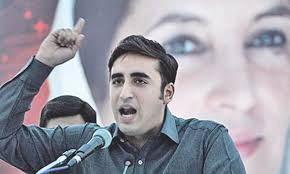
Bilawal Bhutto condemns Karachi blast


https://mediacellppp.wordpress.com
Chairman Pakistan Peoples Party (PPP), Bilawal Bhutto Zardari has expressed shock and sorrow over the bomb blast near Bohra community’s Saleh Mosque in Aram Bagh area of Karachi today.
In a statement, Bilawal Bhutto Zardari said the attacks on mosques, churches, schools, markets and other heavy human targets, defy the teachings of all known religions of the world. He reiterated the determination of the PPP and its provincial government to continue to take every step to put an end to the reprehensible acts of all groups and persons involved in acts of terrorism.
Chairman PPP expressed his condolences to the Bohra community and the families of all those who lost their lives in the heinous attack.

Disturbing trend: Peshawar tops vaccination refusals again


Although the district administration has been holding jirgas to convince people to inoculate their children against polio, Peshawar yet again recorded the highest number of refusals in the latest National Immunization Drive.
A senior health department official told The Express Tribune 11,100 children in Peshawar missed out on vaccination because their parents refused vaccinators during the three-day immunisation drive which ended on Wednesday. Though less in number than the last campaign, the refusals are raising red flags.
“Families living in the suburbs are reluctant to administer polio drops to children,” he said. He added the district administration recently held a jirga in Badhaber where it claimed to have convinced over 120 families to get children vaccinated, but the refusals are a clear indicator that people are reluctant.
However, he was hopeful that the refusals will be reduced in a one-day follow-up drive which was held on Thursday.
When contacted, Deputy Commissioner Riaz Mehsud told The Express Tribune the district administration has devised a strategy and has been holding jirgas to convince locals to vaccinate their children.
“We contact them (parents) through jirgas in their respective villages but if they still refuse vaccination, we will not hesitate to take action against them,” said Mehsud.
The breakdown
According to officials associated with the recent drive, nearly 30,000 children across the province remained unvaccinated because their parents refused the drops.
Of these, Peshawar led with the highest refusals–the second time in a row. In a drive held in the first week of March, 13,436 parents in the district did not allow teams to vaccinate their children.
This time, Bannu reported 5,000 refusals; Swabi 4,719; Lakki Marwat 2,800; Nowshera 1,980; Charsadda 1,500; DI Khan 704; Kohat 610 and Mardan 510.
Similarly, 502 children could not be inoculated in Tank, while the number stood at 336 for Hangu, 68 in Abbottabad, 37 in Haripur, 10 in Malakand, nine in Swat, three in Lower Dir and two in Upper Dir.
Vaccination teams faced no hurdles in Kohistan, Shangla, Battagram, Buner and Chitral as no refusals were reported from these districts. The data for Torghar could not be obtained since it had not been compiled.

India - Ministry of Defence slams Pakistan in its report

Lashing out at Pakistan, the Modi government, in the annual report of the ministry of defence (MoD) for 2014-15 released on Thursday, said that the “use of terrorism as an instrument of state policy has deep roots in the Pakistani military establishment”.
The report added that “Pakistan continues to remain home to several non-state actors with the North Western Frontier Province (NWFP) serving as the fountainhead for terrorist activity in the region”.
Hitting out further at Pakistan, the report said, “Pakistan stepped up its efforts both to internationalise the Kashmir issue and to engineer violence in the state (of J&K). The terrorist infrastructure across the border remains intact and Pakistan’s frustration manifested itself in ceasefire violations and high visibility, audacious attacks by foreign terrorists.”
In a significant comment on China in the wake of increase in Chinese footprints in the Indian Ocean region, the report says, “China is extending its line of access towards the Indian Ocean through Myanmar and Pakistan. Its footprint in India’s immediate neighbourhood has also been increasing as a result of its proactive diplomacy.”
The report also said that “the security situation in J&K is at a very critical stage”. It further said, “Relentless and successful counter-infiltration and counter-terrorism operations have led to the parliamentary and Assembly elections being conducted successfully with very high voter turnout”.
The government has therefore once again set the record straight after J&K chief minister Mufti Muhammad Sayeed’s earlier controversial utterances — rejected by the Indian government — in which he was seen to have virtually credited Pakistan and the separatist Hurriyat for the successful conduct and high participation in the Assembly elections in the Kashmir Valley.
“The expanding footprints of extremist and terrorist organisations in Pakistan and their linkages with terrorist activities in J&K and the rest of India poses a major security challenge to India, with severe ramifications on bilateral relations ...”, the report says.
“Ceasefire violations and infiltration from across the border also continues unabated,” the report states, while referring to “the continued existence of terrorist camps across the international border and LoC”.
The report is much softer on China, saying that “although the unresolved boundary dispute between India and China is a major factor in India’s security calculus, India has engaged with China on the principle of mutual respect and sensitivity ...”. But the report, nevertheless, adds, “India remains conscious and watchful of the implication of China’s increasing military profile in our immediate and extended neighbourhood, as well as the development of strategic infrastructure by China in border areas”.

Pakistan must give up jihadi option forever

Former Pakistani envoy to United States of America (USA) Hussain Haqqani on Friday said Pakistan wasn't doing enough to show the world that it is serious about curbing terrorist setups breeeding on its soil.
"It is time for Pakistan to give up jihadi option forever, only when we do that, we will have credibility in international community," said Haqqani.
Terming terror attacks in India perpetrated by agents from across the border as a deliberate hindrance to peace talks, Haqqani told ANI, "Terrorists have always wished to interrupt talks between India and Pakistan through terror attacks. But India and Pakistan must understand that there is no other way than a peaceful bilateral dialogue. No terrorist is a friend of Kashmir, India or Pakistan."
He called upon the Pakistani government to up the ante against terror if it wanted to show the world that it was serious against militancy. "Pakistan government continues to say that it is trying to eliminate terror and efforts have been started, but they are not enough. Pakistan needs to make it clear to the world and to India that no jihadi group will have safe haven in Pakistan anymore," said Haqqani.
Pakistan itself has suffered in the hands of terror spawning in its backyard, felt Haqqani and said it was high time that the people in-charge accepted this. He averred, "The acceptance and tolerance towards jihadi groups over the past has harmed Pakistan more than any other country in region."
The former Pakistani envoy to the US condemned Friday's terror attack in Jammu and Kashmir's Kathua and said effort was required from Pakistan to build confidence and move towards healthier, meaningful dialogue between the two countries. "Kathua attack should not only be condemned, but Pakistan must extend cooperation in finding out which groups based in Pakistan are behind it. Only then can the confidence be built which will enable India and Pakistan to move forward in a comprehensive dialogue," added Haqqani.
He said the action taken by the Pakistani administration against terror outfit TTP was welcomed but it was serving just as a flash in the pan in the larger scheme of things. "Action against Tehreek-e-Taliban Pakistan is a positive step, however, it is an inadequate step," said Haqqani, and added, "Unless Pakistan acts against Lashkar-e-Toiba (LeT), Lashkar-e-Jhangvi, JeM, all jihadi groups, wherever they might be operating Pakistan will continue to be suspected by international community of harbouring terrorists."
Haqqani called Pakistan High Commissioner in India Abdul Basit's decision to engage with Hurriyat Conference leaders from Kashmir 'a diplomatic faux pas' and criticised the move. "It was ill-advised to engage so publicly with groups from Kashmir that newly elected Indian government did not look upon positively," said Haqqani.
He called upon both nations to change their perception of each other and engage in dialogue with renewed vigour. "There will be occasions when India will call off talks, Pakistan will ocassionally back away from talks due to India's comments. Fundamental change is needed. Pakistan must stop looking at India as existential threat and permanent enemy. And India should stop looking at Pakistan through partition prism," said Haqqani.

Pakistan - SUICIDE BLAST OF ASWJ KILLS TWO RANGERS PERSONNEL IN KARACHI

A loud blast targeting a Rangers mobile near Qalandria Chowk in North Nazimabad killed two paramilitary officials and injured another on Friday in a suicide bomb attack by outlawed AhleSunnat Wal Jamaat and Taliban terrorists.
Three Rangers personnel were injured in the blast. Two officials succumbed to their injuries on the way to the hospital. The deceased officials have been identified as Qasim and Yaar Mohammad.
SP Gulberg has confirmed that it was a suicide blast targeting Rangers mobile.
Two civilians were also injured in the blast identified as Akram and Syeda.
The intensity of the blast has not yet been confirmed, but the explosion was so loud that it was heard in far-reaching areas of North Nazimabad and F B Area, reported DawnNews.
Earlier today, two Bohri Muslim worshiper were martyred in an explosion that took place after Friday prayers outside the Saleh Mosque for the Bohra community, close to Pakistan Chowk.
Rangers have been the target of such attacks in the past. In November 2014, an explosion targeting a Rangers vehicle in Karachi's Baldia Town Sector Four injured four people.
In May 2014, an attack on the Rangers HQ in Karachi resulted in the injuries of at least five Rangers personnel.
http://www.shiitenews.org/index.php/shiitenews/pakistan/suicide-blast-of-aswj-kills-two-rangers-personnel-in-karachi

Thursday, March 19, 2015

MC Hammer - U Can't Touch This

Parents, Students Worried About Turkey's Education System


Parents and students in Turkey have taken to the streets to show their alarm over the state of education in the country, and the direction the government has taken to reform it.  
Generally, education has been viewed as a political football in the past decade under Turkey's Islamist-rooted government.
Observers say much of the problem lies in the legacy of military rule during the 1980s.  Under the generals, thousands of teachers considered either having left-leaning or liberal sympathies were purged.  A ruthless disciplinary system was installed that emphasized loyalty to the state over individual thought.  

Last month some students boycotted classes in a nationwide protest of education policy.  One female student, who asked not to be identified, said conditions are getting worse.

Complaining that the classrooms are tiny and that there are no libraries, or laboratories, she asked "How are we supposed to learn?" She added that the mentality of teaching and the schools are in the past.

Away from secularism
The government insists it is committed to education reform, and under the ruling AK Party the education budget has markedly increased. But critics claim education reform has been haphazard and is continually changing.

Criticism of the Islamist-rooted government has grown with its policy of more religion classes, and a massive program of converting secular schools into Islamic schools is underway, leading many parents to pull their children out of state schools.  There has been a massive expansion of private education, which was unknown in Turkey until a few decades ago.
Private schools start at about $10,000 a year, more than Turkey's average income, but as one parent explained on conditions of anonymity, she feels she has little choice.

"You send your child to a state school, you do not know what the child is going to encounter there.  We hear there is going to be more emphasis on religious education, and I believe there will be more strict implementation of such a thing, rather than private schools," she said. "And I don't believe their education policies will be scientific education, for children to feel free for free thinking, to have good self-confidence.  I believe state schools have more of suppressing the children."
Economic downside
The business community and industry are also concerned about the state of education.  Despite economic gains in the past decade, Finans Bank chief economist Inan Demir says Turkey has hit a ceiling, and education is partly to blame.
"Turkey’s labor force is not fully utilized right now.  And even the utilized portion could be utilized even better.  But that would require a different sort of labor force, a much better educated labor force.  But Turkey has not done much on that front.  So I would say getting to the next leg of rapid growth, Turkey most notably needs reforms on the education front," said Demir.
But President Recep Tayyip Erdogan recently said education's priority should be to bring up a religious generation.  Critics accuse the Islamist-rooted president of seeking social engineering to ensure a loyal electorate.  But the price could be high, says Istanbul Technical University Professor Kerem Cankocak.
"The education system is getting worse and worse.  When I was in high school, which was more than 30 years ago, we were learning evolution.  Now today, none of the children is learning evolution in high school.  You cannot teach genetics, you cannot teach biology without evolution, because there are no other laws.  You cannot run a country without science," said Cankocak.
Education is expected to be a key issue in June’s election, but the ruling AK Party continues to be well ahead of a divided opposition.

Saudi blogger Raif Badawi awaits new schedule for flogging

Pakistan - DIVERTING FOCUS OF NATIONAL ACTION PLAN FROM DEOBANDIS TO ETHNIC TERRORISM

By Eye Ali
Since Summer 2014, focus of Pakistan’s security establishment was on Wahhabis-allied Deobandi terrorists, militants, fanatics and their abettors and facilitators. They launched a much-awaited military operation in North Waziristan. After that Operation Zarb-e-Azb, they also focused on Khyber Agency and began Khyber-One there.
 
Then came Peshawar massacre of army public school’s children and some female teachers and that tragic terrorist attack shook entire world, let alone Pakistan. 150 school children and female teachers were martyred and that angered a vast majority of the silent majority of Pakistan nation. Feeling the heart and amid mounting pressure, civilian leadership and military junta sat together and that brought National Action Plan and under NAP, Provincial Action Plans (PAPs).
Not to forget the fact that from Pakistan’s international geographical borders with Iran and Afghanistan to China and India, all terrorist attacks were perpetrated by Deobandis affiliated with one or another militant outfit that was banned by the State of Pakistan for their terrorist attacks civilians and security officials alike.
But, that has not scared Deobandis because of full support from remnants of General Zia, their godfather who usurped power and sacked democratically elected populist government of Pakistan People’s Party led by Zulfikar Ali Bhutto in 1977. Zia got Bhutto hanged in 1979 and began laying the foundation of turning Pakistan into a Deobandi-Wahhabi State.
Saudi-CIA alliance patronized them and used Deobandis of Pakistan as their proxy to hijack legitimate national resistance of Afghanis to the foreign occupier (then U.S.S.R.). U.S. journalist and author John Cooley narrated all important developments of that era in his book Unholy Wars. Even role of U.S. legislator Charlie Wilson was so prominent that movies and books came to scene with focus on that role.
U.S. diplomat Denis Kux too gave graphic details of the events of marriage of convenience between Saudi Wahhabis/allied-Deobandis and U.S.-led West, a pro-Israel bloc. Deobandis and Wahhabis began marginalizing Shia Muslims and Sunni Bralevis under a well-designed long-term machination. Afghanistan never stabilized since that proxy of Wahhabis-allied Deobandis of pro-Israel Western bloc that was led by United States as per the West’s global counter-communism strategy and that suited the U.S.-led pro-Zionists West altogether.
Surprisingly, neither Pakistan nor Afghanistan prospered in the post-U.S.S.R. world that is also known as “unipolar” world led by U.S. But, Saudis-allied Deobandis emerged as “fortunate sons” of the marriage of convenience between Saudi monarchy and the U.S. Pakistan was sold Deobandi-Wahhabi narrative of strategic depth and under that they pushed this great nation to strategic death.
Deobandis continued proxy role to advance the illegitimate interests of Saudi-U.S. alliance and another fortunate son Taliban was born out of that another marriage of convenience between them. Then, came 9/11 which French research scholar declared The Big Lie and now Zacarias Moussaoui of al-Qaida confirmed Saudi funding for their terrorist activities hence it is quite clear that it was a fixed match in which proxies of U.S.-Saudi alliance and their actual foreign masters would portray them as staunch enemies of each other.
Zacarias Moussaoui confessed his links with Saudi royal family’s princes who held or still hold key positions in Saudi government such as King Salman, Prince Bandar bin Sultan, Prince Turki al Faisal. Nexus of Wahhabis and Wahhabis-allied Deobandi outfits are known in Af-Pak region. Deobandis militant outfit Sipah-e-Sahaba aka ASWJ introduced takfiri terrorism hijacking pro-unity Deobandis against Shia Muslims and Sunni Bralevis and also against non-Muslim minorities such as Hindus and Christians.
They provided logistic support to Taliban in Afghanistan and brought a new son they gave birth in Afghanistan and named that Lashkar-e-Jhangvi named after founder of proscribed ASWJ’s original outfit Sipah-e-Sahaba. Security establishment mainly its intelligence agencies alerted the world that these outfits are allies, facilitators and abettors of al-Qaida that was created in pre-Taliban Afghanistan by the U.S.-led West together with the Saudi monarchy. Former British Foreign Minister Robin Cook disclosed that role in the House and also wrote an article published in Guardian.
Renowned Pakistani diplomats Riaz Khan and S Iftikhar Murshed also mentioned that role to some extent in their on Afghanistan-Pakistan and on Taliban Years respectively.
Even Pakistani Foreign Minister Sartaj Aziz hinted in his book at the main organ behind Afghan Policy of Pakistan that caused damage to Pakistan. He also admitted that Deobandi seminaries were established under that U.S.-Saudi Afghan policy.
Coming back to the present critical scenario, one should not forget the fact that Saudi monarchy had paid Nawaz Government $ 1.5 billion and now invited him at Riyadh where un-elected Saudi ruler, a hereditary monarch, dictated the democratically elected Prime Minister Nawaz Sharif of Pakistan what Saudis want to do.
Soon after Saudi dictation, focus of the National Action Plan was shifted from Deobandis to MQM, a Karachi-based secular party led by a Sunni Bralevi politician Altaf Hussain who welcomed accountability as per law. But, Deobandis threatened the State of Pakistan that they would react to due action against the pro-takfiris and pro-terrorists seminaries. They had opposed the National Action Plan and not voted for Constitutional amendment that was needed to approve the decisions of post-massacre meeting of civilian political leadership and military leadership.
Nobody oppose the targeted military action against any criminal, thug or militant be he or she is ethnic nationalists, but these sorts of terrorism is limited to Karachi or Hyderabad as far as MQM is concerned, Jeay Sindh is also limited and Baloch ethnic nationalists were also involved in Balochistan alone. Instead of taking due action against the takfiri Deobandis who infiltrated these ethnic or sub-nationalist organisations and used them to kill innocent people, action has been diverted to those criminals who have not bombed holy shrines of Islamic saints, nor they bombed Wagah or Taftan border nor they bombed Shia mosques and Imam Bargahs nor they bombed Christian churches nor they bombed GHQ, PAF Base Kamra, PNS Mehran and PNS Kamra nor they bombed ISI officials and offices nor they bombed SSG commandoes at Tarbela. Powers that be need to put the NAP-designed operation on right track and in right direction.
http://www.shiitenews.org/index.php/shiitenews/pakistan/diverting-focus-of-national-action-plan-from-deobandis-to-ethnic-terrorism

IS follows Saudi doctrines


Syed Kamran Hashmi  


We cannot fight a war against radicalism by promoting and exporting radical ideas ourselves either. Experience tells us that people who play with fire ultimately get burnt by it.

Quite often, we have to feign our disapproval over the news of beheadings carried out by Islamic State (IS) in Iraq, pretending we truly believe there is no place for such practice in sharia law. “Barbaric, inhuman and un-Islamic,” some of us proclaim aloud to conform to social pressure, while others wear a mask of innocence on their faces, exclaiming: “A ‘true’ Muslim cannot approve of the actions of IS and its rigid interpretation of Islam.” Others may try to make it an individual problem denying its divine spirit altogether. “Who are these people joining hands with the terrorist organisation?” they ask. “They must belong to poor, uneducated or unstable families.”

However, whether we admit it or not, the reality is that we cannot disagree with IS on an ideological basis. The reason? Just next door to the ‘brutal’ regime of Abu Bakr al-Baghdadi, there sits a similar administration in the Kingdom of Saudi Arabia, a country in which a Pakistani is decapitated almost every week with the approval of the courts and authorisation from its rulers. Do we not know about this already? Is beheading in Saudi Arabia really news to us? What difference does it make if it is carried out by IS, the Taliban in Afghanistan or the Saudi royals? In the end, all of them claim to follow the same scripture. In fact, we have never protested against their punishment or condemned the practice on religious grounds, nor have we raised our voices to save the lives of our citizens. Instead, as soon as we hear about the court judgment, we forsake our countrymen, letting them die alone with little, if any, community or consulate support.

Even if we keep the barbarity of the procedure aside for a moment, can we trust the quality of investigation in Saudi Arabia, a society infamous for mistreating people from the subcontinent on racial grounds? Based on the attitude of its police and the administration towards us, we can surmise that most, if not all, of us suffer a substandard investigation, get represented by incompetent lawyers and receive conviction in a partial trial through a biased judge, a trial in which all the odds are held high against the poor, non-Arab, non-white man to defend himself.

While a Pakistani loses his life, his compatriots here endorse his execution, declaring it as the reason for the low crime rate in the holy lands, a huge achievement by their standards. On numerous occasions, because of its tight grip on power and its ability to maintain law and order, the Saudi government emerges as a role model for Pakistanis. Now, with Mr Baghdadi following in the same footsteps, how can we be disappointed? We should be proud, celebrating the fact that we do not stand alone in our acknowledgement of the royals; our Iraqi ‘brothers’ are also picking up the lead.

For most religiously inclined Pakistanis though, the real question does not entail the ferocity of execution. That does not bother them. Instead, the real question is if Saudi Arabia or IS can back their decision with the Quran and Sunnah. As a rule, Muslims, other than believing in a single omniscient God and Muhammad (PBUH) as his last messenger, disagree on almost everything else. If we start debating, the definition of every word and every term, including the messenger, would become so confusing and convoluted that all of us would need a PhD in the Arabic language and/or linguistics to understand it. So, without going into further details and disclosing tens of meanings of every phrase, we can conclude that there will always be two points of view on the subject of beheadings: one sect recommending decapitation and the other opposing the punishment, both of whom would quote a verse from the Quran to support their argument. You can find them as well. Just spend a few minutes on Google and you will come across hundreds of related articles along with verses in Surah Muhammad (47:4) and Surat Al-Infal (8:12) presented most often to support the practice.

Realising the complexity of the problem, I do not want to focus on the religious aspect, nor do I want to bash the royals anymore. That will take us nowhere. Rather, my goal is to bring up the hypocrisy of our own attitudes towards it. I believe if we have to criticise the punishment, it must be done across the board, including criticising the Kingdom of Saudi Arabia. And if we have to approve it, that needs to be approved as a general rule too, including in the areas now being ruled by IS.

Does this mean we should then support IS? Of course not. However, we cannot fight a war against radicalism by promoting and exporting radical ideas ourselves either. Experience tells us that people who play with fire ultimately get burnt by it. It has bitten Pakistan when it used religion to secure foreign policy objectives in neighbouring countries, killing almost 50,000 people in 10 years or less. And, through IS or any other similar organisation in the present or future, Middle Eastern, African or Indian, Saudi Arabia faces the same threat. Labelling it as a terrorist organisation, while it follows the same rules as yours, will not help either because, in that case, we will need to put the elite class of Saudi Arabia in the same category. Are we ready for that?

The only way the House of Saud can wage a real war against the House of Abu Bakr al-Baghdadi and succeed is by taking on the issue in its homeland first. How? Modernise Saudi society. I think both its clergy and its ruling elite will need to find a way to bring moderation to their interpretation of the religion, a radical change from their current approach. If they do not, extremism will prevail and haunt Saudi Arabia long after IS is defeated in Iraq.

Persian Music - Leila Forouhar - "Norooz"

Video - President Obama’s Nowruz Message to the Iranian People

Video - Hillary Clinton: We have a huge fun deficit in America

Video - President Obama speaks at Convention Center in downtown Cleveland

White House: US 'to reevaluate' backing for Israel at UN

Despite PM's attempt to backtrack from Palestinian state opposition, Washington says it is clear Netanyahu walked back from previous commitment to two-state approach.
Despite Prime Minister Benjamin Netanyahu's attempts to backtrack from hard-line statements against the establishment of a Palestinian state, the White House on Thursday pointedly raised the prospect of withdrawing crucial diplomatic cover for Israel at the United Nations.
Earlier Thursday, Netanyahu denied he had abandoned his commitment to creating a Palestinian state, but said current political conditions made that possibility more remote.

"I don't want a one-state solution. I want a sustainable, peaceful two-state solution. But for that, circumstances have to change," Netanyahu said in an interview on MSNBC, appearing to back away from comments he made during the Israeli election campaign that drew heavy US criticism.
"Steps that the United States has taken at the United Nations had been predicated on this idea that the two-state solution is the best outcome, said spokesman Josh Earnest.

"Now our ally in these talks has said that they are no longer committed to that solution. That means we need to reevaluate our position in this matter, and that is what we will do moving forward."

White House spokesman Josh Earnest told reporters it is clear that Netanyahu during his campaign walked back from his previous commitment to a two-state solution with Palestinians.

Earnest said, however, that the US remains committed to continuing cooperation on military intelligence and security with Israel.

In the interview, Netanyahu said: "I haven't changed my policy. I never retracted my speech in Bar-Ilan University six years ago calling for a demilitarized Palestinian state that recognizes the Jewish state."

The prime minister also pointed to the presence of hostile Islamic groups across the region and said that any captured territory handed over to Abbas would be taken over by militants. Hamas seized control of the Gaza Strip in 2007, shortly after Israeli withdrew.
  
A day before the election Netanyahu told the nrg news website that a Palestinian state would not be established on his watch because of the current climate in the region.

"Whoever ignores that is burying his head in the sand. The left is doing that, burying its head in the sand time after time," he said in the video interview. When asked if that means a Palestinian state will not be established if he is elected, Netanyahu replied, "Indeed."

In another signal that the US administration is looking to turn up the heat on Netanyahu, the White House is sending Obama's chief of staff, Denis McDonough, to address the liberal pro-Israel U.S.-based group J Street on Monday. The group, a proponent of two states side by side, opposed Netanyahu in the election campaign.
  

"US-Israel ties remain strong"

The prime minister made attempts to affirm his country's strong ties with the United States on Thursday after tensions in the run-up to his election victory, saying Israel has "no greater ally."

"There are so many areas where we must work together with the United States," Netanyahu said in an interview with NBC. "America has no greater ally than Israel and Israel has no greater ally than the United States."

Netanyahu won a bitterly contested Israeli election this week after shifting to the right in the final days of campaigning.

"We can have differences, but we have so many things that unite us. We have a situation in the Middle East that is very dangerous, that presents a common challenge," Netanyahu told the network.
    
In the NBC interview, Netanyahu dismissed allegations he was racist, after he said during Election Day that the high Arab voter turnout was endangering his right wing party's dominance.

"I'm not," he said.

Netanyahu said he had not yet spoken to US President Barack Obama, but he was sure they would speak soon, according to NBC.

Secretary of State John Kerry called Netanyahu on Wednesday to congratulate him. Obama will follow suit "in coming days," White House spokesman Josh Earnest said. He said that after previous elections Obama had waited a similar amount of time, holding off until Netanyahu was formally given the go-ahead to form a coalition.

Netanyahu’s insistence that there will be no Palestinian state while he holds office, seen as a maneuver to mobilize his right-wing base, angered the Palestinians and drew criticism from the United Nations and European governments. Chances for restarting long-stalled peace moves already had been low.

US lawmakers were divided on Netanyahu's hardened stance.

"It was remarkable to back-track so significantly on a two-state solution," said Democratic US Senator Chris Murphy, adding it could make Washington's effort to mediate more difficult.

Republican Senator Lindsey Graham said he hoped the United States and Israel would see the election as "an opportunity to start over." But he said: "A two-state solution is impossible as long as Hamas exists and runs Gaza."

Pashto Music Video

PAKISTAN: BALOCH’S SILENT WAR – ANALYSIS


By Vikram Sood
The Baloch have more than one problem. They are just too few to matter in the calculus of Pakistan’s national politics, even though their province is 45 per cent of strategically vital territory. Despite being resource-rich, they are the poorest and most deprived in Pakistan. Islamabad and Rawalpindi are interested only in the enormous natural resources that the Baloch possess but are not allowed to reap the benefits of this bounty.
Baloch have dreamt and steadily struggled for independence ever since August 1947, and have been suppressed brutally. Successive Pakistani regimes have kept the province subjugated, deprived and isolated, their voices stifled in an echo chamber. Foreigners, especially journalists, are persona non grata in Balochistan. Declan Walsh, then from The Guardian, was expelled for his ‘Pakistan’s Dirty War’ a graphic reminder of how gruesome the situation was in Balochistan. The Italian journalist Francesca Marino’s article ‘Apocalypse Pakistan’ would not have endeared her to the Pakistan authorities and she was refused entry.
More than that, several thousand Baloch men and women nationalists are known to have gone missing, and, as usual, the authorities have unleashed sectarian terrorists in Balochistan to discredit the nationalists by injecting their reliable hit men from the ASWJ, the successors to Lashkar-e-Jhangvi. They have repeatedly killed Hazara Shias in Balochistan.
The 2014 annual report of the New York-based Human Rights Watch refers to the crimes against humanity by the Pakistan Army in Balochistan since 1948. The report says that these acts include indiscriminate bombing of civilian populations, arbitrary arrests, extra-judicial abduction of Baloch activists and political prisoners, and targeted killing of most learned and educated members of Baloch society. Since 2010, authorities have pursued a policy of abduct, kill and dump. Enforced disappearances happen with impunity. Exactly a year ago, Zahid Baloch, chairperson of the Balochistan Student Organisation-Azad, was picked up by the Frontier Corps and his safety and whereabouts have remained unknown since then.
There was continued concern with encouragement to fundamentalists and groups like Ansar-ul-Islam, Al-Furqan, Lashkar-e-Islam and others to create cleavages between the Baloch and others who live in the province including Shias, Hindus, Sikhs and Zikris. A website www.crisisbalochistan.com reproduced an interview that Wendy Johnson had with Dr Allah Nazar, of the Baloch Liberation Front (BLF), in 2011. Dr Nazar referred to the battle in Dasht, Balochistan the BLF had with an ISIS front, Lashkar-e-Khurasan, that year and mentioned that the ISIS already had four camps in Balochistan.
There are other complications for the nationalists in Balochistan. The province is now on the high road of heroin smuggling from Afghanistan to Balochistan to the rest of the world. Heroin dons like Imam Bheel Bizenjo have been useful to the State by eliminating prominent Baloch activists. A BLF attempt to assassinate Bheel’s son, Yakub, in 2009 failed. But next year, they succeeded in killing Haji Lal Baksh, the second most powerful drug baron in Balochistan. Imam Bheel remains quite the Godfather under official protection, and when he murdered the Gwadar Deputy Commissioner Abdul Rehman Dashti in his house, not a soul stirred. Last year, in October, Baloch Sarmachars attacked and seized arms belonging to Imam Bheel. The nationalists are thus waging a multi-pronged battle against military forces, the air force, paramilitary forces, the political-criminal-military nexus and the religious extremist-intelligence agencies network.
There is also the China factor. Gwadar has been developed by the Chinese not as a luxury resort. It is part of a grand infrastructure project that links Kashgar in Xinjiang with Gwadar via the Karakoram Highway. The original road was to be west of the Indus running through Balochistan and Khyber Pakhtoonkhwa, but the Punjabi lobby prevailed and the proposed road will run through Punjab with obvious economic advantages. Both the Chinese and the Pakistanis are interested in keeping Balochistan under control.
The character of the Baloch revolt is changing. Mahvish Ahmed, in his detailed essay in The Caravan, New Delhi, brings this out. The traditional centres of opposition in the North East, led by Baloch Sardars like Marris and Bugtis most of whom have died, were eliminated or are in exile was now being replaced by a more urban middle-class leadership from the south.
Meanwhile, the Baloch carry on their campaign on the Internet and the social media, which may have some appeal outside but there is not enough global attention to their plight. Their struggle remains forlorn.

Afghan President Ghani set to embark on key US visit

  • Author Gabriel Domínguez, Masood Saifullah

As Afghan President Ashraf Ghani prepares for his first official US visit, a host of key issues will be on the agenda, including the US troop exit, prospective Taliban peace talks, and the Afghan economy. DW examines.
US President Barack Obama will host Ghani and his Chief Executive Officer, Abdullah Abdullah, when they visit the United States from March 22-25, as Washington considers whether to cut the number of US troops in Afghanistan to 5,500 by the year's end.
According to the White House, the two presidents will discuss a range of issues including security, economic development, and US support to the Afghan-led reconciliation process in what is set to be Ghani's first visit to the country following the disputed 2014 presidential poll. While in Washington, the Afghan president and his delegation will also engage in a "high-level strategic dialogue" hosted by Secretary Kerry at Camp David.
But experts agree that the scheduled US troop drawdown will be the most important issue on the agenda, as Ghani - who is seen as a leader willing to work with Washington, unlike his predecessor Hamid Karzai - has repeatedly urged the US might "re-examine" its timetable for removing the remaining 10,000 US military personnel by the end of 2016.
Improved ties
Ghani's US trip comes at a time when US-Afghan relations are on an upward trajectory, after the relationship reached a low point under Karzai. "Ghani has been saying and doing things that are music to Washington's ears: He signed the bilateral security agreement that Karzai refused to sign; he removed the ban on night raids that Karzai had put in place; and he has been pushing hard for a deeper US role that Karzai very much wanted to eschew," said Michael Kugelman, a South Asia expert at the Washington-based Woodrow Wilson Center for Scholars.
US Secretary of State John Kerry, from left, speaks as Afghan presidential candidates Ashraf Ghani Ahmadzai and Abdullah Abdullah listen during a joint press conference in Kabul
(AP Photo/Rahmat Gul, File)
US-Afghan relations are on an upward trajectory
"In fact, one reason why President Obama has been willing to reconsider his drawdown schedule is because of his realization that bilateral relations are doing so well, and that Ghani is a man that he can certainly do business with," he added.
Jason Campbell, an international security expert at the US-based RAND Corporation, says that one of Ghani and Abdullah's top priorities will likely be to assure the US that Afghanistan's long term stability and prosperity is in everyone's interest, and that they are capable of implementing the necessary changes that will ensure Afghanistan is making the most out of the international support it receives.
"Ghani and Abdullah understand that Washington sets the tone when it comes to much of the international backing dedicated to Afghanistan and securing long term commitments of support will be their primary goal," Campbell told DW.
A slower drawdown?
Under the current exit plan, Washington wants to gradually wind down the level of troops to a "normal" US Embassy presence by the end of 2016, when President Barack Obama leaves office.
But over the past few weeks, doubts have also been raised by Republicans in Congress and other US officials, who argue that such a strategy would jeopardize the gains made over the past 13 years, especially in the face of an increased threat by "Islamic State" (IS) and an emboldened Taliban insurgency.
This is why analysts believe the US administration will likely scrap the current plan. "We should expect President Obama to announce that he will be phasing out the remaining US troops much more slowly than originally planned," said Kugelman. In effect, most, if not all, of the troops expected to leave Afghanistan by the end of this year will likely be staying well into next year, he added.
This would potentially mean that bases in places such as Kandahar, Jalalabad, and Bagram could be kept open longer than originally planned and that the coalition could maintain more of a regional footprint as opposed to becoming exclusively Kabul-focused, according to Campbell.
However, this does not necessarily mean that troops will to stay in the country beyond 2016. "President Obama is at the point of his presidency where legacy-crafting is important, and he wants to cement his legacy as an anti-war president who removed all US troops from Afghanistan under his watch. By allowing US troops to outstay his presidency, he would effectively be undercutting his legacy," said Kugelman.
Volatile security situation
In the meantime, a series of recent UN reports have outlined the fragile security situation in Afghanistan. In February, the United Nations Assistance Mission in Afghanistan (UNAMA) revealed that nearly 3,700 Afghan civilians were killed in the conflict-stricken country last year, the highest rate of civilian casualties since the UN body started collecting data five years ago.
Moreover, UNAMA chief Nicholas Haysom said that the threat posed by IS should not be taken lightly. "Recent reports have indicated that the Islamic State of Iraq, or DAISH as it's called in the region, has established a foothold in Afghanistan. It is UNAMA's assessment that the group's presence is of concern but that IS' significance is not so much a function of its intrinsic capacities in the region, but of its potential to offer an alternative flagpole to which otherwise isolated insurgent splinter groups can rally," said Haysom.
Although some 13,000 foreign troops remain in Afghanistan, their key objective is to advise and train the still-fledgling national forces, and to provide limited counterterrorism support. But by and large, this is a non-combat force that is not in Afghanistan to fight a war. It is in the country to help the 350,000 Afghan troops - who now have full responsibility for security - to fight the war against the insurgents.
Rallying support
The volatile security situation explains why peace and reconciliation with the Taliban are a top priority for President Ghani. And it also sheds light on why Ghani's trip to Washington comes only after visits to Pakistan and China, countries which many view as being in a good position to help Kabul bring about that objective.
In fact, Ajmal Obaid Abidy, Ghani's spokesperson, told DW that the president "wanted to visit the US after achieving a consensus in the region and the Islamic world that Afghanistan's stability is crucial to security in the region. We have worked hard to achieve this goal and therefore the president will be visiting US with a clear message."
Following his election, one of President Ghani's priorities was to solidify Afghanistan's bilateral relationships with key states and jumpstart a peace process with the Taliban that was overlooked by Karzai.
"In making Pakistan his first official visit, Ghani signaled that he wanted to mend a relationship that had reached a low point under Karzai and impress upon Islamabad the importance of their cooperation in engaging the Afghan Taliban in substantive peace talks," said Campbell.
As for China, the country is another key regional ally for Kabul that can be both a significant investor in the Afghan economy and a third party interlocutor with the Taliban. At the same time, Beijing is a key partner for Islamabad and could play a productive role in obtaining and maintaining Pakistani cooperation for such talks.
"From Ghani's perspective, visiting these two countries prior to visiting the United States was an added way of impressing upon them the importance they can play in a stable and prosperous Afghanistan," said Campbell.
An elusive peace
And these efforts seem to have yielded first positive results. Beijing recently said it was ready to support Kabul in facilitating reconciliation discussions with militant Islamic groups, while Islamabad appears to have taken a new, more resolute stance against extremism, particularly following the tragic attack in Peshawar last December.
International Security Assistance Force Joint Command (IJC), Lieutenant General Joseph Anderson, left, folds the flag of IJC during a flag-lowering ceremony in Kabul, Afghanistan, Monday, Dec. 8, 2014
(AP Photo/Massoud Hossaini)
Washington wants to gradually wind down the level of troops to a "normal" US Embassy presence by the end of 2016
However, there is still a lot of contradictory information coming from Kabul and the Taliban regarding the prospective peace talks. While the Afghan government is pushing full-speed ahead for reconciliation, the insurgents remain hesitant and vague.
"Some factions of the Taliban have agreed to pursue talks, but we have no indication that the Taliban leadership - including Mullah Omar - has given its blessing. And until that happens, we can't assume that Taliban commitments to pursue peace are credible," said Kugelman.
Moreover, with the next fighting season not far off, there could be a resumption of accusations between Kabul and Islamabad that the other side is not doing enough to stem the flow of fighters.
Additionally, as Campbell pointed out, while Ghani and Abdullah have expressed their interest in engaging in talks, the degree to which there is consensus among the political elite in Kabul as to negotiating points and red lines is questionable at best. "Overall, the general tenor surrounding peace talks is as positive as it has been in a while but productive discussions will take time," said the analyst.