Tuesday, March 17, 2015

Putin derision reflects West’s rash policies

Russian President Vladimir Putin met with Kyrgyz head of state Almazbek Atambayev on Monday, ending speculation about his non-appearance since March 5.

Putin is depicted as a dictator in Western rhetoric. His disappearance was headline news in the Western media and was made more suspicious as a meeting with the Kazak president was canceled. Numerous rumors such as ill-health, childbirth or even a palace coup were launched, just to demonize Putin.

Russia and the West have been in direct confrontation. Putin is a tough leader of Russia. He is bound to be the subject of Western speculation whenever there are signs the West deems as abnormal. 

The West claims that everything could be attributed to Russia's "autocracy" and lack of freedom of speech.

In the world today, a leader of a country such as Russia which shares hostility with the US needs to put his personal reputation on the line. Since Mikhail Gorbachev, the Kremlin has had three leaders - Boris Yeltsin, Putin and Dmitry Medvedev. Gorbachev led to the fall of the Soviet Union and thus enjoys a favorable reputation in the West. Yeltsin tried to bring Russia closer to the West, although he failed, and the West seems tolerant of him.

Putin took over the reins of a country that was not accepted by the West but was irritated by NATO expansion. Is a tough Putin the reason why Russia has gradually shifted away from the West, or is a hard-line Putin the result of a suppressed Russia? This is an interesting question.

But the West has no interest in thinking about this. Western opinion would rather label Putin as a "devil," which is easy for the West to do. Many Westerners believe that if Russia changes its leadership, Russia will embark on a different path. Such views are perhaps too simplistic. 

As the US aims to break down Russia's strategic deterrence against the US and make it its follower, it is the West that determines Russia's national disposition. Putin's character follows this pattern.

To a large extent, Russian foreign policy is the outcome of the West's Russia policy. Russia's vast territory and abundant resources give it the determination to confront Washington. 

As a third party, China has seen the weakness of the West's Russia policy. The foreign policies of the US and some European powers are made rashly and stubbornly. In some cases, the policies don't reflect serious national interests. Dealing with the West is not always a rational game. 

China may benefit from the confrontation between the West and Russia in promoting its diplomatic strategies. The West is incapable of making a major shift in its Russia policy as it is still stuck in the mentality and ideology of the Cold War.

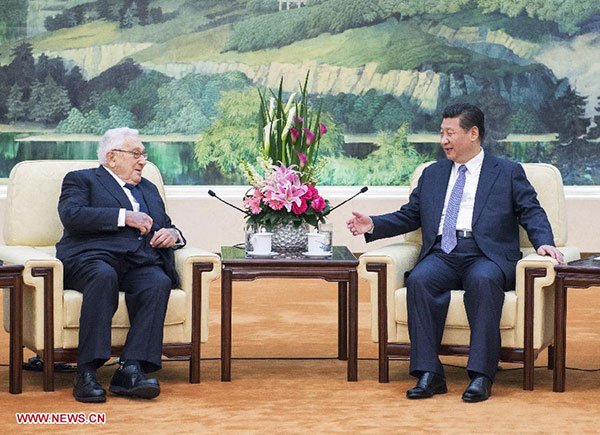
Xi meets with Kissinger, calls for more trust between China, U.S.


President Xi Jinping on Tuesday called for more strategic trust andreciprocal cooperation between China and the United States.

Xi made the remarks as he met with former U.SSecretary of State Henry Kissinger at theGreat Hall of the People in downtown BeijingXi praised the veteran diplomat as an "ice-breakerfor China-.Sdiplomacy in the 1970s and for his continuous contributions to therelationship over the past decades.
Recalling his talks with U.SPresident Barack Obama in Beijing in November and in atelephone conversation last monthXi said the two presidents have charted the course forthe bilateral relationship and China-U.Sties are witnessing visible progress.
Xi highlighted the importance of building a new type of China-U.Srelationship as well aspeacestability and prosperity in the Asia-Pacific region and the world.
"China attaches great importance to ties with the United States and is ready to make jointefforts with the U.Sside to take care of the relationship," said the Chinese leaderaddingthat he looks forward to a state visit to the United States later this year.
Xi said China will stick to the path of peaceful development.
"We need a peaceful environment for development and China is a positive andconstructive force in international affairs," said the Chinese president.
To advance the China-U.Srelationshipthe two sides should learn from historybear inmind the overall situation and enhance mutual understanding to build strategic trust ineach otheraccording to the president.
He said the two countries should respect each other and seek common ground whilesetting aside differences to manage disputes and sensitive problems.
During the meetingXi also briefed the guest on China's annual sessions of the legislativeand political advisory bodieswhich have convened over the past two weeks.
For his partKissinger hailed the ongoing historic reform in China and said that the U.S.-China relationship is an important one involving global peaceprogress and development.
It is a far-sighted decision in the interests of both sides to build a new type of relationshipbetween the two major countriesKissinger saidwishing President Xi a successful visit tothe United States.

Maduro Sends Letter to Putin: 'Venezuela is Your Home'


Venezuelan President Nicolas Maduro expressed confidence that Caracas and Moscow can achieve more than they have over the past 61 years of diplomatic relations.

Caracas is ready to cooperate closely with Moscow within the framework of the UN Security Council, and hopes that the Russian head of state will pay Venezuela a visit, the country's President Nicolas Maduro said in a letter to his Russian counterpart Vladimir Putin.
Venezuela became a new non-permanent member of the UN Security Council in October 2014 and will serve to the end of 2016.
"Again I confirm our willingness to work in close coordination with your Government within the framework of the Security Council and other UN organizations to contribute to international justice and world peace, while defending the dignity of our people," Maduro said.
The Venezuelan leader expressed confidence that Caracas and Moscow can achieve more than they have over the past 61 years of diplomatic relations.
"I hope we can meet here [in Caracas] soon. You should know that this is your home," Maduro wrote to Putin.
Venezuela has supported Russia's stance on many issues in international politics, including the crisis in Ukraine and in the Middle East.


Read more: http://sputniknews.com/politics/20150317/1019610177.html#ixzz3UhEXGITU

Video - U.S. - Rep. Aaron Schock resigns in growing scrutiny over corruption, ethics violations

Video - Israel election: No clear winner, exit polls suggest

Video - NYC St Patrick's Day Parade Draws Thousands

Video - President Obama Hosts a St. Patrick’s Day Reception

Video - President Obama Meets with the Prime Minister of Ireland

Pakistan - Justice for APS: Shuhada Ghazi Forum gives 24-hour deadline to government


Three months after the tragic Army Public School massacre, relatives of students and staff killed, students and social activists still await answers about the brutal act. At a protest against the federal government and security forces on Monday, the protesters gave the government a 24-hour deadline to bring the perpetrators of the terrorist attack to justice. 
The protest rally started at Peshawar Press Club, passed through Saddar Road and culminated at Stadium Chowk. The protesters were holding placards and banners carrying pictures of the slain schoolchildren and demanded Nishan-e-Haider awards for them.
Another protest call was made for outside the CM House on March 19.
Before the rally started, Shuhada Ghazi Forum General Secretary Ajun Khan said, “Three months have passed but we still don’t have any clue of the killers’ identities and their accomplices.” Khan said the Peshawar corps commander is responsible for the security lapse which led to the deaths of hundreds of students.
The forum members gave a 24-hour ultimatum to Prime Minister Nawaz Sharif to expose all “internal and external elements” involved in the heinous crime or the forum will protest outside the CM House and the Supreme Court in Islamabad.
“In our country, justice cannot be secured without protests,” said Khan, “We will contact the United Nations for justice if our own government cannot provide justice to the victims’ families even after protests.”  The families of deceased children refused to accept the highest civilian award, the Tamgah-e-Shujaat, and demanded the highest military award, Nishan-e-Haider instead.
According to the families they would accept no other award and if the government needs to amend the Constitution to award the children and teachers Nishan-e-Haider, it should do so.  On December 16, last year, armed militants laid siege to the army-run school for several hours and killed 151 people, most of them schoolchildren.

Gunmen kill two women polio workers, policeman in Pakistan


Gunmen on Tuesday killed two female polio workers and a police guard in northwest Pakistan, the latest in a spate of deadly attacks on the immunisation teams.
Police said two attackers fired at the workers as they gave polio drops to children in the mountainous Sheikhabad area, 60 kilometres (37 miles) northeast of the city of Mansehra.
"The two-member team was administering polio drops in an Afghan refugee camp and its surrounding areas when two gunmen opened fire on them, killing one lady worker and a policeman and wounding another lady worker and a passer-by," local police chief Muhammad Ejaz Khan told AFP.
He said the second woman polio worker later died of her wounds.
Another senior local police official, Akhtar Hayat, confirmed the incident and casualties.
Pakistan is one of only three countries where polio remains endemic. Attempts to eradicate it have been badly hit by militant attacks on immunisation teams that have claimed 77 lives since December 2012.
The militants claim the polio vaccination drive is a front for espionage or a conspiracy to sterilise Muslims.
Last year the number of polio cases recorded in Pakistan soared to 306, the highest in 14 years.

Pakistan - #LahoreBlast - Tipping Point

The protests and riots that spread across the cities of northern Punjab were ostensibly sparked off by the twin church bombings in Lahore by the Taliban; they may be the immediate trigger, but the spontaneous – and uncharacteristic - outrage displayed by the Christian community betrays a deeper issue: the fact that the Christian minority in Pakistan has been increasingly alienated by successive governments.
The anger was not directed at the Taliban but towards a government that had failed to protect them. The protests represent decades’ worth of persecution that the minority has to face. The Christian community has invariably been bearing the brunt of the blasphemy law; mostly on trumped up charges. Horrific acts such as the lynching of a couple in Kot Radha Krishan and the razing of a hundred houses at the hands of a mob in Joseph Colony are a regular feature. Despite these incidents, only when the government’s apathy had reached breaking point did the community react. Almost inevitably, the investigations into such incidents are quietly forgotten and the police are let off with a slap on the wrist. When they try to raise a voice against such oppression, their champions are murdered and the state lets the killers walk free.
The mob that lynched a common glasscutter, thinking him a militant, and the subsequent one that rampaged through parts of several cities are in the wrong, surely. Their behaviour cannot be justified, but we have to realize that it is the government’s actions that lead the desperate and frustrated crowd to take up arms. This is a first; the way the minority community has taken to the streets, signalling greater danger of social collapse. Just like Sunni ISIS’ atrocities produced a mirror Shia militia, the government needs to address the concerns of the minority before they decide to take matters in their own hands.

Pakistan Church Attack - Cry, my country


The bombing of two churches on Ferozepur Road, Lahore on Sunday, March 16, in which 15 people died there and then and one injured died the next day in hospital, triggered riots in the area when the youth of the victimised Christian community came out in protest on the road, breaking the Metro bus fence and trashing the ticket office. They also halted all traffic, stoning and smashing any vehicle that tried to run the gauntlet. Given the anger of the protestors, the tragedy of two innocent passersby lynched and their bodies burnt has seared the conscience of all citizens. It was obvious on the first day, and most of the morning of the next day, when the protest refused to die down, that the Punjab government thought the best course was to let the anger spend itself, even if it meant the rioters destroyed private property and endangered citizens who happened to be caught up in the melee. Arguably, the police failed to rescue the two lynching victims and followed a strategy of masterly inactivity. On Monday, attempts by former Punjab law minister Sanaullah and Home Minister Khanzada to mollify the rage of the protestors failed. The failure extended to the Church authorities as well as Christian leaders. The protestors were in no mood to accept the usual homilies trotted out on such occasions. On Monday too, another tragedy was enacted when a woman driver, in a desperate attempt to escape the crowd, mowed down two youth and was herself subsequently injured by the rock-throwing crowd. Such was the blind rage of the protestors that their ‘unguided missiles’ did not even spare other residents of Youhanabad, the Christian colony where the two bombed churches were located. As a result, the Christian community (and other residents of the area) divided into two groups at daggers drawn with each other. It was only in the late afternoon of Monday that the Punjab authorities finally came to the conclusion that the protest was not about to go away of its own accord and decided to take action. First, police reinforcements were called up and tear gassing of the protestors began. When even this did not serve the purpose of dispersing the crowds, three companies of Rangers were also summoned. By late afternoon, early evening on Monday, the crowds thinned out and a modicum of calm was restored to what had taken on the appearance of a battlefield. At the time of writing these lines, it cannot be assumed with sanguinity that today will be entirely peaceful. We must wait and see.

The Christian community feels persecuted. Their people have been time and again burnt out of their homes, killed and lynched, usually under cover of a (false) blasphemy charge brought by (usually) vested interests of one sort or another. These were precisely the circumstances that persuaded the late governor Punjab Salmaan Taseer to take up the case of Aasia bibi, an effort that cost him his life at the hands of a fanatic. Federal Minister Shahbaz Bhatti became the next victim of these terrorist forces for opposing the controversial and much abused blasphemy law. After every incident of persecution and worse, the victims, whether Christian or others, receive from the authorities soothing noises about taking steps to prevent such incidents in future, monetary compensation to the families of the dead or injured, and that is the end of that as far as the authorities are concerned. How many such cases have been investigated subsequently to the stage of justice and closure? Neither such hollow assurances nor money can now assuage the anger of the victimised, nor can they any longer serve as balm on wounds; if anything, the track record of continuing persecution and hapless inaction of the authorities are seen as sprinkling salt on those wounds.

It may be of interest to point out that the Jamaatul Ahrar (JuA), a splinter group of the Tehreek-e-Taliban Pakistan (TTP), has claimed responsibility for the atrocity in Lahore. The JuA has recently rejoined the TTP, and ‘celebrated’ this decision by killing Christians at prayer. It may not be stretching the point to conjecture whether the TTP and its affiliates have now graduated to targeting prayer meetings. They were already targeting Friday prayers, particularly in Shia mosques. Now if they have included in their target list churches, we should tighten our belts for more Bloody Sundays and Fridays. 

Pakistan - Living in a contradictory world


By MASOOD KHAN

For many Islamabad High Court’s (IHC) verdict on Punjab Governor Salmaan Taseer’s murderer Mumtaz Qadri’s appeal against his conviction may not be very surprising. In fact many have already predicted what’s being cooked between the court and government counsels. Obviously IHC was not in a position to give a green-chit to a self-confessed murderer. But there was something in the air that a way forward would be found to save him from gallows. Though IHC has upheld Qadri’s conviction under penal code-302, it has removed the Anti-Terrorism Act (ACT) clauses, making the governor’s murder in broad daylight by his own guard not an act of terrorism, just a conflict between two feuding persons. This has now opened the doors for retrial, dragging the case for decades, pressurising the governor’s family to accept blood money, and finally for the murderer to walk free.

The court built the case to remove ATC clauses on prosecution’s evidence and investigation officer’s report which have failed to prove that the governor’s murder was an act of terrorism. Soon after the governor’ death, the then government had to struggle to even find an imam to lead the funeral prayer for martyred Salmaan Taseer and his party leadership couldn’t attend the funeral due to security concerns. Minorities’ Affairs Minister was murdered in Islamabad for voicing on blasphemy laws. Religious extremists threatened Sherry Rehman with dire consequences for calling reforms in blasphemy laws; she was forced by her own party to withdraw a bill in the Parliament on the said law reforms. The judge who convicted Qadri in 2011 was forced to leave Pakistan for safety of his family. Rashid Rehman, a human rights activist and lawyer, was shot dead for taking up the case of a professor accused of blasphemy. Several blasphemy-accused inmates were attacked and killed on the behest of Qadri who was staying in the same Adiyala jail. Civil society members, gathered in remembrance of Taseer, were attacked and thrashed by religious extremists. Worst of all, the present government had to struggle to find a lawyer to be present during Qadri’s appeal in IHC.

I wonder how come IHC has failed to find an act of terror in the killing of a governor of most powerful province of Pakistan at a public place in presence of dozens of guards. Didn’t Qadri’s act create any sense of fear and insecurity among the public (to be on par with literal definition of terrorism)? Even after the murder, Qadri didn’t feel any remorse and declared in the court — “I have taught a lesson to all the apostates as finally they have to meet the same fate”.

If Qadri is absolved of terrorism then we should question the ongoing operation against religious/secretion extremists. They are also doing the same what Qadri did — killing people because of different beliefs/faiths. We shall support the government to appeal against abolition of ATC clauses, and provide fool proof security to lawyers to take up the appeal in Supreme Court.

In my opinion blasphemy laws, enacted by a colonial power in British India, later drastically amended by a military dictator, Ziaul Haq should be debated with open mind to find what message these convictions are delivering. As Prophet Mohammed (PBUH) is ‘Rahmat-al-Aalimeen’ — blessing and kindness for the whole universe, why are we killing people in his name? Are we not committing blasphemy by killing in the name of a prophet who was an example of whole-hearted kindness?

Pakistan - Punjab Govt responsible for loss of lives and property in Lahore

ppppunjab.wordpress.com


The law must take its own course indiscriminately against those who are responsible for loss of scores of precious lives and damaged the public property, said Mian Manzoor Ahmed Wattoo, President PPP Central Punjab is a statement issued from here today.

  He called upon the government to ensure the safety and security of the Christian community and their places of worship which is its constitutional obligation. The government failed in this regard, he added.

He pointed out that loss of lives and property during the last two days in Lahore and elsewhere reflected poorly on the Punjab government adding it was totally clueless and looked  devoid of the capability of taking timely decision to manage the volatile situation to the advantage of citizenry.

He recalled that the government used excessive force without provocation in the Model Town incident killing fourteen innocent people but during the last two days it behaved like a spectator rather than government whose basic responsibility was saving the life and property of the people. It miserably failed on both occasions to the dismay of the people, he added.

 He said that the Christian community appreciated fully well that terrorists were not only their enemy but the enemy of all Pakistani regardless of their creed, faith and ethnicity because they had been killing them indiscriminately. They have killed more than forty thousands people of all ages, overwhelming majority of them are Muslims, he added. We as a nation have to defeat the menace, he added.

Mian Manzoor Ahmed Wattoo said that the PPP wanted the implementation of National Action Plan (NAP) in letter and spirit on pro-active basis as formulated by the entire political leadership of the country. The evil must be eliminated thoroughly by defeating it on its turf, he argued.

Lawyer for Pakistan doctor who helped CIA find bin Laden shot dead


A Pakistani lawyer under death threats for defending a doctor who helped CIA agents hunt al Qaeda leader Osama bin Laden was shot dead on Tuesday, police said, and two militant groups claimed responsibility.
Samiullah Afridi represented Dr Shakil Afridi, who was jailed in 2012 for 33 years for running a fake vaccination campaign believed to have helped the U.S. intelligence agency track down bin Laden. That sentence was overturned in 2013 and the doctor is now in jail awaiting a new trial.
Samiullah Afridi was shot dead on Tuesday as he was returning to his home in the northwestern city of Peshawar, police said. According to media, he had recently returned there from abroad after leaving Pakistan for his safety.
"He was returning home when armed men opened fire. He died on the spot," police official Jamal Hussain said. A hospital spokesman added that Samiullah Afridi was shot twice, in the abdomen and the neck.
Two Pakistan militant groups claimed responsibility for the laywer's death. Jundullah, a Taliban splinter group, said: "We killed him because he was defending Shakil, who is our enemy."
A Taliban faction, Tehrik-e-Taliban Pakistan Jamaatul Ahrar (TTP-JA), later said it had shot him. "Dr Shakil Afridi had spied on our respected and supreme leader Sheikh Osama to the CIA," TTP-JA spokesman Ehsanullah Ehsan said.
"Samiullah Afridi had represented his case," Ehsan said, "that's why we decided to eliminate him when we can't approach Dr Shakil."
U.S. officials have hailed Shakil Afridi as a hero for helping pinpoint bin Laden's location before a 2011 raid by U.S. special forces in Abbottabad, Pakistan, that killed the al Qaeda leader after more than a decade of searching for him.
Samiullah Afridi stopped representing the doctor last year, saying he had become a target. "I have been receiving threats from various organizations, and because of those threats I even went to Dubai some time back," he told Reuters TV.
"Some organizations do not want us to continue defending this case ... Not only is my life in danger, my family is also in danger. I have therefore decided to quit this case."
Shakil Afridi's original sentence damaged ties between Pakistan and the United States that were already strained over the bin Laden raid. Angry U.S. senators withheld $33 million in aid from Pakistan in retaliation.

Pakistan hangs 12 convicts in jails across the country


Pakistan has hanged 12 convicts, the largest number of people executed on the same day since the country overturned a ban on executions.
The men were terrorists, murderers or guilty of "heinous crimes", an interior ministry spokesman said.
At least 27 convicts have been executed since the moratorium was lifted, most of them militants, Reuters reported.
It is estimated there are more than 8,000 Pakistanis on death row. Rights groups say many convictions are unsafe.
A moratorium on hangings was lifted for terror-related crimes after a Taliban attack in December killed more than 150 people, mostly children, at a school in Peshawar.
But last week it became clear that officials had widened the capital punishment policy to include all prisoners on death row whose appeals had been rejected.
The subsequent executions have taken place despite calls by the UN not to resume them.
Human rights groups say that prisoners often do not receive a fair trial within Pakistan's outdated criminal justice system and that poorly-trained police often use torture to force confessions.
Pakistan's Dawn newspaper reported that the latest executions took place in Multan, Karachi, Faisalabad, Rawalpindi, Gujranwala and Jhang.
It reported that the hanging of one man in Multan was delayed at the last minute following an agreement between the defendant and the family of the murder victim.
On Thursday, the government is due to execute Shafqat Hussain, a prisoner who lawyers say was aged only 14 when he was convicted 10 years ago of the kidnap and manslaughter of a child.
They say that his confession was extracted after nine days of torture.

Pakistan - Karak residents protest outside Imran Khan's Bani Gala house

The residents of Karak district on Tuesday have started a demonstration of protest outside Pakistan Tehreek-e-Insaf (PTI) chairman Imran Khan’s house.
The protesters said that the Karak residents do not get water, electricity or gas. The protesters have set up a stage on a mini-container and also danced on different songs as a reminiscer of the PTI’s sit-in at the D-Chowk.

Dunya News - Karak residents protest outside... by dunyanews According to the details, the Karak residents have started a demonstration of protest outside Imran Khan’s house in Bani Gala. They said that they would not return unless Khan ensures them provision of basic necessities. They have demanded construction of Khushal Khan Khattak University on rapid pace in the district.
According to the Khattak Union Ittehad, a demonstration of protest is ongoing in Karak for as many as 24 days due to lack of water, electricity and gas. Upon no response from the government, the protesters have shifted the protest to Bani Gala, outside PTI chairman’s residence.
They said that are not willing to return unless Khan ensures them provision of basic necessities.

Music - Lafani Poetry Rabindranath Tagore - Sardar Ali Takkar

Monday, March 16, 2015

Music Video - She Knows ft. Juicy J

The wives of Turkey's missing and a gender view of human rights


Wives of the disappeared have been at the forefront of the struggle for answers; their stories, human rights researchers say, have been neglected too long.
Kiraz Sahin was 20 years old when her husband Ismail Sahin was "disappeared" from the streets of Istanbul. It was January 1996; their daughter was then four years old, their son, one-and-a-half. Hundreds had already disappeared in Turkey - most are presumed to have been the victims of political murders, killed by Turkish security forces.
For 19 years, Kiraz Sahin struggled to find her husband, an experience she shared with hundreds of other wives. She never remarried, nor took formal work. With the support of family and friends she raised her children, cared for members of her husband's family, and became a grandmother, said Human Rights Association (IHD) members in Istanbul who knew her. She joined Saturday Mothers - now often referred to as the Saturday People - a group made up mostly of loved ones of other "disappeared" people. The group still gathers every Saturday at noon on central Istanbul's Galatasaray Square to commemorate and protest. In the past, the meetings were little tolerated, and even outlawed. Kiraz Sahin, like many Saturday gatherers, was repeatedly tear-gassed, beaten by police and arrested, IHD members said.
In January this year, on the 19th anniversary of Ismail Sahin's disappearance, Kiraz Sahin was unable to attend the Saturday Mothers' meeting. The best she could manage was to send along a recorded message to be played for those gathered on the square over the group's loudspeaker.
"As soon as I get up and out of this hospital bed," they heard her say, "I'll be there with you with my grandkids."
On Friday, 27 February, 2015, Kiraz Sahin died from stomach cancer.
"Kiraz Sahin was made to fit a 19-year search into 40 years of life," Maside Ocak, sister of another disappeared man, Hasan Ocak, told the next day's Saturday Mothers crowd. "Kiraz's life was still not long enough to learn the fate of her husband."
Up to 1500 people are thought to have been "disappeared" in Turkey since the 1980 coup d'etat, according to the Truth Justice Memory Centre in Istanbul. Hundreds more were victims of extrajudicial killings or died while in state custody. Such incidents peaked in the 1990s during a period of heavy fighting between the Turkish state and the Kurdistan Workers' Party (PKK), the 30-year conflict that has claimed 40,000 lives since 1984. While Kiraz Sahin's husband was a Turkmen Alevi and was disappeared from Istanbul, most of the disappeared were Kurds who went missing from Turkey's predominantly Kurdish southeast. Ninety-seven percent of the victims were male.
Ismail Sahin worked for the Istanbul municipality as a street cleaner. He disappeared while working along the very streets in central Istanbul where the Saturday Mothers gather today. The government shows little interest in investigating. Sahin's fate, like 67 percent of the forcibly disappeared, according to the Truth Justice Memory Centre, remains unknown. Ismail Sahin was a member of the Genel-Is trade union. His wife, Kiraz, had few politics to speak of.
"She was an apolitical person from an apolitical family," Zeynep Yildiz of the IHD told Middle East Eye. "She became politicised after her husband's disappearance."

Ripped from the sidelines of disaster

The wives, like Kiraz Sahin, have been at the forefront of the search and struggle for answers; their stories, human rights researchers in Turkey say, have been neglected for too long.
"I read every report on enforced disappearances in Turkey and I could find no references to gender," Ozgur Sevgi Goral, project director at the centre, told MEE during an interview at the organisation's offices.
"This was very striking because a disappearance is a very gendered process," she said. "The males are disappeared, firstly... . And secondly, the females are the ones looking for the [disappeared] males."
During field research Truth Justice Memory Centre staff noticed a trend. "Wives were always saying, 'It's not worth talking about me. Let's talk about him. Let's talk about what happened that day.' This was really heartbreaking for us," Goral said.
"It is hugely important what happened to the [women] for two reasons. First, you don't have a holistic story if you don't know what happened afterwards. An enforced disappearance is not a moment of catastrophe," she said. The before and after, characterised by the conflict and human rights violations that pervaded Turkey at the time, reveal the broader significance of the trauma, she said.
"You don't understand the outrageous aspect of the enforced disappearance if you don't know what happened after. Because what happened after is a tragedy. How did they raise their children?…How did they survive economically?…Were they forced to remarry?"

The necessity of the gender lens

In 2013, the United Nations Working Group on Enforced and Involuntary Disappearances wrote "...the effects of enforced disappearances are lived and faced in different ways by women and girls due to gender roles, which are deeply embedded in history, tradition, religion and culture."
The observation has been borne out in Turkey in several particular ways. Patriarchal and traditional gender roles and family structures often produce an ambiguous identity for wives of the disappeared, Goral said. A 2014 report published by the Truth Justice Memory Centre, describes these women as "neither 'married', nor 'widowed', nor 'divorced'" and details how this complex social burden has interacted with identity, social status and the challenges of day-to-day living. Many wives must assume their husbands' responsibilities in the male-dominated society outside of the home.
Often these women can't speak Turkish; for years speaking Kurdish was forbidden in any official setting or institution.
Not only has this been an obstacle in daily life. "It changes the pattern of the search," Goral said. Non-Turkish speaking women cannot easily apply to local authorities for information about their husbands and often have to pursue less formal investigations. "It's another way women are prevented from having access to justice."
On average, the wives of the disappeared married at 15. Many have faced pressure to remarry, often to a brother-in-law, after a disappearance. Though many have refused, re-marrying can offer economic, social and emotional benefits and can relieve women of traditional connotations. As one woman told researchers, her rationale for re-marrying included "so that people don't call me a harlot."
Wives of a disappeared man can receive certain state benefits, but the husband's status must be defined as either "absent" or dead. Judicial and bureaucratic complications aside, the report's authors describe how many women resist the additional emotional trauma of having to formalise their husband's death.
"There is this pendulum of hope for the wives of the disappeared. Normally, at the end of one week they know he is dead… But still there are processes of waiting. Up to three years they have more hope… Maybe he escaped, they think, maybe he went to South Kurdistan [northern Iraq]."
Hopes are also kept alive by what Goral described as an "industry": people who often appear to be connected to security forces call or contact the family to offer information for money. "And the families, they pay," Goral said. The tip-offs are invariably lies.
Many wives and other family members refuse to rule out the possibility the disappeared will one day return. Goral described one wife who still rejects sympathetic eyewitness accounts of her husband's death (he was strapped tight with hand grenades and blown up), preferring, in her distressed mind, to believe her husband had in fact defected and become a Turkish intelligence agent.

A broader struggle

Women's rights are at the top of the national agenda in Turkey today. Turkish activists, journalists and politicians are working to raise awareness about what is a dismal situation. (See also here.) Their work is complicated. Turkish president Erdogan famously claimed last year that women and men cannot be seen as equals. (See here for more.)
But the struggle of the women who have been affected by enforced disappearances should not be mistaken as a simple subset of this struggle, Goral said. A gendered view of a human rights violation reveals the depth and diversity of the impact of the violation and allows us to have a broader view beyond that of the most obvious victims.
"Seeing the gendered, hierarchical relations within a human rights violation…is not the same thing as militating for women's rights. It's more than that," Goral said.
In having to overcome these hardships, the networks of solidarity and activism that these women have created have, despite the catastrophe at the core of their experience, produced something that may have otherwise proven elusive, Goral said.
"They have been empowered by a tragic event."
- See more at: http://www.middleeasteye.net/in-depth/features/wives-turkeys-missing-and-gender-view-human-rights-1445376631#sthash.7nZ7WYoR.dpuf

Pakistan warns Turkey: Don’t make our mistakes


Fehim Taştekin

The armed uprising in Syria, with the goal of changing the regime, has given birth to organizations that are threatening the entire population of the region, but Turkey is continuing on its way in total disregard for the perils of "Pakistanization."
As Turkey was discussing the training and equipping of Syrian opposition militants in Turkey, Pakistan recalled its own painful experiences.
In Islamabad, Al-Monitor asked Mushahid Hussein, the chairman of the Pakistani Senate's Defense Committee, about his country’s role in Afghanistan and in creating the Taliban and how he sees Turkey’s involvement in Syria.
Mushahid Hussein, well known for his academic work on international relations and his rich journalism experience, said he had reminded Prime Minister Ahmet Davutoglu while he was visiting Islamabad about “Pakistanization syndrome.” Hussein added, "I warned Davutoglu when he was here, ‘You are repeating in Syria the mistakes we made in Afghanistan. Organizations you support now will turn against you.’ Pakistan was wrong in becoming party to the war in Afghanistan and was wrong in supporting the Taliban. We are now paying the costs of these mistakes."
No one took Pakistan’s warning seriously. Turkey's persisting with the train-and-equip program that will produce nothing but permanent armed groups shows that Turkey still does not intend to learn from the lessons of Pakistan.
Turkish and American officials are involved in intensive final preparations for the training to be given at Kaman, Kirsehir. On March 11, US CENTCOM Commander Gen. Lloyd Austin visited the training base, followed by visits to Ankara by retired Gen. John Allen, the special envoy of US President Barack Obama to the global coalition against the Islamic State (IS), and Brett McGurk, deputy undersecretary of the US State Department. Their meetings in Ankara focused on the train-and-equip program and Turkey’s contribution to the anti-IS operations. Reports say the program that will last three years will train 1,500-2,000 fighters.
Reading between the lines of the raging debate, it's easy to get the sense is that the idea behind the anti-IS program is to prevent the Damascus regime from taking over territory to be abandoned by IS. But it must also be considered how the region is to survive with so many armed organizations roaming around. Recalling the experience of Pakistan in such misguided adventures may provide Turkey with a guiding light.
You don’t have to walk the sensationally rough terrain of Khyber Pakhtunkhwa or North Waziristan on the Afghanistan border. A visit to an Islamabad bookshop, where hundreds of books on Pakistan’s impasse are available, may be enough.
There are parallels between the process that drew Pakistan to Afghanistan and the motives that dragged Turkey into the Syrian quagmire: expanding spheres of influence and ambitions to become a regional power. There is not much difference between the ambitions of President Mohammed Zia ul-Haq, who dreamed of expanding Pakistan’s sphere of influence first to Afghanistan and then to Asia, and Turkey’s President Recep Tayyip Erdogan, who wanted to pray in Damascus' Emeviye Mosque and become caliph there.
A short reminder is in order here. In 1979, Pakistan, which, together with the CIA, organized the resistance against the invading Russian army, opened its borders to millions of Afghan refugees. Those refugees provided a ready pool of manpower for the anti-Soviet struggle. Fighters, particularly Pashtuns, were also recruited from religious seminaries in Pakistan.
The CIA and Pakistani intelligence services trained about 80,000 fighters in a $2 billion-$3 billion train-and-equip program. In 1989, after the Soviets withdrew from Afghanistan, it was time to restore order to the country. When Pakistan’s trusted man in Afghanistan, Gulbuddin Hekmatyar, the leader of Hezb-i-Islami, could not consolidate his rule in Kabul, the Taliban was created. Students who were studying at Deobendi fought for two years at Pakistan’s guidance to eliminate other groups and capture Kabul in 1996. According to confidential documents of the US State Department, the Pakistani intelligence services continued with their support of ammunition, fuel and food to the Taliban after the group took over Kabul in 1996. After the 9/11 attacks against the United States, Pakistan had to readjust its relations with the Taliban, which then turned its guns on Pakistan. Taliban leaders who were toppled by the US intervention in 2001 settled down in north Pakistan’s Waziristan region, leading to the emergence of local Taliban groups. About 30 organizations that settled along the "Jihadist Highway" in 2007 came together to establish the Tehrik-i-Taliban Pakistan (TTP) under Baitullah Mehsud and quickly became Pakistan's biggest threat. Pakistanis, with their distinction between "good" and "bad" terrorists, began fighting TTP while continuing to work with the Taliban in Afghanistan.
Afghanistan’s ambassador in Islamabad, Canan Musazay, told Al-Monitor at the Think Tanks Forum of the Islamic Countries, organized by the Turkish Asian Center for Strategic Studies, that Pakistan was still making the "good terrorist-bad terrorist" distinction, and that whether Turkey was still supporting extremism-inclined groups is also a topic of debate.
What kinds of risks are awaiting Turkey while it supports a military uprising and armed groups in its neighbor? Tahir Ahmad, a researcher with The Centre for Pakistan and Gulf Studies, made a comparison between Pakistan and Turkey, telling Al-Monitor, "There are stark similarities between these two cases. The groups trained are religious bigots, which would backfire as they want their own brand of Sharia-based governance and they reject democracy and any alliance with the Western countries or secular trends. The country is geographically contiguous. Proxy warfare can be fought only by ethnic or independence movements, not in this kind of religious warfare. Second, it will create indigenous support for such kinds of extremist groups, which can demand indigenous reforms and would create a security issue. Third, the humanitarian issue, in terms of refugees and sectarian conflicts that emerge from these conflicts, are more dangerous than the external threat. In Turkey, it can also be intra-religious clashes. Instead of going into a war, Turkey should play a diplomatic role. It is the best time for diplomacy and leadership, not proxy warfare."
In Turkey, our Islamic mindset is open to treating the war in our neighbor as jihad. We are now seeing the beginnings of a tragic Deobendi-esque transition from Sufism to radicalism, and so are not surprised to hear of hundreds of Turkish citizens joining IS and Jabhat al-Nusra.
While Pakistan could not control its border regions and saw them become a jihad highway, now Turkey cannot control its porous border, where opposition forces cross it freely.
All these symptoms point to Turkey’s subscription to a scenario of Pakistanization, making the warnings of Hussein, who wants nothing but friendship with Turkey, are extremely important.

Read more: http://www.al-monitor.com/pulse/originals/2015/03/turkey-pakistan-friendly-warning-mistakes.html#ixzz3UbYwvMGw




Tony Blair 'had no credibility' in Middle East process, says US official

By Peter Foster
All sides in Middle East peace process would roll their eyes at mention of Tony Blair's name, US government official involved in talks tells Telegraph
Tony Blair had “no credibility” left with the parties in the Middle East peace process, a former US government official who was closely involved with trying to revive the talks last year has told The Telegraph.
“Frankly all sides just rolled their eyes at the mention of his name,” the official said as it was reported that Mr Blair was being “eased out” of his role as head of so-called Quartet.
Rumours that Mr Blair was being asked to step down have been circulating for some days, but were apparently confirmed on Sunday night by The Financial Times. Mr Blair’s office has declined to comment. In his role, which he took up in 2007, Mr Blair represented the United States of America, the United Nations, Russia and the European Union as a Middle East peace envoy working with the Palestinians.
But in the last round of failed negotiations which began after John Kerry took over as US secretary of state in 2013 and broke down last year, Mr Blair had become “a standing joke”, the official said, speaking last week.
Officially the Obama administration has been supportive of Mr Blair, with officials describing him on Sunday as a “valued partner in trying to bring peace to the Middle East” but in private the former official was scathing. “He showed up, but was not effective,” the senior former official added. “Honestly, when the Kerry negotiations were going on, it was like he’d wait until Kerry was going to be in the region and show up at the same time and then do press releases. It was sort of unseemly. “In the end the Israelis didn’t mind him, because he was heavily tilted towards them, but the Palestinians couldn’t stand him and most of the rest of the peace-making community and other groups included, just rolled their eyes.
“Of course people met with him – he’s the former British prime minister and head of the Quartet – but beyond the media, there’s was really nothing much doing.”
Another diplomat, speaking to the FT, said Mr Blair's departure as Quartet envoy was “long overdue”.
“He has been ineffective in this job. He has no credibility in this part of the world," the source said.
Mr Blair has been under fire for some time, with three former British ambassadors last year backing a campaign for him to be sacked and accusing him of trying to “absolve himself” of responsibility for the crisis in Iraq.