Thursday, February 5, 2015

Don't Expect Bread Lines From Russia's Crisis

Despite dire economic forecasts, Russia will escape high unemployment and social unrest this year thanks to an exodus of migrant workers, clever politics and a flexible shadow economy, analysts said.
Officials are braced for layoffs. Russia must "prepare for the fact that people will become unemployed," Deputy Prime Minister Igor Shuvalov said last month. Extra cash has been allocated for unemployment benefits, and Moscow's economic crisis plan will inject over 52 billion rubles ($790 million) into job creation.
But January was full of announcements of mass firings. As the state began trimming spending by 10 percent almost across the board, media companies, state firms, industrial producers and banks said they would shed thousands of jobs.
Yet analysts said the unemployment rate, now at 5.3 percent, would not spiral. Russia's workforce is shrinking, and the state knows mass layoffs in the public sector could cause political trouble.
Russia will use its "traditional" crisis management technique by cutting salaries over firing staff, said Vladimir Gimpelson, director of the Center for Labour Market Studies at Moscow's Higher School of Economics.
According to official estimates, real incomes will fall this year by 9 percent.

All Will Suffer 

"Nobody is immune in this crisis," and all sectors will suffer job losses, said Chris Weafer, senior partner at Russia-focused business consultancy Macro-Advisory.
Western sanctions on Russia over Moscow's actions in Ukraine and a plunge in the price of oil, Russia's main export, have slashed Russia's income and are propelling the economy toward a contraction of up to 5 percent this year.
Construction and consumer services like retail and restaurants will see big job losses, analysts said, but metallurgy, car production, advertising and the financial sector all face cutbacks.
The ax may fall hardest on bloated state-owned companies caught up in the government's belt-tightening, according to Weafer.
According to online employment service Superjob, the number of jobseekers in January leapt 9 percent, while advertised vacancies fell 8 percent.

But Migrants Suffer First 

Central Asian migrant workers will be the economy's first shock absorber, according to Weafer. A near-halving of the value of the ruble to the U.S. dollar over the last year has slashed the buying power of the remittences they send home to support their families, while rising inflation in Russia increases the cost of living.
The number of incoming workers has already fallen sharply, according to Russia's Federal Migration Service. Over 500,000 Uzbeks and Tajiks left Russia in the second half of last year, news agency RBC reported on Wednesday citing migration service data.
Russian employers are also likely to fire migrants first, creating openings for any Russians willing to take their typically low-paid jobs.
Without this factor, Weafer said, unemployment could rise to 9 percent this year. With it, he predicted an increase to between 6.5 and 7 percent.
The Economic Development Ministry predicts 6 percent unemployment this year.

Shocking Bureaucrats 

Another unlucky group are middle-class bureaucrats, whose likely job losses in 2015 will be a "shock to the system," according to Weafer. These — some 20 percent of the workforce — are the backbone of President Vladimir Putin's political order. The ax has not fallen on them since the 1990s, when Russia endured economic turmoil under former President Boris Yeltsin.
In the global economic crisis of 2008-09 oil prices fell to $40 per barrel, wiping 8 percent off Russian economic output and doubling unemployment. The fall was sharp, but the recovery was swift.
This time is different. The economy began slowing in 2013, and the key problems are structural. That means unemployment will rise more slowly, but will be harder to beat back, according to Andrei Pavlyuchenko, senior analyst at jobs website rabota.ru.
Employers weathered the 2009 crisis because they knew the end was in sight, analysts said. This time no one expects a quick recovery and even the state will have to trim some fat.
Pavlyuchenko forecast unemployment by the end of the year at 8.5 to 9 percent.

Shrinking Workforce 

Russia's demographics mean its workforce is shrinking. According to Weafer, it will decline by up to 10 percent over the next 8 years, exerting powerful downward pressure on unemployment.
Also depressing unemployment are miserly benefits, which the government uses to discourage out-of-work Russians from kicking back and avoiding hunting for a job. The maximum payout is around 5,000 rubles ($75) a month, Gimpelson said, and the average payout is 2,700 rubles, or 8 percent of the average Russian salary.
Most Russians don't even bother to sign up and, understandably, take the first work they can get.
Even if this means in the shadow economy, where one-fifth of Russia's working-age population already earn a living, Gimpelson said.

Social Unrest? 

Russia's misery index — found by adding together a country's unemployment and inflation rates — was 16.7 percent at the end of last year (5.3 percent unemployment plus 11.4 inflation). With inflation predicted to near 15 percent over the coming months, if unemployment increases Russia's misery index will rival that of Greece, which is on about 24 percent.
But Russia is unlikely to suffer a Greek style political turmoil, analysts said.
The Kremlin knows what it is doing: Siloviki — the name given to employees of law enforcement bodies — won't be fired, said Pavel Kudyukin, a lecturer at the Higher School of Economics.
State employees — of which there are 15 million, according to Gimpelson — will see salary cuts and part-time work rather than full layoffs.
Protests will flare up, but will remain local and small scale.
Pavlyuchenko said, "Social pressure is possible; Political [pressure] is not." Thanks to clever state management of virtually all Russian media outlets, Putin may even get more popular as the economic situation worsens against the backdrop of Western sanctions, he added.
Deputy Prime Minister Shuvalov, a dollar multimillionaire, was equally confident, saying Russians would "withstand all hardships … eat less food, use less electricity."

Hollande, Merkel go to Moscow to discuss Ukraine without consulting US – report


German Chancellor Angela Merkel and French President Francois Hollande did not consult Washington before deciding to visit Moscow to hold talks on the Ukrainian crisis, a source in the French government told AP.
The two leaders, who are part of the so-called ‘Normandy Four’ group along with Moscow and Kiev, decided on a trip on Wednesday night, an unnamed French government official said. Merkel and Hollande are due to arrive to the Russian capital on Friday, the next day after visiting Kiev.
“Together with Angela Merkel we have decided to take a new initiative,” Hollande told a news conference on Thursday.
Russian presidential spokesman Dmitry Peskov said that “the leaders of the three states will discuss what specifically the countries can do to contribute to speedy end of the civil war in the southeast of Ukraine, which has escalated in recent days and resulted in many casualties.”
After the Thursday meeting with the German and French leaders, Ukrainian President Poroshenko said that the talks indicated that a ceasefire was possible in eastern Ukraine.
Meanwhile, a senior French official told local weekly Le Nouvel Observateur on Thursday that the decision to meet tet-a-tet with President Vladimir Putin was taken on Tuesday after the Russian leader called on both sides in the Ukrainian conflict to stop military actions and hostilities.
The French weekly also said that this “historic initiative” on the part of the two European leaders was preceded by “secret” talks between Paris, Berlin and Moscow.
As Hollande and Merkel are set to discuss a peaceful resolution to the conflict, the US Secretary of State John Kerry is in Ukraine to answer Kiev’s plea for weapons. Kerry told reporters that US President Barack Obama will make his decision on the possibility of sending lethal aid to Ukraine next week.
The White House however admitted on Thursday that military assistance from the US could increase bloodshed in the region.
Le Nouvel Observateur journalist Vincent Jauvert believes that Hollande and Merkel’s prompt decision to talk with Putin in Moscow comes as an attempt “to get ahead of the Americans who are trying to impose their solution to the problem on Westerners: a transfer of weapons to Ukraine.”
The journalist elaborates that the two leaders went to Kiev straight after Kerry as they “distrust the American administration” and want to “present their diplomatic solutions just before US Vice President Joe Biden” presents the US plan of sending lethal weapons to Kiev at the Munich security conference on Saturday.

Video Report - Kiev agrees to ceasefire with rebels in E. Ukraine

Video Report - Kerry on Ukraine: "You cannot have a one-sided peace"

Pashto Music Video - Gul Panra - Khabara Tola Da Zargi Da

Pashto Music Video - Gul Panra - Meena Da Har Cha Da

Religious intolerance in India would have shocked Mahatma Gandhi: Obama


US President Barack Obama on Thursday said the "acts of intolerance" experienced by religious faiths of all types in India in the past few years would have shocked Mahatma Gandhi.

The comments by Obama came a day after the White House refuted suggestions that the US President's public speech in New Delhi in which he touched upon religious tolerance was a "parting shot" aimed at the ruling BJP.
"Michelle and I returned from India - an incredible, beautiful country, full of magnificent diversity - but a place where, in past years, religious faiths of all types have, on occasion, been targeted by other peoples of faith, simply due to their heritage and their beliefs - acts of intolerance that would have shocked Gandhiji, the person who helped to liberate that nation," Obama said in his remarks at the high-profile National Prayer Breakfast.
The US President, who has just returned from India, was referring to violence against followers of various religions in India in the past few years.
He, however, did not name any particular religion and said the violence is not unique to one group or one religion.
"Humanity has been grappling with these questions throughout human history. And lest we get on our high horse and think this is unique to some other place, remember that during the Crusades and the Inquisition, people committed terrible deeds in the name of Christ.

"In our home country, slavery and Jim Crow (racial segregation state and local laws) all too often was justified in the name of Christ," he said, addressing the gathering of over 3,000 US and international leaders.

"There is a tendency in us, a sinful tendency that can pervert and distort our faith. In today's world, when hate groups have their own Twitter accounts and bigotry can fester in hidden places in cyberspace, it can be even harder to counteract such intolerance.

"But God compels us to try.

"And in this mission, I believe there are a few principles that can guide us, particularly those of us who profess to believe," he said.

In a US-style Town Hall address in New Delhi on January 27, the last day of his India trip, Obama had made a strong pitch for religious tolerance, cautioning that India will succeed so long as it was not "splintered along the lines of religious faith".

The White House yesterday strongly refuted allegations that Obama's remarks on religious tolerance was aimed at the ruling Bharatiya Janata Party (BJP), saying the speech in its entirety was about the "core democratic values and principles" of both the US and India.

How to Save Afghanistan’s Democracy


BY TABISH FORUGH


Afghanistan’s last election almost tore the country apart. The next one has to be different.
 September 21, 2014, after months of gridlock following a hotly contested election, Afghan presidential candidates Ashraf Ghani and Abdullah Abdullah signed a power-sharing deal to form a National Unity Government. As part of the arrangement, Ghani became Afghanistan’s president while Abdullah assumed the newly created position of chief executive officer, who heads the cabinet.
Crucially, the agreement also requires the establishment of a special electoral reform commission to address allegations of electoral fraud and mismanagement and attempt to rebuild the public’s badly eroded trust in the electoral process. The need for such a plan is obvious, given just how destructive election-related disputes have been. In the last election both candidates claimed to have been victims of fraud, with Abdullah in particular pointing to leaked phone conversations which appeared to show staff of the Independent Election Commission (IEC) colluding with members of Ghani’s campaign to arrange stuffing of ballot boxes.
But since the agreement, Afghan officials have done little to make the reform commission a reality. Nor has the international community pushed them to do so — and time is running out. The next parliamentary and district council elections, currently scheduled for May 2015, will elect a majority of the Loya Jirga (the Grand National Assembly), which is responsible for voting on important constitutional amendments. It is imperative that these elections be seen as legitimate, which will require carrying out decisive structural and legal reforms well ahead of time. Realistically, there no longer much of a chance that this is possible, making it advisable to postpone these elections until the summer of 2016. This would allow the Independent Election Committee (IEC) and the Independent Electoral Complaints Commission (IECC) to remedy their technical and institutional failures and would give the new reform commission and the international community time to make the necessary changes.

There are four key areas in need of reform. Above all else, the problem of credibility needs to be addressed. Because the election commissions have become increasingly discredited and unable to fulfill their mandates, their current leadership should step down. Ghani and Abdullah, counterbalancing one another’s political motives, must call for a selection committee to appoint new independent and impartial leaders for these crucial electoral bodies. Furthermore, for the sake of pluralism, the government must invite electoral experts, civil society activists, and lawyers to participate as election commission officers.
Aside from replacing particular directors, improving credibility will also require redesigning the structure of how the IEC is governed. Among other shortcomings, the current arrangement leads to managerial conflict between two key positions: the chairman and the chief electoral officer (CEO), both appointed by the president. In the law, these positions are ranked equally and have no clearly defined roles. In practice, the chairman has little involvement in supervising electoral operations and by and large shows deference to the CEO. Meanwhile, the accusations of ballot stuffing implicating the CEO are evidence that this position is not being effectively monitored. To improve the work of the commissions, redefining their managerial hierarchy and instituting checks and balances must be a priority. The CEO position, for example, should be downgraded from the ministerial level to the highest civil servant position, where he or she would be obligated to report to senior management on daily electoral operations.
Technical improvements to enable the IEC to keep tally of Afghanistan’s voters are the second crucial reform. Although the IEC has conducted full-scale voter registration efforts since 2004, the commission lacks a reliable database to track eligible voters and has difficulty identifying appropriate polling stations. No one knows exactly how many eligible voters there are or where the district boundaries are located. As a result, election operations in Afghanistan are largely based on imprecise estimates.
To address this, the key step would be to establish a verified voter registration list. This will not only bolster the transparency and credibility of future elections, but also enable the IEC to carry them out over several days instead of just one. An updated voters list would allow the IEC to conduct elections in phases based on geographical zones, reduce logistical pressures, and increase procedural oversight and transparency. Such changes would also help the Afghanistan National Security Forces to protect election sites from the Taliban and other armed groups without overextending their departmental resources and staff.
Because the IEC plans to conduct district council elections for the first time, the third key reform is for the commission to adjust electoral operations for district-based constituencies. Government-related agencies should establish an updated list of district boundaries by mid-2015, which will facilitate fairer and more representative elections on the district level.
Fourth, in the longer term, Afghanistan’s electoral system itself must change. In 2004, despite strong recommendations from international experts to institute a system of proportional representation, which ensures strong and representative political parties, Hamid Karzai approved a Single Non-Transferable Voting (SNTV) system, which favors individual candidates. Encircled by powerful leaders of Islamic political parties, Karzai wanted to weaken these parties by alienating them from their constituents.
For this reason, Afghanistan’s legislative branch — made up of representatives who, in some cases, were elected with less than one percent of the vote — has remained fractured, dysfunctional, and unrepresentative of its constituents. The next parliamentary elections will be the third time SNTV is practiced in Afghanistan despite delivering the same ineffective outcome each time. A shift to a mixed SNTV-proportional representation system would increase political party and minority representation in Afghanistan’s national and local legislatures. For the Afghan government and international partners, this must be a long-term priority in the second phase of electoral reform after 2016.
In light of the 2009 and 2014 electoral crises, the tenuous nature of the current unity government, and the country’s ethnically polarized politics, Afghanistan’s stability depends on better-functioning, more legitimate electoral bodies. The West must urge the current unity government to remain committed to implementing the necessary reforms prior to and after the 2016 Loya Jirga convenes. This is the single most important way to support Afghanistan’s decades-long struggle for democracy.

    Pakistan - 'Nawaz's 16 foreign visits in over a year cost Rs 294 million'


    Prime Minister Nawaz's 16 foreign visits in over a year cost the cash-strapped nation over Rs 294 million with his trip to India last year accounting for Rs 4.3 million.

    Dawn News reported that the total number of foreign visits by Sharif from July 2013 to December 2014 were 20.
    However, Prime Minister's Adviser on National Security and Foreign Affairs Sartaj Aziz in a written reply to a question informed the Senate yesterday that the expenditure statements of Sharif's three visits in September 2014 and one in December are still awaited from the respective missions.
    Between July 2013 and September 2014, Sharif undertook 16 foreign visits that cost the nation over Rs 294 million, he said.
    The 20 visits included three each to the US, China and the UK, two to Turkey and one each to Thailand, the Hague, India, Sri Lanka, Afghanistan, Iran, Tajikistan, Germany and Nepal.
    The first official visit was to China which Aziz said provided an opportunity to the Prime Minister to meet the Chinese leadership. An expenditure of Rs 26.2 million was incurred on the visit in July 2013.
    Sharif's week-long visit to New York in September 2013 was the most expensive as an amount of Rs 91.6 million was spent on it. Days after the visit, he again travelled to Washington and held a bilateral meeting with the US President.
    This was the first official visit of a Pakistani premier to Washington in over a decade. The cost of the visit was Rs 35 million.
    An amount of Rs 4.3 million was spent on Sharif's visit to India to attend the swearing-in ceremony of Prime Minister Narendra Modi.
    The minimum expenditure of Rs 1.4 million was incurred when Sharif undertook a day-long visit to Afghanistan in November 2013.
    Sharif's second visit to China cost Rs 11.7 million while details of the expenditure on his third visit (November 7-9, 2014) has not been given by Pakistan's mission in Beijing.
    The cost of his third visit to the US from September 24-27, 2014, stood at Rs 31.7 million.
    The list of foreign tours undertaken by the Prime Minister does not find a mention of his visits to Saudi Arabia.

    Why many Afghans distrust their judicial system


    Frustrated with a corrupt judicial system and an incredibly slow dispensation of justice, some Afghans are turning to "Taliban courts." DW talks to analyst Belquis Ahmadi about why Afghans lack faith in their judiciary.
    Some Afghans seem to be turning their backs on the Afghan judicial system and opting instead for Taliban justice. According to a New York Times report, many Afghans think that the militants' quick and tradition-rooted rulings are their best hope for justice. In the Pakistani cities of Quetta and Chaman, which are believed to be havens for exiled Taliban leaders, local residents describe long lines of Afghans waiting to see judges, said the report.
    Despite progress in strengthening formal justice institutions since 2002, as much as 80 percent of disputes in the South Asian nation are still resolved outside the formal justice system, typically by shuras, jirgas, mullahs, and other community-based actors, says the United States Institute of Peace (USIP).
    Disputes over land and land grabbing have risen in the last decade, with increasingly few options to sustainably resolve them. If left unresolved, disagreements over land ownership can quickly escalate from a civil dispute to acute acts of violence and can feed inter-generational conflict, said USIP. Another way is to look for the Taliban to settle the issue.
    In a DW interview, Belquis Ahmadi, an expert on rule of law in Afghanistan at USIP, explains that while corruption and bureaucratic red tape play a role in the Afghans' limited trust in the judiciary, this is not the main reason why some are opting for Taliban justice. The real problem, she says, is that the Taliban already control a larger part of the country than the government does today.
     DW: How would you describe the current state of Afghan courts and its legal system?
    Belquis Ahmadi: In any society, security is a fundamental, foundational requirement needed to ensure citizens' rights and enable the government to protect those rights and guarantee public order. Today, Afghanistan remains one of the most dangerous countries in the world.
    There are many reasons for this; the most significant ones being state fragility, the withdrawal of international troops, political interference by neighboring countries, waging of jihad and enticing violence in Afghanistan by other countries' state and non-state actors, and lack of a long term sustainable foreign policy by allies.
    Insecurity affects every aspect of Afghans' lives including access to justice and the proper and fair implementation and administration of the rule of law. Limited reach of the formal justice system to many parts of the country, lack of familiarity with formal justice system as a result of close to half a century of conflict, instability and lack of infrastructure, and the ongoing distrust of state institutions have forced many Afghans to seek alternative ways to go about their daily lives.
    Where there is no formal justice system reach, Afghans try to solve disputes through the traditional (or customary) mechanism of resolving disputes that include mediation and arbitration by trusted members of a community.
    Traditional dispute resolution bodies vary significantly in the degree they provide just, fair and humane resolutions to disputes. The traditional or informal justice system is often as corrupt, if not more so, as the formal justice system; again due to the lack of rule of law and accountability.
    In the formal justice system, there are national laws, enacted by legislative body, and codes of conducts, and though in some cases they only remain on paper, they do provide guidance to judges and staff and more often include consideration of human rights; this can have a positive effect on the way decisions are rendered and on the conduct of those who are the administrators of justice. There are also procedures to appeal a decision.
    In the informal justice system there are no written laws that are followed. There are few procedures to appeal a decision. One can choose to go to the formal sector, but if you disagree or disobey the order or decision made by the informal justice actors you could end up paying a huge price. That price may include being outcast from the community, monetary penalties, and houses or harvests burned. Most don't want to pay that price, so they acquiesce.
    How much trust do Afghans have in the current court system and why?
    Trust in the courts is limited. Some of the reasons for this are corruption - in most cases perceived corruption - and the lengthy process of trials and lack of familiarity with how things work within the formal justice system.
    Rural citizens have reduced access to the courts and there remains a lack of knowledge about how a case is filed, responsibilities of the parties, what laws govern the dispute or issue presented, how to appeal, access to legal counsel, and the cost of litigation. Security and control of courts creates an atmosphere that resists more open and accessible courts, courtrooms and information.
    Too often cases are heard in judges' offices and not in open court – this may even be viewed preferably by litigants as they may have family or financial issues being discussed; however, transparency could help increase trust and reduce the opportunity (real or perceived) for corruptive practices. Transparency also creates a demand for competent judges who cannot hide behind a closed door.
    It's been reported that more Afghans are turning to the Taliban seeking justice. What are the main reasons for this?
    I think the issue is not that more and more Afghans are turning to the Taliban to seek justice – the one or two cases referred to in the media do not represent the wishes of millions of Afghans – rather the problem is that the Taliban control a larger part of the country than the government does today.
    Afghans know very well what Taliban justice means. It means beheading a seven-year-old boy accused of being a spy, the stoning of women accused of adultery or running away from abusive relationship, the burning down of houses whose owners were perceived as government supporters, the killing and beheading of men and women for exercising their right to work and feed their families.
    This is what Taliban justice means, and ordinary citizens who live under the rule of the Taliban have no say in decisions made by the extremists.
    In light of this development, are the gains made by the Afghan legal system over the past decade at risk?
    The good news is that the support provided by international community has helped Afghanistan's justice system to be in better shape, in terms of capacity, than it has been over the past twenty years. But certainly, those gains will be at serious risk if the international community turns their back to Afghanistan.
    We don't have to look that far back. We know too well that after the end of the Soviet invasion of Afghanistan, and in spite of the sacrifices that Afghans made, the West left them on their own to revive the economy, infrastructure, education and cultural heritage.
    The void quickly turned to war that not only brought massive loss of life and the catastrophic destruction of property, but also destroyed the fabric of society, peoples' values and hope for future generations.
    While some view Afghanistan as a post-conflict country, the reality is Afghanistan is a war zone, and it needs assistance to find long term solutions to move past the decades of mistrust, despair and destruction. Rule of law, trust in the judicial system, good governance and investment in education are the keys to a prosperous and peaceful Afghanistan.
    What can the Afghan government do to re-establish the people's trust in the country's legal system?
    First, the government must work to restore security, protect citizens' rights, tackle the problem of corruption, and bring those found guilty of corruption and violation of citizens' rights to justice. They also must work to help create jobs and educate the public about laws and the functions of government institutions. A fragile state such as Afghanistan's will not be able to do all this without international support.
    The international community, governments, politicians and media must stop treating Afghans as second class citizens of this world. Stop propagating that Afghans are better off with traditional and informal justice – instead support the formal justice system within Afghanistan legal framework and judicial system. The failure of justice and legal system in Afghanistan will be the failure of international community too.
    Ironically, Afghans have had codified laws for hundreds of years– the NYT article, "Laws suited to Western-style democracies have populated the books" has it wrong. This is yet another view that looks at Afghans as if they live in the Stone Age. Afghans have had laws and have been teachers of law for centuries. The key is to support an open, fair, timely and cost-effective justice system that is free of corruption and committed to serving the citizens of Afghanistan.

    Afghanistan Says 18 Militants Killed Near Pakistan Border


    At least 18 militants and a member of Afghan security forces have been reported killed in a gunbattle in the country's east.
    Officials said the fighting took place in Nazyan district of Nangarhar Province, near the Pakistani border.Azrat Hussain Mashriqiwal, a spokesman for the provincial police chief, said 26 militants and two security personnel were wounded in the fighting that ended on February 4.He said four militants were also captured, including three Pakistani citizens.A cache of weapons and explosives were seized from the militants.A local tribal elder said six civilians also died in the battle.
    The Afghan Taliban said on February 4 they shot down a U.S. helicopter, killing and wounding dozens of Afghan troops in Nazyan district. The report was denied by U.S. military officials.

    Pakistan - Vacuum Of Leadership And Lack Of Institution Building


    By Naseeb Ullah Kakar

    Vacuum of leadership and lack of institution building has shoved our country into anarchy. The only institution that has not collapsed in this country is the army which is being used for almost everything. In Pakistan they are the only hope and Messiah when it comes to disasters, security, maintaining law and order situations, operations, facing terrorists, border security, foreign affairs , and of course now military courts
    Whatever the reason is, it is crystal clear that common Pakistani believes that Army is the only organization which can help them in bad situations. Let us take example from this new government, when first time in history of Pakistan a democratic government handed power to another elected government. These both governments in the presence of strong footings of media, and real commitment from all democratic forces, did nothing to fill the gap and decrease dependence on armed forces.
    Whenever any natural disaster took place in the country the only organization on the front is Army to help people. Why shouldn’t they do? What our responsible leadership has done for these regular floods and earth quake which regularly occurs in most parts of the country?
    Furthermore, maintaining law and order situation throughout the country is responsibility of different forces including police department.  Police department is the main one responsible for internal security. It is the most politicized department throughout the country. Recent government including past governments always tried to use police for their political purposes. And as usual Army whose responsibility is external threats and border security is always needed to maintain law and order internally.
    All disaster management activities which are the responsibility of disaster management organization are handled and responded by Army. Tharparkar drought issue was responded by Army and the issue is still persists and almost hundreds of children have died.
    Attacks on Airports, schools, even Police lines and almost every public places where protection is responsibility of the Police and reaction towards terrorist attacks are responsibility of Antiterrorist forces are also handled by Army.
    Law and order situation in Balochistan and Karachi is being maintained by Army. Operations in tribal areas and in most parts of the country are the responsibility of Army. Afghan negotiations, Relations with U.S, India and all foreign countries are at the core center of the Army.  And now the only area which was purely the responsibility of civilian courts is now being shifted to Army through Army act in shape of military courts by our wise leadership.
    Here the question arises that, if our political leadership cannot run the country, each and every thing is in the hand of the Armed forces then what is the need of this civilian government? It is better to hand over it to Army and should announce martial law. This will be a lesson for the political leadership.

    Pakistan’s “Independent Judiciary”

    https://lubpak.com

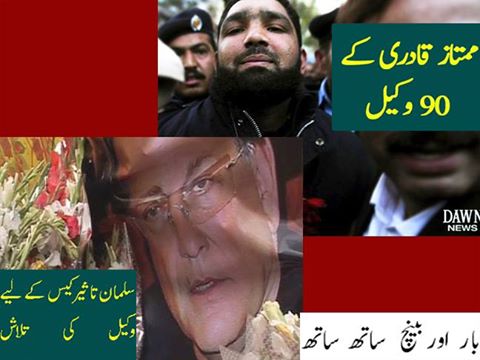
    Pakistan’s “Independent Judiciary” – where the murderer Mumtaz Qadri has 90 lawyers to defend him including the former Chief Justice LHC and PML N stalwart, Khawaja Sharif.
    Meanwhile the PML N government Federal government cannot even provide a prosecutor for the case or even manage to secure the files against the murderer of PPP Governor Punjab Shaheed Salman Taseer. It must also be mentioned that it was PML N that had interfered with Salman Taseer’s security detail days before his murder. A prominent PML N-ASWJ MNA Abid Dogar Deobandi had placed head money reward on Salman Taseer days before the Governor was brutally gunned down.
    And PML N lawyer and human rights activists, Asma Jahangir is even today campaigning for these courts. If her recent statements are any indication of her priorities, Mumtaz Qadri should also be released because prosecuting him would be akin to “revenge”
    If someone wanted to study how the Liars Movement destroyed an already decrepit judiciary in Pakistan, this is one of the most glaring cases.
    https://lubpak.com/archives/331535

    Pakistan - KHYBER WARNED AGAINST SENDING CHILDREN TO SCHOOL

    TALIBAN HAVE ALSO THREATENED ‘SERIOUS CONSEQUENCES’ FOR ANY IDPS WHO RETURN TO THEIR HOMETOWNS.
    The Pakistani Taliban, who killed 150 people, including 134 children, during an attack on Peshawar’s Army Public School in December, have reportedly warned the residents of Khyber Agency of “serious consequences” if they send their children to government schools.
    “Last night, militants distributed pamphlets in the Sheen Darra area of Bara tehsil warning local tribesmen about their intentions,” said Munsif Afridi, a member of a local anti-Taliban lashkar. “The pamphlet had three clauses: (i) No one should send their son or daughter to a government school and no schoolteacher should continue working in such institutions. (ii) Internally displaced families should resist returning to their hometowns. (iii) IDPs should refuse any compensation or aid packages from the government to alleviate their losses.”
    Maj. Gen. Asim Bajwa, spokesman for Pakistan’s armed forces, said in a press conference last month that the government would begin repatriating IDPs from Feb. 1. He also claimed that the military had cleared the terrorists out of a majority of the tribal areas.
    Afridi said the pamphlet ended with a warning for anyone who refused to adhere to its demands. “Anyone who fails to follow these directives shall be held responsible and will face serious consequences,” he added.
    The Pakistani Taliban often distribute threatening pamphlets in the tribal areas, with previous messages warning of “severe consequences” if locals allowed polio vaccinations or adhered to government directions.
    Sangeen Afridi, another local tribesman, told Newsweek that the Tehreek-e-Taliban Pakistan usually issued pamphlets when they were trying to warn someone specific. “It usually means they have some information about a local favoring the Pakistan Army or the government and they want to punish them,” he said. “After every warning, we usually see a body or two with a message threatening similar action against anyone who favors the government,” he added.
    http://newsweekpakistan.com/khyber-warned-against-sending-children-to-school/

    Pakistan - Bad news for bustards again


    The annual slaughter of the migratory Houbara Bustard is about to begin again despite these birds being a protected species under a covenant that Pakistan is a signatory to. This has become concretised as an annual event, with members of the royal families of the Gulf States and the Kingdom of Saudi Arabia coming to Pakistan to blow the bustards out of the sky in the mistaken belief that their flesh is aphrodisiac. The Houbara Bustard is not a challenging game bird as it is slow both in the air and on the ground, and in the last season that permits were issued for, Saudi Prince Fahd bin Sultan slew 2,100 birds in a single three-week holiday in Chaghi district of Balochistan. The hunting of the Houbara Bustard is permitted with falcons but they are rarely used by the hunters, who prefer the opportunities for mass killing offered by rifles and shotguns. Pakistan is the only country to allow the killing of these birds.
    Unsurprisingly, the World Wide Fund for Nature in Pakistan is deeply unhappy with this state of affairs, and is not afraid to say so. The foreign ministry is the responsible agency and issues permits and allocates hunting areas, this year, 17 in all. The WWF has lobbied for the practice to be curtailed to no apparent effect. The government argues that the foreign royals bring in money with them and that this benefits local economies via the trickle-down effect; but not so, says the WWF and at least one local forestry officer. The airport constructed by Prince Fahd is used very little outside the hunting season and although food, money and Hajj tickets are distributed, they are little more than a drop in the ocean and certainly not enough to aggregate to a single percentage point of the provincial economy. There may be hope for the bustard in the recently-enacted Balochistan Wildlife Protection, Preservation, Conservation and Management Act of 2014; which has provision for a substantial fine or the imprisonment of those who violate it, but our craven government is unlikely to bite the hands that feed it.

    Pakistan - Violence in Khyber-Pakhtunkhwa

    Violence has not ceased in the frontline province of Khyber-Pakhtunkhwa, as four Customs officials patrolling the Hangu Road, in Kohat, were shot dead by unknown assailants, on Wednesday. The law and order situation in the province has been seriously affected due to militant strongholds and close proximity with FATA. Migration from Afghanisation and FATA has contributed to the problem. It may not have caused much trouble had proper registration of refugees and displaced persons been carried out at the time of their arrival two decades back and recently. When law enforcement agencies are not even aware of certain people residing in the province, it is highly unlikely that they will be able to shield the larger populace from their actions. The attack on the Army Public School in Peshawar too could have been avoided had the government acted on intelligence reports and the military would have played its part in securing an area largely under its control.
    Following the incident, the police has been conducting “search operations” mainly in Malakand, Mardan, Hangu, DI Khan and Peshawar. According to reports, 2,166 search operations have been carried out so resulting in the arrest of 4,582 people, 2,141 amongst them from Peshawar alone. Moreover, approximately 24,000 houses and 6,000 hotels have been searched as well. While LEAs appear to have taken on a somewhat proactive role, it is difficult to conclude that these actions will have significant and lasting consequences. The courts, where suspects will be presented, may not be satisfied with the evidence presented before it as it often happens. Reform, that is critically needed for lower courts and prosecution, remains missing.
    Under the PTI-led coalition government in KP, the police has indeed shown some improvement. There are less complaints of meddling by politicians, and IG Nasir Khan Durrani has set a new precedent by taking action against corrupt officials. But still, the province has suffered due to lack of attention from provincial and central leaders . The time wasted by Imran Khan and KP Chief Minister Pervaiz Khattak on the container may have been better spent in service of the people who elected them to power. While people respond positively to the change in police, they are not entirely pleased with the PTI leadership, which they accuse of negligence. The law and order situation in KP cannot be improved without countering the pro-terrorism narrative. On this front, the PTI and JI are hopelessly inefficient, even unwilling, and in fact, often contribute to the problem. This much has become clear: this KP government will never present itself as the wall standing between the people and terrorists.

    Peshawar blast: Bomb explodes at Pakistan college


    A bomb has exploded outside a college in the Pakistan city of Peshawar, the latest in a spate of similar incidents.
    The explosion, at about midnight local time, blew a gate off its hinges at the college in the wealthy Hayatabad neighbourhood, but nobody was hurt.
    Two Pakistani schools have suffered attacks in the past three days, just weeks after Taliban gunmen killed 150 at a Peshawar school.
    Officials blamed criminal gangs rather than militants for the latest bombs.
    The BBC's M Ilyas Khan in Islamabad says the incidents have renewed concerns about the safety of educational institutions.
    Police said the Peshawar bomb was planted outside the privately owned Institute of Computer and Management Sciences (ICMS).
    It came a day after a police squad in the north-western city of Bannu defused a bomb outside a government school.
    And on Tuesday, unidentified men threw explosives near two private schools in Karachi.
    There were no casualties in any of the incidents, but they have all created widespread alarm, says our correspondent.